Heritage · Country
Spain Culture and Heritage
Every 1 November, Spanish theatres stage Zorrilla's Don Juan Tenorio and families carry chrysanthemums to the cemetery, while in the countryside archaeologists still lift Civil War dead from unmarked ditches. A guide to Spain's heritage and to the country's long, contested argument with its own dead.Written to last.
By Confinity Heritage Editorial · 2026-07-11 · 8-minute readQuiet tools, kept out of the way.
On the night of 1 November, in theatres across Spain, a ghost story is performed as it has been for nearly two centuries: José Zorrilla's Don Juan Tenorio, the Romantic drama of a libertine redeemed at the last by the love of a dead woman, whose final act unfolds among tombs and statues that come to life. The play is fixed to All Saints, when Spanish families fill the cemeteries with chrysanthemums and eat huesos de santo, the marzipan "saints' bones" sold in every pastry shop that week. It is a country that keeps close company with the dead, in ritual, in sweets, in a play about a graveyard staged like clockwork each autumn.
But Spain's memory is also its deepest wound. The country that built the Escorial as a royal mausoleum and filled ten thousand churches with tombs spent the twentieth century unable to bury its own. The Civil War of 1936 to 1939 and the Franco dictatorship that followed left more than a hundred thousand people in unmarked graves, and only since 2000, when a grandson opened his grandfather's ditch in León, has Spain begun the slow, contested work of exhuming them.
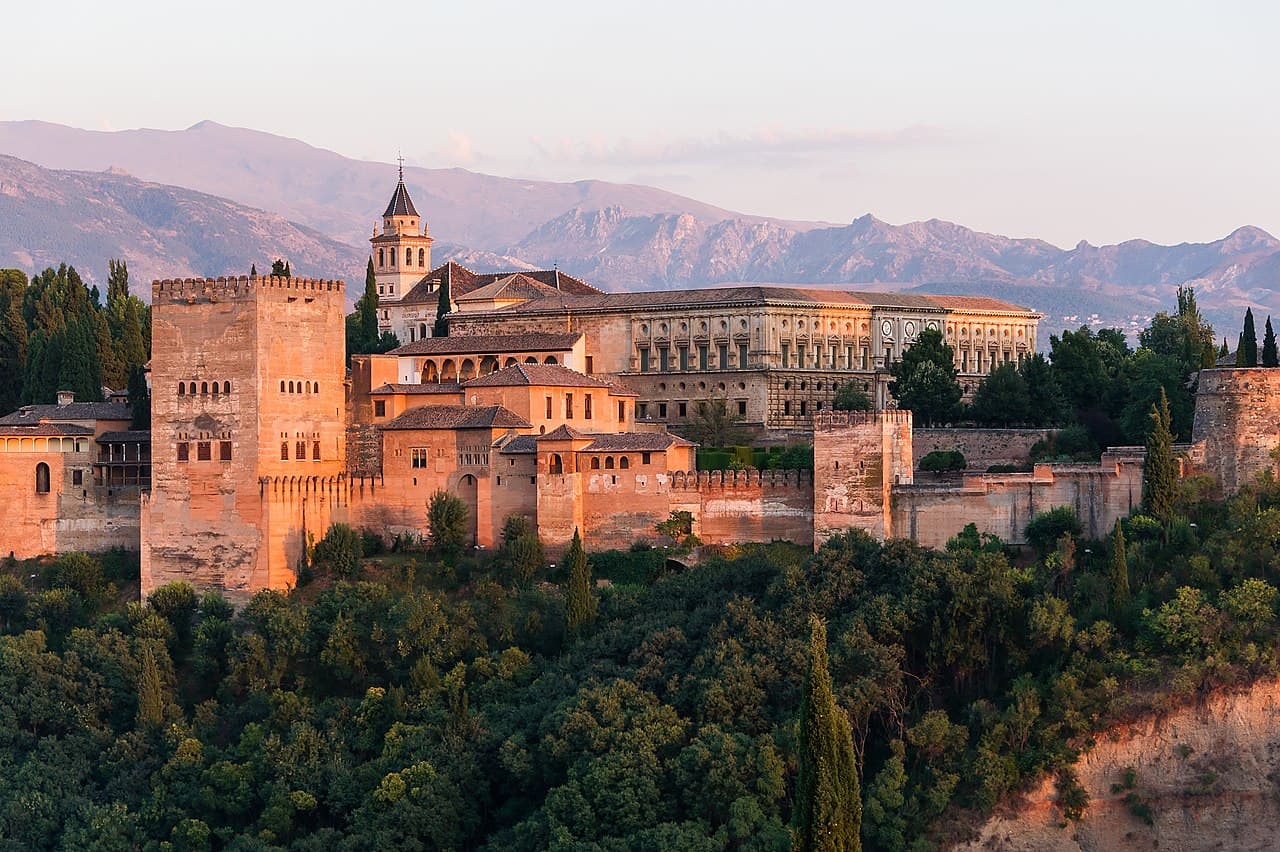
 The Alhambra above Granada, the palace-city of the Nasrid emirs and the last seat of Muslim rule in western Europe. CC0, via Wikimedia Commons.
Spain occupies about 506,000 square kilometres of the Iberian Peninsula, the great block of land it shares with Portugal in Europe's south-western corner, closed off from France by the wall of the Pyrenees and reaching to within fourteen kilometres of Africa at the Strait of Gibraltar. It is a high, dry country: the central Meseta, a vast tableland averaging around 650 metres, dominates the interior, ringed and crossed by mountains, from the Sierra Nevada, which keeps snow above subtropical Granada, to the Picos de Europa in the wet green north. Beyond the mainland lie the Balearic Islands in the Mediterranean and the Canary Islands off the African coast, where Teide, on Tenerife, is at 3,715 metres the highest peak on Spanish soil.
The population passed 49 million at the start of 2025, growing again after years of stagnation, driven almost entirely by immigration from Latin America, North Africa and eastern Europe; by 2024 nearly one resident in five had been born abroad. Spain is a parliamentary monarchy under King Felipe VI, but power is strikingly decentralised: seventeen autonomous communities run their own health, education and cultural policy, and several, notably Catalonia, the Basque Country and Galicia, have their own official languages and fierce senses of nationhood. This is a state that thinks of itself, in a common phrase, as a country of countries, and much of its heritage is regional before it is Spanish, defended by local governments and communities as passionately as anything in Madrid.
Madrid. The capital only since Philip II fixed his court there in 1561, Madrid is a relatively young great city that made itself the symbolic centre of the nation. Its Golden Triangle of art, the Prado, the Reina Sofía and the Thyssen-Bornemisza, holds Velázquez's Las Meninas, Goya's black paintings and Picasso's Guernica; the Puerta del Sol contains kilómetro cero, the point from which all Spanish roads are measured; and the city's memory of the Civil War, which it withstood under siege for nearly three years, is written into neighbourhoods, cemeteries and the bullet-scarred university campus.
Barcelona. Capital of Catalonia and a Mediterranean port since antiquity, Barcelona carries the Gothic Quarter of the medieval city beside the Modernista fantasies of Antoni Gaudí, whose still-unfinished Sagrada Família has been under construction since 1882. It is also the heart of Catalan identity and memory, from the Diada, the national day each 11 September marking the city's fall in 1714, to the Fossar de la Pedrera, the quarry where thousands executed under Franco were buried and which is now a memorial garden.
Seville. The capital of Andalusia grew rich as the monopoly port for trade with the Americas, and its Archivo General de Indias still holds the paper record of that empire. Its Holy Week processions are the most famous in the world, and its cathedral, the largest Gothic church anywhere, holds a monument said to contain the remains of Christopher Columbus, carried aloft by four bearers representing the medieval kingdoms of Spain.
The Alhambra above Granada, the palace-city of the Nasrid emirs and the last seat of Muslim rule in western Europe. CC0, via Wikimedia Commons.
Spain occupies about 506,000 square kilometres of the Iberian Peninsula, the great block of land it shares with Portugal in Europe's south-western corner, closed off from France by the wall of the Pyrenees and reaching to within fourteen kilometres of Africa at the Strait of Gibraltar. It is a high, dry country: the central Meseta, a vast tableland averaging around 650 metres, dominates the interior, ringed and crossed by mountains, from the Sierra Nevada, which keeps snow above subtropical Granada, to the Picos de Europa in the wet green north. Beyond the mainland lie the Balearic Islands in the Mediterranean and the Canary Islands off the African coast, where Teide, on Tenerife, is at 3,715 metres the highest peak on Spanish soil.
The population passed 49 million at the start of 2025, growing again after years of stagnation, driven almost entirely by immigration from Latin America, North Africa and eastern Europe; by 2024 nearly one resident in five had been born abroad. Spain is a parliamentary monarchy under King Felipe VI, but power is strikingly decentralised: seventeen autonomous communities run their own health, education and cultural policy, and several, notably Catalonia, the Basque Country and Galicia, have their own official languages and fierce senses of nationhood. This is a state that thinks of itself, in a common phrase, as a country of countries, and much of its heritage is regional before it is Spanish, defended by local governments and communities as passionately as anything in Madrid.
Madrid. The capital only since Philip II fixed his court there in 1561, Madrid is a relatively young great city that made itself the symbolic centre of the nation. Its Golden Triangle of art, the Prado, the Reina Sofía and the Thyssen-Bornemisza, holds Velázquez's Las Meninas, Goya's black paintings and Picasso's Guernica; the Puerta del Sol contains kilómetro cero, the point from which all Spanish roads are measured; and the city's memory of the Civil War, which it withstood under siege for nearly three years, is written into neighbourhoods, cemeteries and the bullet-scarred university campus.
Barcelona. Capital of Catalonia and a Mediterranean port since antiquity, Barcelona carries the Gothic Quarter of the medieval city beside the Modernista fantasies of Antoni Gaudí, whose still-unfinished Sagrada Família has been under construction since 1882. It is also the heart of Catalan identity and memory, from the Diada, the national day each 11 September marking the city's fall in 1714, to the Fossar de la Pedrera, the quarry where thousands executed under Franco were buried and which is now a memorial garden.
Seville. The capital of Andalusia grew rich as the monopoly port for trade with the Americas, and its Archivo General de Indias still holds the paper record of that empire. Its Holy Week processions are the most famous in the world, and its cathedral, the largest Gothic church anywhere, holds a monument said to contain the remains of Christopher Columbus, carried aloft by four bearers representing the medieval kingdoms of Spain.
 Toledo above the Tagus, the "city of three cultures" where Christians, Muslims and Jews once lived side by side. CC BY 2.5, via Wikimedia Commons.
Toledo. Ringed almost entirely by a gorge of the Tagus, the old imperial capital is called the city of three cultures for the centuries when Christians, Muslims and Jews shared it, leaving mosques, synagogues and a cathedral within a few streets of each other. It was the home of El Greco and the great translation school that carried Arabic and Greek learning into medieval Europe, and its entire historic core is a UNESCO World Heritage Site.
Granada. The last stronghold of al-Andalus, Granada fell to the Catholic Monarchs in 1492, and its Alhambra, the palace-city of the Nasrid emirs, survives as the most complete work of Islamic art and architecture in the West. Ferdinand and Isabella chose to be buried here rather than in Castile, in the Royal Chapel beside the cathedral, tying the city forever to the founding moment of unified Spain.
Bilbao. The industrial Basque port became a global byword for urban reinvention when Frank Gehry's Guggenheim Museum opened in 1997 and drew millions to a city that had lived on shipbuilding and steel. Around it the Basque Country keeps one of Europe's oldest languages and a heritage of its own, from the medieval Tree of Gernika, symbol of Basque liberties, to the town of Gernika itself, destroyed by German bombing in 1937 and made immortal by Picasso.
Spain's history is a long succession of peoples who each left their monuments in the ground and on the skyline. Iberians and Celts met Phoenician and Greek traders on the coasts; Rome conquered the peninsula over two centuries and made Hispania one of its richest provinces, giving it the emperors Trajan and Hadrian, the philosopher Seneca, cities like Mérida and Tarragona, and engineering such as the Aqueduct of Segovia, whose double tier of arches still crosses the city without a drop of mortar. After Rome came the Visigoths, and then, in 711, an Arab and Berber army that overran almost the whole peninsula within a decade and founded al-Andalus, which under the Umayyad caliphate of Córdoba became the most brilliant civilisation in tenth-century Europe, a place of libraries, astronomy and the great mosque that still stands at the city's heart.
Toledo above the Tagus, the "city of three cultures" where Christians, Muslims and Jews once lived side by side. CC BY 2.5, via Wikimedia Commons.
Toledo. Ringed almost entirely by a gorge of the Tagus, the old imperial capital is called the city of three cultures for the centuries when Christians, Muslims and Jews shared it, leaving mosques, synagogues and a cathedral within a few streets of each other. It was the home of El Greco and the great translation school that carried Arabic and Greek learning into medieval Europe, and its entire historic core is a UNESCO World Heritage Site.
Granada. The last stronghold of al-Andalus, Granada fell to the Catholic Monarchs in 1492, and its Alhambra, the palace-city of the Nasrid emirs, survives as the most complete work of Islamic art and architecture in the West. Ferdinand and Isabella chose to be buried here rather than in Castile, in the Royal Chapel beside the cathedral, tying the city forever to the founding moment of unified Spain.
Bilbao. The industrial Basque port became a global byword for urban reinvention when Frank Gehry's Guggenheim Museum opened in 1997 and drew millions to a city that had lived on shipbuilding and steel. Around it the Basque Country keeps one of Europe's oldest languages and a heritage of its own, from the medieval Tree of Gernika, symbol of Basque liberties, to the town of Gernika itself, destroyed by German bombing in 1937 and made immortal by Picasso.
Spain's history is a long succession of peoples who each left their monuments in the ground and on the skyline. Iberians and Celts met Phoenician and Greek traders on the coasts; Rome conquered the peninsula over two centuries and made Hispania one of its richest provinces, giving it the emperors Trajan and Hadrian, the philosopher Seneca, cities like Mérida and Tarragona, and engineering such as the Aqueduct of Segovia, whose double tier of arches still crosses the city without a drop of mortar. After Rome came the Visigoths, and then, in 711, an Arab and Berber army that overran almost the whole peninsula within a decade and founded al-Andalus, which under the Umayyad caliphate of Córdoba became the most brilliant civilisation in tenth-century Europe, a place of libraries, astronomy and the great mosque that still stands at the city's heart.
 The Aqueduct of Segovia, built by Rome around the first or second century AD and standing without mortar. CC0, via Wikimedia Commons.
From the northern mountains the Christian kingdoms pushed slowly south in the centuries-long process later called the Reconquista, until Granada fell in 1492, the same year Isabella and Ferdinand expelled the Jews and Columbus sailed west. The century that followed made Spain the first global empire, its silver from the Americas financing wars across Europe and its language and religion carried to two continents; it was also the age of the Inquisition, of El Greco and Cervantes, and of a slow imperial decline that set in during the seventeenth century. The loss of the last colonies in 1898 provoked a national crisis of confidence; the twentieth century brought the short-lived Second Republic, then the Civil War of 1936 to 1939, in which General Franco's Nationalists overthrew the Republic with German and Italian help, and nearly forty years of dictatorship. Franco's death in 1975 opened the Transition to democracy, a new constitution in 1978, entry into the European Community in 1986, and Spain's remaking as a modern European democracy still visibly marked by everything that came before.
The name España descends, through Latin Hispania, from a Phoenician or Punic word the Carthaginians used for the peninsula, often explained as "land of hyraxes" or "of rabbits", the small mammals that struck sailors as abundant on its coasts. The Romans Latinised it, and the whole later history of Spain can be read in its place names: Roman foundations, Arabic names beginning with the article al- (Alcalá, Alhambra, Almería, from Arabic words for the citadel, the red one, the watchtower), Basque names in the north that predate Latin entirely, and the Guada- rivers whose prefix is the Arabic wadi, a watercourse, as in Guadalquivir, "the great river".
Castilian Spanish, born on the northern Meseta and carried south and then across the Atlantic, is now the mother tongue of nearly half a billion people and second only to Mandarin among the world's first languages. But it is not alone in Spain. Catalan, spoken by millions in Catalonia, Valencia and the Balearics, is a full Romance language with its own medieval literature; Galician, close to Portuguese, is the language of the north-west; and Basque, or Euskara, is a genuine linguistic isolate, unrelated to any other tongue on earth and older than the arrival of Indo-European languages in Europe, a survival that Basques regard as the core of their identity. All three were suppressed under Franco, when only Castilian could be used officially, and their public revival since 1975, in schools, media and street signs, has been one of the central cultural projects of democratic Spain.
Spanish daily life keeps its own distinctive rhythm, built around late meals, the paseo or evening stroll, and a genius for public sociability: the plaza, the terrace, the tapas bar where small plates are shared standing up. Food is intensely regional, from Valencia's paella and the Basque country's pintxos to the cured jamón ibérico of the west and the gazpacho of the Andalusian summer, and the midday meal remains the axis of the day. Football commands enormous passion, above all the rivalry of Real Madrid and Barcelona, whose "Clásico" carries the political charge of capital against Catalonia; and the bullfight, the corrida, endures as a contested inheritance, defended as art and heritage by some and rejected as cruelty by others, absent from Catalonia, where none has been staged since 2011, and from the Canary Islands, but still central to the fiesta calendar of much of the south.
The arts run deep and unbroken. The Golden Age gave the world Cervantes' Don Quixote, often called the first modern novel, and the painting of Velázquez and Zurbarán; Goya bridged court portraiture and the nightmares of war; and the twentieth century produced Picasso, Dalí, Miró and the poet Federico García Lorca, murdered by Nationalist forces in 1936 and never found. Flamenco, born among the Roma and the poor of Andalusia and inscribed by UNESCO as intangible heritage in 2010, fuses song, guitar and dance into Spain's most exported art form. And the festival calendar is a heritage in itself: Seville's Feria de Abril, Valencia's Fallas with their burning effigies, Pamplona's running of the bulls at San Fermín, and the tomato-throwing Tomatina, each a local identity performed in public.
Roman Catholicism shaped Spain more completely than almost any other force, and its marks are everywhere: in the cathedrals of Burgos, León, Seville and Santiago, in the monastery-palace of the Escorial where Spanish kings are entombed, and in a calendar organised around saints and Holy Week. For centuries the Church was inseparable from the state; the Inquisition, established in 1478, enforced orthodoxy and drove out or forcibly converted Spain's Jews and Muslims, ending the long medieval coexistence of the three faiths that Toledo still commemorates. National Catholicism became an official ideology under Franco, which is part of why the country's swing away from religious practice since 1975 has been so sharp.
The Aqueduct of Segovia, built by Rome around the first or second century AD and standing without mortar. CC0, via Wikimedia Commons.
From the northern mountains the Christian kingdoms pushed slowly south in the centuries-long process later called the Reconquista, until Granada fell in 1492, the same year Isabella and Ferdinand expelled the Jews and Columbus sailed west. The century that followed made Spain the first global empire, its silver from the Americas financing wars across Europe and its language and religion carried to two continents; it was also the age of the Inquisition, of El Greco and Cervantes, and of a slow imperial decline that set in during the seventeenth century. The loss of the last colonies in 1898 provoked a national crisis of confidence; the twentieth century brought the short-lived Second Republic, then the Civil War of 1936 to 1939, in which General Franco's Nationalists overthrew the Republic with German and Italian help, and nearly forty years of dictatorship. Franco's death in 1975 opened the Transition to democracy, a new constitution in 1978, entry into the European Community in 1986, and Spain's remaking as a modern European democracy still visibly marked by everything that came before.
The name España descends, through Latin Hispania, from a Phoenician or Punic word the Carthaginians used for the peninsula, often explained as "land of hyraxes" or "of rabbits", the small mammals that struck sailors as abundant on its coasts. The Romans Latinised it, and the whole later history of Spain can be read in its place names: Roman foundations, Arabic names beginning with the article al- (Alcalá, Alhambra, Almería, from Arabic words for the citadel, the red one, the watchtower), Basque names in the north that predate Latin entirely, and the Guada- rivers whose prefix is the Arabic wadi, a watercourse, as in Guadalquivir, "the great river".
Castilian Spanish, born on the northern Meseta and carried south and then across the Atlantic, is now the mother tongue of nearly half a billion people and second only to Mandarin among the world's first languages. But it is not alone in Spain. Catalan, spoken by millions in Catalonia, Valencia and the Balearics, is a full Romance language with its own medieval literature; Galician, close to Portuguese, is the language of the north-west; and Basque, or Euskara, is a genuine linguistic isolate, unrelated to any other tongue on earth and older than the arrival of Indo-European languages in Europe, a survival that Basques regard as the core of their identity. All three were suppressed under Franco, when only Castilian could be used officially, and their public revival since 1975, in schools, media and street signs, has been one of the central cultural projects of democratic Spain.
Spanish daily life keeps its own distinctive rhythm, built around late meals, the paseo or evening stroll, and a genius for public sociability: the plaza, the terrace, the tapas bar where small plates are shared standing up. Food is intensely regional, from Valencia's paella and the Basque country's pintxos to the cured jamón ibérico of the west and the gazpacho of the Andalusian summer, and the midday meal remains the axis of the day. Football commands enormous passion, above all the rivalry of Real Madrid and Barcelona, whose "Clásico" carries the political charge of capital against Catalonia; and the bullfight, the corrida, endures as a contested inheritance, defended as art and heritage by some and rejected as cruelty by others, absent from Catalonia, where none has been staged since 2011, and from the Canary Islands, but still central to the fiesta calendar of much of the south.
The arts run deep and unbroken. The Golden Age gave the world Cervantes' Don Quixote, often called the first modern novel, and the painting of Velázquez and Zurbarán; Goya bridged court portraiture and the nightmares of war; and the twentieth century produced Picasso, Dalí, Miró and the poet Federico García Lorca, murdered by Nationalist forces in 1936 and never found. Flamenco, born among the Roma and the poor of Andalusia and inscribed by UNESCO as intangible heritage in 2010, fuses song, guitar and dance into Spain's most exported art form. And the festival calendar is a heritage in itself: Seville's Feria de Abril, Valencia's Fallas with their burning effigies, Pamplona's running of the bulls at San Fermín, and the tomato-throwing Tomatina, each a local identity performed in public.
Roman Catholicism shaped Spain more completely than almost any other force, and its marks are everywhere: in the cathedrals of Burgos, León, Seville and Santiago, in the monastery-palace of the Escorial where Spanish kings are entombed, and in a calendar organised around saints and Holy Week. For centuries the Church was inseparable from the state; the Inquisition, established in 1478, enforced orthodoxy and drove out or forcibly converted Spain's Jews and Muslims, ending the long medieval coexistence of the three faiths that Toledo still commemorates. National Catholicism became an official ideology under Franco, which is part of why the country's swing away from religious practice since 1975 has been so sharp.
 The hypostyle hall of the Mosque-Cathedral of Córdoba, begun in the eighth century, with a Christian cathedral later built inside it. CC BY 2.0, via Wikimedia Commons.
Today Spain is a rapidly secularising society: a majority still identify as Catholic, but weekly Mass attendance has fallen far, and those declaring no religion, now roughly a third of adults and a clear majority among the young, form the fastest-growing group. Immigration has meanwhile made Spain religiously plural again, with a Muslim population of well over two million, many of them descendants of the same North Africa from which al-Andalus once came, alongside growing evangelical and Orthodox communities. Older devotion survives in the great pilgrimage to Santiago de Compostela, where the shrine of the apostle James drew a record 499,239 pilgrims to collect their Compostela certificate in 2024, and in the sacred geography of monasteries, hermitages and Marian shrines like Montserrat that still anchor regional identity.
Traditional Spanish mourning was Catholic, communal and highly visible. The velatorio, the wake, kept vigil over the body at home or, increasingly, in the tanatorio, the funeral parlour that is now the standard place of Spanish death; widows once wore luto, deep black, for years, and in villages the custom of lifelong mourning by older women survived into living memory. The dead are typically buried within a day or two, and Spanish cemeteries have their own architecture: rather than lying in the ground, many of the dead are slid into nichos, niches stacked several high in long walls, their small plaques and flower-holders forming corridors of names that families tend and repaint. The great secular rite of the calendar is Día de Todos los Santos, All Saints' Day on 1 November, when the whole country visits the cemetery, cleans the graves and lays chrysanthemums, the flower so associated with death that Spaniards rarely give it for any other reason.
That gentler culture of remembrance sits atop a far harder one. The Spanish Civil War killed perhaps half a million people, and the Franco regime executed and buried tens of thousands more in unmarked pits by roadsides and cemetery walls; the exact number of the desaparecidos, the disappeared, is unknown but exceeds one hundred thousand, and Spain has among the highest totals of enforced disappearances still unrecovered of any country in the world. For decades the Transition's unwritten "pact of forgetting" kept these graves closed. That silence broke in 2000, when the journalist Emilio Silva founded the Asociación para la Recuperación de la Memoria Histórica and exhumed thirteen Republicans, including his own grandfather, from a ditch near Priaranza del Bierzo, launching a grassroots movement of forensic archaeologists and volunteers that has since opened hundreds of graves and returned the identified dead to their families.
The state has followed, slowly and amid fierce argument. The Historical Memory Law of 2007 and the stronger Democratic Memory Law of 2022 committed the government to search for and identify the dead, created a national DNA bank and register of victims, and annulled the sentences of Franco-era tribunals. Most symbolically, they addressed the Valle de los Caídos, the vast basilica and 150-metre cross that Franco built north of Madrid partly with the forced labour of political prisoners, where he had himself entombed and where the remains of tens of thousands of war dead from both sides still lie, many moved there without their families' consent. In October 2019, after years of legal battle, Franco's body was exhumed and reburied in a private cemetery; the site has been renamed the Valle de Cuelgamuros and is being reworked into a cemetery with no place of honour for anyone, its meaning still contested by a country that has never fully agreed on how to mourn its twentieth century.
Spanish records are old and the church kept them. The Council of Trent required parish registers from 1563 and Spanish parishes obeyed early, so baptisms, marriages and burials often run continuously from the middle of the sixteenth century. Civil registration is much later: the Registro Civil began on 1 January 1871, three centuries after the parish books it was meant to replace.
That gap matters practically. For most Spanish families the useful record before 1871 is the parish book, held by the diocese, and the diocesan archives set their own access rules. Some are welcoming, some require an appointment and a reason. The state archives publish a great deal through PARES, the national archives portal, which is free and holds the emigration and colonial material as well.
Two Spanish record types have no equivalent elsewhere. The padrón, the municipal population roll, lists households street by street and was kept far more often than a census. And the Inquisition files, held at the national historical archive, contain genealogical investigations of extraordinary depth, because proving limpieza de sangre meant documenting four grandparents and their parishes.
The twentieth century left a different kind of gap. Tens of thousands of people killed in the Civil War and the repression that followed were buried without record, and Spain's own mapping exercise has identified several thousand grave sites. Families searching for them are doing genealogy in reverse, working from a living memory towards a place rather than from a place towards a name.
Spain has one of the deepest heritage inventories in the world and a mature system to protect it. The governing category is the Bien de Interés Cultural, the highest level of legal protection for monuments, sites, gardens and even intangible practices, administered jointly by the central state and the autonomous communities, which hold most day-to-day responsibility for culture. State museums like the Prado, founded in 1819, and national bodies for archives and libraries sit alongside regional agencies, and the Instituto del Patrimonio Cultural de España coordinates conservation and restoration science across the country. Private and civic bodies play their part too, from cathedral chapters to the brotherhoods that maintain Holy Week traditions as living heritage.
With 50 UNESCO World Heritage Sites as of 2024, Spain ranks among the top five countries on earth, behind only Italy, China, Germany and France. They span the whole sweep of its history: the Alhambra and the Mosque-Cathedral of Córdoba from al-Andalus; the old towns of Toledo, Salamanca, Ávila, Cáceres and Cuenca; the Roman ensembles of Mérida, Tarragona and Segovia; the works of Gaudí and the Palau de la Música in Barcelona; the pilgrimage Routes of Santiago de Compostela; the prehistoric rock art of the Cantabrian caves, including Altamira, whose Palaeolithic paintings are so fragile the original was closed and a replica built alongside. Spain also leads on intangible heritage, with flamenco, the Mediterranean diet, the human castles of Catalonia and the patios of Córdoba among its UNESCO-inscribed living traditions.
Spain's archives are among the richest documentary collections anywhere, and much of the work of the last two decades has been to open them online. The Portal de Archivos Españoles, PARES, run by the Ministry of Culture, gives free access to millions of digitised documents from the state archives, above all the Archivo General de Indias in Seville, which holds some 43,000 bundles and around 80 million pages recording three centuries of the Spanish empire in the Americas and the Philippines, and the Archivo General de Simancas, the paper memory of the Habsburg monarchy. The Biblioteca Nacional de España has digitised vast holdings through its Biblioteca Digital Hispánica, and the national aggregator Hispana feeds Spanish content into Europeana, the European digital library.
For family history and personal memory, Spain's parish and civil registers, along with the enormous emigration records generated by centuries of movement to the Americas, have been progressively digitised and indexed, making Spanish and Latin American genealogy one of the fastest-growing fields of the discipline. The recovery of Civil War memory has its own digital architecture: the government's memoria democrática portals, the mapping of mass graves by regional governments and universities, and the national DNA bank established to match exhumed remains to living descendants. Oral history projects and sound archives, including the collections of the national broadcaster RTVE and regional efforts to record the last witnesses of the war and the Transition, are turning living testimony into a permanent record before that generation is gone.
Spain's cultural reach today runs far beyond its borders, carried above all by the Spanish language and the shared culture of the Hispanic world. Spanish cinema, from Luis Buñuel to Pedro Almodóvar, whose films made Madrid's post-Franco liberation into a global style, keeps earning Academy Awards, and a new generation of streaming series, from Money Heist to stories mining the Civil War and the Transition, has found worldwide audiences. In music the flamenco tradition has fused with pop and electronica in stars like Rosalía, and Spanish-language music more broadly is now one of the dominant forces in global streaming.
The country is also arguing, more openly than for decades, about its past. Debates over the Democratic Memory Law, over how to present the empire and the conquest of the Americas in museums, over the future of the Valle de Cuelgamuros and over monuments and street names inherited from the dictatorship run through Spanish public life, dividing along political lines but keeping the country's history permanently in view. Regional identities press the same questions in a different key, with Catalan and Basque movements insisting on their own languages, memories and heritage. And Spain's diaspora and its returning descendants keep the memory two-way: a 2022 law offering citizenship to the descendants of those who fled the Civil War and dictatorship drew hundreds of thousands of applications from across the Americas, reconnecting families to a homeland their grandparents lost.
The grave that started a movement. In 2000 the journalist Emilio Silva located and exhumed the roadside grave of his grandfather, shot by a Falangist squad in 1936, near Priaranza del Bierzo. The dig, the first to use forensic archaeology to recover a Civil War victim, led him to found the Asociación para la Recuperación de la Memoria Histórica, which has since opened hundreds of mass graves and turned private grief into a national reckoning.
Altamira, saved by a copy. When mass tourism threatened to destroy the 36,000-year-old paintings of the Altamira cave in Cantabria, conservators closed the original and, in 2001, opened the Neocueva, an exact replica reproducing the ceiling of bison down to the rock's contours. It let the public keep meeting the art while the fragile original was preserved, a model since copied at Lascaux and elsewhere.
Bilbao's reinvention. The opening of Frank Gehry's Guggenheim Museum in 1997 turned a declining industrial port into a global destination, drawing more than a million visitors a year and coining the phrase "the Bilbao effect" for culture-led urban renewal. It showed how heritage and bold new architecture together could remake a city's fortunes.
Franco leaves the valley. After years of legal challenge, the Spanish state exhumed Francisco Franco from the basilica of the Valle de los Caídos in October 2019 and reburied him in a family plot, ending forty-four years in which a dictator lay honoured in a state monument built partly by prisoners. The renamed Valle de Cuelgamuros is being reworked so that no one is buried there in a place of honour.
A pilgrimage reborn. Nearly abandoned in the mid-twentieth century, the Camino de Santiago has become one of the world's great walking pilgrimages, drawing a record 499,239 people to collect their Compostela in 2024, most of them foreign, and reviving the towns, hostels and Romanesque churches along a thousand-year-old route now protected as World Heritage.
The hypostyle hall of the Mosque-Cathedral of Córdoba, begun in the eighth century, with a Christian cathedral later built inside it. CC BY 2.0, via Wikimedia Commons.
Today Spain is a rapidly secularising society: a majority still identify as Catholic, but weekly Mass attendance has fallen far, and those declaring no religion, now roughly a third of adults and a clear majority among the young, form the fastest-growing group. Immigration has meanwhile made Spain religiously plural again, with a Muslim population of well over two million, many of them descendants of the same North Africa from which al-Andalus once came, alongside growing evangelical and Orthodox communities. Older devotion survives in the great pilgrimage to Santiago de Compostela, where the shrine of the apostle James drew a record 499,239 pilgrims to collect their Compostela certificate in 2024, and in the sacred geography of monasteries, hermitages and Marian shrines like Montserrat that still anchor regional identity.
Traditional Spanish mourning was Catholic, communal and highly visible. The velatorio, the wake, kept vigil over the body at home or, increasingly, in the tanatorio, the funeral parlour that is now the standard place of Spanish death; widows once wore luto, deep black, for years, and in villages the custom of lifelong mourning by older women survived into living memory. The dead are typically buried within a day or two, and Spanish cemeteries have their own architecture: rather than lying in the ground, many of the dead are slid into nichos, niches stacked several high in long walls, their small plaques and flower-holders forming corridors of names that families tend and repaint. The great secular rite of the calendar is Día de Todos los Santos, All Saints' Day on 1 November, when the whole country visits the cemetery, cleans the graves and lays chrysanthemums, the flower so associated with death that Spaniards rarely give it for any other reason.
That gentler culture of remembrance sits atop a far harder one. The Spanish Civil War killed perhaps half a million people, and the Franco regime executed and buried tens of thousands more in unmarked pits by roadsides and cemetery walls; the exact number of the desaparecidos, the disappeared, is unknown but exceeds one hundred thousand, and Spain has among the highest totals of enforced disappearances still unrecovered of any country in the world. For decades the Transition's unwritten "pact of forgetting" kept these graves closed. That silence broke in 2000, when the journalist Emilio Silva founded the Asociación para la Recuperación de la Memoria Histórica and exhumed thirteen Republicans, including his own grandfather, from a ditch near Priaranza del Bierzo, launching a grassroots movement of forensic archaeologists and volunteers that has since opened hundreds of graves and returned the identified dead to their families.
The state has followed, slowly and amid fierce argument. The Historical Memory Law of 2007 and the stronger Democratic Memory Law of 2022 committed the government to search for and identify the dead, created a national DNA bank and register of victims, and annulled the sentences of Franco-era tribunals. Most symbolically, they addressed the Valle de los Caídos, the vast basilica and 150-metre cross that Franco built north of Madrid partly with the forced labour of political prisoners, where he had himself entombed and where the remains of tens of thousands of war dead from both sides still lie, many moved there without their families' consent. In October 2019, after years of legal battle, Franco's body was exhumed and reburied in a private cemetery; the site has been renamed the Valle de Cuelgamuros and is being reworked into a cemetery with no place of honour for anyone, its meaning still contested by a country that has never fully agreed on how to mourn its twentieth century.
Spanish records are old and the church kept them. The Council of Trent required parish registers from 1563 and Spanish parishes obeyed early, so baptisms, marriages and burials often run continuously from the middle of the sixteenth century. Civil registration is much later: the Registro Civil began on 1 January 1871, three centuries after the parish books it was meant to replace.
That gap matters practically. For most Spanish families the useful record before 1871 is the parish book, held by the diocese, and the diocesan archives set their own access rules. Some are welcoming, some require an appointment and a reason. The state archives publish a great deal through PARES, the national archives portal, which is free and holds the emigration and colonial material as well.
Two Spanish record types have no equivalent elsewhere. The padrón, the municipal population roll, lists households street by street and was kept far more often than a census. And the Inquisition files, held at the national historical archive, contain genealogical investigations of extraordinary depth, because proving limpieza de sangre meant documenting four grandparents and their parishes.
The twentieth century left a different kind of gap. Tens of thousands of people killed in the Civil War and the repression that followed were buried without record, and Spain's own mapping exercise has identified several thousand grave sites. Families searching for them are doing genealogy in reverse, working from a living memory towards a place rather than from a place towards a name.
Spain has one of the deepest heritage inventories in the world and a mature system to protect it. The governing category is the Bien de Interés Cultural, the highest level of legal protection for monuments, sites, gardens and even intangible practices, administered jointly by the central state and the autonomous communities, which hold most day-to-day responsibility for culture. State museums like the Prado, founded in 1819, and national bodies for archives and libraries sit alongside regional agencies, and the Instituto del Patrimonio Cultural de España coordinates conservation and restoration science across the country. Private and civic bodies play their part too, from cathedral chapters to the brotherhoods that maintain Holy Week traditions as living heritage.
With 50 UNESCO World Heritage Sites as of 2024, Spain ranks among the top five countries on earth, behind only Italy, China, Germany and France. They span the whole sweep of its history: the Alhambra and the Mosque-Cathedral of Córdoba from al-Andalus; the old towns of Toledo, Salamanca, Ávila, Cáceres and Cuenca; the Roman ensembles of Mérida, Tarragona and Segovia; the works of Gaudí and the Palau de la Música in Barcelona; the pilgrimage Routes of Santiago de Compostela; the prehistoric rock art of the Cantabrian caves, including Altamira, whose Palaeolithic paintings are so fragile the original was closed and a replica built alongside. Spain also leads on intangible heritage, with flamenco, the Mediterranean diet, the human castles of Catalonia and the patios of Córdoba among its UNESCO-inscribed living traditions.
Spain's archives are among the richest documentary collections anywhere, and much of the work of the last two decades has been to open them online. The Portal de Archivos Españoles, PARES, run by the Ministry of Culture, gives free access to millions of digitised documents from the state archives, above all the Archivo General de Indias in Seville, which holds some 43,000 bundles and around 80 million pages recording three centuries of the Spanish empire in the Americas and the Philippines, and the Archivo General de Simancas, the paper memory of the Habsburg monarchy. The Biblioteca Nacional de España has digitised vast holdings through its Biblioteca Digital Hispánica, and the national aggregator Hispana feeds Spanish content into Europeana, the European digital library.
For family history and personal memory, Spain's parish and civil registers, along with the enormous emigration records generated by centuries of movement to the Americas, have been progressively digitised and indexed, making Spanish and Latin American genealogy one of the fastest-growing fields of the discipline. The recovery of Civil War memory has its own digital architecture: the government's memoria democrática portals, the mapping of mass graves by regional governments and universities, and the national DNA bank established to match exhumed remains to living descendants. Oral history projects and sound archives, including the collections of the national broadcaster RTVE and regional efforts to record the last witnesses of the war and the Transition, are turning living testimony into a permanent record before that generation is gone.
Spain's cultural reach today runs far beyond its borders, carried above all by the Spanish language and the shared culture of the Hispanic world. Spanish cinema, from Luis Buñuel to Pedro Almodóvar, whose films made Madrid's post-Franco liberation into a global style, keeps earning Academy Awards, and a new generation of streaming series, from Money Heist to stories mining the Civil War and the Transition, has found worldwide audiences. In music the flamenco tradition has fused with pop and electronica in stars like Rosalía, and Spanish-language music more broadly is now one of the dominant forces in global streaming.
The country is also arguing, more openly than for decades, about its past. Debates over the Democratic Memory Law, over how to present the empire and the conquest of the Americas in museums, over the future of the Valle de Cuelgamuros and over monuments and street names inherited from the dictatorship run through Spanish public life, dividing along political lines but keeping the country's history permanently in view. Regional identities press the same questions in a different key, with Catalan and Basque movements insisting on their own languages, memories and heritage. And Spain's diaspora and its returning descendants keep the memory two-way: a 2022 law offering citizenship to the descendants of those who fled the Civil War and dictatorship drew hundreds of thousands of applications from across the Americas, reconnecting families to a homeland their grandparents lost.
The grave that started a movement. In 2000 the journalist Emilio Silva located and exhumed the roadside grave of his grandfather, shot by a Falangist squad in 1936, near Priaranza del Bierzo. The dig, the first to use forensic archaeology to recover a Civil War victim, led him to found the Asociación para la Recuperación de la Memoria Histórica, which has since opened hundreds of mass graves and turned private grief into a national reckoning.
Altamira, saved by a copy. When mass tourism threatened to destroy the 36,000-year-old paintings of the Altamira cave in Cantabria, conservators closed the original and, in 2001, opened the Neocueva, an exact replica reproducing the ceiling of bison down to the rock's contours. It let the public keep meeting the art while the fragile original was preserved, a model since copied at Lascaux and elsewhere.
Bilbao's reinvention. The opening of Frank Gehry's Guggenheim Museum in 1997 turned a declining industrial port into a global destination, drawing more than a million visitors a year and coining the phrase "the Bilbao effect" for culture-led urban renewal. It showed how heritage and bold new architecture together could remake a city's fortunes.
Franco leaves the valley. After years of legal challenge, the Spanish state exhumed Francisco Franco from the basilica of the Valle de los Caídos in October 2019 and reburied him in a family plot, ending forty-four years in which a dictator lay honoured in a state monument built partly by prisoners. The renamed Valle de Cuelgamuros is being reworked so that no one is buried there in a place of honour.
A pilgrimage reborn. Nearly abandoned in the mid-twentieth century, the Camino de Santiago has become one of the world's great walking pilgrimages, drawing a record 499,239 people to collect their Compostela in 2024, most of them foreign, and reviving the towns, hostels and Romanesque churches along a thousand-year-old route now protected as World Heritage.
National Overview
Notable Cities
Historical Foundations
Linguistic and Etymological Roots
Cultural Identity
Religion and Spirituality
Remembrance and Mourning Traditions
Tracing a Family in Spain
Heritage Preservation Efforts
Digital Heritage
Contemporary Cultural Influences
Success Stories
References and resources
- UNESCO World Heritage Centre, Spain, the state-party page listing all 50 of Spain's World Heritage Sites.
- PARES, Portal de Archivos Españoles, free access to millions of digitised documents from Spain's state archives, including the Archivo General de Indias.
- Biblioteca Nacional de España, the national library and its Biblioteca Digital Hispánica of digitised books, maps and manuscripts.
- Museo Nacional del Prado, Spain's national art museum, founded in 1819.
- Asociación para la Recuperación de la Memoria Histórica, the association that pioneered Civil War exhumations from 2000.
- Ministerio de Política Territorial y Memoria Democrática, the Spanish government department responsible for democratic memory policy and the 2022 law.
- Oficina de Acogida al Peregrino, Santiago de Compostela, the pilgrim office and its annual statistics for the Camino de Santiago.
- Museo Guggenheim Bilbao, the museum whose 1997 opening remade the city.
- Encyclopaedia Britannica, Spain, geography, history and society.