Heritage · University
University of Salamanca: Programs, Campus & Admissions Info
University of Salamanca is a leading institution offering top academic programs, research, and student life. Explore courses, campus details, and admissions info.Written to last.
By Confinity Heritage Editorial · Updated 2026-07-20 · 8-minute readQuiet tools, kept out of the way.
The University of Salamanca is the oldest university in Spain and in the entire Hispanic world, founded by royal decree in 1218 and operating without interruption ever since. It sits at the centre of the old sandstone city of Salamanca in Castile and León, roughly two hours northwest of Madrid, and for three centuries it stood alongside Bologna, Paris and Oxford as one of the four great studia generalia of medieval and Renaissance Europe.
Its importance is not only a matter of age. In the sixteenth century a group of theologians and jurists working here, later called the School of Salamanca, laid down founding arguments about the rights of peoples, the limits of just war, and the workings of money and price. The Spanish crown turned to Salamanca's scholars when it needed learned opinion, including on Christopher Columbus's proposal to sail west. The university's carved entrance, one of the finest examples of the Spanish Plateresque style, hides a small stone frog that has become the most photographed detail in the city. What follows is an account of where the institution came from, what its scholars argued, and what it still holds.
The university traces its origin to a decree issued by Alfonso IX of León between 1218 and the following winter, which recognised the cathedral schools already teaching in Salamanca as a general school, or studium generale. That act of 1218 is the date the institution marks as its foundation, and it was confirmed and expanded by Alfonso IX's grandson, Alfonso X of Castile, known as the Wise.
Two royal and papal acts fixed its status. On 8 May 1254 Alfonso X issued a charter, sometimes called the Magna Carta of the university, that set out its organisation and endowed chairs in canon law, civil law, grammar, logic, medicine and music, and funded a library and its staff. The following year, in 1255, Pope Alexander IV issued a bull confirming the royal charter and granting the university's degrees validity across Christendom. That recognition placed Salamanca among the small number of European schools whose licences to teach were honoured well beyond their own kingdom, and its seal from this period already carried the motto Omnium scientiarum princeps Salmantica docet, meaning that Salamanca, foremost of all, teaches every science.
From the late thirteenth century into the sixteenth, Salamanca grew into one of Europe's leading centres of learning. According to Britannica, it ranked with Paris, Bologna and Oxford as a magnet for scholars, and its faculties of theology and law carried particular weight in the Catholic world. The university reached its peak in the sixteenth century: by around 1580 several thousand new students were arriving each year, and total enrolment ran to the thousands at a time when few institutions of any kind gathered such numbers. Cervantes described the city crowded with students, and the professorial chairs were contested through public elections that drew intense partisanship.
Decline followed in the seventeenth and eighteenth centuries, as the intellectual energy of Spain shifted and the university grew conservative and inward. The Napoleonic wars, the suppression of religious orders, and the loss of endowments in the nineteenth century cut it back further, and enrolment fell to a fraction of its Golden Age size. Recovery came slowly through the twentieth century, helped in 1929 by the founding of a Chair of Spanish Language for foreigners, the seed of the international courses that still draw students from around the world. The university celebrated its 800th anniversary in 2018, an occasion marked across Spain and by a visit from the reigning monarch.
The intellectual achievement most associated with Salamanca is the School of Salamanca, a movement of theologians and jurists active mainly in the sixteenth and early seventeenth centuries. It began with the Dominican friar Francisco de Vitoria (1483–1546), who held the Prime Chair of Theology from 1526 and reshaped how his colleagues read law, ethics and political authority. Around him and his successors grew a body of work that historians treat as a starting point for modern thinking on international law, human rights and economics.
Vitoria's lectures on the Spanish presence in the Americas, delivered around 1539 and later published as De Indis and De iure belli, argued that the indigenous peoples of the New World were rational beings and true owners of their lands, and that neither the Pope nor the Spanish king held automatic dominion over them. He examined which titles might justify conquest and rejected most of the ones then in use. In doing so he drew on the classical idea of the ius gentium, the law of nations, and treated all peoples as members of a single community bound by shared rules. That line of thought is why Vitoria is often named, alongside the later Dutch jurist Hugo Grotius, as a founder of international law.
The circle extended well beyond Vitoria. Domingo de Soto, Martín de Azpilcueta, Luis de Molina and, in the following generation, Francisco Suárez carried the questions forward. Suárez separated the law between nations from the law within a nation, sharpening a distinction still used today. Their economic writing was equally consequential. Working from moral questions about lending, trade and taxation, Azpilcueta observed that the flood of silver arriving from the Americas was pushing prices up, an early statement of what became the quantity theory of money. Others argued that a fair price is set by the common estimation of a market rather than by the labour a good contains, and defended the charging of interest as compensation for risk and forgone use. The economist Joseph Schumpeter later credited these scholars as being closer than any other group to founding modern economics.
The school's influence spread through printed lectures and through the students who carried its arguments to other universities and to the councils of the Spanish empire. Its debates about conscience, dominion and the treatment of subject peoples shaped colonial law and the wider European conversation about the rights that hold between strangers.
Salamanca's lecture halls passed a striking number of consequential figures. Antonio de Nebrija studied and taught here and in 1492 published the first grammar of a modern European language, his Gramática de la lengua castellana. Fray Luis de León, the Augustinian friar, poet and biblical scholar, taught theology at Salamanca; imprisoned for nearly five years by the Inquisition over his translation of the Song of Songs, he is said to have resumed his first lecture on release with the words Decíamos ayer, "as we were saying yesterday."
Fernando de Rojas, author of the early masterpiece La Celestina, studied law here. Hernán Cortés is reported to have studied Latin and law at Salamanca as a teenager before leaving without a degree, and Miguel de Cervantes is traditionally linked to the city, though the documentary record of his enrolment is thin and much debated. The friar Bartolomé de las Casas, the great early defender of indigenous rights, and Manuel Belgrano, the Argentine economist and independence leader who designed his country's flag, both spent time in its faculties.
In the modern era the philosopher and writer Miguel de Unamuno served twice as rector. In October 1936, during the Spanish Civil War, he confronted a Nationalist general in the university's grand hall with the reply that he might win but would not convince, a moment that has become part of the institution's memory. The connection between the university and the Spanish language remains strong: since 1988 its statutes name the promotion and diffusion of Spanish as one of its central purposes, and Salamanca is a partner in the standard-setting work of the Spanish language academies.
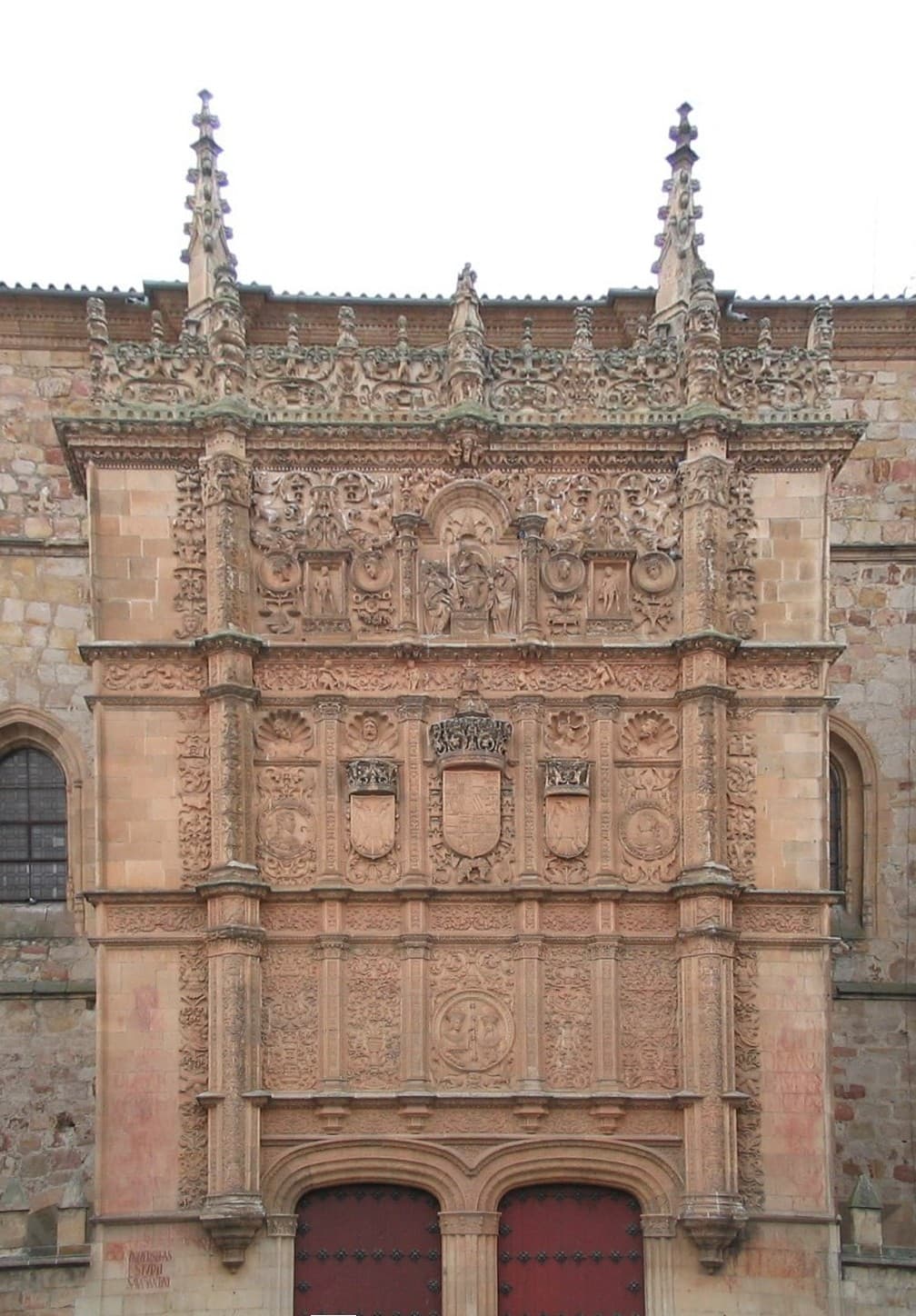
The historic heart of the university is the Escuelas Mayores, the main lecture building constructed in the fifteenth century around the Patio de Escuelas. Its entrance is the celebrated Plateresque façade, carved between about 1518 and 1529 in the finely detailed, silversmith-like style that gives Plateresque its name, from platero, the Spanish word for silversmith. The stone is Villamayor sandstone, which weathers to a warm gold and is soft enough when freshly quarried to be worked in extraordinary detail.
 Somewhere in this stonework sits a small frog on a skull. Finding it unaided is supposed to guarantee that you pass, which is why every visitor spends ten minutes staring at the wall. Photograph by Nacaru, CC BY-SA 4.0, via Wikimedia Commons.
The façade is a woven surface of medallions, coats of arms, saints, mythical figures and scrollwork. At its centre, a medallion shows the Catholic Monarchs, Ferdinand and Isabella, holding a shared sceptre, a tribute to the sovereigns who patronised the university in its ascendancy; above them appear the arms of the Emperor Charles V. Reading the whole composition is a scholarly exercise in itself, and generations of students have treated it as a puzzle.
Hidden among the carving is the frog of Salamanca, a small figure perched on one of a group of stone skulls on the right-hand pilaster. Tradition holds that a visitor who spots the frog unaided will have good fortune, and students once believed that finding it meant passing their examinations. The carving's meaning is debated: some read the frog on a skull as a warning against vice and a reminder of mortality, in the manner of a memento mori, while other readings tie the skulls to death and the frog to older moral emblems. Whatever the intent, the search for the frog is now a fixture of any visit, and pointing it out has become a small rite for guides and locals.
Around the corner stand the Escuelas Menores, the minor schools, with their own courtyard, and inside them survives the Cielo de Salamanca, a fifteenth-century fresco of the zodiac and constellations painted by Fernando Gallego for the ceiling of the old library. The Aula Fray Luis de León, the lecture room preserved with its rough wooden benches and lectern, is kept as it was in the sixteenth century and is shown as the room where Fray Luis resumed teaching after his imprisonment.
Salamanca gave Spain and Latin America a shared academic model. As the first university of the Hispanic world, it trained the clergy, lawyers and administrators who staffed the church and the crown on both sides of the Atlantic, and its statutes and curricula were copied by universities founded in the Americas from the sixteenth century onward. To study Salamanca is in part to study the intellectual foundations of the Spanish-speaking world.
The city grew around the institution to the point that the two are hard to separate. In 1988 UNESCO inscribed the Old City of Salamanca on the World Heritage List, citing an urban ensemble in which Romanesque, Gothic, Renaissance and Baroque buildings sit together, with the university at its core. The nickname the golden city comes from the way its sandstone glows in low sun, and much of that stone frames university buildings. A Spanish proverb, Quod natura non dat, Salmantica non praestat, "what nature does not give, Salamanca does not lend," captures the reputation the place carried for centuries: that it could sharpen a mind but not create talent from nothing.
Its traditions have never needed reviving, and stay alive in the tunas, the student musical groups in cloaks and ribbons, and in the crowded student life of a city where a large share of the population is enrolled. That continuity, learning carried out in the same rooms for eight centuries, is a large part of what makes Salamanca matter.
Behind the carved façades, the university holds one of the most important historical collections in Spain. The Biblioteca General Histórica keeps thousands of manuscripts, some medieval, along with hundreds of incunabula, the books printed in the first decades after the invention of movable type, and tens of thousands of printed volumes from the sixteenth to eighteenth centuries. The old library hall, with its tiered shelving and painted ceiling, is itself a preserved interior, and its holdings document how learning was gathered, contested and passed on across the centuries.
The archive extends beyond books. The university preserves its own records, the charters and statutes that trace its governance back to the thirteenth century, the registers of chairs and disputations, scientific instruments, globes and furniture. To make this heritage available without wearing out the originals, the university runs a digital repository, GREDOS, through which digitised manuscripts, rare books and scholarly publications can be consulted remotely. The combination of a guarded physical archive and open digital access is how a collection of this age stays both safe and useful.
For a heritage of this kind, preservation is not only a matter of keeping objects intact. It is the continuous work of cataloguing, conserving, copying and interpreting, so that a decree from 1254 or a lecture from 1539 can still be read and understood. Salamanca has done that work for eight hundred years, which is why so much of its past survives in a form that can be studied today.
The University of Salamanca is a public institution with roughly 30,000 students across faculties in Salamanca and satellite campuses in Ávila, Zamora and Béjar, drawing students from dozens of countries. Its international Spanish courses, descended from the 1929 chair, remain a major part of its work and bring learners of the language to the city year round. The historic buildings are open to visitors, usually for a modest admission that also gives access to the old library, the Escuelas Menores and the Cielo de Salamanca.
Reaching Salamanca is straightforward: high-speed and regional trains connect it to Madrid in around one and a half to two and a half hours, and the historic centre is compact enough to explore on foot. The Escuelas Mayores stand on the Patio de Escuelas, a short walk from the Plaza Mayor, and the frog on the façade can be found without a ticket by anyone willing to search the carving. Practical details on courses, visits and admissions are published on the university's official site and its international courses site.
Somewhere in this stonework sits a small frog on a skull. Finding it unaided is supposed to guarantee that you pass, which is why every visitor spends ten minutes staring at the wall. Photograph by Nacaru, CC BY-SA 4.0, via Wikimedia Commons.
The façade is a woven surface of medallions, coats of arms, saints, mythical figures and scrollwork. At its centre, a medallion shows the Catholic Monarchs, Ferdinand and Isabella, holding a shared sceptre, a tribute to the sovereigns who patronised the university in its ascendancy; above them appear the arms of the Emperor Charles V. Reading the whole composition is a scholarly exercise in itself, and generations of students have treated it as a puzzle.
Hidden among the carving is the frog of Salamanca, a small figure perched on one of a group of stone skulls on the right-hand pilaster. Tradition holds that a visitor who spots the frog unaided will have good fortune, and students once believed that finding it meant passing their examinations. The carving's meaning is debated: some read the frog on a skull as a warning against vice and a reminder of mortality, in the manner of a memento mori, while other readings tie the skulls to death and the frog to older moral emblems. Whatever the intent, the search for the frog is now a fixture of any visit, and pointing it out has become a small rite for guides and locals.
Around the corner stand the Escuelas Menores, the minor schools, with their own courtyard, and inside them survives the Cielo de Salamanca, a fifteenth-century fresco of the zodiac and constellations painted by Fernando Gallego for the ceiling of the old library. The Aula Fray Luis de León, the lecture room preserved with its rough wooden benches and lectern, is kept as it was in the sixteenth century and is shown as the room where Fray Luis resumed teaching after his imprisonment.
Salamanca gave Spain and Latin America a shared academic model. As the first university of the Hispanic world, it trained the clergy, lawyers and administrators who staffed the church and the crown on both sides of the Atlantic, and its statutes and curricula were copied by universities founded in the Americas from the sixteenth century onward. To study Salamanca is in part to study the intellectual foundations of the Spanish-speaking world.
The city grew around the institution to the point that the two are hard to separate. In 1988 UNESCO inscribed the Old City of Salamanca on the World Heritage List, citing an urban ensemble in which Romanesque, Gothic, Renaissance and Baroque buildings sit together, with the university at its core. The nickname the golden city comes from the way its sandstone glows in low sun, and much of that stone frames university buildings. A Spanish proverb, Quod natura non dat, Salmantica non praestat, "what nature does not give, Salamanca does not lend," captures the reputation the place carried for centuries: that it could sharpen a mind but not create talent from nothing.
Its traditions have never needed reviving, and stay alive in the tunas, the student musical groups in cloaks and ribbons, and in the crowded student life of a city where a large share of the population is enrolled. That continuity, learning carried out in the same rooms for eight centuries, is a large part of what makes Salamanca matter.
Behind the carved façades, the university holds one of the most important historical collections in Spain. The Biblioteca General Histórica keeps thousands of manuscripts, some medieval, along with hundreds of incunabula, the books printed in the first decades after the invention of movable type, and tens of thousands of printed volumes from the sixteenth to eighteenth centuries. The old library hall, with its tiered shelving and painted ceiling, is itself a preserved interior, and its holdings document how learning was gathered, contested and passed on across the centuries.
The archive extends beyond books. The university preserves its own records, the charters and statutes that trace its governance back to the thirteenth century, the registers of chairs and disputations, scientific instruments, globes and furniture. To make this heritage available without wearing out the originals, the university runs a digital repository, GREDOS, through which digitised manuscripts, rare books and scholarly publications can be consulted remotely. The combination of a guarded physical archive and open digital access is how a collection of this age stays both safe and useful.
For a heritage of this kind, preservation is not only a matter of keeping objects intact. It is the continuous work of cataloguing, conserving, copying and interpreting, so that a decree from 1254 or a lecture from 1539 can still be read and understood. Salamanca has done that work for eight hundred years, which is why so much of its past survives in a form that can be studied today.
The University of Salamanca is a public institution with roughly 30,000 students across faculties in Salamanca and satellite campuses in Ávila, Zamora and Béjar, drawing students from dozens of countries. Its international Spanish courses, descended from the 1929 chair, remain a major part of its work and bring learners of the language to the city year round. The historic buildings are open to visitors, usually for a modest admission that also gives access to the old library, the Escuelas Menores and the Cielo de Salamanca.
Reaching Salamanca is straightforward: high-speed and regional trains connect it to Madrid in around one and a half to two and a half hours, and the historic centre is compact enough to explore on foot. The Escuelas Mayores stand on the Patio de Escuelas, a short walk from the Plaza Mayor, and the frog on the façade can be found without a ticket by anyone willing to search the carving. Practical details on courses, visits and admissions are published on the university's official site and its international courses site.
History and founding
The School of Salamanca
Notable scholars and alumni
The buildings and the frog
Cultural significance
What it preserves
Visiting and today
References and resources
- University of Salamanca, Wikipedia
- University of Salamanca, Encyclopaedia Britannica
- School of Salamanca, Wikipedia
- Universidad de Salamanca, official website
- History of the University, Cursos Internacionales
- Old City of Salamanca, UNESCO World Heritage Centre
- Higher School of the University of Salamanca, Junta de Castilla y León tourism
- Francisco de Vitoria, Wikipedia
- Biblioteca General Histórica, University of Salamanca
- GREDOS digital repository