Heritage · Landmark
The Sagrada Familia: History, Architecture and Visitor Guide
The Sagrada Familia is Antoni Gaudi's basilica in Barcelona, begun in 1882 and still being finished. Explore its history, architecture and visitor guide.Written to last.
By Confinity Heritage Editorial · Updated 2026-07-31 · 7-minute readQuiet tools, kept out of the way.
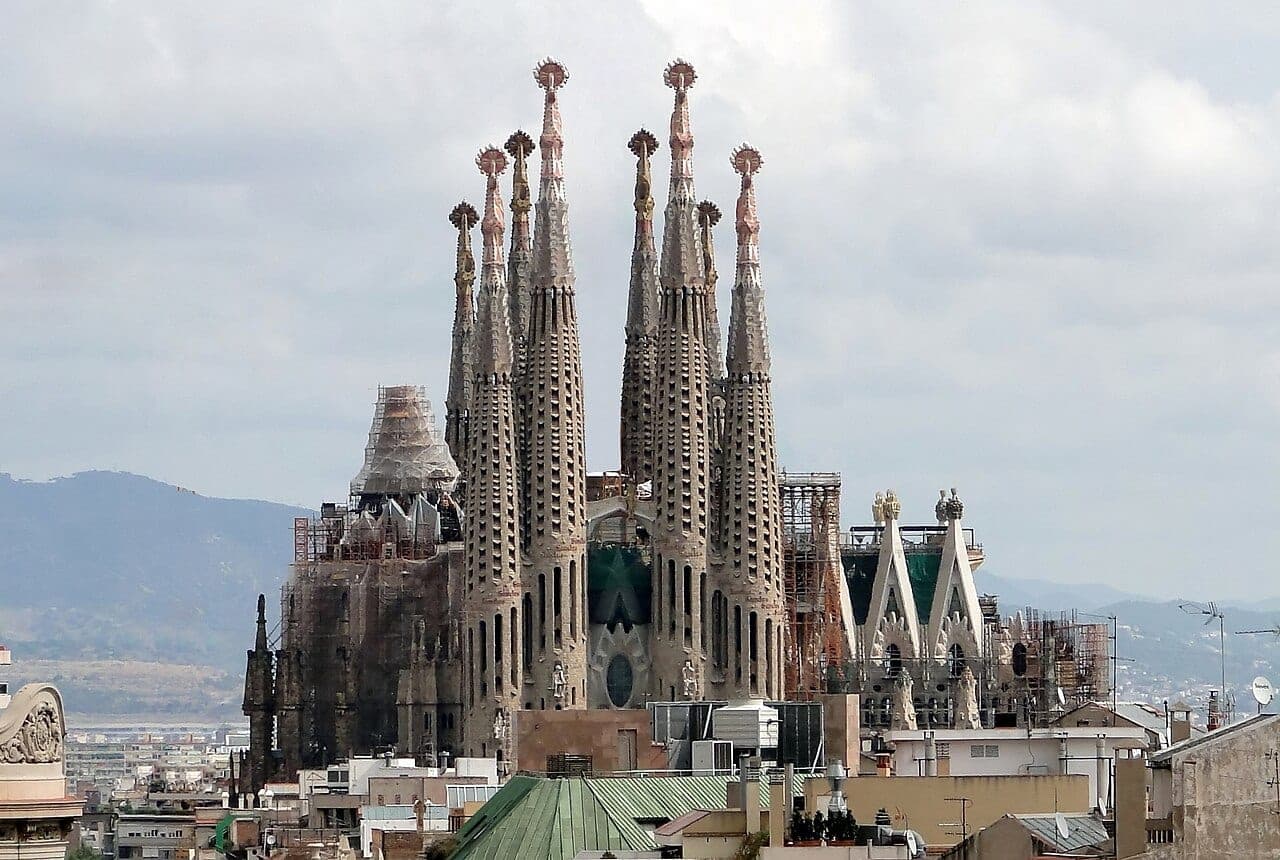
On a street corner in Barcelona rises a church that has been under construction for longer than any living person has been alive. The Basílica de la Sagrada Família was begun in 1882 and is still not entirely finished, though its main structure reached completion in 2026 (Wikipedia). It is the work most closely tied to the Catalan architect Antoni Gaudí, who gave the last decades of his life to it and is buried in its crypt. The building is an active Roman Catholic basilica and one of the most recognisable structures in Spain. Parts of it belong to the UNESCO World Heritage listing known as the Works of Antoni Gaudí, first inscribed in 1984 and extended in 2005 (UNESCO).
Construction began on 19 March 1882 under the architect Francisco de Paula del Villar, who planned a conventional Gothic revival church. Villar resigned the following year, and in 1883 the commission passed to Gaudí, then in his early thirties (Wikipedia). Gaudí redrew the project entirely, abandoning the standard scheme for a design of far greater ambition and scale.
He worked on the Sagrada Família for the rest of his life, and in his final years he devoted himself to it almost exclusively, living for a time on the building site. On 7 June 1926 Gaudí was struck by a tram in central Barcelona and died three days later, and he was buried in the basilica's crypt (Wikipedia). At his death the church was only between 15 and 25 percent finished, with the crypt, the apse walls and part of the Nativity façade standing (Britannica).
Work continued under his assistants, but disaster came in July 1936, at the start of the Spanish Civil War, when the workshop was broken into and set alight, partially destroying the models, drawings and plaster studies that Gaudí had left behind (Britannica). Later architects, among them Francesc Quintana, Isidre Puig Boada and Lluís Bonet i Garí, had to reconstruct his intentions from surviving fragments, photographs and their own knowledge of his methods. Progress was slow for decades, limited by funds and by the sheer difficulty of the design. It accelerated from the late twentieth century as tourist revenue and computer modelling made the geometry buildable, and Jordi Faulí has served as chief architect since 2012 (Wikipedia). Finishing work on the Glory façade and its surroundings is expected to continue past 2026, with published estimates pointing to the early or mid 2030s, so any single completion date should be treated with caution.
Gaudí's design joins the vertical drama of Gothic architecture to forms drawn from the natural world. He replaced the flying buttresses of medieval churches with branching interior columns that lean and divide like trees, carrying the roof loads directly and doing away with external supports (Britannica). Each column shifts in cross-section as it rises, from a square base to an octagon, then a sixteen-sided figure and finally a circle, a system Gaudí worked out through hanging-chain models rather than conventional drawing.
 The nave columns branch as they rise, a structural idea Gaudi worked out with hanging chain models rather than calculation. Photograph by Julian Lupyan, CC0, via Wikimedia Commons.
The building is organised around three great façades, each telling part of the life of Christ. The Nativity façade, the one built largely in Gaudí's lifetime, faces east and is dense with carved plants, animals and figures celebrating the birth of Jesus. The Passion façade, begun in 1954 and carrying the austere, angular sculptures of Josep Maria Subirachs, faces west and depicts the suffering and death of Christ. The Glory façade, the principal entrance, was begun in 2002 and represents the road to God (Wikipedia).
When complete the church is designed to carry eighteen spires: twelve for the apostles, four for the evangelists, one for the Virgin Mary and the tallest for Jesus Christ. The central Tower of Jesus Christ reaches 172.5 metres, and its topping-out in February 2026 made the Sagrada Família the tallest church in the world, surpassing the spire of Ulm Minster in Germany (Wikipedia).
Gaudí conceived the Sagrada Família as an act of collective devotion that no single generation would see finished. It was funded from the start by donations from ordinary worshippers, and that principle still holds: construction is paid for largely by entrance fees and private gifts rather than by the state or the church hierarchy (Wikipedia).
The building has become the defining image of Barcelona and a focus of Catalan identity, drawing millions of visitors each year. Yet it remains first a working church. Pope Benedict XVI consecrated it and declared it a minor basilica on 7 November 2010, and Mass is celebrated there regularly (Britannica). Gaudí's wider body of work in the city is recognised by UNESCO for its originality, and the Sagrada Família has become a subject of study for architects and engineers around the world (UNESCO).
The basilica sits in the Eixample district of Barcelona and is reached easily by the city's metro. Entry to the church requires a timed ticket, best booked online in advance because demand is high throughout the year. Separate tickets allow access to the towers of the Nativity and Passion façades, reached by lift and returned by a narrow spiral stair. Opening hours are shorter on Sundays and religious holidays, when parts of the church are reserved for worship. Because the interior is known for the coloured light thrown by its stained glass, many visitors find that a bright morning or late afternoon shows the columns and vaults at their best. Current hours, prices and any construction closures are published on the basilica's official website, which remains the most reliable source (Sagrada Família).
The nave columns branch as they rise, a structural idea Gaudi worked out with hanging chain models rather than calculation. Photograph by Julian Lupyan, CC0, via Wikimedia Commons.
The building is organised around three great façades, each telling part of the life of Christ. The Nativity façade, the one built largely in Gaudí's lifetime, faces east and is dense with carved plants, animals and figures celebrating the birth of Jesus. The Passion façade, begun in 1954 and carrying the austere, angular sculptures of Josep Maria Subirachs, faces west and depicts the suffering and death of Christ. The Glory façade, the principal entrance, was begun in 2002 and represents the road to God (Wikipedia).
When complete the church is designed to carry eighteen spires: twelve for the apostles, four for the evangelists, one for the Virgin Mary and the tallest for Jesus Christ. The central Tower of Jesus Christ reaches 172.5 metres, and its topping-out in February 2026 made the Sagrada Família the tallest church in the world, surpassing the spire of Ulm Minster in Germany (Wikipedia).
Gaudí conceived the Sagrada Família as an act of collective devotion that no single generation would see finished. It was funded from the start by donations from ordinary worshippers, and that principle still holds: construction is paid for largely by entrance fees and private gifts rather than by the state or the church hierarchy (Wikipedia).
The building has become the defining image of Barcelona and a focus of Catalan identity, drawing millions of visitors each year. Yet it remains first a working church. Pope Benedict XVI consecrated it and declared it a minor basilica on 7 November 2010, and Mass is celebrated there regularly (Britannica). Gaudí's wider body of work in the city is recognised by UNESCO for its originality, and the Sagrada Família has become a subject of study for architects and engineers around the world (UNESCO).
The basilica sits in the Eixample district of Barcelona and is reached easily by the city's metro. Entry to the church requires a timed ticket, best booked online in advance because demand is high throughout the year. Separate tickets allow access to the towers of the Nativity and Passion façades, reached by lift and returned by a narrow spiral stair. Opening hours are shorter on Sundays and religious holidays, when parts of the church are reserved for worship. Because the interior is known for the coloured light thrown by its stained glass, many visitors find that a bright morning or late afternoon shows the columns and vaults at their best. Current hours, prices and any construction closures are published on the basilica's official website, which remains the most reliable source (Sagrada Família).
History
Architecture
Cultural role
Visiting
References and resources
- UNESCO World Heritage Centre: Works of Antoni Gaudí: the World Heritage inscription of 1984, extended in 2005, that includes parts of the Sagrada Família.
- Encyclopaedia Britannica: Sagrada Família: Gaudí's role, the 1936 damage, the façades and the 2010 consecration.
- Basílica de la Sagrada Família, official site: visiting hours, tickets and current construction news.
- Wikipedia: Sagrada Família: construction timeline, the spires, tower heights and the 2026 topping-out.