Heritage · Landmark
The Alhambra: History, Architecture and Visitor Guide
Nasrid palace-and-fortress complex in Granada, begun 1238; home to the Court of the Lions and Generalife gardens. A UNESCO World Heritage Site since 1984.Written to last.
By Confinity Heritage Editorial · Updated 2026-07-31 · 7-minute readQuiet tools, kept out of the way.
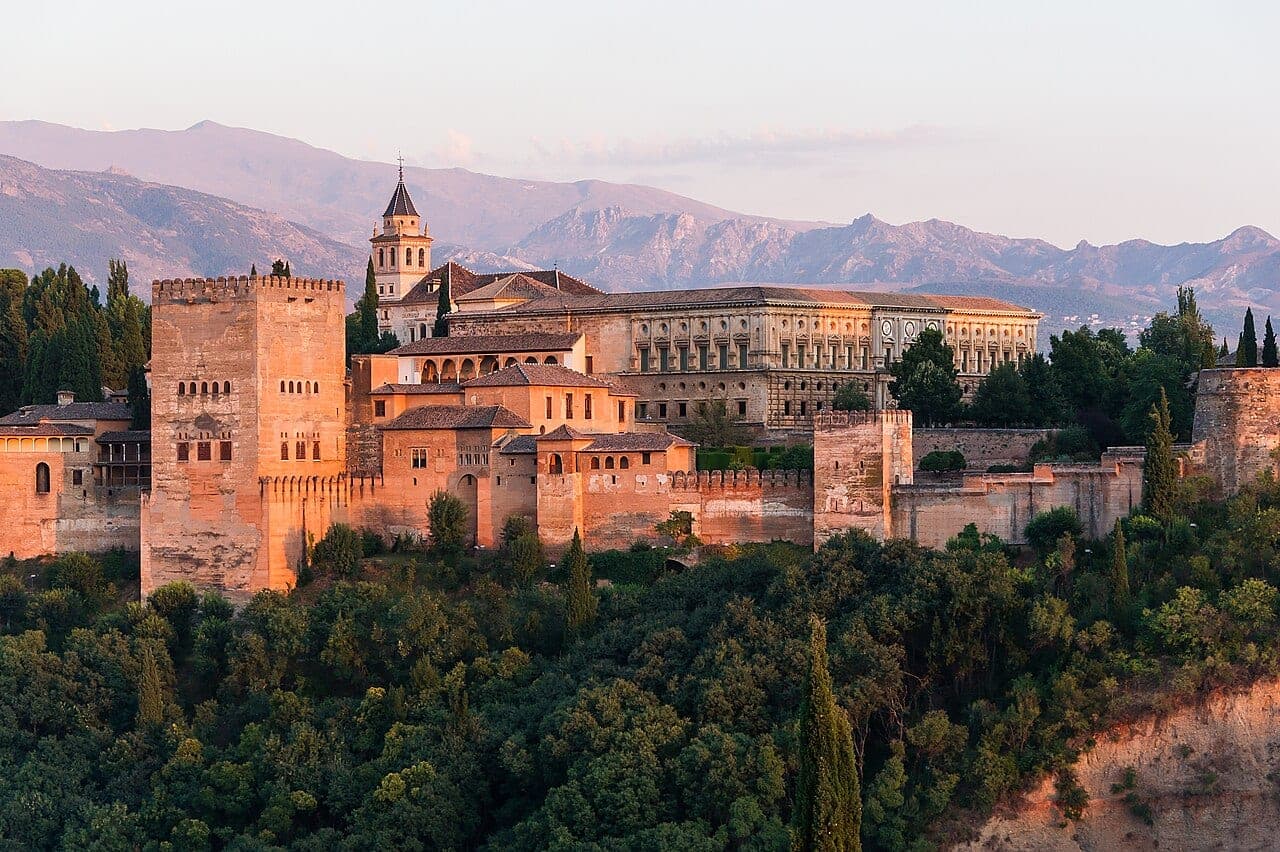
The Alhambra rises on the Sabika hill above Granada in southern Spain, a walled city of palaces, courtyards, gardens, and fortifications that served as the seat of the Nasrid rulers of Granada. Its name comes from the Arabic al-Qal'a al-Hamra, "the red fortress," after the reddish rammed-earth walls that glow at sundown. Built mainly in the 13th and 14th centuries, it is the most complete surviving palace complex of the medieval Islamic world and, with the neighbouring Generalife gardens and the old Albayzín quarter, a UNESCO World Heritage Site inscribed in 1984.
Its survival is what makes it exceptional. Most royal residences of al-Andalus were destroyed or built over, but here an entire Nasrid court, from throne rooms to bath houses to water channels, remains intact enough to walk through. It ranks among the most visited and recognisable monuments in Europe.
The hill had been fortified long before the Nasrids, but the Alhambra as it is known today began in 1238, when Muhammad I ibn al-Ahmar, founder of the Nasrid dynasty and first emir of Granada, moved his court there and rebuilt the stronghold. The Alcazaba, the military citadel at the western tip of the complex, is the oldest surviving part of his work.
The Nasrid emirate was the last Muslim state in the Iberian Peninsula, a tributary of Castile that endured for more than two and a half centuries while the rest of al-Andalus fell. Its wealth funded the great building campaigns of the 14th century under the emirs Yusuf I and his son Muhammad V, who gave the Nasrid Palaces most of their present form, including the Court of the Lions.
That world ended in 1492. After a decade of war, the last Nasrid ruler, Muhammad XII, known to the Spanish as Boabdil, surrendered the city to the Catholic Monarchs, Isabella I of Castile and Ferdinand II of Aragon, on 2 January 1492, completing the centuries-long Reconquista. The monarchs took up residence and preserved much of the Nasrid work rather than razing it. Their grandson, the Holy Roman Emperor Charles V, made a heavier mark: after visiting in 1526 he commissioned a monumental Renaissance palace inside the walls, designed by Pedro Machuca and begun in 1527, though it was left unfinished after 1637.
By the 18th century the Alhambra had fallen into neglect, occupied by squatters and later damaged by Napoleon's troops, who blew up part of the fortifications as they retreated in 1812. Its revival owed much to the Romantic movement: the American writer Washington Irving lived in the crumbling palace in 1829 and published Tales of the Alhambra in 1832, a collection of sketches and legends that spread its fame across Europe and North America and helped prompt its restoration.
The Alhambra is the finest surviving expression of Nasrid art, the last great phase of Islamic architecture in the West. Its builders worked in modest materials, plaster, timber, ceramic, and worked stone, but raised them to extraordinary refinement. Walls are sheathed in carved stucco worked into arabesques and geometric lattices, in glazed tilework set in mosaics, and in Arabic calligraphy that repeats poetry and the Nasrid motto, "There is no victor but God." Ceilings dissolve into muqarnas, the honeycomb of small prismatic cells that hang like stalactites and turn solid vaults into weightless surfaces.
 The Court of the Lions, where twelve carved lions carry a basin fed by a hydraulic system that has been running, on and off, since the fourteenth century. Photograph by Jebulon, CC0, via Wikimedia Commons.
Water is almost a building material in its own right, with channels, pools, and fountains running through every court to cool the air and fill the rooms with sound. The Court of the Lions, built under Muhammad V in the second half of the 14th century, is the centrepiece: a rectangular courtyard ringed by slender marble columns, with a central fountain resting on twelve carved stone lions from whose mouths water flows.
Beyond the palaces lies the Generalife, the Nasrid emirs' summer estate on the neighbouring hill. Its terraced gardens, orchards, and the long pool of the Patio de la Acequia are among the oldest surviving Moorish gardens and a model of the Islamic idea of the garden as an earthly paradise. In deliberate contrast, Charles V's palace is a strict Renaissance block: a square exterior enclosing a circular two-storey courtyard, the first design of its kind in Europe.
The Alhambra is the last and most complete Muslim palace to survive in western Europe, and the enduring symbol of al-Andalus, the centuries of Islamic rule in the Iberian Peninsula. For visitors it condenses that vanished civilisation into a single place: its science, poetry, and craftsmanship, and the moment of its passing in 1492. It has shaped the Western imagination of the medieval Moorish past and remains a touchstone in discussions of Spain's plural Christian, Muslim, and Jewish heritage.
The Alhambra is one of Spain's most visited monuments, and access is managed through timed tickets sold by the Patronato de la Alhambra y Generalife. Entry to the Nasrid Palaces is strictly controlled: each ticket carries a fixed half-hour slot, and visitors must enter within it. Daily numbers are capped, so palace tickets, especially in high season, sell out well in advance and are best booked online before travelling. General admission also covers the Alcazaba and the Generalife, and a separate evening ticket allows night visits. The site sits above Granada's city centre, and a full visit takes several hours.
Since 1984 the Alhambra has been protected as a UNESCO World Heritage Site, managed by the Patronato de la Alhambra y Generalife, a public body responsible for its conservation, study, and public access. The fragile stucco, tilework, and timber ceilings require constant care against weathering, pollution, and mass tourism, which is one reason numbers to the Nasrid Palaces are capped. Ongoing programmes conserve the surfaces, restore the water systems and gardens, and research the building's history, balancing the survival of a delicate monument against the demand to see it.
The Court of the Lions, where twelve carved lions carry a basin fed by a hydraulic system that has been running, on and off, since the fourteenth century. Photograph by Jebulon, CC0, via Wikimedia Commons.
Water is almost a building material in its own right, with channels, pools, and fountains running through every court to cool the air and fill the rooms with sound. The Court of the Lions, built under Muhammad V in the second half of the 14th century, is the centrepiece: a rectangular courtyard ringed by slender marble columns, with a central fountain resting on twelve carved stone lions from whose mouths water flows.
Beyond the palaces lies the Generalife, the Nasrid emirs' summer estate on the neighbouring hill. Its terraced gardens, orchards, and the long pool of the Patio de la Acequia are among the oldest surviving Moorish gardens and a model of the Islamic idea of the garden as an earthly paradise. In deliberate contrast, Charles V's palace is a strict Renaissance block: a square exterior enclosing a circular two-storey courtyard, the first design of its kind in Europe.
The Alhambra is the last and most complete Muslim palace to survive in western Europe, and the enduring symbol of al-Andalus, the centuries of Islamic rule in the Iberian Peninsula. For visitors it condenses that vanished civilisation into a single place: its science, poetry, and craftsmanship, and the moment of its passing in 1492. It has shaped the Western imagination of the medieval Moorish past and remains a touchstone in discussions of Spain's plural Christian, Muslim, and Jewish heritage.
The Alhambra is one of Spain's most visited monuments, and access is managed through timed tickets sold by the Patronato de la Alhambra y Generalife. Entry to the Nasrid Palaces is strictly controlled: each ticket carries a fixed half-hour slot, and visitors must enter within it. Daily numbers are capped, so palace tickets, especially in high season, sell out well in advance and are best booked online before travelling. General admission also covers the Alcazaba and the Generalife, and a separate evening ticket allows night visits. The site sits above Granada's city centre, and a full visit takes several hours.
Since 1984 the Alhambra has been protected as a UNESCO World Heritage Site, managed by the Patronato de la Alhambra y Generalife, a public body responsible for its conservation, study, and public access. The fragile stucco, tilework, and timber ceilings require constant care against weathering, pollution, and mass tourism, which is one reason numbers to the Nasrid Palaces are capped. Ongoing programmes conserve the surfaces, restore the water systems and gardens, and research the building's history, balancing the survival of a delicate monument against the demand to see it.
History
Architecture
Cultural role
Visiting
Preservation
References and resources
- UNESCO World Heritage Centre: Alhambra, Generalife and Albayzín, Granada: the official inscription and site description.
- Encyclopaedia Britannica: Alhambra: overview of the complex's history and architecture.
- Wikipedia: Alhambra: detailed history, construction phases, and architectural description with sources.