Heritage · Museum
Museo del Prado: History, Collection and Visitor Guide
Madrid's Museo del Prado, Spain's national art museum, opened in 1819 and holds the world's finest collection of Spanish painting from Velazquez to Goya.Written to last.
By Confinity Heritage Editorial · Updated 2026-07-31 · 7-minute readQuiet tools, kept out of the way.
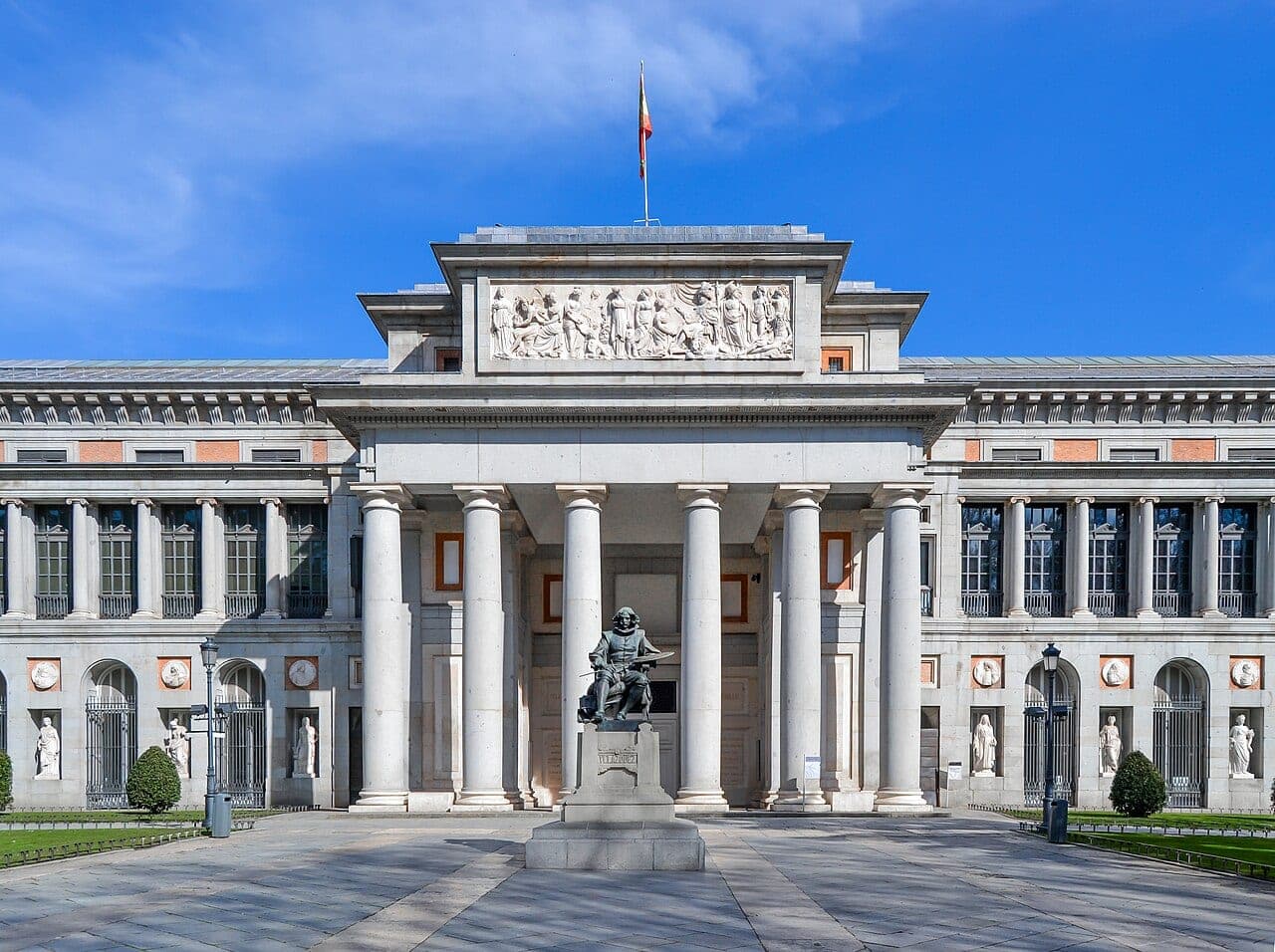
The Museo del Prado, on the Paseo del Prado in central Madrid, holds the largest and most complete collection of Spanish painting in existence, together with the European works that Spain's monarchs admired and bought over three centuries. It opened to the public on 10 November 1819 and today shows the work of Diego Velázquez, Francisco de Goya, and El Greco in greater depth than any other museum, alongside masterpieces such as Hieronymus Bosch's The Garden of Earthly Delights and a body of Titian gathered by the Habsburg court (Britannica).
The building itself was not designed as an art gallery. The architect Juan de Villanueva drew it up in 1785 for King Charles III as a cabinet of natural history, part of a scientific quarter planned beside the royal botanical garden. War, the death of the king, and a change of purpose turned it into something else, and the neoclassical shell that resulted became one of the defining public buildings of nineteenth-century Madrid.
Construction of Villanueva's building began in 1785 but was interrupted by the Peninsular War, during which French troops occupying Madrid used the half-finished structure for stables and stripped lead from its roof (Wikipedia). After the restoration of Ferdinand VII, his second wife, Queen María Isabel de Braganza, pressed for the building to house the royal collections of painting and sculpture, which had been scattered and damaged during years of war and exile. The completed museum opened in 1819 as the Royal Museum of Paintings and Sculptures. Its first catalogue listed 311 paintings, though the crown's holdings already numbered more than 1,500 works drawn from the various royal residences (Museo del Prado).
The museum remained crown property until the revolution of 1868 deposed Isabella II. The collection then passed to the state and took the name it has carried since, the Museo del Prado. Public ownership brought new material: works from suppressed monasteries, gifts, purchases, and, in 1872, the holdings of the closed Museo de la Trinidad. The original building was first enlarged in 1918 and expanded repeatedly through the twentieth century as both the collection and its audience grew.
The most significant modern change came in 2007, when the architect Rafael Moneo completed an extension that added roughly 16,000 square metres of floor space. It linked the original building to the cloister of the nearby church of San Jerónimo el Real and added underground galleries, a lecture hall, and temporary exhibition space beneath a glass-roofed foyer (Wikipedia). A further project, led by Norman Foster and Carlos Rubio to convert the neighbouring Hall of Realms, was approved in 2021.
The heart of the Prado is Spanish painting from the sixteenth to the nineteenth century. It owns the largest group of works by Velázquez, court painter to Philip IV, including Las Meninas, his 1656 portrait of the royal family and their attendants that many consider the most studied painting in Western art. Nearby hang The Surrender of Breda, the equestrian portraits, and The Spinners.
 Villanueva designed the building in 1785 as a natural history cabinet. It was a cavalry barracks under the French occupation before it ever held a painting. Photograph by Javier Perez Montes, CC BY-SA 4.0, via Wikimedia Commons.
The museum's Goya holdings are equally unmatched, spanning his bright early cartoons for the royal weaving works, the court portraits, The Third of May 1808, and the fourteen so-called Black Paintings. Goya applied the Black Paintings directly to the walls of his house outside Madrid late in life; they were later transferred to canvas and given to the Prado, where they hang together in a single darkened sequence (Britannica).
El Greco is represented by works including The Nobleman with his Hand on his Chest and The Trinity, and the older Spanish schools by Ribera, Zurbarán, and Murillo. Beyond Spain, the collection reflects the taste of the Habsburg and Bourbon courts. Bosch's The Garden of Earthly Delights, the Netherlandish triptych acquired by Philip II, is among the most visited works in the building. Titian's imperial portraits and mythological poesie, painted for Charles V and Philip II, form the finest Titian holding anywhere, and the European galleries continue through Rubens, Dürer, Rembrandt, Raphael, and Fra Angelico's Annunciation.
The Prado is the premier art institution of Spain and the principal record of the Spanish Golden Age, the period across the sixteenth and seventeenth centuries when the country's painters worked at the height of their powers under royal and church patronage. Because the collection grew directly from the taste of successive monarchs rather than from a broad museum survey, it gives an unusually direct view of what the Spanish crown valued and commissioned. For Spanish national identity and for the study of European painting alike it holds a central place, and its images by Velázquez and Goya circulate far beyond the museum walls.
The museum closed to the public on 30 August 1936, six weeks into the Spanish Civil War, and the deputy director, Francisco Javier Sánchez Cantón, had the paintings carried down to the lower floors. The first evacuation order reached him on 5 November, as the fighting arrived at the Ciudad Universitaria on the western edge of the city. Eleven days after that, eight incendiary bombs fell on the Prado itself and did considerable damage to the structure; the museum's architect, José Lino Vaamonde, mapped and photographed every impact the following morning (Wikipedia).
The staff took down 353 paintings and 168 drawings, along with the Dauphin's Treasure, and sent them by road to Valencia (Wikipedia). The canvases travelled on their stretchers rather than rolled, wrapped in paper and then in a waterproof layer, braced inside screwed and sealed crates on army lorries fitted with fire extinguishers. Where a crate would not clear a bridge, as at Arganda, it was lifted out and carried over by hand. The improvisation of those first runs cost something: Velázquez's equestrian portrait of the Count-Duke of Olivares reached Valencia seriously damaged (Spanish Wikipedia). In Valencia the pictures were kept in the Torres de Serranos and the church of the Patriarca, both reinforced against blast.
From Valencia they went north into Catalonia, through Peralada and Darnius to talc mines at La Vajol near the French border. On 3 February 1939, in the castle of Sant Ferran at Figueres, the Republic signed an agreement placing the collection in the keeping of the Secretary-General of the League of Nations, with an annex committing the League to return every work to Spain. The Condor Legion was bombing Figueres in the days the document was signed. A special train carried the pictures from Perpignan to Geneva on 12 March, and that summer 174 of them hung in the Musée d'Art et d'Histoire, Las Meninas among them (Wikipedia). More than 400,000 people came to see the show.
The collection came home on a train that left Geneva on the night of 6 September 1939, five days after Germany invaded Poland, and crossed France with its lights out. It had been gone for nearly three years. Pablo Picasso, whom the Republic had appointed director of the Prado in absentia in 1936, supplied funds for the evacuation (Wikipedia); his Guernica, painted the following year, hangs today in the Museo Reina Sofía, a short walk south along the Paseo del Prado.
The museum sits on the Paseo del Prado in the centre of Madrid, forming one corner of the city's Golden Triangle of Art with the Thyssen-Bornemisza Museum and the Reina Sofía, home to Picasso's Guernica. In 2021 the wider setting, the Paseo del Prado and the adjoining Buen Retiro park, was inscribed as a UNESCO World Heritage Site (Wikipedia). The nearest Metro stations are Banco de España and Atocha, and the Atocha mainline station is a short walk away.
The main entrance is the Puerta de los Jerónimos, set within the Moneo extension. The Prado charges general admission but offers free entry during the last two hours of each day; opening hours and ticketing change through the year, so it is worth checking the official website before a visit. Given the size of the collection, most visitors follow a route through the Spanish rooms and a few key European works rather than attempting the whole building at once.
Villanueva designed the building in 1785 as a natural history cabinet. It was a cavalry barracks under the French occupation before it ever held a painting. Photograph by Javier Perez Montes, CC BY-SA 4.0, via Wikimedia Commons.
The museum's Goya holdings are equally unmatched, spanning his bright early cartoons for the royal weaving works, the court portraits, The Third of May 1808, and the fourteen so-called Black Paintings. Goya applied the Black Paintings directly to the walls of his house outside Madrid late in life; they were later transferred to canvas and given to the Prado, where they hang together in a single darkened sequence (Britannica).
El Greco is represented by works including The Nobleman with his Hand on his Chest and The Trinity, and the older Spanish schools by Ribera, Zurbarán, and Murillo. Beyond Spain, the collection reflects the taste of the Habsburg and Bourbon courts. Bosch's The Garden of Earthly Delights, the Netherlandish triptych acquired by Philip II, is among the most visited works in the building. Titian's imperial portraits and mythological poesie, painted for Charles V and Philip II, form the finest Titian holding anywhere, and the European galleries continue through Rubens, Dürer, Rembrandt, Raphael, and Fra Angelico's Annunciation.
The Prado is the premier art institution of Spain and the principal record of the Spanish Golden Age, the period across the sixteenth and seventeenth centuries when the country's painters worked at the height of their powers under royal and church patronage. Because the collection grew directly from the taste of successive monarchs rather than from a broad museum survey, it gives an unusually direct view of what the Spanish crown valued and commissioned. For Spanish national identity and for the study of European painting alike it holds a central place, and its images by Velázquez and Goya circulate far beyond the museum walls.
The museum closed to the public on 30 August 1936, six weeks into the Spanish Civil War, and the deputy director, Francisco Javier Sánchez Cantón, had the paintings carried down to the lower floors. The first evacuation order reached him on 5 November, as the fighting arrived at the Ciudad Universitaria on the western edge of the city. Eleven days after that, eight incendiary bombs fell on the Prado itself and did considerable damage to the structure; the museum's architect, José Lino Vaamonde, mapped and photographed every impact the following morning (Wikipedia).
The staff took down 353 paintings and 168 drawings, along with the Dauphin's Treasure, and sent them by road to Valencia (Wikipedia). The canvases travelled on their stretchers rather than rolled, wrapped in paper and then in a waterproof layer, braced inside screwed and sealed crates on army lorries fitted with fire extinguishers. Where a crate would not clear a bridge, as at Arganda, it was lifted out and carried over by hand. The improvisation of those first runs cost something: Velázquez's equestrian portrait of the Count-Duke of Olivares reached Valencia seriously damaged (Spanish Wikipedia). In Valencia the pictures were kept in the Torres de Serranos and the church of the Patriarca, both reinforced against blast.
From Valencia they went north into Catalonia, through Peralada and Darnius to talc mines at La Vajol near the French border. On 3 February 1939, in the castle of Sant Ferran at Figueres, the Republic signed an agreement placing the collection in the keeping of the Secretary-General of the League of Nations, with an annex committing the League to return every work to Spain. The Condor Legion was bombing Figueres in the days the document was signed. A special train carried the pictures from Perpignan to Geneva on 12 March, and that summer 174 of them hung in the Musée d'Art et d'Histoire, Las Meninas among them (Wikipedia). More than 400,000 people came to see the show.
The collection came home on a train that left Geneva on the night of 6 September 1939, five days after Germany invaded Poland, and crossed France with its lights out. It had been gone for nearly three years. Pablo Picasso, whom the Republic had appointed director of the Prado in absentia in 1936, supplied funds for the evacuation (Wikipedia); his Guernica, painted the following year, hangs today in the Museo Reina Sofía, a short walk south along the Paseo del Prado.
The museum sits on the Paseo del Prado in the centre of Madrid, forming one corner of the city's Golden Triangle of Art with the Thyssen-Bornemisza Museum and the Reina Sofía, home to Picasso's Guernica. In 2021 the wider setting, the Paseo del Prado and the adjoining Buen Retiro park, was inscribed as a UNESCO World Heritage Site (Wikipedia). The nearest Metro stations are Banco de España and Atocha, and the Atocha mainline station is a short walk away.
The main entrance is the Puerta de los Jerónimos, set within the Moneo extension. The Prado charges general admission but offers free entry during the last two hours of each day; opening hours and ticketing change through the year, so it is worth checking the official website before a visit. Given the size of the collection, most visitors follow a route through the Spanish rooms and a few key European works rather than attempting the whole building at once.
History
The collection
Cultural role
The wartime convoy to Geneva
Visiting
References and resources
- Museo Nacional del Prado: History of the Museum: the museum's own account of the Villanueva building, the 1819 opening, and the growth of the collection.
- Museo Nacional del Prado (official): visitor information, collection database, and institutional history.
- Encyclopaedia Britannica: Prado Museum: overview of the museum's history, building, and collections.
- Wikipedia: Museo del Prado: detailed history, architecture, and holdings with sourced references.
- Wikipedia: José Lino Vaamonde: the Prado's architect-conservator, the incendiary bombs of 16 November 1936, and the wartime rescue boards.
- Wikipedia: Paul Lachenal: the international committee formed in January 1939 and the Geneva exhibition of 174 paintings.
- Wikipedia: Las Meninas: the painting's condition history and its evacuation to Geneva in 1939.
- Wikipedia: Pablo Picasso: his appointment as director of the Prado in absentia and his funding of the evacuation.
- Traslado de obras del Museo del Prado durante la Guerra Civil, Spanish Wikipedia: the route, the packing methods, the Figueres agreement of 3 February 1939, and the return train.