Heritage · Country
Philippines Culture and Heritage
From the Ifugao rice terraces cut into the Cordillera mountains to the candlelit cemeteries of Undas each November, the Philippines gathers more than 7,000 islands and over a hundred languages into one deeply Catholic archipelago. A guide to Filipino heritage, three centuries of colonial history, and the customs by which families keep company with their dead.Written to last.
By Confinity Heritage Editorial · Updated 2026-07-31 · 8-minute readQuiet tools, kept out of the way.
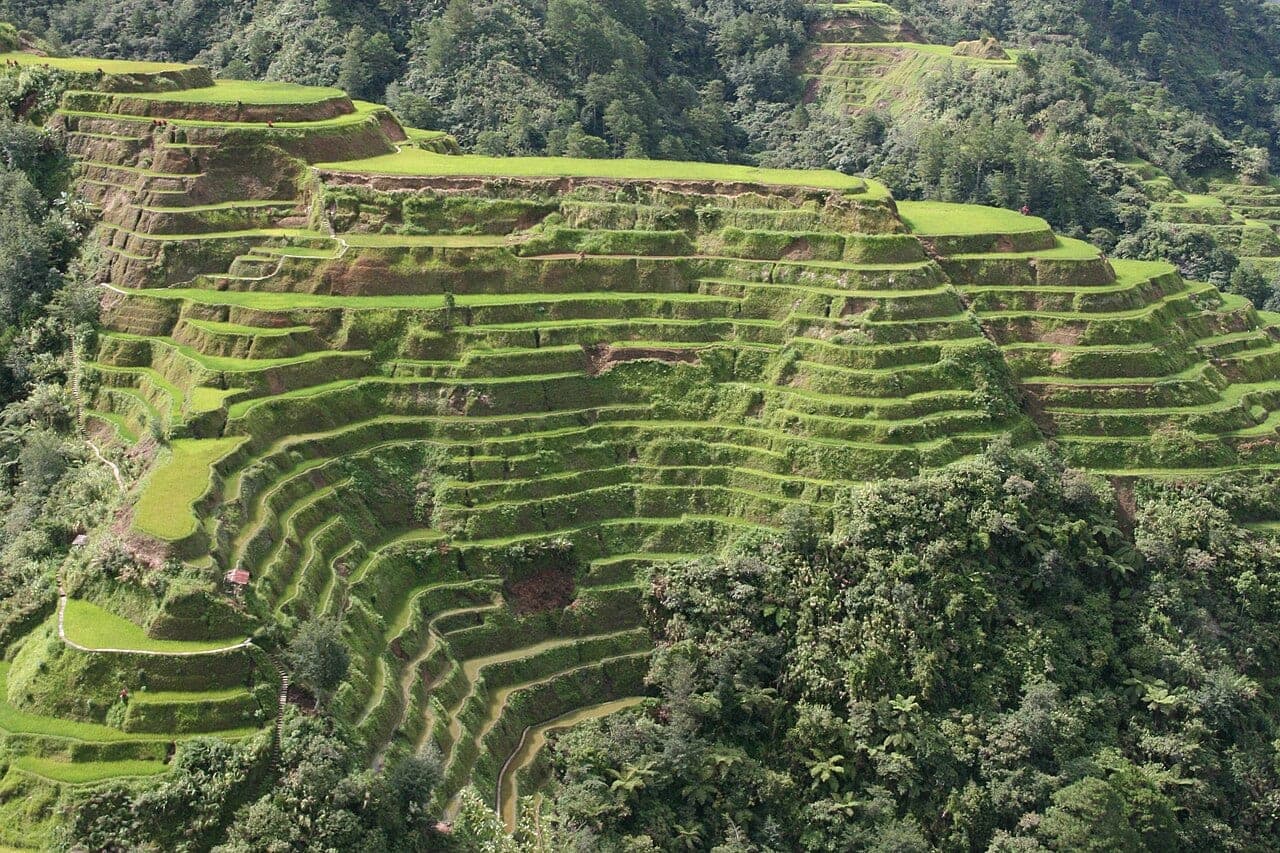
The Philippines is scattered across the western Pacific in more than seven thousand pieces. Government surveys count 7,641 islands strung between the South China Sea and the wider Pacific, a country that Austronesian seafarers began settling thousands of years ago and that later absorbed more than three centuries of Spanish rule, half a century of American governance, and a violent wartime occupation. High in the northern Cordillera, the Ifugao and their neighbours cut rice terraces into the mountainsides that UNESCO would later honour as a living cultural landscape; across the lowlands, Spanish friars raised stone churches whose fiestas still order the year. Around 117 million people now live across the archipelago, speaking more than 170 languages beneath two official tongues, Filipino and English.
Few nations keep their dead as close. When someone dies, Filipino families hold the lamay, a wake of several days in which relatives, neighbours and friends keep vigil through the nights with prayer, food, shared memory and, often, laughter; and each year at the start of November, in the days called Undas, millions travel home to clean, repaint and adorn the graves of their kin, then settle in among the tombs to eat, pray and remember together.
The Philippines covers about 300,000 square kilometres of land divided among three major island groups: Luzon in the north, the Visayas in the centre, and Mindanao in the south. Of its 7,641 islands, fewer than a thousand are inhabited, with Luzon and Mindanao the largest by far. The country lies on the Pacific Ring of Fire and inside the typhoon belt, giving it active volcanoes such as Mayon and Taal, frequent earthquakes and some twenty tropical cyclones a year; the 1991 eruption of Mount Pinatubo was among the most powerful of the twentieth century.
With around 117 million people, the Philippines is one of the world's fifteen most populous countries. It is a unitary republic of more than eighty provinces, governed from Manila under a presidential system inherited from the American era.
Manila. The capital was founded by the Spanish under Miguel López de Legazpi in 1571 on the site of Maynila, a Muslim settlement at the mouth of the Pasig River. Its walled core, Intramuros, held churches, colleges and the fortress of Fort Santiago, and its sixteenth-century San Agustin Church is one of the country's UNESCO-listed Baroque churches. Much of the old city was destroyed in the 1945 Battle of Manila, among the most devastating urban battles of the Second World War.
 Vigan kept its Spanish colonial street plan and its houses because it was too far from the fighting of 1945 to be flattened. Photograph by Ranieljosecastaneda, CC BY-SA 4.0, via Wikimedia Commons.
Cebu. In the central Visayas, Cebu is the oldest Spanish city in the country, established by Legazpi in 1565. Magellan landed here in 1521; the Santo Niño de Cebú, an image left by his expedition, remains the focus of the vast Sinulog festival each January.
Vigan. On the north-west coast of Luzon, Vigan preserves the best-surviving Spanish colonial townscape in Asia, its cobbled Calle Crisologo lined with the tile-roofed mansions of a mestizo merchant class; UNESCO inscribed the Historic Town of Vigan in 1999.
Davao. The largest city by land area and the commercial heart of Mindanao, Davao sits beneath Mount Apo, the highest peak in the country, a gateway to the island's Muslim and Indigenous south.
Baguio. Laid out by American planners as a hill station in the Cordillera, Baguio became the country's "summer capital" and a centre of Igorot culture and craft.
The archipelago's population was shaped above all by Austronesian voyagers, who spread through the islands by sea over several thousand years, bringing rice, pottery and the outrigger boat. In the highlands of Luzon, the Ifugao and neighbouring Cordillera peoples cut the mountain rice terraces for which the region is famous, sustained by Indigenous knowledge across generations. By the first millennium CE, lowland communities were trading with China and Borneo; the Laguna Copperplate Inscription, dated to around 900 CE and written in a script of Indian origin, is the earliest known document from the islands.
By the time Europeans arrived, the islands held a patchwork of polities: the kingdoms of Tondo and Maynila on Manila Bay, the rajahnates of Cebu and Butuan in the Visayas, and, in the south, the Muslim sultanates of Sulu and Maguindanao. Ferdinand Magellan reached the islands in 1521 and claimed them for Spain before dying at Mactan, but permanent colonisation began only in 1565 with Legazpi. The Spanish named the islands for their king, made Manila the hub of the Manila galleon trade that carried silver and silk between Asia and Mexico from 1565 to 1815, and converted most of the lowland population to Roman Catholicism, the deepest of the colonial legacies.
Three centuries of friar-led rule bred both devotion and resentment. In the late nineteenth century the writer and physician José Rizal, whose novels Noli Me Tangere and El Filibusterismo exposed colonial abuses, gave the reform movement its voice; his execution on 30 December 1896 made him a national martyr and fed the revolution already begun by Andrés Bonifacio's secret society, the Katipunan. On 12 June 1898, as Spain's war with the United States reached the Pacific, General Emilio Aguinaldo declared Philippine independence and proclaimed the first republic in Asia. Spain instead ceded the islands to the United States by the Treaty of Paris that December, and the Philippine-American War of 1899 to 1902 cost many thousands of Filipino soldiers and far more civilians their lives.
American rule brought public schooling in English and a promise of eventual self-government, formalised in the Commonwealth of 1935 under President Manuel Quezon. That path was broken by the Second World War. Japan invaded in December 1941; the surrender of Bataan and Corregidor in 1942 was followed by the Bataan Death March, in which thousands of prisoners died, and by three years of harsh occupation. MacArthur's forces returned at Leyte in October 1944, and the Battle of Manila in early 1945 left an estimated 100,000 or more civilians dead and the capital in ruins. Full independence came on 4 July 1946; in 1962 the country moved its Independence Day to 12 June, honouring the 1898 declaration rather than the American grant.
The country's name is a colonial inheritance. In 1543 the Spanish navigator Ruy López de Villalobos named part of the archipelago Las Islas Filipinas in honour of Philip, then heir to the Spanish throne and later King Philip II; the name spread to the whole island group after Legazpi's conquest and passed into English as the Philippines. The people who bear it call themselves Filipinos, and their homeland, in the national language, Pilipinas.
Beneath two official languages lies one of the most linguistically varied countries on earth. Filipino, the national language, is a standardised form of Tagalog, the tongue of the Manila region, while English, a legacy of the American period, remains the language of the higher courts, business and much of education. Around these, catalogues of the world's languages count well over a hundred living tongues, among them Cebuano, Ilocano, Hiligaynon, Waray, Bikol, Kapampangan and the Mindanao languages of the south. Before the Spanish brought the Roman alphabet, several communities wrote in Indigenous scripts of Indian descent, including baybayin in the Tagalog lowlands and the surviving paleographs of the Mangyan of Mindoro and the peoples of Palawan.
The rhythm of Filipino life turns on the family and the fiesta. Each town and barangay keeps the feast of its patron saint with processions, brass bands and open houses where guests are fed without invitation, a fusion of Catholic devotion and older communal habit. Underlying it is the ethic of bayanihan, mutual aid freely given, whose classic image is neighbours carrying a family's stilt house on their shoulders to a new site. Kinship reaches wide through the compadrazgo system of godparents, and respect for elders is marked in the mano, pressing an elder's hand to one's forehead.
Vigan kept its Spanish colonial street plan and its houses because it was too far from the fighting of 1945 to be flattened. Photograph by Ranieljosecastaneda, CC BY-SA 4.0, via Wikimedia Commons.
Cebu. In the central Visayas, Cebu is the oldest Spanish city in the country, established by Legazpi in 1565. Magellan landed here in 1521; the Santo Niño de Cebú, an image left by his expedition, remains the focus of the vast Sinulog festival each January.
Vigan. On the north-west coast of Luzon, Vigan preserves the best-surviving Spanish colonial townscape in Asia, its cobbled Calle Crisologo lined with the tile-roofed mansions of a mestizo merchant class; UNESCO inscribed the Historic Town of Vigan in 1999.
Davao. The largest city by land area and the commercial heart of Mindanao, Davao sits beneath Mount Apo, the highest peak in the country, a gateway to the island's Muslim and Indigenous south.
Baguio. Laid out by American planners as a hill station in the Cordillera, Baguio became the country's "summer capital" and a centre of Igorot culture and craft.
The archipelago's population was shaped above all by Austronesian voyagers, who spread through the islands by sea over several thousand years, bringing rice, pottery and the outrigger boat. In the highlands of Luzon, the Ifugao and neighbouring Cordillera peoples cut the mountain rice terraces for which the region is famous, sustained by Indigenous knowledge across generations. By the first millennium CE, lowland communities were trading with China and Borneo; the Laguna Copperplate Inscription, dated to around 900 CE and written in a script of Indian origin, is the earliest known document from the islands.
By the time Europeans arrived, the islands held a patchwork of polities: the kingdoms of Tondo and Maynila on Manila Bay, the rajahnates of Cebu and Butuan in the Visayas, and, in the south, the Muslim sultanates of Sulu and Maguindanao. Ferdinand Magellan reached the islands in 1521 and claimed them for Spain before dying at Mactan, but permanent colonisation began only in 1565 with Legazpi. The Spanish named the islands for their king, made Manila the hub of the Manila galleon trade that carried silver and silk between Asia and Mexico from 1565 to 1815, and converted most of the lowland population to Roman Catholicism, the deepest of the colonial legacies.
Three centuries of friar-led rule bred both devotion and resentment. In the late nineteenth century the writer and physician José Rizal, whose novels Noli Me Tangere and El Filibusterismo exposed colonial abuses, gave the reform movement its voice; his execution on 30 December 1896 made him a national martyr and fed the revolution already begun by Andrés Bonifacio's secret society, the Katipunan. On 12 June 1898, as Spain's war with the United States reached the Pacific, General Emilio Aguinaldo declared Philippine independence and proclaimed the first republic in Asia. Spain instead ceded the islands to the United States by the Treaty of Paris that December, and the Philippine-American War of 1899 to 1902 cost many thousands of Filipino soldiers and far more civilians their lives.
American rule brought public schooling in English and a promise of eventual self-government, formalised in the Commonwealth of 1935 under President Manuel Quezon. That path was broken by the Second World War. Japan invaded in December 1941; the surrender of Bataan and Corregidor in 1942 was followed by the Bataan Death March, in which thousands of prisoners died, and by three years of harsh occupation. MacArthur's forces returned at Leyte in October 1944, and the Battle of Manila in early 1945 left an estimated 100,000 or more civilians dead and the capital in ruins. Full independence came on 4 July 1946; in 1962 the country moved its Independence Day to 12 June, honouring the 1898 declaration rather than the American grant.
The country's name is a colonial inheritance. In 1543 the Spanish navigator Ruy López de Villalobos named part of the archipelago Las Islas Filipinas in honour of Philip, then heir to the Spanish throne and later King Philip II; the name spread to the whole island group after Legazpi's conquest and passed into English as the Philippines. The people who bear it call themselves Filipinos, and their homeland, in the national language, Pilipinas.
Beneath two official languages lies one of the most linguistically varied countries on earth. Filipino, the national language, is a standardised form of Tagalog, the tongue of the Manila region, while English, a legacy of the American period, remains the language of the higher courts, business and much of education. Around these, catalogues of the world's languages count well over a hundred living tongues, among them Cebuano, Ilocano, Hiligaynon, Waray, Bikol, Kapampangan and the Mindanao languages of the south. Before the Spanish brought the Roman alphabet, several communities wrote in Indigenous scripts of Indian descent, including baybayin in the Tagalog lowlands and the surviving paleographs of the Mangyan of Mindoro and the peoples of Palawan.
The rhythm of Filipino life turns on the family and the fiesta. Each town and barangay keeps the feast of its patron saint with processions, brass bands and open houses where guests are fed without invitation, a fusion of Catholic devotion and older communal habit. Underlying it is the ethic of bayanihan, mutual aid freely given, whose classic image is neighbours carrying a family's stilt house on their shoulders to a new site. Kinship reaches wide through the compadrazgo system of godparents, and respect for elders is marked in the mano, pressing an elder's hand to one's forehead.
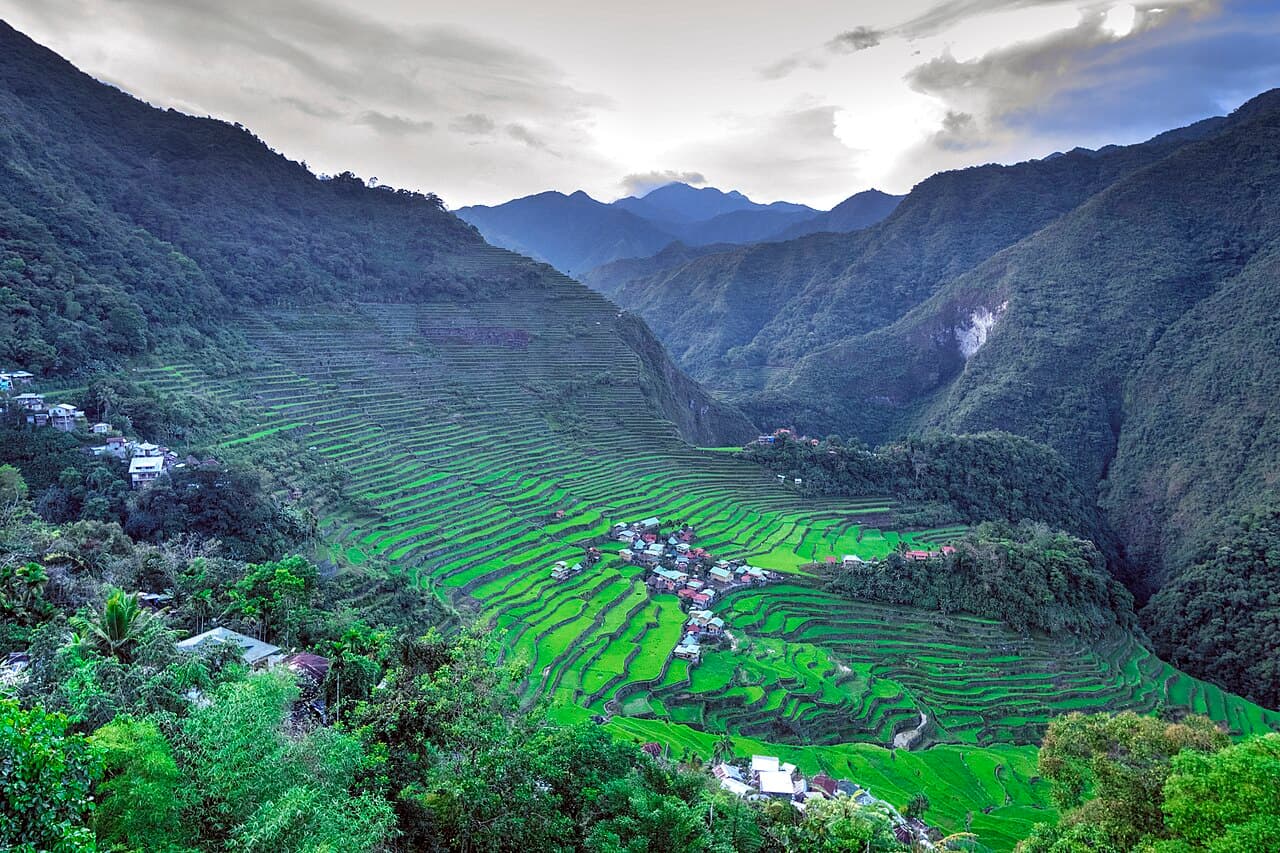 The Cordillera terraces are held up by drystone walls that have to be repaired by hand every year, which makes them a piece of heritage that fails within a generation if people stop farming. Photograph by Ranieljosecastaneda, CC BY-SA 4.0, via Wikimedia Commons.
That identity is carried in food, cloth and performance. Filipino cooking, built on rice and the interplay of sour, salty and sweet, has given the world adobo, sinigang, lechon and the shaved-ice dessert halo-halo. The barong tagalog, an embroidered shirt often woven from pineapple-fibre piña cloth, is the national dress for men, and Aklan's piña handloom weaving was recognised by UNESCO in 2023. In music and dance, the bamboo-pole dance tinikling and the love songs of the kundiman sit beside living epic traditions: the Hudhud chants of the Ifugao and the Darangen of the Maranao are both inscribed on UNESCO's intangible heritage list.
The Philippines is one of only two majority-Christian countries in Asia. At the 2020 census, 78.8 per cent of the population identified as Roman Catholic, the fruit of Spanish evangelisation, with a further tenth in other Christian churches, among them the home-grown Iglesia ni Cristo and the Philippine Independent (Aglipayan) Church. Catholic devotion is fervent and physical, from the barefoot millions who join the procession of the Black Nazarene in Manila to the Santo Niño festivals of Sinulog in Cebu and Ati-Atihan in Aklan.
Islam is the faith of the south and the oldest of the world religions in the islands, carried by traders and preachers to Mindanao and the Sulu archipelago before the Spanish arrived. Muslims, historically called Moros, are about 6 per cent of the national population but a clear majority in the Bangsamoro Autonomous Region, where more than nine in ten people are Muslim. Beneath both traditions run older Indigenous beliefs in ancestral and nature spirits, the anito, tended by ritual specialists such as the babaylan; among the Cordillera and other Indigenous communities these practices continue, and everywhere they colour a folk Catholicism in which the saints, the dead and the spirits of place are held close.
Death in the Philippines is a communal event, and its central rite is the lamay, the wake. The body is kept, usually at home or in a chapel, for anywhere from three days to more than a week while relatives, neighbours and friends sit with the bereaved around the clock; there is prayer and the nightly rosary, but also food, card games, singing and the telling of stories, so that the family is never left alone with its grief. After the burial many families pray the pasiyam, a novena of nine successive nights, and mark the fortieth day and the first anniversary, at which point the year of mourning, the babang luksa, is set aside.
The great national season of remembrance is Undas, the Filipino observance of All Saints' Day on 1 November and All Souls' Day on the day after. It is among the largest annual movements of people in the country: families return to their home provinces, and cemeteries fill with candles, flowers and crowds who clean and repaint the tombs of their dead, then remain for hours or overnight, laying out the departed's favourite dishes, praying, and keeping company with the living and the lost alike. The mood blends solemnity and reunion, resting on the settled conviction that death does not end a family's relationship with its members. Distinct customs persist alongside the Catholic mainstream, among them the cliff burials and hanging coffins of the Igorot around Sagada, where the dead are laid high on the rock faces of their ancestral mountains.
The night before the graves are visited belongs to a quieter custom. At pangangaluluwa, groups went from house to house after dark singing in the first person as the souls in purgatory, asking the household to pray for them and then asking for something to eat. Trick-or-treating has taken most of its ground, and several provinces have set about reviving it.
Filipino surnames come from a book, and knowing that is the single most useful fact in Philippine genealogy.
In 1849 the governor-general, Narciso Clavería, ordered that every Filipino family take a permanent surname, and issued a catalogue of them, the Catálogo alfabético de apellidos, to be distributed by province and by town. Local officials worked through the list, so families in one municipality often received surnames beginning with the same letter. A Filipino surname therefore usually says where a family was in 1849 rather than who they descended from, and the reverse lookup, from surname to town, is a real research technique.
Catholic parish registers are the substance. Spanish friars had been recording baptisms, marriages and burials since the sixteenth century, and the surviving books are among the oldest vital records in Asia. Civil registration came under the American administration from 1898, and is held by the Philippine Statistics Authority.
The great loss is Manila. The battle for the city in February and March 1945 destroyed much of the intramural district along with a large part of the civil and church archive kept there, and it killed roughly a hundred thousand civilians. Families whose records were in Manila often find the trail stops in 1945 and has to be picked up again from provincial copies.
The Family History Library microfilmed a very large share of the surviving parish books, so a great deal of Philippine research is now done free, from screens, anywhere in the world.
The Philippines holds six UNESCO World Heritage sites, three cultural and three natural. The oldest inscriptions, both from 1993, are the Baroque Churches of the Philippines, four earthquake-braced Spanish colonial churches in Manila, Paoay, Santa Maria and Miag-ao, and the Tubbataha Reefs Natural Park, a coral wilderness in the Sulu Sea. In 1995 the Rice Terraces of the Philippine Cordilleras, a set of five Ifugao terrace clusters, became the first site ever inscribed in UNESCO's cultural-landscape category. The Historic Town of Vigan and the Puerto-Princesa Subterranean River National Park followed in 1999, and the Mount Hamiguitan Range Wildlife Sanctuary on Mindanao in 2014.
Protection rests on the National Cultural Heritage Act of 2009 and on institutions including the National Museum of the Philippines, the National Historical Commission, and the National Commission for Culture and the Arts. The rice terraces were placed on the List of World Heritage in Danger in 2001 as younger Ifugao left farming and some walls decayed, and it took a decade of restoration before UNESCO removed them from the danger list in 2012. Beyond the World Heritage sites, the country safeguards living traditions through UNESCO's intangible heritage lists, from the Hudhud and Darangen epics to the tugging rituals of several provinces and, on the urgent-safeguarding list, the Buklog thanksgiving ritual of the Subanen of Mindanao.
Filipino documentary memory has found a place on UNESCO's Memory of the World register. Four Philippine collections are inscribed: the Presidential Papers of Manuel Quezon, the Philippine Paleographs recording the surviving Indigenous scripts of Mindoro and Palawan, the radio broadcast of the People Power Revolution of 1986, and the José Maceda Collection, a large ethnomusicological archive held at the University of the Philippines.
The country's memory institutions have steadily moved their holdings online: the National Library has digitised parts of its Filipiniana and rare-book collections, and the Presidential Museum and Library built the Philippine Diary Project, publishing the diaries of Filipinos across the twentieth century. For a widely dispersed people, such projects bring the records, images and voices of home within reach from anywhere.
Filipino culture travels with its people. A diaspora of roughly ten million, one of the largest in the world, has carried Filipino food, faith and festival to cities across the Gulf, North America, Europe and East Asia, and its remittances reshape the economy each year. Filipino talent is prominent worldwide: the singer and actor Lea Salonga; the boxer and later senator Manny Pacquiao; and film-makers from Lino Brocka onward whose work reaches international festivals.
Literature keeps the national memory in view, from Rizal's novels, still read in schools, to the fiction of Nick Joaquín and F. Sionil José. Filipino popular culture is unusually musical: karaoke is close to a national pastime, the "sing-along system" was itself a Filipino invention, and choirs and cover bands from the islands perform around the world. Through all of it the home traditions hold: the fiesta, the family, the lamay and Undas endure among Filipinos wherever they live, exported intact rather than left behind.
The terraces come back from the brink. After the Ifugao rice terraces were listed as World Heritage in Danger in 2001, a decade of restoration, renewed farming and community stewardship brought them back, and UNESCO removed them from the danger list in 2012, a living landscape saved by the people who work it.
The Balangiga Bells return home. Three church bells taken by American soldiers from Balangiga on Samar as war trophies in 1901 were returned to the Philippines in December 2018 after more than a century, and rehung in their parish church, closing one of the longest-running wounds of the American war.
A revolution preserved in sound. The radio broadcasts that guided the peaceful People Power Revolution of 1986, when millions on Manila's EDSA avenue brought down a dictatorship without a battle, were inscribed on UNESCO's Memory of the World register, preserving the voices of those four days.
Epics kept alive. The Hudhud chants of the Ifugao and the Darangen of the Maranao, once at risk as their elderly bearers passed on, have been documented, taught to the young and performed anew under UNESCO safeguarding, so that two of the great oral literatures of the islands survive as living practice rather than as archive.
The Cordillera terraces are held up by drystone walls that have to be repaired by hand every year, which makes them a piece of heritage that fails within a generation if people stop farming. Photograph by Ranieljosecastaneda, CC BY-SA 4.0, via Wikimedia Commons.
That identity is carried in food, cloth and performance. Filipino cooking, built on rice and the interplay of sour, salty and sweet, has given the world adobo, sinigang, lechon and the shaved-ice dessert halo-halo. The barong tagalog, an embroidered shirt often woven from pineapple-fibre piña cloth, is the national dress for men, and Aklan's piña handloom weaving was recognised by UNESCO in 2023. In music and dance, the bamboo-pole dance tinikling and the love songs of the kundiman sit beside living epic traditions: the Hudhud chants of the Ifugao and the Darangen of the Maranao are both inscribed on UNESCO's intangible heritage list.
The Philippines is one of only two majority-Christian countries in Asia. At the 2020 census, 78.8 per cent of the population identified as Roman Catholic, the fruit of Spanish evangelisation, with a further tenth in other Christian churches, among them the home-grown Iglesia ni Cristo and the Philippine Independent (Aglipayan) Church. Catholic devotion is fervent and physical, from the barefoot millions who join the procession of the Black Nazarene in Manila to the Santo Niño festivals of Sinulog in Cebu and Ati-Atihan in Aklan.
Islam is the faith of the south and the oldest of the world religions in the islands, carried by traders and preachers to Mindanao and the Sulu archipelago before the Spanish arrived. Muslims, historically called Moros, are about 6 per cent of the national population but a clear majority in the Bangsamoro Autonomous Region, where more than nine in ten people are Muslim. Beneath both traditions run older Indigenous beliefs in ancestral and nature spirits, the anito, tended by ritual specialists such as the babaylan; among the Cordillera and other Indigenous communities these practices continue, and everywhere they colour a folk Catholicism in which the saints, the dead and the spirits of place are held close.
Death in the Philippines is a communal event, and its central rite is the lamay, the wake. The body is kept, usually at home or in a chapel, for anywhere from three days to more than a week while relatives, neighbours and friends sit with the bereaved around the clock; there is prayer and the nightly rosary, but also food, card games, singing and the telling of stories, so that the family is never left alone with its grief. After the burial many families pray the pasiyam, a novena of nine successive nights, and mark the fortieth day and the first anniversary, at which point the year of mourning, the babang luksa, is set aside.
The great national season of remembrance is Undas, the Filipino observance of All Saints' Day on 1 November and All Souls' Day on the day after. It is among the largest annual movements of people in the country: families return to their home provinces, and cemeteries fill with candles, flowers and crowds who clean and repaint the tombs of their dead, then remain for hours or overnight, laying out the departed's favourite dishes, praying, and keeping company with the living and the lost alike. The mood blends solemnity and reunion, resting on the settled conviction that death does not end a family's relationship with its members. Distinct customs persist alongside the Catholic mainstream, among them the cliff burials and hanging coffins of the Igorot around Sagada, where the dead are laid high on the rock faces of their ancestral mountains.
The night before the graves are visited belongs to a quieter custom. At pangangaluluwa, groups went from house to house after dark singing in the first person as the souls in purgatory, asking the household to pray for them and then asking for something to eat. Trick-or-treating has taken most of its ground, and several provinces have set about reviving it.
Filipino surnames come from a book, and knowing that is the single most useful fact in Philippine genealogy.
In 1849 the governor-general, Narciso Clavería, ordered that every Filipino family take a permanent surname, and issued a catalogue of them, the Catálogo alfabético de apellidos, to be distributed by province and by town. Local officials worked through the list, so families in one municipality often received surnames beginning with the same letter. A Filipino surname therefore usually says where a family was in 1849 rather than who they descended from, and the reverse lookup, from surname to town, is a real research technique.
Catholic parish registers are the substance. Spanish friars had been recording baptisms, marriages and burials since the sixteenth century, and the surviving books are among the oldest vital records in Asia. Civil registration came under the American administration from 1898, and is held by the Philippine Statistics Authority.
The great loss is Manila. The battle for the city in February and March 1945 destroyed much of the intramural district along with a large part of the civil and church archive kept there, and it killed roughly a hundred thousand civilians. Families whose records were in Manila often find the trail stops in 1945 and has to be picked up again from provincial copies.
The Family History Library microfilmed a very large share of the surviving parish books, so a great deal of Philippine research is now done free, from screens, anywhere in the world.
The Philippines holds six UNESCO World Heritage sites, three cultural and three natural. The oldest inscriptions, both from 1993, are the Baroque Churches of the Philippines, four earthquake-braced Spanish colonial churches in Manila, Paoay, Santa Maria and Miag-ao, and the Tubbataha Reefs Natural Park, a coral wilderness in the Sulu Sea. In 1995 the Rice Terraces of the Philippine Cordilleras, a set of five Ifugao terrace clusters, became the first site ever inscribed in UNESCO's cultural-landscape category. The Historic Town of Vigan and the Puerto-Princesa Subterranean River National Park followed in 1999, and the Mount Hamiguitan Range Wildlife Sanctuary on Mindanao in 2014.
Protection rests on the National Cultural Heritage Act of 2009 and on institutions including the National Museum of the Philippines, the National Historical Commission, and the National Commission for Culture and the Arts. The rice terraces were placed on the List of World Heritage in Danger in 2001 as younger Ifugao left farming and some walls decayed, and it took a decade of restoration before UNESCO removed them from the danger list in 2012. Beyond the World Heritage sites, the country safeguards living traditions through UNESCO's intangible heritage lists, from the Hudhud and Darangen epics to the tugging rituals of several provinces and, on the urgent-safeguarding list, the Buklog thanksgiving ritual of the Subanen of Mindanao.
Filipino documentary memory has found a place on UNESCO's Memory of the World register. Four Philippine collections are inscribed: the Presidential Papers of Manuel Quezon, the Philippine Paleographs recording the surviving Indigenous scripts of Mindoro and Palawan, the radio broadcast of the People Power Revolution of 1986, and the José Maceda Collection, a large ethnomusicological archive held at the University of the Philippines.
The country's memory institutions have steadily moved their holdings online: the National Library has digitised parts of its Filipiniana and rare-book collections, and the Presidential Museum and Library built the Philippine Diary Project, publishing the diaries of Filipinos across the twentieth century. For a widely dispersed people, such projects bring the records, images and voices of home within reach from anywhere.
Filipino culture travels with its people. A diaspora of roughly ten million, one of the largest in the world, has carried Filipino food, faith and festival to cities across the Gulf, North America, Europe and East Asia, and its remittances reshape the economy each year. Filipino talent is prominent worldwide: the singer and actor Lea Salonga; the boxer and later senator Manny Pacquiao; and film-makers from Lino Brocka onward whose work reaches international festivals.
Literature keeps the national memory in view, from Rizal's novels, still read in schools, to the fiction of Nick Joaquín and F. Sionil José. Filipino popular culture is unusually musical: karaoke is close to a national pastime, the "sing-along system" was itself a Filipino invention, and choirs and cover bands from the islands perform around the world. Through all of it the home traditions hold: the fiesta, the family, the lamay and Undas endure among Filipinos wherever they live, exported intact rather than left behind.
The terraces come back from the brink. After the Ifugao rice terraces were listed as World Heritage in Danger in 2001, a decade of restoration, renewed farming and community stewardship brought them back, and UNESCO removed them from the danger list in 2012, a living landscape saved by the people who work it.
The Balangiga Bells return home. Three church bells taken by American soldiers from Balangiga on Samar as war trophies in 1901 were returned to the Philippines in December 2018 after more than a century, and rehung in their parish church, closing one of the longest-running wounds of the American war.
A revolution preserved in sound. The radio broadcasts that guided the peaceful People Power Revolution of 1986, when millions on Manila's EDSA avenue brought down a dictatorship without a battle, were inscribed on UNESCO's Memory of the World register, preserving the voices of those four days.
Epics kept alive. The Hudhud chants of the Ifugao and the Darangen of the Maranao, once at risk as their elderly bearers passed on, have been documented, taught to the young and performed anew under UNESCO safeguarding, so that two of the great oral literatures of the islands survive as living practice rather than as archive.
National Overview
Notable Cities
Historical Foundations
Linguistic and Etymological Roots
Cultural Identity
Religion and Spirituality
Remembrance and Mourning Traditions
Tracing a Family in Philippines
Heritage Preservation Efforts
Digital Heritage
Contemporary Cultural Influences
Success Stories
References and resources
- Encyclopaedia Britannica: Philippines. Geography, population, languages and national history.
- UNESCO World Heritage Centre: Philippines. The country's six World Heritage sites and their inscription dates.
- UNESCO World Heritage Centre: Rice Terraces of the Philippine Cordilleras. The Ifugao terraces, their 1995 inscription and their years on the danger list.
- UNESCO Intangible Cultural Heritage: Philippines. Hudhud, Darangen, tugging rituals, piña weaving and the Buklog.
- Philippine Statistics Authority: Religious Affiliation, 2020 Census. Catholic, Muslim and other religious shares nationally and in Mindanao.
- UNESCO National Commission of the Philippines: Memory of the World Programme. The four inscribed Philippine documentary collections.
- Encyclopaedia Britannica: Philippine-American War. The 1899 to 1902 conflict that followed the American annexation.
- Philippine News Agency: Returning to the roots of Filipino 'Undas'. The customs of the lamay, the pasiyam and the November remembrance of the dead.