Heritage · Country
Montserrat Culture and Heritage
A Caribbean island settled by Irish Catholics in 1632, whose Georgian capital was buried by a volcano in the 1990s and remains the only abandoned town still serving as a country's official capital. This is a guide to Montserrat's heritage, its double-edged St Patrick's Day and the graves its people cannot reach.Written to last.
By Confinity Heritage Editorial · Updated 2026-08-17 · 8-minute readQuiet tools, kept out of the way.
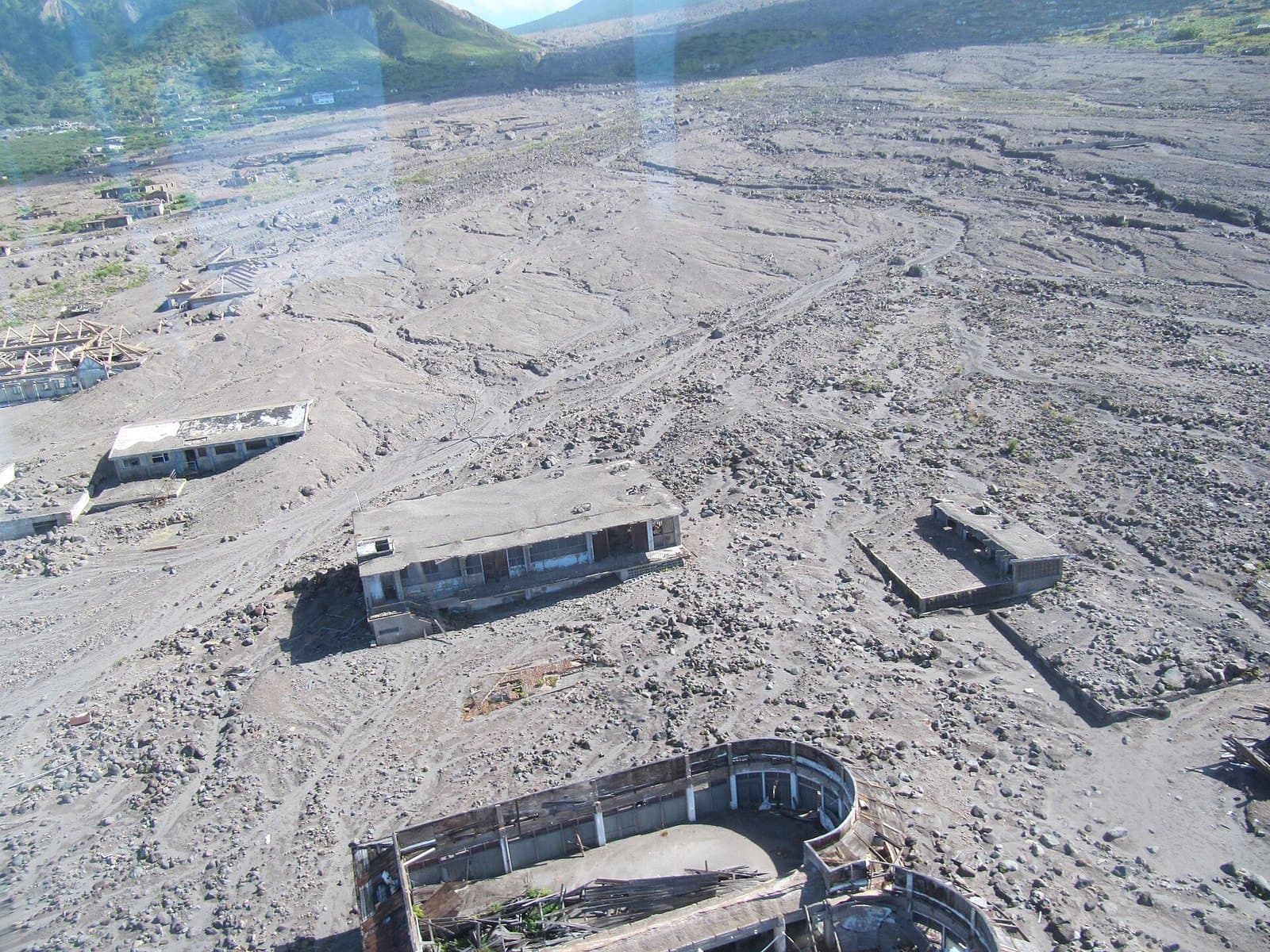
Montserrat has a capital city that nobody can live in. Plymouth, a Georgian port on the southwest coast with a courthouse, a cathedral, a customs house and about four thousand residents, was evacuated in 1995 and buried over the following two years under volcanic ash and mud that in places lies twelve metres deep. It has never been rebuilt and never been formally replaced. Government works from Brades in the north, but Plymouth remains the official capital of the territory, which makes it the only abandoned town on earth still serving as a country's de jure capital.
The other thing everyone knows about Montserrat is the shamrock. Irish settlers arrived in 1632, the map is full of Irish names, the immigration stamp carries a shamrock, and 17 March is a national holiday. That story is real, and it is also more complicated than the tourist version, because 17 March 1768 is the date on which enslaved Montserratians planned to rise against the planters while the planters were drinking. This is a guide to both inheritances, to the volcano that scattered the island's people across Britain, and to how Montserratians mourn when the graveyard is inside an exclusion zone.
Montserrat is a British Overseas Territory in the Leeward Islands, a pear-shaped volcanic island of about 102 square kilometres lying between Antigua and Guadeloupe. It is roughly 16 kilometres long and 11 wide, and its high ground is the Soufrière Hills, whose growing lava dome now reaches around 1,050 metres, up from 915 before the eruption began (Britannica). More than half the island, everything south of the Belham Valley, lies inside an exclusion zone that ordinary people may not enter. About 4,400 people live in the habitable north, against roughly 11,000 before 1995 and fewer than 1,200 at the low point in 1997. Montserratians have held the right of residence in the United Kingdom since 1998 and full British citizenship since 2002, a status granted in direct response to the disaster.
Plymouth. The capital, laid out from the seventeenth century and rebuilt in Georgian stone and timber, held the government offices, the courts, the hospital, the port and the island's commercial life. It is now a grey field of half-buried roofs, visited only under police licence.
Brades. A village in the northwest that became the seat of government after the evacuation, housing the ministries, legislature and courts in buildings never designed for them.
Little Bay. The site chosen for a new capital and port. The national museum, the cultural centre and the ferry berth are here, and construction has proceeded in stages for two decades.
Salem, St Peter's and Cudjoe Head. The northern villages that absorbed the displaced. Cudjoe Head is named for a man remembered as a leader of the 1768 conspiracy, and the St Patrick's Festival opens there.
The Kalinago called the island Alliouagana, usually glossed as land of the prickly bush, and Arawakan-speaking peoples had settled sites at Trants, Little Bay and Old Fort Point long before that. Columbus sighted it in 1493 and named it Santa María de Montserrate for the monastery on the serrated mountain outside Barcelona.
Settlement began in 1632, when Irish colonists came from St Kitts at the instigation of Sir Thomas Warner, with others arriving from Virginia. Most were indentured servants and a minority were merchants and planters, and the numbers grew after Oliver Cromwell's campaigns in Ireland, when transported Irish prisoners were shipped to the Caribbean, some of whom reached Montserrat by way of Barbados. By the 1670s the island had a larger Irish population than any other English colony in the Americas. What followed complicates the sentimental reading: as sugar took hold, Irish settlers who prospered became planters and slaveholders, and the historian Donald Akenson argued in If the Irish Ran the World that Montserrat shows the Irish behaving in the colonies exactly as other Europeans did, which is a harder thing to celebrate than shared victimhood.
The enslaved population soon outnumbered everyone else, and the plantation landscape of Galways, Waterworks and Roches was worked by Africans shipped through the Leeward trade. On 17 March 1768 a group of enslaved and free Black Montserratians planned to seize the arms at Government House while the planters were occupied with their St Patrick's Day celebrations, and to rise across the island. The plot was betrayed before it began. Nine of those held to have led it were executed, and about thirty more were imprisoned and then sold off the island (Wikipedia). Local tradition names the leader as Cudjoe, whose head is said to have been displayed from a silk-cotton tree, and gives its name to the village of Cudjoe Head.
Slavery ended with the imperial abolition of 1834. Sugar declined, and from the 1850s the island turned to limes, with the Sturge family building a lime-juice trade that passed 100,000 gallons a year by 1895 and gave Montserrat a second export crop and a smallholding peasantry. The twentieth century brought cotton, then tourism, and two catastrophes. Hurricane Hugo crossed the island in the early hours of 17 September 1989 as a category four storm and damaged more than nine in ten of its buildings. Six years later, on 18 July 1995, the Soufrière Hills volcano, quiet for centuries, began to vent steam and ash.
What followed was slow and then very fast. Plymouth was evacuated, reoccupied, and evacuated again; people moved north into shelters, schools and churches; and on 25 June 1997 a pyroclastic flow ran down Mosquito Ghaut, overtopped it and swept the officially evacuated area around Streatham, killing nineteen people and severely burning others (Montserrat Volcano Observatory). Plymouth was abandoned for good, and about two-thirds of the population left, most of them for Britain. Eruptions continued into 2010, when flows buried what remained of W. H. Bramble Airport.
English is the official language, and everyday speech is Montserrat Creole, an English-lexicon Creole closely related to Antiguan and Barbudan Creole and shaped by the West African languages of the enslaved population. The map, by contrast, is Irish: Kinsale, Cork Hill, St Patrick's, Galways, Sweeney's, Delvins, Riley's and Fogarty, alongside surnames including Daly, Ryan, Riley, Farrell, Sweeney and Irish, carried by Montserratians of African descent whose ancestors took the names of the families who owned them.
The question of how deep that inheritance runs has been argued about for sixty years and deserves care. The anthropologist John C. Messenger, working in the 1960s and 1970s, advanced a strongly Hibernicist reading in which Irish speech, dance and custom survived as a living layer of Montserratian culture. Later scholarship has been sceptical. The phonetician John Wells examined the island's speech and published his findings under the title The Brogue That Isn't in the Journal of the International Phonetic Association in 1980, concluding that the celebrated Irish lilt of Montserratian English does not stand up to phonetic analysis. The Montserratian historian and poet Howard Fergus set out an Africanist reading against Messenger's, holding that the Hibernicist case rested on conjecture and thin evidence and that it displaced the African sources of the island's culture. Claims that Irish Gaelic was still spoken on Montserrat in the nineteenth or twentieth century circulate widely and rest on anecdote rather than recorded evidence. The honest position is that the Irish presence is documented beyond doubt in names, records and land, and that the specific cultural survivals often attributed to it are contested.
Montserrat's St Patrick's Day is the clearest expression of how the island holds two histories at once. It became a public holiday in 1985, and the reason given was the 1768 uprising rather than the saint. It has since grown into a festival of roughly ten days built around 17 March, opening with a torch lighting at Cudjoe Head and a freedom run to Salem, and running through masquerade performances, a recreated slave village with a feast of local food, church services, kite flying, calypso and soca concerts, hikes and a road race (Montserrat Tourism Authority). Green is worn and shamrocks appear, and so do the names of the nine executed men. Visitors who arrive expecting an Irish theme party tend to leave having attended a commemoration, and Montserratians themselves argue publicly, every year, about the balance between the two.
The masquerade is the island's own performance form and the centre of the festival. Dancers wear tall mitre-shaped headdresses hung with ribbons and small mirrors, coloured smocks and wire masks, and one figure carries a whip; the music is a fife carrying the melody over goatskin kettle and snare drums, played outdoors so the heads stay tight in the sun. The dance is understood as an assertion made in the face of laws that banned African drumming and ritual, and it is danced for the ancestors. Its steps are commonly described as blending Irish jig and polka figures with West African posture and rhythm, a reading that is repeated widely and that Montserratian scholars and dancers continue to debate rather than accept as settled (National Geographic).
Beyond the masquerade the island keeps string band music, jumbie dance and a long calypso tradition, and it produced one global hit. Alphonsus Cassell, who performed as Arrow, recorded Hot Hot Hot on Montserrat in 1982, and it became one of the most widely covered soca songs ever written. The kitchen's centrepiece is goat water, a slow-cooked stew thickened with flour and seasoned with cloves and rum, eaten at every festival and funeral here.
Montserrat is overwhelmingly Christian and predominantly Protestant, with recent estimates putting Protestants near 77 per cent and Roman Catholics under 10 per cent. That ratio is itself a historical record: the island was founded as a refuge for Irish Catholics, but English penal legislation restricted Catholic worship and officeholding for generations, and the Anglican establishment followed by Methodist and Adventist mission work reshaped religious life long before emancipation.
The volcano took the churches with everything else. St Anthony's Anglican Church in Plymouth, whose foundation goes back to the seventeenth century and which held memorials to generations of island families, sits inside the exclusion zone, as do the Catholic and Methodist churches of the south. Congregations reformed in the north in halls and schools, and the loss of a building people were baptised, married and buried in is spoken of here as a bereavement in its own right. Alongside the churches runs a body of belief in jumbies, the restless dead, which appears in the jumbie dance, in stories and in domestic precaution after a death.
A Montserratian funeral follows the pattern of the eastern Caribbean. The wake is held in the house or the yard over several nights, with hymns, prayers, food, storytelling and rum, in the tradition known across the region as nine nights; the church service that follows fills to the doors, and the whole village walks behind the coffin. Goat water is served afterwards. Graves are tended and repainted, anniversaries are kept, and the diaspora flies home for funerals when it can.
 Soufriere Hills buried Plymouth from 1995 and the capital was abandoned. Around two thirds of the island's people left and did not come back, and Montserrat holds the only ghost-town capital in the world. Photograph by Leonora Enking, CC BY-SA 2.0, via Wikimedia Commons.
What makes remembrance here unlike anywhere else is that most of the island's dead are on the wrong side of a line. The national cemetery and the burial grounds of the southern parishes lie inside the exclusion zone, entombed in ash or unreachable without a police licence, so that families with three or four generations in the same plot cannot go and stand at it. A Montserratian writing about a return visit in 2004 described the sequence plainly: the old cemetery buried, a replacement cemetery opened after the evacuation and since filled, and local churches now asked to find burial plots for their members, with his own father buried in a small Methodist churchyard rather than the family ground (Deseret News). Ordinary grief on this island carries an extra weight, because the ritual that consoles people elsewhere, the visit to the grave, is administratively out of reach.
Public remembrance runs on the same two lines as everything else. The nineteen who died on 25 June 1997 are named at anniversary services, and the executed conspirators of 1768 are commemorated each March at the opening of the St Patrick's Festival, in a country that also keeps the holiday of the men they planned to rise against.
Montserrat's records are Irish in origin and were partly buried in 1997.
The island was settled from the 1630s largely by Irish Catholics, many transported after Cromwell's campaigns, and Irish surnames, Riley, Sweeney, Daley, Farrell, remain common among the Afro-Montserratian population who took them from the families that held them. That connection is why Montserrat keeps St Patrick's Day, and why the day also commemorates a slave uprising planned for 17 March 1768.
Anglican and Catholic registers, the slave registers of 1817 to 1834, and the compensation records follow the British Caribbean pattern. Civil registration and the colonial series were held in Plymouth, the capital.
Then the volcano. The Soufrière Hills began erupting in 1995, and pyroclastic flows destroyed Plymouth in 1997. The southern two thirds of the island, including the capital, the port, the airport and the government offices, remain an exclusion zone under many metres of ash. Records were evacuated where possible and a great deal was not. Two thirds of the population left, mostly for Britain and Antigua, and the island has around five thousand residents where it had twelve thousand.
The Montserrat National Trust and the archive service have worked to recover and copy what survived, and a substantial part of Montserratian family history is now held by the diaspora in Britain, in family papers carried out.
The Montserrat National Trust carries most of the load. Its museum occupied the old sugar mill at Richmond Hill until volcanic activity closed the site in 1996, and after sixteen years of improvised display the National Museum of Montserrat opened at Little Bay in 2012, its exhibits running from the Amerindian settlements through colonisation, enslavement and emancipation to the eruption (Montserrat National Trust). The Trust also runs a botanic garden, holds the island's oral history and photographic collections, and counts much of its membership among Montserratians living abroad, which for an island of four thousand people is a structural fact rather than a fundraising convenience.
Archaeology has had to work around the volcano. The Galways Plantation project, which excavated one of the best-preserved sugar estates in the Caribbean through the 1980s and early 1990s, produced a detailed record of the site shortly before it disappeared into the exclusion zone, and the material and reports are now the only access anyone has to it. Since the mid-2010s the Little Bay Plantation Archaeology and Heritage Project has excavated in the north, combining digging with archival research, oral history recording and mapping, in part to build a heritage site that visitors can actually reach (Archaeological Institute of America).
The other preservation institution is scientific. The Montserrat Volcano Observatory was set up within days of the first explosions in July 1995 by the University of the West Indies Seismic Research Unit, and given a permanent home at Flemmings in 2002; it monitors the dome with seismometers, GPS, gas spectrometry and survey, and it runs a public exhibition and film (Montserrat Volcano Observatory). It is the reason the 1997 deaths were nineteen rather than many hundreds, and its continuous record is now one of the most complete accounts of a long dome-building eruption anywhere.
Montserrat's archive problem is unusual: the population is mostly not on the island, and a good deal of the physical record is behind a police cordon. The Volcano Observatory publishes its bulletins, hazard maps and eruption chronology openly, so the defining event of modern Montserrat has a public, dated record that anyone in the diaspora can read, and the National Trust puts collection material online for the same reason.
Scholarly work has followed. The dance researcher Kate Spanos built Dancing the Archive, an open web project on the masquerade and on post-volcano identity, gathering film, photographs and interviews with performers on the island and in Britain. Colonial records sit in the Colonial Office series at The National Archives at Kew, and the Legacies of British Slavery database at University College London lists the 1834 compensation claims made on Montserratian estates. What no digitisation can substitute for is the material inside the exclusion zone, including parish registers, gravestones and family papers left in houses nobody has entered since 1997.
More Montserratians live in Britain than on Montserrat, and that diaspora is now the main carrier of the culture. It funds the National Trust, fills the St Patrick's Festival, sends children back for summers and argues about the island's future in forums and newspapers published from abroad. The festival is the calendar's anchor for that reason: it is the week the island is full.
Two other pieces of Montserrat's heritage travel further than its population. The first is Hot Hot Hot, played at parties by people who could not find the island on a map. The second is AIR Studios at Belham Valley, opened by the Beatles producer George Martin in 1979 so musicians could record away from cities, where more than seventy albums were made in ten years, among them Dire Straits' Brothers in Arms, The Police's Ghost in the Machine and Synchronicity, Elton John's Too Low for Zero and the Rolling Stones' Steel Wheels. Hurricane Hugo wrecked it in September 1989 and it never reopened; the ruins stand at the edge of the exclusion zone. Martin did not walk away from the island, and a benefit concert he organised helped build the Montserrat Cultural Centre at Little Bay, which opened in 2007 and hosts the performances the island lost with Plymouth.
A warning system that worked. The Montserrat Volcano Observatory, improvised in July 1995, has monitored the dome continuously for three decades and kept the eruption's death toll to nineteen.
A museum rebuilt in the north. After the Richmond Hill sugar mill closed in 1996, the Montserrat National Trust reopened the National Museum at Little Bay in 2012 with the collection intact and the story extended to the eruption.
A plantation recorded before it was lost. The Galways excavations documented an unusually complete sugar estate in the years just before the site passed into the exclusion zone.
A holiday that tells the truth. Montserrat's St Patrick's Day was made a public holiday to mark the 1768 uprising, so the island's best-known celebration names the people who rebelled as well as the settlers who arrived.
Soufriere Hills buried Plymouth from 1995 and the capital was abandoned. Around two thirds of the island's people left and did not come back, and Montserrat holds the only ghost-town capital in the world. Photograph by Leonora Enking, CC BY-SA 2.0, via Wikimedia Commons.
What makes remembrance here unlike anywhere else is that most of the island's dead are on the wrong side of a line. The national cemetery and the burial grounds of the southern parishes lie inside the exclusion zone, entombed in ash or unreachable without a police licence, so that families with three or four generations in the same plot cannot go and stand at it. A Montserratian writing about a return visit in 2004 described the sequence plainly: the old cemetery buried, a replacement cemetery opened after the evacuation and since filled, and local churches now asked to find burial plots for their members, with his own father buried in a small Methodist churchyard rather than the family ground (Deseret News). Ordinary grief on this island carries an extra weight, because the ritual that consoles people elsewhere, the visit to the grave, is administratively out of reach.
Public remembrance runs on the same two lines as everything else. The nineteen who died on 25 June 1997 are named at anniversary services, and the executed conspirators of 1768 are commemorated each March at the opening of the St Patrick's Festival, in a country that also keeps the holiday of the men they planned to rise against.
Montserrat's records are Irish in origin and were partly buried in 1997.
The island was settled from the 1630s largely by Irish Catholics, many transported after Cromwell's campaigns, and Irish surnames, Riley, Sweeney, Daley, Farrell, remain common among the Afro-Montserratian population who took them from the families that held them. That connection is why Montserrat keeps St Patrick's Day, and why the day also commemorates a slave uprising planned for 17 March 1768.
Anglican and Catholic registers, the slave registers of 1817 to 1834, and the compensation records follow the British Caribbean pattern. Civil registration and the colonial series were held in Plymouth, the capital.
Then the volcano. The Soufrière Hills began erupting in 1995, and pyroclastic flows destroyed Plymouth in 1997. The southern two thirds of the island, including the capital, the port, the airport and the government offices, remain an exclusion zone under many metres of ash. Records were evacuated where possible and a great deal was not. Two thirds of the population left, mostly for Britain and Antigua, and the island has around five thousand residents where it had twelve thousand.
The Montserrat National Trust and the archive service have worked to recover and copy what survived, and a substantial part of Montserratian family history is now held by the diaspora in Britain, in family papers carried out.
The Montserrat National Trust carries most of the load. Its museum occupied the old sugar mill at Richmond Hill until volcanic activity closed the site in 1996, and after sixteen years of improvised display the National Museum of Montserrat opened at Little Bay in 2012, its exhibits running from the Amerindian settlements through colonisation, enslavement and emancipation to the eruption (Montserrat National Trust). The Trust also runs a botanic garden, holds the island's oral history and photographic collections, and counts much of its membership among Montserratians living abroad, which for an island of four thousand people is a structural fact rather than a fundraising convenience.
Archaeology has had to work around the volcano. The Galways Plantation project, which excavated one of the best-preserved sugar estates in the Caribbean through the 1980s and early 1990s, produced a detailed record of the site shortly before it disappeared into the exclusion zone, and the material and reports are now the only access anyone has to it. Since the mid-2010s the Little Bay Plantation Archaeology and Heritage Project has excavated in the north, combining digging with archival research, oral history recording and mapping, in part to build a heritage site that visitors can actually reach (Archaeological Institute of America).
The other preservation institution is scientific. The Montserrat Volcano Observatory was set up within days of the first explosions in July 1995 by the University of the West Indies Seismic Research Unit, and given a permanent home at Flemmings in 2002; it monitors the dome with seismometers, GPS, gas spectrometry and survey, and it runs a public exhibition and film (Montserrat Volcano Observatory). It is the reason the 1997 deaths were nineteen rather than many hundreds, and its continuous record is now one of the most complete accounts of a long dome-building eruption anywhere.
Montserrat's archive problem is unusual: the population is mostly not on the island, and a good deal of the physical record is behind a police cordon. The Volcano Observatory publishes its bulletins, hazard maps and eruption chronology openly, so the defining event of modern Montserrat has a public, dated record that anyone in the diaspora can read, and the National Trust puts collection material online for the same reason.
Scholarly work has followed. The dance researcher Kate Spanos built Dancing the Archive, an open web project on the masquerade and on post-volcano identity, gathering film, photographs and interviews with performers on the island and in Britain. Colonial records sit in the Colonial Office series at The National Archives at Kew, and the Legacies of British Slavery database at University College London lists the 1834 compensation claims made on Montserratian estates. What no digitisation can substitute for is the material inside the exclusion zone, including parish registers, gravestones and family papers left in houses nobody has entered since 1997.
More Montserratians live in Britain than on Montserrat, and that diaspora is now the main carrier of the culture. It funds the National Trust, fills the St Patrick's Festival, sends children back for summers and argues about the island's future in forums and newspapers published from abroad. The festival is the calendar's anchor for that reason: it is the week the island is full.
Two other pieces of Montserrat's heritage travel further than its population. The first is Hot Hot Hot, played at parties by people who could not find the island on a map. The second is AIR Studios at Belham Valley, opened by the Beatles producer George Martin in 1979 so musicians could record away from cities, where more than seventy albums were made in ten years, among them Dire Straits' Brothers in Arms, The Police's Ghost in the Machine and Synchronicity, Elton John's Too Low for Zero and the Rolling Stones' Steel Wheels. Hurricane Hugo wrecked it in September 1989 and it never reopened; the ruins stand at the edge of the exclusion zone. Martin did not walk away from the island, and a benefit concert he organised helped build the Montserrat Cultural Centre at Little Bay, which opened in 2007 and hosts the performances the island lost with Plymouth.
A warning system that worked. The Montserrat Volcano Observatory, improvised in July 1995, has monitored the dome continuously for three decades and kept the eruption's death toll to nineteen.
A museum rebuilt in the north. After the Richmond Hill sugar mill closed in 1996, the Montserrat National Trust reopened the National Museum at Little Bay in 2012 with the collection intact and the story extended to the eruption.
A plantation recorded before it was lost. The Galways excavations documented an unusually complete sugar estate in the years just before the site passed into the exclusion zone.
A holiday that tells the truth. Montserrat's St Patrick's Day was made a public holiday to mark the 1768 uprising, so the island's best-known celebration names the people who rebelled as well as the settlers who arrived.
National Overview
Notable Cities
Historical Foundations
Linguistic and Etymological Roots
Cultural Identity
Religion and Spirituality
Remembrance and Mourning Traditions
Tracing a Family in Montserrat
Heritage Preservation Efforts
Digital Heritage
Contemporary Cultural Influences
Success Stories
References and resources
- Encyclopaedia Britannica, Montserrat: geography and government.
- Montserrat slave rebellion of 1768, Wikipedia: the plot, the betrayal and the executions.
- MVO, Chronology of the Eruption: the 1995 onset and the deaths of 25 June 1997.
- MVO, History of the Observatory: its founding and monitoring networks.
- Montserrat National Trust, The National Museum: the collection and the move to Little Bay.
- Little Bay Plantation Project: excavation, oral history and mapping in the north.
- J. C. Wells, The Brogue That Isn't: the 1980 phonetic assessment of the Irish-accent claim.
- Dancing the Archive: Kate Spanos on the masquerade and post-volcano identity.
- National Geographic, St Patrick's Day on Montserrat: the festival's two meanings.
- Montserrat Tourism Authority, Festivals and Events: the St Patrick's Festival programme.
- Deseret News, Going Home to Montserrat: the buried cemetery and burial after the evacuation.
- AIR Studios, History: the Montserrat studio and its closure.