Heritage · Country
Basque Country Culture and Heritage
Basque is the last pre-Indo-European language in western Europe, with no known relatives anywhere, and its speaker numbers are rising. A guide to Basque heritage, from the oak at Gernika and the discoidal grave stones to the wax tapers still burned for the dead at Amezketa.Written to last.
By Confinity Heritage Editorial · Updated 2026-08-17 · 8-minute readQuiet tools, kept out of the way.
In the parish church of Amezketa, in the hills of Gipuzkoa, a woman kneels on the flagstone that belongs to her farmhouse and lights an argizaiola: a flat carved board around which a very long thin wax taper has been wound, so it can be lit at one end and burn slowly through a service. The stone is the jarleku, the house's own place in the church, once the burial spot of the family's dead and afterwards the point at which the house went on feeding and lighting them. Amezketa is one of the last places where this survives, and it is among the most distinctive death customs left in Europe.
Behind that flagstone lies the older fact about this place. The people of the western Pyrenees speak a language with no known relatives anywhere on earth. Euskara was here before Latin and before the first Indo-European speakers reached the Atlantic, and it is still spoken, taught in schools and sung in improvised verse to arenas of ten thousand people.
The Basque Autonomous Community covers about 7,200 square kilometres on the Bay of Biscay, with roughly 2.2 million people, in three historical territories: Bizkaia around Bilbao, Gipuzkoa around Donostia-San Sebastián, and Araba around Vitoria-Gasteiz, seat of the Basque parliament and government. The land is green, steep and wet in the north, where short rivers cut to the sea between wooded ridges, and drier south of the watershed. Basque and Spanish are both official; the community runs its own police, the Ertzaintza, its own health and education systems and its own broadcaster, and its parliament seats twenty-five members from each territory regardless of population. Two neighbouring territories share the language and much of the culture without the institutions: Navarre, a separate autonomous community governed from Pamplona, and the French provinces of Labourd, Lower Navarre and Soule, which have no distinct administrative status in France.
Bilbao. An estuary city founded in 1300, Bilbao spent a century on iron, shipbuilding and banking and then lost most of it. Frank Gehry's Guggenheim Museum, opened in 1997 on a derelict riverside, drew visitors by the million and gave urban planning the phrase "the Bilbao effect"; the older city keeps the Casco Viejo and the Basque Museum.
Donostia-San Sebastián. Built around the shell-shaped bay of La Concha and rebuilt in Belle Époque style after a fire in 1813, San Sebastián was European Capital of Culture in 2016 and holds one of the densest concentrations of high-end restaurants anywhere; the Museo San Telmo, in a Dominican convent, holds its social history.
Vitoria-Gasteiz and Gernika-Lumo. The administrative capital keeps a medieval old town laid out as an almond of concentric streets, its cathedral under a long archaeological restoration kept open to visitors. Gernika, a small town in Bizkaia, is the symbolic centre of Basque self-government, where the assembly of Biscay met under an oak and the lords of Biscay swore to respect its fueros; it was bombed on 26 April 1937 and rebuilt.
Roman writers knew the Vascones of the western Pyrenees, but the region was never thoroughly Romanised, nor absorbed by the Visigoths or by al-Andalus as the rest of the peninsula was. The medieval Kingdom of Navarre was the one Basque state; Biscay, Gipuzkoa and Álava attached themselves to Castile between the twelfth and fourteenth centuries, keeping their own law. That law was the fueros, a body of territorial rights covering taxation, military service and local government, and its symbol was the oak at Gernika, under which the Juntas Generales of Biscay assembled and beneath which the lord of Biscay, later the king of Castile, swore to uphold the charter.
The fueros were curtailed after the Carlist wars, and in their place came the Economic Agreement of 1878, the concierto económico, which is unusual enough to be worth setting out. Under it the provincial councils, the diputaciones forales, collect almost all the taxes raised in their territory, then pay a negotiated global sum, the cupo, to the Spanish state as the Basque share of national spending the community doesn't carry out. That is close to the reverse of the arrangement elsewhere in Spain, where Madrid collects and transfers; the quota rests on an imputation index of 6.24 per cent. Franco abolished it for Bizkaia and Gipuzkoa on 23 June 1937 as a punishment for their loyalty to the Republic, leaving it for Álava and for Navarre, which has a parallel arrangement of its own, the convenio económico, resting on a settlement of 1841. All three territories had it restored in 1981.
Modern Basque nationalism dates from Sabino Arana and the Basque Nationalist Party, founded in 1895. A Basque government formed under the Republic in 1936 and went into exile in 1937; the dictatorship then banned Basque from public life, schools and print, and Basque names could not be registered. Self-government returned with the Statute of Gernika, agreed in 1979 and approved by referendum on 25 October that year on a turnout depressed by an abstention campaign, creating the parliament, the office of lehendakari, the Ertzaintza and the restored fiscal agreement. The Statute leaves open the possibility of Navarre joining should it decide to. It has not, and its position is one of the live questions of Basque politics: many Basque nationalists regard Navarre as part of the cultural territory of Euskal Herria, and many Navarrese do not.
ETA, Euskadi Ta Askatasuna, was founded on 31 July 1959 by students who had broken with the nationalist party over its passivity under Franco, and it turned to armed action in the 1960s. Its campaign continued for four decades after Franco's death and through the restoration of self-government. Counts differ by method and period; a commonly used figure is 829 people killed between 1968 and 2010, and the toll of the wider conflict is usually given as more than 850 dead and over 20,000 injured. The dead included police officers, soldiers, politicians and judges, and shopkeepers, drivers, children and passers-by killed in bombings such as Hipercor in Barcelona in 1987. ETA declared a definitive end to armed activity on 21 October 2011, announced its disarmament in April 2017 and dissolved its structures in a letter released on 2 May 2018. The memory of those years is institutionalised on more than one side: the Memorial Centre for the Victims of Terrorism opened in Vitoria-Gasteiz in 2021, victims' associations such as the AVT and COVITE keep their own archives and commemorations, and Gogora, the Basque Institute of Memory, Coexistence and Human Rights, created in 2014, gathers testimony covering victims of ETA alongside victims of the Civil War, of Francoist repression and of state and para-state violence, a scope that is itself argued over.
Euskara is a language isolate. No relationship to any other living or recorded language has been demonstrated to general satisfaction, and the attempts, to Caucasian languages, to Iberian, to Berber, remain speculative. It is the only pre-Indo-European language of western Europe still in daily use, which makes the ordinary speech of a Gipuzkoan farmer a survival with no parallel on the continent.
The language isn't one thing. Six main dialects are usually counted, Bizkaian, Gipuzkoan, Upper Navarrese, Eastern Navarrese, Navarro-Lapurdian and Souletin, and speakers from opposite ends of the territory could historically struggle to follow each other. That is what euskara batua was built to solve: at a congress convened by Euskaltzaindia, the Royal Academy of the Basque Language, at Arantzazu in 1968, a unified standard was agreed, based mainly on the central dialects.
The revival happened against the odds, and chiefly through schools. Under Franco the ikastolak, Basque-medium schools, were founded and run illegally, often in private flats and back rooms, by parents who risked fines or worse; legalised in stages from the 1960s, they became the foundation of a system in which most pupils are now taught wholly through Basque. In 1991 about 22 per cent of the community's population were Basque speakers; by 2021 the figure was above 30 per cent, and among sixteen to twenty-four-year-olds it passed 70 per cent, a rise where nearly every comparable minority language in Europe records a fall. Navarre, whose own law divides the province into Basque-speaking, mixed and non-Basque-speaking zones, sits near 14 per cent.
Basque surnames are a map. Most describe a place, because they began as the name of a house and the house took its name from the ground it stood on: Etxeberria, "the new house"; Zubiaurre, "in front of the bridge"; Mendizabal, "wide mountain".
The unit of Basque rural society is the baserri, the farmhouse, and the word for house, etxe, carries far more than a building: it held land, a name, a place in the church, a grave and obligations to neighbouring houses, and it passed undivided to a single heir, who might be a daughter. People were identified by their house before their surname, and in many villages still are. Its visual signature is the lauburu, a four-headed curved cross carved on lintels, chests and grave stones.
 Basque lords swore to respect Biscayan liberties under the oak at Gernika. The town was bombed in April 1937, the assembly house and the tree survived, and the tree is replaced from its own acorns when it dies. Photograph by Ebaki, CC BY-SA 4.0, via Wikimedia Commons.
Basque sport is a live competitive circuit with rankings and television. Pelota is played in a frontón in almost every village, from bare-handed mano to the basket-and-glove cesta punta, and the rural sports, herri kirolak, grew out of farm and quarry work: harrijasotzaileak lift stones of more than 300 kilos, aizkolaris chop through ranks of beech trunks against the clock, and crews of thirteen row the old sardine boats in regattas that empty coastal towns.
The most distinctive art is spoken. Bertsolaritza is improvised sung verse: a bertsolari is given a subject, a metre and a melody, a few seconds to think, and must produce a complete rhymed stanza on the spot, often in dialogue with an opponent. It is taught in schools, and its four-yearly championship fills the Bilbao Exhibition Centre with more than ten thousand people who sit in silence to listen to poetry; Maialen Lujanbio became the first woman to take the champion's txapela in 2009. The practice is recognised as intangible heritage by the Basque, Navarrese and French Basque authorities, though it isn't on UNESCO's international list.
At table the culture is equally specific: pintxos along a bar counter, the men's gastronomic societies, txakoli poured from a height to raise its prickle, and the cider houses of Gipuzkoa, where from January to April the call of txotx sends everyone to catch cider from a thin jet across the room.
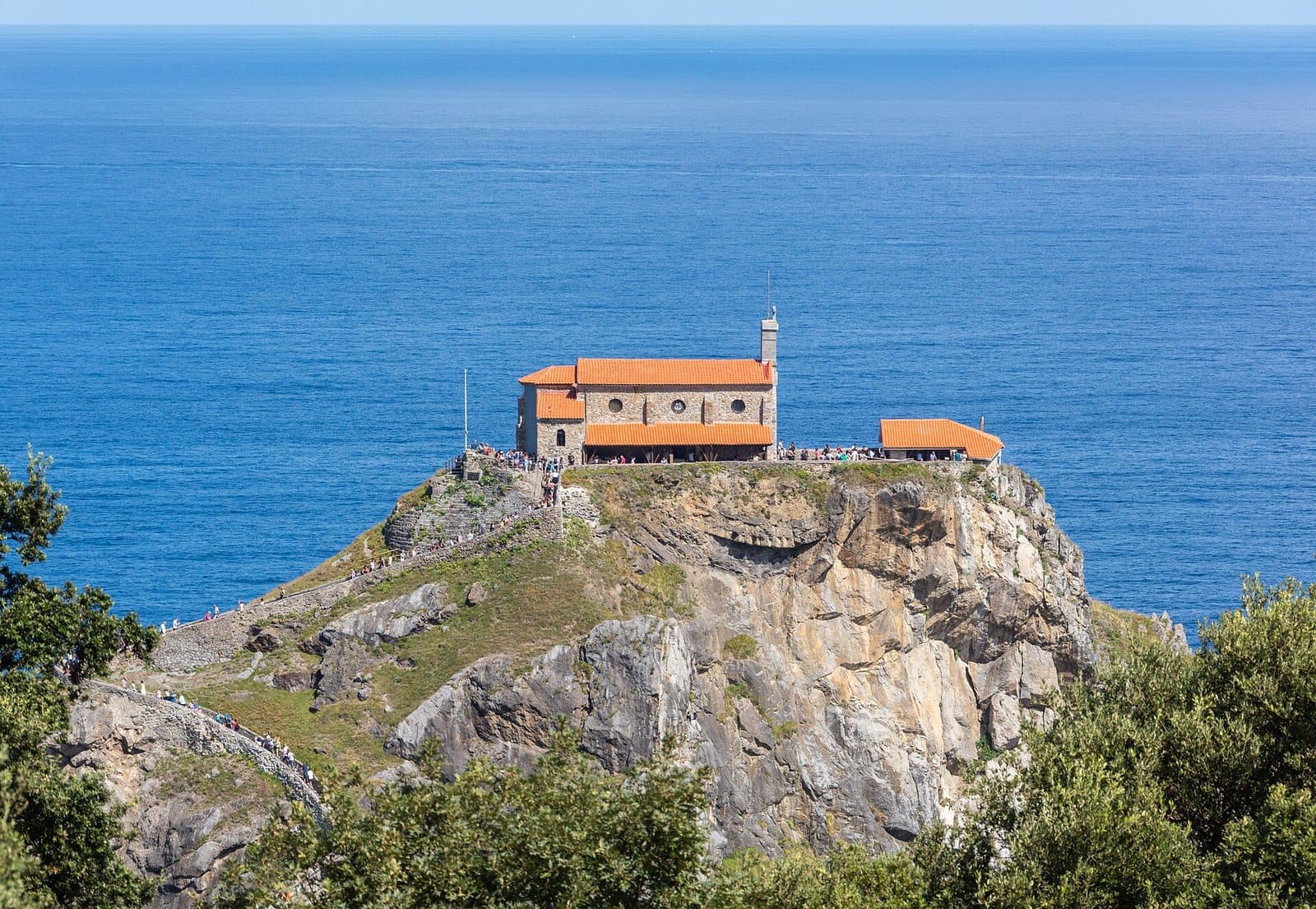
The Basque provinces were among the most devoutly Catholic parts of Spain into the twentieth century, and exported clergy in quantity: Ignatius of Loyola, born at Azpeitia, founded the Society of Jesus, and Francis Xavier came from a castle in Navarre. The sanctuary of Loyola, the Marian shrine at Arantzazu and the coastal hermitage of San Juan de Gaztelugatxe, reached by a causeway and a long stepped path, remain places of pilgrimage.
Basque lords swore to respect Biscayan liberties under the oak at Gernika. The town was bombed in April 1937, the assembly house and the tree survived, and the tree is replaced from its own acorns when it dies. Photograph by Ebaki, CC BY-SA 4.0, via Wikimedia Commons.
Basque sport is a live competitive circuit with rankings and television. Pelota is played in a frontón in almost every village, from bare-handed mano to the basket-and-glove cesta punta, and the rural sports, herri kirolak, grew out of farm and quarry work: harrijasotzaileak lift stones of more than 300 kilos, aizkolaris chop through ranks of beech trunks against the clock, and crews of thirteen row the old sardine boats in regattas that empty coastal towns.
The most distinctive art is spoken. Bertsolaritza is improvised sung verse: a bertsolari is given a subject, a metre and a melody, a few seconds to think, and must produce a complete rhymed stanza on the spot, often in dialogue with an opponent. It is taught in schools, and its four-yearly championship fills the Bilbao Exhibition Centre with more than ten thousand people who sit in silence to listen to poetry; Maialen Lujanbio became the first woman to take the champion's txapela in 2009. The practice is recognised as intangible heritage by the Basque, Navarrese and French Basque authorities, though it isn't on UNESCO's international list.
At table the culture is equally specific: pintxos along a bar counter, the men's gastronomic societies, txakoli poured from a height to raise its prickle, and the cider houses of Gipuzkoa, where from January to April the call of txotx sends everyone to catch cider from a thin jet across the room.
The Basque provinces were among the most devoutly Catholic parts of Spain into the twentieth century, and exported clergy in quantity: Ignatius of Loyola, born at Azpeitia, founded the Society of Jesus, and Francis Xavier came from a castle in Navarre. The sanctuary of Loyola, the Marian shrine at Arantzazu and the coastal hermitage of San Juan de Gaztelugatxe, reached by a causeway and a long stepped path, remain places of pilgrimage.
 Gaztelugatxe, reached by 241 steps, where visitors ring the bell at the top three times. Photograph by Einaz80, CC BY-SA 4.0, via Wikimedia Commons.
The Camino de Santiago crosses the territory twice, by the inland route through Navarre and by the Camino del Norte along the coast; the northern routes joined the UNESCO pilgrimage inscription in 2015. Older belief survives in the folklore collected by the ethnographer José Miguel de Barandiarán, who recorded the cycle of Mari, a female figure of the mountain caves. Practice today follows the Spanish pattern of decline.
Basque death custom is organised around the house rather than the individual. The baserri was linked to its parish church by a recognised path, the hil bide or corpse road, along which the body had to travel; inside, the house owned a jarleku, in earlier centuries a real burial vault and later a symbolic one marked by a low bench or a cloth. The etxekoandre, the woman of the house, sat there and made the offerings for its dead: bread, and light. The light was the argizaiola, and the practice, documented into the twentieth century across Gipuzkoa and Navarre, survives at Amezketa. William A. Douglass recorded the whole system in Death in Murelaga (1969), showing how obligations at a death fell by kinship and by the nearness of one farmhouse to another.
Above ground the marker was the hilarri, from hil, dead, and harri, stone: a disc-headed stele on a trapezoidal base, commonest in the sixteenth and seventeenth centuries, its circle carved with rosettes, sun rays, crosses and the lauburu, and set facing the sunrise. Fields of them survive around old churches, and Basque fishermen carried the form as far as Newfoundland.
Twentieth-century memory has a fixed date. On 26 April 1937 the Condor Legion of the German Luftwaffe and units of the Italian Aviazione Legionaria bombed and burned Gernika on a market day. The Basque government of the day reported 1,654 dead; later research, including local work by historians in Gernika itself, argues for a much lower figure, commonly between roughly 150 and 300, and the discrepancy is a matter of wartime record-keeping and propaganda rather than of doubt about what happened. The Francoist authorities denied the bombing for decades and blamed retreating Republicans; German responsibility was acknowledged when President Roman Herzog sent an apology to the survivors in 1997. Picasso, working in Paris on a commission for the Republic's pavilion at that year's international exposition, painted Guernica within weeks; the canvas travelled for decades, spent years at the Museum of Modern Art in New York, and came to Spain in 1981. It hangs in Madrid, and has never been shown in the town it names.
The Civil War dead are still being lifted. The Aranzadi Science Society, founded in San Sebastián in 1947, has led hundreds of exhumations, working with the Basque government and with families who have nothing but a village name and a date. Gogora holds the resulting testimony alongside the record of the ETA years, so one institution now curates griefs the same streets produced fifty years apart.
Basque family records are organised around the house, and the house has a name older than any of the people in it.
The baserri, the farmhouse, carries a name, and historically a family took its identity from the house rather than the other way round: a person who moved into a baserri by marriage could be known by its name. Many Basque surnames are descriptions of a place, Etxeberria the new house, Zabala the wide place, Mendizabal the broad mountain, so a surname is frequently a map reference. Inheritance passed the house undivided to a single heir, which kept the name and the land together and sent the other siblings away.
Parish registers begin in the sixteenth century and are held by the diocesan archives; the provincial archives of Bizkaia, Gipuzkoa, Araba and Navarre hold the notarial and administrative series, and a good deal is digitised.
The Basque record is also a record of emigration. Basques went to Spanish America from the sixteenth century, and to the American West as sheepherders in the nineteenth and twentieth, and the boarding houses of Nevada and Idaho, the Basque hotels, kept their own kind of register. Those communities preserved language and family knowledge that the wars at home interrupted.
The twentieth century's absences are Gernika, bombed in 1937, and the Francoist repression, which executed, imprisoned and exiled people and banned the language. The exhumation programmes are still working.
Heritage law is a Basque competence, exercised through the culture department and the three provincial councils, and it protects the baserri landscape and industrial remains as well as monuments. UNESCO listings on Basque soil include the Vizcaya Bridge, the 1893 transporter bridge over the Nervión, the first of its kind and inscribed in 2006; the Camino del Norte, added in 2015; and the cave of Santimamiñe, one of the decorated Palaeolithic caves inscribed in 2008.
The institutions doing the work are mostly local and old. Euskaltzaindia, founded in 1918, governs the language and publishes its dictionaries; Aranzadi covers archaeology, anthropology and forensic work; and the museums carry the rest, from the Basque Museum in Bilbao to the Gernika Peace Museum, which sets the bombing in a general argument about civilian casualties. The Bertsozale Elkartea runs the bertsolaritza schools, archive and championship, a rare case of an oral art managing its own transmission.
The most useful Basque digital project for family memory is Ahotsak, an oral archive of thousands of hours of older speakers recorded village by village and indexed by dialect and subject, so a grandchild in Boise can hear how people actually talked in a particular valley before the standard language reached it. Aranzadi's Badator database opens its ethnographic and archaeological records; the Basque government's digital library publishes scanned books and newspapers, including clandestine and exile material; and Gogora and the Memorial Centre both publish their testimony.
Basque cooking has been the most visible export: San Sebastián and its hinterland hold one of the highest concentrations of Michelin stars per head anywhere, the Basque Culinary Center opened as a university faculty of gastronomy in 2011, and the pintxo has been copied worldwide. Cinema in Basque has moved from domestic curiosity to festival regular.
The diaspora keeps its own version: Basque emigrants to the Americas, many of them shepherds in Nevada, Idaho and Argentina, founded euskal etxeak, Basque centres, that still teach the language and the dances. At home the arguments continue over how much of the school day should be in Basque, what to do with the baserri landscape as farming shrinks, and how to tell the story of the last sixty years to children born after it ended.
A language that turned the curve. Basque went from a banned household tongue to a school language in fifty years, and the share of speakers rose from about 22 per cent in 1991 to over 30 per cent in 2021, with fluency among sixteen to twenty-four-year-olds above 70 per cent. Language planners elsewhere study the sequence, because almost no other European minority language has reversed direction.
A standard, and schools founded in secret. At Arantzazu in 1968 Euskaltzaindia agreed euskara batua, giving a fragmented language a single written form without abolishing the dialects people speak at home. The ikastolak began in flats and back rooms under a regime that had outlawed the language, run by parents at their own risk; legalised from the 1960s, they became the backbone of a system in which most Basque children are now taught wholly in Basque.
Improvised verse fills an arena. Bertsolaritza was a village pastime that could have died with its last practitioners. Instead it acquired schools and a championship that packs a conference centre with more than ten thousand listeners, and in 2009 Maialen Lujanbio became the first woman to win it.
Gernika answered. The town rebuilt, opened a peace museum that treats its own bombing as a case study in what happens to civilians in war, twinned itself in 1989 with Pforzheim, a German city destroyed by bombing in 1945, and received an apology from Germany's president in 1997.
Gaztelugatxe, reached by 241 steps, where visitors ring the bell at the top three times. Photograph by Einaz80, CC BY-SA 4.0, via Wikimedia Commons.
The Camino de Santiago crosses the territory twice, by the inland route through Navarre and by the Camino del Norte along the coast; the northern routes joined the UNESCO pilgrimage inscription in 2015. Older belief survives in the folklore collected by the ethnographer José Miguel de Barandiarán, who recorded the cycle of Mari, a female figure of the mountain caves. Practice today follows the Spanish pattern of decline.
Basque death custom is organised around the house rather than the individual. The baserri was linked to its parish church by a recognised path, the hil bide or corpse road, along which the body had to travel; inside, the house owned a jarleku, in earlier centuries a real burial vault and later a symbolic one marked by a low bench or a cloth. The etxekoandre, the woman of the house, sat there and made the offerings for its dead: bread, and light. The light was the argizaiola, and the practice, documented into the twentieth century across Gipuzkoa and Navarre, survives at Amezketa. William A. Douglass recorded the whole system in Death in Murelaga (1969), showing how obligations at a death fell by kinship and by the nearness of one farmhouse to another.
Above ground the marker was the hilarri, from hil, dead, and harri, stone: a disc-headed stele on a trapezoidal base, commonest in the sixteenth and seventeenth centuries, its circle carved with rosettes, sun rays, crosses and the lauburu, and set facing the sunrise. Fields of them survive around old churches, and Basque fishermen carried the form as far as Newfoundland.
Twentieth-century memory has a fixed date. On 26 April 1937 the Condor Legion of the German Luftwaffe and units of the Italian Aviazione Legionaria bombed and burned Gernika on a market day. The Basque government of the day reported 1,654 dead; later research, including local work by historians in Gernika itself, argues for a much lower figure, commonly between roughly 150 and 300, and the discrepancy is a matter of wartime record-keeping and propaganda rather than of doubt about what happened. The Francoist authorities denied the bombing for decades and blamed retreating Republicans; German responsibility was acknowledged when President Roman Herzog sent an apology to the survivors in 1997. Picasso, working in Paris on a commission for the Republic's pavilion at that year's international exposition, painted Guernica within weeks; the canvas travelled for decades, spent years at the Museum of Modern Art in New York, and came to Spain in 1981. It hangs in Madrid, and has never been shown in the town it names.
The Civil War dead are still being lifted. The Aranzadi Science Society, founded in San Sebastián in 1947, has led hundreds of exhumations, working with the Basque government and with families who have nothing but a village name and a date. Gogora holds the resulting testimony alongside the record of the ETA years, so one institution now curates griefs the same streets produced fifty years apart.
Basque family records are organised around the house, and the house has a name older than any of the people in it.
The baserri, the farmhouse, carries a name, and historically a family took its identity from the house rather than the other way round: a person who moved into a baserri by marriage could be known by its name. Many Basque surnames are descriptions of a place, Etxeberria the new house, Zabala the wide place, Mendizabal the broad mountain, so a surname is frequently a map reference. Inheritance passed the house undivided to a single heir, which kept the name and the land together and sent the other siblings away.
Parish registers begin in the sixteenth century and are held by the diocesan archives; the provincial archives of Bizkaia, Gipuzkoa, Araba and Navarre hold the notarial and administrative series, and a good deal is digitised.
The Basque record is also a record of emigration. Basques went to Spanish America from the sixteenth century, and to the American West as sheepherders in the nineteenth and twentieth, and the boarding houses of Nevada and Idaho, the Basque hotels, kept their own kind of register. Those communities preserved language and family knowledge that the wars at home interrupted.
The twentieth century's absences are Gernika, bombed in 1937, and the Francoist repression, which executed, imprisoned and exiled people and banned the language. The exhumation programmes are still working.
Heritage law is a Basque competence, exercised through the culture department and the three provincial councils, and it protects the baserri landscape and industrial remains as well as monuments. UNESCO listings on Basque soil include the Vizcaya Bridge, the 1893 transporter bridge over the Nervión, the first of its kind and inscribed in 2006; the Camino del Norte, added in 2015; and the cave of Santimamiñe, one of the decorated Palaeolithic caves inscribed in 2008.
The institutions doing the work are mostly local and old. Euskaltzaindia, founded in 1918, governs the language and publishes its dictionaries; Aranzadi covers archaeology, anthropology and forensic work; and the museums carry the rest, from the Basque Museum in Bilbao to the Gernika Peace Museum, which sets the bombing in a general argument about civilian casualties. The Bertsozale Elkartea runs the bertsolaritza schools, archive and championship, a rare case of an oral art managing its own transmission.
The most useful Basque digital project for family memory is Ahotsak, an oral archive of thousands of hours of older speakers recorded village by village and indexed by dialect and subject, so a grandchild in Boise can hear how people actually talked in a particular valley before the standard language reached it. Aranzadi's Badator database opens its ethnographic and archaeological records; the Basque government's digital library publishes scanned books and newspapers, including clandestine and exile material; and Gogora and the Memorial Centre both publish their testimony.
Basque cooking has been the most visible export: San Sebastián and its hinterland hold one of the highest concentrations of Michelin stars per head anywhere, the Basque Culinary Center opened as a university faculty of gastronomy in 2011, and the pintxo has been copied worldwide. Cinema in Basque has moved from domestic curiosity to festival regular.
The diaspora keeps its own version: Basque emigrants to the Americas, many of them shepherds in Nevada, Idaho and Argentina, founded euskal etxeak, Basque centres, that still teach the language and the dances. At home the arguments continue over how much of the school day should be in Basque, what to do with the baserri landscape as farming shrinks, and how to tell the story of the last sixty years to children born after it ended.
A language that turned the curve. Basque went from a banned household tongue to a school language in fifty years, and the share of speakers rose from about 22 per cent in 1991 to over 30 per cent in 2021, with fluency among sixteen to twenty-four-year-olds above 70 per cent. Language planners elsewhere study the sequence, because almost no other European minority language has reversed direction.
A standard, and schools founded in secret. At Arantzazu in 1968 Euskaltzaindia agreed euskara batua, giving a fragmented language a single written form without abolishing the dialects people speak at home. The ikastolak began in flats and back rooms under a regime that had outlawed the language, run by parents at their own risk; legalised from the 1960s, they became the backbone of a system in which most Basque children are now taught wholly in Basque.
Improvised verse fills an arena. Bertsolaritza was a village pastime that could have died with its last practitioners. Instead it acquired schools and a championship that packs a conference centre with more than ten thousand listeners, and in 2009 Maialen Lujanbio became the first woman to win it.
Gernika answered. The town rebuilt, opened a peace museum that treats its own bombing as a case study in what happens to civilians in war, twinned itself in 1989 with Pforzheim, a German city destroyed by bombing in 1945, and received an apology from Germany's president in 1997.
National Overview
Notable Cities
Historical Foundations
Linguistic and Etymological Roots
Cultural Identity
Religion and Spirituality
Remembrance and Mourning Traditions
Tracing a Family in Basque Country
Heritage Preservation Efforts
Digital Heritage
Contemporary Cultural Influences
Success Stories
References and resources
- Euskaltzaindia: the Basque language academy.
- Wikipedia, Basque language: isolate status, dialects, survey data.
- Wikipedia, Basque Economic Agreement: the concierto económico.
- Wikipedia, Statute of Autonomy of the Basque Country: the Statute of Gernika.
- Wikipedia, Bombing of Guernica: the raid and its historiography.
- Gernika Peace Museum: the bombing and its aftermath.
- Gogora: testimony from the Civil War and ETA.
- Memorial Centre for the Victims of Terrorism: Vitoria-Gasteiz, 2021.
- Aranzadi Science Society: archaeology and exhumation.
- Ahotsak: the oral archive of Basque speech.
- Bertsozale Elkartea: bertsolaritza schools, championship.
- Britannica, Basque Country: geography, history.