Heritage · Country
Canary Islands Culture and Heritage
Eight islands off the Saharan coast, settled by Amazigh farmers long before Castile arrived, where the indigenous inheritance survives in place names, in a whistled language taught in schools, and in the DNA of the modern population. This is a guide to Canarian heritage and remembrance.Written to last.
By Confinity Heritage Editorial · Updated 2026-08-17 · 8-minute readQuiet tools, kept out of the way.
The Canary Islands lie about a hundred kilometres off the Saharan coast of Africa and roughly a thousand from the Iberian peninsula, which is the first fact anyone learns about them and the one that explains the most. People were living here for well over a thousand years before Europe arrived: Amazigh farmers and herders from North Africa who crossed to eight volcanic islands, adapted to each of them separately, and lost contact with the continent and largely with one another. When Castile came in the fifteenth century it found not one people but several, speaking related languages, keeping goats and barley on terraced slopes, mummifying their dead in caves.
What happened next took ninety-four years and ended in 1496 with the fall of Tenerife. The indigenous population did not survive that process intact, and it did not simply vanish either. Its words are still in daily Canarian speech, its shrines were absorbed into Catholic devotion, its whistled language is still spoken on one island and taught in its schools, and its genetic inheritance runs through the two and a quarter million people who live here now.
The Canary Islands are an autonomous community of Spain and one of the European Union's outermost regions, with a population of more than 2.2 million across eight inhabited islands: Tenerife, Gran Canaria, Lanzarote, Fuerteventura, La Palma, La Gomera, El Hierro and La Graciosa, the last recognised as the eighth island in 2018 (Britannica). The archipelago is volcanic and steep, running from the old, dry, wind-scoured east near the African coast to the young, wet, forested west, and it holds Spain's highest point in the 3,715-metre Teide on Tenerife. Government is unusual: the capital alternates between Santa Cruz de Tenerife and Las Palmas de Gran Canaria, an arrangement reflecting a rivalry old enough to have produced two provinces, two universities and two of everything else. Spanish is the language, in a distinctive Canarian form.
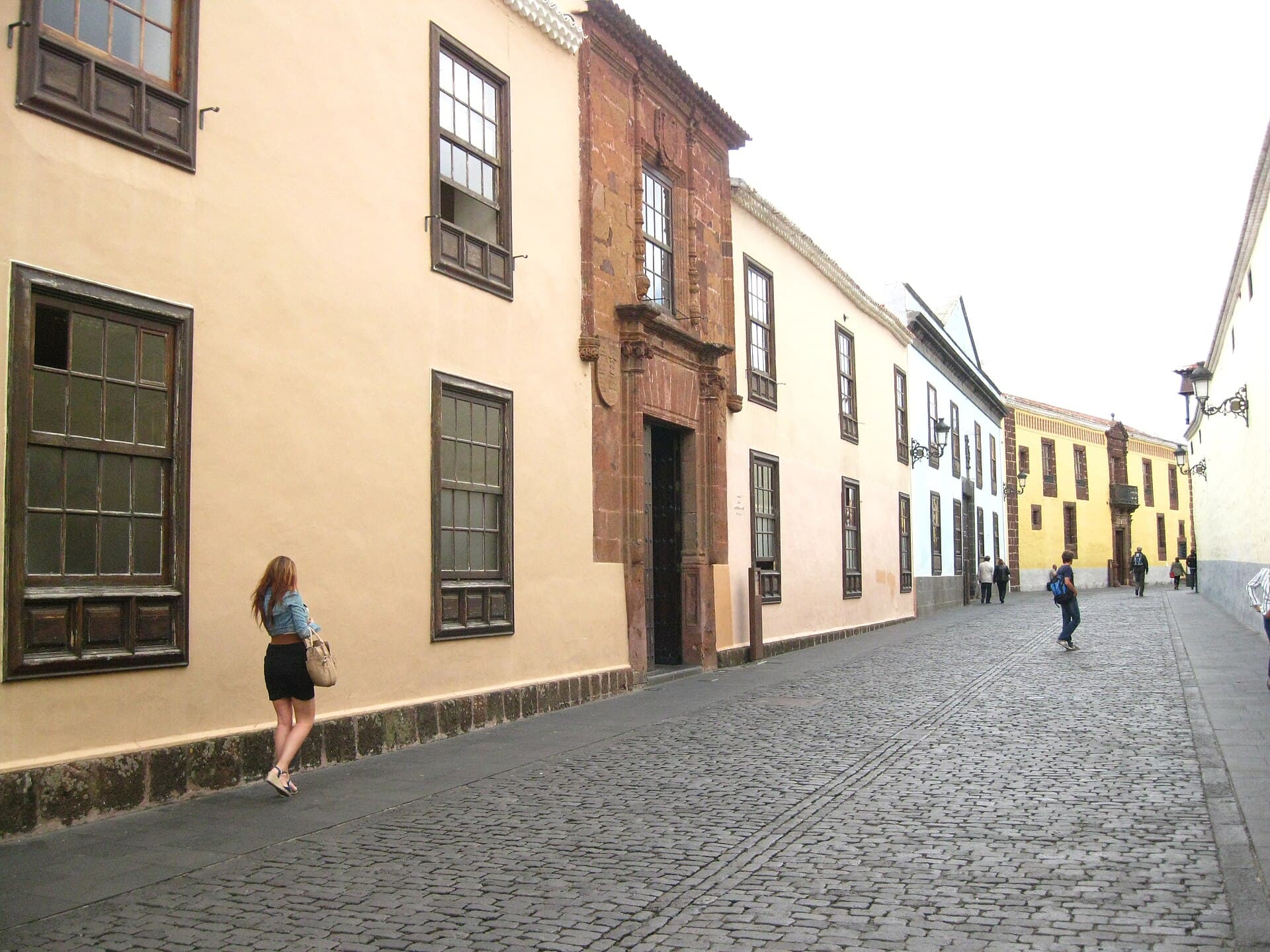
San Cristóbal de La Laguna. Founded on Tenerife in 1496, the year the last island fell, La Laguna was laid out without walls on an open grid, an early experiment in the planned unfortified colonial town, and that plan was carried across the Atlantic as a reference for cities in the Americas, which is why UNESCO inscribed the old town in 1999 (UNESCO). Its streets still hold the sixteenth to eighteenth-century houses of the Canarian gentry behind carved stone portals, the cathedral, the Iglesia de la Concepción with its Mudéjar ceilings, and the older of the archipelago's two universities.
 La Laguna was laid out in the 1490s as an unwalled colonial town on a grid, and that plan was carried straight across the Atlantic and used again in the Americas. Photograph by Diego Delso, CC BY-SA 4.0, via Wikimedia Commons.
Santa Cruz de Tenerife. The port capital, home of the archipelago's largest carnival and of the Museo de la Naturaleza y Arqueología, which holds the principal collection of indigenous Canarian material, mummies included.
Las Palmas de Gran Canaria. The largest city in the archipelago, founded in 1478 at the start of the campaign against Gran Canaria. Its Vegueta quarter holds the cathedral of Santa Ana, El Museo Canario, and the Casa de Colón, built around the governor's house where Columbus is said to have stayed.
Gáldar and San Sebastián de La Gomera. Gáldar, on Gran Canaria, was the seat of a pre-conquest kingdom and sits over the Cueva Pintada, whose geometric wall paintings are the best-known indigenous artwork in the islands. San Sebastián, on La Gomera, is the last European harbour Columbus used before sailing west in 1492.
The date of the first settlement is genuinely disputed. Older accounts place arrivals as early as the first millennium BCE; the securest radiocarbon dates and the ancient genomes now available point to permanent settlement by Amazigh populations from North Africa in roughly the first centuries of the common era, with the possibility of earlier, less well-attested contact (Nature Communications). Whenever they came, they came without the ability to leave: the islands had no seagoing craft at contact, and each population developed on its own, into the Guanches of Tenerife, the Canarii of Gran Canaria, the Bimbaches of El Hierro, the Majos of Lanzarote and Fuerteventura and their neighbours, with the name Guanche now used for all of them.
Castilian and Norman activity began in 1402, when Jean de Béthencourt landed on Lanzarote under a Castilian licence. Lanzarote, Fuerteventura, El Hierro and La Gomera fell within decades, through a mixture of force, treaty and the seizure of people for the slave markets of Iberia. The larger central islands took longer. Gran Canaria held out from 1478 to 1483, and Tenerife resisted longest: in 1494 the forces of Alonso Fernández de Lugo were routed at the First Battle of Acentejo, one of the few clear indigenous victories over a European army in the age of Atlantic expansion, and it took a second campaign, a second battle at Acentejo in 1495 and an epidemic among the defenders before Tenerife was taken in 1496 (Conquest of the Canary Islands).
The consequences were severe, and there is no reason to soften them. Fighting, imported disease and mass enslavement destroyed the indigenous societies as political entities within two generations; captives were shipped to Spanish and Portuguese markets, land was distributed to settlers, and the languages fell out of use. Historians of settler colonialism have argued that the process meets the definition of genocide (Guanches). What did not happen was disappearance. Survivors, many of them women, were absorbed into the colonial population through marriage and household service, and modern Canarians carry roughly a sixth to a third of their autosomal ancestry from that population, with indigenous maternal lineages much better represented than paternal ones, exactly the asymmetry a violent takeover followed by intermarriage would produce.
What followed was four centuries of the islands as an Atlantic waypoint. Sugar plantations, worked in part by enslaved Africans, made the first colonial fortunes; then malvasía wine, exported to England in quantity and familiar enough in London to be named on the Elizabethan stage; then cochineal, then bananas, then tourism. Columbus stopped at Las Palmas and San Sebastián de La Gomera in 1492 and on later voyages, and the archipelago became the standard last port before the Atlantic crossing, putting Canarian ships, sailors, seeds and settlers into the founding of the Americas.
The other side of that traffic was departure. From the seventeenth century onward Canarians left in very large numbers for Cuba, Venezuela and Puerto Rico, sometimes under the tributo de sangre that required islands to send families to populate Spanish territory; Canarian settlers founded San Antonio in Texas in 1731 and the Isleño communities of Louisiana in the 1770s (Isleños). The flow reversed in the later twentieth century, when Venezuelan crises brought tens of thousands of Canarian families home, with accents, foods and habits acquired abroad.
Canarians speak Spanish, in a variety closer to Caribbean Spanish than to Madrid. It has seseo, no distinction between s and the Castilian th sound; it uses ustedes where the peninsula uses vosotros; it aspirates or drops the s at the end of syllables; and it carries three layers of borrowing (Canarian Spanish). Portuguese, from the settlers and labourers of the sugar era, gave millo for maize, gaveta for a drawer, fonil for a funnel. The Americas gave back guagua for a bus and papa for potato. Underneath both lies the indigenous substrate: gofio, the toasted grain flour eaten since before the conquest, baifo for a kid goat, tabaiba for an endemic shrub, jable for the wind-blown sand of Lanzarote.
The indigenous languages themselves, related to Amazigh varieties of the Maghreb, died out in the sixteenth and seventeenth centuries, leaving vocabulary, rock inscriptions in Libyco-Berber script, and above all the map. Tenerife, Teide, Timanfaya, Tacoronte, Güímar, Tamaduste, Agaete and hundreds of other names are indigenous, so that a Canarian giving directions speaks the pre-conquest language every day without noticing.
One indigenous communication system did not die. Silbo Gomero, the whistled register of La Gomera, encodes Spanish as whistled tones that carry across the island's deep ravines for several kilometres, and it descends from a whistled form of the pre-conquest language once used on several islands (Silbo Gomero). By the 1980s it was close to extinction, kept by shepherds and older residents. It is not close to extinction now, for reasons set out below.
Canarian identity is worked out between three poles: Spanish, African and American. It shows most plainly in things people do with their bodies. Lucha canaria, Canarian wrestling, is a team sport of throws inside a sand ring, descended from a pre-conquest practice recorded by the first chroniclers and still played in island leagues (Lucha canaria). Juego del palo, a stick-fighting discipline of parries and feints, has the same root and survived in rural families as a skill passed between generations.
Music runs on the timple, a small five-string instrument built in the islands and used in the folias, isas and malagueñas of the folk repertoire. The largest public expression of all this is Carnival at Santa Cruz de Tenerife, among the biggest in the world, with its murgas, comparsas and the election of a queen in costumes that can weigh more than the woman wearing them; it survived a ban under Franco by continuing under another name. Food carries the indigenous line most directly: gofio is still eaten daily, one of very few staple foods in Europe a pre-European population would recognise.
The islands are Catholic, and their devotion has an unusually clear indigenous seam. The patron of the archipelago is the Virgin of Candelaria, whose image was, by the account preserved since the sixteenth century, found on a Tenerife beach by two Guanche herdsmen before the conquest and venerated by the indigenous population before any Spaniard arrived (Our Lady of Candelaria). Whatever the historical value of that account, its function is plain: it makes the islands' central devotion something the pre-conquest population began. The basilica at Candelaria draws pilgrims in August, and statues of the nine Guanche kings stand along the seafront outside it.
Each island keeps its own patronal cycle. Gran Canaria has the Virgen del Pino at Teror; El Hierro carries the Virgen de los Reyes across the island every four years. The most concentrated is the Bajada de la Virgen de las Nieves on La Palma, held every five years since the seventeenth century, when the patron is brought down from her sanctuary to Santa Cruz de La Palma over weeks of processions, dances and the Danza de Enanos, and the whole island, emigrants included, arranges its calendar around the return.
Canarian mourning follows Spanish Catholic form: a wake, a funeral Mass, burial and a novena of prayers, with the ninth day and the first anniversary marked by a Mass for the dead. The visible difference is in the cemeteries. Canarian burial is overwhelmingly in nichos, chambers stacked several high in long walls, with a marble plate carrying the name, the dates and usually a photograph, and families hold their niches across generations. Because the plates are at eye height, a Canarian cemetery reads as a wall of faces, and visiting means standing in front of a particular photograph rather than walking among stones.
All Saints and All Souls, on the first and second of November, are the year's remembrance days: families clean the niches, bring flowers and gather. The islands also keep the Noche de Finaos on the night of 31 October, an old vigil in which households eat roasted chestnuts and dried fruit, drink anise and, above all, name and tell stories about the finaos, the family's dead, one by one. It is a household practice rather than a church one, and Canarian cultural organisations have pushed it hard in recent years as the islands' own answer to imported Halloween (La Voz de Lanzarote).
Then there are the ranchos de ánimas, the most specific remembrance custom in the archipelago. A rancho is a group of singers from one village who go house to house at night singing for the souls in purgatory, accompanied by tambourine, triangle and a low drone, and who collect alms to pay for Masses for the dead. Introduced in the sixteenth century and surviving on Lanzarote, Fuerteventura and Gran Canaria, the practice runs from the vigil of All Souls to Saint Lucy's day, after which the same groups turn to Christmas songs and continue until Candlemas (Cultura Tradicional de Gran Canaria). What survives in them is a medieval economy of intercession, kept going by a few villages and a small number of ageing singers.
Canarian records begin with a conquest and the people who were conquered are still in the DNA.
The Guanches, Amazigh-speaking people who had been on the islands for two thousand years, were conquered by Castile through the fifteenth century, and the survivors were absorbed, enslaved or died of disease. Their language is gone except in place names and in the whistled speech of La Gomera, silbo gomero, which UNESCO recognised in 2009 and which is taught in schools. Genetic studies have shown a substantial Guanche maternal inheritance in the modern population, so the ancestry survived even where the record did not.
Parish registers begin in the late fifteenth and sixteenth centuries, among the earliest in the Spanish world, and the archives at Las Palmas and Santa Cruz de Tenerife hold them with the notarial and Inquisition series.
The Canaries were the last stop before the Atlantic crossing, so the islands are documented in the shipping records of the Carrera de Indias, and Canarian emigration to Cuba, Venezuela and Puerto Rico was so heavy that isleño communities there kept their own identity; the isleños of St Bernard Parish in Louisiana, brought in the 1770s, spoke a Canarian Spanish into the twentieth century.
The other export was labour to the sugar and later banana economies, and the return migration from Cuba and Venezuela in the twentieth century brought money and families back.
The archipelago holds four World Heritage Sites: La Laguna's old town, inscribed in 1999; Garajonay National Park and its laurel forest on La Gomera, inscribed in 1986; Teide National Park, added in 2007 for its volcanic landscape (UNESCO); and, in 2019, Risco Caído and the Sacred Mountains of Gran Canaria, a cultural landscape of cave dwellings, granaries and almogarenes, indigenous ritual sites, one of which admits a beam of light that moves across carved walls through the year (UNESCO).
The indigenous record is held by two institutions above all. The Museo de la Naturaleza y Arqueología in Santa Cruz de Tenerife keeps the largest collection of Guanche material, including mummies preserved with resins and herbs and wrapped in goatskin, and presents them with the caution such remains now require (Museos de Tenerife). El Museo Canario in Las Palmas, founded in 1879, holds the archaeology and human remains of Gran Canaria, and the Cueva Pintada in Gáldar protects the painted cave and the indigenous village around it, with access by guided visit only (Cueva Pintada).
The hardest recent test came from the ground. The Cumbre Vieja eruption on La Palma, from 19 September to 13 December 2021, buried roughly 3,000 buildings under lava and erased the village of Todoque, along with churches, schools and banana terraces built by generations of the same families (Cumbre Vieja eruption). Nobody was killed, and thousands lost the physical anchors of family memory in weeks: houses, photographs, land boundaries. The island's response has included systematic collection of testimony and images from displaced residents, heritage work done under emergency conditions.
Canarian institutions have put an unusual amount of their documentary memory online. Memoria Digital de Canarias, run by the University of Las Palmas de Gran Canaria, publishes digitised books, photographs, maps and manuscripts, and its companion Jable holds a searchable archive of the Canarian press running back to the early nineteenth century, which makes two centuries of local reporting, obituaries and emigration notices open to anyone (mdC). El Museo Canario has digitised much of its library.
Silbo Gomero has a substantial recorded corpus, which matters for a language that exists only in sound. For emigrant families in Cuba, Venezuela and Louisiana, the parish registers and passenger lists digitised in the islands are the practical route back to a specific village, which is why genealogy is among the busiest uses of these archives.
Modern Canarian culture is shaped by two things above all: many millions of visitors a year, and a permanent argument about how African, how Spanish and how American the islands actually are. Tourism sustains the economy and strains it, driving housing costs beyond local wages and provoking large public protests in the mid-2020s. Alongside that has grown a strong current of cultural self-assertion, in music that mixes timple with Latin American and African forms, in writing and film in Canarian Spanish, and in renewed interest in indigenous history among young people.
The islands also sit at a migration frontier: boats from West Africa arrive on Canarian shores in numbers, which places the archipelago's African geography at the centre of Spanish and European politics and complicates any comfortable account of where the Canaries belong.
A whistled language saved by a school timetable. Silbo Gomero was close to disappearing when La Gomera's authorities made it a compulsory subject in the island's primary and secondary schools in 1999. Every child educated on La Gomera since has learned it, the number of competent whistlers has risen rather than fallen, and UNESCO inscribed the language on its Representative List of Intangible Cultural Heritage in 2009 (UNESCO). It is among the clearest cases in Europe of a school system reversing a language's decline.
A painted cave protected in place. The Cueva Pintada at Gáldar, damaged by exposure after its rediscovery, was closed, studied and re-opened inside a purpose-built museum that conserves the paintings and the indigenous village around them together, with visits guided and limited.
A town plan that crossed an ocean. La Laguna's unwalled grid of 1496 became a working model for colonial city planning in the Americas, and the survival of that plan earned the old town World Heritage status in 1999.
Ancestry established rather than assumed. Ancient DNA from pre-conquest burials has confirmed the North African origin of the indigenous population and measured how much of it survives in Canarians today, turning a contested question of identity into a documented one.
La Laguna was laid out in the 1490s as an unwalled colonial town on a grid, and that plan was carried straight across the Atlantic and used again in the Americas. Photograph by Diego Delso, CC BY-SA 4.0, via Wikimedia Commons.
Santa Cruz de Tenerife. The port capital, home of the archipelago's largest carnival and of the Museo de la Naturaleza y Arqueología, which holds the principal collection of indigenous Canarian material, mummies included.
Las Palmas de Gran Canaria. The largest city in the archipelago, founded in 1478 at the start of the campaign against Gran Canaria. Its Vegueta quarter holds the cathedral of Santa Ana, El Museo Canario, and the Casa de Colón, built around the governor's house where Columbus is said to have stayed.
Gáldar and San Sebastián de La Gomera. Gáldar, on Gran Canaria, was the seat of a pre-conquest kingdom and sits over the Cueva Pintada, whose geometric wall paintings are the best-known indigenous artwork in the islands. San Sebastián, on La Gomera, is the last European harbour Columbus used before sailing west in 1492.
The date of the first settlement is genuinely disputed. Older accounts place arrivals as early as the first millennium BCE; the securest radiocarbon dates and the ancient genomes now available point to permanent settlement by Amazigh populations from North Africa in roughly the first centuries of the common era, with the possibility of earlier, less well-attested contact (Nature Communications). Whenever they came, they came without the ability to leave: the islands had no seagoing craft at contact, and each population developed on its own, into the Guanches of Tenerife, the Canarii of Gran Canaria, the Bimbaches of El Hierro, the Majos of Lanzarote and Fuerteventura and their neighbours, with the name Guanche now used for all of them.
Castilian and Norman activity began in 1402, when Jean de Béthencourt landed on Lanzarote under a Castilian licence. Lanzarote, Fuerteventura, El Hierro and La Gomera fell within decades, through a mixture of force, treaty and the seizure of people for the slave markets of Iberia. The larger central islands took longer. Gran Canaria held out from 1478 to 1483, and Tenerife resisted longest: in 1494 the forces of Alonso Fernández de Lugo were routed at the First Battle of Acentejo, one of the few clear indigenous victories over a European army in the age of Atlantic expansion, and it took a second campaign, a second battle at Acentejo in 1495 and an epidemic among the defenders before Tenerife was taken in 1496 (Conquest of the Canary Islands).
The consequences were severe, and there is no reason to soften them. Fighting, imported disease and mass enslavement destroyed the indigenous societies as political entities within two generations; captives were shipped to Spanish and Portuguese markets, land was distributed to settlers, and the languages fell out of use. Historians of settler colonialism have argued that the process meets the definition of genocide (Guanches). What did not happen was disappearance. Survivors, many of them women, were absorbed into the colonial population through marriage and household service, and modern Canarians carry roughly a sixth to a third of their autosomal ancestry from that population, with indigenous maternal lineages much better represented than paternal ones, exactly the asymmetry a violent takeover followed by intermarriage would produce.
What followed was four centuries of the islands as an Atlantic waypoint. Sugar plantations, worked in part by enslaved Africans, made the first colonial fortunes; then malvasía wine, exported to England in quantity and familiar enough in London to be named on the Elizabethan stage; then cochineal, then bananas, then tourism. Columbus stopped at Las Palmas and San Sebastián de La Gomera in 1492 and on later voyages, and the archipelago became the standard last port before the Atlantic crossing, putting Canarian ships, sailors, seeds and settlers into the founding of the Americas.
The other side of that traffic was departure. From the seventeenth century onward Canarians left in very large numbers for Cuba, Venezuela and Puerto Rico, sometimes under the tributo de sangre that required islands to send families to populate Spanish territory; Canarian settlers founded San Antonio in Texas in 1731 and the Isleño communities of Louisiana in the 1770s (Isleños). The flow reversed in the later twentieth century, when Venezuelan crises brought tens of thousands of Canarian families home, with accents, foods and habits acquired abroad.
Canarians speak Spanish, in a variety closer to Caribbean Spanish than to Madrid. It has seseo, no distinction between s and the Castilian th sound; it uses ustedes where the peninsula uses vosotros; it aspirates or drops the s at the end of syllables; and it carries three layers of borrowing (Canarian Spanish). Portuguese, from the settlers and labourers of the sugar era, gave millo for maize, gaveta for a drawer, fonil for a funnel. The Americas gave back guagua for a bus and papa for potato. Underneath both lies the indigenous substrate: gofio, the toasted grain flour eaten since before the conquest, baifo for a kid goat, tabaiba for an endemic shrub, jable for the wind-blown sand of Lanzarote.
The indigenous languages themselves, related to Amazigh varieties of the Maghreb, died out in the sixteenth and seventeenth centuries, leaving vocabulary, rock inscriptions in Libyco-Berber script, and above all the map. Tenerife, Teide, Timanfaya, Tacoronte, Güímar, Tamaduste, Agaete and hundreds of other names are indigenous, so that a Canarian giving directions speaks the pre-conquest language every day without noticing.
One indigenous communication system did not die. Silbo Gomero, the whistled register of La Gomera, encodes Spanish as whistled tones that carry across the island's deep ravines for several kilometres, and it descends from a whistled form of the pre-conquest language once used on several islands (Silbo Gomero). By the 1980s it was close to extinction, kept by shepherds and older residents. It is not close to extinction now, for reasons set out below.
Canarian identity is worked out between three poles: Spanish, African and American. It shows most plainly in things people do with their bodies. Lucha canaria, Canarian wrestling, is a team sport of throws inside a sand ring, descended from a pre-conquest practice recorded by the first chroniclers and still played in island leagues (Lucha canaria). Juego del palo, a stick-fighting discipline of parries and feints, has the same root and survived in rural families as a skill passed between generations.
Music runs on the timple, a small five-string instrument built in the islands and used in the folias, isas and malagueñas of the folk repertoire. The largest public expression of all this is Carnival at Santa Cruz de Tenerife, among the biggest in the world, with its murgas, comparsas and the election of a queen in costumes that can weigh more than the woman wearing them; it survived a ban under Franco by continuing under another name. Food carries the indigenous line most directly: gofio is still eaten daily, one of very few staple foods in Europe a pre-European population would recognise.
The islands are Catholic, and their devotion has an unusually clear indigenous seam. The patron of the archipelago is the Virgin of Candelaria, whose image was, by the account preserved since the sixteenth century, found on a Tenerife beach by two Guanche herdsmen before the conquest and venerated by the indigenous population before any Spaniard arrived (Our Lady of Candelaria). Whatever the historical value of that account, its function is plain: it makes the islands' central devotion something the pre-conquest population began. The basilica at Candelaria draws pilgrims in August, and statues of the nine Guanche kings stand along the seafront outside it.
Each island keeps its own patronal cycle. Gran Canaria has the Virgen del Pino at Teror; El Hierro carries the Virgen de los Reyes across the island every four years. The most concentrated is the Bajada de la Virgen de las Nieves on La Palma, held every five years since the seventeenth century, when the patron is brought down from her sanctuary to Santa Cruz de La Palma over weeks of processions, dances and the Danza de Enanos, and the whole island, emigrants included, arranges its calendar around the return.
Canarian mourning follows Spanish Catholic form: a wake, a funeral Mass, burial and a novena of prayers, with the ninth day and the first anniversary marked by a Mass for the dead. The visible difference is in the cemeteries. Canarian burial is overwhelmingly in nichos, chambers stacked several high in long walls, with a marble plate carrying the name, the dates and usually a photograph, and families hold their niches across generations. Because the plates are at eye height, a Canarian cemetery reads as a wall of faces, and visiting means standing in front of a particular photograph rather than walking among stones.
All Saints and All Souls, on the first and second of November, are the year's remembrance days: families clean the niches, bring flowers and gather. The islands also keep the Noche de Finaos on the night of 31 October, an old vigil in which households eat roasted chestnuts and dried fruit, drink anise and, above all, name and tell stories about the finaos, the family's dead, one by one. It is a household practice rather than a church one, and Canarian cultural organisations have pushed it hard in recent years as the islands' own answer to imported Halloween (La Voz de Lanzarote).
Then there are the ranchos de ánimas, the most specific remembrance custom in the archipelago. A rancho is a group of singers from one village who go house to house at night singing for the souls in purgatory, accompanied by tambourine, triangle and a low drone, and who collect alms to pay for Masses for the dead. Introduced in the sixteenth century and surviving on Lanzarote, Fuerteventura and Gran Canaria, the practice runs from the vigil of All Souls to Saint Lucy's day, after which the same groups turn to Christmas songs and continue until Candlemas (Cultura Tradicional de Gran Canaria). What survives in them is a medieval economy of intercession, kept going by a few villages and a small number of ageing singers.
Canarian records begin with a conquest and the people who were conquered are still in the DNA.
The Guanches, Amazigh-speaking people who had been on the islands for two thousand years, were conquered by Castile through the fifteenth century, and the survivors were absorbed, enslaved or died of disease. Their language is gone except in place names and in the whistled speech of La Gomera, silbo gomero, which UNESCO recognised in 2009 and which is taught in schools. Genetic studies have shown a substantial Guanche maternal inheritance in the modern population, so the ancestry survived even where the record did not.
Parish registers begin in the late fifteenth and sixteenth centuries, among the earliest in the Spanish world, and the archives at Las Palmas and Santa Cruz de Tenerife hold them with the notarial and Inquisition series.
The Canaries were the last stop before the Atlantic crossing, so the islands are documented in the shipping records of the Carrera de Indias, and Canarian emigration to Cuba, Venezuela and Puerto Rico was so heavy that isleño communities there kept their own identity; the isleños of St Bernard Parish in Louisiana, brought in the 1770s, spoke a Canarian Spanish into the twentieth century.
The other export was labour to the sugar and later banana economies, and the return migration from Cuba and Venezuela in the twentieth century brought money and families back.
The archipelago holds four World Heritage Sites: La Laguna's old town, inscribed in 1999; Garajonay National Park and its laurel forest on La Gomera, inscribed in 1986; Teide National Park, added in 2007 for its volcanic landscape (UNESCO); and, in 2019, Risco Caído and the Sacred Mountains of Gran Canaria, a cultural landscape of cave dwellings, granaries and almogarenes, indigenous ritual sites, one of which admits a beam of light that moves across carved walls through the year (UNESCO).
The indigenous record is held by two institutions above all. The Museo de la Naturaleza y Arqueología in Santa Cruz de Tenerife keeps the largest collection of Guanche material, including mummies preserved with resins and herbs and wrapped in goatskin, and presents them with the caution such remains now require (Museos de Tenerife). El Museo Canario in Las Palmas, founded in 1879, holds the archaeology and human remains of Gran Canaria, and the Cueva Pintada in Gáldar protects the painted cave and the indigenous village around it, with access by guided visit only (Cueva Pintada).
The hardest recent test came from the ground. The Cumbre Vieja eruption on La Palma, from 19 September to 13 December 2021, buried roughly 3,000 buildings under lava and erased the village of Todoque, along with churches, schools and banana terraces built by generations of the same families (Cumbre Vieja eruption). Nobody was killed, and thousands lost the physical anchors of family memory in weeks: houses, photographs, land boundaries. The island's response has included systematic collection of testimony and images from displaced residents, heritage work done under emergency conditions.
Canarian institutions have put an unusual amount of their documentary memory online. Memoria Digital de Canarias, run by the University of Las Palmas de Gran Canaria, publishes digitised books, photographs, maps and manuscripts, and its companion Jable holds a searchable archive of the Canarian press running back to the early nineteenth century, which makes two centuries of local reporting, obituaries and emigration notices open to anyone (mdC). El Museo Canario has digitised much of its library.
Silbo Gomero has a substantial recorded corpus, which matters for a language that exists only in sound. For emigrant families in Cuba, Venezuela and Louisiana, the parish registers and passenger lists digitised in the islands are the practical route back to a specific village, which is why genealogy is among the busiest uses of these archives.
Modern Canarian culture is shaped by two things above all: many millions of visitors a year, and a permanent argument about how African, how Spanish and how American the islands actually are. Tourism sustains the economy and strains it, driving housing costs beyond local wages and provoking large public protests in the mid-2020s. Alongside that has grown a strong current of cultural self-assertion, in music that mixes timple with Latin American and African forms, in writing and film in Canarian Spanish, and in renewed interest in indigenous history among young people.
The islands also sit at a migration frontier: boats from West Africa arrive on Canarian shores in numbers, which places the archipelago's African geography at the centre of Spanish and European politics and complicates any comfortable account of where the Canaries belong.
A whistled language saved by a school timetable. Silbo Gomero was close to disappearing when La Gomera's authorities made it a compulsory subject in the island's primary and secondary schools in 1999. Every child educated on La Gomera since has learned it, the number of competent whistlers has risen rather than fallen, and UNESCO inscribed the language on its Representative List of Intangible Cultural Heritage in 2009 (UNESCO). It is among the clearest cases in Europe of a school system reversing a language's decline.
A painted cave protected in place. The Cueva Pintada at Gáldar, damaged by exposure after its rediscovery, was closed, studied and re-opened inside a purpose-built museum that conserves the paintings and the indigenous village around them together, with visits guided and limited.
A town plan that crossed an ocean. La Laguna's unwalled grid of 1496 became a working model for colonial city planning in the Americas, and the survival of that plan earned the old town World Heritage status in 1999.
Ancestry established rather than assumed. Ancient DNA from pre-conquest burials has confirmed the North African origin of the indigenous population and measured how much of it survives in Canarians today, turning a contested question of identity into a documented one.
National Overview
Notable Cities
Historical Foundations
Linguistic and Etymological Roots
Cultural Identity
Religion and Spirituality
Remembrance and Mourning Traditions
Tracing a Family in Canary Islands
Heritage Preservation Efforts
Digital Heritage
Contemporary Cultural Influences
Success Stories
References and resources
- Encyclopaedia Britannica, Canary Islands: geography, administration and history.
- UNESCO, San Cristóbal de La Laguna: the 1496 grid plan and its influence in the Americas.
- UNESCO, Teide National Park: the volcanic landscape and Spain's highest peak.
- UNESCO, Risco Caído and the Sacred Mountains of Gran Canaria: indigenous cave settlement and ritual sites.
- UNESCO, Whistled language of La Gomera: Silbo Gomero and its transmission.
- Nature Communications, genomic history of the indigenous Canarians: settlement dating and modern ancestry.
- Guanches, Wikipedia: origins, mummification, the conquest and the genetic legacy.
- Conquest of the Canary Islands, Wikipedia: 1402 to 1496, Acentejo and the fall of Tenerife.
- Canarian Spanish, Wikipedia: seseo, ustedes and the three layers of borrowing.
- Isleños, Wikipedia: Canarian emigration to Cuba, Venezuela and Louisiana.
- Cultura Tradicional de Gran Canaria, Rancho de Ánimas: the singing groups and their calendar.
- La Voz de Lanzarote, Los Finaos: the 31 October vigil for the family dead.
- Museos de Tenerife, Museo de la Naturaleza y Arqueología: the Guanche mummies and archaeology.
- Cueva Pintada Museum and Archaeological Park: the painted cave at Gáldar.
- 2021 Cumbre Vieja eruption, Wikipedia: the buildings destroyed and the loss of Todoque.
- Memoria Digital de Canarias and Jable: digitised Canarian books, images and two centuries of island newspapers.