Heritage · Museum
Museo Reina Sofía: Modern Art & Picasso's Guernica
The Reina Sofía is Spain's national museum of twentieth-century and contemporary art, opened in 1992 inside Madrid's former Sabatini Hospital. It is best known as the home of Pablo Picasso's Guernica, the vast anti-war canvas that returned to Spain in 1981 after more than four decades abroad.Written to last.
By Confinity Heritage Editorial · Updated 2026-07-31 · 7-minute readQuiet tools, kept out of the way.
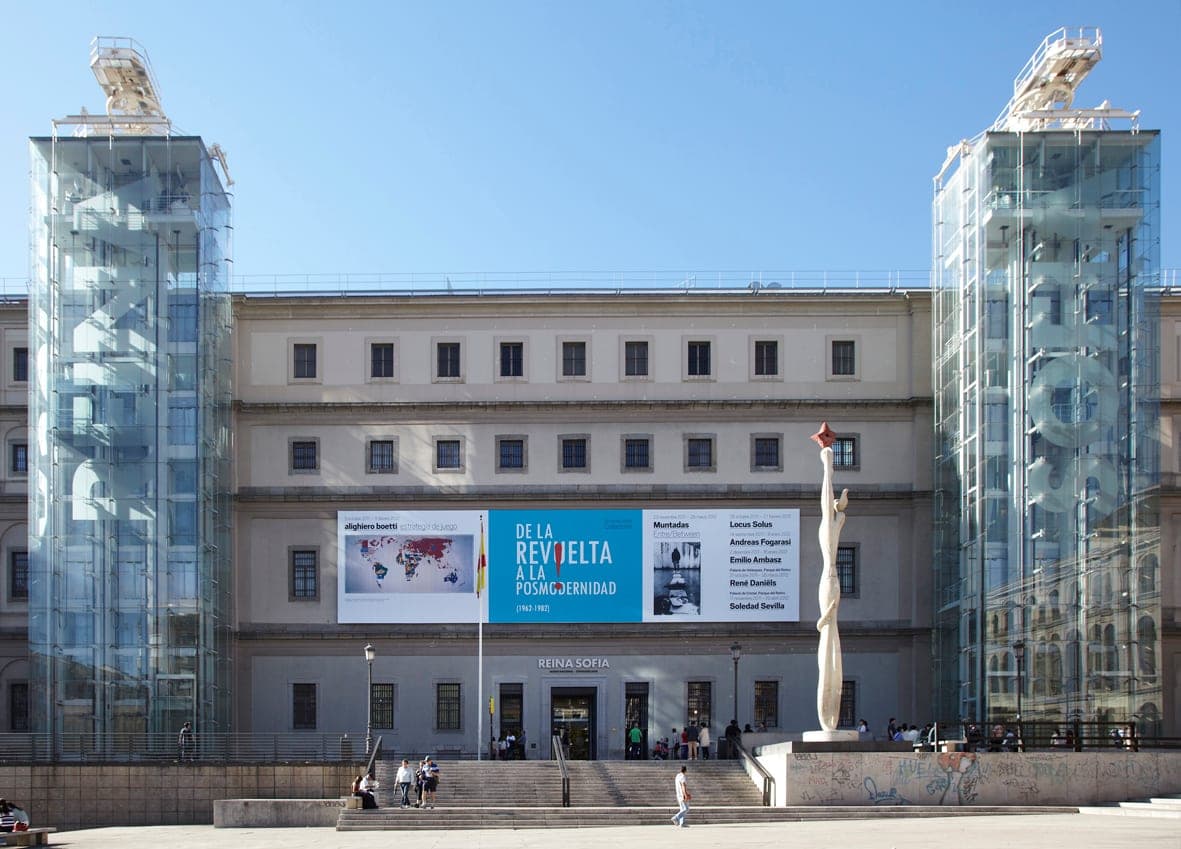
The Museo Nacional Centro de Arte Reina Sofía, usually shortened to the Reina Sofía, is Spain's national museum of twentieth-century and contemporary art. It occupies a long former hospital at the southern end of Madrid's Paseo del Prado, a few steps from Atocha station, and it takes its name from Queen Sofía of Spain, who inaugurated the museum on 10 September 1992. Where the neighbouring Prado closes its account of Spanish painting around the era of Goya, the Reina Sofía picks the story up and carries it into the present, gathering the work of the artists who redrew what art could be after 1900.
For most visitors the museum means one painting. Pablo Picasso's Guernica, painted in 1937 in response to the destruction of a Basque market town, hangs at the centre of the collection and draws crowds that stand before it in near silence. Around that single canvas the museum has built a wider record of Spanish modernism, with concentrations of Salvador Dalí, Joan Miró and Juan Gris, alongside international movements from Cubism to the art of recent decades. The result is a national collection that is also a record of a difficult century.
The Reina Sofía is a young institution in an old building, and its early years were a sequence of gradual steps rather than a single opening. The Spanish state began adapting the former hospital as a cultural venue in the early 1980s, and in 1986 it opened as the Centro de Arte Reina Sofía, an exhibition space without a permanent collection of its own. In 1988 a royal decree raised it to the status of a national museum, and in 1990 it was given the mandate to hold and display the country's collection of modern and contemporary art. The formal inauguration of the permanent collection followed on 10 September 1992 (museum history).
That timing matters. Spain had emerged from the dictatorship of Francisco Franco, who died in 1975, into a constitutional democracy whose 1978 constitution guaranteed the cultural freedoms the previous regime had suppressed. A national museum of twentieth-century art, much of it made by artists who had gone into exile or worked against the grain of the Franco years, was in part a statement about the kind of country Spain intended to be, and the arrival of Guernica gave that statement its sharpest expression.
Since 1992 the museum has grown in scale and ambition. It added the large Jean Nouvel extension in 2005, expanded its exhibitions and research, and built an art library and archive that serve scholars as well as the public. Manuel Segade became director in June 2023. In 2025 the museum recorded roughly 1.6 million visitors, placing it among the most visited art museums in Spain.
The permanent collection is arranged as a broadly chronological narrative of art from about 1900 onward, spread across the Sabatini building and the newer Nouvel wing. The museum divides it into three chapters, covering roughly 1900 to 1945, 1945 to 1968, and 1962 to 1982, so that a visit traces the movement from the birth of the avant-garde, through the rupture of the Spanish Civil War, into the postwar decades and the transition to democracy.
Cubism is a natural starting point, because two of its central figures were Spanish. Picasso and Juan Gris both worked in Paris in the years when the movement was invented, and the museum holds early Cubist canvases that show how the language of fractured planes and shifting viewpoints was assembled. Gris, sometimes overshadowed by Picasso and Georges Braque, is represented in depth.
The other pillars of the collection are Dalí and Miró. Salvador Dalí is present in his Surrealist prime, with works including The Great Masturbator (1929), Girl at the Window (1925) and The Enigma of Hitler (about 1939), paintings that move between tender realism and hallucinatory dream imagery. Joan Miró, the Catalan painter whose floating signs and biomorphic shapes became one of the most recognisable idioms of modern art, is shown across several rooms. The collection also holds the sculptors Julio González and Eduardo Chillida, the abstract painter Antoni Tàpies, and figures whose reputations the museum has worked to widen, among them María Blanchard, Maruja Mallo and Ángeles Santos.
Beyond the Spanish core, the museum reaches into the wider international avant-garde and collects contemporary art up to the present through acquisitions, commissions and temporary exhibitions. Photography, film, architecture and documentary material sit alongside painting and sculpture.
Guernica is the reason many visitors come, and it is treated with the gravity its subject demands. The painting is very large, roughly 3.5 metres high and just under 7.8 metres wide, and it is worked entirely in grey, black and white, a palette that evokes newsprint and mourning rather than the colour of life. Its imagery is a compressed scene of terror: a screaming horse, a bull, a mother holding a dead child, a fallen fighter whose broken sword lets a single small flower grow, a figure falling in flames, and a bare electric bulb burning above like a hard eye. There is no aircraft and no explosion in the picture. The violence is shown through its effect on bodies.
The occasion was an atrocity. On 26 April 1937, during the Spanish Civil War, the German Condor Legion, fighting on the side of Franco's Nationalists and supported by Italian aircraft, bombed the Basque town of Guernica over the course of an afternoon, killing many civilians and destroying much of the town. The raid was widely reported, notably by the correspondent George Steer in The Times and The New York Times, and news of it reached Picasso in Paris. The Spanish Republican government had already commissioned him to paint a mural for its pavilion at the 1937 Paris International Exposition. He abandoned his earlier idea, took the bombing as his subject, and completed the canvas in about five weeks, finishing early in June 1937.
After the Exposition the painting began a long exile. It travelled through Scandinavia and Britain in 1938 and 1939 to raise funds for Spanish relief, then crossed the Atlantic, and from late 1939 it was held at the Museum of Modern Art in New York. Picasso, who never returned to Franco's Spain, asked that Guernica be given to the Spanish people only when liberty and democracy had been restored, and he left it in MoMA's care until that condition was met. Franco's death in 1975 and the democratic settlement that followed opened the way. The painting arrived in Spain in September 1981, in the centenary year of Picasso's birth, and went first on display at the Casón del Buen Retiro, an annexe of the Prado, before moving to the Reina Sofía in 1992.
Guernica has since become one of the most widely recognised anti-war images ever made, invoked far beyond the event that produced it. The museum now regards the canvas as too fragile to travel, so it stays in Madrid, and requests to move it elsewhere have been declined on conservation grounds. Presented soberly, without spectacle, it asks the visitor to look steadily at what the bombing of a town does to the people in it.
The museum's main home is the old Hospital General de Madrid, a large eighteenth-century building generally associated with the architect Francesco Sabatini, who worked for King Charles III and gave his name to the structure that carries the collection today. The design was begun under José de Hermosilla and continued by Sabatini, and the building served as a general hospital until 1969. After it closed it stood in decline for some years before the state chose it for the new art centre and began its conversion in the 1980s. Its long, austere galleries and central courtyard suit large-scale modern work, and in 1989 the British architect Ian Ritchie added three glass lift towers to the main façade.
 The Sabatini building was an eighteenth-century hospital. The glass lift towers were added in 1988 and are the reason the conversion works: they took the circulation out of the wards. Photograph by Javier Perez Montes, CC BY-SA 4.0, via Wikimedia Commons.
The most dramatic addition came in 2005, when the French architect Jean Nouvel completed a major extension on the building's western side. Nouvel, who later received the Pritzker Prize, added about 8,000 square metres of new space, including galleries, an auditorium, a library, a bookshop and a restaurant, arranged around a partly covered public courtyard shaded by a striking red overhanging roof. The extension opens the museum toward the surrounding city and roughly doubled the room available for exhibitions and services, allowing the Reina Sofía to operate at the scale of a major international museum.
The Reina Sofía forms one corner of what Madrid calls the Golden Triangle of Art, a cluster of three great collections set within walking distance of one another along the Paseo del Prado. The Prado holds the historic collection of European painting to the early nineteenth century, including the Spanish masters Velázquez and Goya. The Thyssen-Bornemisza, assembled by a single family and acquired by the Spanish state in 1993, surveys the centuries between, from the early Renaissance to the twentieth century. The Reina Sofía completes the sequence with the modern and contemporary period. Taken together the three museums let a visitor walk through roughly eight centuries of Western art in a single district, which is why the area is one of the principal reasons people travel to Madrid.
Within that grouping the Reina Sofía carries a particular weight, because its holdings are bound up with the political history of modern Spain. Its collection includes the work of artists who lived through the Civil War and the dictatorship, some of them in exile, and its central painting is a memorial to a wartime atrocity. The museum is therefore not only a gallery of modern art but a place where the country examines its own recent past.
The Reina Sofía is at Calle de Santa Isabel 52, on the southern edge of central Madrid, near Atocha, the city's main railway station, and the Estación del Arte Metro stop. Its position at the foot of the Paseo del Prado makes it easy to combine with the Prado and the Thyssen-Bornemisza in a single day, though each museum rewards a longer visit on its own.
Opening hours vary by day and the museum is closed on Tuesdays, so it is worth checking the official website before travelling for current times, ticket prices and any temporary closures, since these change. The museum offers free admission during certain evening hours and on some days, and reduced or free entry applies to particular categories of visitor; the specifics are best confirmed online rather than relied on from memory. Guernica occupies its own room in the Sabatini building and is usually the focus of any visit, so many people head there first before working through the rest of the collection. Photography rules are stricter around it, and staff ask visitors to respect the quiet that tends to settle in front of the painting.
The Sabatini building was an eighteenth-century hospital. The glass lift towers were added in 1988 and are the reason the conversion works: they took the circulation out of the wards. Photograph by Javier Perez Montes, CC BY-SA 4.0, via Wikimedia Commons.
The most dramatic addition came in 2005, when the French architect Jean Nouvel completed a major extension on the building's western side. Nouvel, who later received the Pritzker Prize, added about 8,000 square metres of new space, including galleries, an auditorium, a library, a bookshop and a restaurant, arranged around a partly covered public courtyard shaded by a striking red overhanging roof. The extension opens the museum toward the surrounding city and roughly doubled the room available for exhibitions and services, allowing the Reina Sofía to operate at the scale of a major international museum.
The Reina Sofía forms one corner of what Madrid calls the Golden Triangle of Art, a cluster of three great collections set within walking distance of one another along the Paseo del Prado. The Prado holds the historic collection of European painting to the early nineteenth century, including the Spanish masters Velázquez and Goya. The Thyssen-Bornemisza, assembled by a single family and acquired by the Spanish state in 1993, surveys the centuries between, from the early Renaissance to the twentieth century. The Reina Sofía completes the sequence with the modern and contemporary period. Taken together the three museums let a visitor walk through roughly eight centuries of Western art in a single district, which is why the area is one of the principal reasons people travel to Madrid.
Within that grouping the Reina Sofía carries a particular weight, because its holdings are bound up with the political history of modern Spain. Its collection includes the work of artists who lived through the Civil War and the dictatorship, some of them in exile, and its central painting is a memorial to a wartime atrocity. The museum is therefore not only a gallery of modern art but a place where the country examines its own recent past.
The Reina Sofía is at Calle de Santa Isabel 52, on the southern edge of central Madrid, near Atocha, the city's main railway station, and the Estación del Arte Metro stop. Its position at the foot of the Paseo del Prado makes it easy to combine with the Prado and the Thyssen-Bornemisza in a single day, though each museum rewards a longer visit on its own.
Opening hours vary by day and the museum is closed on Tuesdays, so it is worth checking the official website before travelling for current times, ticket prices and any temporary closures, since these change. The museum offers free admission during certain evening hours and on some days, and reduced or free entry applies to particular categories of visitor; the specifics are best confirmed online rather than relied on from memory. Guernica occupies its own room in the Sabatini building and is usually the focus of any visit, so many people head there first before working through the rest of the collection. Photography rules are stricter around it, and staff ask visitors to respect the quiet that tends to settle in front of the painting.
History and founding
The collection
Guernica
The building