Heritage · Country
Galicia Culture and Heritage
A ninth-century hermit is said to have found a forgotten tomb in a Galician wood, and more than 530,000 people walked to it in 2025. This guide covers Galicia's heritage: the Camino, the Galician language, the granite crosses at every crossroads, and a folklore in which the dead walk at night.Written to last.
By Confinity Heritage Editorial · Updated 2026-08-17 · 8-minute readQuiet tools, kept out of the way.
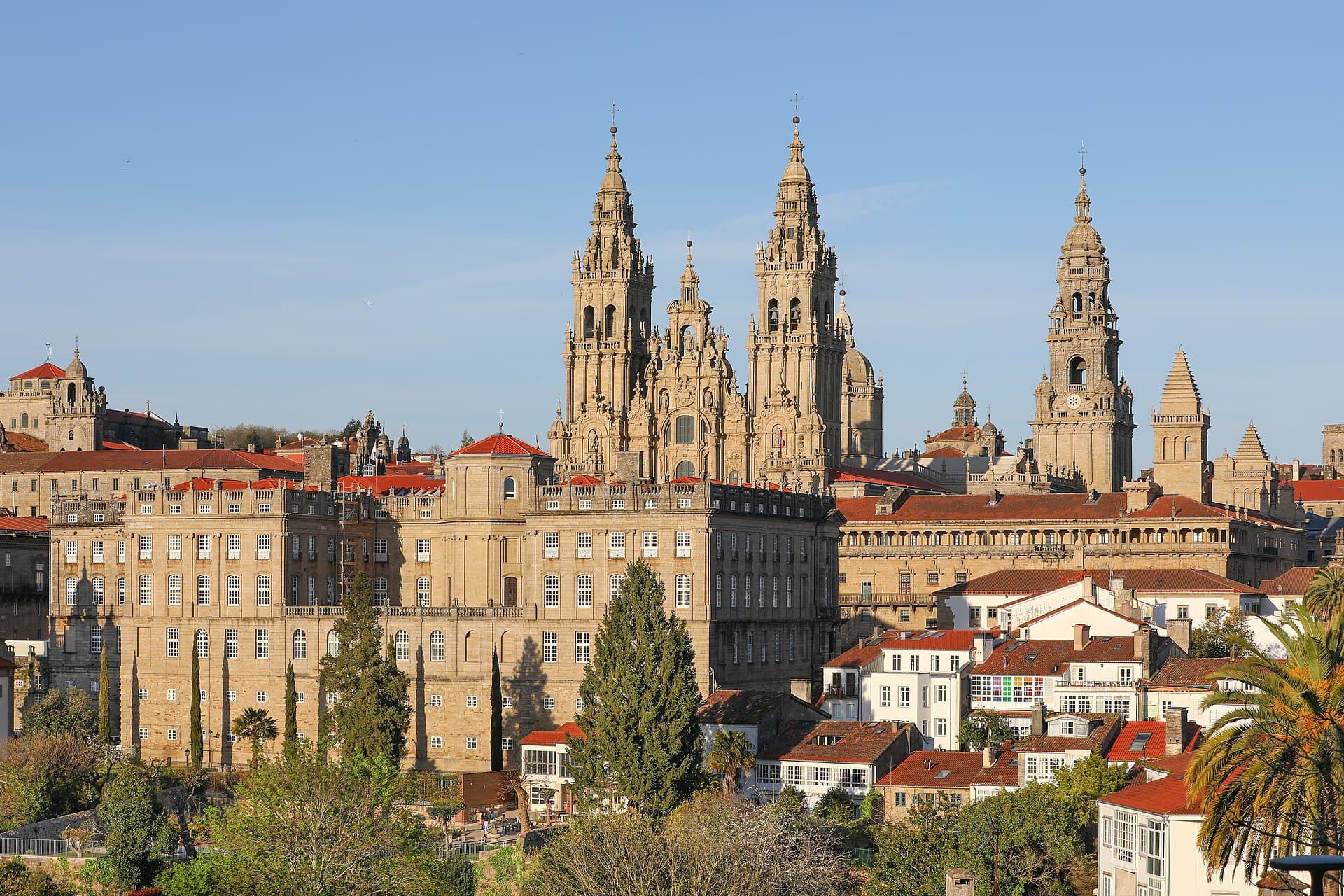
Sometime in the first decades of the ninth century, by the tradition the Galician church has kept ever since, a hermit called Pelagius saw lights over a wooded hill near Iria Flavia. The local bishop, Teodomiro, went to look, found a Roman-era burial and declared it the grave of the apostle James, and King Alfonso II of Asturias came from Oviedo to see for himself and ordered a church raised over it. Everything after that, the cathedral, the city, the road across northern Spain, grew out of one act of identification.
Galicia is the wet green corner of Iberia above Portugal, and it has spent a thousand years as a destination for other people's grief and hope. It also has a memory culture of its own, and the two are wound together: the granite that built the cathedral was cut into wayside crosses at every parish boundary and into roadside shrines where coins are still left for the souls in purgatory, and the coast that guided pilgrims to the end of the known world swallowed ships by the hundred.
Galicia covers about 29,574 square kilometres in the north-west corner of Spain, bounded by the Atlantic on two sides and by the River Miño along its frontier with Portugal, with a population of roughly 2.71 million in 2025 (Wikipedia). It is granite country, worn into low green mountains and cut on the seaward side by the rías, drowned river valleys that give the region one of Europe's longest sheltered coastlines and one of its great shellfish grounds. Rain arrives most of the year, and the oak, chestnut and stone-walled fields look more like Brittany than like Castile.
Galicia is one of Spain's seventeen autonomous communities, divided into the provinces of A Coruña, Lugo, Ourense and Pontevedra and governed from Santiago by the Xunta de Galicia. Its 1981 Statute of Autonomy names it a "nacionalidade histórica", a historic nationality, one of three regions that had approved home rule before the Civil War and were fast-tracked to self-government after Franco (Wikipedia). Galician is co-official with Castilian Spanish. The demography is difficult: Galicia has one of Europe's oldest populations, with more deaths than births every year since the mid-1980s.
Santiago de Compostela. The capital is a compact city of granite arcades built from and for the pilgrimage. Its cathedral, begun in 1075 over the tomb, is a Romanesque building wrapped in the Baroque west front known as the Fachada do Obradoiro, finished in the 1740s. Behind that front stands the Pórtico da Gloria, the triple portal completed by Master Mateo in 1188, whose 200 figures of prophets, apostles and elders were carved and painted as a vision of the Last Judgement and returned to something near their medieval colour by a conservation campaign completed in 2018 (Britannica). The whole old town was inscribed by UNESCO in 1985.
A Coruña. Built on an isthmus, A Coruña keeps the Tower of Hercules, a Roman lighthouse of the first or second century AD that has been refaced but never gone dark and is the oldest working lighthouse anywhere.
Vigo. Galicia's most populous municipality and one of Europe's busiest fishing ports, on a deep ría facing the Cíes Islands.
Lugo. The only city still completely encircled by its Roman walls, built in the late third century, running 2.1 kilometres with 71 surviving towers and inscribed by UNESCO in 2000; the walkway on top is an ordinary public promenade.
Before Rome, the north-west was a landscape of castros, fortified hilltop villages of round stone houses ringed by ditches and ramparts, several thousand of them mapped; the largest excavated example, the Citânia de Santa Trega above the mouth of the Miño, held hundreds of dwellings. Rome took the region in campaigns ending around 19 BC and organised it as the province of Gallaecia, named for the Callaeci peoples the legions had fought (Wikipedia).
 The Tower of Hercules is Roman, and it is the only lighthouse from the ancient world still working as one. Photograph by Diego Delso, CC BY-SA 4.0, via Wikimedia Commons.
When the western empire failed, the Suebi crossed into the peninsula and in 411 founded a kingdom based on Braga and Lugo that lasted until the Visigoths absorbed it in 585 (Wikipedia). Then came the tomb, and a shrine whose pull reorganised northern Iberia. Al-Mansur sacked Compostela in 997 and carried off its bells while leaving the grave untouched; under Archbishop Diego Gelmírez in the early twelfth century the city acquired a metropolitan see, a fleet and a promotional literature (Wikipedia). The Codex Calixtinus, compiled around 1140 and kept in the cathedral archive, contains what amounts to the first guidebook for European travellers, with stages, water quality and warnings about the locals (Wikipedia).
Galicia's later medieval history is one of losing political weight. The Irmandiño revolts of 1431 and 1467 to 1469, in which peasant brotherhoods pulled down more than a hundred castles, were crushed (Wikipedia). The Catholic Monarchs then imposed direct Castilian rule in a settlement Galician historians call the doma, the taming, of the kingdom, after which the nobility and the church adopted Castilian and Galician left the written record for roughly three hundred years. Recovery began with the nineteenth-century regionalists, ran through a home-rule statute approved by plebiscite in June 1936 and shelved by the coup weeks later, and resumed in 1981.
Galician, galego, descends from the Latin of Gallaecia and is the closest living relative of Portuguese; the two were one literary tongue, Galician-Portuguese, until political separation pulled them apart from the fourteenth century. In the thirteenth century Castilian poets wrote their lyric verse in it. The cantigas de amigo, love songs voiced by a woman waiting by the sea, survive in poets like Martin Codax, whose Vindel Parchment carries words and melody together and is one of the very few sources for secular medieval song with notation (Wikipedia). Alfonso X of Castile wrote his prose in Castilian and his 400-odd Cantigas de Santa Maria in Galician-Portuguese (Wikipedia).
Then the language fell out of writing. Galicians call the years from roughly 1500 to 1800 the Séculos Escuros, the Dark Centuries, when Galician stayed the speech of nearly everyone while every document, sermon and lesson appeared in Castilian (Wikipedia). The recovery, the Rexurdimento, began with Rosalía de Castro, whose Cantares gallegos appeared on 17 May 1863 and is treated as the founding book of modern Galician literature (Wikipedia). The Real Academia Galega, founded in 1906 on the initiative of emigrants in Havana, later chose that date for Día das Letras Galegas, held every 17 May since 1963 and dedicated each year to a different writer in the language (Wikipedia).
The place names carry the layers. Compostela comes either from Latin compositum, a burial ground, or from campus stellae, field of the star, and scholars have argued it for centuries; endings in -obre mark pre-Roman settlement, and -áns and -ariz record Germanic landholders of the Suebi period. Santiago is a contraction of Sant Iago, Saint James.
Galicia thinks of itself as part of an Atlantic Celtic world, and that identification is a real and consequential cultural fact whatever the archaeology says. The instrument is the gaita galega, a bagpipe with a conical chanter played at romarías and taught in hundreds of municipal schools; the Festival Internacional do Mundo Celta de Ortigueira has drawn crowds since 1978, and Milladoiro, Luar na Lubre and the piper Carlos Núñez have toured for decades with Breton, Irish and Scottish musicians. The claim of ancient Celtic ethnicity is a separate question that historians treat carefully. It was elaborated in the nineteenth century, above all by Manuel Murguía in his Historia de Galicia of 1865, as part of a deliberate project to give Galicia a national origin distinct from Castile (Wikipedia). Archaeologists accept that castro-culture peoples spoke a Celtic language and shared material traits with communities from Ireland to Iberia, and disagree about how far a shared Celtic identity can be read back from that. The affiliation is real and modern; the ancient substrate under it is contested.
The vernacular building is distinctive. The hórreo is a stone or wood granary raised on staddle stones, slotted for ventilation and topped with a cross at one gable and a finial at the other; there are tens of thousands of them. The cruceiro, a carved granite cross on a stepped base, stands at crossroads, churchyards and field corners across the whole region, often with a Calvary on one face and a Pietà on the other; the one at Hío was cut from a single block in the 1870s.
Emigration is the other half of the identity. From the mid-nineteenth century Galicians left in huge numbers for Cuba, Argentina and Uruguay, so many that in parts of Latin America gallego became the everyday word for any Spaniard. Buenos Aires was called the fifth Galician province, and Fidel Castro's father emigrated from Láncara in Lugo. Those who came back built the indiano houses that still line village streets.
Galicia is Catholic in a form that has always run close to older material. The cult of Saint James rests on the tradition that the apostle preached in Iberia, was beheaded in Jerusalem, and was carried back by his disciples in a stone boat that came ashore near Padrón. Scholars have offered other explanations for the tomb, the most persistent being that the fourth-century Galician ascetic Priscillian, executed for heresy at Trier and brought home by his followers, lies under the cathedral (Wikipedia). The church has never accepted that reading, and the evidence on both sides is thin.
The Tower of Hercules is Roman, and it is the only lighthouse from the ancient world still working as one. Photograph by Diego Delso, CC BY-SA 4.0, via Wikimedia Commons.
When the western empire failed, the Suebi crossed into the peninsula and in 411 founded a kingdom based on Braga and Lugo that lasted until the Visigoths absorbed it in 585 (Wikipedia). Then came the tomb, and a shrine whose pull reorganised northern Iberia. Al-Mansur sacked Compostela in 997 and carried off its bells while leaving the grave untouched; under Archbishop Diego Gelmírez in the early twelfth century the city acquired a metropolitan see, a fleet and a promotional literature (Wikipedia). The Codex Calixtinus, compiled around 1140 and kept in the cathedral archive, contains what amounts to the first guidebook for European travellers, with stages, water quality and warnings about the locals (Wikipedia).
Galicia's later medieval history is one of losing political weight. The Irmandiño revolts of 1431 and 1467 to 1469, in which peasant brotherhoods pulled down more than a hundred castles, were crushed (Wikipedia). The Catholic Monarchs then imposed direct Castilian rule in a settlement Galician historians call the doma, the taming, of the kingdom, after which the nobility and the church adopted Castilian and Galician left the written record for roughly three hundred years. Recovery began with the nineteenth-century regionalists, ran through a home-rule statute approved by plebiscite in June 1936 and shelved by the coup weeks later, and resumed in 1981.
Galician, galego, descends from the Latin of Gallaecia and is the closest living relative of Portuguese; the two were one literary tongue, Galician-Portuguese, until political separation pulled them apart from the fourteenth century. In the thirteenth century Castilian poets wrote their lyric verse in it. The cantigas de amigo, love songs voiced by a woman waiting by the sea, survive in poets like Martin Codax, whose Vindel Parchment carries words and melody together and is one of the very few sources for secular medieval song with notation (Wikipedia). Alfonso X of Castile wrote his prose in Castilian and his 400-odd Cantigas de Santa Maria in Galician-Portuguese (Wikipedia).
Then the language fell out of writing. Galicians call the years from roughly 1500 to 1800 the Séculos Escuros, the Dark Centuries, when Galician stayed the speech of nearly everyone while every document, sermon and lesson appeared in Castilian (Wikipedia). The recovery, the Rexurdimento, began with Rosalía de Castro, whose Cantares gallegos appeared on 17 May 1863 and is treated as the founding book of modern Galician literature (Wikipedia). The Real Academia Galega, founded in 1906 on the initiative of emigrants in Havana, later chose that date for Día das Letras Galegas, held every 17 May since 1963 and dedicated each year to a different writer in the language (Wikipedia).
The place names carry the layers. Compostela comes either from Latin compositum, a burial ground, or from campus stellae, field of the star, and scholars have argued it for centuries; endings in -obre mark pre-Roman settlement, and -áns and -ariz record Germanic landholders of the Suebi period. Santiago is a contraction of Sant Iago, Saint James.
Galicia thinks of itself as part of an Atlantic Celtic world, and that identification is a real and consequential cultural fact whatever the archaeology says. The instrument is the gaita galega, a bagpipe with a conical chanter played at romarías and taught in hundreds of municipal schools; the Festival Internacional do Mundo Celta de Ortigueira has drawn crowds since 1978, and Milladoiro, Luar na Lubre and the piper Carlos Núñez have toured for decades with Breton, Irish and Scottish musicians. The claim of ancient Celtic ethnicity is a separate question that historians treat carefully. It was elaborated in the nineteenth century, above all by Manuel Murguía in his Historia de Galicia of 1865, as part of a deliberate project to give Galicia a national origin distinct from Castile (Wikipedia). Archaeologists accept that castro-culture peoples spoke a Celtic language and shared material traits with communities from Ireland to Iberia, and disagree about how far a shared Celtic identity can be read back from that. The affiliation is real and modern; the ancient substrate under it is contested.
The vernacular building is distinctive. The hórreo is a stone or wood granary raised on staddle stones, slotted for ventilation and topped with a cross at one gable and a finial at the other; there are tens of thousands of them. The cruceiro, a carved granite cross on a stepped base, stands at crossroads, churchyards and field corners across the whole region, often with a Calvary on one face and a Pietà on the other; the one at Hío was cut from a single block in the 1870s.
Emigration is the other half of the identity. From the mid-nineteenth century Galicians left in huge numbers for Cuba, Argentina and Uruguay, so many that in parts of Latin America gallego became the everyday word for any Spaniard. Buenos Aires was called the fifth Galician province, and Fidel Castro's father emigrated from Láncara in Lugo. Those who came back built the indiano houses that still line village streets.
Galicia is Catholic in a form that has always run close to older material. The cult of Saint James rests on the tradition that the apostle preached in Iberia, was beheaded in Jerusalem, and was carried back by his disciples in a stone boat that came ashore near Padrón. Scholars have offered other explanations for the tomb, the most persistent being that the fourth-century Galician ascetic Priscillian, executed for heresy at Trier and brought home by his followers, lies under the cathedral (Wikipedia). The church has never accepted that reading, and the evidence on both sides is thin.
 Santiago has drawn pilgrims for more than a thousand years, and the roads they wore across Europe are themselves inscribed as heritage. Photograph by Luis Miguel Bugallo Sanchez, CC BY-SA 3.0, via Wikimedia Commons.
The cathedral liturgy is famous for the botafumeiro, a 53-kilogram silver-plated censer swung on a rope by eight men until it arcs across the transept at some 68 kilometres an hour (Wikipedia). Compostela keeps Holy Years, the Xacobeo, whenever 25 July falls on a Sunday and the Holy Door is opened; the 2021 year ran through 2022 because of the pandemic, and the next falls in 2027.
Away from the cathedral, devotion is local and physical. Marian shrines draw romarías, day-long pilgrimages combining Mass, procession and an afternoon of food and music: the Virxe da Barca at Muxía, where pilgrims crawl under a rocking stone said to be the sail of the apostle's boat, and Santa Marta de Ribarteme, where survivors of a near-death experience are carried through the village in open coffins. The proverb about witches, "eu non creo nas meigas, pero habelas hainas", I don't believe in witches, but they exist, is the standard Galician summary of its own religious temper.
Few European folk beliefs about the dead have held on as stubbornly as the Santa Compaña. It is a procession of shrouded souls carrying candles that walks the parish lanes at night, led by a living person compelled into the role, who bears a cross or a cauldron of holy water. The one who leads it does not know at first, grows pale and thin, and can be released only by passing the cross to someone else. Ethnographers have collected the belief across Galicia and into Asturias and northern Portugal, under local names including Estadea and Hoste, and the escapes are as specific as the danger: draw a circle on the ground and stand inside it, lie face down without looking up, keep both hands full so nothing can be handed to you (Wikipedia). It is told today as a story more often than as a warning. It is still told.
Alongside it sit the meigas, the wise women of Galician tradition, healers and cursers at once, and the queimada, in which grape spirit, sugar, coffee beans and lemon peel are set alight in a clay bowl while a spoken esconxuro, an exorcism, names the spirits to be driven off. It is performed at weddings and fiestas everywhere; the text most often recited was written in 1967 by Mariano Marcos Abalo, so the ceremony as staged today is a modern composition on older foundations (Wikipedia).
The dead are also marked in stone. Cruceiros are memorials as much as devotions, raised where someone died, at a boundary a funeral procession crossed, or in thanks for a life spared. Beside them stand the petos de ánimas, small niched shrines showing souls in the flames of purgatory with a slot for coins, whose whole purpose is to let a passer-by shorten a stranger's time there (Galipedia). On 1 and 2 November families clean and flower the graves, and Galicia has revived Samaín, the autumn festival of carved gourds recorded in its villages before the American Halloween arrived.
The sea keeps its own ledger. The coast from Malpica to Fisterra is called the Costa da Morte, the coast of death, for the ships lost on it; the reefs off Camariñas took HMS Serpent on 10 November 1890 with all but three of her 175 crew, and the villagers of Xaviña buried the bodies where they washed up, in a walled plot above the water still called the Cemiterio dos Ingleses (Wikipedia). Families of drowned fishermen have long held funerals without a body. The most recent communal wound is industrial: on 19 November 2002 the tanker Prestige broke apart off Fisterra and coated the coast in heavy fuel oil, ruining the shellfish grounds for a season and bringing hundreds of thousands into the streets under the slogan Nunca Máis, never again (Wikipedia).
Galician records are parish records, and the parish is the only unit that has ever really counted here.
Galicia has more than three thousand parishes, and the parish register, held by the diocesan archives at Santiago, Lugo, Ourense, Mondoñedo and Tui, is the vital record from the sixteenth century. Because Galician settlement is dispersed into tiny hamlets rather than villages, and because a handful of surnames cover a very large share of the population, Galician research is done by parish and by house name, the casa, which identifies a family where the surname cannot.
The great Galician movement is emigration. Somewhere over a million people left between the middle of the nineteenth century and the middle of the twentieth, chiefly for Argentina, Cuba, Uruguay, Brazil and Venezuela, and the word gallego became the general term for a Spaniard in Buenos Aires because so many of them were. The emigration was documented at both ends: passport and conscription records at home, and the arrival registers, mutual aid societies and Galician centres abroad, which are substantial archives in their own right.
The Xunta's own emigration archive and the Consello da Cultura Galega have gathered a great deal of it.
Two older layers. The Camino brought pilgrims and their hospitals kept records, and the Santiago cathedral archive is one of the richest in Spain. And the pazo estates and the foro land tenure system produced notarial documents naming tenants and their heirs across generations.
Galicia holds four UNESCO World Heritage inscriptions: the old town of Santiago de Compostela, listed in 1985; the Routes of Santiago de Compostela, beginning with the Camino Francés in 1993 and extended in 2015 to the Camino Primitivo and the northern coastal routes (UNESCO); the Roman Walls of Lugo in 2000 (UNESCO); and the Tower of Hercules in 2009 (UNESCO). The Ribeira Sacra, where the Sil meets the Miño, holds the densest concentration of Romanesque monastic architecture in Spain among vine terraces worked since Roman times, and has been on Spain's tentative list since 1996 (UNESCO).
The vernacular has an unusual legal shield. Under Galicia's cultural heritage law of 2016, every hórreo, cruceiro and peto de ánimas with evidence of construction before 1901 counts automatically as a protected cultural asset with no declaration procedure, covering thousands of small structures no listing programme could have handled one at a time (Diario Oficial de Galicia).
Two institutions carry the ethnographic record. The Museo do Pobo Galego, founded in 1976 in the former Dominican convent of San Domingos de Bonaval, documents the crafts, fishing gear, dress and building of ordinary Galicians, and its church holds the Panteón de Galegos Ilustres, where Rosalía de Castro and the artist and politician Castelao are buried (Museo do Pobo Galego). The Consello da Cultura Galega, created by the Statute of Autonomy in 1983, advises on language and culture and runs the main documentary archives (Consello da Cultura Galega).
Galiciana, the digital library of Galicia, publishes scanned books, manuscripts, maps and the full runs of historic Galician newspapers, free to read (Galiciana). The Consello da Cultura Galega runs the Arquivo da Emigración Galega, which collects the letters, photographs, association records and passenger papers of the diaspora and makes much of it searchable, of direct use to families in Argentina, Cuba and Uruguay tracing a great-grandparent's village (Arquivo da Emigración Galega). The Real Academia Galega publishes its dictionary and normative rulings online (Real Academia Galega), and the medieval lyric corpus is searchable, text and manuscript image together, through the Cantigas Medievais Galego-Portuguesas database (Universidade Nova de Lisboa).
The Camino is the clearest case of a heritage revival that changed a region's economy. Compostelas issued by the pilgrim office rose from a few hundred a year in the mid-1980s to 530,987 in 2025, the highest figure ever recorded, and the money lands in small towns along the routes (Oficina de Acogida al Peregrino). Galician writing travels too: Manuel Rivas, who writes in Galician, has been translated into more than twenty languages (Wikipedia), and the Galician-language crime series O sabor das margaridas went out worldwide on Netflix (Wikipedia).
The most striking recent development is musical. Tanxugueiras, three singers who perform with the pandeireta, the square-frame tambourine played by generations of Galician women, took the old repertoire into electronic production and came close to representing Spain at Eurovision in 2022 with a song in Galician; they won the televote by a wide margin and lost on the jury (Wikipedia). Whatever the result, a country that had spent three centuries not writing in Galician spent that week arguing about it in prime time.
A pilgrimage brought back from almost nothing. Waymarking by local associations, hostel building and UNESCO listing turned a few hundred walkers a year in the early 1980s into 530,987 pilgrims in 2025, reviving the Romanesque churches, bridges and villages along the way.
A language that came back into print. Written out of public life for three centuries, Galician is now co-official, taught throughout the school system, standardised by the Real Academia Galega and honoured every 17 May.
A Roman lighthouse still lit. The Tower of Hercules has guided ships since the first or second century AD and was inscribed by UNESCO in 2009 as the oldest working lighthouse anywhere.
Blanket protection for the smallest monuments. Galicia's 2016 heritage law protects every hórreo, cruceiro and peto de ánimas built before 1901 automatically, saving thousands of humble structures no inventory could have reached in time.
Santiago has drawn pilgrims for more than a thousand years, and the roads they wore across Europe are themselves inscribed as heritage. Photograph by Luis Miguel Bugallo Sanchez, CC BY-SA 3.0, via Wikimedia Commons.
The cathedral liturgy is famous for the botafumeiro, a 53-kilogram silver-plated censer swung on a rope by eight men until it arcs across the transept at some 68 kilometres an hour (Wikipedia). Compostela keeps Holy Years, the Xacobeo, whenever 25 July falls on a Sunday and the Holy Door is opened; the 2021 year ran through 2022 because of the pandemic, and the next falls in 2027.
Away from the cathedral, devotion is local and physical. Marian shrines draw romarías, day-long pilgrimages combining Mass, procession and an afternoon of food and music: the Virxe da Barca at Muxía, where pilgrims crawl under a rocking stone said to be the sail of the apostle's boat, and Santa Marta de Ribarteme, where survivors of a near-death experience are carried through the village in open coffins. The proverb about witches, "eu non creo nas meigas, pero habelas hainas", I don't believe in witches, but they exist, is the standard Galician summary of its own religious temper.
Few European folk beliefs about the dead have held on as stubbornly as the Santa Compaña. It is a procession of shrouded souls carrying candles that walks the parish lanes at night, led by a living person compelled into the role, who bears a cross or a cauldron of holy water. The one who leads it does not know at first, grows pale and thin, and can be released only by passing the cross to someone else. Ethnographers have collected the belief across Galicia and into Asturias and northern Portugal, under local names including Estadea and Hoste, and the escapes are as specific as the danger: draw a circle on the ground and stand inside it, lie face down without looking up, keep both hands full so nothing can be handed to you (Wikipedia). It is told today as a story more often than as a warning. It is still told.
Alongside it sit the meigas, the wise women of Galician tradition, healers and cursers at once, and the queimada, in which grape spirit, sugar, coffee beans and lemon peel are set alight in a clay bowl while a spoken esconxuro, an exorcism, names the spirits to be driven off. It is performed at weddings and fiestas everywhere; the text most often recited was written in 1967 by Mariano Marcos Abalo, so the ceremony as staged today is a modern composition on older foundations (Wikipedia).
The dead are also marked in stone. Cruceiros are memorials as much as devotions, raised where someone died, at a boundary a funeral procession crossed, or in thanks for a life spared. Beside them stand the petos de ánimas, small niched shrines showing souls in the flames of purgatory with a slot for coins, whose whole purpose is to let a passer-by shorten a stranger's time there (Galipedia). On 1 and 2 November families clean and flower the graves, and Galicia has revived Samaín, the autumn festival of carved gourds recorded in its villages before the American Halloween arrived.
The sea keeps its own ledger. The coast from Malpica to Fisterra is called the Costa da Morte, the coast of death, for the ships lost on it; the reefs off Camariñas took HMS Serpent on 10 November 1890 with all but three of her 175 crew, and the villagers of Xaviña buried the bodies where they washed up, in a walled plot above the water still called the Cemiterio dos Ingleses (Wikipedia). Families of drowned fishermen have long held funerals without a body. The most recent communal wound is industrial: on 19 November 2002 the tanker Prestige broke apart off Fisterra and coated the coast in heavy fuel oil, ruining the shellfish grounds for a season and bringing hundreds of thousands into the streets under the slogan Nunca Máis, never again (Wikipedia).
Galician records are parish records, and the parish is the only unit that has ever really counted here.
Galicia has more than three thousand parishes, and the parish register, held by the diocesan archives at Santiago, Lugo, Ourense, Mondoñedo and Tui, is the vital record from the sixteenth century. Because Galician settlement is dispersed into tiny hamlets rather than villages, and because a handful of surnames cover a very large share of the population, Galician research is done by parish and by house name, the casa, which identifies a family where the surname cannot.
The great Galician movement is emigration. Somewhere over a million people left between the middle of the nineteenth century and the middle of the twentieth, chiefly for Argentina, Cuba, Uruguay, Brazil and Venezuela, and the word gallego became the general term for a Spaniard in Buenos Aires because so many of them were. The emigration was documented at both ends: passport and conscription records at home, and the arrival registers, mutual aid societies and Galician centres abroad, which are substantial archives in their own right.
The Xunta's own emigration archive and the Consello da Cultura Galega have gathered a great deal of it.
Two older layers. The Camino brought pilgrims and their hospitals kept records, and the Santiago cathedral archive is one of the richest in Spain. And the pazo estates and the foro land tenure system produced notarial documents naming tenants and their heirs across generations.
Galicia holds four UNESCO World Heritage inscriptions: the old town of Santiago de Compostela, listed in 1985; the Routes of Santiago de Compostela, beginning with the Camino Francés in 1993 and extended in 2015 to the Camino Primitivo and the northern coastal routes (UNESCO); the Roman Walls of Lugo in 2000 (UNESCO); and the Tower of Hercules in 2009 (UNESCO). The Ribeira Sacra, where the Sil meets the Miño, holds the densest concentration of Romanesque monastic architecture in Spain among vine terraces worked since Roman times, and has been on Spain's tentative list since 1996 (UNESCO).
The vernacular has an unusual legal shield. Under Galicia's cultural heritage law of 2016, every hórreo, cruceiro and peto de ánimas with evidence of construction before 1901 counts automatically as a protected cultural asset with no declaration procedure, covering thousands of small structures no listing programme could have handled one at a time (Diario Oficial de Galicia).
Two institutions carry the ethnographic record. The Museo do Pobo Galego, founded in 1976 in the former Dominican convent of San Domingos de Bonaval, documents the crafts, fishing gear, dress and building of ordinary Galicians, and its church holds the Panteón de Galegos Ilustres, where Rosalía de Castro and the artist and politician Castelao are buried (Museo do Pobo Galego). The Consello da Cultura Galega, created by the Statute of Autonomy in 1983, advises on language and culture and runs the main documentary archives (Consello da Cultura Galega).
Galiciana, the digital library of Galicia, publishes scanned books, manuscripts, maps and the full runs of historic Galician newspapers, free to read (Galiciana). The Consello da Cultura Galega runs the Arquivo da Emigración Galega, which collects the letters, photographs, association records and passenger papers of the diaspora and makes much of it searchable, of direct use to families in Argentina, Cuba and Uruguay tracing a great-grandparent's village (Arquivo da Emigración Galega). The Real Academia Galega publishes its dictionary and normative rulings online (Real Academia Galega), and the medieval lyric corpus is searchable, text and manuscript image together, through the Cantigas Medievais Galego-Portuguesas database (Universidade Nova de Lisboa).
The Camino is the clearest case of a heritage revival that changed a region's economy. Compostelas issued by the pilgrim office rose from a few hundred a year in the mid-1980s to 530,987 in 2025, the highest figure ever recorded, and the money lands in small towns along the routes (Oficina de Acogida al Peregrino). Galician writing travels too: Manuel Rivas, who writes in Galician, has been translated into more than twenty languages (Wikipedia), and the Galician-language crime series O sabor das margaridas went out worldwide on Netflix (Wikipedia).
The most striking recent development is musical. Tanxugueiras, three singers who perform with the pandeireta, the square-frame tambourine played by generations of Galician women, took the old repertoire into electronic production and came close to representing Spain at Eurovision in 2022 with a song in Galician; they won the televote by a wide margin and lost on the jury (Wikipedia). Whatever the result, a country that had spent three centuries not writing in Galician spent that week arguing about it in prime time.
A pilgrimage brought back from almost nothing. Waymarking by local associations, hostel building and UNESCO listing turned a few hundred walkers a year in the early 1980s into 530,987 pilgrims in 2025, reviving the Romanesque churches, bridges and villages along the way.
A language that came back into print. Written out of public life for three centuries, Galician is now co-official, taught throughout the school system, standardised by the Real Academia Galega and honoured every 17 May.
A Roman lighthouse still lit. The Tower of Hercules has guided ships since the first or second century AD and was inscribed by UNESCO in 2009 as the oldest working lighthouse anywhere.
Blanket protection for the smallest monuments. Galicia's 2016 heritage law protects every hórreo, cruceiro and peto de ánimas built before 1901 automatically, saving thousands of humble structures no inventory could have reached in time.
National Overview
Notable Cities
Historical Foundations
Linguistic and Etymological Roots
Cultural Identity
Religion and Spirituality
Remembrance and Mourning Traditions
Tracing a Family in Galicia
Heritage Preservation Efforts
Digital Heritage
Contemporary Cultural Influences
Success Stories
References and resources
- UNESCO, Santiago de Compostela (Old Town): the pilgrimage city, 1985.
- UNESCO, Routes of Santiago de Compostela in Spain: the Camino Francés and the northern routes.
- UNESCO, Roman Walls of Lugo: the complete Roman circuit.
- UNESCO, Tower of Hercules: the Roman lighthouse at A Coruña.
- Oficina de Acogida al Peregrino: official annual pilgrim statistics.
- Encyclopaedia Britannica, Santiago de Compostela: the shrine and cathedral.
- Real Academia Galega: the language academy and Día das Letras Galegas.
- Consello da Cultura Galega: the statutory cultural body.
- Museo do Pobo Galego: the ethnographic museum.
- Galiciana: the digital library of Galicia.
- Lei 5/2016 do patrimonio cultural de Galicia: the automatic protection of hórreos, cruceiros and petos de ánimas.
- Santa Compaña, Wikipedia: the procession of the dead.