Heritage · Country
Germany Culture and Heritage
Set into the pavements of German towns are more than a hundred thousand small brass squares, each engraved with the name of one person taken from that spot by the Nazis, so that a family walking home steps daily over the memory of a neighbour. A guide to Germany's heritage, its cathedrals and castles, and the unflinching culture of remembrance the country has built out of its darkest history.Written to last.
By Confinity Heritage Editorial · 2026-07-11 · 8-minute readQuiet tools, kept out of the way.
Germany has turned remembrance into a national discipline, and it does so in the smallest as well as the grandest ways. Since 1992 the artist Gunter Demnig has been setting brass cobblestones, Stolpersteine or "stumbling stones", into the footpaths outside the last freely chosen homes of people murdered under National Socialism, each stone hand-stamped with a name, a date of birth and the fate that followed. There are now well over a hundred thousand of them across Germany and some thirty other countries, the largest decentralised memorial in the world, and they work precisely because they are underfoot: you find them not in a museum but on the way to the bakery, and you have to bow your head to read one.
That instinct, to place memory where people cannot avoid it, runs through the whole of German heritage. Berlin set a field of 2,711 concrete slabs for the murdered Jews of Europe beside its most famous boulevard; Dresden rebuilt from rubble the church its own war had destroyed; and the country observes a solemn national day of mourning every November and a Holocaust remembrance day every January. Germany also holds a heritage of extraordinary beauty, its Rhine castles and Gothic cathedrals, Bach and Beethoven, the Bauhaus and the Christmas market, and this profile follows both: the culture the Germans have made, and the exacting, public way they have chosen to remember what they have done and lost.
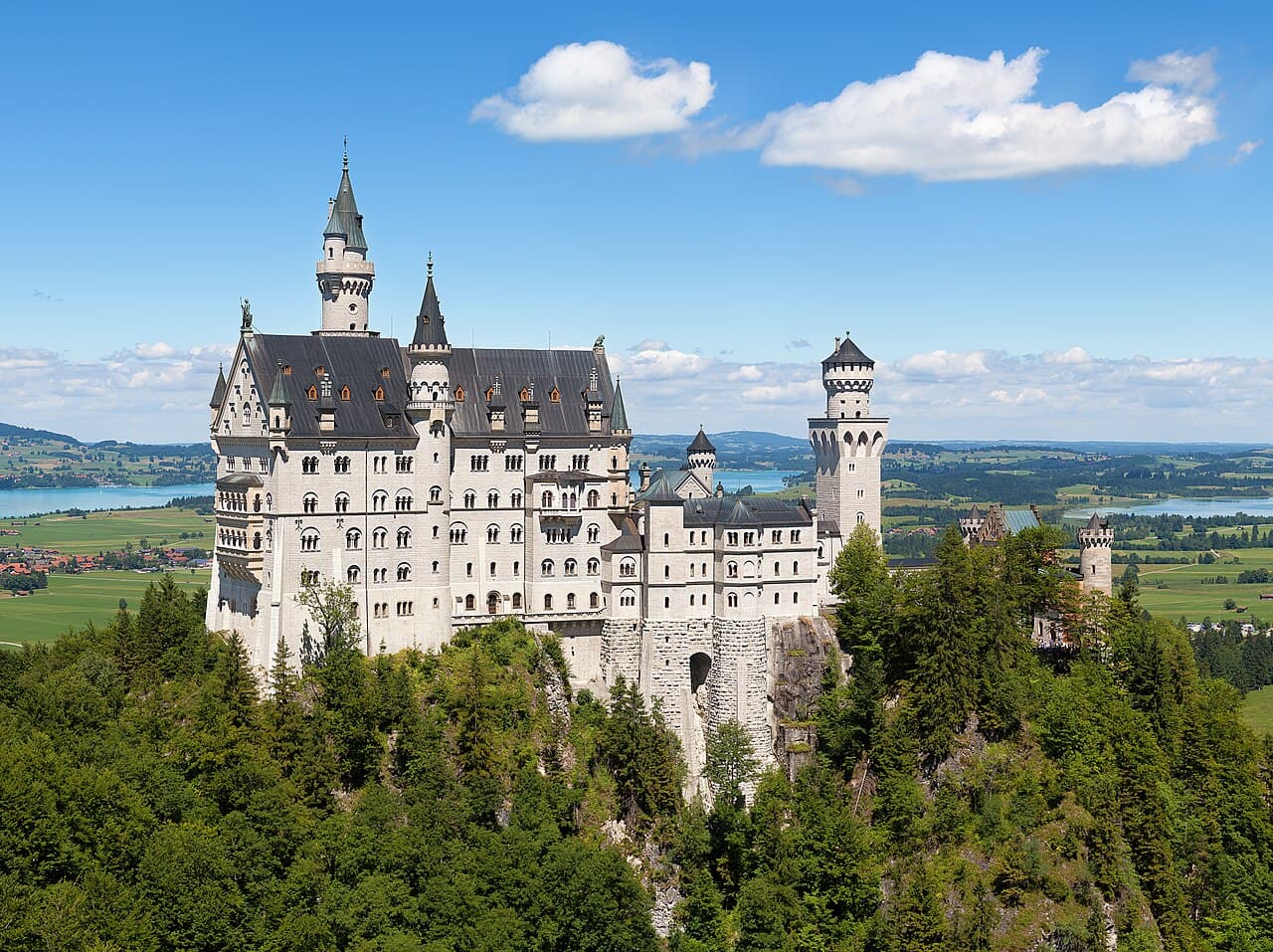
 Neuschwanstein Castle in the Bavarian Alps, built for King Ludwig II and inscribed as World Heritage in 2025, in an early photochrom print. Public domain, via Wikimedia Commons.
Germany sits at the centre of Europe, sharing land borders with nine countries, more than any other European country except Russia. Its landscape rises from north to south: the flat, sandy North German Plain and the coasts of the North and Baltic Seas give way to the wooded central uplands, the Harz, the Black Forest and the Rhineland hills, and finally to the Bavarian Alps, where the Zugspitze reaches 2,962 metres on the Austrian frontier. The Rhine, the Elbe, the Danube and the Main have carried German trade and settlement for two thousand years, and the terraced vineyards of the Rhine and Mosel gorges, castle-crowned and steep, are among the most storied river landscapes in the world.
With about 84 million people, Germany is the most populous country in the European Union and its largest economy. It is a federal republic of sixteen states, the Länder, each with real powers over culture, education and policing, a structure deliberately built after 1945 to disperse authority that had once been dangerously concentrated. Berlin is the capital and by far the largest city, though economic weight is spread across many centres, from Munich and Frankfurt to Hamburg and the industrial Ruhr. Germany is also a country reshaped by migration: the "guest workers" invited from the 1950s, above all from Turkey, and more recent arrivals of refugees have made its cities diverse, and questions of who belongs to the nation and how its history should be taught remain central to public life.
Berlin. The capital is a city that wears its twentieth century on the surface. The Brandenburg Gate, once stranded in the death strip of the Berlin Wall, is now the symbol of a reunited country; beside it stretch the concrete stelae of the Memorial to the Murdered Jews of Europe. The Reichstag, burned in 1933 and crowned with a glass dome after reunification, houses the Bundestag; the Berlin Wall Memorial on Bernauer Straße preserves a stretch of the border that divided the city from 1961 to 1989; and the Topography of Terror stands on the site of the Gestapo headquarters. Few cities anywhere confront their own history so directly.
Neuschwanstein Castle in the Bavarian Alps, built for King Ludwig II and inscribed as World Heritage in 2025, in an early photochrom print. Public domain, via Wikimedia Commons.
Germany sits at the centre of Europe, sharing land borders with nine countries, more than any other European country except Russia. Its landscape rises from north to south: the flat, sandy North German Plain and the coasts of the North and Baltic Seas give way to the wooded central uplands, the Harz, the Black Forest and the Rhineland hills, and finally to the Bavarian Alps, where the Zugspitze reaches 2,962 metres on the Austrian frontier. The Rhine, the Elbe, the Danube and the Main have carried German trade and settlement for two thousand years, and the terraced vineyards of the Rhine and Mosel gorges, castle-crowned and steep, are among the most storied river landscapes in the world.
With about 84 million people, Germany is the most populous country in the European Union and its largest economy. It is a federal republic of sixteen states, the Länder, each with real powers over culture, education and policing, a structure deliberately built after 1945 to disperse authority that had once been dangerously concentrated. Berlin is the capital and by far the largest city, though economic weight is spread across many centres, from Munich and Frankfurt to Hamburg and the industrial Ruhr. Germany is also a country reshaped by migration: the "guest workers" invited from the 1950s, above all from Turkey, and more recent arrivals of refugees have made its cities diverse, and questions of who belongs to the nation and how its history should be taught remain central to public life.
Berlin. The capital is a city that wears its twentieth century on the surface. The Brandenburg Gate, once stranded in the death strip of the Berlin Wall, is now the symbol of a reunited country; beside it stretch the concrete stelae of the Memorial to the Murdered Jews of Europe. The Reichstag, burned in 1933 and crowned with a glass dome after reunification, houses the Bundestag; the Berlin Wall Memorial on Bernauer Straße preserves a stretch of the border that divided the city from 1961 to 1989; and the Topography of Terror stands on the site of the Gestapo headquarters. Few cities anywhere confront their own history so directly.
.jpg%2F1280px-Pariser_Platz%252C_Berlin_1900_(2).jpg&w=3840&q=75) The Brandenburg Gate on Pariser Platz, Berlin, around 1900, long before the Wall would run past it. Public domain, via Wikimedia Commons.
Munich. The Bavarian capital pairs Baroque exuberance and beer-hall tradition with a sober memory of its role as the "capital of the Nazi movement". The Marienplatz and the vast Oktoberfest embody the city's festive side; the NS-Dokumentationszentrum, opened in 2015 on the site of the former Nazi party headquarters, examines the darker one, as does the concentration camp memorial at nearby Dachau, the first camp the regime built.
Cologne. Founded by the Romans as Colonia, Cologne is dominated by its cathedral, begun in 1248 and finally completed in 1880, one of the largest Gothic churches in the world and a UNESCO World Heritage Site since 1996. The twin-spired Dom famously survived the wartime bombing that flattened the city around it, and its permanent stonemasons' workshop, the Dombauhütte, has maintained the building continuously for centuries.
The Brandenburg Gate on Pariser Platz, Berlin, around 1900, long before the Wall would run past it. Public domain, via Wikimedia Commons.
Munich. The Bavarian capital pairs Baroque exuberance and beer-hall tradition with a sober memory of its role as the "capital of the Nazi movement". The Marienplatz and the vast Oktoberfest embody the city's festive side; the NS-Dokumentationszentrum, opened in 2015 on the site of the former Nazi party headquarters, examines the darker one, as does the concentration camp memorial at nearby Dachau, the first camp the regime built.
Cologne. Founded by the Romans as Colonia, Cologne is dominated by its cathedral, begun in 1248 and finally completed in 1880, one of the largest Gothic churches in the world and a UNESCO World Heritage Site since 1996. The twin-spired Dom famously survived the wartime bombing that flattened the city around it, and its permanent stonemasons' workshop, the Dombauhütte, has maintained the building continuously for centuries.
 The west front of Cologne Cathedral, begun in 1248 and completed in 1880, a UNESCO World Heritage Site. CC BY 2.0, via Wikimedia Commons.
Dresden. The Baroque capital of Saxony, "Florence on the Elbe", was destroyed by Allied firebombing in February 1945. Its great Frauenkirche lay as a heap of rubble for half a century, deliberately left as a ruin by the East German state, until after reunification it was rebuilt stone by catalogued stone and reconsecrated in 2005, a monument to both destruction and reconciliation.
Weimar. A small town with an outsize place in German culture, Weimar was home to Goethe and Schiller, gave its name to the Bauhaus design school founded there in 1919 and to the republic proclaimed the same year. On the hill above it stands the memorial to the Buchenwald concentration camp, so that the town holds the heights and depths of German history within a few kilometres.
Germany's story begins long before there was a Germany. The Neander valley near Düsseldorf gave its name to Neanderthal humans, and in AD 9 an alliance of Germanic tribes under Arminius destroyed three Roman legions in the Teutoburg Forest, halting Rome's advance and fixing a frontier, the Limes, that still marks the land. From the coronation of Charlemagne in 800 grew the Holy Roman Empire, a loose patchwork of hundreds of principalities, bishoprics and free cities that endured, in name at least, until 1806. The medieval centuries built the Hanseatic League of trading towns around the Baltic, the great cathedrals of Cologne, Speyer and Aachen, and the imperial cities whose guilds and printing presses would change the world.
The single most consequential German event was the Reformation. In 1517 the monk Martin Luther is said to have posted ninety-five theses at Wittenberg, and his translation of the Bible into German both split western Christianity and forged the modern German language. The wars of religion that followed culminated in the Thirty Years' War of 1618 to 1648, which killed perhaps a third of the population of the German lands. Prussia rose to power in the eighteenth century; in 1871, after victory over France, Otto von Bismarck united the German states into a single empire proclaimed, pointedly, in the Hall of Mirrors at Versailles. That empire's defeat in the First World War produced the fragile Weimar Republic, and its collapse brought Adolf Hitler to power in 1933. The Nazi regime built a dictatorship, murdered six million Jews and millions of others in the Holocaust, and plunged the world into a war that ended with Germany in ruins and divided. For forty years the country was split between a democratic West and a communist East, separated after 1961 by the Berlin Wall, until the Wall fell on 9 November 1989 and Germany was formally reunified on 3 October 1990, now marked as the Day of German Unity.
The Germans call their country Deutschland, from an old word, diutisc, meaning simply "of the people", used to distinguish the common Germanic speech from Latin. Other nations named it differently, and the variety is telling: English "Germany" and Italian "Germania" come from the Latin name for the tribes east of the Rhine, French "Allemagne" from the Alemanni who lived nearest France, and several Slavic and Baltic languages use forms of "Niemcy", from a word meaning "the mute" who could not be understood. German itself is a West Germanic language, close cousin to Dutch and English, and Luther's sixteenth-century Bible did more than any other single work to shape a standard High German out of a mass of dialects.
Beneath that standard, regional speech remains strong and cherished. Bavarian, Swabian, the Low German or Plattdeutsch of the north and the dialects of the Rhineland differ sharply from one another and from the textbook language. Germany also shelters older minority tongues protected under European charters: Sorbian, a Slavic language still spoken in the Lusatia region east of Dresden, along with North and Saterland Frisian and a Danish minority in Schleswig near the border. The nineteenth-century brothers Jacob and Wilhelm Grimm, remembered abroad for their fairy tales, were in fact pioneering scholars of this linguistic heritage, launching the monumental German Dictionary that traced every word to its roots and helped make the study of language itself a German specialism.
German everyday culture prizes reliability, thoroughness and the pleasures of the seasons. Bread is close to a national obsession, with hundreds of registered varieties of dark, seeded and sourdough loaves, and German bakery culture is listed on the country's own inventory of intangible heritage. Beer is brewed under the spirit of the Reinheitsgebot, the purity regulation dating from 1516, and celebrated at Munich's Oktoberfest and countless local festivals; the ritual of Kaffee und Kuchen, coffee and cake in the afternoon, structures the weekend. The Christmas market, the Weihnachtsmarkt, with its mulled wine, carved ornaments and gingerbread, is one of Germany's most successful cultural exports, copied in cities around the world.
Above all Germany is the land of music and thought. Bach, Handel, Beethoven, Brahms and Wagner form a musical canon without equal, and the country still supports more professional orchestras and opera houses than any other. Its philosophers, Kant, Hegel, Marx, Nietzsche, shaped modern thought; its writers run from Goethe and Schiller to the Nobel laureates Thomas Mann, Günter Grass and Herta Müller. The Bauhaus reinvented design and architecture; German engineering built the modern car and the Autobahn. Community life is famously organised through the Verein, the registered club or society, of which there are hundreds of thousands covering everything from football to choral singing and pigeon-fancying, and the year is punctuated by regional festivals, from the pre-Lenten carnival of the Rhineland, Karneval or Fasching, to the wine festivals of the south.
Germany is the country where western Christianity divided, and the fault line still shows on the map. The Reformation left the north and east largely Protestant and the south and west, Bavaria and the Rhineland, largely Catholic, a division sealed by the principle that a territory would follow the faith of its ruler. For centuries the two confessions shaped separate cultures of worship, art and education, and the state still collects a church tax, the Kirchensteuer, from registered members on behalf of both churches. Germany's cathedrals map this Christian heritage in stone: Aachen, where Charlemagne was buried and thirty kings were crowned and Germany's first World Heritage Site; Speyer, with the tombs of the medieval emperors; Cologne, Trier and the Luther sites of Wittenberg and the Wartburg, where the reformer translated the New Testament in hiding.
Today Germany is far more secular and more plural than that inheritance suggests. Membership of both major churches has fallen steeply, and in much of the former communist East a majority now profess no religion at all, one of the most secular populations in the world. At the same time immigration has made Islam the country's third-largest faith, with several million Muslims, most with Turkish roots, and Jewish communities have been rebuilt since 1945, notably by arrivals from the former Soviet Union, so that synagogues and community centres stand again in cities where the Nazis had tried to erase them. Christmas, Easter and the regional saints' days remain public holidays and cultural anchors even for the unbelieving, and Advent traditions in particular still order the German winter.
German mourning is orderly, seasonal and, in its public dimension, unusually reflective. Private funeral custom centres on the cemetery, the Friedhof, and on the tending of the grave, an obligation taken seriously enough to be regulated: plots are leased for a fixed period of rest, the Ruhezeit, after which they may be reused, and grave-tending, Grabpflege, has long been an expected duty and even a paid profession. German law traditionally required that the dead, including cremated ashes, be interred in a cemetery rather than scattered or kept at home, a rule that expresses a strong sense that mourning belongs to a shared, cared-for place. In recent decades that has softened: woodland burial grounds, where ashes are laid at the foot of a tree in a "Friedwald" or "Ruheforst", have become popular, and cremation is now the majority choice. The calendar carries two solemn autumn days for the dead: Totensonntag, the Protestant "Sunday of the Dead" on the last Sunday of the church year, and Allerheiligen, All Saints' Day, in Catholic regions, when families light grave candles and visit their relatives' resting places.
It is in public remembrance that Germany has become, by conscious effort, a model watched around the world. Out of the catastrophe of National Socialism the country developed what it calls Erinnerungskultur, a culture of memory, and Vergangenheitsbewältigung, the long labour of coming to terms with the past. The central expression is the Memorial to the Murdered Jews of Europe, opened in Berlin in 2005, a field of 2,711 grey concrete stelae of varying heights through which visitors walk, disorienting and wordless, with a documentation centre of victims' names beneath. Around the country stand the preserved concentration camp memorials, Dachau, Buchenwald, Bergen-Belsen, Sachsenhausen and others, maintained by law as places of learning; the House of the Wannsee Conference, where the murder of Europe's Jews was coordinated; and, since 1996, an official Day of Remembrance for the Victims of National Socialism on 27 January, the date Auschwitz was liberated, marked by a ceremony in the Bundestag.
Older and broader grief has its rituals too. Volkstrauertag, the national day of mourning held two Sundays before Advent, commemorates the dead of both world wars and the victims of tyranny with a state ceremony and a moment of silence, a deliberately sombre counterpart to more celebratory national days elsewhere. The German War Graves Commission, the Volksbund Deutsche Kriegsgräberfürsorge, founded in 1919, cares for the graves of some 2.8 million German war dead in more than forty countries and organises youth work camps at the cemeteries. And in the heart of Berlin the Neue Wache, a former guardhouse, serves as the central memorial to the victims of war and dictatorship, empty but for an enlarged copy of Käthe Kollwitz's sculpture of a mother cradling her dead son, open to the sky and the weather above her.
The west front of Cologne Cathedral, begun in 1248 and completed in 1880, a UNESCO World Heritage Site. CC BY 2.0, via Wikimedia Commons.
Dresden. The Baroque capital of Saxony, "Florence on the Elbe", was destroyed by Allied firebombing in February 1945. Its great Frauenkirche lay as a heap of rubble for half a century, deliberately left as a ruin by the East German state, until after reunification it was rebuilt stone by catalogued stone and reconsecrated in 2005, a monument to both destruction and reconciliation.
Weimar. A small town with an outsize place in German culture, Weimar was home to Goethe and Schiller, gave its name to the Bauhaus design school founded there in 1919 and to the republic proclaimed the same year. On the hill above it stands the memorial to the Buchenwald concentration camp, so that the town holds the heights and depths of German history within a few kilometres.
Germany's story begins long before there was a Germany. The Neander valley near Düsseldorf gave its name to Neanderthal humans, and in AD 9 an alliance of Germanic tribes under Arminius destroyed three Roman legions in the Teutoburg Forest, halting Rome's advance and fixing a frontier, the Limes, that still marks the land. From the coronation of Charlemagne in 800 grew the Holy Roman Empire, a loose patchwork of hundreds of principalities, bishoprics and free cities that endured, in name at least, until 1806. The medieval centuries built the Hanseatic League of trading towns around the Baltic, the great cathedrals of Cologne, Speyer and Aachen, and the imperial cities whose guilds and printing presses would change the world.
The single most consequential German event was the Reformation. In 1517 the monk Martin Luther is said to have posted ninety-five theses at Wittenberg, and his translation of the Bible into German both split western Christianity and forged the modern German language. The wars of religion that followed culminated in the Thirty Years' War of 1618 to 1648, which killed perhaps a third of the population of the German lands. Prussia rose to power in the eighteenth century; in 1871, after victory over France, Otto von Bismarck united the German states into a single empire proclaimed, pointedly, in the Hall of Mirrors at Versailles. That empire's defeat in the First World War produced the fragile Weimar Republic, and its collapse brought Adolf Hitler to power in 1933. The Nazi regime built a dictatorship, murdered six million Jews and millions of others in the Holocaust, and plunged the world into a war that ended with Germany in ruins and divided. For forty years the country was split between a democratic West and a communist East, separated after 1961 by the Berlin Wall, until the Wall fell on 9 November 1989 and Germany was formally reunified on 3 October 1990, now marked as the Day of German Unity.
The Germans call their country Deutschland, from an old word, diutisc, meaning simply "of the people", used to distinguish the common Germanic speech from Latin. Other nations named it differently, and the variety is telling: English "Germany" and Italian "Germania" come from the Latin name for the tribes east of the Rhine, French "Allemagne" from the Alemanni who lived nearest France, and several Slavic and Baltic languages use forms of "Niemcy", from a word meaning "the mute" who could not be understood. German itself is a West Germanic language, close cousin to Dutch and English, and Luther's sixteenth-century Bible did more than any other single work to shape a standard High German out of a mass of dialects.
Beneath that standard, regional speech remains strong and cherished. Bavarian, Swabian, the Low German or Plattdeutsch of the north and the dialects of the Rhineland differ sharply from one another and from the textbook language. Germany also shelters older minority tongues protected under European charters: Sorbian, a Slavic language still spoken in the Lusatia region east of Dresden, along with North and Saterland Frisian and a Danish minority in Schleswig near the border. The nineteenth-century brothers Jacob and Wilhelm Grimm, remembered abroad for their fairy tales, were in fact pioneering scholars of this linguistic heritage, launching the monumental German Dictionary that traced every word to its roots and helped make the study of language itself a German specialism.
German everyday culture prizes reliability, thoroughness and the pleasures of the seasons. Bread is close to a national obsession, with hundreds of registered varieties of dark, seeded and sourdough loaves, and German bakery culture is listed on the country's own inventory of intangible heritage. Beer is brewed under the spirit of the Reinheitsgebot, the purity regulation dating from 1516, and celebrated at Munich's Oktoberfest and countless local festivals; the ritual of Kaffee und Kuchen, coffee and cake in the afternoon, structures the weekend. The Christmas market, the Weihnachtsmarkt, with its mulled wine, carved ornaments and gingerbread, is one of Germany's most successful cultural exports, copied in cities around the world.
Above all Germany is the land of music and thought. Bach, Handel, Beethoven, Brahms and Wagner form a musical canon without equal, and the country still supports more professional orchestras and opera houses than any other. Its philosophers, Kant, Hegel, Marx, Nietzsche, shaped modern thought; its writers run from Goethe and Schiller to the Nobel laureates Thomas Mann, Günter Grass and Herta Müller. The Bauhaus reinvented design and architecture; German engineering built the modern car and the Autobahn. Community life is famously organised through the Verein, the registered club or society, of which there are hundreds of thousands covering everything from football to choral singing and pigeon-fancying, and the year is punctuated by regional festivals, from the pre-Lenten carnival of the Rhineland, Karneval or Fasching, to the wine festivals of the south.
Germany is the country where western Christianity divided, and the fault line still shows on the map. The Reformation left the north and east largely Protestant and the south and west, Bavaria and the Rhineland, largely Catholic, a division sealed by the principle that a territory would follow the faith of its ruler. For centuries the two confessions shaped separate cultures of worship, art and education, and the state still collects a church tax, the Kirchensteuer, from registered members on behalf of both churches. Germany's cathedrals map this Christian heritage in stone: Aachen, where Charlemagne was buried and thirty kings were crowned and Germany's first World Heritage Site; Speyer, with the tombs of the medieval emperors; Cologne, Trier and the Luther sites of Wittenberg and the Wartburg, where the reformer translated the New Testament in hiding.
Today Germany is far more secular and more plural than that inheritance suggests. Membership of both major churches has fallen steeply, and in much of the former communist East a majority now profess no religion at all, one of the most secular populations in the world. At the same time immigration has made Islam the country's third-largest faith, with several million Muslims, most with Turkish roots, and Jewish communities have been rebuilt since 1945, notably by arrivals from the former Soviet Union, so that synagogues and community centres stand again in cities where the Nazis had tried to erase them. Christmas, Easter and the regional saints' days remain public holidays and cultural anchors even for the unbelieving, and Advent traditions in particular still order the German winter.
German mourning is orderly, seasonal and, in its public dimension, unusually reflective. Private funeral custom centres on the cemetery, the Friedhof, and on the tending of the grave, an obligation taken seriously enough to be regulated: plots are leased for a fixed period of rest, the Ruhezeit, after which they may be reused, and grave-tending, Grabpflege, has long been an expected duty and even a paid profession. German law traditionally required that the dead, including cremated ashes, be interred in a cemetery rather than scattered or kept at home, a rule that expresses a strong sense that mourning belongs to a shared, cared-for place. In recent decades that has softened: woodland burial grounds, where ashes are laid at the foot of a tree in a "Friedwald" or "Ruheforst", have become popular, and cremation is now the majority choice. The calendar carries two solemn autumn days for the dead: Totensonntag, the Protestant "Sunday of the Dead" on the last Sunday of the church year, and Allerheiligen, All Saints' Day, in Catholic regions, when families light grave candles and visit their relatives' resting places.
It is in public remembrance that Germany has become, by conscious effort, a model watched around the world. Out of the catastrophe of National Socialism the country developed what it calls Erinnerungskultur, a culture of memory, and Vergangenheitsbewältigung, the long labour of coming to terms with the past. The central expression is the Memorial to the Murdered Jews of Europe, opened in Berlin in 2005, a field of 2,711 grey concrete stelae of varying heights through which visitors walk, disorienting and wordless, with a documentation centre of victims' names beneath. Around the country stand the preserved concentration camp memorials, Dachau, Buchenwald, Bergen-Belsen, Sachsenhausen and others, maintained by law as places of learning; the House of the Wannsee Conference, where the murder of Europe's Jews was coordinated; and, since 1996, an official Day of Remembrance for the Victims of National Socialism on 27 January, the date Auschwitz was liberated, marked by a ceremony in the Bundestag.
Older and broader grief has its rituals too. Volkstrauertag, the national day of mourning held two Sundays before Advent, commemorates the dead of both world wars and the victims of tyranny with a state ceremony and a moment of silence, a deliberately sombre counterpart to more celebratory national days elsewhere. The German War Graves Commission, the Volksbund Deutsche Kriegsgräberfürsorge, founded in 1919, cares for the graves of some 2.8 million German war dead in more than forty countries and organises youth work camps at the cemeteries. And in the heart of Berlin the Neue Wache, a former guardhouse, serves as the central memorial to the victims of war and dictatorship, empty but for an enlarged copy of Käthe Kollwitz's sculpture of a mother cradling her dead son, open to the sky and the weather above her.
 The Memorial to the Murdered Jews of Europe in Berlin, 2,711 concrete stelae designed by Peter Eisenman and opened in 2005. CC BY 3.0, via Wikimedia Commons.
German records are excellent and they are scattered, and the reason for both is the same: for most of the period that matters there was no Germany, only several hundred states that each kept their own books.
Civil registration came late and in two steps. Prussia introduced it in October 1874 and the rest of the German Empire followed on 1 January 1876, after which the Standesamt, the local registry office, recorded every birth, marriage and death. Those registers are still held municipally rather than nationally, so research means finding the right Standesamt rather than searching a single index.
Before 1876 the church books are the record, and they are often superb. Lutheran and Catholic parishes kept baptisms, marriages and burials from the sixteenth century onward, many with the confirmation lists and communicant rolls that let you watch a household change year by year. Archion holds the Protestant registers and Matricula the Catholic ones, and between them a large share of the surviving books can be read at home.
Two twentieth-century facts govern everything. Bombing destroyed archives and parish books outright, and the eastern territories lost in 1945 took their records into Poland and Russia or lost them altogether, which is why Silesian and East Prussian research so often ends at a gap rather than an ancestor. And for anyone tracing a family caught up in the Nazi period, the Arolsen Archives hold the largest collection of records of persecution in the world, more than thirty million documents, and they are searchable free.
Because Germany is a federal country, the protection of monuments is chiefly a matter for the sixteen states, each with its own heritage law and register, a legacy of the same distrust of central power that shapes the constitution. Alongside the state offices, the Deutsche Stiftung Denkmalschutz, a private foundation, raises money to rescue endangered buildings, and every September the Tag des offenen Denkmals, the German edition of the European Heritage Days, opens tens of thousands of protected sites to the public. Germany's 55 UNESCO World Heritage sites, the third-highest total of any country, range across the whole of its history: Aachen Cathedral, inscribed in 1978 as the country's first, the cathedrals of Cologne and Speyer, Luther's Wittenberg and the Wartburg, the classical Weimar of Goethe, the Bauhaus sites, Berlin's Museum Island, the Roman frontier, the old towns of Bamberg and Quedlinburg, and, added in 2025, the fairy-tale palaces of King Ludwig II of Bavaria, Neuschwanstein among them.
Germany has also made a distinctive art of reconstruction. Where other countries might have cleared their bombed ruins, Germans have repeatedly chosen to rebuild what was lost, faithfully and at great cost. Dresden's Frauenkirche was raised again from its own catalogued rubble; the old town of Frankfurt was recreated house by house in the 2010s; and the Prussian royal palace in the centre of Berlin, demolished by the communist authorities, was rebuilt behind its historic façades and reopened in 2020 as the Humboldt Forum. The living craft traditions that make such work possible are themselves protected: the network of cathedral stonemasons' lodges, the Bauhütten that have maintained Germany's great churches for centuries, was added to UNESCO's register of intangible cultural heritage in 2020.
Germany has built ambitious digital infrastructure for its cultural memory. The Deutsche Digitale Bibliothek, the German Digital Library, links the collections of libraries, museums, archives and media institutions into a single portal of tens of millions of objects, and feeds them onward into the pan-European Europeana platform. The Bundesarchiv, the Federal Archives, has digitised large runs of official records, photographs and film, and the churches, whose registers are the foundation of German genealogy, have brought their historic parish books online through the Protestant Archion and Catholic Matricula projects, opening centuries of baptisms, marriages and burials to family historians.
The most searching digital project addresses the Nazi era. The Arolsen Archives, formerly the International Tracing Service and now the International Center on Nazi Persecution, hold some thirty million documents concerning about 17.5 million people who suffered under National Socialism, from concentration-camp registers to forced-labour and displaced-persons files. Recognised on UNESCO's Memory of the World register, the archive began publishing its records online in 2019, and its #StolenMemory campaign uses that data to trace the families of victims and return personal effects, watches, rings and photographs, held since the war. Volunteers around the world help index the documents, turning a bureaucracy of persecution into a tool for restoring names and reuniting objects with descendants, decades after the events they record.
Germany today is a cultural exporter as much as an economic one. Its cinema has won international prizes, from the Oscar-honoured drama of Stasi surveillance, The Lives of Others, to a steady stream of Berlinale premieres; German electronic music, from the pioneers Kraftwerk to Berlin's global techno scene, reshaped popular sound; and the country's literature, philosophy and design retain worldwide influence. Major events such as the Documenta contemporary art exhibition in Kassel and the Frankfurt and Leipzig book fairs make Germany a hub of cultural exchange, and its network of Goethe-Instituts carries the language and culture abroad.
The defining contemporary debate remains how a diverse, democratic Germany should carry its history. The country's culture of memory is admired internationally, yet argued over at home, from historians' disputes about how the Holocaust compares to other crimes to the rise of a nationalist politics that challenges the whole enterprise of public remorse. Germany is also beginning to reckon with its colonial past, acknowledging in 2021 the genocide of the Herero and Nama peoples in what is now Namibia and returning looted Benin Bronzes to Nigeria in 2022. And the presence of millions of citizens with Turkish, Middle Eastern and other roots, and the memory of the refugees welcomed in 2015, keep the question of who counts as German, and whose stories belong in its museums, at the centre of national life.
Rebuilding the Frauenkirche. Dresden's great Baroque church, reduced to rubble in the firebombing of February 1945 and left as a ruin for decades, was rebuilt after reunification using thousands of original stones recovered and catalogued from the debris, their darkened surfaces still visible in the new walls. Funded by donors in Germany and abroad, including the British "Dresden Trust", it was reconsecrated in 2005 and crowned with a golden cross made by the son of a Royal Air Force bomber pilot, a monument to reconciliation as much as to reconstruction.
The stones that carry names. Gunter Demnig's Stolpersteine, begun in 1992, have grown into the largest decentralised memorial in the world, with well over a hundred thousand brass cobblestones laid across Germany and some thirty other countries. Each returns a murdered person's name to the exact place where they last lived freely, and the project's spread has been driven by ordinary citizens, schools and local groups who research the victims and sponsor the stones.
An archive that gives back. The Arolsen Archives, holding thirty million records of Nazi persecution, moved online in 2019 and were added to UNESCO's Memory of the World. Through the #StolenMemory campaign the centre has used these documents to find the families of victims and hand back personal belongings kept since 1945, reuniting watches and photographs with grandchildren who never knew the relatives they belonged to.
Cathedral builders without end. Cologne Cathedral, begun in 1248 and left unfinished for three centuries before its completion in 1880, has been maintained ever since by its own permanent workshop of stonemasons. That tradition of the Bauhütte, the cathedral lodge passing skills from master to apprentice, was recognised on UNESCO's intangible heritage register in 2020, proof that a building survives because the craft that made it is kept alive.
The Memorial to the Murdered Jews of Europe in Berlin, 2,711 concrete stelae designed by Peter Eisenman and opened in 2005. CC BY 3.0, via Wikimedia Commons.
German records are excellent and they are scattered, and the reason for both is the same: for most of the period that matters there was no Germany, only several hundred states that each kept their own books.
Civil registration came late and in two steps. Prussia introduced it in October 1874 and the rest of the German Empire followed on 1 January 1876, after which the Standesamt, the local registry office, recorded every birth, marriage and death. Those registers are still held municipally rather than nationally, so research means finding the right Standesamt rather than searching a single index.
Before 1876 the church books are the record, and they are often superb. Lutheran and Catholic parishes kept baptisms, marriages and burials from the sixteenth century onward, many with the confirmation lists and communicant rolls that let you watch a household change year by year. Archion holds the Protestant registers and Matricula the Catholic ones, and between them a large share of the surviving books can be read at home.
Two twentieth-century facts govern everything. Bombing destroyed archives and parish books outright, and the eastern territories lost in 1945 took their records into Poland and Russia or lost them altogether, which is why Silesian and East Prussian research so often ends at a gap rather than an ancestor. And for anyone tracing a family caught up in the Nazi period, the Arolsen Archives hold the largest collection of records of persecution in the world, more than thirty million documents, and they are searchable free.
Because Germany is a federal country, the protection of monuments is chiefly a matter for the sixteen states, each with its own heritage law and register, a legacy of the same distrust of central power that shapes the constitution. Alongside the state offices, the Deutsche Stiftung Denkmalschutz, a private foundation, raises money to rescue endangered buildings, and every September the Tag des offenen Denkmals, the German edition of the European Heritage Days, opens tens of thousands of protected sites to the public. Germany's 55 UNESCO World Heritage sites, the third-highest total of any country, range across the whole of its history: Aachen Cathedral, inscribed in 1978 as the country's first, the cathedrals of Cologne and Speyer, Luther's Wittenberg and the Wartburg, the classical Weimar of Goethe, the Bauhaus sites, Berlin's Museum Island, the Roman frontier, the old towns of Bamberg and Quedlinburg, and, added in 2025, the fairy-tale palaces of King Ludwig II of Bavaria, Neuschwanstein among them.
Germany has also made a distinctive art of reconstruction. Where other countries might have cleared their bombed ruins, Germans have repeatedly chosen to rebuild what was lost, faithfully and at great cost. Dresden's Frauenkirche was raised again from its own catalogued rubble; the old town of Frankfurt was recreated house by house in the 2010s; and the Prussian royal palace in the centre of Berlin, demolished by the communist authorities, was rebuilt behind its historic façades and reopened in 2020 as the Humboldt Forum. The living craft traditions that make such work possible are themselves protected: the network of cathedral stonemasons' lodges, the Bauhütten that have maintained Germany's great churches for centuries, was added to UNESCO's register of intangible cultural heritage in 2020.
Germany has built ambitious digital infrastructure for its cultural memory. The Deutsche Digitale Bibliothek, the German Digital Library, links the collections of libraries, museums, archives and media institutions into a single portal of tens of millions of objects, and feeds them onward into the pan-European Europeana platform. The Bundesarchiv, the Federal Archives, has digitised large runs of official records, photographs and film, and the churches, whose registers are the foundation of German genealogy, have brought their historic parish books online through the Protestant Archion and Catholic Matricula projects, opening centuries of baptisms, marriages and burials to family historians.
The most searching digital project addresses the Nazi era. The Arolsen Archives, formerly the International Tracing Service and now the International Center on Nazi Persecution, hold some thirty million documents concerning about 17.5 million people who suffered under National Socialism, from concentration-camp registers to forced-labour and displaced-persons files. Recognised on UNESCO's Memory of the World register, the archive began publishing its records online in 2019, and its #StolenMemory campaign uses that data to trace the families of victims and return personal effects, watches, rings and photographs, held since the war. Volunteers around the world help index the documents, turning a bureaucracy of persecution into a tool for restoring names and reuniting objects with descendants, decades after the events they record.
Germany today is a cultural exporter as much as an economic one. Its cinema has won international prizes, from the Oscar-honoured drama of Stasi surveillance, The Lives of Others, to a steady stream of Berlinale premieres; German electronic music, from the pioneers Kraftwerk to Berlin's global techno scene, reshaped popular sound; and the country's literature, philosophy and design retain worldwide influence. Major events such as the Documenta contemporary art exhibition in Kassel and the Frankfurt and Leipzig book fairs make Germany a hub of cultural exchange, and its network of Goethe-Instituts carries the language and culture abroad.
The defining contemporary debate remains how a diverse, democratic Germany should carry its history. The country's culture of memory is admired internationally, yet argued over at home, from historians' disputes about how the Holocaust compares to other crimes to the rise of a nationalist politics that challenges the whole enterprise of public remorse. Germany is also beginning to reckon with its colonial past, acknowledging in 2021 the genocide of the Herero and Nama peoples in what is now Namibia and returning looted Benin Bronzes to Nigeria in 2022. And the presence of millions of citizens with Turkish, Middle Eastern and other roots, and the memory of the refugees welcomed in 2015, keep the question of who counts as German, and whose stories belong in its museums, at the centre of national life.
Rebuilding the Frauenkirche. Dresden's great Baroque church, reduced to rubble in the firebombing of February 1945 and left as a ruin for decades, was rebuilt after reunification using thousands of original stones recovered and catalogued from the debris, their darkened surfaces still visible in the new walls. Funded by donors in Germany and abroad, including the British "Dresden Trust", it was reconsecrated in 2005 and crowned with a golden cross made by the son of a Royal Air Force bomber pilot, a monument to reconciliation as much as to reconstruction.
The stones that carry names. Gunter Demnig's Stolpersteine, begun in 1992, have grown into the largest decentralised memorial in the world, with well over a hundred thousand brass cobblestones laid across Germany and some thirty other countries. Each returns a murdered person's name to the exact place where they last lived freely, and the project's spread has been driven by ordinary citizens, schools and local groups who research the victims and sponsor the stones.
An archive that gives back. The Arolsen Archives, holding thirty million records of Nazi persecution, moved online in 2019 and were added to UNESCO's Memory of the World. Through the #StolenMemory campaign the centre has used these documents to find the families of victims and hand back personal belongings kept since 1945, reuniting watches and photographs with grandchildren who never knew the relatives they belonged to.
Cathedral builders without end. Cologne Cathedral, begun in 1248 and left unfinished for three centuries before its completion in 1880, has been maintained ever since by its own permanent workshop of stonemasons. That tradition of the Bauhütte, the cathedral lodge passing skills from master to apprentice, was recognised on UNESCO's intangible heritage register in 2020, proof that a building survives because the craft that made it is kept alive.
National Overview
Notable Cities
Historical Foundations
Linguistic and Etymological Roots
Cultural Identity
Religion and Spirituality
Remembrance and Mourning Traditions
Tracing a Family in Germany
Heritage Preservation Efforts
Digital Heritage
Contemporary Cultural Influences
Success Stories
References and resources
- UNESCO World Heritage Centre, Germany, the state-party page listing all 55 German World Heritage sites, from Aachen Cathedral to the palaces of Ludwig II.
- Deutsche Digitale Bibliothek, the German Digital Library, aggregating tens of millions of objects from the country's cultural institutions.
- Arolsen Archives, the International Center on Nazi Persecution, whose thirty million documents on victims are searchable online.
- Stiftung Denkmal für die ermordeten Juden Europas, the foundation that runs the Berlin Holocaust memorial and related sites of remembrance.
- Stolpersteine, Gunter Demnig's project, the world's largest decentralised memorial to the victims of National Socialism.
- Volksbund Deutsche Kriegsgräberfürsorge, the German War Graves Commission, caring for some 2.8 million war graves in more than forty countries.
- Stiftung Frauenkirche Dresden, the foundation behind the rebuilding of Dresden's Frauenkirche, reconsecrated in 2005.
- Bundesarchiv, the Federal Archives of Germany and their digitised holdings.
- Encyclopaedia Britannica, Germany, geography, history and political background.