Heritage · Country
Benin Culture and Heritage
At Abomey the earthen palaces of the kings of Dahomey still carry their bas-reliefs, and at Ouidah a road of memory runs down to the Door of No Return on the Atlantic sand. This is a guide to the heritage of Benin, cradle of Vodun and homeland of the Agojie women warriors, and to the customs with which its peoples remember the dead.Written to last.
By Confinity Heritage Editorial · Updated 2026-07-31 · 8-minute readQuiet tools, kept out of the way.
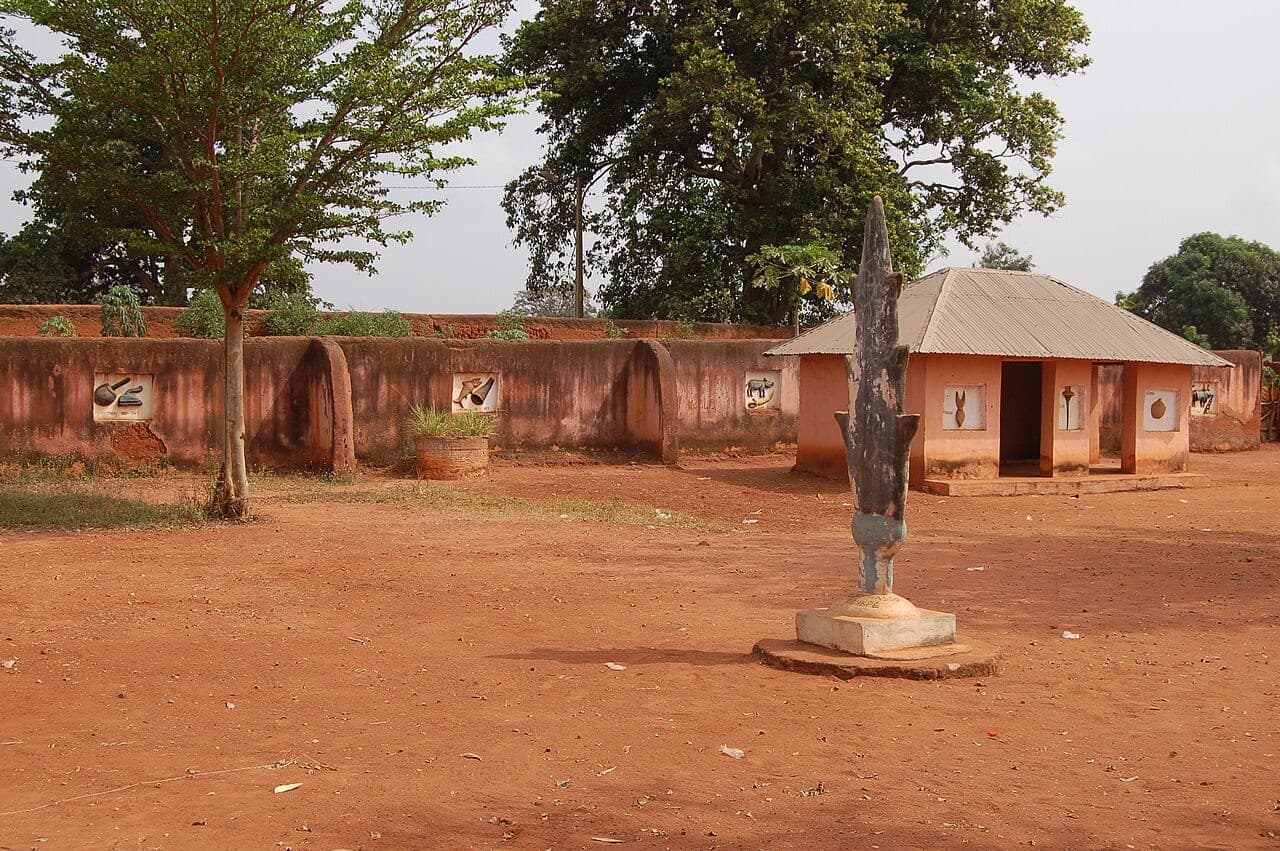
The Republic of Benin is a narrow country on the Bight of Benin, reaching north from a short Atlantic coast toward the River Niger. For most of its recorded history its heartland was not called Benin at all but Dahomey, the kingdom whose rulers governed from the earthen palaces of Abomey and whose armies included the Agojie, the women soldiers Europeans named the Amazons. The country took the name Benin only in 1975, from the bay offshore, and it should not be confused with the older Kingdom of Benin, an Edo state whose capital, Benin City, lies in present-day Nigeria and whose celebrated brass and bronze works belong to that country.
Memory sits close to the surface here. At Ouidah, once among the busiest embarkation points of the transatlantic slave trade, a four-kilometre road runs from the old auction square down to the beach and the Door of No Return, raised to the hundreds of thousands of people taken from this shore. Inland, Vodun is not folklore but a recognised religion with a national holiday, and each January the coast fills with practitioners from across Benin and the wider diaspora. In 2021 France returned twenty-six royal treasures looted from Abomey in 1892, and their homecoming reopened questions of loss, restitution and what a nation chooses to keep.
Benin covers roughly 113,000 square kilometres, a long strip bordered by Togo to the west, Nigeria to the east, and Burkina Faso and Niger to the north, with only about 120 kilometres of coastline on the Gulf of Guinea. The land rises from a low, sandy shore backed by lagoons through a fertile clay plateau to wooded savannah and the Atacora hills in the north-west. The population of around fourteen million is young and concentrated in the south, near the coast and the two largest cities.
More than fifty peoples live in Benin. The Fon and related Aja and Gun groups predominate in the south, alongside the Yoruba near the Nigerian border, while the north is home to the Bariba, Dendi, Fulani and the Otammari of the Atacora, among others. French is the official language, a legacy of colonial rule, while Fon and Yoruba are the widest-spoken tongues of daily life. Porto-Novo is the constitutional capital, but Cotonou, larger and set on the coast, is the seat of government and the commercial centre.
Porto-Novo. The official capital sits on a lagoon inland from the sea and grew as the coastal kingdom of Hogbonu. Its name, Portuguese for "new port," records the traders who worked this shore. The city carries a distinctive Afro-Brazilian architecture, brought by the Agudas, families of formerly enslaved people and their descendants who returned from Brazil in the nineteenth century; the Great Mosque, built in the style of a Bahian baroque church, is the best-known example. Porto-Novo joined the UNESCO Creative Cities Network in recognition of this built heritage.
 Ganvie was built out on the lagoon by people escaping slave raids, on the understanding that the raiders' religion forbade them from following onto the water. Photograph by jbdodane, CC BY 2.0, via Wikimedia Commons.
Cotonou. The largest city and economic heart of Benin is the country's main port and administrative centre. Its Fon name is often rendered as "the mouth of the river of death," a memory of the lagoon channel it commands. It holds the Dantokpa market, one of the largest in West Africa, and since 2022 a thirty-metre bronze statue of an Agojie warrior, raised by the state to honour the women soldiers of Dahomey.
Abomey. Some hundred kilometres inland, Abomey was the capital of the Kingdom of Dahomey for nearly three centuries. Its Royal Palaces, built of earth and once enclosed by a great wall, are a UNESCO World Heritage Site and house the Historical Museum of Abomey. The town remains a centre of the appliqué, weaving and metalwork crafts that once served the court.
Ouidah. On the coast west of Cotonou, Ouidah holds two histories at once. It was a principal port of the transatlantic slave trade for close to two centuries, and it is today regarded as the spiritual capital of Vodun. Its Portuguese fort, its Route des Esclaves and its January festival draw visitors and pilgrims from across the Atlantic world.
The southern peoples trace their origins to the Aja town of Tado, in what is now Togo, from which migrants founded the kingdom of Allada, also called Great Ardra. By tradition, princes leaving Allada established two further states: Hogbonu, the later Porto-Novo, and Dahomey on the Abomey plateau early in the seventeenth century. Dahomey grew into a centralised military kingdom whose kings built their palaces one beside another within the same walls at Abomey. King Agaja, reigning in the early eighteenth century, drove south to the sea, taking Allada in 1724 and the port of Ouidah in 1727, and so brought the kingdom into direct contact with European traders.
Dahomey reached its height in the nineteenth century under King Ghezo, who ruled from 1818 to 1858, threw off the tribute owed to the Yoruba empire of Oyo, and reorganised the army. It was Ghezo who expanded the female regiments the world came to know as the Dahomey Amazons. In the Fon language they were called mino, "our mothers," or ahosi, and in their own tradition the Agojie; by mid-century they may have made up a third or more of the standing army, and they fought with a discipline European observers recorded with unease. Ghezo was followed by Glele and, in 1889, by Behanzin.
The wealth of the coast rested for two centuries on a trade in human beings. Dahomey's wars produced captives who were sold at Ouidah to Portuguese, French, English and other traders and carried across the Atlantic to the plantations of the Americas. Hundreds of thousands passed through this shore, which Europeans called the Slave Coast, and the loss shaped both the kingdom that traded and the diaspora that grew from those who were taken. Abolition by the European powers in the nineteenth century undercut the economy that had come to depend on it, and cast a shadow Benin has since chosen to face rather than forget.
Behanzin resisted the French advance from Cotonou and fought two wars against a column led by Colonel Alfred Dodds in 1892 and 1894. As Dodds approached Abomey in 1892, the king ordered the palaces burned rather than surrendered whole. Defeated, he gave himself up in January 1894 and was deported to Martinique and later Algeria, where he died in 1906, the last independent king of Dahomey. The French absorbed the territory as the colony of Dahomey within French West Africa.
Dahomey gained full independence from France on 1 August 1960. The first republic was unstable, marked by repeated coups, until Mathieu Kérékou seized power in 1972 and, from 1974, declared a Marxist-Leninist course of nationalisation and state planning. In 1975 the country was renamed the People's Republic of Benin, and kept that name and system through fifteen years of economic decline. In February 1990, facing bankruptcy and unrest, Kérékou convened a national conference that stripped him of most of his powers and set Benin on a peaceful path to multiparty democracy, a model watched closely across francophone Africa. Nicéphore Soglo won the presidency in 1991, and Kérékou returned to office by the ballot box in 1996.
French remains the language of government, law and schooling, a direct inheritance of colonial rule, but it is a first language for very few. The living tongues are African: Fon, or Fongbe, spoken across the south and understood far beyond its home region; Yoruba, called Nago locally, near the Nigerian border; Gun around Porto-Novo; and, in the north, Bariba, Dendi, Fulfulde and the languages of the Atacora peoples.
The country's own name carries a deliberate choice. When the kingdom of Dahomey became a republic in 1960 it kept the royal name, but in 1975 the new government replaced it with Benin, taken from the Bight of Benin, the arm of the Atlantic along the southern coast. The change was meant to reach past the associations of a single kingdom and its old capital toward a name shared by the whole coast and all its peoples. The word Benin in the bay's name is far older, drawn ultimately from the Edo kingdom to the east; the modern republic thus shares a name, but not a history, with the Kingdom of Benin in Nigeria and its bronzes.
The visual signature of Dahomey is the bas-relief and the appliqué banner. On the palace walls at Abomey, moulded earthen reliefs set out the deeds and emblems of each king in scenes of war, ritual and rule. The same royal symbols reappear in the appliqué cloths sewn by the artisan families of Abomey, among them the Yemadje, who cut coloured figures and stitch them onto a plain ground: the buffalo of Ghezo, the lion of Glele, the shark of Behanzin. Weaving, brass casting and wood carving round out a court tradition that survives as a living craft.
Vodun runs through southern culture as both religion and art. Its yearly focus is the festival at Ouidah, held around the national Vodun holiday in January, when shrines open, drummers and dancers fill the streets and the town welcomes practitioners from across Benin and the Americas. On the water north of Cotonou lies Ganvie, a settlement of teak and bamboo houses raised on stilts across Lake Nokoué, home to some thirty thousand Tofinu people. It began in the seventeenth century as a refuge from the slave raids of the mainland kingdoms, and its name is said to mean "we survived," a memory built into the village. Beninese cuisine leans on maize, cassava and yam, worked into pâte and akassa and served with sauces of tomato, okra, groundnut and red palm oil, alongside grilled lagoon fish and fried plantain.
Benin is one of the few countries to recognise Vodun formally as a religion. During the democratic opening of the 1990s the state acknowledged it and set aside 10 January as a national holiday, ending decades in which the faith had been discouraged. Vodun understands a supreme creator, a company of deities tied to natural forces, and the ancestors as bound together in a single order of obligation and healing; its priests, shrines and ceremonies remain central to community life across the south, with Ouidah as its acknowledged spiritual centre.
Alongside Vodun, Christianity and Islam claim large followings. Roman Catholicism, established under French rule, and a range of Protestant and independent churches are strongest in the south and centre; Islam predominates in the north, carried along the old trans-Saharan trade routes and represented among the Dendi, Fulani and Yoruba. Many Beninese move between these traditions without contradiction, keeping ancestral rites while attending church or mosque, especially at moments of birth, marriage and death.
In the Vodun worldview death is a passage rather than an ending. The dead join the ancestors, who remain present to their descendants and must be honoured with offerings, libations and the naming of names; neglect of them is thought to bring misfortune. A death sets in motion a sequence of duties that extend well beyond the burial: divination to learn the wishes of the departed, the installation of the spirit among the ancestors, and periodic ceremonies at family shrines. Funerals among the Fon and related peoples are communal events of drumming, dance and feasting, sober and celebratory at once, in which the community accompanies one of its own out of the world.
Ouidah holds a wider grief. The Route des Esclaves traces the path captives were forced to walk from the auction square to the sea, past the Tree of Forgetfulness, where they were made to circle in a ritual meant to sever memory of home, to the Zomai enclosure where they were held in darkness, and down to the beach and the Door of No Return. The monuments there are places of mourning for a loss measured in generations, and returning members of the diaspora come to walk the road and stand at the shore. The rite of forgetting has since been answered by a Door of Return, an assertion that the broken tie can be acknowledged even when it cannot be undone.
The other faiths keep their own observances. Christian families hold funeral Masses and services, often followed by wakes and by remembrance on set anniversaries. Muslims bury their dead quickly and simply after the funeral prayer, facing Mecca, and mark the days that follow with recitation and shared meals. Across all these traditions the pattern is one: the dead are not left behind but carried forward in observance, a duty the living owe.
Benin's records begin at the water, because Ouidah was one of the busiest embarkation points of the Atlantic slave trade.
Between two and a half and three million people are estimated to have been shipped from the Bight of Benin. The Portuguese fort at Ouidah, the French and English factories, and the Dahomean court all kept accounts, and the surviving ledgers, held in Portugal, France, Britain and Brazil rather than in Benin, are commercial records in which individual people appear as cargo. Reconstructing a family across that crossing is done by matching those records to arrival papers in Bahia, Havana and Charleston, and the work is slow and often ends in a probability rather than a name.
The reverse traffic is better documented. Formerly enslaved Brazilians returned to the coast from the 1830s and formed the Agudá community, whose Portuguese surnames, Catholic parishes and family papers still trace back to specific plantations in Bahia.
French colonial administration from the 1890s produced an état civil applied unevenly, and those files are split between Porto-Novo and the archives at Aix-en-Provence.
The older Beninese record is royal and ritual. The kings of Dahomey were commemorated in the palaces at Abomey with appliqué banners and recades that encode each reign, and Vodun lineages maintain their own descent and their own priests. The return of twenty-six royal objects from France in 2021 brought part of that record physically home for the first time since 1892.
The Royal Palaces of Abomey were inscribed on the UNESCO World Heritage List in 1985 for their earthen architecture and their bas-reliefs, and placed at the same time on the List of World Heritage in Danger after a tornado had damaged the fragile structures. A long restoration campaign, supported through a partnership between UNESCO and Japan, allowed the property to be removed from the danger list in 2007. The palaces of Ghezo and Glele today form the Historical Museum of Abomey, and a new institution, the Museum of the Epic of the Amazons and the Kings of Danhome, has been built on the palatial site.
At Ouidah, the Ouidah Museum of History occupies the Portuguese fort of Sao Joao Baptista de Ajuda, built in 1721 and held as a Portuguese enclave until Dahomey annexed it in 1961. Opened as a museum in 1967, it holds some seven hundred objects covering the kingdom of Dahomey, the Atlantic slave trade and Vodun, and it anchors the memorial landscape of the Route des Esclaves that runs from the town to the shore.
The most closely watched act of preservation in recent years was a homecoming. In November 2021, following a French law passed the previous year, twenty-six royal treasures taken from Abomey by Colonel Dodds's forces in 1892, among them carved thrones, palace doors and the great anthropomorphic statues of the kings, were transferred from the Quai Branly museum in Paris to Benin. Their return, shown first to large crowds in Cotonou, gave weight to a broader argument about the restitution of African heritage held in European collections.
Benin has begun to build a digital record around the returned treasures and the sites that hold them. The twenty-six works from Abomey were documented and catalogued in detail during the restitution, and the new museum projects at Abomey and along the coast are designed with digital interpretation in mind. State and cultural bodies now publish online material around the Vodun festival, expanded into a multi-day programme with its own digital platform, extending the reach of a celebration once confined to Ouidah.
International partners have added to the record, digitising photographs, ethnographic collections and archival material on Dahomey and the slave trade for researchers and for descendant communities who cannot travel to see them. As the museums at Abomey, Ouidah and Cotonou come fully into service, the aim is to pair the physical return of heritage with an open digital archive accessible wherever the diaspora has settled.
Benin's deepest cultural export travelled the Atlantic in chains and survived. The Vodun of the Fon and Aja peoples is a direct ancestor of the Vodou of Haiti, of the Candomble Jeje of Brazil, of practices in Cuba and across the Caribbean, and of the folk traditions of New Orleans and the Gulf. The word itself, meaning spirit or deity in Fon and Ewe, passed into all of them. For millions in the Americas, the shrines of Ouidah are a point of origin, and the January festival has become a gathering place for a religion now global.
At home and abroad, Beninese artists carry the country's name forward. The singer Angelique Kidjo, born in Ouidah, has won international acclaim while drawing openly on Fon rhythm and Vodun imagery, and a generation of writers, sculptors and musicians has followed. The story of the Agojie reached a worldwide audience through recent cinema, prompting fresh interest in Abomey. The government has made culture a pillar of national policy, investing in museums and festivals for the diaspora and for tourism as much as for Beninese at home.
The treasures come home. The return of twenty-six royal works to Benin in November 2021, after a change in French law, was among the first large restitutions of looted heritage from a European national collection to an African state, and set a reference point for negotiations elsewhere.
A festival becomes a movement. The Vodun holiday at Ouidah, long a single day on 10 January, has grown into a multi-day festival drawing practitioners and visitors from across Benin and the Atlantic diaspora, turning a once-discouraged religion into a source of national pride.
Abomey saved and reopened. Sustained conservation work lifted the Royal Palaces of Abomey off the List of World Heritage in Danger in 2007, and a new museum on the site now presents the kingdom of Dahomey and the Agojie to a broad public.
Ganvie endures. The stilt village on Lake Nokoue, founded as a refuge from slave raiding, remains a living community of tens of thousands whose very name preserves the memory of survival.
Ganvie was built out on the lagoon by people escaping slave raids, on the understanding that the raiders' religion forbade them from following onto the water. Photograph by jbdodane, CC BY 2.0, via Wikimedia Commons.
Cotonou. The largest city and economic heart of Benin is the country's main port and administrative centre. Its Fon name is often rendered as "the mouth of the river of death," a memory of the lagoon channel it commands. It holds the Dantokpa market, one of the largest in West Africa, and since 2022 a thirty-metre bronze statue of an Agojie warrior, raised by the state to honour the women soldiers of Dahomey.
Abomey. Some hundred kilometres inland, Abomey was the capital of the Kingdom of Dahomey for nearly three centuries. Its Royal Palaces, built of earth and once enclosed by a great wall, are a UNESCO World Heritage Site and house the Historical Museum of Abomey. The town remains a centre of the appliqué, weaving and metalwork crafts that once served the court.
Ouidah. On the coast west of Cotonou, Ouidah holds two histories at once. It was a principal port of the transatlantic slave trade for close to two centuries, and it is today regarded as the spiritual capital of Vodun. Its Portuguese fort, its Route des Esclaves and its January festival draw visitors and pilgrims from across the Atlantic world.
The southern peoples trace their origins to the Aja town of Tado, in what is now Togo, from which migrants founded the kingdom of Allada, also called Great Ardra. By tradition, princes leaving Allada established two further states: Hogbonu, the later Porto-Novo, and Dahomey on the Abomey plateau early in the seventeenth century. Dahomey grew into a centralised military kingdom whose kings built their palaces one beside another within the same walls at Abomey. King Agaja, reigning in the early eighteenth century, drove south to the sea, taking Allada in 1724 and the port of Ouidah in 1727, and so brought the kingdom into direct contact with European traders.
Dahomey reached its height in the nineteenth century under King Ghezo, who ruled from 1818 to 1858, threw off the tribute owed to the Yoruba empire of Oyo, and reorganised the army. It was Ghezo who expanded the female regiments the world came to know as the Dahomey Amazons. In the Fon language they were called mino, "our mothers," or ahosi, and in their own tradition the Agojie; by mid-century they may have made up a third or more of the standing army, and they fought with a discipline European observers recorded with unease. Ghezo was followed by Glele and, in 1889, by Behanzin.
The wealth of the coast rested for two centuries on a trade in human beings. Dahomey's wars produced captives who were sold at Ouidah to Portuguese, French, English and other traders and carried across the Atlantic to the plantations of the Americas. Hundreds of thousands passed through this shore, which Europeans called the Slave Coast, and the loss shaped both the kingdom that traded and the diaspora that grew from those who were taken. Abolition by the European powers in the nineteenth century undercut the economy that had come to depend on it, and cast a shadow Benin has since chosen to face rather than forget.
Behanzin resisted the French advance from Cotonou and fought two wars against a column led by Colonel Alfred Dodds in 1892 and 1894. As Dodds approached Abomey in 1892, the king ordered the palaces burned rather than surrendered whole. Defeated, he gave himself up in January 1894 and was deported to Martinique and later Algeria, where he died in 1906, the last independent king of Dahomey. The French absorbed the territory as the colony of Dahomey within French West Africa.
Dahomey gained full independence from France on 1 August 1960. The first republic was unstable, marked by repeated coups, until Mathieu Kérékou seized power in 1972 and, from 1974, declared a Marxist-Leninist course of nationalisation and state planning. In 1975 the country was renamed the People's Republic of Benin, and kept that name and system through fifteen years of economic decline. In February 1990, facing bankruptcy and unrest, Kérékou convened a national conference that stripped him of most of his powers and set Benin on a peaceful path to multiparty democracy, a model watched closely across francophone Africa. Nicéphore Soglo won the presidency in 1991, and Kérékou returned to office by the ballot box in 1996.
French remains the language of government, law and schooling, a direct inheritance of colonial rule, but it is a first language for very few. The living tongues are African: Fon, or Fongbe, spoken across the south and understood far beyond its home region; Yoruba, called Nago locally, near the Nigerian border; Gun around Porto-Novo; and, in the north, Bariba, Dendi, Fulfulde and the languages of the Atacora peoples.
The country's own name carries a deliberate choice. When the kingdom of Dahomey became a republic in 1960 it kept the royal name, but in 1975 the new government replaced it with Benin, taken from the Bight of Benin, the arm of the Atlantic along the southern coast. The change was meant to reach past the associations of a single kingdom and its old capital toward a name shared by the whole coast and all its peoples. The word Benin in the bay's name is far older, drawn ultimately from the Edo kingdom to the east; the modern republic thus shares a name, but not a history, with the Kingdom of Benin in Nigeria and its bronzes.
The visual signature of Dahomey is the bas-relief and the appliqué banner. On the palace walls at Abomey, moulded earthen reliefs set out the deeds and emblems of each king in scenes of war, ritual and rule. The same royal symbols reappear in the appliqué cloths sewn by the artisan families of Abomey, among them the Yemadje, who cut coloured figures and stitch them onto a plain ground: the buffalo of Ghezo, the lion of Glele, the shark of Behanzin. Weaving, brass casting and wood carving round out a court tradition that survives as a living craft.
Vodun runs through southern culture as both religion and art. Its yearly focus is the festival at Ouidah, held around the national Vodun holiday in January, when shrines open, drummers and dancers fill the streets and the town welcomes practitioners from across Benin and the Americas. On the water north of Cotonou lies Ganvie, a settlement of teak and bamboo houses raised on stilts across Lake Nokoué, home to some thirty thousand Tofinu people. It began in the seventeenth century as a refuge from the slave raids of the mainland kingdoms, and its name is said to mean "we survived," a memory built into the village. Beninese cuisine leans on maize, cassava and yam, worked into pâte and akassa and served with sauces of tomato, okra, groundnut and red palm oil, alongside grilled lagoon fish and fried plantain.
Benin is one of the few countries to recognise Vodun formally as a religion. During the democratic opening of the 1990s the state acknowledged it and set aside 10 January as a national holiday, ending decades in which the faith had been discouraged. Vodun understands a supreme creator, a company of deities tied to natural forces, and the ancestors as bound together in a single order of obligation and healing; its priests, shrines and ceremonies remain central to community life across the south, with Ouidah as its acknowledged spiritual centre.
Alongside Vodun, Christianity and Islam claim large followings. Roman Catholicism, established under French rule, and a range of Protestant and independent churches are strongest in the south and centre; Islam predominates in the north, carried along the old trans-Saharan trade routes and represented among the Dendi, Fulani and Yoruba. Many Beninese move between these traditions without contradiction, keeping ancestral rites while attending church or mosque, especially at moments of birth, marriage and death.
In the Vodun worldview death is a passage rather than an ending. The dead join the ancestors, who remain present to their descendants and must be honoured with offerings, libations and the naming of names; neglect of them is thought to bring misfortune. A death sets in motion a sequence of duties that extend well beyond the burial: divination to learn the wishes of the departed, the installation of the spirit among the ancestors, and periodic ceremonies at family shrines. Funerals among the Fon and related peoples are communal events of drumming, dance and feasting, sober and celebratory at once, in which the community accompanies one of its own out of the world.
Ouidah holds a wider grief. The Route des Esclaves traces the path captives were forced to walk from the auction square to the sea, past the Tree of Forgetfulness, where they were made to circle in a ritual meant to sever memory of home, to the Zomai enclosure where they were held in darkness, and down to the beach and the Door of No Return. The monuments there are places of mourning for a loss measured in generations, and returning members of the diaspora come to walk the road and stand at the shore. The rite of forgetting has since been answered by a Door of Return, an assertion that the broken tie can be acknowledged even when it cannot be undone.
The other faiths keep their own observances. Christian families hold funeral Masses and services, often followed by wakes and by remembrance on set anniversaries. Muslims bury their dead quickly and simply after the funeral prayer, facing Mecca, and mark the days that follow with recitation and shared meals. Across all these traditions the pattern is one: the dead are not left behind but carried forward in observance, a duty the living owe.
Benin's records begin at the water, because Ouidah was one of the busiest embarkation points of the Atlantic slave trade.
Between two and a half and three million people are estimated to have been shipped from the Bight of Benin. The Portuguese fort at Ouidah, the French and English factories, and the Dahomean court all kept accounts, and the surviving ledgers, held in Portugal, France, Britain and Brazil rather than in Benin, are commercial records in which individual people appear as cargo. Reconstructing a family across that crossing is done by matching those records to arrival papers in Bahia, Havana and Charleston, and the work is slow and often ends in a probability rather than a name.
The reverse traffic is better documented. Formerly enslaved Brazilians returned to the coast from the 1830s and formed the Agudá community, whose Portuguese surnames, Catholic parishes and family papers still trace back to specific plantations in Bahia.
French colonial administration from the 1890s produced an état civil applied unevenly, and those files are split between Porto-Novo and the archives at Aix-en-Provence.
The older Beninese record is royal and ritual. The kings of Dahomey were commemorated in the palaces at Abomey with appliqué banners and recades that encode each reign, and Vodun lineages maintain their own descent and their own priests. The return of twenty-six royal objects from France in 2021 brought part of that record physically home for the first time since 1892.
The Royal Palaces of Abomey were inscribed on the UNESCO World Heritage List in 1985 for their earthen architecture and their bas-reliefs, and placed at the same time on the List of World Heritage in Danger after a tornado had damaged the fragile structures. A long restoration campaign, supported through a partnership between UNESCO and Japan, allowed the property to be removed from the danger list in 2007. The palaces of Ghezo and Glele today form the Historical Museum of Abomey, and a new institution, the Museum of the Epic of the Amazons and the Kings of Danhome, has been built on the palatial site.
At Ouidah, the Ouidah Museum of History occupies the Portuguese fort of Sao Joao Baptista de Ajuda, built in 1721 and held as a Portuguese enclave until Dahomey annexed it in 1961. Opened as a museum in 1967, it holds some seven hundred objects covering the kingdom of Dahomey, the Atlantic slave trade and Vodun, and it anchors the memorial landscape of the Route des Esclaves that runs from the town to the shore.
The most closely watched act of preservation in recent years was a homecoming. In November 2021, following a French law passed the previous year, twenty-six royal treasures taken from Abomey by Colonel Dodds's forces in 1892, among them carved thrones, palace doors and the great anthropomorphic statues of the kings, were transferred from the Quai Branly museum in Paris to Benin. Their return, shown first to large crowds in Cotonou, gave weight to a broader argument about the restitution of African heritage held in European collections.
Benin has begun to build a digital record around the returned treasures and the sites that hold them. The twenty-six works from Abomey were documented and catalogued in detail during the restitution, and the new museum projects at Abomey and along the coast are designed with digital interpretation in mind. State and cultural bodies now publish online material around the Vodun festival, expanded into a multi-day programme with its own digital platform, extending the reach of a celebration once confined to Ouidah.
International partners have added to the record, digitising photographs, ethnographic collections and archival material on Dahomey and the slave trade for researchers and for descendant communities who cannot travel to see them. As the museums at Abomey, Ouidah and Cotonou come fully into service, the aim is to pair the physical return of heritage with an open digital archive accessible wherever the diaspora has settled.
Benin's deepest cultural export travelled the Atlantic in chains and survived. The Vodun of the Fon and Aja peoples is a direct ancestor of the Vodou of Haiti, of the Candomble Jeje of Brazil, of practices in Cuba and across the Caribbean, and of the folk traditions of New Orleans and the Gulf. The word itself, meaning spirit or deity in Fon and Ewe, passed into all of them. For millions in the Americas, the shrines of Ouidah are a point of origin, and the January festival has become a gathering place for a religion now global.
At home and abroad, Beninese artists carry the country's name forward. The singer Angelique Kidjo, born in Ouidah, has won international acclaim while drawing openly on Fon rhythm and Vodun imagery, and a generation of writers, sculptors and musicians has followed. The story of the Agojie reached a worldwide audience through recent cinema, prompting fresh interest in Abomey. The government has made culture a pillar of national policy, investing in museums and festivals for the diaspora and for tourism as much as for Beninese at home.
The treasures come home. The return of twenty-six royal works to Benin in November 2021, after a change in French law, was among the first large restitutions of looted heritage from a European national collection to an African state, and set a reference point for negotiations elsewhere.
A festival becomes a movement. The Vodun holiday at Ouidah, long a single day on 10 January, has grown into a multi-day festival drawing practitioners and visitors from across Benin and the Atlantic diaspora, turning a once-discouraged religion into a source of national pride.
Abomey saved and reopened. Sustained conservation work lifted the Royal Palaces of Abomey off the List of World Heritage in Danger in 2007, and a new museum on the site now presents the kingdom of Dahomey and the Agojie to a broad public.
Ganvie endures. The stilt village on Lake Nokoue, founded as a refuge from slave raiding, remains a living community of tens of thousands whose very name preserves the memory of survival.
National Overview
Notable Cities
Historical Foundations
Linguistic and Etymological Roots
Cultural Identity
Religion and Spirituality
Remembrance and Mourning Traditions
Tracing a Family in Benin
Heritage Preservation Efforts
Digital Heritage
Contemporary Cultural Influences
Success Stories
References and resources
- UNESCO World Heritage Centre: Royal Palaces of Abomey. The inscription, criteria and conservation history of the Abomey site.
- Encyclopaedia Britannica: Benin. Geography, peoples, history and political background.
- Encyclopaedia Britannica: Dahomey women warriors. The history of the Agojie under Ghezo and after.
- Encyclopaedia Britannica: Behanzin. The last independent king of Dahomey and his exile.
- Musée du quai Branly: Restitution of 26 works to the Republic of Benin. The 2021 return of the Abomey royal treasures.
- Britannica: São João Baptista de Ajudá. The Portuguese fort at Ouidah that houses the Museum of History.
- Door of No Return, Ouidah. The memorial arch on the beach and the Route des Esclaves.
- Vodun Days official festival site. The annual Vodun celebration at Ouidah and its programme.
- Expertise France: Museum of the Epic of the Amazons and Kings of Danhomey. The new museum on the Abomey palatial site.
- Amazon Monument (Benin). The thirty-metre statue in Cotonou honouring the Agojie.
- UNESCO Creative Cities: Porto-Novo. The capital's Afro-Brazilian built heritage.