Heritage · Country
Poland Culture and Heritage
On the night of 1 November, Poland's cemeteries turn into oceans of light as families set millions of znicze on the graves, and no grave is left dark, including the graves of former enemies. A guide to the country's heritage and to a nation that rebuilt its capital from paintings and learned to say the word Katyń out loud.Written to last.
By Confinity Heritage Editorial · 2026-07-11 · 8-minute readQuiet tools, kept out of the way.
On the evening of 1 November, Poland can be picked out from the air by its cemeteries. For Wszystkich Świętych, All Saints' Day, families travel across the country to the graves of their dead and set out znicze, the squat glass grave-lanterns sold by the millions each autumn, until whole burial grounds become seas of trembling flame. The custom is close to universal: people tend not only their own family plots but the neglected graves nearby, the tombs of strangers, of soldiers, even of former enemies, so that on this one night no grave is left in the dark. It is one of the most visible acts of collective remembrance anywhere in Europe, a nation lighting its dead all at once.
Poland has needed such rituals more than most. It is a country that was wiped off the map of Europe for 123 years, that lost around six million citizens in the Second World War, half of them Jews murdered in death camps built on its soil, and that saw its capital deliberately reduced to rubble and then rebuilt, brick by brick, partly from eighteenth-century paintings. For half a century it could not even name some of its dead: the 22,000 officers shot at Katyń in 1940 were blamed on the Germans until the truth was finally admitted in 1990.
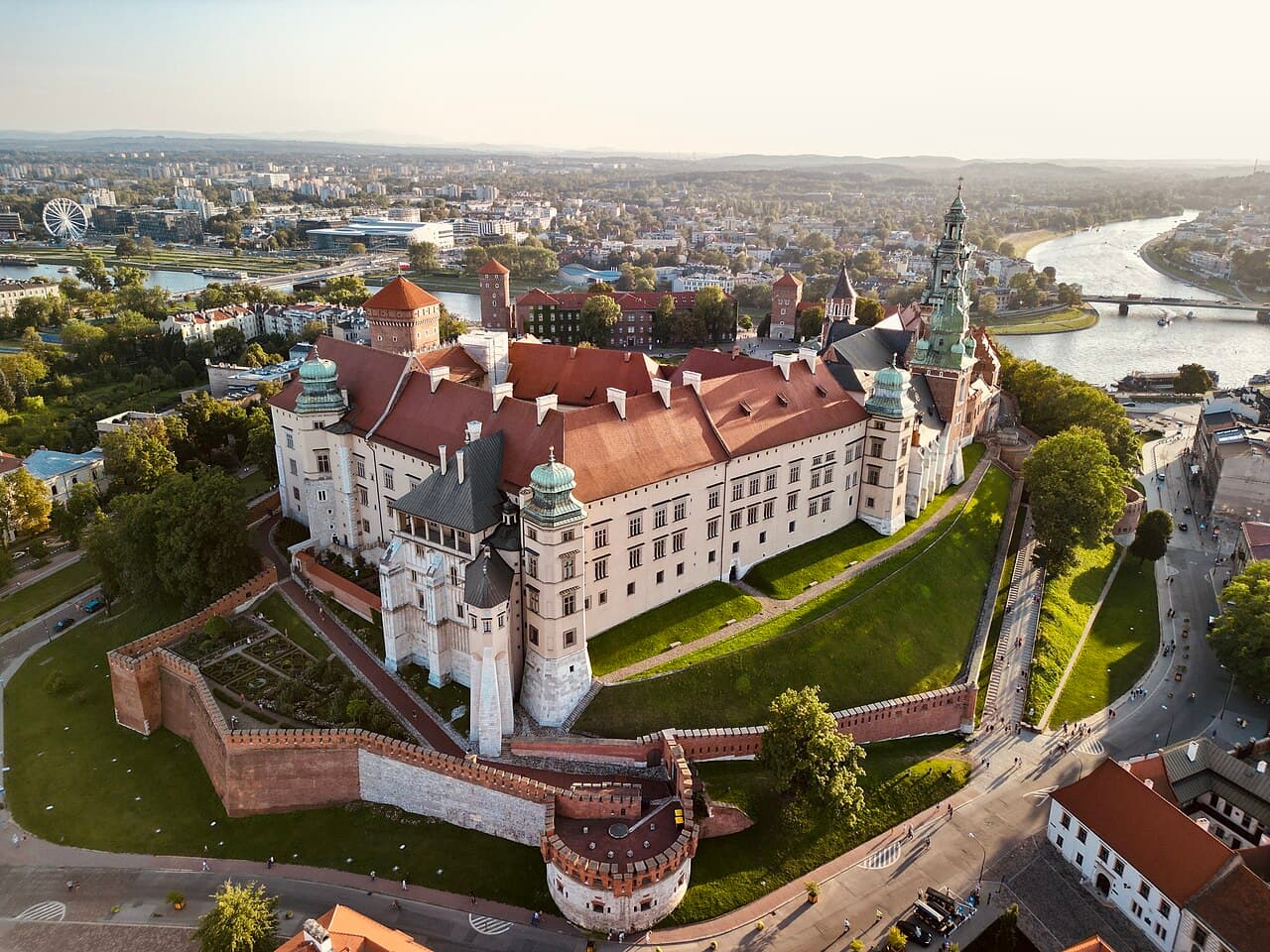
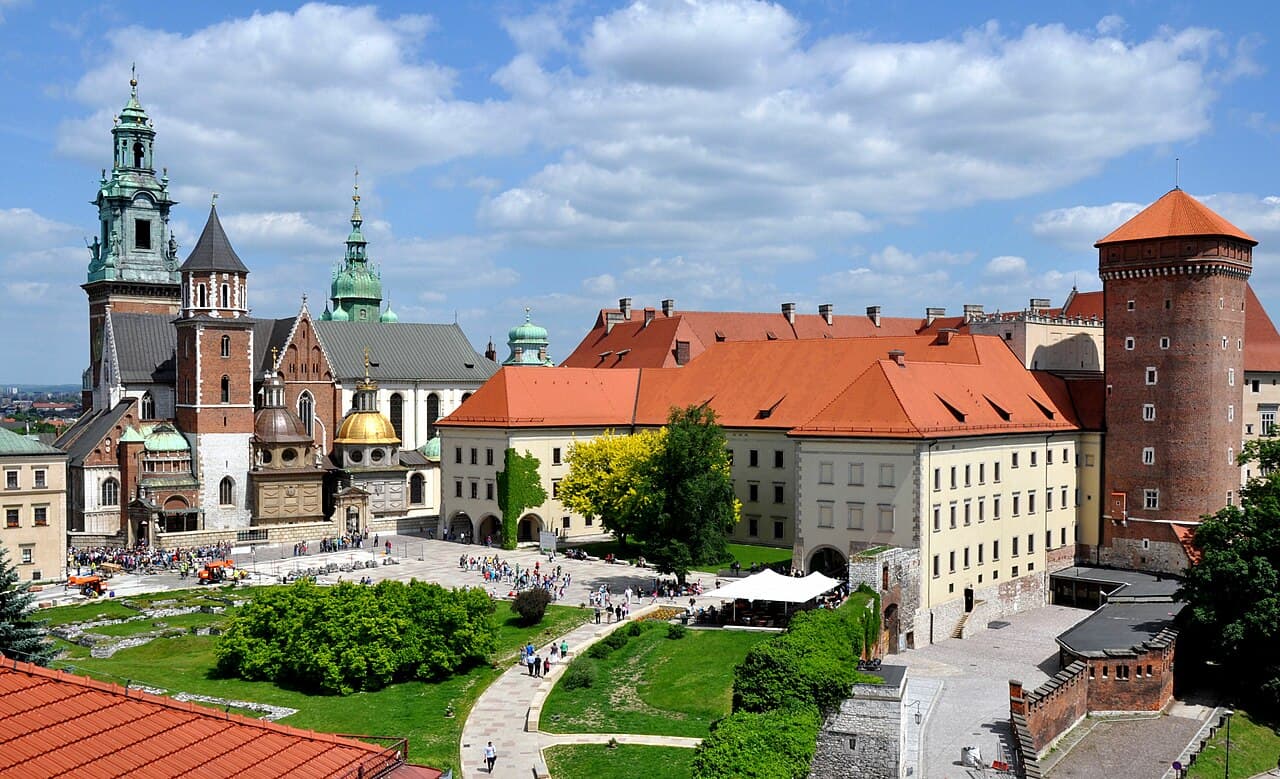 Wawel Royal Castle and cathedral above the Vistula in Kraków, coronation site and burial place of Poland's kings. CC BY 3.0, via Wikimedia Commons.
Poland occupies about 312,700 square kilometres in the middle of the North European Plain, a largely flat, open country that has long been both a crossroads and a battlefield, with few natural borders to defend. It stretches from a Baltic coastline of dunes and lagoons in the north, some 770 kilometres long by the official measure, to the Sudeten and Carpathian mountains in the south, where the jagged Tatras rise to Rysy at 2,499 metres, Poland's highest point. The great rivers, above all the Vistula, or Wisła, which runs the length of the country through Kraków and Warsaw to the sea at Gdańsk, have carried its trade and its history; and in the east survives Białowieża, the last great fragment of the primeval lowland forest that once covered the continent, home to Europe's largest land mammal, the European bison, brought back from the edge of extinction.
Poland has around 37.5 million people and is, by European standards, unusually homogeneous, more than nine in ten ethnically Polish and Catholic, a uniformity that is itself a product of the twentieth century's catastrophes, which destroyed the country's Jewish, German and other minorities and shifted its borders hundreds of kilometres westward after 1945. It is a parliamentary republic, a member of NATO since 1999 and the European Union since 2004, and one of the fastest-growing economies in the bloc. The capital is Warsaw, the largest city and seat of government, but the country's historic and spiritual centre of gravity lies south, in Kraków, the old royal capital that came through the war almost undamaged.
Warsaw. The capital since the end of the sixteenth century, Warsaw was systematically destroyed by German forces in 1944, with some 85 per cent of its buildings reduced to ruins, and then rebuilt in one of history's great acts of restoration. Its Old Town, reconstructed so faithfully from surviving plans and paintings that it was inscribed on the World Heritage List, sits amid a modern city of memorials: the Warsaw Uprising Museum, the monument to the Ghetto Heroes, and the POLIN Museum of the History of Polish Jews.
Wawel Royal Castle and cathedral above the Vistula in Kraków, coronation site and burial place of Poland's kings. CC BY 3.0, via Wikimedia Commons.
Poland occupies about 312,700 square kilometres in the middle of the North European Plain, a largely flat, open country that has long been both a crossroads and a battlefield, with few natural borders to defend. It stretches from a Baltic coastline of dunes and lagoons in the north, some 770 kilometres long by the official measure, to the Sudeten and Carpathian mountains in the south, where the jagged Tatras rise to Rysy at 2,499 metres, Poland's highest point. The great rivers, above all the Vistula, or Wisła, which runs the length of the country through Kraków and Warsaw to the sea at Gdańsk, have carried its trade and its history; and in the east survives Białowieża, the last great fragment of the primeval lowland forest that once covered the continent, home to Europe's largest land mammal, the European bison, brought back from the edge of extinction.
Poland has around 37.5 million people and is, by European standards, unusually homogeneous, more than nine in ten ethnically Polish and Catholic, a uniformity that is itself a product of the twentieth century's catastrophes, which destroyed the country's Jewish, German and other minorities and shifted its borders hundreds of kilometres westward after 1945. It is a parliamentary republic, a member of NATO since 1999 and the European Union since 2004, and one of the fastest-growing economies in the bloc. The capital is Warsaw, the largest city and seat of government, but the country's historic and spiritual centre of gravity lies south, in Kraków, the old royal capital that came through the war almost undamaged.
Warsaw. The capital since the end of the sixteenth century, Warsaw was systematically destroyed by German forces in 1944, with some 85 per cent of its buildings reduced to ruins, and then rebuilt in one of history's great acts of restoration. Its Old Town, reconstructed so faithfully from surviving plans and paintings that it was inscribed on the World Heritage List, sits amid a modern city of memorials: the Warsaw Uprising Museum, the monument to the Ghetto Heroes, and the POLIN Museum of the History of Polish Jews.
 The Renaissance Cloth Hall on Kraków's Main Market Square, the medieval heart of the old royal capital. CC BY 2.0, via Wikimedia Commons.
Kraków. The royal capital until the court moved to Warsaw, Kraków escaped wartime destruction and keeps the largest medieval market square in Europe, the Wawel castle and cathedral where Polish kings were crowned and buried, and the old Jewish quarter of Kazimierz. Its historic centre was among the first sites anywhere inscribed on the UNESCO World Heritage List in 1978, and it remains the country's cultural capital.
Gdańsk. The great Baltic port, a Hanseatic and long partly German city called Danzig, is where the Second World War began, at the Westerplatte peninsula on 1 September 1939. Four decades later its Lenin Shipyard gave birth to Solidarity, the trade union led by Lech Wałęsa whose strikes in 1980 began the unravelling of communism across the Eastern bloc, a story now told at the European Solidarity Centre.
Wrocław. The historic capital of Silesia, known for centuries as the German Breslau before becoming Polish in 1945, Wrocław is a city rebuilt by people themselves displaced, many from the eastern lands Poland lost to the Soviet Union. Its Centennial Hall, a pioneering reinforced-concrete structure of 1913, is a World Heritage Site, and the city is dotted with hundreds of small bronze dwarf statues that have become its playful emblem.
Toruń. A brick-Gothic town on the Vistula that survived the war intact, Toruń was the birthplace of Nicolaus Copernicus, who overturned the cosmos from this corner of northern Poland. Its medieval old town, built by the Teutonic Knights and enriched by Hanseatic trade, is a World Heritage Site and one of the best-preserved in the country.
Poland dates its birth to the year 966, when Mieszko I, ruler of the Slavic Polanie tribe, accepted Christianity and brought his lands into Latin Europe; his son Bolesław the Brave was crowned the first king in 1025. Over the following centuries the Piast and then the Jagiellonian dynasties built a large and, for its time, strikingly tolerant realm. The union with Lithuania, sealed in 1385 and made permanent in 1569, created the Polish-Lithuanian Commonwealth, a vast multi-ethnic state stretching deep into today's Ukraine and Belarus, governed by an elected king and a noble parliament and home to the largest Jewish population in the world, drawn by charters of protection when much of Europe was expelling its Jews.
That commonwealth weakened through the eighteenth century until its powerful neighbours simply divided it up: in three partitions between 1772 and 1795, Russia, Prussia and Austria erased Poland from the map entirely, and for 123 years there was no Polish state, only a nation kept alive in language, faith, literature and memory. Independence was regained in 1918 after the First World War, but the reborn republic lasted barely two decades before Germany invaded on 1 September 1939 and the Soviet Union from the east on 17 September, opening the most catastrophic chapter in the country's history. Poland lost around six million people, roughly a fifth of its population; its Jewish community, some three million strong, was almost entirely annihilated in the Holocaust, much of it in death camps the Germans built on occupied Polish soil. After the war Poland fell under Soviet-backed communist rule, endured martial law in 1981, and finally broke free when the Solidarity movement forced partly free elections in June 1989, the first crack in the Iron Curtain, followed by full democracy, NATO membership and entry into the European Union.
The name Polska comes from the Polanie, an early Slavic tribe whose own name derives from pole, the Polish word for "field" or "open country", so that Poland means, quite literally, the land of the people of the fields, an apt name for a nation of the great plain. Polish is a West Slavic language of the Lechitic group, closely related to Czech and Slovak, written in the Latin alphabet since the Middle Ages with a distinctive array of diacritics and digraphs, and famous among learners for consonant clusters and a full system of seven grammatical cases. It became a vehicle of high literature early, and during the partitions, when the state had vanished, the language carried the nation: the Romantic poets Adam Mickiewicz and Juliusz Słowacki, writing in exile, kept Polish identity alive for generations who had never known an independent country.
The map of Poland records its shifting borders and mixed past. Many towns carry both Polish and older German names from the western and northern regions that were German before 1945, Wrocław for Breslau, Gdańsk for Danzig, Szczecin for Stettin, while the eastern borderlands, the Kresy, that Poland lost to the Soviet Union have left their own memory in the culture of cities like Lwów, now Lviv in Ukraine. Alongside Polish, the country recognises regional and minority languages, most notably Kashubian, a distinct Slavic tongue spoken near the Baltic coast, along with the German, Belarusian, Lithuanian and other minorities of the borderlands, and the Romani communities scattered across the country.
Polish culture prizes hospitality, family and a strong sense of history, shaped by centuries in which the nation survived through its private and religious life when its public institutions were suppressed. The table is central: pierogi, the stuffed dumplings that come in endless varieties; bigos, the hunter's stew of cabbage and meat; sour rye żurek soup; and the Christmas Eve supper of Wigilia, a meatless twelve-dish meal at which an empty place is traditionally left for an unexpected guest, and the family shares the opłatek wafer. Vodka is the national spirit and a fixture of celebration and mourning alike. Folk traditions remain strong, from the highland górale culture of the Tatra region, with its wooden architecture, music and costume, to painted paper cut-outs, hand-decorated Easter eggs and the elaborate szopki, the fantastical Nativity cribs of Kraków recognised by UNESCO.
The arts occupy an outsized place in national life. Fryderyk Chopin, born near Warsaw in 1810, turned Polish folk dances, the mazurka and the polonaise, into some of the most beloved music in the world, and the Chopin Competition held in Warsaw every five years is a national event. Poland has produced a remarkable line of Nobel laureates in literature, from Henryk Sienkiewicz and Władysław Reymont to the poets Czesław Miłosz and Wisława Szymborska and the novelist Olga Tokarczuk, who won in 2018. Its cinema, from Andrzej Wajda's war trilogy to Krzysztof Kieślowski, has a global reputation, and its poster art and theatre carried coded resistance through the communist decades. Sport, above all football and the ski-jumping that turns górale champions into national heroes, completes a culture that treats its artists and its athletes as bearers of collective pride.
Poland is one of the most Catholic countries in Europe, and the Church has been inseparable from national identity for a thousand years, above all during the partitions and the communist era, when it was the one institution the nation controlled and a refuge for its language and memory. The spiritual heart of the country is the monastery of Jasna Góra at Częstochowa, home of the icon of the Black Madonna, the "Queen of Poland", to which hundreds of thousands of pilgrims walk each August, some for days on foot from across the country. The bond between faith and nation was sealed in 1978, when Karol Wojtyła, the archbishop of Kraków, was elected Pope John Paul II; his triumphant return visits, beginning in 1979, are widely credited with helping inspire Solidarity and the fall of communism, and he remains a revered national figure.
Yet Poland was for most of its history a plural society. The old Commonwealth sheltered not only the world's largest Jewish community but Orthodox Christians, Protestants, Armenians and even the Muslim Lipka Tatars, whose descendants still keep small wooden mosques in the north-east. The Holocaust and the postwar border changes destroyed almost all of that diversity, leaving the overwhelmingly Catholic country of today. Now religion is changing again: the Church remains powerful, but practice is falling sharply among the young, and debates over its role in politics, education and law have become a central fault line in Polish public life, a sign of a society renegotiating an inheritance that once seemed permanent.
Polish mourning is Catholic, communal and deeply tied to the calendar. A death is followed by the wake and the Rosary, a Requiem Mass, and burial, most often in the ground beneath a stone monument in a family plot that relatives tend for generations. But the great national rites of remembrance are the linked feasts of the dead at the start of November: Wszystkich Świętych, All Saints' Day on 1 November, and Zaduszki, All Souls' Day on the 2nd, an old Slavic commemoration of the ancestors folded into the Christian calendar. On these days families across the country, and Poles returning from abroad, converge on the cemeteries to clean the graves, lay flowers and light the znicze, until the burial grounds glow with millions of flames after dark. The custom's generosity is its defining feature: candles are placed on the graves of strangers, of soldiers of every nation, of the forgotten, so that none is left unlit.
The Renaissance Cloth Hall on Kraków's Main Market Square, the medieval heart of the old royal capital. CC BY 2.0, via Wikimedia Commons.
Kraków. The royal capital until the court moved to Warsaw, Kraków escaped wartime destruction and keeps the largest medieval market square in Europe, the Wawel castle and cathedral where Polish kings were crowned and buried, and the old Jewish quarter of Kazimierz. Its historic centre was among the first sites anywhere inscribed on the UNESCO World Heritage List in 1978, and it remains the country's cultural capital.
Gdańsk. The great Baltic port, a Hanseatic and long partly German city called Danzig, is where the Second World War began, at the Westerplatte peninsula on 1 September 1939. Four decades later its Lenin Shipyard gave birth to Solidarity, the trade union led by Lech Wałęsa whose strikes in 1980 began the unravelling of communism across the Eastern bloc, a story now told at the European Solidarity Centre.
Wrocław. The historic capital of Silesia, known for centuries as the German Breslau before becoming Polish in 1945, Wrocław is a city rebuilt by people themselves displaced, many from the eastern lands Poland lost to the Soviet Union. Its Centennial Hall, a pioneering reinforced-concrete structure of 1913, is a World Heritage Site, and the city is dotted with hundreds of small bronze dwarf statues that have become its playful emblem.
Toruń. A brick-Gothic town on the Vistula that survived the war intact, Toruń was the birthplace of Nicolaus Copernicus, who overturned the cosmos from this corner of northern Poland. Its medieval old town, built by the Teutonic Knights and enriched by Hanseatic trade, is a World Heritage Site and one of the best-preserved in the country.
Poland dates its birth to the year 966, when Mieszko I, ruler of the Slavic Polanie tribe, accepted Christianity and brought his lands into Latin Europe; his son Bolesław the Brave was crowned the first king in 1025. Over the following centuries the Piast and then the Jagiellonian dynasties built a large and, for its time, strikingly tolerant realm. The union with Lithuania, sealed in 1385 and made permanent in 1569, created the Polish-Lithuanian Commonwealth, a vast multi-ethnic state stretching deep into today's Ukraine and Belarus, governed by an elected king and a noble parliament and home to the largest Jewish population in the world, drawn by charters of protection when much of Europe was expelling its Jews.
That commonwealth weakened through the eighteenth century until its powerful neighbours simply divided it up: in three partitions between 1772 and 1795, Russia, Prussia and Austria erased Poland from the map entirely, and for 123 years there was no Polish state, only a nation kept alive in language, faith, literature and memory. Independence was regained in 1918 after the First World War, but the reborn republic lasted barely two decades before Germany invaded on 1 September 1939 and the Soviet Union from the east on 17 September, opening the most catastrophic chapter in the country's history. Poland lost around six million people, roughly a fifth of its population; its Jewish community, some three million strong, was almost entirely annihilated in the Holocaust, much of it in death camps the Germans built on occupied Polish soil. After the war Poland fell under Soviet-backed communist rule, endured martial law in 1981, and finally broke free when the Solidarity movement forced partly free elections in June 1989, the first crack in the Iron Curtain, followed by full democracy, NATO membership and entry into the European Union.
The name Polska comes from the Polanie, an early Slavic tribe whose own name derives from pole, the Polish word for "field" or "open country", so that Poland means, quite literally, the land of the people of the fields, an apt name for a nation of the great plain. Polish is a West Slavic language of the Lechitic group, closely related to Czech and Slovak, written in the Latin alphabet since the Middle Ages with a distinctive array of diacritics and digraphs, and famous among learners for consonant clusters and a full system of seven grammatical cases. It became a vehicle of high literature early, and during the partitions, when the state had vanished, the language carried the nation: the Romantic poets Adam Mickiewicz and Juliusz Słowacki, writing in exile, kept Polish identity alive for generations who had never known an independent country.
The map of Poland records its shifting borders and mixed past. Many towns carry both Polish and older German names from the western and northern regions that were German before 1945, Wrocław for Breslau, Gdańsk for Danzig, Szczecin for Stettin, while the eastern borderlands, the Kresy, that Poland lost to the Soviet Union have left their own memory in the culture of cities like Lwów, now Lviv in Ukraine. Alongside Polish, the country recognises regional and minority languages, most notably Kashubian, a distinct Slavic tongue spoken near the Baltic coast, along with the German, Belarusian, Lithuanian and other minorities of the borderlands, and the Romani communities scattered across the country.
Polish culture prizes hospitality, family and a strong sense of history, shaped by centuries in which the nation survived through its private and religious life when its public institutions were suppressed. The table is central: pierogi, the stuffed dumplings that come in endless varieties; bigos, the hunter's stew of cabbage and meat; sour rye żurek soup; and the Christmas Eve supper of Wigilia, a meatless twelve-dish meal at which an empty place is traditionally left for an unexpected guest, and the family shares the opłatek wafer. Vodka is the national spirit and a fixture of celebration and mourning alike. Folk traditions remain strong, from the highland górale culture of the Tatra region, with its wooden architecture, music and costume, to painted paper cut-outs, hand-decorated Easter eggs and the elaborate szopki, the fantastical Nativity cribs of Kraków recognised by UNESCO.
The arts occupy an outsized place in national life. Fryderyk Chopin, born near Warsaw in 1810, turned Polish folk dances, the mazurka and the polonaise, into some of the most beloved music in the world, and the Chopin Competition held in Warsaw every five years is a national event. Poland has produced a remarkable line of Nobel laureates in literature, from Henryk Sienkiewicz and Władysław Reymont to the poets Czesław Miłosz and Wisława Szymborska and the novelist Olga Tokarczuk, who won in 2018. Its cinema, from Andrzej Wajda's war trilogy to Krzysztof Kieślowski, has a global reputation, and its poster art and theatre carried coded resistance through the communist decades. Sport, above all football and the ski-jumping that turns górale champions into national heroes, completes a culture that treats its artists and its athletes as bearers of collective pride.
Poland is one of the most Catholic countries in Europe, and the Church has been inseparable from national identity for a thousand years, above all during the partitions and the communist era, when it was the one institution the nation controlled and a refuge for its language and memory. The spiritual heart of the country is the monastery of Jasna Góra at Częstochowa, home of the icon of the Black Madonna, the "Queen of Poland", to which hundreds of thousands of pilgrims walk each August, some for days on foot from across the country. The bond between faith and nation was sealed in 1978, when Karol Wojtyła, the archbishop of Kraków, was elected Pope John Paul II; his triumphant return visits, beginning in 1979, are widely credited with helping inspire Solidarity and the fall of communism, and he remains a revered national figure.
Yet Poland was for most of its history a plural society. The old Commonwealth sheltered not only the world's largest Jewish community but Orthodox Christians, Protestants, Armenians and even the Muslim Lipka Tatars, whose descendants still keep small wooden mosques in the north-east. The Holocaust and the postwar border changes destroyed almost all of that diversity, leaving the overwhelmingly Catholic country of today. Now religion is changing again: the Church remains powerful, but practice is falling sharply among the young, and debates over its role in politics, education and law have become a central fault line in Polish public life, a sign of a society renegotiating an inheritance that once seemed permanent.
Polish mourning is Catholic, communal and deeply tied to the calendar. A death is followed by the wake and the Rosary, a Requiem Mass, and burial, most often in the ground beneath a stone monument in a family plot that relatives tend for generations. But the great national rites of remembrance are the linked feasts of the dead at the start of November: Wszystkich Świętych, All Saints' Day on 1 November, and Zaduszki, All Souls' Day on the 2nd, an old Slavic commemoration of the ancestors folded into the Christian calendar. On these days families across the country, and Poles returning from abroad, converge on the cemeteries to clean the graves, lay flowers and light the znicze, until the burial grounds glow with millions of flames after dark. The custom's generosity is its defining feature: candles are placed on the graves of strangers, of soldiers of every nation, of the forgotten, so that none is left unlit.
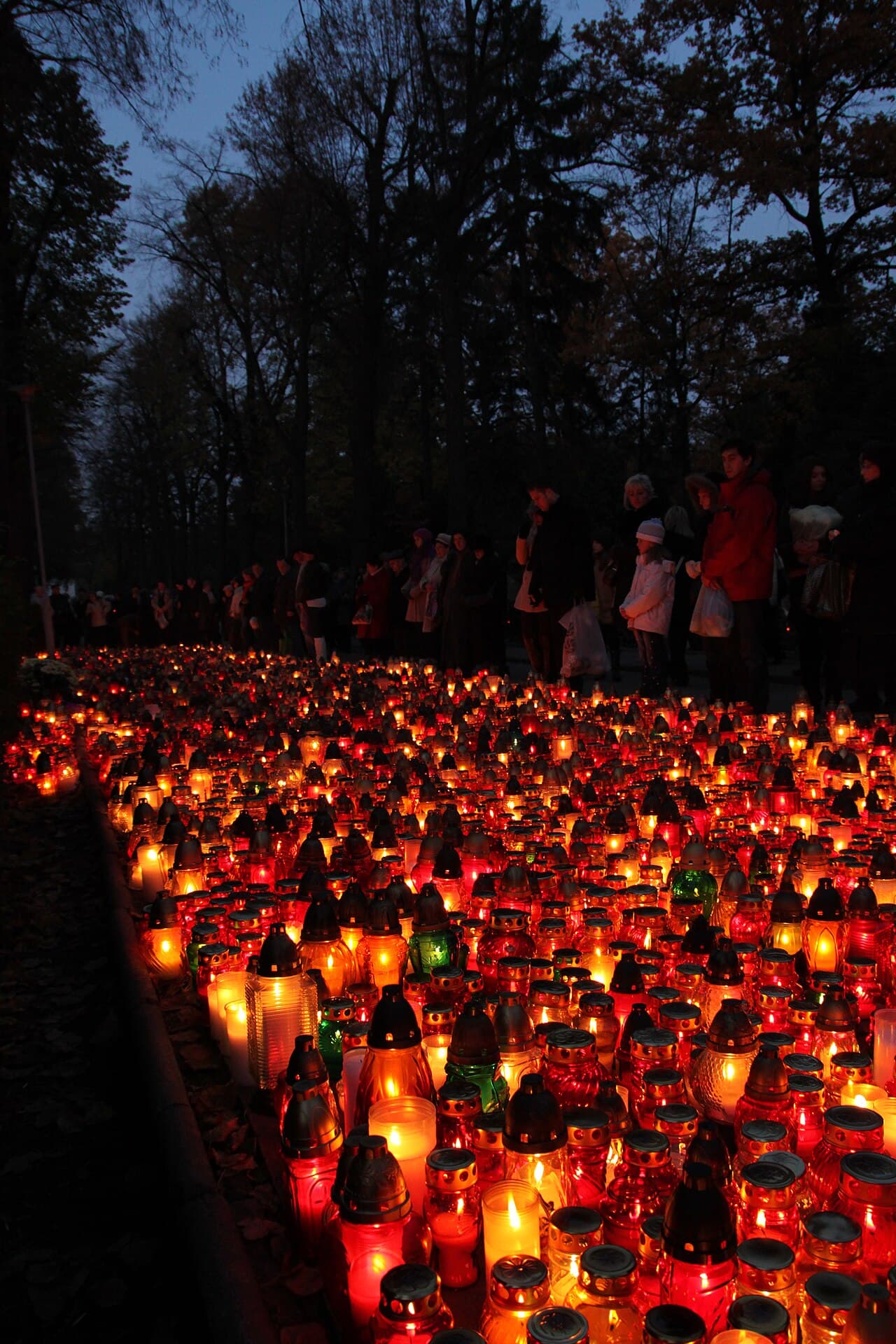 Grave candles, znicze, lit for All Saints' Day at a cemetery in Wrocław. CC BY 2.0, via Wikimedia Commons.
Poland's public remembrance is shaped by an unusually traumatic history, and much of it is about naming the dead the state once tried to erase. The clearest example is Katyń: in the spring of 1940 the Soviet secret police shot roughly 22,000 Polish officers, reservists and members of the intelligentsia in the forests of Katyń and other sites, then blamed the massacre on Nazi Germany, a lie the communist authorities enforced in Poland for half a century until Moscow finally admitted responsibility in 1990. The wound was reopened in April 2010 when a plane carrying President Lech Kaczyński and 95 others to a Katyń commemoration crashed at Smoleńsk, killing everyone aboard, an event now marked by memorials and, each month, by remembrance in Warsaw. The Warsaw Uprising of 1944, in which the Home Army fought the Germans for 63 days at the cost of some 200,000 mostly civilian lives, is commemorated every 1 August at 5 p.m., when sirens sound across the capital and the whole city stops in its tracks for a minute's silence.
The cemeteries themselves carry this national memory. Warsaw's Powązki, founded in 1790, is the country's most famous burial ground, and the adjacent Powązki Military Cemetery holds the graves of insurgents, soldiers and victims of the communist terror, a place where the state and families come together each November. The graves of the Ghetto and the mass killing sites, the memorials at Auschwitz-Birkenau and the other camps, and the monuments to the Uprising and to Solidarity's martyrs all form part of a landscape in which, more than almost anywhere, remembering the dead is understood as a civic and national duty, guarded by the state's Institute of National Remembrance and by the private act of every family that lights a candle in the dark.
Polish genealogy begins with a map, because for the whole nineteenth century Poland was not on one. The country was partitioned between Russia, Prussia and Austria, and each partition kept records differently, in a different language and to a different form. A single family that never moved can appear in Polish, then Russian, then Polish again, depending on which decade you are looking at and who was in charge.
The Napoleonic Code brought civil registration to the Duchy of Warsaw from 1808, and in the Russian partition the parish priest kept the civil register as well as the church one, which is unusually convenient: one book, one entry, in a fixed narrative form that names the parents, the godparents and the hour.
Most of what survives is now reachable without leaving the house. Szukajwarchiwach, run by the state archives, publishes millions of scans free. Geneteka, built and indexed by volunteers of the Polish Genealogical Society, holds tens of millions of name entries drawn from parishes across all three partitions and links out to the images. Neither asks for a subscription.
What is missing is missing violently. The Second World War destroyed archives across the country and the Warsaw Uprising of 1944 took a great deal of the capital's records with it. The border moved west in 1945, so registers for parishes that were Polish before the war are now held in Ukraine, Belarus and Lithuania. Polish family history is often the work of establishing where a record ought to be before asking whether it still is.
Poland's greatest single contribution to the theory and practice of heritage is Warsaw itself. When the Germans razed the city in 1944, Poland chose not to build a new modern capital on the ruins but to reconstruct the historic centre as it had been, using surviving architectural surveys, old photographs and, famously, the detailed cityscapes painted in the eighteenth century by Bernardo Bellotto, known as Canaletto. The result was so complete and so carefully done that UNESCO inscribed the reconstructed Old Town on the World Heritage List in 1980 as an exceptional example of the near-total rebuilding of a historic city, a decision that helped the whole world take the reconstruction of destroyed heritage seriously.
Grave candles, znicze, lit for All Saints' Day at a cemetery in Wrocław. CC BY 2.0, via Wikimedia Commons.
Poland's public remembrance is shaped by an unusually traumatic history, and much of it is about naming the dead the state once tried to erase. The clearest example is Katyń: in the spring of 1940 the Soviet secret police shot roughly 22,000 Polish officers, reservists and members of the intelligentsia in the forests of Katyń and other sites, then blamed the massacre on Nazi Germany, a lie the communist authorities enforced in Poland for half a century until Moscow finally admitted responsibility in 1990. The wound was reopened in April 2010 when a plane carrying President Lech Kaczyński and 95 others to a Katyń commemoration crashed at Smoleńsk, killing everyone aboard, an event now marked by memorials and, each month, by remembrance in Warsaw. The Warsaw Uprising of 1944, in which the Home Army fought the Germans for 63 days at the cost of some 200,000 mostly civilian lives, is commemorated every 1 August at 5 p.m., when sirens sound across the capital and the whole city stops in its tracks for a minute's silence.
The cemeteries themselves carry this national memory. Warsaw's Powązki, founded in 1790, is the country's most famous burial ground, and the adjacent Powązki Military Cemetery holds the graves of insurgents, soldiers and victims of the communist terror, a place where the state and families come together each November. The graves of the Ghetto and the mass killing sites, the memorials at Auschwitz-Birkenau and the other camps, and the monuments to the Uprising and to Solidarity's martyrs all form part of a landscape in which, more than almost anywhere, remembering the dead is understood as a civic and national duty, guarded by the state's Institute of National Remembrance and by the private act of every family that lights a candle in the dark.
Polish genealogy begins with a map, because for the whole nineteenth century Poland was not on one. The country was partitioned between Russia, Prussia and Austria, and each partition kept records differently, in a different language and to a different form. A single family that never moved can appear in Polish, then Russian, then Polish again, depending on which decade you are looking at and who was in charge.
The Napoleonic Code brought civil registration to the Duchy of Warsaw from 1808, and in the Russian partition the parish priest kept the civil register as well as the church one, which is unusually convenient: one book, one entry, in a fixed narrative form that names the parents, the godparents and the hour.
Most of what survives is now reachable without leaving the house. Szukajwarchiwach, run by the state archives, publishes millions of scans free. Geneteka, built and indexed by volunteers of the Polish Genealogical Society, holds tens of millions of name entries drawn from parishes across all three partitions and links out to the images. Neither asks for a subscription.
What is missing is missing violently. The Second World War destroyed archives across the country and the Warsaw Uprising of 1944 took a great deal of the capital's records with it. The border moved west in 1945, so registers for parishes that were Polish before the war are now held in Ukraine, Belarus and Lithuania. Polish family history is often the work of establishing where a record ought to be before asking whether it still is.
Poland's greatest single contribution to the theory and practice of heritage is Warsaw itself. When the Germans razed the city in 1944, Poland chose not to build a new modern capital on the ruins but to reconstruct the historic centre as it had been, using surviving architectural surveys, old photographs and, famously, the detailed cityscapes painted in the eighteenth century by Bernardo Bellotto, known as Canaletto. The result was so complete and so carefully done that UNESCO inscribed the reconstructed Old Town on the World Heritage List in 1980 as an exceptional example of the near-total rebuilding of a historic city, a decision that helped the whole world take the reconstruction of destroyed heritage seriously.
-LCCN2001697518.jpg%2F1280px-Old_part_of_town%252C_Warsaw%252C_Russia_(i.e._Warsaw%252C_Poland)-LCCN2001697518.jpg&w=3840&q=75) Warsaw's old town in a photochrome print of around 1900, decades before the destruction from which the city was rebuilt. Public domain, via Wikimedia Commons.
Poland now has 17 UNESCO World Heritage Sites, 15 cultural and two natural, an inventory that reads like a map of its history. The historic centre of Kraków and the Wieliczka Salt Mine, with its underground chapels carved from rock salt, were among the first sites listed anywhere in 1978; Auschwitz-Birkenau was inscribed in 1979 as a warning to humanity; and the list runs on through the medieval castle of the Teutonic Knights at Malbork, the largest brick castle in the world, the old towns of Toruń and Zamość, the wooden churches of the south, the Churches of Peace, and the primeval Białowieża Forest, shared with Belarus. National protection is overseen by the National Heritage Board of Poland and the state conservation service, backed by a strong tradition of restoration workshops whose skills, honed on the rebuilding of Warsaw and Gdańsk, are exported across the world.
Poland has invested heavily in bringing its archives and libraries online, in part to reconnect a vast diaspora with records scattered by war and border changes. The National Library's digital platform, POLONA, is one of the largest in Europe, offering millions of digitised books, manuscripts, maps, prints and photographs free of charge. The state archives run Szukaj w Archiwach, "Search the Archives", which puts tens of millions of scanned documents online, from parish and civil registers to census and land records, making it a central tool for the genealogists who come to Poland's records from around the world.
The country's difficult twentieth century has its own dedicated archives. The Institute of National Remembrance holds and increasingly digitises the files of the communist-era security services and documents of Nazi and Soviet crimes, and its research underpins the naming of victims and perpetrators alike. Volunteer-driven projects have transformed family history: Geneteka, run by the Polish Genealogical Society, indexes millions of birth, marriage and death entries transcribed by volunteers, while institutions like the POLIN Museum and the Jewish Historical Institute have digitised records and testimony to reconstruct the world destroyed in the Holocaust. Together these projects are rebuilding, in data, some of the human memory that the wars and partitions tried to erase.
Poland's cultural profile abroad has risen sharply in the democratic decades. Its cinema keeps earning the highest honours, from Paweł Pawlikowski's Ida, which took the Academy Award for best foreign-language film in 2015, to his Cold War, both black-and-white meditations on memory and the communist past, building on a tradition that runs back to Wajda and Kieślowski. Olga Tokarczuk's Nobel Prize in Literature in 2018 confirmed the international standing of Polish letters, and Polish composers, jazz musicians and video-game studios, the makers of The Witcher among them, have found global audiences. The Chopin Competition and the country's festivals of music and theatre continue to draw the world to Warsaw and Kraków.
The living debates are about how to hold the past. Poland argues, often bitterly, over the memory of the war and the Holocaust, over the record of the communist period and the files held by the Institute of National Remembrance, and over the place of the Catholic Church in a modernising society. The enormous Polish diaspora, the Polonia, keeps these questions alive far beyond the borders: the Polish communities of Chicago, London, the American Midwest and beyond, some the descendants of nineteenth-century emigrants, others of wartime exiles or recent EU migrants, sustain parishes, Saturday schools, folk ensembles and archives, and return in growing numbers to trace their families in the newly digitised records. For a nation so long divided and dispersed, this reconnection of the scattered with their origins is itself a form of heritage work.
A city raised from its paintings. After 1944 Poland rebuilt the historic centre of Warsaw from surveys, photographs and the eighteenth-century cityscapes of Canaletto, recreating a destroyed capital so faithfully that UNESCO listed the reconstructed Old Town in 1980. It is the defining case for how, and whether, ruined heritage can be brought back.
The truth about Katyń. For fifty years the Soviet massacre of 22,000 Polish officers in 1940 was officially blamed on the Germans, and to say otherwise in communist Poland was dangerous. Persistent memory in families and among historians kept the truth alive until Moscow admitted responsibility in 1990, and Katyń is now openly commemorated, a victory of remembrance over an enforced lie.
Solidarity and its centre. The strikes at Gdańsk's Lenin Shipyard in 1980 created Solidarity, the mass movement that helped bring down communism across the Eastern bloc; its heritage is now preserved and interpreted at the European Solidarity Centre, opened in Gdańsk in 2014 on the site where the movement was born.
The Jewish past made visible. The POLIN Museum of the History of Polish Jews, opened in Warsaw in 2013 on the site of the wartime ghetto, uses a thousand years of records, objects and digitised testimony to restore the memory of a community that was almost entirely destroyed, turning the largest such loss in Europe into a place of learning rather than only of mourning.
A nation lit each November. The custom of covering the cemeteries with znicze on All Saints' Day, extended even to abandoned and enemy graves, has kept a whole society in the habit of tending its dead. It is a living tradition of remembrance that needs no state to sustain it, renewed by millions of families every single year.
Warsaw's old town in a photochrome print of around 1900, decades before the destruction from which the city was rebuilt. Public domain, via Wikimedia Commons.
Poland now has 17 UNESCO World Heritage Sites, 15 cultural and two natural, an inventory that reads like a map of its history. The historic centre of Kraków and the Wieliczka Salt Mine, with its underground chapels carved from rock salt, were among the first sites listed anywhere in 1978; Auschwitz-Birkenau was inscribed in 1979 as a warning to humanity; and the list runs on through the medieval castle of the Teutonic Knights at Malbork, the largest brick castle in the world, the old towns of Toruń and Zamość, the wooden churches of the south, the Churches of Peace, and the primeval Białowieża Forest, shared with Belarus. National protection is overseen by the National Heritage Board of Poland and the state conservation service, backed by a strong tradition of restoration workshops whose skills, honed on the rebuilding of Warsaw and Gdańsk, are exported across the world.
Poland has invested heavily in bringing its archives and libraries online, in part to reconnect a vast diaspora with records scattered by war and border changes. The National Library's digital platform, POLONA, is one of the largest in Europe, offering millions of digitised books, manuscripts, maps, prints and photographs free of charge. The state archives run Szukaj w Archiwach, "Search the Archives", which puts tens of millions of scanned documents online, from parish and civil registers to census and land records, making it a central tool for the genealogists who come to Poland's records from around the world.
The country's difficult twentieth century has its own dedicated archives. The Institute of National Remembrance holds and increasingly digitises the files of the communist-era security services and documents of Nazi and Soviet crimes, and its research underpins the naming of victims and perpetrators alike. Volunteer-driven projects have transformed family history: Geneteka, run by the Polish Genealogical Society, indexes millions of birth, marriage and death entries transcribed by volunteers, while institutions like the POLIN Museum and the Jewish Historical Institute have digitised records and testimony to reconstruct the world destroyed in the Holocaust. Together these projects are rebuilding, in data, some of the human memory that the wars and partitions tried to erase.
Poland's cultural profile abroad has risen sharply in the democratic decades. Its cinema keeps earning the highest honours, from Paweł Pawlikowski's Ida, which took the Academy Award for best foreign-language film in 2015, to his Cold War, both black-and-white meditations on memory and the communist past, building on a tradition that runs back to Wajda and Kieślowski. Olga Tokarczuk's Nobel Prize in Literature in 2018 confirmed the international standing of Polish letters, and Polish composers, jazz musicians and video-game studios, the makers of The Witcher among them, have found global audiences. The Chopin Competition and the country's festivals of music and theatre continue to draw the world to Warsaw and Kraków.
The living debates are about how to hold the past. Poland argues, often bitterly, over the memory of the war and the Holocaust, over the record of the communist period and the files held by the Institute of National Remembrance, and over the place of the Catholic Church in a modernising society. The enormous Polish diaspora, the Polonia, keeps these questions alive far beyond the borders: the Polish communities of Chicago, London, the American Midwest and beyond, some the descendants of nineteenth-century emigrants, others of wartime exiles or recent EU migrants, sustain parishes, Saturday schools, folk ensembles and archives, and return in growing numbers to trace their families in the newly digitised records. For a nation so long divided and dispersed, this reconnection of the scattered with their origins is itself a form of heritage work.
A city raised from its paintings. After 1944 Poland rebuilt the historic centre of Warsaw from surveys, photographs and the eighteenth-century cityscapes of Canaletto, recreating a destroyed capital so faithfully that UNESCO listed the reconstructed Old Town in 1980. It is the defining case for how, and whether, ruined heritage can be brought back.
The truth about Katyń. For fifty years the Soviet massacre of 22,000 Polish officers in 1940 was officially blamed on the Germans, and to say otherwise in communist Poland was dangerous. Persistent memory in families and among historians kept the truth alive until Moscow admitted responsibility in 1990, and Katyń is now openly commemorated, a victory of remembrance over an enforced lie.
Solidarity and its centre. The strikes at Gdańsk's Lenin Shipyard in 1980 created Solidarity, the mass movement that helped bring down communism across the Eastern bloc; its heritage is now preserved and interpreted at the European Solidarity Centre, opened in Gdańsk in 2014 on the site where the movement was born.
The Jewish past made visible. The POLIN Museum of the History of Polish Jews, opened in Warsaw in 2013 on the site of the wartime ghetto, uses a thousand years of records, objects and digitised testimony to restore the memory of a community that was almost entirely destroyed, turning the largest such loss in Europe into a place of learning rather than only of mourning.
A nation lit each November. The custom of covering the cemeteries with znicze on All Saints' Day, extended even to abandoned and enemy graves, has kept a whole society in the habit of tending its dead. It is a living tradition of remembrance that needs no state to sustain it, renewed by millions of families every single year.
National Overview
Notable Cities
Historical Foundations
Linguistic and Etymological Roots
Cultural Identity
Religion and Spirituality
Remembrance and Mourning Traditions
Tracing a Family in Poland
Heritage Preservation Efforts
Digital Heritage
Contemporary Cultural Influences
Success Stories
References and resources
- UNESCO World Heritage Centre, Poland, the state-party page listing all 17 of Poland's World Heritage Sites.
- POLONA, National Digital Library, millions of digitised books, manuscripts, maps and photographs from the National Library of Poland.
- Szukaj w Archiwach, Search the Archives, the online portal of the Polish state archives, with tens of millions of scanned documents.
- Institute of National Remembrance (IPN), the state body that documents twentieth-century crimes and holds the communist-era security files.
- Auschwitz-Birkenau Memorial and Museum, the memorial and museum on the site of the largest Nazi death camp.
- POLIN Museum of the History of Polish Jews, the Warsaw museum recovering a thousand years of Polish-Jewish life.
- European Solidarity Centre, Gdańsk, the centre documenting the Solidarity movement and the fall of communism.
- National Heritage Board of Poland, the state agency responsible for the protection of Poland's monuments.
- Encyclopaedia Britannica, Poland, geography, history and society.