Heritage · Country
Nigeria Culture and Heritage
Nigeria carries the Nok terracottas, the Ife heads and the Benin Bronzes, along with more than 500 languages and some 250 ethnic nations. A guide to how Africa's most populous country keeps its memory, mourns its dead through second burials and masquerades, and sends its culture abroad in the films of Nollywood and the sound of Afrobeats.Written to last.
By Confinity Heritage Editorial · Updated 2026-07-31 · 8-minute readQuiet tools, kept out of the way.
Few countries hold as many separate deep pasts as Nigeria. On the Jos Plateau, tin miners in the twentieth century unearthed terracotta heads made by the Nok, who were smelting iron and modelling the human face in clay by the middle of the first millennium before Christ. At Igbo-Ukwu, ninth-century smiths cast copper alloy of a delicacy that radiocarbon dating confirmed only after initial disbelief; at Ile-Ife the Yoruba cast portrait heads of startling naturalism; and in Benin City the guilds of the Oba produced the brass works now scattered across the world's museums as the Benin Bronzes. No single tradition explains the country: Nigeria was assembled from many.
That plurality defines the place. More than 230 million people, close to one in six Africans, live within its borders, speaking over 500 languages and belonging to some 250 ethnic nations, the Hausa-Fulani of the north, the Yoruba of the south-west and the Igbo of the south-east chief among them. Nigeria mourns at length, marking its dead with second burials, masquerades and feasts that run for days, and it carries its culture abroad through Nollywood and Afrobeats.
Nigeria occupies 923,769 square kilometres of West Africa, bordered by Benin, Niger, Chad and Cameroon, with the Gulf of Guinea to the south. Two rivers give the land its shape and its name: the Niger, entering from the north-west, and its tributary the Benue, from the east; they meet at a broad confluence at Lokoja and run south into the creeks and mangroves of the oil-bearing Niger Delta. The country ranges from coastal rainforest in the south to savanna and the dry Sahel in the north.
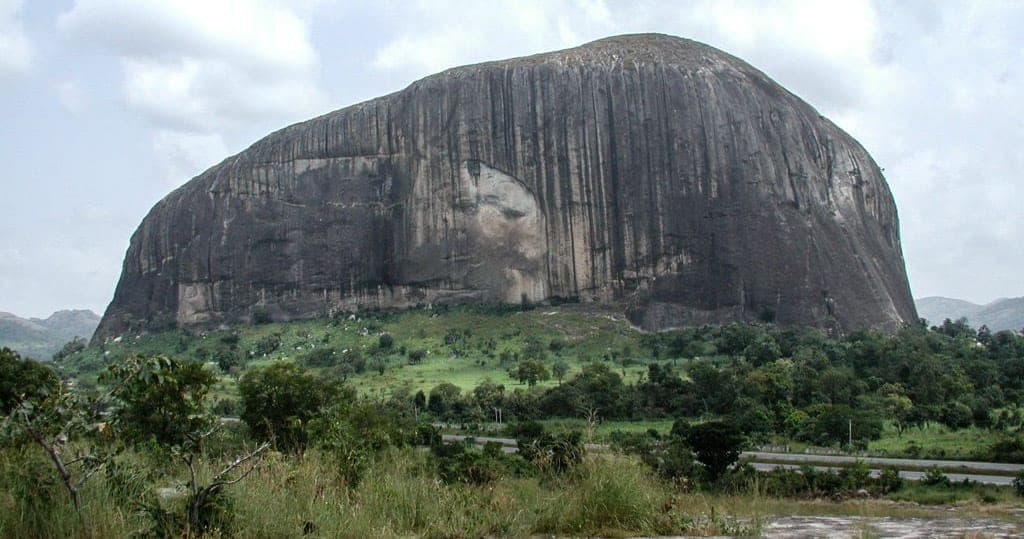
With more than 230 million people, Nigeria is the most populous country in Africa and the sixth most populous on earth. It is a federal republic of 36 states and the Federal Capital Territory; in 1991 the seat of government moved to a purpose-built inland capital, Abuja, near the monolith of Zuma Rock. Lagos, the former capital, remains the largest city. The currency is the naira, and the national motto is "Unity and Faith, Peace and Progress".
Lagos. A Yoruba island kingdom and British colony from 1861, Lagos grew into a megacity of many millions and the cultural capital of the country; nearby Badagry, a former slave-trading port, preserves the memory of the transatlantic trade.
Abuja. Planned from the 1970s and made capital in 1991, Abuja sits at the country's centre, chosen as neutral ground between north and south, its National Mosque and national ecumenical centre facing each other.
Kano. The greatest city of the north is over a thousand years old, a former seat of the Sokoto Caliphate whose ancient walls and indigo dye pits mark the heart of Hausa civilisation.
Benin City. Capital of the Kingdom of Benin, whose Oba still reigns, this was the source of the Benin Bronzes and remains a centre of brass-casting.
Ile-Ife. Regarded by the Yoruba as the place where the world was created, Ile-Ife produced the naturalistic bronze and terracotta heads and remains the seat of the Ooni, a senior traditional monarch.
Settlement here reaches deep. The Nok culture of the central plateau, flourishing from roughly the fifth century BCE to the second century CE, left the earliest known sculpture in sub-Saharan Africa and some of the region's first ironworking. By the ninth century the smiths of Igbo-Ukwu were casting ceremonial bronzes; between about the eleventh and fifteenth centuries Ile-Ife produced its naturalistic royal heads; and the Kingdom of Benin developed the palace art that culminated in the Benin Bronzes. In the north, Kanem-Bornu and the walled Hausa city-states grew wealthy on trans-Saharan trade, while the Oyo Empire dominated the Yoruba south-west.
The nineteenth century reshaped the north when the Fulani scholar Usman dan Fodio launched a reformist jihad in 1804, founding the Sokoto Caliphate, one of the largest states in nineteenth-century Africa. For centuries the coast had also fed the transatlantic slave trade, through the Bights of Benin and Biafra, which carried millions of Africans into bondage, a trauma that marked every society in the region. Britain abolished its slave trade in 1807 and moved to formal control: Lagos was annexed in 1861, and on 1 January 1914 the administrator Frederick Lugard amalgamated the Northern and Southern Protectorates into a single colony, largely for administrative convenience; the name Nigeria, drawn from the Niger, had been proposed in 1897 by the journalist Flora Shaw, later Lugard's wife. Independence came on 1 October 1960 and a republic in 1963. Within a few years, coups, ethnic killings and the secession of the south-east as the Republic of Biafra brought civil war from 1967 to 1970; a federal blockade caused a devastating famine, and estimates of the dead, most of them Biafran civilians lost to starvation and disease, range from about one million to as high as three million. The war ended in January 1970 with Gowon's declaration that there was to be neither victor nor vanquished.
The country's name is geographic, "the land of the Niger". English, the language of the former colonial power, was kept at independence as the official language precisely because it belonged to no single ethnic group, and it remains the medium of government, courts and the press where no indigenous tongue holds a majority. Beneath it lie three great regional languages: Hausa, an Afroasiatic language and the lingua franca of the north; and Yoruba and Igbo, both of the Niger-Congo family, dominant in the south-west and south-east. Alongside them run more than 500 further languages, some spoken by only a few thousand people and increasingly endangered.
Writing predates the Latin alphabet: Hausa has long been written in Ajami, an adapted Arabic script, and the Igbo and Efik developed Nsibidi, a system of ideographic symbols. Binding the country together informally is Nigerian Pidgin, an English-based creole now spoken by tens of millions across every region and class, a national language of the street, of comedy and popular music, and, since 2017, of the BBC's dedicated Pidgin news service.
Masking is among Nigeria's most powerful shared arts. Among the Yoruba, the Egungun masquerade brings the ancestors visibly among the living, dancers hidden in swirling cloth, while Gelede honours the spiritual power of women; in the south-east the Igbo Mmanwu masquerades embody spirits from the fierce to the comic, and across the north the Durbar festivals gather thousands of caparisoned horsemen to salute their emirs at the close of Ramadan.
Cloth carries identity directly: the Yoruba make indigo adire and weave the prestigious aso oke, the Igbo weave akwete, and the north is known for embroidered robes and the flowing agbada. Music runs through everything, from the tone-bending Yoruba talking drum to the Afrobeat forged in the 1970s by the activist bandleader Fela Kuti, whose fusion of Yoruba rhythm, jazz and funk carried songs of political protest.
Nigeria is divided almost evenly between the two great world faiths, along a partly geographic line. Islam predominates in the north, where it arrived across the Sahara from around the eleventh century, took root in Kanem-Bornu and the Hausa cities and was renewed by the Sokoto jihad; several northern states apply Sharia in personal and criminal law. Christianity predominates in the south, spread by nineteenth-century missionaries and since transformed by a vast growth of Pentecostal and indigenous Aladura churches. Traditional religions are practised across the country, often alongside the two.
 The Osun-Osogbo grove is the last large sacred forest of its kind in Yorubaland, and it survived because the artist Susanne Wenger and local devotees rebuilt its shrines. Photograph by Dalphnewhite, CC BY-SA 4.0, via Wikimedia Commons.
Chief among the older systems is the Yoruba religion of the Orisha, a pantheon of deities, Sango of thunder, Ogun of iron, Osun of the river, mediating between humanity and the supreme creator, Olodumare. Its guiding practice is Ifa, a divination system in which a trained babalawo consults a vast oral corpus to counsel the living; UNESCO recognised Ifa as intangible heritage in 2008, and carried across the Atlantic in the slave trade, Yoruba worship survives today in Brazil's Candomblé and Cuba's Santería. Among the Igbo, a comparable order recognises the creator Chukwu and the personal spirit, or chi, that accompanies each life.
Across Nigeria's cultures, the dead are not simply lost: a person who has lived well and died in old age becomes an ancestor, and the funeral is the rite that completes that passage. Among the Igbo this produces the "second burial", the ikwa ozu. The first burial follows death quickly and quietly; the second, staged months or years later once the family has gathered its resources, is an elaborate public celebration, with feasting, music and masquerades, that formally sends the deceased into the community of the ancestors. The Yoruba mark the death of an elder in the same spirit, treating the passing of the very old less as tragedy than as a life to be honoured, and the Egungun masquerade lets the ancestors return to bless their descendants.
Mourning is communal and demanding. Kin, neighbours, church societies, town unions and colleagues are expected to attend, to contribute and to sit with the bereaved, and the scale of a funeral is read as a measure of the family's standing. Because many Nigerians live far from their ancestral towns, bodies are routinely carried home for burial so that a person may lie among their own people. Against these traditions stands a national wound remembered only cautiously: the civil war of 1967 to 1970 left as many as a few million dead, yet in the interest of reunification the state largely avoided public memorial, and the loss lived on chiefly in family memory and in the literature of survivors. The National War Museum at Umuahia preserves the story of that conflict.
Nigeria is the most populous country in Africa and has never had a comprehensive civil register, so its family records are lineage records.
Yoruba, Igbo, Hausa, Fulani, Ijaw, Tiv and the rest each keep descent in their own way, and in most of them the lineage is recited and holds land. Yoruba oríkì, the praise poems attached to a family and a town, encode ancestry and are performed at the occasions where identity matters. Igbo umunna, the patrilineage, organises land and obligation. The dynastic lists of Ife, Oyo, Benin and the Kanem-Bornu and Sokoto states are among the longest documented successions in Africa.
Islamic northern Nigeria has a written tradition: Arabic manuscripts, sharia court registers, and the scholarly genealogies of the Sokoto Caliphate.
Colonial administration produced a substantial archive, now at the National Archives in Ibadan, Enugu and Kaduna, including the intelligence reports written when the British were working out which chief ruled whom, which are inadvertently genealogical. Mission registers from the Church Missionary Society, whose Yoruba clergy included Samuel Ajayi Crowther, a man liberated from a slave ship who became the first African Anglican bishop, carry nineteenth-century vital events.
For the African diaspora, the Bight of Benin and the Bight of Biafra were among the largest sources of the transatlantic trade, and Nigerian ports appear in the voyage records that families in the Americas now use to work backwards.
Nigeria's material heritage is overseen by the National Commission for Museums and Monuments, which runs the national museums, foremost the National Museum in Lagos, whose galleries hold Nok, Ife, Igbo-Ukwu and Benin works. The country has two UNESCO World Heritage Sites, both cultural. The Sukur Cultural Landscape in Adamawa State, inscribed in 1999, was the first African cultural landscape on the list, a hilltop settlement of terraced fields and the remains of an old iron industry. The Osun-Osogbo Sacred Grove in Osun State, inscribed in 2005, is a forest of some 75 hectares along the Osun River, dedicated to the river goddess Osun. Nigeria has also won UNESCO recognition for living traditions including Ifa divination, the Gelede oral heritage, the Ijele masquerade and the Argungu fishing festival.
The Osun-Osogbo grove is the last large sacred forest of its kind in Yorubaland, and it survived because the artist Susanne Wenger and local devotees rebuilt its shrines. Photograph by Dalphnewhite, CC BY-SA 4.0, via Wikimedia Commons.
Chief among the older systems is the Yoruba religion of the Orisha, a pantheon of deities, Sango of thunder, Ogun of iron, Osun of the river, mediating between humanity and the supreme creator, Olodumare. Its guiding practice is Ifa, a divination system in which a trained babalawo consults a vast oral corpus to counsel the living; UNESCO recognised Ifa as intangible heritage in 2008, and carried across the Atlantic in the slave trade, Yoruba worship survives today in Brazil's Candomblé and Cuba's Santería. Among the Igbo, a comparable order recognises the creator Chukwu and the personal spirit, or chi, that accompanies each life.
Across Nigeria's cultures, the dead are not simply lost: a person who has lived well and died in old age becomes an ancestor, and the funeral is the rite that completes that passage. Among the Igbo this produces the "second burial", the ikwa ozu. The first burial follows death quickly and quietly; the second, staged months or years later once the family has gathered its resources, is an elaborate public celebration, with feasting, music and masquerades, that formally sends the deceased into the community of the ancestors. The Yoruba mark the death of an elder in the same spirit, treating the passing of the very old less as tragedy than as a life to be honoured, and the Egungun masquerade lets the ancestors return to bless their descendants.
Mourning is communal and demanding. Kin, neighbours, church societies, town unions and colleagues are expected to attend, to contribute and to sit with the bereaved, and the scale of a funeral is read as a measure of the family's standing. Because many Nigerians live far from their ancestral towns, bodies are routinely carried home for burial so that a person may lie among their own people. Against these traditions stands a national wound remembered only cautiously: the civil war of 1967 to 1970 left as many as a few million dead, yet in the interest of reunification the state largely avoided public memorial, and the loss lived on chiefly in family memory and in the literature of survivors. The National War Museum at Umuahia preserves the story of that conflict.
Nigeria is the most populous country in Africa and has never had a comprehensive civil register, so its family records are lineage records.
Yoruba, Igbo, Hausa, Fulani, Ijaw, Tiv and the rest each keep descent in their own way, and in most of them the lineage is recited and holds land. Yoruba oríkì, the praise poems attached to a family and a town, encode ancestry and are performed at the occasions where identity matters. Igbo umunna, the patrilineage, organises land and obligation. The dynastic lists of Ife, Oyo, Benin and the Kanem-Bornu and Sokoto states are among the longest documented successions in Africa.
Islamic northern Nigeria has a written tradition: Arabic manuscripts, sharia court registers, and the scholarly genealogies of the Sokoto Caliphate.
Colonial administration produced a substantial archive, now at the National Archives in Ibadan, Enugu and Kaduna, including the intelligence reports written when the British were working out which chief ruled whom, which are inadvertently genealogical. Mission registers from the Church Missionary Society, whose Yoruba clergy included Samuel Ajayi Crowther, a man liberated from a slave ship who became the first African Anglican bishop, carry nineteenth-century vital events.
For the African diaspora, the Bight of Benin and the Bight of Biafra were among the largest sources of the transatlantic trade, and Nigerian ports appear in the voyage records that families in the Americas now use to work backwards.
Nigeria's material heritage is overseen by the National Commission for Museums and Monuments, which runs the national museums, foremost the National Museum in Lagos, whose galleries hold Nok, Ife, Igbo-Ukwu and Benin works. The country has two UNESCO World Heritage Sites, both cultural. The Sukur Cultural Landscape in Adamawa State, inscribed in 1999, was the first African cultural landscape on the list, a hilltop settlement of terraced fields and the remains of an old iron industry. The Osun-Osogbo Sacred Grove in Osun State, inscribed in 2005, is a forest of some 75 hectares along the Osun River, dedicated to the river goddess Osun. Nigeria has also won UNESCO recognition for living traditions including Ifa divination, the Gelede oral heritage, the Ijele masquerade and the Argungu fishing festival.
 The Benin Bronzes were taken in the British raid of 1897 and dispersed to museums across Europe and North America. Photograph by Warofdreams, CC BY-SA 3.0, via Wikimedia Commons.
No heritage question involving Nigeria is more prominent than that of the Benin Bronzes. Thousands of these brass and ivory works were taken from the royal palace of Benin City by a British military expedition in 1897 and afterwards dispersed to museums across Europe and North America; the British Museum alone holds several hundred. Since 2020 a growing number of institutions have moved to return them: German museums transferred ownership of well over a thousand pieces and repatriated an initial group in 2022, and institutions in Britain, the Netherlands and the United States have handed works back. Some major holders, constrained in part by laws governing their collections, have not, and their retention remains contested. Within Nigeria, a further discussion over custody involves the federal government, Edo State and the Oba of Benin, whose royal house was the original owner; a new Edo Museum of West African Art is planned in Benin City. The scale, pace and terms of restitution continue to be debated by the parties concerned.
The dispersal of Nigeria's art has prompted one of the most ambitious digital heritage projects on the continent. Digital Benin, launched in 2022 and led from the museum now known as MARKK in Hamburg with Nigerian partners, has assembled a single online catalogue of thousands of objects looted from Benin in 1897 and now held in more than a hundred institutions worldwide, recording Edo-language names, in effect a virtual return of a heritage that remains physically divided.
Nigeria's languages and popular memory have found their own digital life. Yoruba, Igbo and Hausa all have growing online presences, and the country's enormous social-media population records festivals, funerals and music in a continuous informal archive; Nigerian Pidgin reaches a mass audience through the BBC's Pidgin service.
Few countries of the global south project their culture as widely as Nigeria. Nollywood, the film industry centred on Lagos and the south-east, releases well over a thousand titles a year and by output ranks among the largest in the world, second only to India's; from direct-to-video dramas in the early 1990s it has grown into a streaming business reaching audiences across Africa and its diaspora, now co-producing with Netflix. In music, the contemporary genre known as Afrobeats, distinct from Fela Kuti's earlier Afrobeat, has become a force in global pop through artists such as Burna Boy, a Grammy winner in 2021, Wizkid, Davido and Tems.
The literary tradition is equally weighty. Wole Soyinka became, in 1986, the first African to win the Nobel Prize in Literature; Chinua Achebe's "Things Fall Apart" (1958) is among the most widely read novels ever written in Africa; Ben Okri won the Booker Prize in 1991; and Chimamanda Ngozi Adichie leads a later generation carrying Nigerian storytelling to readers everywhere. A vast diaspora sustains churches, mosques and hometown associations across the world.
A sacred grove saved. The Osun-Osogbo grove, decaying by the mid-twentieth century, was restored through the New Sacred Art movement led by the Austrian-born artist Susanne Wenger, who settled in Osogbo, became a priestess of the Orisha and rebuilt its shrines with local artists; their work preserved it until UNESCO inscribed it as World Heritage in 2005, and its annual festival now draws visitors from around the world.
A looted corpus reunited online. Digital Benin has gathered, in one searchable catalogue, thousands of Benin objects held across more than a hundred institutions in dozens of countries, letting scholars and the people of Benin see the whole of a heritage that physical restitution can only slowly reassemble.
A first Nobel for Africa. When Wole Soyinka won the Nobel Prize in Literature in 1986, he became the first African laureate in that field, recognition that placed Nigerian writing at the centre of world literature.
The Bronzes begin to come home. From the early 2020s, museums and universities in Germany, Britain, the Netherlands and the United States began returning Benin Bronzes, and Germany transferred ownership of more than a thousand works, one of the most significant restitution movements yet seen.
The Benin Bronzes were taken in the British raid of 1897 and dispersed to museums across Europe and North America. Photograph by Warofdreams, CC BY-SA 3.0, via Wikimedia Commons.
No heritage question involving Nigeria is more prominent than that of the Benin Bronzes. Thousands of these brass and ivory works were taken from the royal palace of Benin City by a British military expedition in 1897 and afterwards dispersed to museums across Europe and North America; the British Museum alone holds several hundred. Since 2020 a growing number of institutions have moved to return them: German museums transferred ownership of well over a thousand pieces and repatriated an initial group in 2022, and institutions in Britain, the Netherlands and the United States have handed works back. Some major holders, constrained in part by laws governing their collections, have not, and their retention remains contested. Within Nigeria, a further discussion over custody involves the federal government, Edo State and the Oba of Benin, whose royal house was the original owner; a new Edo Museum of West African Art is planned in Benin City. The scale, pace and terms of restitution continue to be debated by the parties concerned.
The dispersal of Nigeria's art has prompted one of the most ambitious digital heritage projects on the continent. Digital Benin, launched in 2022 and led from the museum now known as MARKK in Hamburg with Nigerian partners, has assembled a single online catalogue of thousands of objects looted from Benin in 1897 and now held in more than a hundred institutions worldwide, recording Edo-language names, in effect a virtual return of a heritage that remains physically divided.
Nigeria's languages and popular memory have found their own digital life. Yoruba, Igbo and Hausa all have growing online presences, and the country's enormous social-media population records festivals, funerals and music in a continuous informal archive; Nigerian Pidgin reaches a mass audience through the BBC's Pidgin service.
Few countries of the global south project their culture as widely as Nigeria. Nollywood, the film industry centred on Lagos and the south-east, releases well over a thousand titles a year and by output ranks among the largest in the world, second only to India's; from direct-to-video dramas in the early 1990s it has grown into a streaming business reaching audiences across Africa and its diaspora, now co-producing with Netflix. In music, the contemporary genre known as Afrobeats, distinct from Fela Kuti's earlier Afrobeat, has become a force in global pop through artists such as Burna Boy, a Grammy winner in 2021, Wizkid, Davido and Tems.
The literary tradition is equally weighty. Wole Soyinka became, in 1986, the first African to win the Nobel Prize in Literature; Chinua Achebe's "Things Fall Apart" (1958) is among the most widely read novels ever written in Africa; Ben Okri won the Booker Prize in 1991; and Chimamanda Ngozi Adichie leads a later generation carrying Nigerian storytelling to readers everywhere. A vast diaspora sustains churches, mosques and hometown associations across the world.
A sacred grove saved. The Osun-Osogbo grove, decaying by the mid-twentieth century, was restored through the New Sacred Art movement led by the Austrian-born artist Susanne Wenger, who settled in Osogbo, became a priestess of the Orisha and rebuilt its shrines with local artists; their work preserved it until UNESCO inscribed it as World Heritage in 2005, and its annual festival now draws visitors from around the world.
A looted corpus reunited online. Digital Benin has gathered, in one searchable catalogue, thousands of Benin objects held across more than a hundred institutions in dozens of countries, letting scholars and the people of Benin see the whole of a heritage that physical restitution can only slowly reassemble.
A first Nobel for Africa. When Wole Soyinka won the Nobel Prize in Literature in 1986, he became the first African laureate in that field, recognition that placed Nigerian writing at the centre of world literature.
The Bronzes begin to come home. From the early 2020s, museums and universities in Germany, Britain, the Netherlands and the United States began returning Benin Bronzes, and Germany transferred ownership of more than a thousand works, one of the most significant restitution movements yet seen.
National Overview
Notable Cities
Historical Foundations
Linguistic and Etymological Roots
Cultural Identity
Religion and Spirituality
Remembrance and Mourning Traditions
Tracing a Family in Nigeria
Heritage Preservation Efforts
Digital Heritage
Contemporary Cultural Influences
Success Stories
References and resources
- UNESCO World Heritage Centre: Nigeria. State-party page.
- UNESCO World Heritage Centre: Osun-Osogbo Sacred Grove. Inscription record.
- UNESCO World Heritage Centre: Sukur Cultural Landscape. Nigeria's first inscription.
- UNESCO Intangible Cultural Heritage: Ifa divination system. Inscribed 2008.
- Encyclopaedia Britannica: Nigeria. Geography and history.
- Encyclopaedia Britannica: Nigerian Civil War. The 1967 to 1970 conflict.
- Encyclopaedia Britannica: Benin Bronzes. Looting and restitution.
- Digital Benin. Catalogue of dispersed Benin objects.
- National Commission for Museums and Monuments. Nigeria's heritage authority.
- The Metropolitan Museum of Art: Osun-Osogbo Sacred Grove. Background on the grove.