Heritage · Landmark
Neuschwanstein Castle: History and Visitor Guide
Neuschwanstein Castle in Bavaria is King Ludwig II's unfinished Romanesque Revival palace, begun 1869 and made a UNESCO World Heritage Site in 2025.Written to last.
By Confinity Heritage Editorial · Updated 2026-07-31 · 7-minute readQuiet tools, kept out of the way.
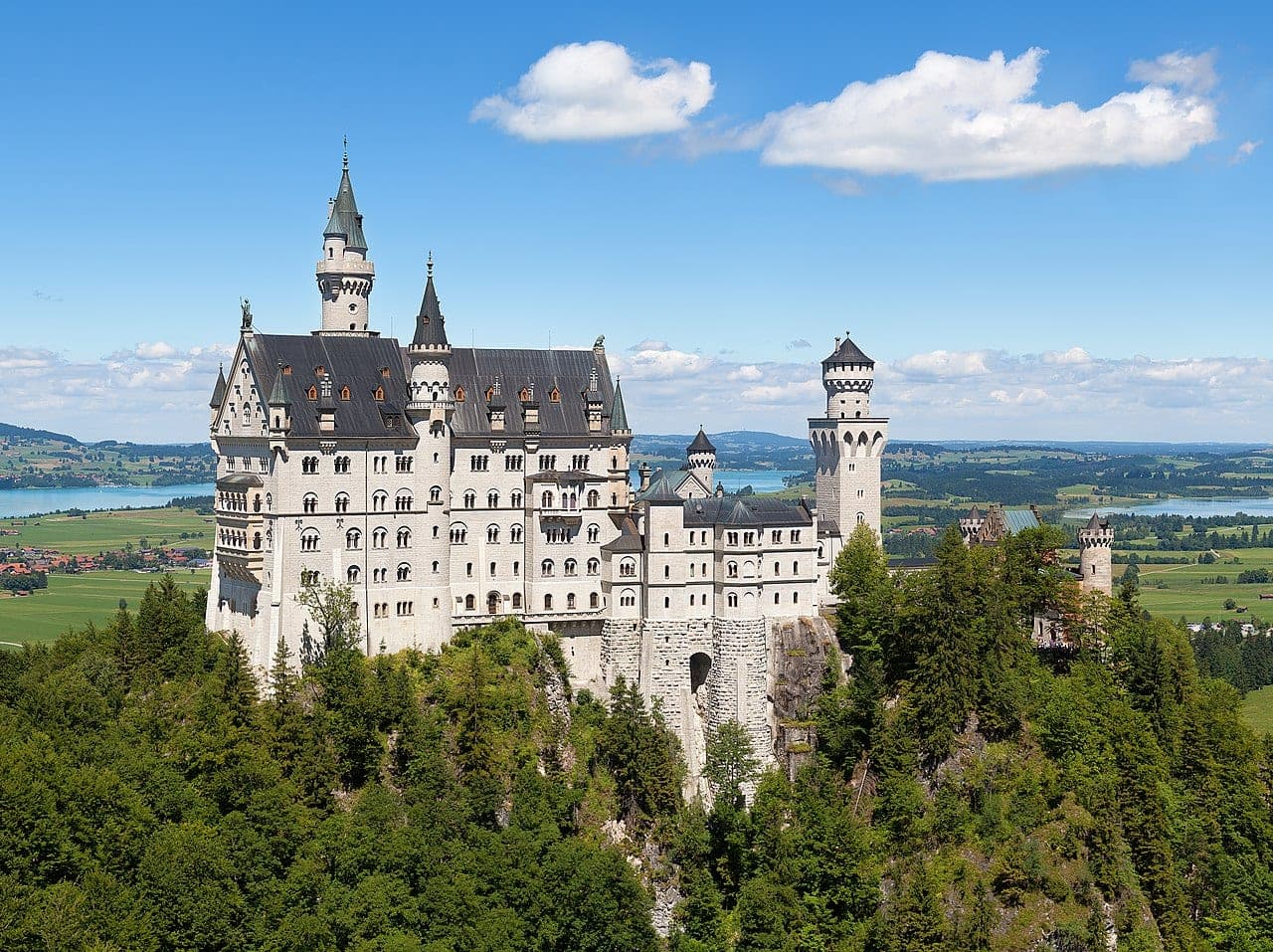
Neuschwanstein Castle rises from a rugged hill above the village of Hohenschwangau in the Bavarian Alps of southern Germany, its pale towers and turrets set against forested slopes and the lake called the Alpsee below. King Ludwig II of Bavaria commissioned it as a private retreat, a personal vision of an idealised medieval castle raised with the money and engineering of the industrial nineteenth century. The foundation stone was laid on 5 September 1869, and building continued for the rest of the king's life without ever reaching completion (Wikipedia). Today it draws well over a million visitors a year, and in July 2025 it was inscribed on the UNESCO World Heritage List.
Ludwig II came to the Bavarian throne in 1864, aged eighteen, and never grew comfortable in the public role of a monarch. Shy, withdrawn and drawn to art and legend, he became known to later generations as the "fairy-tale king" for the romantic palaces he built (Britannica). Neuschwanstein was the grandest of them. He conceived it as a homage to the operas of Richard Wagner, whose work he admired and financially supported; the finished rooms are steeped in the medieval myths that Wagner set to music, and Ludwig dedicated the building to the composer (Wikipedia).
Crucially, Ludwig paid for the castle out of his own purse and through heavy borrowing rather than from the Bavarian treasury (Wikipedia). As costs climbed to roughly 6.2 million gold marks, far beyond the original estimates, his mounting debts alarmed his ministers. In June 1886 a government commission declared him unfit to rule, and on 9 June he was deposed. Four days later, on 13 June 1886, Ludwig was found dead in the shallow water of Lake Starnberg together with his physician, in circumstances that were never fully explained and are still debated (Wikipedia). The king had spent only a handful of months in the still-unfinished castle. Within about six weeks of his death, the Bavarian authorities opened Neuschwanstein to paying visitors, and it has been open to the public ever since (Wikipedia).
For all its medieval appearance, Neuschwanstein is a work of the nineteenth century built in the Romanesque Revival style. Its silhouette of white towers was first sketched not by an architect but by Christian Jank, a theatrical scene painter, and then turned into buildable plans by the architect Eduard Riedel (Wikipedia). The result looks like a knight's castle from the age of the Hohenstaufen emperors, yet behind the stone lies thoroughly modern engineering. The structure relied on brick and steel framing, and it was fitted out with central heating, running water on every floor, flushing toilets, a telephone line and a battery-powered bell system to summon servants (Wikipedia).
 A medieval castle in appearance and a nineteenth-century building in fact, with a steel-framed throne hall, central heating and running water. Photograph by Diego Delso, CC BY-SA 4.0, via Wikimedia Commons.
The interiors that were finished are elaborate. The Throne Hall evokes a Byzantine church, and the Singers' Hall on the upper floor was modelled on a room at the Wartburg, decorated with scenes from the legends of Parzival and Lohengrin. Murals throughout the completed rooms illustrate the Wagnerian and medieval stories the king loved. Even so, the castle was never finished. Only about fifteen rooms were completed out of more than two hundred that had been planned, and construction largely halted after Ludwig's death, leaving much of the interior and a projected keep unbuilt (Wikipedia).
Neuschwanstein has become one of the most recognisable buildings in the world, in large part through the entertainment industry. Its towered profile is widely cited as an inspiration for the fairy-tale castles of Walt Disney, including the Sleeping Beauty Castle at Disneyland (Wikipedia). That association helped turn a private royal folly into a global icon. The castle now receives more than 1.4 million visitors a year, with far higher daily numbers in summer, and it serves as an emblem of Bavaria itself (Wikipedia). In July 2025, UNESCO inscribed it, together with Ludwig's palaces at Herrenchiemsee and Linderhof and the King's House on Schachen, on the World Heritage List as "The Palaces of King Ludwig II of Bavaria" (UNESCO).
The castle sits above the village of Hohenschwangau, near the town of Füssen in the far south of Bavaria, close to the Austrian border. Tickets are sold through the Ticket Center Hohenschwangau in the village below, and the interior can be seen only on a guided tour rather than by wandering freely (Bavarian Palace Administration). Because visitor numbers are high and the tours run to a timed schedule, booking online in advance is strongly recommended, since same-day tickets are limited and cannot be reserved. From the village, most visitors reach the castle by a steep walk of around half an hour, or for part of the way by shuttle bus or horse-drawn carriage. Photography is not permitted inside the castle, though the surrounding hills, including the nearby Marienbrücke footbridge over the Pöllat gorge, offer the classic exterior views.
A medieval castle in appearance and a nineteenth-century building in fact, with a steel-framed throne hall, central heating and running water. Photograph by Diego Delso, CC BY-SA 4.0, via Wikimedia Commons.
The interiors that were finished are elaborate. The Throne Hall evokes a Byzantine church, and the Singers' Hall on the upper floor was modelled on a room at the Wartburg, decorated with scenes from the legends of Parzival and Lohengrin. Murals throughout the completed rooms illustrate the Wagnerian and medieval stories the king loved. Even so, the castle was never finished. Only about fifteen rooms were completed out of more than two hundred that had been planned, and construction largely halted after Ludwig's death, leaving much of the interior and a projected keep unbuilt (Wikipedia).
Neuschwanstein has become one of the most recognisable buildings in the world, in large part through the entertainment industry. Its towered profile is widely cited as an inspiration for the fairy-tale castles of Walt Disney, including the Sleeping Beauty Castle at Disneyland (Wikipedia). That association helped turn a private royal folly into a global icon. The castle now receives more than 1.4 million visitors a year, with far higher daily numbers in summer, and it serves as an emblem of Bavaria itself (Wikipedia). In July 2025, UNESCO inscribed it, together with Ludwig's palaces at Herrenchiemsee and Linderhof and the King's House on Schachen, on the World Heritage List as "The Palaces of King Ludwig II of Bavaria" (UNESCO).
The castle sits above the village of Hohenschwangau, near the town of Füssen in the far south of Bavaria, close to the Austrian border. Tickets are sold through the Ticket Center Hohenschwangau in the village below, and the interior can be seen only on a guided tour rather than by wandering freely (Bavarian Palace Administration). Because visitor numbers are high and the tours run to a timed schedule, booking online in advance is strongly recommended, since same-day tickets are limited and cannot be reserved. From the village, most visitors reach the castle by a steep walk of around half an hour, or for part of the way by shuttle bus or horse-drawn carriage. Photography is not permitted inside the castle, though the surrounding hills, including the nearby Marienbrücke footbridge over the Pöllat gorge, offer the classic exterior views.
History
Architecture
Cultural role
Visiting
References and resources
- Encyclopaedia Britannica: Neuschwanstein Castle: overview of Ludwig II, the design and the castle's history.
- Bavarian Palace Administration: Neuschwanstein: official visitor information, tickets and guided tours.
- Wikipedia: Neuschwanstein Castle: construction dates, funding, interiors, completion status and visitor figures.
- UNESCO World Heritage Centre: The Palaces of King Ludwig II of Bavaria: the 2025 World Heritage inscription covering Neuschwanstein, Linderhof, Schachen and Herrenchiemsee.