Heritage · Landmark
Cologne Cathedral: Germany's Gothic Masterpiece
Begun in 1248 and left half-built for more than three centuries, Cologne Cathedral was finished in 1880 to its original medieval plans. It outlived the bombing that flattened the city around it, and the workshop that raises its stone has never once closed.Written to last.
By Confinity Heritage Editorial · Updated 2026-07-31 · 7-minute readQuiet tools, kept out of the way.
Few buildings carry the weight of an unfinished promise the way Cologne Cathedral does. For more than three hundred years it was a half-kept intention on the banks of the Rhine: a soaring choir joined to a stump of a tower, with a wooden medieval crane frozen at the top like a question no generation could answer. Travellers drew that crane. Painters painted it. It became so fixed a part of the skyline that the people of Cologne half forgot it had ever meant to come down. The cathedral was, for centuries, a monument less to what had been built than to what had been remembered and set aside.
That the building was finished at all is one of the quieter miracles of the nineteenth century. When the towers were finally topped out in 1880, the masons were not improvising a modern ending; they were reading the original medieval drawings, completing a design conceived 632 years earlier (Britannica). Today the cathedral is Germany's most visited landmark, drawing roughly six million people a year, and it has been a UNESCO World Heritage Site since 1996 (UNESCO). It is a place where medieval and modern hands meet in the same stone, and where the act of remembering became, over centuries, the act of building.
The foundation stone was laid on 15 August 1248 by Archbishop Konrad von Hochstaden (Wikipedia). The ambition behind it was specific. Cologne already held one of the greatest relics in Christendom, the bones said to be those of the Three Magi, and the old Romanesque cathedral on the site was no longer equal to the pilgrim crowds. The archbishops wanted a shrine city to rival the pilgrimage routes of Rome and Santiago de Compostela, and they looked to the new French Gothic then rising at Amiens for their model.
The medieval builders worked with astonishing conviction for a time. The choir, the eastern heart of the church, was completed and solemnly consecrated in 1322 (Cologne Tourism). Then the momentum drained away. Money, plague, shifting priorities and the slow decline of the medieval church economy all played a part, and by the middle of the sixteenth century work had effectively stopped. The great crane was left standing on the unfinished south tower, where it would remain for roughly four hundred years, a landmark of the Cologne skyline and a standing reminder of a project abandoned rather than completed (Britannica).
The revival came from the Romantic nineteenth century, and it came partly by luck. The original medieval elevation of the west facade, the drawing later known as Plan F, had been split apart and lost; the two halves were rediscovered separately in 1814 and 1816, in Darmstadt and Paris (Wikipedia). Their recovery turned a vague nostalgia into a concrete possibility: the cathedral could be finished exactly as its first architects had drawn it. In an age of rising German national feeling, completing the Dom became a cause. King Friedrich Wilhelm IV of Prussia laid a new foundation stone in 1842, and much of the funding came from a civic subscription society, the Zentral-Dombau-Verein (Cologne Tourism). On 15 October 1880 the completed cathedral was celebrated in a great national ceremony attended by Emperor Wilhelm I (Britannica).
Cologne Cathedral is High Gothic carried to its outer limit, and it is the largest Gothic church in Northern Europe (Britannica). Because the west end was completed from the surviving medieval plans rather than reinvented, the building holds a rare unity: the twin spires, the tracery and the sculptural programme read as a single idea rather than a compromise across eras.
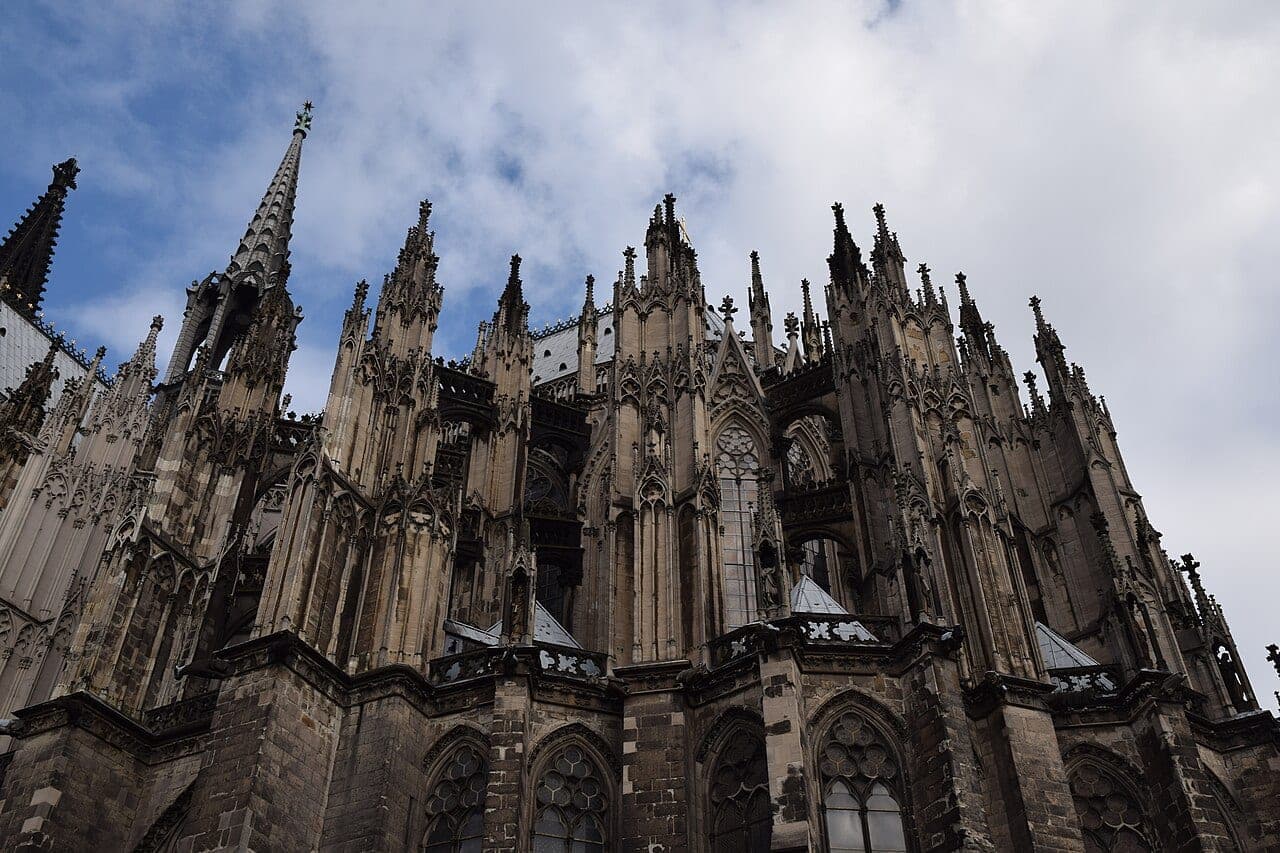
 The choir vault reaches about 43 metres, among the highest built in the Gothic period, and was finished in 1322; the nave around it waited another five centuries. Photograph by Avishai Teicher, CC BY-SA 4.0, via Wikimedia Commons.
The twin openwork spires rise to 157.38 metres (about 516 feet), and for four years the finished cathedral was the tallest building in the world, from 1880 until the Washington Monument overtook it in 1884 (Wikipedia). Together the towers form what is often described as the largest facade of any church in the world. Inside, the five-aisled basilica lifts the eye still higher: the nave vault reaches roughly 43 metres, among the tallest of any Gothic interior (Wikipedia).
The glass is a history in itself. The cathedral holds cycles of medieval stained glass, including the celebrated early fourteenth-century windows of the choir, alongside the large Renaissance windows of the north aisle. To that inheritance the twenty-first century added a note of its own: in 2007 the artist Gerhard Richter completed a south transept window of some eleven thousand squares of coloured glass, arranged by a partly random scheme, a modern voice set deliberately among the old (Cologne Tourism).
The cathedral exists, in the end, because of a single reliquary. In 1164 Archbishop Rainald von Dassel, who was also imperial chancellor to Frederick Barbarossa, brought the relics venerated as those of the Three Magi to Cologne from Milan, which had fallen to the emperor two years earlier (Britannica). Their arrival transformed the city almost overnight into one of the foremost pilgrimage destinations of medieval Europe, and it is why the arms of Cologne still carry three crowns.
To hold the relics, the goldsmith Nicholas of Verdun and his workshop created the Shrine of the Three Kings, worked in stages from about 1180 to 1225 (Wikipedia). Shaped like a basilica in miniature, built up from oak and sheathed in gold and silver, and set with enamel, filigree, antique gems and cameos, it is the largest reliquary to survive from the Middle Ages and a high point of medieval goldsmithing. It rests behind the high altar, and the whole eastern architecture of the cathedral was, in a real sense, designed around it.
The shrine does not stand alone. The cathedral keeps the Gero Crucifix, carved around the year 970 and regarded as the oldest surviving large monumental crucifix north of the Alps, its carved face still holding a startling human grief (Wikipedia). There is the tender Milan Madonna, and the Altar of the City Patrons painted by Stefan Lochner in the fifteenth century, once admired by Albrecht Durer. A visit to the cathedral is, among other things, a walk through a thousand years of how people have tried to give lasting form to what they loved and mourned.
In the Second World War, Cologne became one of the most heavily bombed cities in Germany, and the medieval old town around the cathedral was almost entirely destroyed. The Dom itself was struck by fourteen aerial bombs and yet remained standing, its towers rising battered but intact above a field of rubble (Kolner Dom). The famous wartime photographs, in which the twin spires loom over a flattened city, made the survival into a symbol of continuity and, later, of reconstruction. Its very visibility had helped it live: the towers served as a landmark for Allied navigators, and the building was not singled out for deliberate levelling.
Survival, though, is not the same as safety, and this is where the cathedral's deepest lesson about memory lies. Its soft sandstone weathers constantly under rain, frost and, in the modern era, air pollution and acid rain. To keep the building standing, Cologne maintains the Dombauhutte, the cathedral works, a permanent workshop of stonemasons, sculptors, glaziers and restorers whose task never ends (Kolner Dom). It is often said that scaffolding has never once been fully absent from the cathedral since 1880: as one stone is renewed, another begins to fail. Remembrance here is not a plaque or a single act. It is a craft handed from one generation to the next, a promise to keep repairing what cannot be allowed to fall.
Cologne Cathedral rises directly beside the city's central railway station, so most visitors meet it within minutes of arriving (Cologne Tourism). Entry to the cathedral itself is free, though it remains an active place of worship, and quiet and modest dress are expected, particularly during Mass.
The most memorable effort is the climb of the south tower, roughly 533 steps up a spiral stair to a viewing platform near the base of the spires, with the city and the Rhine spread out below (Cologne Tourism). On the way up, visitors pass the bell chamber, home to St Peter's Bell, known affectionately in Cologne as the Dicker Pitter, one of the largest free-swinging church bells in the world. The cathedral treasury, set in the medieval vaults on the north side, displays reliquaries, vestments and liturgical objects across centuries.
Because the cathedral is so central and so heavily visited, early morning or later evening tends to offer the calmest experience, away from the peak of the day. However you come to it, the building rewards slowness: the Shrine of the Three Kings behind the altar, the old glass catching the light, and, somewhere overhead, the sound of masons at work on a cathedral that is, in a sense, never finished.
The choir vault reaches about 43 metres, among the highest built in the Gothic period, and was finished in 1322; the nave around it waited another five centuries. Photograph by Avishai Teicher, CC BY-SA 4.0, via Wikimedia Commons.
The twin openwork spires rise to 157.38 metres (about 516 feet), and for four years the finished cathedral was the tallest building in the world, from 1880 until the Washington Monument overtook it in 1884 (Wikipedia). Together the towers form what is often described as the largest facade of any church in the world. Inside, the five-aisled basilica lifts the eye still higher: the nave vault reaches roughly 43 metres, among the tallest of any Gothic interior (Wikipedia).
The glass is a history in itself. The cathedral holds cycles of medieval stained glass, including the celebrated early fourteenth-century windows of the choir, alongside the large Renaissance windows of the north aisle. To that inheritance the twenty-first century added a note of its own: in 2007 the artist Gerhard Richter completed a south transept window of some eleven thousand squares of coloured glass, arranged by a partly random scheme, a modern voice set deliberately among the old (Cologne Tourism).
The cathedral exists, in the end, because of a single reliquary. In 1164 Archbishop Rainald von Dassel, who was also imperial chancellor to Frederick Barbarossa, brought the relics venerated as those of the Three Magi to Cologne from Milan, which had fallen to the emperor two years earlier (Britannica). Their arrival transformed the city almost overnight into one of the foremost pilgrimage destinations of medieval Europe, and it is why the arms of Cologne still carry three crowns.
To hold the relics, the goldsmith Nicholas of Verdun and his workshop created the Shrine of the Three Kings, worked in stages from about 1180 to 1225 (Wikipedia). Shaped like a basilica in miniature, built up from oak and sheathed in gold and silver, and set with enamel, filigree, antique gems and cameos, it is the largest reliquary to survive from the Middle Ages and a high point of medieval goldsmithing. It rests behind the high altar, and the whole eastern architecture of the cathedral was, in a real sense, designed around it.
The shrine does not stand alone. The cathedral keeps the Gero Crucifix, carved around the year 970 and regarded as the oldest surviving large monumental crucifix north of the Alps, its carved face still holding a startling human grief (Wikipedia). There is the tender Milan Madonna, and the Altar of the City Patrons painted by Stefan Lochner in the fifteenth century, once admired by Albrecht Durer. A visit to the cathedral is, among other things, a walk through a thousand years of how people have tried to give lasting form to what they loved and mourned.
In the Second World War, Cologne became one of the most heavily bombed cities in Germany, and the medieval old town around the cathedral was almost entirely destroyed. The Dom itself was struck by fourteen aerial bombs and yet remained standing, its towers rising battered but intact above a field of rubble (Kolner Dom). The famous wartime photographs, in which the twin spires loom over a flattened city, made the survival into a symbol of continuity and, later, of reconstruction. Its very visibility had helped it live: the towers served as a landmark for Allied navigators, and the building was not singled out for deliberate levelling.
Survival, though, is not the same as safety, and this is where the cathedral's deepest lesson about memory lies. Its soft sandstone weathers constantly under rain, frost and, in the modern era, air pollution and acid rain. To keep the building standing, Cologne maintains the Dombauhutte, the cathedral works, a permanent workshop of stonemasons, sculptors, glaziers and restorers whose task never ends (Kolner Dom). It is often said that scaffolding has never once been fully absent from the cathedral since 1880: as one stone is renewed, another begins to fail. Remembrance here is not a plaque or a single act. It is a craft handed from one generation to the next, a promise to keep repairing what cannot be allowed to fall.
Cologne Cathedral rises directly beside the city's central railway station, so most visitors meet it within minutes of arriving (Cologne Tourism). Entry to the cathedral itself is free, though it remains an active place of worship, and quiet and modest dress are expected, particularly during Mass.
The most memorable effort is the climb of the south tower, roughly 533 steps up a spiral stair to a viewing platform near the base of the spires, with the city and the Rhine spread out below (Cologne Tourism). On the way up, visitors pass the bell chamber, home to St Peter's Bell, known affectionately in Cologne as the Dicker Pitter, one of the largest free-swinging church bells in the world. The cathedral treasury, set in the medieval vaults on the north side, displays reliquaries, vestments and liturgical objects across centuries.
Because the cathedral is so central and so heavily visited, early morning or later evening tends to offer the calmest experience, away from the peak of the day. However you come to it, the building rewards slowness: the Shrine of the Three Kings behind the altar, the old glass catching the light, and, somewhere overhead, the sound of masons at work on a cathedral that is, in a sense, never finished.
History
Architecture