Heritage · Landmark
The Brandenburg Gate: History and Visitor Guide
The Brandenburg Gate, a neoclassical triumphal gate built 1788-1791 in Berlin and topped by the Quadriga, became a defining symbol of German history.Written to last.
By Confinity Heritage Editorial · Updated 2026-07-31 · 7-minute readQuiet tools, kept out of the way.
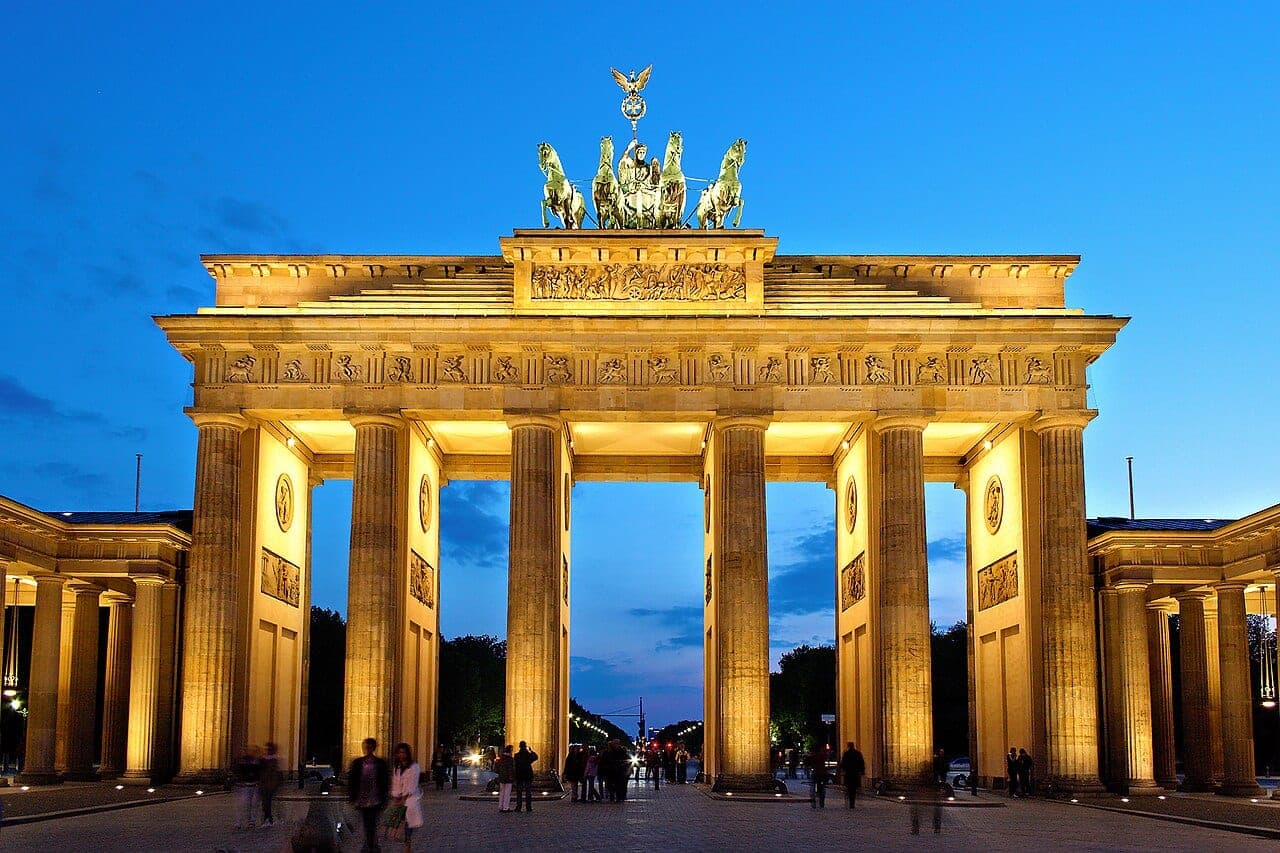
At the western end of Berlin's grand avenue Unter den Linden, the Brandenburg Gate rises above Pariser Platz as the last survivor of the city gates that once pierced the old customs wall. Built between 1788 and 1791 for King Frederick William II of Prussia, and crowned by the Quadriga, a chariot pulled by four horses, the gate has watched almost every turn of modern German history unfold beneath it (Wikipedia).
For nearly three decades the gate was walled off inside the no-man's-land between East and West Berlin. That it now opens freely onto a public square is itself a summary of the twentieth century, and the reason it is read today less as a triumphal arch than as an emblem of unity (Britannica).
The gate was commissioned by Frederick William II of Prussia and designed by the architect Carl Gotthard Langhans, who built it between 1788 and 1791 to replace a plainer earlier gate on the road toward the town of Brandenburg an der Havel (Wikipedia). In 1793 the sculptor Johann Gottfried Schadow added the Quadriga on top: a winged figure driving a four-horse chariot, originally a goddess bearing a wreath as an emblem of peace (Britannica).
After Prussia's defeat in 1806, Napoleon entered Berlin in triumph and had the Quadriga taken down and carried to Paris (Wikipedia). It came back in 1814, after Napoleon's own fall, and was restored to its place. The architect Karl Friedrich Schinkel reworked the figure into Victoria, a goddess of victory, adding a Prussian eagle and an Iron Cross to her staff, so that a chariot of peace returned as a monument to military triumph.
After 1933 the National Socialists used the gate as a stage for torchlit parades marking their rise to power, turning the neoclassical arch into a prop of the regime. The Second World War left it badly damaged: by 1945 the structure was pocked with bullet holes and shell fragments, and the Quadriga was almost entirely destroyed in the fighting for Berlin (Wikipedia). A plaster cast made in 1942 later allowed a new Quadriga to be cast, and the two Berlin authorities cooperated, unusually, to restore the gate in the late 1950s.
When East Germany began building the Berlin Wall on 13 August 1961, the border ran directly past the gate, which was sealed inside the fortified strip separating the two halves of the city (Britannica). For the next twenty-eight years it was closed to ordinary traffic, marooned in the guarded no-man's-land where neither East nor West Berliners could reach it, and it became the most visible symbol of a divided Europe.
It was against that backdrop that United States President Ronald Reagan spoke in front of the gate on 12 June 1987, appealing to the Soviet leader with the line, "Mr. Gorbachev, tear down this wall" (Wikipedia). The speech is now remembered as a defining moment of the late Cold War.
The wall fell on the night of 9 November 1989, and crowds gathered at the gate to climb the barrier and celebrate, though the gate itself stayed closed for several more weeks. It was formally reopened as a border crossing on 22 December 1989, when West German chancellor Helmut Kohl walked through to be met on the far side by the East German prime minister (Wikipedia). Less than a year later, on 3 October 1990, Germany was reunified, and the gate that had marked the division became the natural place for the celebration.
Langhans designed the gate in the sober neoclassical manner that was then replacing the Baroque, taking as his model the Propylaea, the monumental gateway to the Acropolis in Athens (Britannica). The sandstone structure carries twelve fluted Doric columns, six to each side, arranged to form five parallel passageways; the wider central opening was long reserved for the royal family and their guests. The gate rises about 26 metres high and extends more than 60 metres wide (Wikipedia).
 The Quadriga. Napoleon took it to Paris in 1806; it came back in 1814, and the goddess acquired an iron cross she had not previously carried. Photograph by W. Bulach, CC BY-SA 4.0, via Wikimedia Commons.
Above the central entablature sits the Quadriga, Schadow's copper chariot group, in which the winged goddess drives four horses toward the city. Pairing a Greek temple gateway with a triumphal chariot linked Prussia to the ideals of classical Athens and Rome, while reliefs drawn from the labours of Hercules reinforced the theme of heroic virtue.
Because the gate has been claimed in turn by monarchy, dictatorship, division and democracy, it now serves as Germany's central place of national memory and celebration (Britannica). Since reunification, Pariser Platz has hosted New Year's Eve gatherings, concerts and public mourning, and the gate is often lit in the colours of other nations in solidarity after tragedies abroad.
Its meaning has shifted with its history. The chariot that Napoleon carried off, that the Nazis paraded beneath, and that stood mute in the death strip, is today most often read as a symbol of peace and of freedom regained. Close by lie the Reichstag to the north and the Memorial to the Murdered Jews of Europe just south of the square.
The Brandenburg Gate stands at the head of Pariser Platz in the Mitte district, where Unter den Linden meets the edge of the Tiergarten park. The square around it is a pedestrian zone, open at all hours and free to visit, so the gate can be seen and walked through at any time of day (Wikipedia). The nearest station, Brandenburger Tor, lies directly beneath the square and is served by both the U-Bahn and S-Bahn, making public transport the simplest way to arrive.
Because the gate is a monument rather than a museum, there is no ticket and no interior to tour, though a small Room of Silence within the northern gatehouse offers a quiet space for reflection. Many visitors combine it with nearby sights, walking east along Unter den Linden or north to the Reichstag; the square is busiest around midday and calmest in the early morning. Details on nearby exhibitions and access are best checked with the Berlin city tourist information service before a visit.
The Quadriga. Napoleon took it to Paris in 1806; it came back in 1814, and the goddess acquired an iron cross she had not previously carried. Photograph by W. Bulach, CC BY-SA 4.0, via Wikimedia Commons.
Above the central entablature sits the Quadriga, Schadow's copper chariot group, in which the winged goddess drives four horses toward the city. Pairing a Greek temple gateway with a triumphal chariot linked Prussia to the ideals of classical Athens and Rome, while reliefs drawn from the labours of Hercules reinforced the theme of heroic virtue.
Because the gate has been claimed in turn by monarchy, dictatorship, division and democracy, it now serves as Germany's central place of national memory and celebration (Britannica). Since reunification, Pariser Platz has hosted New Year's Eve gatherings, concerts and public mourning, and the gate is often lit in the colours of other nations in solidarity after tragedies abroad.
Its meaning has shifted with its history. The chariot that Napoleon carried off, that the Nazis paraded beneath, and that stood mute in the death strip, is today most often read as a symbol of peace and of freedom regained. Close by lie the Reichstag to the north and the Memorial to the Murdered Jews of Europe just south of the square.
The Brandenburg Gate stands at the head of Pariser Platz in the Mitte district, where Unter den Linden meets the edge of the Tiergarten park. The square around it is a pedestrian zone, open at all hours and free to visit, so the gate can be seen and walked through at any time of day (Wikipedia). The nearest station, Brandenburger Tor, lies directly beneath the square and is served by both the U-Bahn and S-Bahn, making public transport the simplest way to arrive.
Because the gate is a monument rather than a museum, there is no ticket and no interior to tour, though a small Room of Silence within the northern gatehouse offers a quiet space for reflection. Many visitors combine it with nearby sights, walking east along Unter den Linden or north to the Reichstag; the square is busiest around midday and calmest in the early morning. Details on nearby exhibitions and access are best checked with the Berlin city tourist information service before a visit.
History
The Wall and reunification
Architecture
Cultural role
Visiting
References and resources
- Encyclopaedia Britannica: Brandenburg Gate: history, dimensions, the Quadriga and the gate's Cold War role.
- Wikipedia: Brandenburg Gate: construction dates, architect, wartime damage, restoration and reunification.
- Wikipedia: Tear down this wall!: Ronald Reagan's speech at the gate on 12 June 1987.