Heritage · Museum
Pergamon Museum: Ancient Wonders on Berlin's Museum Island
On Berlin's Museum Island, the Pergamon Museum lets visitors walk beneath the Pergamon Altar and through the blue-glazed Ishtar Gate of Babylon, each rebuilt at full scale. Germany's most visited museum closed in 2023 for a phased renovation, with its north wing and altar hall set to reopen in June 2027.Written to last.
By Confinity Heritage Editorial · Updated 2026-07-31 · 7-minute readQuiet tools, kept out of the way.
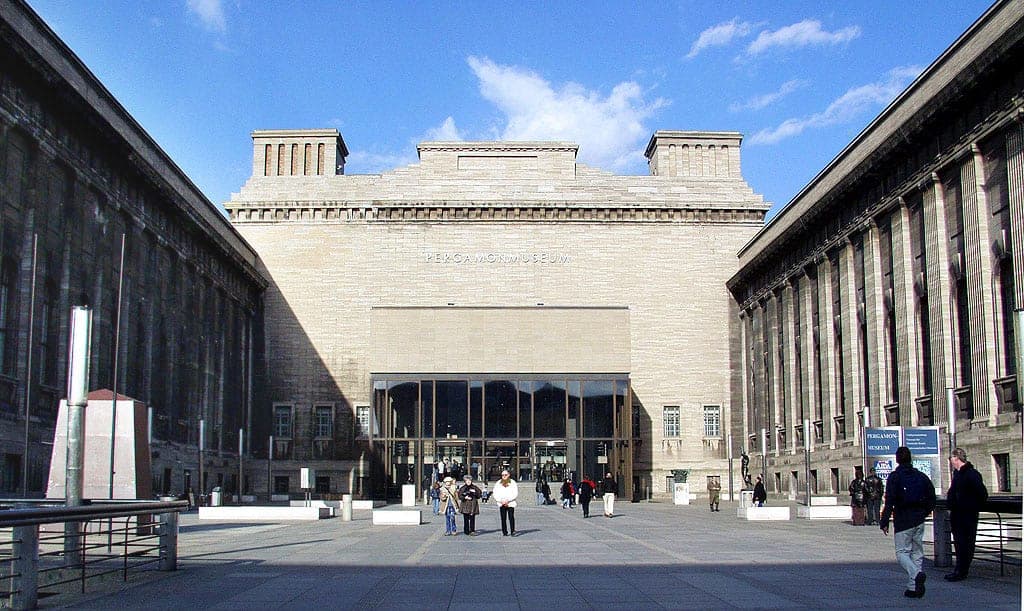
The Pergamon Museum (Pergamonmuseum) on Berlin's Museum Island is a place you enter rather than simply look at. Its galleries were built around monumental architecture carried from the ancient world and reassembled at full height, so that a visitor climbs the marble stair of a Hellenistic altar, passes beneath the glazed blue arch of a Babylonian gate, and stands before the carved front of a Roman market building, all under one roof. That approach, showing ancient buildings as buildings rather than as fragments in cases, made it the most visited museum in Germany, drawing well over a million people a year in the period before its main halls began to close for renovation.
The museum opened in 1930 as the last of the buildings on Museum Island, a group inscribed as a UNESCO World Heritage Site in 1999. Behind a broad three-winged front it holds three separate collections: the Antikensammlung (Collection of Classical Antiquities), the Vorderasiatisches Museum (Museum of the Ancient Near East), and the Museum für Islamische Kunst (Museum of Islamic Art). Since October 2023 the building has been closed for the most far-reaching renovation in its history, and its reopening is planned in stages beginning in 2027.
The Pergamon Museum was commissioned under Kaiser Wilhelm II to house the results of German archaeological excavations that had outgrown the earlier museums on the island. Alfred Messel designed the building from around 1906, and after his death in 1909 his friend Ludwig Hoffmann, the city architect of Berlin, carried the project through to completion. Construction ran from 1910 to 1930, interrupted by the First World War and the inflation of the 1920s, which is why a museum begun under the empire finally opened during the Weimar Republic. An earlier, smaller building on the site, put up around the turn of the century to shelter the Pergamon Altar, had developed structural problems and was demolished to make way for the present one.
Messel's design broke with the idea of a museum as a gallery of movable objects. He planned enormous halls sized to receive whole architectural monuments, so the building is shaped around its largest exhibits rather than the other way around.
The collections suffered during the Second World War. Museum Island was bombed in the Allied air raids of 1943 to 1945, and although many objects had been moved to shelters, parts of the buildings and some works were damaged. After the war, Soviet forces removed large quantities of material to the Soviet Union as war trophies. Much of it was returned to East Germany in 1958, when the museum lay in the German Democratic Republic, but a significant number of objects were kept and remain in Russian institutions such as the Pushkin Museum in Moscow and the Hermitage in Saint Petersburg, where their status is still subject to dispute.
Three collections share the building, each with its own history and curators.
The Antikensammlung, the Collection of Classical Antiquities, holds Greek, Etruscan, and Roman art, and it is the home of the Pergamon Altar and the Market Gate of Miletus. Its holdings trace sculpture, architecture, and everyday objects across the classical Mediterranean.
The Vorderasiatisches Museum, the Museum of the Ancient Near East, presents roughly six thousand years of culture from Mesopotamia, Assyria, Babylonia, and Anatolia, drawn largely from German excavations at sites such as Babylon, Uruk, and Assur. Its centrepiece is the reconstructed Ishtar Gate and Processional Way of Babylon, and it also holds cuneiform tablets, among them a fragment of the Epic of Gilgamesh.
The Museum für Islamische Kunst, the Museum of Islamic Art, covers art from the eighth to the nineteenth century across a region reaching from Spain to India. Among its best-known pieces are the Mshatta facade, the painted Aleppo Room, and a carved wooden dome from the Alhambra.
The Pergamon Altar gives the museum its name. Built in the second century BC at Pergamon, a Greek city in western Asia Minor near modern Bergama in Turkey, it was excavated by the German engineer Carl Humann from 1878, and its fragments were shipped to Berlin under an agreement with the Ottoman authorities. Its great frieze, about 113 metres long, depicts the Gigantomachy, the battle between the gods and the giants, in some of the most dramatic relief carving to survive from the ancient world. In the museum the altar's west front and monumental stair were rebuilt at full scale so that visitors could climb toward the columned hall above.
 What stands in Berlin is the smaller of the two gates, rebuilt from excavated glazed brick with modern brick filling the gaps. The larger one is still in storage: there is no room for it. Photograph by Jose Luiz, CC BY-SA 4.0, via Wikimedia Commons.
The Ishtar Gate and Processional Way were built in Babylon around 575 BC under King Nebuchadnezzar II and excavated by Robert Koldewey between 1902 and 1914. The reconstruction in Berlin uses original glazed bricks, their deep blue ground set with striding lions, bulls, and dragons, to recreate the smaller front gate and a stretch of the ceremonial avenue that led into the city. It is one of the most recognisable displays in any museum.
The Market Gate of Miletus is a two-storey Roman gateway from the Greek city of Miletus on the coast of Asia Minor, built in about the second century AD and later toppled by an earthquake. Brought to Berlin in the early twentieth century, it was reassembled from its surviving parts, with modern material filling the gaps, into a facade that fills the end of a hall.
The Mshatta facade is the carved stone front of an unfinished Umayyad desert palace of the eighth century at Qasr Mshatta in present-day Jordan. It was given to Wilhelm II by the Ottoman sultan Abdülhamid II in 1903 and is a key work of early Islamic art, its limestone densely carved with rosettes, animals, and foliage.
The Pergamon Museum is the youngest of the buildings on Museum Island, the ensemble of five museums built between 1830 and 1930 on an island in the River Spree and added to the UNESCO World Heritage List in 1999 as a rare example of a purpose-built museum quarter. Within that group the Pergamon has long been the biggest draw, and its method of showing architecture at full scale has shaped how other museums present monumental remains.
That method is also the source of continuing debate. Because its largest exhibits are whole structures removed from their original sites, the museum sits at the centre of long-running restitution discussions. Turkey has requested the return of items including the Pergamon Altar, and Iraq and others have raised claims to material such as the Babylonian holdings. The objects were removed around the turn of the twentieth century under permits and find-sharing arrangements made with the Ottoman and other authorities of the day. Those who favour keeping the collections in Berlin argue that the acquisitions were lawful under the agreements of the time and that the museum has conserved, studied, and displayed the material for more than a century. Those calling for return argue that the arrangements were made under unequal conditions and that such heritage carries a strong claim to its place of origin. Some German public figures have suggested returning the altar, while the responsible authorities have generally maintained the existing position, and the differing views remain unresolved.
The building's condition and its outdated infrastructure made a full overhaul necessary. The hall holding the Pergamon Altar closed in 2014 for structural work and was expected to stay shut for years even before the wider plans advanced. On 23 October 2023 the rest of the museum closed as well, beginning the most extensive renovation since it was built.
The work is planned in two phases as part of the Museum Island master plan. The north wing and the central building are due to reopen on 4 June 2027, bringing back the Pergamon Altar and the Hellenistic hall of the Antikensammlung, the full display of the Museum für Islamische Kunst (including the Mshatta facade, the Aleppo Room, and the Alhambra dome), and a selection of highlights from the Vorderasiatisches Museum. The south wing is expected to remain closed until around 2037, and completion of the whole project has been projected into the late 2030s or beyond.
While the main building is closed, its most famous objects are not on view in situ, but the other museums on Museum Island, among them the Neues Museum, the Altes Museum, the Alte Nationalgalerie, the Bode-Museum, and the James Simon Gallery, remain open, and the Berlin State Museums have presented Pergamon highlights and information about the project at the James Simon Gallery. Because dates and displays continue to change, anyone planning a visit should check the official Berlin State Museums website before travelling.
What stands in Berlin is the smaller of the two gates, rebuilt from excavated glazed brick with modern brick filling the gaps. The larger one is still in storage: there is no room for it. Photograph by Jose Luiz, CC BY-SA 4.0, via Wikimedia Commons.
The Ishtar Gate and Processional Way were built in Babylon around 575 BC under King Nebuchadnezzar II and excavated by Robert Koldewey between 1902 and 1914. The reconstruction in Berlin uses original glazed bricks, their deep blue ground set with striding lions, bulls, and dragons, to recreate the smaller front gate and a stretch of the ceremonial avenue that led into the city. It is one of the most recognisable displays in any museum.
The Market Gate of Miletus is a two-storey Roman gateway from the Greek city of Miletus on the coast of Asia Minor, built in about the second century AD and later toppled by an earthquake. Brought to Berlin in the early twentieth century, it was reassembled from its surviving parts, with modern material filling the gaps, into a facade that fills the end of a hall.
The Mshatta facade is the carved stone front of an unfinished Umayyad desert palace of the eighth century at Qasr Mshatta in present-day Jordan. It was given to Wilhelm II by the Ottoman sultan Abdülhamid II in 1903 and is a key work of early Islamic art, its limestone densely carved with rosettes, animals, and foliage.
The Pergamon Museum is the youngest of the buildings on Museum Island, the ensemble of five museums built between 1830 and 1930 on an island in the River Spree and added to the UNESCO World Heritage List in 1999 as a rare example of a purpose-built museum quarter. Within that group the Pergamon has long been the biggest draw, and its method of showing architecture at full scale has shaped how other museums present monumental remains.
That method is also the source of continuing debate. Because its largest exhibits are whole structures removed from their original sites, the museum sits at the centre of long-running restitution discussions. Turkey has requested the return of items including the Pergamon Altar, and Iraq and others have raised claims to material such as the Babylonian holdings. The objects were removed around the turn of the twentieth century under permits and find-sharing arrangements made with the Ottoman and other authorities of the day. Those who favour keeping the collections in Berlin argue that the acquisitions were lawful under the agreements of the time and that the museum has conserved, studied, and displayed the material for more than a century. Those calling for return argue that the arrangements were made under unequal conditions and that such heritage carries a strong claim to its place of origin. Some German public figures have suggested returning the altar, while the responsible authorities have generally maintained the existing position, and the differing views remain unresolved.
The building's condition and its outdated infrastructure made a full overhaul necessary. The hall holding the Pergamon Altar closed in 2014 for structural work and was expected to stay shut for years even before the wider plans advanced. On 23 October 2023 the rest of the museum closed as well, beginning the most extensive renovation since it was built.
The work is planned in two phases as part of the Museum Island master plan. The north wing and the central building are due to reopen on 4 June 2027, bringing back the Pergamon Altar and the Hellenistic hall of the Antikensammlung, the full display of the Museum für Islamische Kunst (including the Mshatta facade, the Aleppo Room, and the Alhambra dome), and a selection of highlights from the Vorderasiatisches Museum. The south wing is expected to remain closed until around 2037, and completion of the whole project has been projected into the late 2030s or beyond.
While the main building is closed, its most famous objects are not on view in situ, but the other museums on Museum Island, among them the Neues Museum, the Altes Museum, the Alte Nationalgalerie, the Bode-Museum, and the James Simon Gallery, remain open, and the Berlin State Museums have presented Pergamon highlights and information about the project at the James Simon Gallery. Because dates and displays continue to change, anyone planning a visit should check the official Berlin State Museums website before travelling.
History and founding
The collections
The great installations
Cultural significance
Renovation and visiting
References and resources
- Berlin State Museums: Pergamonmuseum: official visitor information, collections, and history.
- Berlin State Museums: Refurbishment: the museum's account of the phased renovation and the master plan.
- Berlin State Museums: Reopening on 4 June 2027: what will be accessible when the north wing and central building reopen.
- Wikipedia: Pergamon Museum: detailed history, architecture, collections, and wartime losses with sources.
- Wikipedia: Pergamon Altar: the altar's date, excavation, frieze, and display in Berlin.
- UNESCO: Museumsinsel (Museum Island): the World Heritage listing for the museum quarter.