Heritage · Country
Austria Culture and Heritage
When Otto von Habsburg was carried to the Capuchin crypt in 2011, the friar behind the door refused to open until the heir to an empire was announced simply as a mortal, sinful man. A guide to Austria's heritage, its layered faiths, and the elaborate ways the Austrians escort their dead.Written to last.
By Confinity Heritage Editorial · 2026-07-11 · 8-minute readQuiet tools, kept out of the way.
On 16 July 2011 a coffin was carried through Vienna to the door of the Capuchin friary on the Neuer Markt, and the ancient ceremony was performed one more time. The master of the household knocked three times. A friar inside asked who sought entry, and a herald recited the dead man's titles, a cascade of archduchies and crowns, and heard the reply: "We do not know him." He knocked again with a shorter, plainer list of honours, and again the answer came back that the friar did not know him. Only on the third knock, when Otto von Habsburg was named as "a mortal and sinful man", did the doors swing open. It is the Anklopfzeremonie, the knocking ceremony, and it states in a few sentences what Austria has always known about the dead: that titles stop at the threshold, and that even an emperor's heir enters the grave as everyone else does.
Austria keeps company with its dead in ways that can seem almost theatrical, and it does so out of long habit. Its Habsburg rulers were buried in three places at once, the body in one crypt, the heart in another, the entrails in a third; its villagers in Hallstatt dig up their grandparents, paint the skulls with flowers and names, and stack them tidily in a chapel; and its capital elevated the funeral into an art form so refined that Viennese still speak, half in earnest, of a "schöne Leich", a beautiful corpse and a send-off to match.
 Schönbrunn Palace, the Habsburgs' summer residence in Vienna and a UNESCO World Heritage Site. CC0, via Wikimedia Commons.
Austria is a landlocked country of about 83,900 square kilometres in the middle of Europe, sharing borders with eight neighbours, from Germany and the Czech Republic in the north to Italy and Slovenia in the south. The Alps fill roughly two-thirds of the land, rising to the Grossglockner at 3,798 metres, and the country's rivers, above all the Danube, cut the valleys where most people live. The east flattens into the Pannonian plain around Vienna and the reedy shallows of Lake Neusiedl; the west narrows into the high valleys of Tyrol and Vorarlberg. It is a small country that was once the hub of a very large empire, and the disproportion between its present size and its former reach explains much about its heritage, its architecture and its sense of itself.
Austria has about 9.1 million people, a fifth of them in Vienna, and is a federal republic of nine states, each with real powers over culture and education. It has been neutral since the State Treaty of 1955 ended the postwar occupation, joined the European Union in 1995 and uses the euro. Its population has been reshaped by migration, first the guest workers from Turkey and the former Yugoslavia in the 1960s and 1970s, later refugees from the Balkans, Syria and Ukraine, so that the cities are more diverse than the alpine image suggests. What holds the country together is less a single ethnic story than a shared inheritance of landscape, music, Catholic ritual and the memory of empire, carried in an extraordinary density of palaces, churches, archives and graves.
Vienna. The capital grew from the Roman camp of Vindobona on the Danube into the seat of the Habsburgs and, for centuries, the largest German-speaking city in the world. It is a museum of its own past: the Hofburg palace complex, the Gothic cathedral of St Stephen with its ducal crypt, the Ringstrasse of grand nineteenth-century institutions, and the Central Cemetery with its avenues of honorary graves. Vienna is also the city of Freud, Klimt, Mahler and the Vienna Circle, and its coffee houses and concert halls keep a cultural life that once set the tempo for Europe.
Schönbrunn Palace, the Habsburgs' summer residence in Vienna and a UNESCO World Heritage Site. CC0, via Wikimedia Commons.
Austria is a landlocked country of about 83,900 square kilometres in the middle of Europe, sharing borders with eight neighbours, from Germany and the Czech Republic in the north to Italy and Slovenia in the south. The Alps fill roughly two-thirds of the land, rising to the Grossglockner at 3,798 metres, and the country's rivers, above all the Danube, cut the valleys where most people live. The east flattens into the Pannonian plain around Vienna and the reedy shallows of Lake Neusiedl; the west narrows into the high valleys of Tyrol and Vorarlberg. It is a small country that was once the hub of a very large empire, and the disproportion between its present size and its former reach explains much about its heritage, its architecture and its sense of itself.
Austria has about 9.1 million people, a fifth of them in Vienna, and is a federal republic of nine states, each with real powers over culture and education. It has been neutral since the State Treaty of 1955 ended the postwar occupation, joined the European Union in 1995 and uses the euro. Its population has been reshaped by migration, first the guest workers from Turkey and the former Yugoslavia in the 1960s and 1970s, later refugees from the Balkans, Syria and Ukraine, so that the cities are more diverse than the alpine image suggests. What holds the country together is less a single ethnic story than a shared inheritance of landscape, music, Catholic ritual and the memory of empire, carried in an extraordinary density of palaces, churches, archives and graves.
Vienna. The capital grew from the Roman camp of Vindobona on the Danube into the seat of the Habsburgs and, for centuries, the largest German-speaking city in the world. It is a museum of its own past: the Hofburg palace complex, the Gothic cathedral of St Stephen with its ducal crypt, the Ringstrasse of grand nineteenth-century institutions, and the Central Cemetery with its avenues of honorary graves. Vienna is also the city of Freud, Klimt, Mahler and the Vienna Circle, and its coffee houses and concert halls keep a cultural life that once set the tempo for Europe.
 The Franz-Josefs-Kai along the Danube Canal in Vienna, in a photochrom print from the 1890s. Public domain, via Wikimedia Commons.
Salzburg. Built where the Salzach river carried the wealth of the nearby salt mines, Salzburg was ruled for centuries by prince-archbishops who left it a Baroque old town of churches, squares and the great cliff-top fortress of Hohensalzburg, one of the largest surviving castles in central Europe. It is Mozart's birthplace, home since 1920 to a summer festival that is among the world's most prestigious, and its historic centre is a UNESCO World Heritage Site.
Graz. The capital of Styria kept its Renaissance and medieval core so intact that it too became a World Heritage Site, later extended to include the seventeenth-century palace of Eggenberg. A university city with a large student population, Graz balances its old town of red roofs and its clock-tower hill against the mirrored bulge of the modern Kunsthaus, nicknamed the "friendly alien".
Innsbruck. Ringed by the Nordkette range, the Tyrolean capital was a favourite Habsburg residence, and Emperor Maximilian I left it the Golden Roof and an extraordinary memorial: the Hofkirche, where his empty tomb is guarded by twenty-eight larger-than-life bronze figures of his real and imagined ancestors, the "Schwarze Mander" or black men. Innsbruck has twice hosted the Winter Olympics, in 1964 and 1976.
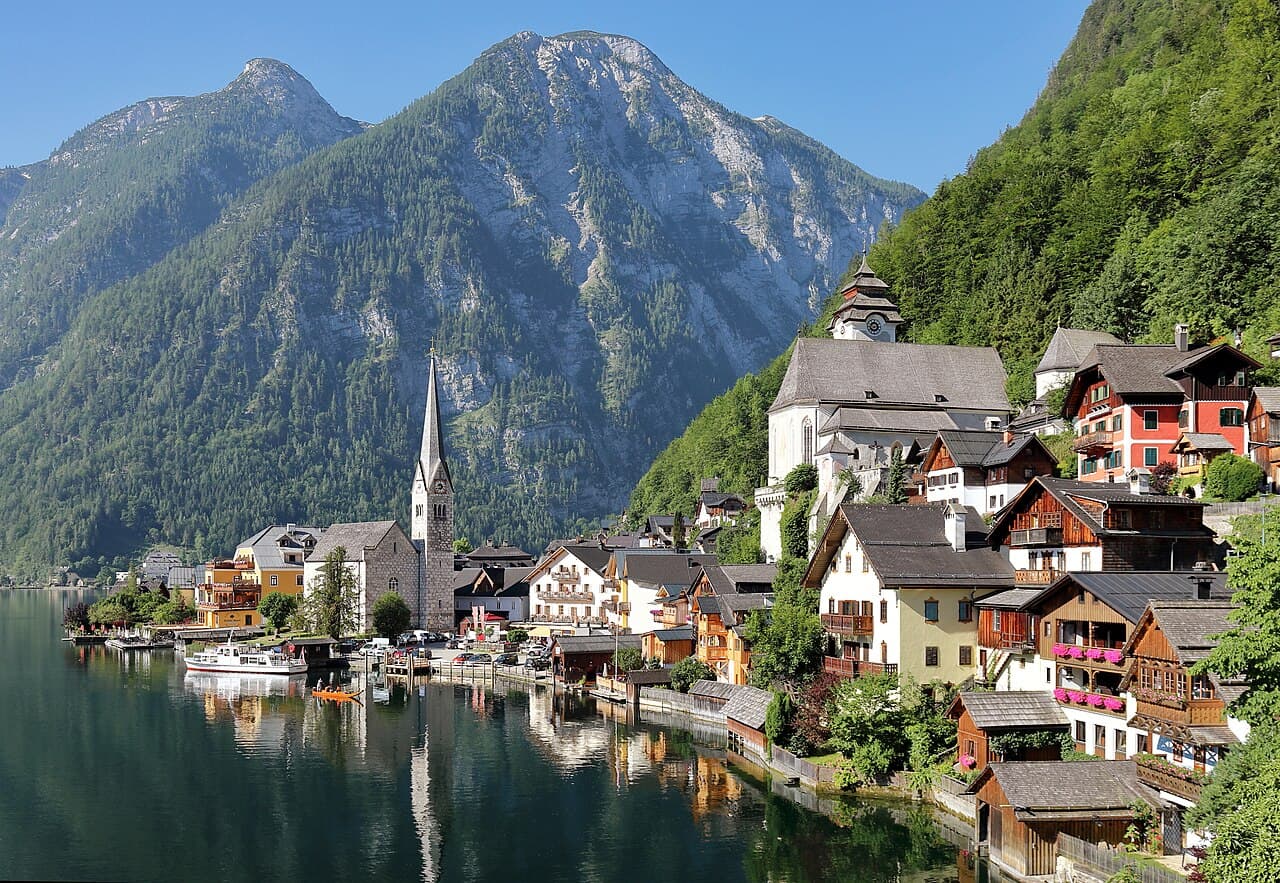
Hallstatt. A village of a few hundred people wedged between a lake and a mountain, Hallstatt has given its name to an entire era of European prehistory, the Hallstatt culture of the Early Iron Age, because of the vast cemetery excavated above it. People have mined salt on the mountain for some seven thousand years, and the same lack of flat ground that made the village famous produced its most striking custom, the charnel house of painted skulls described below. With the Dachstein massif it forms a World Heritage cultural landscape.
The land that became Austria was a Roman frontier, guarded by the Danube forts of the province of Noricum, before the Bavarians settled it and Charlemagne organised a march against the Avars in the east. The decisive moment came in 976, when the Babenberg family took over this "Ostarrîchi", the eastern realm first named in a document of 996; they ruled for nearly three centuries and made Vienna a capital. In 1278 the Habsburgs won the territory in battle, and they held it, with barely a break, until 1918. Through strategic marriages more than conquest, they accumulated crowns across Europe, elected Holy Roman Emperors almost continuously from the fifteenth century, and turned Vienna into the administrative heart of a sprawling multinational state.
That state was tested and enlarged by crisis. Twice, in 1529 and again in 1683, Ottoman armies besieged Vienna, and the relief of the second siege pushed Habsburg power deep into Hungary and the Balkans. The eighteenth century brought the long reign of Maria Theresa, the only woman to rule the Habsburg lands, and her son Joseph II, whose reforms reached even into how people were allowed to be buried. Defeat by Napoleon ended the Holy Roman Empire in 1806; the Congress of Vienna in 1815 redrew Europe in the city's ballrooms. In 1867 the monarchy reorganised itself as Austria-Hungary, a dual state of many peoples that flourished culturally even as its nationalisms pulled it apart. The assassination of the heir Franz Ferdinand in Sarajevo in 1914 triggered the First World War, and the empire collapsed at its end. The small German-speaking republic that remained was annexed by Nazi Germany in the Anschluss of 1938, shared in the crimes of the Third Reich, and emerged from the Second World War occupied by the Allies until the 1955 State Treaty restored full sovereignty on condition of permanent neutrality.
Austria's name is a thousand years old and means, plainly, the eastern land. The Old High German Ostarrîchi of the 996 document, the medieval Latin Marchia Orientalis or eastern march, and the modern German Österreich all carry the same sense of a frontier on the eastern edge of the German-speaking and Frankish world. The Latin form Austria, from which English takes the name, simply Latinised the eastern idea. German is the language of nearly everyone, but Austrian German has its own vocabulary, especially for food and officialdom, and its dialects, from the broad Viennese of the capital to the alpine speech of Tyrol and Vorarlberg, are strong markers of belonging.
The map records older layers. Roman names survive beneath the German ones: Vienna was Vindobona, Salzburg was Juvavum, and the salt that gave Salzburg, the Salzach and the Salzkammergut their names had been dug and traded since prehistory. In the south, along the Carinthian valleys, Slavic place names and a Slovene-speaking minority remain from the Slavs who settled there in the early Middle Ages; in Burgenland, on the Hungarian border, live communities of Burgenland Croats, descended from sixteenth-century settlers, and a Hungarian-speaking minority. These groups, together with the Roma and the small remnant of the once-great Jewish community, are recognised as autochthonous minorities, and their languages are protected, if precariously, in a country that is otherwise overwhelmingly German-speaking.
If one institution stands for Austrian everyday culture it is the Viennese coffee house, listed by UNESCO as intangible cultural heritage, where a single small cup buys a chair, a newspaper and an afternoon. Around it cluster the foods that Austria has exported to the world's imagination: the Wiener schnitzel, the apple strudel, the Sachertorte with its guarded recipe, and the Tafelspitz that was said to be the emperor's favourite. The alpine west lives a different rhythm of dairy farming, mountain huts and skiing, a national sport pursued with a seriousness that turns downhill racers into household names.
Above all, Austria is a country organised around music. Vienna was the working city of Haydn, Mozart, Beethoven, Schubert, Brahms, Bruckner, Mahler and the Strauss dynasty, and later the birthplace of Schoenberg's atonal revolution; the Vienna Philharmonic's New Year's Concert is broadcast to tens of millions, the Vienna Boys' Choir has sung since 1498, and the Salzburg Festival fills each summer with opera and drama. Folk custom runs alongside the high tradition and is often darker than the tourist image: the horned Krampus and the wild Perchten who chase away winter in the alpine valleys, the Christmas markets, the Fasching carnival, and the Advent song "Silent Night", written in a Salzburg-district village in 1818 and now sung everywhere on earth. The Spanish Riding School, with its Lipizzaner stallions, keeps a form of classical horsemanship recognised as living heritage.
Austria is a historically Catholic country, and the Church shaped its landscape as thoroughly as the mountains did. The Counter-Reformation, driven by the Habsburgs, rolled back an early Protestant surge and rebuilt the country in Baroque, giving it the monasteries that still crown its river bluffs, the pilgrimage church of Mariazell in Styria that draws the faithful from across central Europe, and prince-bishops who ruled Salzburg as a church state until 1803. The tradition of the Habsburgs as defenders of the faith, the Pietas Austriaca, bound dynasty and religion into a single idea of the country.
That inheritance is now shared with a much more plural present. At recent counts Catholics are only just over half the population and falling, the fastest-growing group being those with no religious affiliation. Islam has a long formal standing here: it was recognised by the Islam Act of 1912, passed after Austria-Hungary annexed Bosnia, and Muslims are now the second-largest religious community, around eight per cent, most with Turkish or Bosnian roots. The Protestant churches remain a small minority, strongest in Carinthia and Burgenland. The Jewish community, which numbered nearly two hundred thousand in Vienna alone before 1938 and gave the city Freud, Mahler, Schnitzler and Wittgenstein, was destroyed by expulsion and murder in the Holocaust; a few thousand Jews live in Austria today, and the restored synagogues and the Shoah names memorial unveiled in Vienna in 2021 stand for an absence as much as a presence.
Austrian remembrance begins with the Habsburgs, who turned their own deaths into a state liturgy. From the seventeenth century the dynasty practised a divided burial: the embalmed body went to the Imperial Crypt beneath the Capuchin church, the Kaisergruft, where more than one hundred and forty Habsburgs lie in sarcophagi ranging from plain to wildly Baroque; the heart, in a silver urn, went to the Herzgruft of the Augustinian church; and the viscera went to the ducal crypt under St Stephen's Cathedral. A body could thus be mourned in three churches at once. The custom faded, but the Kaisergruft is still in use and still the destination of the knocking ceremony, and the tombs of Maria Theresa and her husband, of the assassinated Empress Elisabeth, and of Franz Joseph remain among the most visited sites in Vienna.
The Franz-Josefs-Kai along the Danube Canal in Vienna, in a photochrom print from the 1890s. Public domain, via Wikimedia Commons.
Salzburg. Built where the Salzach river carried the wealth of the nearby salt mines, Salzburg was ruled for centuries by prince-archbishops who left it a Baroque old town of churches, squares and the great cliff-top fortress of Hohensalzburg, one of the largest surviving castles in central Europe. It is Mozart's birthplace, home since 1920 to a summer festival that is among the world's most prestigious, and its historic centre is a UNESCO World Heritage Site.
Graz. The capital of Styria kept its Renaissance and medieval core so intact that it too became a World Heritage Site, later extended to include the seventeenth-century palace of Eggenberg. A university city with a large student population, Graz balances its old town of red roofs and its clock-tower hill against the mirrored bulge of the modern Kunsthaus, nicknamed the "friendly alien".
Innsbruck. Ringed by the Nordkette range, the Tyrolean capital was a favourite Habsburg residence, and Emperor Maximilian I left it the Golden Roof and an extraordinary memorial: the Hofkirche, where his empty tomb is guarded by twenty-eight larger-than-life bronze figures of his real and imagined ancestors, the "Schwarze Mander" or black men. Innsbruck has twice hosted the Winter Olympics, in 1964 and 1976.
Hallstatt. A village of a few hundred people wedged between a lake and a mountain, Hallstatt has given its name to an entire era of European prehistory, the Hallstatt culture of the Early Iron Age, because of the vast cemetery excavated above it. People have mined salt on the mountain for some seven thousand years, and the same lack of flat ground that made the village famous produced its most striking custom, the charnel house of painted skulls described below. With the Dachstein massif it forms a World Heritage cultural landscape.
The land that became Austria was a Roman frontier, guarded by the Danube forts of the province of Noricum, before the Bavarians settled it and Charlemagne organised a march against the Avars in the east. The decisive moment came in 976, when the Babenberg family took over this "Ostarrîchi", the eastern realm first named in a document of 996; they ruled for nearly three centuries and made Vienna a capital. In 1278 the Habsburgs won the territory in battle, and they held it, with barely a break, until 1918. Through strategic marriages more than conquest, they accumulated crowns across Europe, elected Holy Roman Emperors almost continuously from the fifteenth century, and turned Vienna into the administrative heart of a sprawling multinational state.
That state was tested and enlarged by crisis. Twice, in 1529 and again in 1683, Ottoman armies besieged Vienna, and the relief of the second siege pushed Habsburg power deep into Hungary and the Balkans. The eighteenth century brought the long reign of Maria Theresa, the only woman to rule the Habsburg lands, and her son Joseph II, whose reforms reached even into how people were allowed to be buried. Defeat by Napoleon ended the Holy Roman Empire in 1806; the Congress of Vienna in 1815 redrew Europe in the city's ballrooms. In 1867 the monarchy reorganised itself as Austria-Hungary, a dual state of many peoples that flourished culturally even as its nationalisms pulled it apart. The assassination of the heir Franz Ferdinand in Sarajevo in 1914 triggered the First World War, and the empire collapsed at its end. The small German-speaking republic that remained was annexed by Nazi Germany in the Anschluss of 1938, shared in the crimes of the Third Reich, and emerged from the Second World War occupied by the Allies until the 1955 State Treaty restored full sovereignty on condition of permanent neutrality.
Austria's name is a thousand years old and means, plainly, the eastern land. The Old High German Ostarrîchi of the 996 document, the medieval Latin Marchia Orientalis or eastern march, and the modern German Österreich all carry the same sense of a frontier on the eastern edge of the German-speaking and Frankish world. The Latin form Austria, from which English takes the name, simply Latinised the eastern idea. German is the language of nearly everyone, but Austrian German has its own vocabulary, especially for food and officialdom, and its dialects, from the broad Viennese of the capital to the alpine speech of Tyrol and Vorarlberg, are strong markers of belonging.
The map records older layers. Roman names survive beneath the German ones: Vienna was Vindobona, Salzburg was Juvavum, and the salt that gave Salzburg, the Salzach and the Salzkammergut their names had been dug and traded since prehistory. In the south, along the Carinthian valleys, Slavic place names and a Slovene-speaking minority remain from the Slavs who settled there in the early Middle Ages; in Burgenland, on the Hungarian border, live communities of Burgenland Croats, descended from sixteenth-century settlers, and a Hungarian-speaking minority. These groups, together with the Roma and the small remnant of the once-great Jewish community, are recognised as autochthonous minorities, and their languages are protected, if precariously, in a country that is otherwise overwhelmingly German-speaking.
If one institution stands for Austrian everyday culture it is the Viennese coffee house, listed by UNESCO as intangible cultural heritage, where a single small cup buys a chair, a newspaper and an afternoon. Around it cluster the foods that Austria has exported to the world's imagination: the Wiener schnitzel, the apple strudel, the Sachertorte with its guarded recipe, and the Tafelspitz that was said to be the emperor's favourite. The alpine west lives a different rhythm of dairy farming, mountain huts and skiing, a national sport pursued with a seriousness that turns downhill racers into household names.
Above all, Austria is a country organised around music. Vienna was the working city of Haydn, Mozart, Beethoven, Schubert, Brahms, Bruckner, Mahler and the Strauss dynasty, and later the birthplace of Schoenberg's atonal revolution; the Vienna Philharmonic's New Year's Concert is broadcast to tens of millions, the Vienna Boys' Choir has sung since 1498, and the Salzburg Festival fills each summer with opera and drama. Folk custom runs alongside the high tradition and is often darker than the tourist image: the horned Krampus and the wild Perchten who chase away winter in the alpine valleys, the Christmas markets, the Fasching carnival, and the Advent song "Silent Night", written in a Salzburg-district village in 1818 and now sung everywhere on earth. The Spanish Riding School, with its Lipizzaner stallions, keeps a form of classical horsemanship recognised as living heritage.
Austria is a historically Catholic country, and the Church shaped its landscape as thoroughly as the mountains did. The Counter-Reformation, driven by the Habsburgs, rolled back an early Protestant surge and rebuilt the country in Baroque, giving it the monasteries that still crown its river bluffs, the pilgrimage church of Mariazell in Styria that draws the faithful from across central Europe, and prince-bishops who ruled Salzburg as a church state until 1803. The tradition of the Habsburgs as defenders of the faith, the Pietas Austriaca, bound dynasty and religion into a single idea of the country.
That inheritance is now shared with a much more plural present. At recent counts Catholics are only just over half the population and falling, the fastest-growing group being those with no religious affiliation. Islam has a long formal standing here: it was recognised by the Islam Act of 1912, passed after Austria-Hungary annexed Bosnia, and Muslims are now the second-largest religious community, around eight per cent, most with Turkish or Bosnian roots. The Protestant churches remain a small minority, strongest in Carinthia and Burgenland. The Jewish community, which numbered nearly two hundred thousand in Vienna alone before 1938 and gave the city Freud, Mahler, Schnitzler and Wittgenstein, was destroyed by expulsion and murder in the Holocaust; a few thousand Jews live in Austria today, and the restored synagogues and the Shoah names memorial unveiled in Vienna in 2021 stand for an absence as much as a presence.
Austrian remembrance begins with the Habsburgs, who turned their own deaths into a state liturgy. From the seventeenth century the dynasty practised a divided burial: the embalmed body went to the Imperial Crypt beneath the Capuchin church, the Kaisergruft, where more than one hundred and forty Habsburgs lie in sarcophagi ranging from plain to wildly Baroque; the heart, in a silver urn, went to the Herzgruft of the Augustinian church; and the viscera went to the ducal crypt under St Stephen's Cathedral. A body could thus be mourned in three churches at once. The custom faded, but the Kaisergruft is still in use and still the destination of the knocking ceremony, and the tombs of Maria Theresa and her husband, of the assassinated Empress Elisabeth, and of Franz Joseph remain among the most visited sites in Vienna.
 The funeral procession of Emperor Franz Joseph I through Vienna in 1916, one of the last great ceremonies of the monarchy. Public domain, via Wikimedia Commons.
Ordinary Austrians developed their own strong grammar of mourning, and Vienna in particular built a whole culture around the good death. The Viennese ideal of a "schöne Leich", a beautiful funeral, meant a fine hearse, a full turnout and a proper meal afterwards, and it was taken seriously enough that the city's funeral service now runs a Funeral Museum at the Central Cemetery to explain it. That cemetery, the Zentralfriedhof, opened on All Saints' Day in 1874 and holds around three million graves, more dead than the living city; its honorary graves gather Beethoven, Schubert, Brahms, Strauss and other national figures in a musicians' quarter, while a separate section preserves the Jewish graves that families murdered in the Holocaust could no longer tend. Mozart, by contrast, was buried in 1791 in a simple communal grave at the St Marx Cemetery, its exact spot lost, and the wistful monument that now marks the area speaks to a very Austrian mixture of reverence and neglect.
The calendar carries remembrance into every household. On All Saints' and All Souls', the first and second of November, families across the country visit the graves, clean and plant them, and light candles so that whole cemeteries glow at dusk. In the alpine parishes the custom of the charnel house arose from simple necessity: at Hallstatt, where there was never enough ground to bury everyone, bodies were exhumed after ten or fifteen years and the skulls were bleached, painted with the person's name, dates and a wreath of flowers or ivy, and arranged in the Beinhaus beside the church, where more than a thousand of them can still be seen. The country also carries heavier, more contested memory: the concentration camp at Mauthausen, where tens of thousands died, is preserved as a national memorial with an annual liberation ceremony each May, and Austria's long, slow reckoning with its role in Nazism, from the Waldheim affair of 1986 to Chancellor Vranitzky's acknowledgement of shared responsibility in 1991, has reshaped how the republic remembers the years between 1938 and 1945.
Austrian research is done in the parish, because for most of the country's history the parish was the registry. Catholic registers of baptism, marriage and burial survive from the sixteenth and seventeenth centuries, and Austria was early to put them online: Matricula publishes digitised registers from most dioceses free, and the images are the original books rather than transcriptions.
Civil registration arrived remarkably late. Austria had no general state registry until 1938, when the German Standesamt system was imposed after the Anschluss, so for anything before that the church book is the primary record for the great majority of families.
The empire is the complication. Until 1918 the Habsburg lands covered what is now Austria, Hungary, Czechia, Slovakia, Slovenia, Croatia and parts of Poland, Ukraine, Romania, Serbia and Italy. A family that never left its village may have records now held in half a dozen countries, in German, Latin, Hungarian, Czech or Polish, and the first task is usually to work out which modern archive inherited the parish.
Jewish records were kept separately and their fate was separate. The registers of the Vienna community survived the war largely intact because they were kept by the community itself under Nazi administration, and they are now among the most complete Jewish vital records in central Europe. For families deported from Austria after 1938, the documentation of what followed is held with the Nazi records at Arolsen and with the Documentation Centre of Austrian Resistance in Vienna.
Austria was an early adopter of official heritage protection. A central commission for the study and preservation of monuments was set up under the emperor in 1850, and its descendant, the Federal Monuments Office, the Bundesdenkmalamt, still administers the listing and protection of buildings and sites across the country. The great monastic libraries, at Admont, Melk and elsewhere, function as heritage institutions in their own right, and the network of state and city museums, crowned by Vienna's Kunsthistorisches Museum with its Habsburg collections, keeps an inheritance assembled over centuries of imperial acquisition.
Austria holds twelve UNESCO World Heritage Sites, and the list reads like a syllabus of the country's history: the palace and gardens of Schönbrunn, the historic centres of Salzburg, Graz and Vienna, the Wachau valley of the Danube with its abbeys and vineyards, the Hallstatt-Dachstein and Salzkammergut cultural landscape, and the Semmering Railway, the mountain line of 1854 that was the first in the world to be inscribed as a heritage site for its engineering and its integration into the alpine scenery. Membership of the list is no guarantee of safety: the Historic Centre of Vienna was placed on UNESCO's List of World Heritage in Danger in July 2017 because of a high-rise development near the Ringstrasse, a reminder that a living capital and its protected skyline are not always easy to reconcile.
The funeral procession of Emperor Franz Joseph I through Vienna in 1916, one of the last great ceremonies of the monarchy. Public domain, via Wikimedia Commons.
Ordinary Austrians developed their own strong grammar of mourning, and Vienna in particular built a whole culture around the good death. The Viennese ideal of a "schöne Leich", a beautiful funeral, meant a fine hearse, a full turnout and a proper meal afterwards, and it was taken seriously enough that the city's funeral service now runs a Funeral Museum at the Central Cemetery to explain it. That cemetery, the Zentralfriedhof, opened on All Saints' Day in 1874 and holds around three million graves, more dead than the living city; its honorary graves gather Beethoven, Schubert, Brahms, Strauss and other national figures in a musicians' quarter, while a separate section preserves the Jewish graves that families murdered in the Holocaust could no longer tend. Mozart, by contrast, was buried in 1791 in a simple communal grave at the St Marx Cemetery, its exact spot lost, and the wistful monument that now marks the area speaks to a very Austrian mixture of reverence and neglect.
The calendar carries remembrance into every household. On All Saints' and All Souls', the first and second of November, families across the country visit the graves, clean and plant them, and light candles so that whole cemeteries glow at dusk. In the alpine parishes the custom of the charnel house arose from simple necessity: at Hallstatt, where there was never enough ground to bury everyone, bodies were exhumed after ten or fifteen years and the skulls were bleached, painted with the person's name, dates and a wreath of flowers or ivy, and arranged in the Beinhaus beside the church, where more than a thousand of them can still be seen. The country also carries heavier, more contested memory: the concentration camp at Mauthausen, where tens of thousands died, is preserved as a national memorial with an annual liberation ceremony each May, and Austria's long, slow reckoning with its role in Nazism, from the Waldheim affair of 1986 to Chancellor Vranitzky's acknowledgement of shared responsibility in 1991, has reshaped how the republic remembers the years between 1938 and 1945.
Austrian research is done in the parish, because for most of the country's history the parish was the registry. Catholic registers of baptism, marriage and burial survive from the sixteenth and seventeenth centuries, and Austria was early to put them online: Matricula publishes digitised registers from most dioceses free, and the images are the original books rather than transcriptions.
Civil registration arrived remarkably late. Austria had no general state registry until 1938, when the German Standesamt system was imposed after the Anschluss, so for anything before that the church book is the primary record for the great majority of families.
The empire is the complication. Until 1918 the Habsburg lands covered what is now Austria, Hungary, Czechia, Slovakia, Slovenia, Croatia and parts of Poland, Ukraine, Romania, Serbia and Italy. A family that never left its village may have records now held in half a dozen countries, in German, Latin, Hungarian, Czech or Polish, and the first task is usually to work out which modern archive inherited the parish.
Jewish records were kept separately and their fate was separate. The registers of the Vienna community survived the war largely intact because they were kept by the community itself under Nazi administration, and they are now among the most complete Jewish vital records in central Europe. For families deported from Austria after 1938, the documentation of what followed is held with the Nazi records at Arolsen and with the Documentation Centre of Austrian Resistance in Vienna.
Austria was an early adopter of official heritage protection. A central commission for the study and preservation of monuments was set up under the emperor in 1850, and its descendant, the Federal Monuments Office, the Bundesdenkmalamt, still administers the listing and protection of buildings and sites across the country. The great monastic libraries, at Admont, Melk and elsewhere, function as heritage institutions in their own right, and the network of state and city museums, crowned by Vienna's Kunsthistorisches Museum with its Habsburg collections, keeps an inheritance assembled over centuries of imperial acquisition.
Austria holds twelve UNESCO World Heritage Sites, and the list reads like a syllabus of the country's history: the palace and gardens of Schönbrunn, the historic centres of Salzburg, Graz and Vienna, the Wachau valley of the Danube with its abbeys and vineyards, the Hallstatt-Dachstein and Salzkammergut cultural landscape, and the Semmering Railway, the mountain line of 1854 that was the first in the world to be inscribed as a heritage site for its engineering and its integration into the alpine scenery. Membership of the list is no guarantee of safety: the Historic Centre of Vienna was placed on UNESCO's List of World Heritage in Danger in July 2017 because of a high-rise development near the Ringstrasse, a reminder that a living capital and its protected skyline are not always easy to reconcile.
 The Semmering Railway, opened in 1854 and later the first railway inscribed as a UNESCO World Heritage Site, in a photochrom print around 1900. Public domain, via Wikimedia Commons.
The custodians of Austria's records have moved a remarkable quantity of material online. The Austrian National Library runs ANNO, AustriaN Newspapers Online, a free archive of digitised newspapers and journals reaching back to the seventeenth century, and its ALEX service does the same for historical laws and statutes, so that the paper trail of the empire and the republics can be searched from anywhere. For family history the key resource is Matricula, which has digitised the baptism, marriage and death registers of Catholic parishes across Austria and neighbouring countries, opening to the public the same records that once lived only in parish safes. Volunteer bodies such as GenTeam add indexes and finding aids.
The Austrian State Archives, including the vast war archive of the imperial and royal army, have digitised muster rolls, files and maps used by researchers tracing soldiers of the Habsburg forces. Museums have joined the shift: high-resolution images of paintings and objects from the national collections are increasingly available online, and the Jewish Museum Vienna and the documentation centres of the resistance and of the Holocaust have built databases that name the dead and record the destroyed communities, turning archival recovery into an act of memorial. Together these projects make Austria's dense written heritage, long the preserve of scholars in reading rooms, something a descendant or a curious reader can consult from a screen.
Austria's cultural weight still rests heavily on its musical past, exported through the New Year's Concert, the Salzburg Festival and a tourist economy built around Mozart and, for foreign visitors, the film "The Sound of Music", which is far better known abroad than at home. But the country also produced a modern avant-garde out of all proportion to its size: the Vienna Actionists of the 1960s, the novelists Thomas Bernhard and Elfriede Jelinek, who won the Nobel Prize in Literature in 2004, and filmmakers such as Michael Haneke, twice a winner of the Palme d'Or, whose unsparing work is a long way from the alpine idyll.
The living debates are about memory and belonging. Austria has argued, publicly and often bitterly, over how to commemorate the Nazi years, from the redesign of Heldenplatz, where Hitler proclaimed the Anschluss in 1938, to the removal or reframing of monuments to compromised figures. It has debated the place of its Turkish and Bosnian Muslim citizens and the meaning of its neutrality in a changed Europe. And it has continued the work of restitution, returning art and property looted from Jewish families, a process that has reshaped the ethics of its museums. These arguments, conducted in a country that reveres its heritage, are themselves part of that heritage now.
Woman in Gold. In 2006, after a legal battle that reached the United States Supreme Court, an arbitration panel in Vienna ordered Austria to return five Klimt paintings, including the shimmering gold portrait of Adele Bloch-Bauer, to Maria Altmann, the niece of their original owners, from whom the Nazis had stolen them. The case, made possible by Austria's Art Restitution Act of 1998, became the most famous restitution in the world and forced a national reckoning with the provenance of museum collections.
The oldest staircase in Europe. In the salt mountain above Hallstatt, archaeologists uncovered a wooden staircase preserved by the salt for more than three thousand years, dated to the Bronze Age around 1108 BC and thought to be the oldest intact wooden staircase known anywhere. Studied and conserved, in part at the Natural History Museum in Vienna, it was returned to the mine, where visitors now see it in place, a direct physical link to the prehistoric miners who gave the Hallstatt culture its name.
The Semmering, kept as heritage. The mountain railway over the Semmering pass, an engineering marvel of 1854 with its curving viaducts and tunnels, was inscribed in 1998 as the world's first railway World Heritage Site, recognised both as a technical achievement and as a landscape deliberately composed. More than a century and a half after it opened, the line still carries trains, proof that working infrastructure can be conserved without being embalmed.
Naming the murdered. In November 2021 Vienna unveiled the Shoah Wall of Names in the Ostarrichi Park, inscribing the names of around 64,000 Austrian Jews murdered in the Holocaust. Built after decades of effort by survivors and their descendants, it gave individual identity back to victims who had been counted only as numbers, and placed that reckoning permanently in the centre of the capital.
A museum for the beautiful funeral. When Vienna reopened its Funeral Museum at the Central Cemetery in 2014, it turned the city's long fascination with dying well into a public heritage of its own, displaying reusable coffins from Joseph II's cost-cutting reforms, mourning dress and the paraphernalia of the "schöne Leich". Rather than hide its death culture, Vienna curated it, and made remembrance itself a thing to be studied and preserved.
The Semmering Railway, opened in 1854 and later the first railway inscribed as a UNESCO World Heritage Site, in a photochrom print around 1900. Public domain, via Wikimedia Commons.
The custodians of Austria's records have moved a remarkable quantity of material online. The Austrian National Library runs ANNO, AustriaN Newspapers Online, a free archive of digitised newspapers and journals reaching back to the seventeenth century, and its ALEX service does the same for historical laws and statutes, so that the paper trail of the empire and the republics can be searched from anywhere. For family history the key resource is Matricula, which has digitised the baptism, marriage and death registers of Catholic parishes across Austria and neighbouring countries, opening to the public the same records that once lived only in parish safes. Volunteer bodies such as GenTeam add indexes and finding aids.
The Austrian State Archives, including the vast war archive of the imperial and royal army, have digitised muster rolls, files and maps used by researchers tracing soldiers of the Habsburg forces. Museums have joined the shift: high-resolution images of paintings and objects from the national collections are increasingly available online, and the Jewish Museum Vienna and the documentation centres of the resistance and of the Holocaust have built databases that name the dead and record the destroyed communities, turning archival recovery into an act of memorial. Together these projects make Austria's dense written heritage, long the preserve of scholars in reading rooms, something a descendant or a curious reader can consult from a screen.
Austria's cultural weight still rests heavily on its musical past, exported through the New Year's Concert, the Salzburg Festival and a tourist economy built around Mozart and, for foreign visitors, the film "The Sound of Music", which is far better known abroad than at home. But the country also produced a modern avant-garde out of all proportion to its size: the Vienna Actionists of the 1960s, the novelists Thomas Bernhard and Elfriede Jelinek, who won the Nobel Prize in Literature in 2004, and filmmakers such as Michael Haneke, twice a winner of the Palme d'Or, whose unsparing work is a long way from the alpine idyll.
The living debates are about memory and belonging. Austria has argued, publicly and often bitterly, over how to commemorate the Nazi years, from the redesign of Heldenplatz, where Hitler proclaimed the Anschluss in 1938, to the removal or reframing of monuments to compromised figures. It has debated the place of its Turkish and Bosnian Muslim citizens and the meaning of its neutrality in a changed Europe. And it has continued the work of restitution, returning art and property looted from Jewish families, a process that has reshaped the ethics of its museums. These arguments, conducted in a country that reveres its heritage, are themselves part of that heritage now.
Woman in Gold. In 2006, after a legal battle that reached the United States Supreme Court, an arbitration panel in Vienna ordered Austria to return five Klimt paintings, including the shimmering gold portrait of Adele Bloch-Bauer, to Maria Altmann, the niece of their original owners, from whom the Nazis had stolen them. The case, made possible by Austria's Art Restitution Act of 1998, became the most famous restitution in the world and forced a national reckoning with the provenance of museum collections.
The oldest staircase in Europe. In the salt mountain above Hallstatt, archaeologists uncovered a wooden staircase preserved by the salt for more than three thousand years, dated to the Bronze Age around 1108 BC and thought to be the oldest intact wooden staircase known anywhere. Studied and conserved, in part at the Natural History Museum in Vienna, it was returned to the mine, where visitors now see it in place, a direct physical link to the prehistoric miners who gave the Hallstatt culture its name.
The Semmering, kept as heritage. The mountain railway over the Semmering pass, an engineering marvel of 1854 with its curving viaducts and tunnels, was inscribed in 1998 as the world's first railway World Heritage Site, recognised both as a technical achievement and as a landscape deliberately composed. More than a century and a half after it opened, the line still carries trains, proof that working infrastructure can be conserved without being embalmed.
Naming the murdered. In November 2021 Vienna unveiled the Shoah Wall of Names in the Ostarrichi Park, inscribing the names of around 64,000 Austrian Jews murdered in the Holocaust. Built after decades of effort by survivors and their descendants, it gave individual identity back to victims who had been counted only as numbers, and placed that reckoning permanently in the centre of the capital.
A museum for the beautiful funeral. When Vienna reopened its Funeral Museum at the Central Cemetery in 2014, it turned the city's long fascination with dying well into a public heritage of its own, displaying reusable coffins from Joseph II's cost-cutting reforms, mourning dress and the paraphernalia of the "schöne Leich". Rather than hide its death culture, Vienna curated it, and made remembrance itself a thing to be studied and preserved.
National Overview
Notable Cities
Historical Foundations
Linguistic and Etymological Roots
Cultural Identity
Religion and Spirituality
Remembrance and Mourning Traditions
Tracing a Family in Austria
Heritage Preservation Efforts
Digital Heritage
Contemporary Cultural Influences
Success Stories
References and resources
- UNESCO World Heritage Centre, Austria, the state-party page covering Schönbrunn, Hallstatt-Dachstein, the Semmering Railway and Austria's other inscribed sites.
- Bundesdenkmalamt (Federal Monuments Office), the national authority for listing and protecting Austria's monuments and archaeological sites.
- Austrian National Library, ANNO (AustriaN Newspapers Online), the free digital archive of historical newspapers and journals.
- Matricula, digitised parish registers, baptism, marriage and burial records from Catholic parishes across Austria.
- Kaisergruft / Imperial Crypt of the Capuchins, the Habsburg burial vault beneath the Capuchin church in Vienna.
- Vienna Central Cemetery (Friedhöfe Wien), Austria's largest cemetery, its honorary graves and its Funeral Museum.
- Mauthausen Memorial, the national memorial at the former concentration camp, with its archive and commemorations.
- Salzwelten Hallstatt, the seven-thousand-year-old salt mine and the Bronze Age staircase.
- Encyclopaedia Britannica, Austria, geography, history and political background.