Heritage · Country
Namibia Culture and Heritage
Namibia keeps its memory in the oldest desert on earth and in the engraved sandstone of Twyfelfontein, where hunter-gatherers cut giraffes into stone six thousand years ago. It is also a country that carries the weight of the first genocide of the twentieth century, and remembers its dead in red dress, in song and at the graves of its chiefs.Written to last.
By Confinity Heritage Editorial · Updated 2026-07-31 · 8-minute readQuiet tools, kept out of the way.
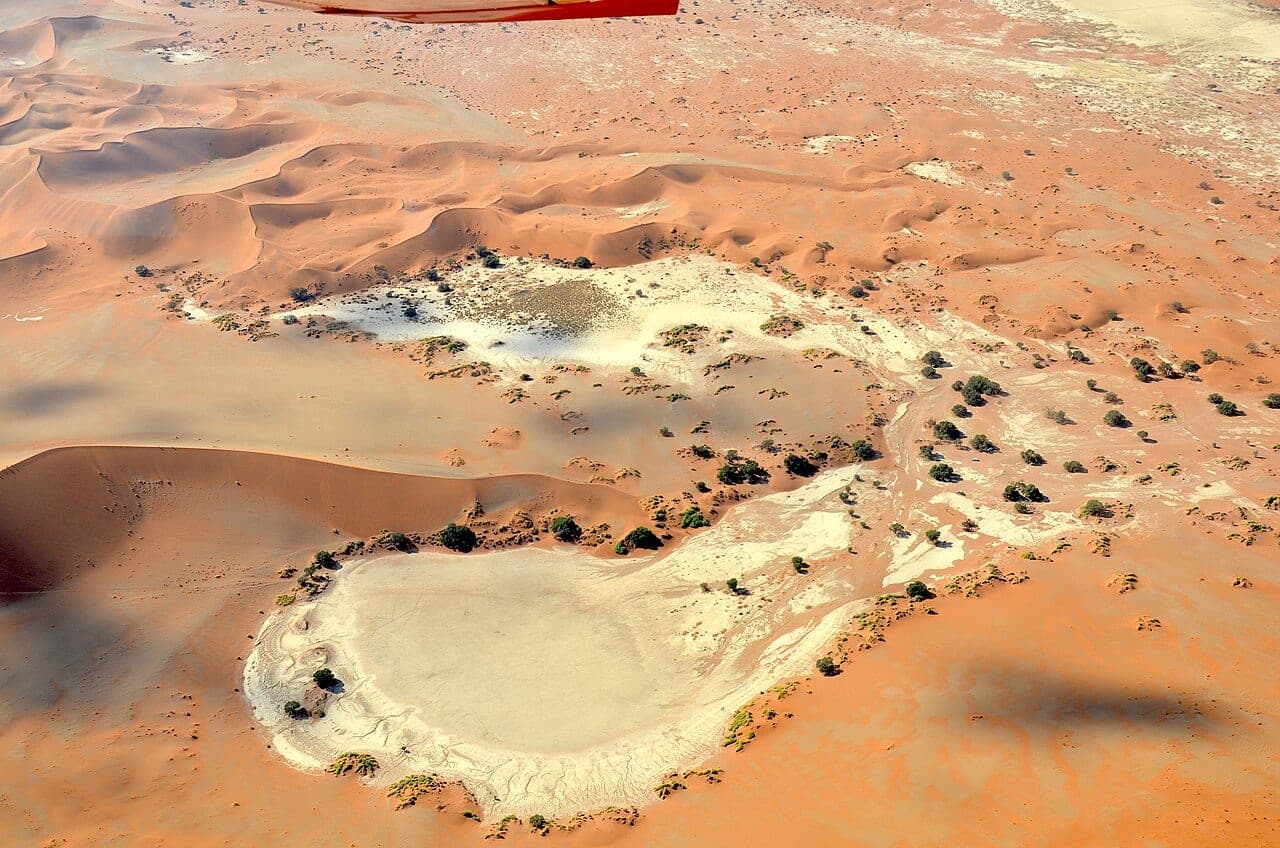
At Sossusvlei, in the heart of the Namib, wind has piled sand into dunes that climb more than three hundred metres above a cracked white pan. A short walk away lies Deadvlei, a clay floor bleached almost to bone, where the blackened skeletons of camel-thorn trees have stood for roughly nine centuries, too dry to rot. The Namib has held its arid climate for somewhere between 55 and 80 million years, which makes it the oldest desert on earth, and much of its only reliable moisture arrives as fog off the cold Atlantic. This is a landscape that keeps things: bones, footprints, and the marks people leave in stone.
Namibia's heritage is bound up with that same instinct to keep. Six thousand years ago, hunter-gatherers cut giraffes, lions and human figures into the sandstone at Twyfelfontein; a little over a century ago, German colonial troops carried out what historians widely describe as the first genocide of the twentieth century against the Herero and Nama; and since independence in 1990, Namibians of many communities have built a shared country while holding those memories in plain sight.
Namibia is a large, dry country on the south-western coast of Africa, roughly 824,000 square kilometres, bordered by Angola and Zambia to the north, Botswana to the east, South Africa to the south, and the Atlantic along the Skeleton Coast to the west. With a population of about 2.6 million, it is among the most sparsely settled countries in the world. The land descends from the fog-bound coastal Namib, across a central plateau, to the Kalahari sands in the east and the wetter floodplains of the far north, where nearly half the population lives.
Its people belong to many communities. The Ovambo of the north form about half the nation; the Kavango, Herero, Damara, Nama, Caprivian peoples, San, Himba and Tswana make up much of the rest, alongside communities of German and Afrikaner descent. The economy rests on mining (diamonds, uranium, gold and zinc), on fishing in the cold Benguela current, on cattle and karakul sheep, and on tourism drawn by the desert and by some of Africa's most effective wildlife recovery. When Namibia adopted its constitution in 1990, it became one of the first states to write the protection of the environment into its founding law, a commitment that would go on to shape its conservation record.
Windhoek. The capital sits high on the central plateau, a city of around 430,000 built where hot springs once drew herders; its Khoekhoe and Otjiherero names both refer to steam or hot water. German colonial architecture survives in the Christuskirche, a Lutheran church completed around 1910, in the old fort known as the Alte Feste, now a museum, and in the Tintenpalast, the seat of parliament. South of the city rises Heroes' Acre, the national monument to the liberation struggle, while the township of Katutura, laid out under apartheid-era removals, carries a harder chapter.
Swakopmund. Founded in 1892 as the main port of the German colony, Swakopmund still reads as a fragment of Wilhelmine Germany set between dune and sea, with palm-lined streets, Jugendstil facades and a German-speaking community that has held on for generations. It is now a seaside resort and a base for travel into the Namib.
Walvis Bay. Namibia's deep-water harbour and fishing capital opens onto a lagoon crowded with flamingos and pelicans, one of the most important coastal wetlands in southern Africa. Held as a South African enclave long after the rest of the territory changed hands, it was reintegrated into Namibia on 1 March 1994, an event generally seen as completing the country's territorial unity.
Luderitz. On the southern coast, this small town keeps a striking array of German Art Nouveau buildings, among them the Goerke Haus and the hilltop Felsenkirche. Nearby lie Kolmanskop, a diamond-boom settlement now half-buried by the advancing sand, and Shark Island, where a colonial camp during the genocide became a place of mass death and is today a site of mourning.
The first inhabitants were the San, hunter-gatherers whose knowledge of the desert reaches back tens of thousands of years and whose ancestors left the engravings and paintings scattered across the country. Over later centuries, Khoekhoe-speaking herders, including the Nama and the Damara, moved through the region with their livestock, and Bantu-speaking farmers and cattle-keepers, among them the Ovambo in the northern floodplains and the Herero on the central grasslands, established the communities that shape Namibia today. Migration, trade and competition over grazing bound these peoples together long before any European claim.
Germany proclaimed the colony of German South West Africa in 1884, and settler demand for land and cattle pressed hard on Herero and Nama society. In January 1904 the Herero, under paramount chief Samuel Maharero, rose against German rule; the Nama, led by Hendrik Witbooi, followed. After the Battle of Waterberg in August 1904, the German commander Lothar von Trotha issued an extermination order declaring that every Herero within the colony's borders would be shot. German forces drove survivors, including women and children, into the waterless Omaheke sandveld and held the wells behind them, so that thirst finished what the guns had begun. Captives, Herero and Nama alike, were confined in concentration camps, among them the camp on Shark Island at Luderitz, where prisoners died in large numbers from cold, hunger, exhaustion and disease, and where the skulls of the dead were shipped to Germany for pseudo-scientific study. Between 1904 and 1908 roughly eighty per cent of the Herero and about half of the Nama were killed, tens of thousands of people.
In May 2021, after years of negotiation, Germany formally acknowledged that it had committed genocide and pledged around 1.1 billion euros over thirty years for development in the affected regions. Many Herero and Nama leaders rejected the settlement, arguing that their communities were not full parties to the talks and that development aid is not the same as reparation. The wound remains open, and the memory of these years sits at the centre of how the nation understands itself.
During the First World War, South African forces occupied the territory, and from 1920 South Africa governed it under a League of Nations mandate, later extending its apartheid system of racial separation across the land. The United Nations revoked the mandate in 1966, but South Africa refused to withdraw. That same year the South West Africa People's Organisation, SWAPO, opened an armed struggle with a clash at Omugulugwombashe on 26 August, a date now observed as Heroes' Day. A long war followed, entangled with the conflict in neighbouring Angola and marked by events such as the 1978 attack on a SWAPO settlement at Cassinga. After a United Nations-supervised transition, Namibia became independent on 21 March 1990, with Sam Nujoma as its first president. The peaceful return of Walvis Bay in 1994 closed the last chapter of the country's decolonisation.
English is the sole official language, adopted at independence as a neutral common tongue after decades of Afrikaans-medium administration. Afrikaans and German remain widely spoken from the colonial era, and Afrikaans still works as a lingua franca between communities. Most Namibians speak an African language at home: Oshiwambo, the language of the Ovambo, is used by around half the population, while Otjiherero, the Rukavango languages and Khoekhoegowab all have large communities of speakers. Khoekhoegowab, shared by the Nama and Damara, carries the click consonants of the region's oldest speech, and several San languages survive in smaller communities.
The country's name comes from the desert that defines it. Namib is a Khoekhoe word usually translated as "vast place" or "an area where there is nothing". The name Namibia was proposed in the 1960s by the nationalist Mburumba Kerina and taken up as the country moved toward independence, naming the new nation after its land rather than after any single one of its peoples.
Among the most recognisable images of Namibia is the dress of Herero women: a floor-length gown modelled on Victorian fashion, the ohorokova, worn over many petticoats, and the otjikaiva, a headdress folded into two points that echo the horns of cattle, the animal at the centre of Herero wealth. The style was adopted from the wives of German missionaries and settlers in the nineteenth century, and Herero women have since made it their own, worn as a garment of dignity and, for a people who survived an attempt to destroy them, of quiet defiance.
 Twyfelfontein holds some two thousand engravings around a spring, made by hunter-gatherers over perhaps two thousand years. Photograph by Sonse, CC BY 2.0, via Wikimedia Commons.
The San, the country's first inhabitants, carry a heritage of desert knowledge, storytelling and the healing trance dance, and their forebears authored the rock art that draws visitors worldwide. In the far north-west, the Himba keep a semi-nomadic life around their cattle; Himba women coat their skin and braided hair with otjize, a paste of ochre and butterfat that gives them their deep red colour, and each homestead keeps the okuruwo, a sacred fire tended between the family and its ancestors. Craft traditions run from Kavango wood carving and San ostrich-eggshell beadwork to karakul weaving in the south, while music ranges from Nama and Damara song to the church choirs of the north and, in the towns, to hip-hop and the dance style known as kwaito.
Namibia is a predominantly Christian country, with adherence usually put at around eighty to ninety per cent. The Lutheran churches are the largest, a legacy of German and Finnish missionaries, and Catholic, Anglican and Reformed congregations are also numerous. The constitution guarantees freedom of worship, and small Muslim, Jewish, Hindu and Bahai communities live mainly in the towns.
Older beliefs continue alongside the churches. Many communities recognise a distant creator, called Kalunga among the Ovambo and Mukuru among the Herero and Himba, approached less directly than the ancestors, who remain close to the living and are present at moments of trouble and transition. Many families see no contradiction in attending church while also honouring those who have gone before.
Death in Namibia is a communal event that draws family and neighbours from far away. Burial follows a period of gathering, prayer and condolence, and the preference is strong for burial at home, among one's own people. Livestock is slaughtered to feed the mourners and honour the dead, an act that is hospitality and offering at once. Among the Ovambo, Herero, Himba and others, the dead do not depart entirely: they become ancestors who watch over the living and are addressed at births, marriages, illness and hardship. Graves, sometimes marked with the horns of the cattle sacrificed at the funeral, remain places of return. As across much of southern Africa, the formal end of mourning often comes months later with a tombstone unveiling, a second gathering at which the stone is dedicated and the family readmitted to ordinary time.
Public remembrance carries the genocide alongside the liberation struggle. Each August the Herero gather at Okahandja for Maherero Day, also called Red Flag Day, an observance that began after the remains of Samuel Maharero were brought home from exile and reburied there in 1923. Men in military-style dress and women in the ohorokova process to the graves of the chiefs, and a church service follows, joining Christian rite to ancestral honour; the Nama hold comparable commemorations. The state marks Heroes' Day on 26 August and Cassinga Day on 4 May, and the return of skulls and other human remains taken to Germany during the colonial period has become its own solemn ritual of reburial, closing a circle that the genocide left open for more than a century.
Namibia's colonial archive documents a genocide, and the German government has spent a century deciding what to call it.
Between 1904 and 1908 German colonial forces killed the great majority of the Herero and a large part of the Nama population, drove survivors into the Omaheke desert, and held people in camps at Shark Island and elsewhere. The German military and colonial records document the extermination order, the camps and the deaths, and they are held in Germany and Windhoek. Skulls and other remains were sent to German institutions for racial research; the first repatriations to Namibia took place in 2011 and have continued since, and Germany acknowledged the killings as genocide in 2021 while avoiding the legal consequences of that word.
For families the practical sources are mission registers, Rhenish, Finnish and Catholic, which are the earliest written vital records, and the South African administrative record from 1915 to 1990, including the pass and contract labour system that governed African movement.
The National Archives of Namibia in Windhoek hold the German, South African and independence-era series and are well organised.
Herero, Nama, Ovambo, Damara and San communities keep their own descent, and Herero genealogy is double, running through both a patrilineal and a matrilineal line, so a person belongs to two groups at once.
The Ovambo contract labour records document generations of men sent south to the mines.
Namibia holds two UNESCO World Heritage sites, and both are landscapes of memory. Twyfelfontein, or /Ui-//aes, inscribed in 2007 as the country's first World Heritage site, holds one of the largest concentrations of rock engravings in Africa: more than two thousand images cut into over two hundred sandstone slabs, most of them at least six thousand years old, with giraffes especially common. The site is co-managed with the Damara community who live beside it. The Namib Sand Sea, inscribed in 2013, protects roughly three million hectares of the fog-fed dune fields that include Sossusvlei and Deadvlei, one of the few coastal deserts on earth shaped by fog rather than rain.
Institutional care rests with the National Museum of Namibia and the National Archives in Windhoek, the National Heritage Council established under the National Heritage Act of 2004, and the Museums Association of Namibia, which supports a growing network of community-run museums. These museums, often built and staffed by the peoples whose heritage they hold, keep the interpretation of culture in local hands.
Much of Namibia's documentary heritage is moving online. The Museums Association of Namibia has developed digital cataloguing and virtual exhibitions to widen access to distant collections, and the British Museum's African rock art image project has published open-access photographs of Twyfelfontein and other sites, allowing engravings to be studied without physical wear. The National Archives has begun digitising fragile records, and the University of Namibia and the Namibia University of Science and Technology sustain research repositories in language, history and oral testimony.
A quieter strand runs through the provenance research under way in German museums, which is building records of human remains and cultural objects removed during the colonial period, work that underpins repatriation. Informally, Namibians have turned social media into a folk archive, where Maherero Day processions, Himba life, choir performances and Oshiwambo storytelling circulate daily and reach the diaspora.
Namibia's desert is one of the most filmed landscapes on the continent; the dunes near Swakopmund stood in for a post-apocalyptic world in the 2015 film Mad Max: Fury Road. The country's own screen culture is younger but growing, with features such as The White Line and the short Baxu and the Giants, which sets a San child's story against rhino poaching. In literature, Neshani Andreas won readers across Africa with The Purple Violet of Oshaantu, a novel of village life in the north.
Namibian hip-hop and kwaito fill the airwaves at home, gospel and choral traditions anchor the churches, and the Herero dress that began as an imposed colonial fashion now appears on runways and in gallery photography as a statement of identity, an inherited past reworked into something the present can own.
Wildlife returned to the commons. Namibia's best-known heritage achievement is also its most ecological. In 1996, building on the environmental clause in its constitution, the country passed legislation allowing rural communities to form communal conservancies with rights over the wildlife on their land and a share of the income it brings. By the early 2020s there were more than eighty registered conservancies covering roughly a fifth of the country, home to well over two hundred thousand people. Where wild animals had once been a liability to be poached or driven off, they became an asset worth protecting, and the model has been copied across the continent.
The desert lions come back. Elephant numbers in the country more than tripled; the black rhino rebounded until Namibia held one of the largest free-ranging populations on earth; and the desert-adapted lions of the north-west, reduced to fewer than twenty-five in the mid-1990s, climbed back into the hundreds. By tying the survival of animals to the livelihoods of the people who live beside them, Namibia turned conservation from an act done to communities into one done by them.
Twyfelfontein holds some two thousand engravings around a spring, made by hunter-gatherers over perhaps two thousand years. Photograph by Sonse, CC BY 2.0, via Wikimedia Commons.
The San, the country's first inhabitants, carry a heritage of desert knowledge, storytelling and the healing trance dance, and their forebears authored the rock art that draws visitors worldwide. In the far north-west, the Himba keep a semi-nomadic life around their cattle; Himba women coat their skin and braided hair with otjize, a paste of ochre and butterfat that gives them their deep red colour, and each homestead keeps the okuruwo, a sacred fire tended between the family and its ancestors. Craft traditions run from Kavango wood carving and San ostrich-eggshell beadwork to karakul weaving in the south, while music ranges from Nama and Damara song to the church choirs of the north and, in the towns, to hip-hop and the dance style known as kwaito.
Namibia is a predominantly Christian country, with adherence usually put at around eighty to ninety per cent. The Lutheran churches are the largest, a legacy of German and Finnish missionaries, and Catholic, Anglican and Reformed congregations are also numerous. The constitution guarantees freedom of worship, and small Muslim, Jewish, Hindu and Bahai communities live mainly in the towns.
Older beliefs continue alongside the churches. Many communities recognise a distant creator, called Kalunga among the Ovambo and Mukuru among the Herero and Himba, approached less directly than the ancestors, who remain close to the living and are present at moments of trouble and transition. Many families see no contradiction in attending church while also honouring those who have gone before.
Death in Namibia is a communal event that draws family and neighbours from far away. Burial follows a period of gathering, prayer and condolence, and the preference is strong for burial at home, among one's own people. Livestock is slaughtered to feed the mourners and honour the dead, an act that is hospitality and offering at once. Among the Ovambo, Herero, Himba and others, the dead do not depart entirely: they become ancestors who watch over the living and are addressed at births, marriages, illness and hardship. Graves, sometimes marked with the horns of the cattle sacrificed at the funeral, remain places of return. As across much of southern Africa, the formal end of mourning often comes months later with a tombstone unveiling, a second gathering at which the stone is dedicated and the family readmitted to ordinary time.
Public remembrance carries the genocide alongside the liberation struggle. Each August the Herero gather at Okahandja for Maherero Day, also called Red Flag Day, an observance that began after the remains of Samuel Maharero were brought home from exile and reburied there in 1923. Men in military-style dress and women in the ohorokova process to the graves of the chiefs, and a church service follows, joining Christian rite to ancestral honour; the Nama hold comparable commemorations. The state marks Heroes' Day on 26 August and Cassinga Day on 4 May, and the return of skulls and other human remains taken to Germany during the colonial period has become its own solemn ritual of reburial, closing a circle that the genocide left open for more than a century.
Namibia's colonial archive documents a genocide, and the German government has spent a century deciding what to call it.
Between 1904 and 1908 German colonial forces killed the great majority of the Herero and a large part of the Nama population, drove survivors into the Omaheke desert, and held people in camps at Shark Island and elsewhere. The German military and colonial records document the extermination order, the camps and the deaths, and they are held in Germany and Windhoek. Skulls and other remains were sent to German institutions for racial research; the first repatriations to Namibia took place in 2011 and have continued since, and Germany acknowledged the killings as genocide in 2021 while avoiding the legal consequences of that word.
For families the practical sources are mission registers, Rhenish, Finnish and Catholic, which are the earliest written vital records, and the South African administrative record from 1915 to 1990, including the pass and contract labour system that governed African movement.
The National Archives of Namibia in Windhoek hold the German, South African and independence-era series and are well organised.
Herero, Nama, Ovambo, Damara and San communities keep their own descent, and Herero genealogy is double, running through both a patrilineal and a matrilineal line, so a person belongs to two groups at once.
The Ovambo contract labour records document generations of men sent south to the mines.
Namibia holds two UNESCO World Heritage sites, and both are landscapes of memory. Twyfelfontein, or /Ui-//aes, inscribed in 2007 as the country's first World Heritage site, holds one of the largest concentrations of rock engravings in Africa: more than two thousand images cut into over two hundred sandstone slabs, most of them at least six thousand years old, with giraffes especially common. The site is co-managed with the Damara community who live beside it. The Namib Sand Sea, inscribed in 2013, protects roughly three million hectares of the fog-fed dune fields that include Sossusvlei and Deadvlei, one of the few coastal deserts on earth shaped by fog rather than rain.
Institutional care rests with the National Museum of Namibia and the National Archives in Windhoek, the National Heritage Council established under the National Heritage Act of 2004, and the Museums Association of Namibia, which supports a growing network of community-run museums. These museums, often built and staffed by the peoples whose heritage they hold, keep the interpretation of culture in local hands.
Much of Namibia's documentary heritage is moving online. The Museums Association of Namibia has developed digital cataloguing and virtual exhibitions to widen access to distant collections, and the British Museum's African rock art image project has published open-access photographs of Twyfelfontein and other sites, allowing engravings to be studied without physical wear. The National Archives has begun digitising fragile records, and the University of Namibia and the Namibia University of Science and Technology sustain research repositories in language, history and oral testimony.
A quieter strand runs through the provenance research under way in German museums, which is building records of human remains and cultural objects removed during the colonial period, work that underpins repatriation. Informally, Namibians have turned social media into a folk archive, where Maherero Day processions, Himba life, choir performances and Oshiwambo storytelling circulate daily and reach the diaspora.
Namibia's desert is one of the most filmed landscapes on the continent; the dunes near Swakopmund stood in for a post-apocalyptic world in the 2015 film Mad Max: Fury Road. The country's own screen culture is younger but growing, with features such as The White Line and the short Baxu and the Giants, which sets a San child's story against rhino poaching. In literature, Neshani Andreas won readers across Africa with The Purple Violet of Oshaantu, a novel of village life in the north.
Namibian hip-hop and kwaito fill the airwaves at home, gospel and choral traditions anchor the churches, and the Herero dress that began as an imposed colonial fashion now appears on runways and in gallery photography as a statement of identity, an inherited past reworked into something the present can own.
Wildlife returned to the commons. Namibia's best-known heritage achievement is also its most ecological. In 1996, building on the environmental clause in its constitution, the country passed legislation allowing rural communities to form communal conservancies with rights over the wildlife on their land and a share of the income it brings. By the early 2020s there were more than eighty registered conservancies covering roughly a fifth of the country, home to well over two hundred thousand people. Where wild animals had once been a liability to be poached or driven off, they became an asset worth protecting, and the model has been copied across the continent.
The desert lions come back. Elephant numbers in the country more than tripled; the black rhino rebounded until Namibia held one of the largest free-ranging populations on earth; and the desert-adapted lions of the north-west, reduced to fewer than twenty-five in the mid-1990s, climbed back into the hundreds. By tying the survival of animals to the livelihoods of the people who live beside them, Namibia turned conservation from an act done to communities into one done by them.
National Overview
Notable Cities
Historical Foundations
Linguistic and Etymological Roots
Cultural Identity
Religion and Spirituality
Remembrance and Mourning Traditions
Tracing a Family in Namibia
Heritage Preservation Efforts
Digital Heritage
Contemporary Cultural Influences
Success Stories
References and resources
- UNESCO World Heritage Centre: Twyfelfontein or /Ui-//aes. Inscription record for Namibia's first World Heritage site and its rock engravings.
- UNESCO World Heritage Centre: Namib Sand Sea. The fog-fed dune fields including Sossusvlei, inscribed in 2013.
- Encyclopaedia Britannica: Namibia. Geography, peoples, history and political background.
- Encyclopaedia Britannica: Twyfelfontein. The engravings of Damaraland and their dating.
- Encyclopaedia Britannica: Sossusvlei. The dunes and pans of the central Namib.
- Encyclopaedia Britannica: Walvis Bay. The port, lagoon and its 1994 reintegration.
- Wikipedia: Herero and Nama genocide. The events of 1904 to 1908 and their historiography.
- German Federal Government: Commemoration of the genocide of the Herero and Nama. The 2021 acknowledgement and its terms.
- Wikipedia: Herero Day. Maherero Day at Okahandja and the reburial of Samuel Maharero.
- World Wildlife Fund: Community-fueled conservation, Namibia's success story. The communal conservancy programme and wildlife recovery.