Heritage · Country
Russia Culture and Heritage
From the onion domes of Saint Basil's to the boiled wheat shared on the fortieth day after a death, Russia has treated remembrance as both liturgy and duty. A guide to the country's heritage, its Orthodox and literary inheritance, and the sober memory of the twentieth century's losses.Written to last.
By Confinity Heritage Editorial · Updated 2026-07-31 · 8-minute readQuiet tools, kept out of the way.
Russia keeps its dead close. On the ninth of May each year the country falls silent for the roughly twenty-seven million Soviet citizens who died in the conflict it calls the Great Patriotic War, and then fills its streets with the Immortal Regiment, ordinary people carrying photographs of parents, grandparents and great-grandparents above their heads. Forty days after a funeral, families gather again over a bowl of sweetened wheat; on the second Tuesday after Easter they carry painted eggs to the cemetery and eat beside the graves. Across a land that reaches over eleven time zones and the northern third of a continent, this habit of commemoration is one of the few things practised, in more or less the same form, from Kaliningrad on the Baltic to the shores of the Pacific.
That memory has many keepers. The Russian Orthodox Church, revived after decades of official atheism, tends the calendar of remembrance and the domed churches that mark almost every town. The literary and musical inheritance, running from Pushkin and Tolstoy to Tchaikovsky and Shostakovich, is taught and recited as a shared possession. And alongside the honoured dead of the war lie the harder memories of the twentieth century, the labour camps of the Gulag and the executions of the Stalin years, recorded by historians, marked by monuments in Moscow and gathered into a growing digital archive.
Russia is the largest country on earth by area, covering about 17.1 million square kilometres, close to an eighth of the world's inhabited land, and spanning eastern Europe and northern Asia across eleven time zones. It borders more than a dozen states, from Norway and the Baltic republics in the west to China, Mongolia and North Korea in the east, and it faces the United States across the narrow Bering Strait. The Ural Mountains draw the conventional line between its European and Asian halves; north of the tree line lies Arctic tundra, and below it the taiga, the largest forest on the planet, which gives way to the open steppe of the south.
Its natural landmarks are on the same scale. The Volga, the longest river in Europe, is honoured in folk song as "Mother Volga"; Lake Baikal in Siberia is the deepest and oldest lake in the world and holds around a fifth of its unfrozen fresh water; and the Trans-Siberian Railway, the longest in the world, still binds the far ends of the country together over seven days and seven time zones. About 144 million people live here, most of them west of the Urals, and the federation is home to more than 190 recognised peoples speaking over a hundred languages, from Tatar and Chechen to Buryat and Sakha. Orthodox Christians form the largest religious group, alongside substantial Muslim, Buddhist and Jewish communities and older indigenous traditions.
Moscow. The capital grew from a wooden fort first recorded in 1147 into the seat of the grand princes who gathered the Russian lands. At its heart the Kremlin, a walled citadel of cathedrals and palaces rebuilt in brick by Italian architects in the late fifteenth century, looks out over Red Square and the coloured domes of Saint Basil's Cathedral, raised between 1555 and 1561 to mark the capture of Kazan. Moscow holds the Bolshoi Theatre, the Tretyakov Gallery's collection of Russian painting and icons, and, rebuilt in the 1990s, the vast Cathedral of Christ the Saviour.
Saint Petersburg. Founded by Peter the Great in 1703 as a window on Europe, the imperial capital for two centuries was laid out in stone along the Neva by Italian and French architects. Its historic centre is a World Heritage site, and the Winter Palace houses the Hermitage, one of the largest art museums in the world. The city endured one of the cruellest episodes of the Second World War, the 872-day siege of Leningrad, whose hundreds of thousands of civilian dead lie under the grass mounds of Piskaryovskoye Memorial Cemetery.
Veliky Novgorod. One of the oldest cities in Russia, Novgorod was a self-governing merchant republic of the medieval north and a cradle of Russian statehood. Its Cathedral of Saint Sophia, begun in the 1040s, is among the oldest churches still in use, and the 1862 Millennium of Russia monument in its kremlin gathers a bronze crowd of the figures who shaped the nation.
Kazan. The capital of the republic of Tatarstan, on the Volga, has been a meeting point of Orthodox and Muslim Russia for centuries. Within its World Heritage kremlin the Qolsharif Mosque, reconstructed in 2005, rises close to an Orthodox cathedral, an arrangement the city presents as a model of coexistence.
Volgograd. Known as Stalingrad from 1925 to 1961, the city on the Volga gave its name to a turning-point battle of the Second World War in Europe. Its losses are marked on the hill of Mamayev Kurgan by "The Motherland Calls", among the tallest statues in the world when it was completed in 1967, and by an eternal flame guarded around the clock.
Russian history is usually traced to Kievan Rus, a federation of East Slavic lands centred on Kiev that took shape in the ninth century and, in 988, adopted Orthodox Christianity from Byzantium under Grand Prince Vladimir. Fragmented by the thirteenth-century Mongol invasions, the Rus principalities paid tribute to the Golden Horde until the Grand Duchy of Moscow slowly gathered power and independence. In 1547 Ivan IV was crowned the first tsar, founding the Tsardom of Russia and beginning the long expansion east across Siberia.
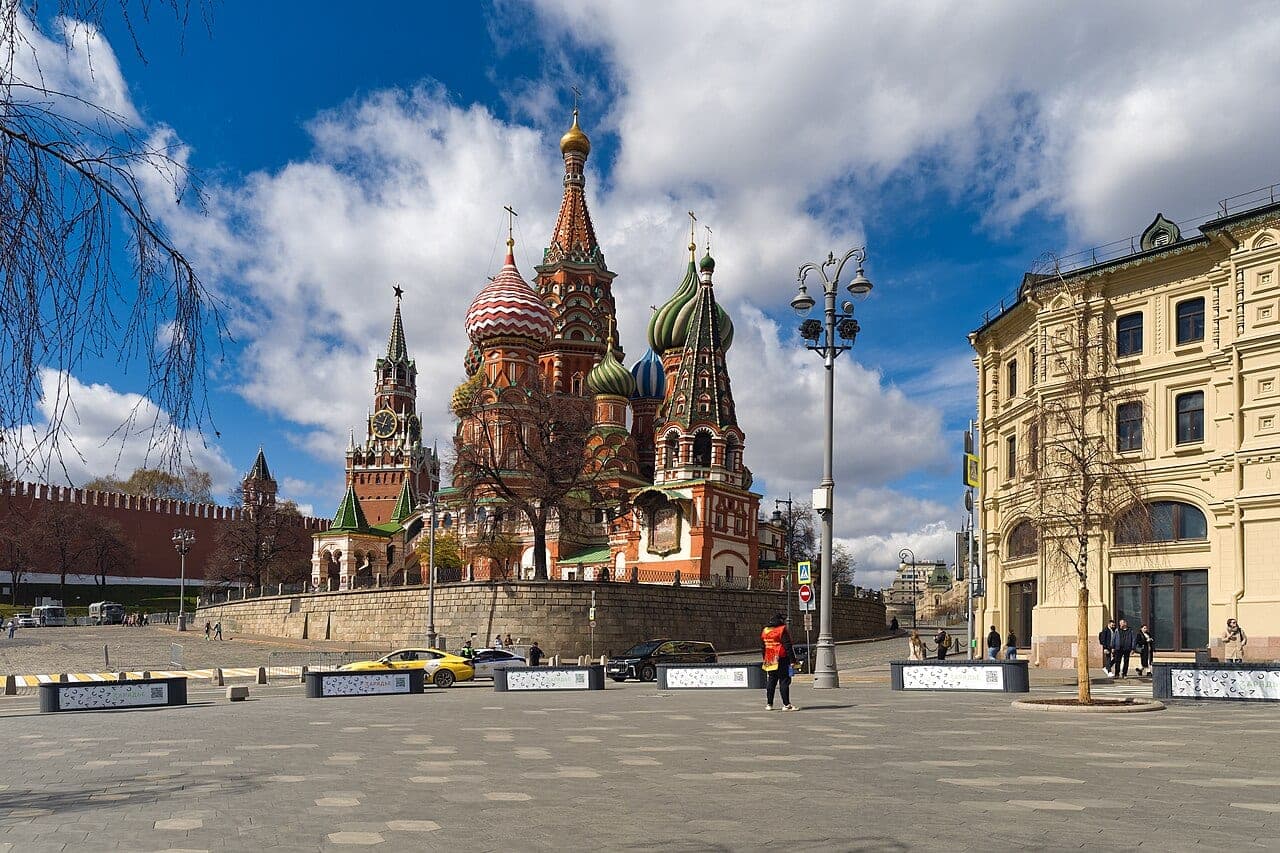
 Saint Basil's, finished in 1561, is ten churches on one foundation. Photograph by Diego Delso, public domain, via Wikimedia Commons.
The Romanov dynasty, which came to the throne in 1613 after the disorder known as the Time of Troubles, ruled for three centuries. Peter the Great turned the tsardom toward Europe, built Saint Petersburg and in 1721 proclaimed the Russian Empire; Catherine the Great extended its borders and its art collections; and in 1812 the empire absorbed and then repelled Napoleon's invasion. The nineteenth century brought the emancipation of the serfs in 1861 and, with it, the social pressures that fed a century of revolutionary thought.
The First World War broke the empire. The February Revolution of 1917 forced the abdication of Nicholas II, and the October Revolution brought the Bolsheviks to power under Lenin. After a civil war the Union of Soviet Socialist Republics was founded in 1922. The Soviet decades saw forced industrialisation and collectivisation, the repressions of the Stalin era, the enormous sacrifices and eventual victory of the Great Patriotic War, and the country's emergence as a global power that put the first satellite and the first human into space. The USSR dissolved in December 1991, and the Russian Federation succeeded it as an independent state.
Russian is an East Slavic language and the most widely spoken Slavic tongue, with well over 250 million speakers worldwide and official status across much of the former Soviet space. It is written in the Cyrillic alphabet, whose story begins with the Byzantine missionary brothers Cyril and Methodius. In 863 they devised the Glagolitic script to translate scripture into Slavonic; their disciples in the First Bulgarian Empire later shaped from it the alphabet that took Cyril's name, and it spread into the Rus lands after the conversion of 988, carried by the Church. Old Church Slavonic remains the liturgical language of Russian Orthodoxy to this day.
The name of the country descends from Rus, the term for the early state around Kiev, itself often linked to the Varangians, the Scandinavian traders and warriors who moved along the river routes. The federation's linguistic map is one of the most varied on earth: alongside Russian, its republics give official standing to dozens of languages, among them Tatar, Bashkir, Chechen, Chuvash, the Turkic Sakha of the far north-east and the Mongolic Buryat of the Baikal region. Some of the smaller tongues of Siberia and the north are endangered, and revival programmes in schools and local media work to keep them spoken.
Few national cultures are as closely identified with their writers. Alexander Pushkin, whose verse novel "Eugene Onegin" fixed the modern literary language in the 1830s, is treated as the founder of Russian literature; the century that followed produced Nikolai Gogol, Ivan Turgenev, Fyodor Dostoevsky, whose "Crime and Punishment" and "The Brothers Karamazov" probe faith and conscience, Leo Tolstoy, whose "War and Peace" and "Anna Karenina" are among the most read of all novels, and the playwright and story-writer Anton Chekhov. The Silver Age added the poets Anna Akhmatova, Osip Mandelstam and Marina Tsvetaeva, several of whom bore witness to the repressions of their time, and Russian writers have taken the Nobel Prize in Literature five times, from Ivan Bunin in 1933 to Joseph Brodsky in 1987.
The musical inheritance is as deep. Mikhail Glinka opened a national school in the nineteenth century; the group of composers known as The Five, among them Modest Mussorgsky and Nikolai Rimsky-Korsakov, drew on folk song and Orthodox chant, while Pyotr Tchaikovsky gave the world "Swan Lake", "The Nutcracker" and the "1812 Overture". The twentieth century brought Sergei Rachmaninoff, Igor Stravinsky, whose "Rite of Spring" reshaped modern music, Sergei Prokofiev and Dmitri Shostakovich, whose Seventh Symphony was first performed in besieged Leningrad in 1942. Russian ballet, centred on Moscow's Bolshoi and Saint Petersburg's Mariinsky, set an international standard, and Sergei Diaghilev's Ballets Russes carried it to the West. In painting, the medieval icons of Andrei Rublev, the realist canvases of the nineteenth-century Wanderers and the early abstraction of Kandinsky, Malevich and Chagall each mark a distinct chapter. Everyday culture keeps its own emblems: the nested matryoshka doll, the samovar and shared tea, the wooden banya, and a folk-song tradition sung at every table.
Orthodox Christianity has shaped Russian identity since 988, and today around two-thirds of the population identify with the Russian Orthodox Church. From Byzantium the Rus inherited a faith of icons, chant and elaborate liturgy; after the fall of Constantinople in 1453 Moscow came to see itself as a "Third Rome", a guardian of Orthodoxy, and a Moscow patriarchate was established in 1589. The Church suffered heavily under Soviet rule, when thousands of churches were closed or destroyed, among them the Cathedral of Christ the Saviour, dynamited in 1931 and rebuilt after 1991. Its revival since has been rapid, and monasteries such as the Trinity Lavra of Saint Sergius at Sergiev Posad, the spiritual centre of Russian Orthodoxy, again draw pilgrims in large numbers.
Saint Basil's, finished in 1561, is ten churches on one foundation. Photograph by Diego Delso, public domain, via Wikimedia Commons.
The Romanov dynasty, which came to the throne in 1613 after the disorder known as the Time of Troubles, ruled for three centuries. Peter the Great turned the tsardom toward Europe, built Saint Petersburg and in 1721 proclaimed the Russian Empire; Catherine the Great extended its borders and its art collections; and in 1812 the empire absorbed and then repelled Napoleon's invasion. The nineteenth century brought the emancipation of the serfs in 1861 and, with it, the social pressures that fed a century of revolutionary thought.
The First World War broke the empire. The February Revolution of 1917 forced the abdication of Nicholas II, and the October Revolution brought the Bolsheviks to power under Lenin. After a civil war the Union of Soviet Socialist Republics was founded in 1922. The Soviet decades saw forced industrialisation and collectivisation, the repressions of the Stalin era, the enormous sacrifices and eventual victory of the Great Patriotic War, and the country's emergence as a global power that put the first satellite and the first human into space. The USSR dissolved in December 1991, and the Russian Federation succeeded it as an independent state.
Russian is an East Slavic language and the most widely spoken Slavic tongue, with well over 250 million speakers worldwide and official status across much of the former Soviet space. It is written in the Cyrillic alphabet, whose story begins with the Byzantine missionary brothers Cyril and Methodius. In 863 they devised the Glagolitic script to translate scripture into Slavonic; their disciples in the First Bulgarian Empire later shaped from it the alphabet that took Cyril's name, and it spread into the Rus lands after the conversion of 988, carried by the Church. Old Church Slavonic remains the liturgical language of Russian Orthodoxy to this day.
The name of the country descends from Rus, the term for the early state around Kiev, itself often linked to the Varangians, the Scandinavian traders and warriors who moved along the river routes. The federation's linguistic map is one of the most varied on earth: alongside Russian, its republics give official standing to dozens of languages, among them Tatar, Bashkir, Chechen, Chuvash, the Turkic Sakha of the far north-east and the Mongolic Buryat of the Baikal region. Some of the smaller tongues of Siberia and the north are endangered, and revival programmes in schools and local media work to keep them spoken.
Few national cultures are as closely identified with their writers. Alexander Pushkin, whose verse novel "Eugene Onegin" fixed the modern literary language in the 1830s, is treated as the founder of Russian literature; the century that followed produced Nikolai Gogol, Ivan Turgenev, Fyodor Dostoevsky, whose "Crime and Punishment" and "The Brothers Karamazov" probe faith and conscience, Leo Tolstoy, whose "War and Peace" and "Anna Karenina" are among the most read of all novels, and the playwright and story-writer Anton Chekhov. The Silver Age added the poets Anna Akhmatova, Osip Mandelstam and Marina Tsvetaeva, several of whom bore witness to the repressions of their time, and Russian writers have taken the Nobel Prize in Literature five times, from Ivan Bunin in 1933 to Joseph Brodsky in 1987.
The musical inheritance is as deep. Mikhail Glinka opened a national school in the nineteenth century; the group of composers known as The Five, among them Modest Mussorgsky and Nikolai Rimsky-Korsakov, drew on folk song and Orthodox chant, while Pyotr Tchaikovsky gave the world "Swan Lake", "The Nutcracker" and the "1812 Overture". The twentieth century brought Sergei Rachmaninoff, Igor Stravinsky, whose "Rite of Spring" reshaped modern music, Sergei Prokofiev and Dmitri Shostakovich, whose Seventh Symphony was first performed in besieged Leningrad in 1942. Russian ballet, centred on Moscow's Bolshoi and Saint Petersburg's Mariinsky, set an international standard, and Sergei Diaghilev's Ballets Russes carried it to the West. In painting, the medieval icons of Andrei Rublev, the realist canvases of the nineteenth-century Wanderers and the early abstraction of Kandinsky, Malevich and Chagall each mark a distinct chapter. Everyday culture keeps its own emblems: the nested matryoshka doll, the samovar and shared tea, the wooden banya, and a folk-song tradition sung at every table.
Orthodox Christianity has shaped Russian identity since 988, and today around two-thirds of the population identify with the Russian Orthodox Church. From Byzantium the Rus inherited a faith of icons, chant and elaborate liturgy; after the fall of Constantinople in 1453 Moscow came to see itself as a "Third Rome", a guardian of Orthodoxy, and a Moscow patriarchate was established in 1589. The Church suffered heavily under Soviet rule, when thousands of churches were closed or destroyed, among them the Cathedral of Christ the Saviour, dynamited in 1931 and rebuilt after 1991. Its revival since has been rapid, and monasteries such as the Trinity Lavra of Saint Sergius at Sergiev Posad, the spiritual centre of Russian Orthodoxy, again draw pilgrims in large numbers.
 The Church of the Transfiguration at Kizhi, twenty-two domes of aspen shingle raised in 1714 by carpenters working in wood alone. Photograph by Alexxx1979, CC BY-SA 4.0, via Wikimedia Commons.
Russia has also been a Muslim country for centuries. Islam is the second-largest faith, practised by perhaps a tenth of the population, above all among the Tatars and Bashkirs of the Volga and the peoples of the North Caucasus such as the Chechens and Dagestanis; Kazan and Ufa are historic centres of Russian Islam. Buddhism has deep roots in three regions: Kalmykia on the Caspian, the only Buddhist-majority republic in Europe, and Buryatia and Tuva near Lake Baikal and the Mongolian border. Judaism has a long and often painful history in the country, and among the indigenous peoples of Siberia and the north, older shamanic traditions endure alongside the world faiths.
An Orthodox funeral in Russia usually takes place on the third day after death, the body laid in an open coffin so that mourners may take their leave with a final kiss. The service asks that the departed be granted rest, and its recurring refrain, "vechnaya pamyat", means "eternal memory". A memorial office called the panikhida is served on the third, ninth and fortieth days, the fortieth marking the point at which tradition holds the soul completes its passage. At each gathering the family shares kutya, a dish of boiled wheat sweetened with honey and raisins, the grain standing for resurrection. Mourning is measured in the same calendar of anniversaries, and on Radonitsa, the "day of rejoicing" on the second Tuesday after Easter, families go out to the cemeteries to tidy the graves and eat among their dead.
Public remembrance is dominated by the Second World War, in which the Soviet Union lost around twenty-seven million people, more than any other country. Victory Day, the ninth of May, is the most important secular holiday of the year, marked by parades, a minute's silence and the laying of flowers at the eternal flames that burn in almost every town, and at the Tomb of the Unknown Soldier by the Kremlin wall. In 2012 three journalists in the Siberian city of Tomsk began the Immortal Regiment, a procession in which people carry photographs of relatives who served or died in the war; the practice spread across the country and abroad within a few years, giving the anniversary a personal and family character. The colossal war memorials of the Soviet era, "The Motherland Calls" on Mamayev Kurgan at Volgograd and the mourning figure at Piskaryovskoye in Saint Petersburg, remain places of pilgrimage.
The harder memory of the twentieth century is the fate of those who died in the Gulag, the vast Soviet system of labour camps, and in the mass executions of the Stalin years; historians count hundreds of thousands shot in the Great Terror of 1937 and 1938 alone, and millions more who perished in the camps, in forced deportations and in famine. This memory too has its monuments. In 1990 a boulder brought from the Solovetsky Islands, site of one of the first camps, was set up on Lubyanka Square opposite the former security headquarters as the Solovetsky Stone; the thirtieth of October is observed as the Day of Remembrance of the Victims of Political Repression; and in 2017 a national monument, the Wall of Grief by the sculptor Georgy Frangulyan, was unveiled in Moscow. At the former Butovo firing range near the capital, where thousands were executed, the names of the dead are read aloud each year. Much of the documentation of these events was compiled by Memorial, a society founded in 1987 to record the victims of Soviet repression, which was ordered dissolved by court order in 2021 and received the Nobel Peace Prize in 2022; its annual "Returning the Names" reading at the Solovetsky Stone, held since 2006, gives voice to the individual dead one name at a time.
Russian family records rest on two imperial systems, both of them administrative in purpose and genealogical by accident.
The metrical books, the metricheskie knigi, were required of Orthodox parishes from 1722 under Peter the Great, and they record baptisms, marriages and burials in the church's own hand. The revision lists, the revizskie skazki, were tax censuses taken ten times between 1719 and 1858, and they name every male in a household, with women added from the third revision onward. Together they cover most of the population for most of two centuries, which is more than can be said for many wealthier countries at the same date.
Both are held in regional state archives rather than in Moscow, so research means identifying the province, then the district, then the parish. Some archives have digitised extensively and some have not, and the practical position for a researcher outside Russia has become considerably harder since 2022.
The Soviet period is the hard part. Records were closed or destroyed, families changed names, and millions of people appear only in the files of the system that punished them. Those files exist. The Memorial society spent thirty years compiling databases of the victims of political repression, naming several million people from archives across the former union, and that work is why a great many Russian families know what happened to a great-grandfather. Memorial was ordered liquidated by the Supreme Court in 2021. The databases it built are still consulted.
Russia protects a heritage of extraordinary range through its great museums and a network of federal and regional bodies. The State Hermitage in Saint Petersburg, founded in 1764 when Catherine the Great bought a collection of European paintings, holds around three million items and is the largest art museum in the world by gallery space; it has been open to the public since 1852. The Moscow Kremlin and Red Square, inscribed together on the UNESCO World Heritage List in 1990, remain the symbolic centre of the country, and the Tretyakov Gallery and the State Russian Museum guard the national collections of Russian art.
Russia counts thirty-three World Heritage sites, both cultural and natural. Among them are the Historic Centre of Saint Petersburg, the white-stone churches of Vladimir and Suzdal, the medieval monuments of Novgorod, the Trinity Lavra of Saint Sergius, and the wooden churches of Kizhi Pogost in Karelia, whose 22-domed Church of the Transfiguration was raised in 1714. The natural sites include Lake Baikal, the volcanoes of Kamchatka, the Golden Mountains of Altai and the virgin forests of Komi, and the most recent inscription, in 2025, is the prehistoric rock paintings of Shulgan-Tash Cave in Bashkortostan. Restoration remains a demanding craft: the Church of the Transfiguration at Kizhi reopened in 2021 after a fifteen-year rescue that lifted the timber church in sections to replace its rotten logs.
Russia's memory institutions have moved steadily online. The Boris Yeltsin Presidential Library, opened in Saint Petersburg in 2009, is a national digital library gathering scanned documents on the country's history, statehood and language, and the National Electronic Library links the holdings of libraries across the federation; the Russian State Library in Moscow, one of the largest in the world, has digitised a growing share of its manuscripts and books. The Hermitage and other major museums have put high-resolution images of their collections on the web and share galleries through international platforms.
The remembrance of the twentieth century has a particular digital presence. Volunteers and historians have built searchable databases of those who died in the war and of the victims of political repression, among them the Open List, an online register of the repressed compiled from archives and family records, and the online rolls that let families record their war dead. The Prozhito project, based at the European University in Saint Petersburg, has assembled thousands of personal diaries, many of them from the Soviet decades, into a single searchable archive, so that private testimony from the hardest years is preserved and open to readers.
Russian culture continues to reach a global audience. Its ballet companies tour the world, its conservatories train musicians who fill international orchestras, and the four-yearly International Tchaikovsky Competition in Moscow remains one of the most watched events in classical music. Russian literature is translated and read everywhere, and the classic novels are permanent fixtures of world reading lists. In cinema, the montage theory of Sergei Eisenstein and the meditative films of Andrei Tarkovsky shaped the art form, and Aleksandr Sokurov's "Russian Ark", filmed in 2002 in a single unbroken take through the halls of the Hermitage, turned the museum itself into a journey through Russian history.
Other inheritances travel just as far. Chess, long a national passion, produced a line of world champions; the space heritage that began with Yuri Gagarin's first flight in 1961 is commemorated each year on Cosmonautics Day; and the Russian-speaking diaspora, spread across Europe, the Americas and Israel, keeps its language, festivals and Orthodox parishes alive far from home. Folk ensembles, choirs and craft traditions continue to be performed and taught both within the country and among communities abroad.
The church that was lifted to be saved. After decades closed to visitors, the 1714 Church of the Transfiguration at Kizhi Pogost reopened in 2021, its 22 wooden domes restored through a fifteen-year project that raised the structure in tiers so that decayed logs could be replaced, a rare feat of wooden-architecture conservation.
Names returned from the archives. Volunteer historians and the Memorial society turned scattered records into public databases of those lost to Soviet repression, and each year on the eve of the Day of Remembrance the "Returning the Names" ceremony reads the victims aloud one by one, restoring individuality to numbers once meant to be forgotten.
A cathedral rebuilt from memory. The Cathedral of Christ the Saviour in Moscow, dynamited in 1931, was reconstructed in the 1990s on its original site using photographs and drawings, and reconsecrated in 2000, an emblem of the Orthodox revival that followed the Soviet period.
The Hermitage in a single shot. Aleksandr Sokurov's "Russian Ark" carried a global audience through three centuries of Russian history in one continuous ninety-six-minute take through the Winter Palace, showing how a museum can become a way of telling a nation's story.
The Church of the Transfiguration at Kizhi, twenty-two domes of aspen shingle raised in 1714 by carpenters working in wood alone. Photograph by Alexxx1979, CC BY-SA 4.0, via Wikimedia Commons.
Russia has also been a Muslim country for centuries. Islam is the second-largest faith, practised by perhaps a tenth of the population, above all among the Tatars and Bashkirs of the Volga and the peoples of the North Caucasus such as the Chechens and Dagestanis; Kazan and Ufa are historic centres of Russian Islam. Buddhism has deep roots in three regions: Kalmykia on the Caspian, the only Buddhist-majority republic in Europe, and Buryatia and Tuva near Lake Baikal and the Mongolian border. Judaism has a long and often painful history in the country, and among the indigenous peoples of Siberia and the north, older shamanic traditions endure alongside the world faiths.
An Orthodox funeral in Russia usually takes place on the third day after death, the body laid in an open coffin so that mourners may take their leave with a final kiss. The service asks that the departed be granted rest, and its recurring refrain, "vechnaya pamyat", means "eternal memory". A memorial office called the panikhida is served on the third, ninth and fortieth days, the fortieth marking the point at which tradition holds the soul completes its passage. At each gathering the family shares kutya, a dish of boiled wheat sweetened with honey and raisins, the grain standing for resurrection. Mourning is measured in the same calendar of anniversaries, and on Radonitsa, the "day of rejoicing" on the second Tuesday after Easter, families go out to the cemeteries to tidy the graves and eat among their dead.
Public remembrance is dominated by the Second World War, in which the Soviet Union lost around twenty-seven million people, more than any other country. Victory Day, the ninth of May, is the most important secular holiday of the year, marked by parades, a minute's silence and the laying of flowers at the eternal flames that burn in almost every town, and at the Tomb of the Unknown Soldier by the Kremlin wall. In 2012 three journalists in the Siberian city of Tomsk began the Immortal Regiment, a procession in which people carry photographs of relatives who served or died in the war; the practice spread across the country and abroad within a few years, giving the anniversary a personal and family character. The colossal war memorials of the Soviet era, "The Motherland Calls" on Mamayev Kurgan at Volgograd and the mourning figure at Piskaryovskoye in Saint Petersburg, remain places of pilgrimage.
The harder memory of the twentieth century is the fate of those who died in the Gulag, the vast Soviet system of labour camps, and in the mass executions of the Stalin years; historians count hundreds of thousands shot in the Great Terror of 1937 and 1938 alone, and millions more who perished in the camps, in forced deportations and in famine. This memory too has its monuments. In 1990 a boulder brought from the Solovetsky Islands, site of one of the first camps, was set up on Lubyanka Square opposite the former security headquarters as the Solovetsky Stone; the thirtieth of October is observed as the Day of Remembrance of the Victims of Political Repression; and in 2017 a national monument, the Wall of Grief by the sculptor Georgy Frangulyan, was unveiled in Moscow. At the former Butovo firing range near the capital, where thousands were executed, the names of the dead are read aloud each year. Much of the documentation of these events was compiled by Memorial, a society founded in 1987 to record the victims of Soviet repression, which was ordered dissolved by court order in 2021 and received the Nobel Peace Prize in 2022; its annual "Returning the Names" reading at the Solovetsky Stone, held since 2006, gives voice to the individual dead one name at a time.
Russian family records rest on two imperial systems, both of them administrative in purpose and genealogical by accident.
The metrical books, the metricheskie knigi, were required of Orthodox parishes from 1722 under Peter the Great, and they record baptisms, marriages and burials in the church's own hand. The revision lists, the revizskie skazki, were tax censuses taken ten times between 1719 and 1858, and they name every male in a household, with women added from the third revision onward. Together they cover most of the population for most of two centuries, which is more than can be said for many wealthier countries at the same date.
Both are held in regional state archives rather than in Moscow, so research means identifying the province, then the district, then the parish. Some archives have digitised extensively and some have not, and the practical position for a researcher outside Russia has become considerably harder since 2022.
The Soviet period is the hard part. Records were closed or destroyed, families changed names, and millions of people appear only in the files of the system that punished them. Those files exist. The Memorial society spent thirty years compiling databases of the victims of political repression, naming several million people from archives across the former union, and that work is why a great many Russian families know what happened to a great-grandfather. Memorial was ordered liquidated by the Supreme Court in 2021. The databases it built are still consulted.
Russia protects a heritage of extraordinary range through its great museums and a network of federal and regional bodies. The State Hermitage in Saint Petersburg, founded in 1764 when Catherine the Great bought a collection of European paintings, holds around three million items and is the largest art museum in the world by gallery space; it has been open to the public since 1852. The Moscow Kremlin and Red Square, inscribed together on the UNESCO World Heritage List in 1990, remain the symbolic centre of the country, and the Tretyakov Gallery and the State Russian Museum guard the national collections of Russian art.
Russia counts thirty-three World Heritage sites, both cultural and natural. Among them are the Historic Centre of Saint Petersburg, the white-stone churches of Vladimir and Suzdal, the medieval monuments of Novgorod, the Trinity Lavra of Saint Sergius, and the wooden churches of Kizhi Pogost in Karelia, whose 22-domed Church of the Transfiguration was raised in 1714. The natural sites include Lake Baikal, the volcanoes of Kamchatka, the Golden Mountains of Altai and the virgin forests of Komi, and the most recent inscription, in 2025, is the prehistoric rock paintings of Shulgan-Tash Cave in Bashkortostan. Restoration remains a demanding craft: the Church of the Transfiguration at Kizhi reopened in 2021 after a fifteen-year rescue that lifted the timber church in sections to replace its rotten logs.
Russia's memory institutions have moved steadily online. The Boris Yeltsin Presidential Library, opened in Saint Petersburg in 2009, is a national digital library gathering scanned documents on the country's history, statehood and language, and the National Electronic Library links the holdings of libraries across the federation; the Russian State Library in Moscow, one of the largest in the world, has digitised a growing share of its manuscripts and books. The Hermitage and other major museums have put high-resolution images of their collections on the web and share galleries through international platforms.
The remembrance of the twentieth century has a particular digital presence. Volunteers and historians have built searchable databases of those who died in the war and of the victims of political repression, among them the Open List, an online register of the repressed compiled from archives and family records, and the online rolls that let families record their war dead. The Prozhito project, based at the European University in Saint Petersburg, has assembled thousands of personal diaries, many of them from the Soviet decades, into a single searchable archive, so that private testimony from the hardest years is preserved and open to readers.
Russian culture continues to reach a global audience. Its ballet companies tour the world, its conservatories train musicians who fill international orchestras, and the four-yearly International Tchaikovsky Competition in Moscow remains one of the most watched events in classical music. Russian literature is translated and read everywhere, and the classic novels are permanent fixtures of world reading lists. In cinema, the montage theory of Sergei Eisenstein and the meditative films of Andrei Tarkovsky shaped the art form, and Aleksandr Sokurov's "Russian Ark", filmed in 2002 in a single unbroken take through the halls of the Hermitage, turned the museum itself into a journey through Russian history.
Other inheritances travel just as far. Chess, long a national passion, produced a line of world champions; the space heritage that began with Yuri Gagarin's first flight in 1961 is commemorated each year on Cosmonautics Day; and the Russian-speaking diaspora, spread across Europe, the Americas and Israel, keeps its language, festivals and Orthodox parishes alive far from home. Folk ensembles, choirs and craft traditions continue to be performed and taught both within the country and among communities abroad.
The church that was lifted to be saved. After decades closed to visitors, the 1714 Church of the Transfiguration at Kizhi Pogost reopened in 2021, its 22 wooden domes restored through a fifteen-year project that raised the structure in tiers so that decayed logs could be replaced, a rare feat of wooden-architecture conservation.
Names returned from the archives. Volunteer historians and the Memorial society turned scattered records into public databases of those lost to Soviet repression, and each year on the eve of the Day of Remembrance the "Returning the Names" ceremony reads the victims aloud one by one, restoring individuality to numbers once meant to be forgotten.
A cathedral rebuilt from memory. The Cathedral of Christ the Saviour in Moscow, dynamited in 1931, was reconstructed in the 1990s on its original site using photographs and drawings, and reconsecrated in 2000, an emblem of the Orthodox revival that followed the Soviet period.
The Hermitage in a single shot. Aleksandr Sokurov's "Russian Ark" carried a global audience through three centuries of Russian history in one continuous ninety-six-minute take through the Winter Palace, showing how a museum can become a way of telling a nation's story.
National Overview
Notable Cities
Historical Foundations
Linguistic and Etymological Roots
Cultural Identity
Religion and Spirituality
Remembrance and Mourning Traditions
Tracing a Family in Russia
Heritage Preservation Efforts
Digital Heritage
Contemporary Cultural Influences
Success Stories
References and resources
- UNESCO World Heritage Centre, Russian Federation: the country's World Heritage sites, cultural and natural.
- Encyclopaedia Britannica, Russia: geography, history and society.
- The State Hermitage Museum, Facts and Figures: the museum's founding, collection and scale.
- Britannica, Saints Cyril and Methodius: the origin of the Slavonic alphabet.
- Russian Orthodox Cathedral of St John the Baptist, Commemoration of the Dead: the panikhida, the fortieth day and kutya.
- OrthodoxWiki, Radonitsa: the springtime commemoration of the dead.
- Wikipedia, Immortal Regiment: the procession's origins in Tomsk in 2012.
- Nobel Peace Prize 2022, Memorial: the society and its documentation of Soviet repression.
- Wikipedia, Wall of Grief: the 2017 national monument to the victims of political repression.
- The Art Newspaper, Kizhi Pogost church restored (2021): the restoration of the Church of the Transfiguration.
- Boris Yeltsin Presidential Library: Russia's national digital library.