Heritage · Country
France Culture and Heritage
Every evening at half past six a small group gathers under the Arc de Triomphe to relight a flame that has not been allowed to go out since 1923, and every 1 November French families carry some twenty-five million pots of chrysanthemums to the graves of their dead. A guide to France's heritage and to the careful, public ways the French keep company with those they have lost.Written to last.
By Confinity Heritage Editorial · 2026-07-11 · 8-minute readQuiet tools, kept out of the way.
France remembers in public, at scale, and by law. Under the Arc de Triomphe lies the Tomb of the Unknown Soldier, chosen in 1920 from the anonymous dead of the First World War, and above it a flame that veterans' associations have rekindled every single evening since 11 November 1923, a ritual unbroken even through the German occupation. A few weeks earlier each year, on Toussaint, All Saints' Day, the country performs a quieter version of the same devotion: shops fill with chrysanthemums, families drive to the cemeteries of the villages they came from, and roughly twenty-five million pots of the flower are set on graves in a single week, so many that the French will not give a chrysanthemum as a gift for any other purpose.
Between those two gestures, the state ceremony and the family pilgrimage, lies a whole culture of memory. France invented the modern idea of "patrimoine", passed one of the first comprehensive laws to protect historic monuments, built the garden cemetery that the world copied, and raised a war memorial in almost every one of its 36,000 communes.
 Mont-Saint-Michel, the abbey-island on the Normandy tidal flats, in a 1930s photograph. Public domain, via Wikimedia Commons.
France is the largest country in the European Union by area, its mainland covering about 551,000 square kilometres from the chalk cliffs of the Channel coast to the Mediterranean, and from the Atlantic to the Alps and the Rhine. The land is famously varied: the wide cereal plains of the Paris basin, the volcanic domes of the Auvergne, the vineyards of Bordeaux and Burgundy, the lavender plateaus of Provence, and two great mountain walls, the Pyrenees along the Spanish border and the Alps rising to Mont Blanc, at 4,808 metres the highest point in western Europe. France is also a country of several oceans: its overseas departments and territories, from Guadeloupe and Martinique in the Caribbean to French Guiana, Réunion, Mayotte and scattered Pacific islands, extend the Republic across the globe and give it the second-largest maritime domain on earth.
The population is about 68 million, and the country is governed as the Fifth Republic, the system Charles de Gaulle designed in 1958, with a directly elected president and a prime minister answerable to the National Assembly. France is a centralised state with a strong republican creed, summed up in the motto Liberté, Égalité, Fraternité and in the principle of laïcité, a strict separation of religion from public institutions. It is also a country shaped by immigration, from Italians, Poles and Spaniards in earlier generations to large communities with roots in North and West Africa, so that the France of today is at once intensely proud of a single national culture and visibly plural in its cities and suburbs.
Paris. The capital has been the seat of French power since the Capetian kings settled there a thousand years ago, and it wears its memory openly. The Panthéon, built as a church and converted by the Revolution into a secular temple, holds the tombs of Voltaire, Rousseau, Victor Hugo, Marie Curie, the Resistance leader Jean Moulin and, since the 2020s, Josephine Baker and Missak Manouchian. Notre-Dame de Paris, gutted by fire in April 2019, reopened on 7 December 2024 after a restoration that reassembled its medieval oak roof by hand. And in the east of the city lies Père-Lachaise, opened in 1804, the model garden cemetery that every capital would later imitate.
Mont-Saint-Michel, the abbey-island on the Normandy tidal flats, in a 1930s photograph. Public domain, via Wikimedia Commons.
France is the largest country in the European Union by area, its mainland covering about 551,000 square kilometres from the chalk cliffs of the Channel coast to the Mediterranean, and from the Atlantic to the Alps and the Rhine. The land is famously varied: the wide cereal plains of the Paris basin, the volcanic domes of the Auvergne, the vineyards of Bordeaux and Burgundy, the lavender plateaus of Provence, and two great mountain walls, the Pyrenees along the Spanish border and the Alps rising to Mont Blanc, at 4,808 metres the highest point in western Europe. France is also a country of several oceans: its overseas departments and territories, from Guadeloupe and Martinique in the Caribbean to French Guiana, Réunion, Mayotte and scattered Pacific islands, extend the Republic across the globe and give it the second-largest maritime domain on earth.
The population is about 68 million, and the country is governed as the Fifth Republic, the system Charles de Gaulle designed in 1958, with a directly elected president and a prime minister answerable to the National Assembly. France is a centralised state with a strong republican creed, summed up in the motto Liberté, Égalité, Fraternité and in the principle of laïcité, a strict separation of religion from public institutions. It is also a country shaped by immigration, from Italians, Poles and Spaniards in earlier generations to large communities with roots in North and West Africa, so that the France of today is at once intensely proud of a single national culture and visibly plural in its cities and suburbs.
Paris. The capital has been the seat of French power since the Capetian kings settled there a thousand years ago, and it wears its memory openly. The Panthéon, built as a church and converted by the Revolution into a secular temple, holds the tombs of Voltaire, Rousseau, Victor Hugo, Marie Curie, the Resistance leader Jean Moulin and, since the 2020s, Josephine Baker and Missak Manouchian. Notre-Dame de Paris, gutted by fire in April 2019, reopened on 7 December 2024 after a restoration that reassembled its medieval oak roof by hand. And in the east of the city lies Père-Lachaise, opened in 1804, the model garden cemetery that every capital would later imitate.
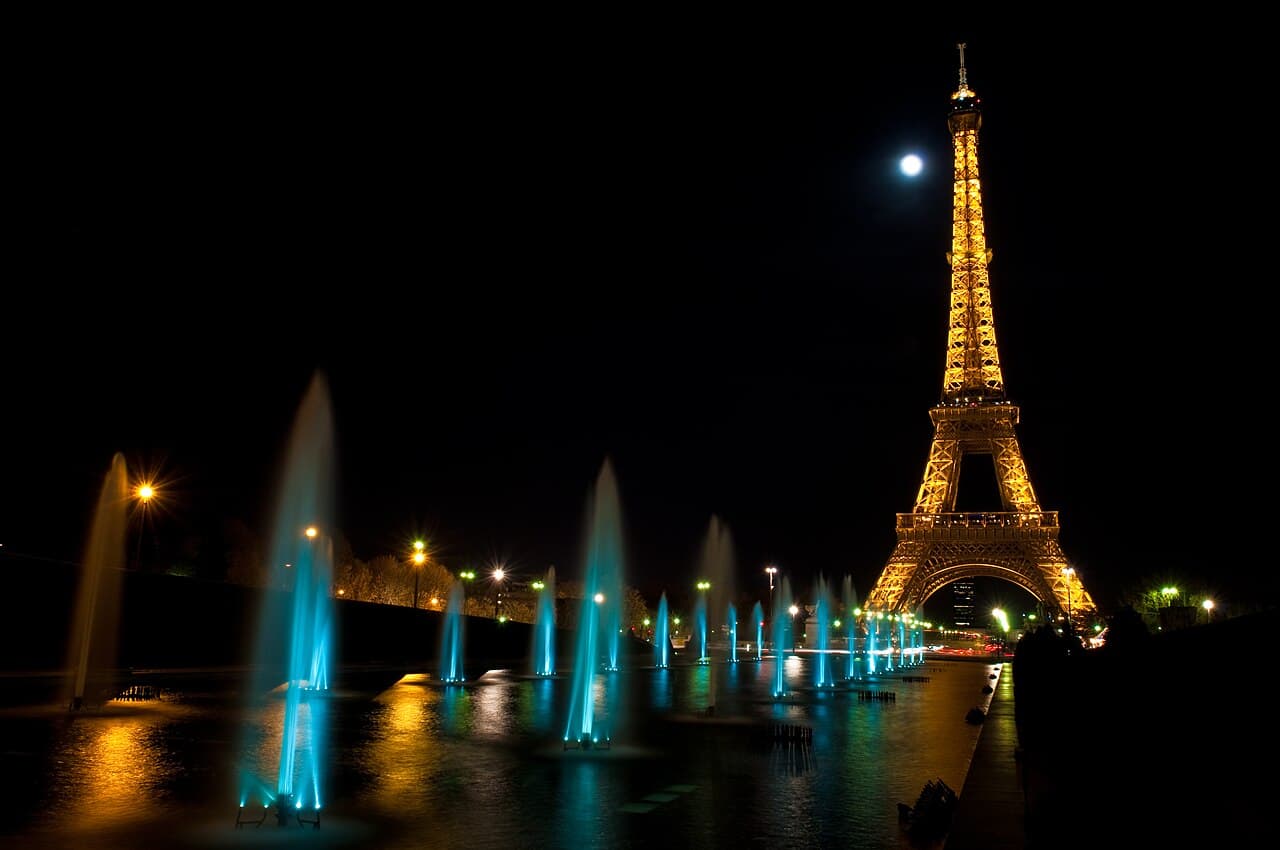
 The Eiffel Tower, built for the 1889 World's Fair, above the Champ de Mars in Paris. CC0, via Wikimedia Commons.
Lyon. The Roman Lugdunum, capital of the Three Gauls, keeps its ancient theatres on the hill of Fourvière and a warren of covered passages, the traboules, through the old silk-weavers' quarter. Each 8 December the whole city places candles in its windows for the Fête des Lumières, a festival of light with Marian and civic roots that now draws millions. Lyon also keeps a harder memory: its Centre d'Histoire de la Résistance et de la Déportation, in a building once used by the Gestapo, documents the wartime Resistance for which the city was a hub.
Marseille. Founded by Greek sailors from Phocaea around 600 BC as Massalia, Marseille is the oldest city in France, a Mediterranean port that has taken in newcomers for twenty-six centuries. The basilica of Notre-Dame de la Garde watches over its harbour, and the Museum of European and Mediterranean Civilisations, opened in 2013, turned the old port entrance into a place for thinking about the sea's shared history.
Reims. The cathedral of Reims was the coronation church of the kings of France, from the medieval monarchs to the crowning of Charles VII in 1429 with Joan of Arc at his side. Shattered by German shellfire in the First World War and painstakingly rebuilt, it stands for both French kingship and the country's twentieth-century wounds; the German surrender that ended the war in Europe was signed in Reims in May 1945.
Verdun. A quiet town on the Meuse, Verdun gave its name to the longest battle of the First World War, ten months of 1916 that killed some 300,000 men. The battlefield above the town, with its ossuary, its national cemetery and the vanished "destroyed villages" that were never rebuilt, has become France's central site of war remembrance and, since a famous 1984 handclasp between François Mitterrand and Helmut Kohl, a symbol of Franco-German reconciliation.
France's human story reaches deep into the Ice Age. The painted caves of the Dordogne, above all Lascaux with its galloping bulls and horses of roughly 17,000 years ago, are among the greatest works of prehistoric art anywhere, and the alignments of standing stones at Carnac in Brittany, thousands of megaliths raised more than six thousand years ago, were added to the UNESCO World Heritage List in 2025. Iron Age Gaul was a patchwork of Celtic peoples until Julius Caesar's conquest in the 50s BC; the resistance of the chieftain Vercingetorix, defeated at Alesia in 52 BC, became a founding legend of the nation. Roman Gaul gave France its cities, roads and the Latin that would grow into French, before Frankish kingdoms rose from the wreckage of empire. The Frankish leader Clovis, baptised a Christian around 496, and later Charlemagne, crowned emperor in 800, set the pattern of a Christian realm at the heart of Europe.
From the Capetian kings who made Paris their capital in 987, France assembled itself over centuries of war, marriage and administration. The Middle Ages raised the great Gothic cathedrals, the Hundred Years' War against England produced the martyr-heroine Joan of Arc, burned at Rouen in 1431, and the Renaissance filled the Loire valley with châteaux. Under Louis XIV, the "Sun King", the monarchy reached its height and built Versailles as a theatre of absolute power. Then came the rupture that still defines the country: the Revolution of 1789, the storming of the Bastille on 14 July, the Declaration of the Rights of Man and the Terror. Napoleon rebuilt the state and redrew Europe before his fall in 1815, and the nineteenth century swung between empire and republic; the Franco-Prussian War of 1870 cost France Alsace and Lorraine and left a bitterness that fed into the catastrophe of 1914. The First World War killed close to 1.4 million French soldiers; the Second brought defeat, the Vichy regime, occupation, the Resistance and the deportation of Jews to the death camps, before the Liberation of 1944. The Fifth Republic, decolonisation and the long, painful end of French Algeria have shaped the country ever since.
The name France comes from the Franks, the Germanic people who settled Gaul in the early Middle Ages; their name is usually linked to a word meaning "free" or "bold". French itself is a Romance language, descended from the Latin that Roman Gaul absorbed and reshaped, and it carries the country's layered past in its very map. Place names ending in "-ac" mark Gallo-Roman estates in the south-west; "-ville" and "-court" villages recall Frankish landholders; Breton names in the far west belong to a Celtic language brought back across the Channel; and the old divide between the langue d'oïl of the north and the langue d'oc of the south still echoes in the name of the Occitan-speaking region of Languedoc.
France has guarded its language with unusual deliberation. The Ordinance of Villers-Cotterêts in 1539 made French, rather than Latin, the language of law and administration, and in 1635 Cardinal Richelieu founded the Académie française, whose forty members, the "immortels", still labour over the official dictionary. That drive for a single national tongue came at the expense of France's regional languages: Breton, Occitan, Alsatian, Corsican, Catalan and Basque were long discouraged in schools, and all are now classed as endangered to varying degrees, sustained by bilingual schools, local media and revival movements. Meanwhile French became one of the world's great international languages, the tongue of diplomacy for centuries and today spoken by some 300 million people across the Francophone world, from Québec to West Africa, a reach that France cultivates through the Organisation internationale de la Francophonie.
French daily life is organised around a handful of shared pleasures that the country takes seriously. Food comes first: the "gastronomic meal of the French", with its ritual of apéritif, several courses, cheese and wine, was placed on UNESCO's list of intangible heritage in 2010, and the artisanal baguette followed in 2022, a defence of the neighbourhood bakery as much as of the bread. Wine and cheese are matters of regional identity, each village and vineyard defending its appellation; the café and the long lunch remain fixtures of daily life. France codified fine cooking, high fashion and much of modern art, and it invented cinema itself: the Lumière brothers projected the first films in Lyon and Paris in 1895, and the Cannes Film Festival is still the world's most prestigious.
Sport and festival bind the year together. The Tour de France, first ridden in 1903, sends the peloton around the country every July; football is the mass passion, its World Cup wins in 1998 and 2018 celebrated as moments of unity; rugby holds the south-west. The literary and intellectual inheritance is vast, from Montaigne, Molière and Racine through Hugo, Balzac, Flaubert and Proust to Camus, Sartre and Beauvoir, and the French treat their writers as public figures, buried in the Panthéon and argued over in the press. Folk custom endures too, from the flower festivals of Provence to the pardons of Brittany, and modern France is inseparable from the cultures its immigrants brought, so that raï and rap, couscous and merguez are now as French as anything else.
France was for centuries the "eldest daughter of the Church", and Catholicism shaped its landscape and its calendar. Clovis's baptism tied the Frankish monarchy to Rome; the medieval centuries covered the country with the finest Gothic architecture in the world, at Chartres, Amiens, Reims and Notre-Dame de Paris, cathedrals built as prayers in stone and as reliquaries for the bones of saints. The Reformation split France in the sixteenth century and plunged it into the Wars of Religion, whose horrors included the Saint Bartholomew's Day Massacre of Protestants in 1572; the Edict of Nantes granted toleration in 1598, only for Louis XIV to revoke it in 1685, driving many Huguenots into exile.
Modern France is defined instead by laïcité, the secular settlement enshrined in the law of 1905 that separated church and state and made the Republic officially neutral in matters of faith. The result is a country at once deeply marked by Catholic heritage and among the most secular in Europe, and home to the largest Muslim and Jewish communities in western Europe, with constant debate about how a strictly secular public sphere should accommodate them. Older forms of devotion persist alongside: Lourdes, in the Pyrenees, where a young woman reported visions of the Virgin in 1858, still draws millions of pilgrims and sick visitors a year, one of the most visited shrines in the Christian world.
French mourning has a rhythm and a vocabulary of its own. A death is announced by the faire-part, a printed notice sent to family and friends and often posted at the church door or the town hall; condolences follow in set phrases, and the funeral, historically a Catholic Mass, increasingly takes a civil form as the country secularises and as cremation, once frowned on by the Church, becomes common. The dead are gathered in the cemetery, and here France made a lasting contribution to the world. A Napoleonic decree of 1804 ordered burials moved out of the crowded churchyards to new grounds beyond the city, and in the same year Paris opened Père-Lachaise on a hillside in the east, laid out like an English landscape garden with winding paths and family tombs. It now holds more than a million burials, from Chopin and Molière to Édith Piaf, Oscar Wilde and Jim Morrison, and it became the template for the garden cemetery everywhere.
The great annual act of remembrance is Toussaint, All Saints' Day, on 1 November, followed the next day by the Day of the Dead. It is a public holiday, and families across the country visit the graves of their relatives, clean the stone, and lay pots of chrysanthemums, the hardy autumn flower that has become so bound up with the day that around twenty-five million pots are placed on French graves each year and the flower is rarely given for any happier occasion. The custom took its modern form after the First World War, when the president asked that war memorials be decorated with flowers and the chrysanthemum, still in bloom in November, became the flower of the fallen.
War memory is woven through the whole country. After 1918 nearly every one of France's 36,000 communes raised a monument aux morts inscribed with the names of its dead, so that even the smallest village square carries its list of the lost, read aloud each 11 November, Armistice Day, which remains a national holiday alongside 8 May for the victory of 1945. In Paris the Tomb of the Unknown Soldier under the Arc de Triomphe, with its flame relit every evening since 1923, is the focus of national ceremony. Above Verdun stands the most concentrated of all these sites: the Douaumont Ossuary, inaugurated in 1932, a vast vaulted monument whose lower windows reveal the jumbled bones of at least 130,000 unidentified French and German soldiers gathered from the battlefield, with a national cemetery of 16,000 crosses spread before it. The Second World War added its own places of memory, among them the Mémorial de la Shoah in Paris and the ruins of Oradour-sur-Glane, a village whose 643 inhabitants were massacred by an SS unit on 10 June 1944 and whose burned-out houses and rusted cars have been preserved exactly as they were left, a "martyred village" kept as evidence and warning.
The Eiffel Tower, built for the 1889 World's Fair, above the Champ de Mars in Paris. CC0, via Wikimedia Commons.
Lyon. The Roman Lugdunum, capital of the Three Gauls, keeps its ancient theatres on the hill of Fourvière and a warren of covered passages, the traboules, through the old silk-weavers' quarter. Each 8 December the whole city places candles in its windows for the Fête des Lumières, a festival of light with Marian and civic roots that now draws millions. Lyon also keeps a harder memory: its Centre d'Histoire de la Résistance et de la Déportation, in a building once used by the Gestapo, documents the wartime Resistance for which the city was a hub.
Marseille. Founded by Greek sailors from Phocaea around 600 BC as Massalia, Marseille is the oldest city in France, a Mediterranean port that has taken in newcomers for twenty-six centuries. The basilica of Notre-Dame de la Garde watches over its harbour, and the Museum of European and Mediterranean Civilisations, opened in 2013, turned the old port entrance into a place for thinking about the sea's shared history.
Reims. The cathedral of Reims was the coronation church of the kings of France, from the medieval monarchs to the crowning of Charles VII in 1429 with Joan of Arc at his side. Shattered by German shellfire in the First World War and painstakingly rebuilt, it stands for both French kingship and the country's twentieth-century wounds; the German surrender that ended the war in Europe was signed in Reims in May 1945.
Verdun. A quiet town on the Meuse, Verdun gave its name to the longest battle of the First World War, ten months of 1916 that killed some 300,000 men. The battlefield above the town, with its ossuary, its national cemetery and the vanished "destroyed villages" that were never rebuilt, has become France's central site of war remembrance and, since a famous 1984 handclasp between François Mitterrand and Helmut Kohl, a symbol of Franco-German reconciliation.
France's human story reaches deep into the Ice Age. The painted caves of the Dordogne, above all Lascaux with its galloping bulls and horses of roughly 17,000 years ago, are among the greatest works of prehistoric art anywhere, and the alignments of standing stones at Carnac in Brittany, thousands of megaliths raised more than six thousand years ago, were added to the UNESCO World Heritage List in 2025. Iron Age Gaul was a patchwork of Celtic peoples until Julius Caesar's conquest in the 50s BC; the resistance of the chieftain Vercingetorix, defeated at Alesia in 52 BC, became a founding legend of the nation. Roman Gaul gave France its cities, roads and the Latin that would grow into French, before Frankish kingdoms rose from the wreckage of empire. The Frankish leader Clovis, baptised a Christian around 496, and later Charlemagne, crowned emperor in 800, set the pattern of a Christian realm at the heart of Europe.
From the Capetian kings who made Paris their capital in 987, France assembled itself over centuries of war, marriage and administration. The Middle Ages raised the great Gothic cathedrals, the Hundred Years' War against England produced the martyr-heroine Joan of Arc, burned at Rouen in 1431, and the Renaissance filled the Loire valley with châteaux. Under Louis XIV, the "Sun King", the monarchy reached its height and built Versailles as a theatre of absolute power. Then came the rupture that still defines the country: the Revolution of 1789, the storming of the Bastille on 14 July, the Declaration of the Rights of Man and the Terror. Napoleon rebuilt the state and redrew Europe before his fall in 1815, and the nineteenth century swung between empire and republic; the Franco-Prussian War of 1870 cost France Alsace and Lorraine and left a bitterness that fed into the catastrophe of 1914. The First World War killed close to 1.4 million French soldiers; the Second brought defeat, the Vichy regime, occupation, the Resistance and the deportation of Jews to the death camps, before the Liberation of 1944. The Fifth Republic, decolonisation and the long, painful end of French Algeria have shaped the country ever since.
The name France comes from the Franks, the Germanic people who settled Gaul in the early Middle Ages; their name is usually linked to a word meaning "free" or "bold". French itself is a Romance language, descended from the Latin that Roman Gaul absorbed and reshaped, and it carries the country's layered past in its very map. Place names ending in "-ac" mark Gallo-Roman estates in the south-west; "-ville" and "-court" villages recall Frankish landholders; Breton names in the far west belong to a Celtic language brought back across the Channel; and the old divide between the langue d'oïl of the north and the langue d'oc of the south still echoes in the name of the Occitan-speaking region of Languedoc.
France has guarded its language with unusual deliberation. The Ordinance of Villers-Cotterêts in 1539 made French, rather than Latin, the language of law and administration, and in 1635 Cardinal Richelieu founded the Académie française, whose forty members, the "immortels", still labour over the official dictionary. That drive for a single national tongue came at the expense of France's regional languages: Breton, Occitan, Alsatian, Corsican, Catalan and Basque were long discouraged in schools, and all are now classed as endangered to varying degrees, sustained by bilingual schools, local media and revival movements. Meanwhile French became one of the world's great international languages, the tongue of diplomacy for centuries and today spoken by some 300 million people across the Francophone world, from Québec to West Africa, a reach that France cultivates through the Organisation internationale de la Francophonie.
French daily life is organised around a handful of shared pleasures that the country takes seriously. Food comes first: the "gastronomic meal of the French", with its ritual of apéritif, several courses, cheese and wine, was placed on UNESCO's list of intangible heritage in 2010, and the artisanal baguette followed in 2022, a defence of the neighbourhood bakery as much as of the bread. Wine and cheese are matters of regional identity, each village and vineyard defending its appellation; the café and the long lunch remain fixtures of daily life. France codified fine cooking, high fashion and much of modern art, and it invented cinema itself: the Lumière brothers projected the first films in Lyon and Paris in 1895, and the Cannes Film Festival is still the world's most prestigious.
Sport and festival bind the year together. The Tour de France, first ridden in 1903, sends the peloton around the country every July; football is the mass passion, its World Cup wins in 1998 and 2018 celebrated as moments of unity; rugby holds the south-west. The literary and intellectual inheritance is vast, from Montaigne, Molière and Racine through Hugo, Balzac, Flaubert and Proust to Camus, Sartre and Beauvoir, and the French treat their writers as public figures, buried in the Panthéon and argued over in the press. Folk custom endures too, from the flower festivals of Provence to the pardons of Brittany, and modern France is inseparable from the cultures its immigrants brought, so that raï and rap, couscous and merguez are now as French as anything else.
France was for centuries the "eldest daughter of the Church", and Catholicism shaped its landscape and its calendar. Clovis's baptism tied the Frankish monarchy to Rome; the medieval centuries covered the country with the finest Gothic architecture in the world, at Chartres, Amiens, Reims and Notre-Dame de Paris, cathedrals built as prayers in stone and as reliquaries for the bones of saints. The Reformation split France in the sixteenth century and plunged it into the Wars of Religion, whose horrors included the Saint Bartholomew's Day Massacre of Protestants in 1572; the Edict of Nantes granted toleration in 1598, only for Louis XIV to revoke it in 1685, driving many Huguenots into exile.
Modern France is defined instead by laïcité, the secular settlement enshrined in the law of 1905 that separated church and state and made the Republic officially neutral in matters of faith. The result is a country at once deeply marked by Catholic heritage and among the most secular in Europe, and home to the largest Muslim and Jewish communities in western Europe, with constant debate about how a strictly secular public sphere should accommodate them. Older forms of devotion persist alongside: Lourdes, in the Pyrenees, where a young woman reported visions of the Virgin in 1858, still draws millions of pilgrims and sick visitors a year, one of the most visited shrines in the Christian world.
French mourning has a rhythm and a vocabulary of its own. A death is announced by the faire-part, a printed notice sent to family and friends and often posted at the church door or the town hall; condolences follow in set phrases, and the funeral, historically a Catholic Mass, increasingly takes a civil form as the country secularises and as cremation, once frowned on by the Church, becomes common. The dead are gathered in the cemetery, and here France made a lasting contribution to the world. A Napoleonic decree of 1804 ordered burials moved out of the crowded churchyards to new grounds beyond the city, and in the same year Paris opened Père-Lachaise on a hillside in the east, laid out like an English landscape garden with winding paths and family tombs. It now holds more than a million burials, from Chopin and Molière to Édith Piaf, Oscar Wilde and Jim Morrison, and it became the template for the garden cemetery everywhere.
The great annual act of remembrance is Toussaint, All Saints' Day, on 1 November, followed the next day by the Day of the Dead. It is a public holiday, and families across the country visit the graves of their relatives, clean the stone, and lay pots of chrysanthemums, the hardy autumn flower that has become so bound up with the day that around twenty-five million pots are placed on French graves each year and the flower is rarely given for any happier occasion. The custom took its modern form after the First World War, when the president asked that war memorials be decorated with flowers and the chrysanthemum, still in bloom in November, became the flower of the fallen.
War memory is woven through the whole country. After 1918 nearly every one of France's 36,000 communes raised a monument aux morts inscribed with the names of its dead, so that even the smallest village square carries its list of the lost, read aloud each 11 November, Armistice Day, which remains a national holiday alongside 8 May for the victory of 1945. In Paris the Tomb of the Unknown Soldier under the Arc de Triomphe, with its flame relit every evening since 1923, is the focus of national ceremony. Above Verdun stands the most concentrated of all these sites: the Douaumont Ossuary, inaugurated in 1932, a vast vaulted monument whose lower windows reveal the jumbled bones of at least 130,000 unidentified French and German soldiers gathered from the battlefield, with a national cemetery of 16,000 crosses spread before it. The Second World War added its own places of memory, among them the Mémorial de la Shoah in Paris and the ruins of Oradour-sur-Glane, a village whose 643 inhabitants were massacred by an SS unit on 10 June 1944 and whose burned-out houses and rusted cars have been preserved exactly as they were left, a "martyred village" kept as evidence and warning.
_(9124638286).jpg%2F1280px-Ossuary_of_Douaumont_(Verdun%252C_France_2013)_(9124638286).jpg&w=3840&q=75) The Douaumont Ossuary above Verdun, which holds the remains of some 130,000 unidentified soldiers, with the national cemetery before it. CC BY 2.0, via Wikimedia Commons.
France invented the modern civil register and then handed it to the mayor. The Revolution took vital records off the church in 1792 and required every commune to record births, marriages and deaths in duplicate from the start of 1793, one copy kept locally and one sent to the court, which is why so much survives: to lose a record you had to lose it twice.
Before that the parish registers run back to the sixteenth century, and the same communes hold them. Almost every departmental archive has now digitised both and put them online free, which makes France one of the easiest countries in Europe to research from a long way away. There is no single national index; you go department by department, which sounds worse than it is once you know where the family was from.
The French registers also carry the marginal note, the mention marginale, added later to an existing entry. A birth record can therefore tell you about a marriage in another town thirty years afterwards, and a divorce after that, which turns a single certificate into a summary of a life.
Paris is the exception and the wound. The fires of the Commune in May 1871 destroyed the city's civil registers for everything before 1860, some eight million records. A reconstitution effort assembled about a third of them from surviving copies and family papers, and that partial rebuild is what Parisian research uses now. It is a reminder that the duplicate system worked everywhere except the one place where both copies were kept in the same city.
France effectively invented the modern idea of national heritage. The Revolution, having seized church and aristocratic property, faced the question of what to do with it, and out of that came the notion of a "patrimoine" belonging to the nation as a whole. In the 1830s the state created the post of Inspector of Historic Monuments, held for a time by the writer Prosper Mérimée, who toured the country cataloguing endangered buildings and whose inventory survives as the Mérimée database. The law of 31 December 1913 on historic monuments gave France one of the earliest comprehensive systems for protecting and classifying its built heritage, still the backbone of the system today, administered by the Ministry of Culture and the Centre des Monuments Nationaux, which manages around a hundred sites from the Mont-Saint-Michel abbey to the medieval walls of Carcassonne.
The Douaumont Ossuary above Verdun, which holds the remains of some 130,000 unidentified soldiers, with the national cemetery before it. CC BY 2.0, via Wikimedia Commons.
France invented the modern civil register and then handed it to the mayor. The Revolution took vital records off the church in 1792 and required every commune to record births, marriages and deaths in duplicate from the start of 1793, one copy kept locally and one sent to the court, which is why so much survives: to lose a record you had to lose it twice.
Before that the parish registers run back to the sixteenth century, and the same communes hold them. Almost every departmental archive has now digitised both and put them online free, which makes France one of the easiest countries in Europe to research from a long way away. There is no single national index; you go department by department, which sounds worse than it is once you know where the family was from.
The French registers also carry the marginal note, the mention marginale, added later to an existing entry. A birth record can therefore tell you about a marriage in another town thirty years afterwards, and a divorce after that, which turns a single certificate into a summary of a life.
Paris is the exception and the wound. The fires of the Commune in May 1871 destroyed the city's civil registers for everything before 1860, some eight million records. A reconstitution effort assembled about a third of them from surviving copies and family papers, and that partial rebuild is what Parisian research uses now. It is a reminder that the duplicate system worked everywhere except the one place where both copies were kept in the same city.
France effectively invented the modern idea of national heritage. The Revolution, having seized church and aristocratic property, faced the question of what to do with it, and out of that came the notion of a "patrimoine" belonging to the nation as a whole. In the 1830s the state created the post of Inspector of Historic Monuments, held for a time by the writer Prosper Mérimée, who toured the country cataloguing endangered buildings and whose inventory survives as the Mérimée database. The law of 31 December 1913 on historic monuments gave France one of the earliest comprehensive systems for protecting and classifying its built heritage, still the backbone of the system today, administered by the Ministry of Culture and the Centre des Monuments Nationaux, which manages around a hundred sites from the Mont-Saint-Michel abbey to the medieval walls of Carcassonne.
.jpg%2F1280px-Fa%25C3%25A7ade_of_The_Palace_of_Versailles_(24194247422).jpg&w=3840&q=75) The Palace of Versailles, built as the seat of Louis XIV's court and a UNESCO World Heritage Site. CC BY 2.0, via Wikimedia Commons.
France also gave Europe one of its most successful public rituals of heritage. In 1984 the culture minister Jack Lang launched the first open day at historic monuments; it grew into the Journées Européennes du Patrimoine, the European Heritage Days now held across the continent every September, when normally closed palaces, ministries and private châteaux open their doors to millions of visitors. The country's 56 UNESCO World Heritage sites map its range, from the palace and park of Versailles, the cathedral of Chartres and the banks of the Seine in Paris to the Loire valley, the Canal du Midi, the pilgrimage routes to Santiago and the Carnac megaliths inscribed in 2025. More recent tools include the Fondation du Patrimoine and its heritage lottery, fronted by the broadcaster Stéphane Bern, which funds the repair of humble local churches, wash-houses and windmills that fall outside the grand monument system.
France has digitised its records on a national scale, to the benefit of scholars and family historians alike. The Bibliothèque nationale de France runs Gallica, one of the world's largest digital libraries, offering many millions of books, manuscripts, maps, newspapers and images free online. Genealogy is a mass pursuit built on the country's civil records: since the Revolution, births, marriages and deaths have been registered by every town hall, and the older parish registers reach back centuries, and France's departmental archives have scanned enormous quantities of this état civil, putting local registers online department by department. Around them a thriving community works through commercial and collaborative platforms such as Geneanet, the French genealogy network now used by millions across Europe.
Memory of the war dead has its own digital home. Mémoire des Hommes, run by the Ministry of the Armed Forces, has digitised the individual record cards of the roughly 1.4 million French soldiers who "died for France" in the First World War, so that a name on a village memorial can be traced to a service file from a laptop, along with records of later conflicts and of those deported during the Second World War. The Institut National de l'Audiovisuel preserves and steadily opens the vast archive of French radio and television, and museum collections are being brought online through platforms such as the Joconde database, making France's cultural memory searchable as never before.
France remains a cultural power out of proportion to its size. Its cinema is protected and prolific, its literary prizes are national events, and Paris is still a world capital of art, fashion and ideas. French music has repeatedly reshaped the global soundscape, from the chanson tradition to the electronic "French touch" of Daft Punk, and French cuisine and luxury goods carry the country's image everywhere. The heritage sector is itself a major industry, drawing tens of millions of visitors a year to Versailles, the Mont-Saint-Michel, the châteaux of the Loire and the museums of Paris, led by the Louvre, the most visited museum on earth.
The liveliest current in French culture, though, runs through the country's reckoning with its diversity and its past. Debates over laïcité, immigration and the place of Islam are constant and often fierce; the memory of the Algerian War and of colonial violence, including the killing of Algerian protesters in Paris on 17 October 1961, has been slowly and painfully brought into public acknowledgement. France has begun to confront the contents of its museums as well, and following an official report in 2018 it started returning looted objects to west Africa, among them royal treasures sent back to Benin in 2021. The gradual admission of new figures to the Panthéon, the Resistance fighter and immigrant Missak Manouchian among them in 2024, shows a Republic still actively deciding whom it wishes to remember.
Rebuilding Notre-Dame. When fire tore through Notre-Dame de Paris on 15 April 2019 and brought down its spire, the government pledged to rebuild, and donations poured in from around the world. Over five years, hundreds of firms and craftspeople, carpenters, stone-cutters, glaziers and organ-builders, restored the cathedral using traditional methods, felling oaks to recreate the medieval roof frame known as "the forest". The cathedral reopened on 7 December 2024, cleaned and repaired, a demonstration that France could still marshal both money and vanishing skills to save its greatest monuments.
The heritage open day that spread across Europe. France's 1984 experiment in opening historic monuments to the public for a weekend proved so popular that the Council of Europe adopted it, and the European Heritage Days now run in some fifty countries. What began as a single French initiative has become the continent's largest cultural event, drawing many millions through doors that are otherwise closed.
Saving Lascaux by copying it. The painted cave of Lascaux, discovered in 1940, was so damaged by the breath and footfalls of visitors that it was closed in 1963. Rather than lose the art to the world, France built facsimiles: Lascaux II opened nearby in 1983, and the full-scale Lascaux IV in 2016, reproducing the paintings so faithfully that the public can see them while the original is sealed and monitored, a pioneering answer to the problem of loving a fragile site to death.
Naming 1.4 million dead. The Mémoire des Hommes project digitised the record cards of every French serviceman who died in the First World War, some 1.4 million files, and put them online for free. It turned an unmanageable archive into a resource that descendants across France and beyond now use daily to connect a name carved on a village cross to a real life and death.
The Palace of Versailles, built as the seat of Louis XIV's court and a UNESCO World Heritage Site. CC BY 2.0, via Wikimedia Commons.
France also gave Europe one of its most successful public rituals of heritage. In 1984 the culture minister Jack Lang launched the first open day at historic monuments; it grew into the Journées Européennes du Patrimoine, the European Heritage Days now held across the continent every September, when normally closed palaces, ministries and private châteaux open their doors to millions of visitors. The country's 56 UNESCO World Heritage sites map its range, from the palace and park of Versailles, the cathedral of Chartres and the banks of the Seine in Paris to the Loire valley, the Canal du Midi, the pilgrimage routes to Santiago and the Carnac megaliths inscribed in 2025. More recent tools include the Fondation du Patrimoine and its heritage lottery, fronted by the broadcaster Stéphane Bern, which funds the repair of humble local churches, wash-houses and windmills that fall outside the grand monument system.
France has digitised its records on a national scale, to the benefit of scholars and family historians alike. The Bibliothèque nationale de France runs Gallica, one of the world's largest digital libraries, offering many millions of books, manuscripts, maps, newspapers and images free online. Genealogy is a mass pursuit built on the country's civil records: since the Revolution, births, marriages and deaths have been registered by every town hall, and the older parish registers reach back centuries, and France's departmental archives have scanned enormous quantities of this état civil, putting local registers online department by department. Around them a thriving community works through commercial and collaborative platforms such as Geneanet, the French genealogy network now used by millions across Europe.
Memory of the war dead has its own digital home. Mémoire des Hommes, run by the Ministry of the Armed Forces, has digitised the individual record cards of the roughly 1.4 million French soldiers who "died for France" in the First World War, so that a name on a village memorial can be traced to a service file from a laptop, along with records of later conflicts and of those deported during the Second World War. The Institut National de l'Audiovisuel preserves and steadily opens the vast archive of French radio and television, and museum collections are being brought online through platforms such as the Joconde database, making France's cultural memory searchable as never before.
France remains a cultural power out of proportion to its size. Its cinema is protected and prolific, its literary prizes are national events, and Paris is still a world capital of art, fashion and ideas. French music has repeatedly reshaped the global soundscape, from the chanson tradition to the electronic "French touch" of Daft Punk, and French cuisine and luxury goods carry the country's image everywhere. The heritage sector is itself a major industry, drawing tens of millions of visitors a year to Versailles, the Mont-Saint-Michel, the châteaux of the Loire and the museums of Paris, led by the Louvre, the most visited museum on earth.
The liveliest current in French culture, though, runs through the country's reckoning with its diversity and its past. Debates over laïcité, immigration and the place of Islam are constant and often fierce; the memory of the Algerian War and of colonial violence, including the killing of Algerian protesters in Paris on 17 October 1961, has been slowly and painfully brought into public acknowledgement. France has begun to confront the contents of its museums as well, and following an official report in 2018 it started returning looted objects to west Africa, among them royal treasures sent back to Benin in 2021. The gradual admission of new figures to the Panthéon, the Resistance fighter and immigrant Missak Manouchian among them in 2024, shows a Republic still actively deciding whom it wishes to remember.
Rebuilding Notre-Dame. When fire tore through Notre-Dame de Paris on 15 April 2019 and brought down its spire, the government pledged to rebuild, and donations poured in from around the world. Over five years, hundreds of firms and craftspeople, carpenters, stone-cutters, glaziers and organ-builders, restored the cathedral using traditional methods, felling oaks to recreate the medieval roof frame known as "the forest". The cathedral reopened on 7 December 2024, cleaned and repaired, a demonstration that France could still marshal both money and vanishing skills to save its greatest monuments.
The heritage open day that spread across Europe. France's 1984 experiment in opening historic monuments to the public for a weekend proved so popular that the Council of Europe adopted it, and the European Heritage Days now run in some fifty countries. What began as a single French initiative has become the continent's largest cultural event, drawing many millions through doors that are otherwise closed.
Saving Lascaux by copying it. The painted cave of Lascaux, discovered in 1940, was so damaged by the breath and footfalls of visitors that it was closed in 1963. Rather than lose the art to the world, France built facsimiles: Lascaux II opened nearby in 1983, and the full-scale Lascaux IV in 2016, reproducing the paintings so faithfully that the public can see them while the original is sealed and monitored, a pioneering answer to the problem of loving a fragile site to death.
Naming 1.4 million dead. The Mémoire des Hommes project digitised the record cards of every French serviceman who died in the First World War, some 1.4 million files, and put them online for free. It turned an unmanageable archive into a resource that descendants across France and beyond now use daily to connect a name carved on a village cross to a real life and death.
National Overview
Notable Cities
Historical Foundations
Linguistic and Etymological Roots
Cultural Identity
Religion and Spirituality
Remembrance and Mourning Traditions
Tracing a Family in France
Heritage Preservation Efforts
Digital Heritage
Contemporary Cultural Influences
Success Stories
References and resources
- UNESCO World Heritage Centre, France, the state-party page listing all 54 French World Heritage sites, from Versailles to the Carnac megaliths.
- Centre des Monuments Nationaux, the national body that manages around a hundred monuments, including Mont-Saint-Michel and Carcassonne.
- Gallica, Bibliothèque nationale de France, one of the world's largest digital libraries of books, manuscripts, maps and newspapers.
- Mémoire des Hommes, the Ministry of the Armed Forces database of French war dead, including the digitised records of 1.4 million killed in 1914–18.
- Archives nationales, the national archives of France, custodians of the country's public records since the Middle Ages.
- Journées Européennes du Patrimoine, the French-born European Heritage Days, held every September since 1984.
- Mémorial de Verdun, the museum and remembrance site of the 1916 battle, beside the Douaumont Ossuary and national cemetery.
- Geneanet, the collaborative genealogy platform widely used for French civil and parish records.
- Encyclopaedia Britannica, France, geography, history and political background.