Heritage · Country
Czechia Culture and Heritage
On the walls of Prague's Pinkas Synagogue are written, by hand, the names of nearly 78,000 Jews of Bohemia and Moravia murdered in the Holocaust, painted out under communism and painstakingly restored after 1989. A guide to Czechia's heritage, its Hussite and Habsburg past, and how one of Europe's most secular nations tends its dead.Written to last.
By Confinity Heritage Editorial · 2026-07-11 · 8-minute readQuiet tools, kept out of the way.
In the Pinkas Synagogue in Prague's old Jewish quarter, the walls are covered floor to ceiling in small handwritten names: the surname in red, the given names and dates in black, family by family, town by town, nearly 78,000 Jews of Bohemia and Moravia who were deported and killed between 1941 and 1945. Artists first inscribed them in the late 1950s. In 1968 the communist authorities, uneasy with a memorial that spoke of Jewish suffering, let the walls "deteriorate" and then painted the names over on the pretext of damp in the masonry. Only after the Velvet Revolution of 1989 were the names uncovered and written again, one by one, a labour finished in the mid-1990s. It is a fitting emblem for a country whose memory has repeatedly been erased and repeatedly restored.
Czechia has been overwritten many times, by Habsburg re-Catholicisation after 1620, by Nazi occupation, by four decades of communist rule that toppled statues and rewrote textbooks, yet its heritage keeps resurfacing: the medieval golden age of Charles IV in Prague's stone, the reformer Jan Hus burned in 1415 and still commemorated every 6 July, the bones of tens of thousands arranged into a chapel at Sedlec, the village of Lidice razed to nothing in 1942 and rebuilt as a place of pilgrimage.
 Prague Castle and St Vitus Cathedral above the Vltava, in a photochrom print of the 1890s. Public domain, via Wikimedia Commons.
Czechia, the Czech Republic, is a landlocked country of about 78,870 square kilometres in the heart of Europe, bordered by Germany, Poland, Slovakia and Austria. It is built from three historic lands: Bohemia in the west, the largest, a basin ringed by wooded mountains; Moravia in the east, opening toward the Danube; and a small part of Silesia in the north-east. The Bohemian Massif that underlies the country is framed by low ranges, the Krkonoše or Giant Mountains along the Polish border, where Sněžka reaches 1,603 metres, the Šumava forests toward Bavaria, and the Ore Mountains to the north-west. The rivers divide the waters of Europe: the Elbe and its tributary the Vltava drain Bohemia north to the North Sea, while the Morava carries Moravia's water south to the Danube and the Black Sea.
About 10.9 million people live here, most of them Czech, with long-settled Moravian, Slovak, Polish, Vietnamese and Ukrainian communities and, since 2022, a large number of Ukrainian refugees. The country is a parliamentary republic; its president since 2023 is Petr Pavel, a former general. Prague, the capital, holds about 1.3 million people and has been the political and cultural centre of the Czech lands for a thousand years. Czechia emerged in its present form on 1 January 1993, when Czechoslovakia divided peacefully into the Czech Republic and Slovakia, the so-called Velvet Divorce. It joined NATO in 1999 and the European Union in 2004, sits inside the Schengen area, and keeps its own currency, the Czech koruna. In 2016 the government endorsed "Czechia" as the country's short geographic name in English alongside the formal Czech Republic.
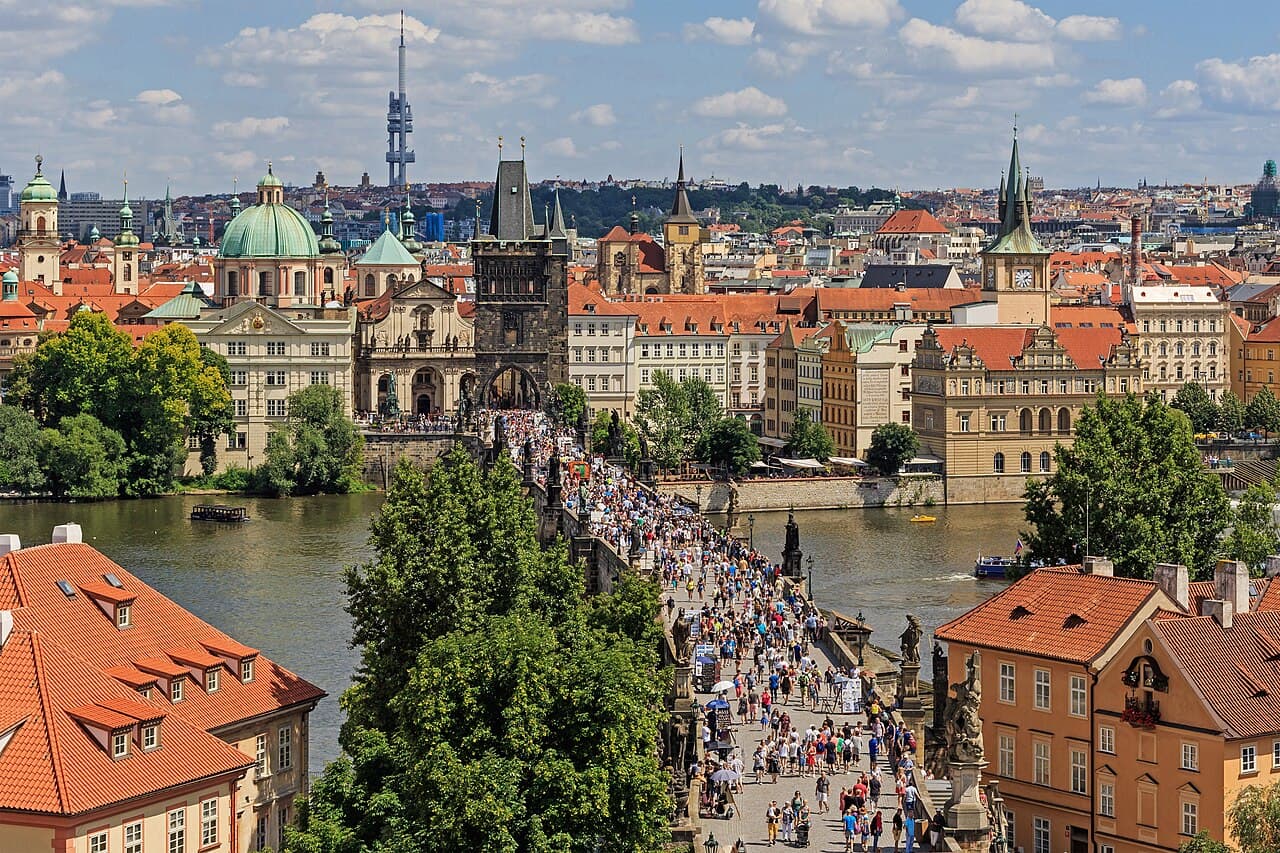
Prague. The capital, "the city of a hundred spires", grew around a castle founded in the ninth century that is still the largest ancient castle complex in the world and the seat of the president. Charles IV made it an imperial capital in the fourteenth century, and his Charles Bridge, Old Town Square, and St Vitus Cathedral remain its heart, along with the medieval Astronomical Clock, the Orloj, which has marked the hours on the Old Town Hall since 1410. The old Jewish quarter of Josefov, with its six surviving synagogues and its layered cemetery, is one of the most important sites of Jewish heritage in Europe.
Brno. The capital of Moravia and the country's second city is a place of science and modern architecture. In its Augustinian abbey the monk Gregor Mendel worked out the laws of heredity from his pea plants in the 1860s, founding genetics, and the functionalist Villa Tugendhat, designed by Mies van der Rohe in 1930, is a UNESCO World Heritage Site.
Prague Castle and St Vitus Cathedral above the Vltava, in a photochrom print of the 1890s. Public domain, via Wikimedia Commons.
Czechia, the Czech Republic, is a landlocked country of about 78,870 square kilometres in the heart of Europe, bordered by Germany, Poland, Slovakia and Austria. It is built from three historic lands: Bohemia in the west, the largest, a basin ringed by wooded mountains; Moravia in the east, opening toward the Danube; and a small part of Silesia in the north-east. The Bohemian Massif that underlies the country is framed by low ranges, the Krkonoše or Giant Mountains along the Polish border, where Sněžka reaches 1,603 metres, the Šumava forests toward Bavaria, and the Ore Mountains to the north-west. The rivers divide the waters of Europe: the Elbe and its tributary the Vltava drain Bohemia north to the North Sea, while the Morava carries Moravia's water south to the Danube and the Black Sea.
About 10.9 million people live here, most of them Czech, with long-settled Moravian, Slovak, Polish, Vietnamese and Ukrainian communities and, since 2022, a large number of Ukrainian refugees. The country is a parliamentary republic; its president since 2023 is Petr Pavel, a former general. Prague, the capital, holds about 1.3 million people and has been the political and cultural centre of the Czech lands for a thousand years. Czechia emerged in its present form on 1 January 1993, when Czechoslovakia divided peacefully into the Czech Republic and Slovakia, the so-called Velvet Divorce. It joined NATO in 1999 and the European Union in 2004, sits inside the Schengen area, and keeps its own currency, the Czech koruna. In 2016 the government endorsed "Czechia" as the country's short geographic name in English alongside the formal Czech Republic.
Prague. The capital, "the city of a hundred spires", grew around a castle founded in the ninth century that is still the largest ancient castle complex in the world and the seat of the president. Charles IV made it an imperial capital in the fourteenth century, and his Charles Bridge, Old Town Square, and St Vitus Cathedral remain its heart, along with the medieval Astronomical Clock, the Orloj, which has marked the hours on the Old Town Hall since 1410. The old Jewish quarter of Josefov, with its six surviving synagogues and its layered cemetery, is one of the most important sites of Jewish heritage in Europe.
Brno. The capital of Moravia and the country's second city is a place of science and modern architecture. In its Augustinian abbey the monk Gregor Mendel worked out the laws of heredity from his pea plants in the 1860s, founding genetics, and the functionalist Villa Tugendhat, designed by Mies van der Rohe in 1930, is a UNESCO World Heritage Site.
 The Sprudel colonnade at Carlsbad, now Karlovy Vary, in a photochrom print of about 1900. Public domain, via Wikimedia Commons.
Karlovy Vary. Founded by Charles IV around a hot spring in the fourteenth century and named for him, the spa town of Karlovy Vary, long known by its German name Carlsbad, drew Europe's aristocracy and artists to drink and bathe in its mineral waters. Beethoven, Goethe and countless others took the cure along its colonnades, and in 2021 the town was inscribed, with Mariánské Lázně and Františkovy Lázně, as part of the transnational Great Spa Towns of Europe World Heritage Site.
Kutná Hora. The silver of Kutná Hora made it the richest town in medieval Bohemia after Prague, and its wealth built the soaring Gothic Church of St Barbara, patron of miners. On the town's edge, the Sedlec Ossuary arranges the bones of tens of thousands of the dead into a chapel decorated with a chandelier of every bone in the human body. The whole historic centre is a UNESCO World Heritage Site.
Olomouc. The old capital of Moravia and seat of an archbishopric keeps the country's second-oldest university and one of central Europe's finest squares, dominated by the Holy Trinity Column of 1754, a baroque monument to the passing of a plague and itself a World Heritage Site.
Český Krumlov. A small town wrapped in a bend of the Vltava beneath a vast Renaissance castle, Český Krumlov survived the centuries almost unchanged and became a World Heritage Site in 1992, its castle keeping a rare eighteenth-century baroque theatre with its original stage machinery still working.
Liberec. The largest city of northern Bohemia, long known by its German name Reichenberg, grew rich on textiles in the nineteenth century, when it was one of the industrial engines of the Austro-Hungarian Empire and a centre of the German-speaking population of the Sudetenland. Its ornate neo-Renaissance town hall and its position beneath the Jizera Mountains recall a prosperous, deeply mixed Czech-German past that the expulsions of 1945 and 1946 brought to an abrupt end.
The Sprudel colonnade at Carlsbad, now Karlovy Vary, in a photochrom print of about 1900. Public domain, via Wikimedia Commons.
Karlovy Vary. Founded by Charles IV around a hot spring in the fourteenth century and named for him, the spa town of Karlovy Vary, long known by its German name Carlsbad, drew Europe's aristocracy and artists to drink and bathe in its mineral waters. Beethoven, Goethe and countless others took the cure along its colonnades, and in 2021 the town was inscribed, with Mariánské Lázně and Františkovy Lázně, as part of the transnational Great Spa Towns of Europe World Heritage Site.
Kutná Hora. The silver of Kutná Hora made it the richest town in medieval Bohemia after Prague, and its wealth built the soaring Gothic Church of St Barbara, patron of miners. On the town's edge, the Sedlec Ossuary arranges the bones of tens of thousands of the dead into a chapel decorated with a chandelier of every bone in the human body. The whole historic centre is a UNESCO World Heritage Site.
Olomouc. The old capital of Moravia and seat of an archbishopric keeps the country's second-oldest university and one of central Europe's finest squares, dominated by the Holy Trinity Column of 1754, a baroque monument to the passing of a plague and itself a World Heritage Site.
Český Krumlov. A small town wrapped in a bend of the Vltava beneath a vast Renaissance castle, Český Krumlov survived the centuries almost unchanged and became a World Heritage Site in 1992, its castle keeping a rare eighteenth-century baroque theatre with its original stage machinery still working.
Liberec. The largest city of northern Bohemia, long known by its German name Reichenberg, grew rich on textiles in the nineteenth century, when it was one of the industrial engines of the Austro-Hungarian Empire and a centre of the German-speaking population of the Sudetenland. Its ornate neo-Renaissance town hall and its position beneath the Jizera Mountains recall a prosperous, deeply mixed Czech-German past that the expulsions of 1945 and 1946 brought to an abrupt end.
 A view of Reichenberg, today the city of Liberec, in a photochrom print of about 1900. Public domain, via Wikimedia Commons.
Slavic tribes settled the Czech lands in the early Middle Ages, and in the ninth century they formed part of Great Moravia, the realm to which the Byzantine missionaries Cyril and Methodius brought Christianity and the first Slavic script in 863. The Přemyslid dynasty then built the Bohemian state around Prague, and its early duke Václav, the "Good King Wenceslas" of the carol, murdered by his brother around 935, became the country's patron saint and the enduring symbol of its statehood. Bohemia's golden age came under Charles IV, king of Bohemia and Holy Roman Emperor, who in the fourteenth century made Prague an imperial capital, founded Charles University in 1348, the oldest university in central Europe, and began the cathedral of St Vitus and the bridge that still bears his name.
A century later Bohemia became the seedbed of the European Reformation. The Prague theologian Jan Hus, preaching against church corruption, was condemned and burned at the stake at the Council of Constance in 1415, and the outrage set off the Hussite Wars, in which Czech armies under Jan Žižka defeated crusade after crusade. Religious and political conflict ran on for two centuries and reached its turning point at the Battle of White Mountain outside Prague in 1620, when the Protestant Bohemian estates were crushed; the Habsburgs then re-Catholicised the country by force, executed the rebel leaders in Prague's Old Town Square, and folded Bohemia into their empire for three hundred years. The Czech National Revival of the nineteenth century rebuilt the language and the sense of nationhood, and in 1918, from the wreck of Austria-Hungary, Tomáš Garrigue Masaryk founded Czechoslovakia. That first republic was betrayed at Munich in 1938, when the Western powers handed its border regions to Hitler, occupied in 1939, and subjected to the Nazi Protectorate of Bohemia and Moravia; the assassination of the SS governor Reinhard Heydrich in 1942 brought savage reprisals, including the annihilation of the village of Lidice. After the war came the communist coup of 1948, the crushed reform movement of the 1968 Prague Spring under Soviet tanks, the long "normalisation", and at last the Velvet Revolution of November 1989, which swept the playwright Václav Havel from prison to the presidency.
Czech is a West Slavic language, close to Slovak and more distantly to Polish, written in the Latin alphabet with a distinctive set of diacritics, the háček or "little hook" above letters such as č, š and ž, a system whose invention is traditionally credited to Jan Hus and his circle in the early fifteenth century to render Czech sounds precisely. The language nearly became a peasant tongue under Habsburg German dominance, but the scholars of the National Revival, above all the linguist Josef Dobrovský and the lexicographer Josef Jungmann, rebuilt its literary form in the early nineteenth century, and it is now the confident national language, famous among linguists for tongue-twisting consonant clusters in words such as zmrzl, "froze", that manage without a single vowel.
The names of the country carry its layers. "Czech", Čech, derives from the mythical forefather Čech who, the medieval chronicles say, led his people to the hill of Říp and named the land. "Bohemia", the western land's Latin and international name, comes from the Boii, the Celtic tribe recorded here by the Romans, whose home was Boiohaemum, "the home of the Boii". "Moravia" takes its name from the river Morava. The endorsement of the short name "Czechia" in 2016 was partly an attempt to give the whole state a single, easy geographic name that includes Moravia and Silesia as well as Bohemia, since "Bohemia" strictly means only the western third. Place names across the country record its German-Czech past, so that most towns carry two names, Prague and Praha, Pilsen and Plzeň, Carlsbad and Karlovy Vary, a doubled map left by centuries of shared and contested settlement.
Czech identity is often described by Czechs themselves as sceptical, ironic and stubbornly down-to-earth, a temper shaped by centuries of outlasting bigger powers. Its great comic novel, Jaroslav Hašek's The Good Soldier Švejk, made a bumbling, apparently idiotic conscript into a national anti-hero who defeats the Austro-Hungarian war machine by taking its orders with ruinous literal obedience. That wry spirit runs through the country's beloved marionette theatre, a puppet tradition so deep it is inscribed by UNESCO, and through the animated Little Mole, Krtek, known to children across the former Eastern bloc and beyond.
No account of Czech culture can skip its beer. Czechs drink more beer per head than any other nation on earth, and the pilsner style that now dominates the world was invented in Plzeň in 1842, when the town's brewery produced the first pale lager, Pilsner Urquell. Bohemian glass and crystal have been prized since the seventeenth century, and the shoe empire of Tomáš Baťa and the cars of Škoda carried Czech manufacturing worldwide. In music the country gave the world Antonín Dvořák, whose New World Symphony was written during his years in America, Bedřich Smetana, whose cycle Má vlast opens with the tone poem Vltava tracing the national river, and Leoš Janáček of Moravia. In the visual arts Alfons Mucha defined Art Nouveau and spent his last years on the vast Slav Epic, and Franz Kafka, writing in German in Prague, gave the modern world one of its words for dread. Folk custom survives strongly in Moravia, where the ornate costumes, wine and songs of villages such as those of the Slovácko region still mark weddings and the church year.
Czechia is, by most measures, one of the most secular countries in the world, and this is itself a historical inheritance. The 2021 census recorded that a large majority of Czechs declared no religion or gave no answer, and only a small minority, under a tenth, identified as Roman Catholic, with smaller Protestant and Hussite churches. The roots of this run deep: the trauma of forced re-Catholicisation after 1620, when the state and the church were fused instruments of a foreign dynasty, left a lasting suspicion of organised religion, which four decades of communist atheism then reinforced. Yet the country's sacred history is anything but empty. Christianity came with Cyril and Methodius in 863, whose feast on 5 July is a public holiday, and the following day, 6 July, marks the burning of Jan Hus, so that the calendar honours in two days both the coming of the faith and its greatest Czech rebel.
The land is dense with saints and shrines. St Wenceslas, murdered around 935, is the eternal patron, his equestrian statue presiding over the Prague square that bears his name; St Adalbert, St Ludmila, St Agnes of Bohemia, and above all St John of Nepomuk, a priest thrown from the Charles Bridge into the Vltava around 1393 and later made patron of confessors, fill the churches and bridges with baroque devotion. In Moravia, where Catholic practice remained far stronger than in Bohemia, the pilgrimage basilica of Velehrad marks the supposed centre of Great Moravia and draws tens of thousands each summer.
Czech remembrance is shaped by a paradox: a largely secular people who still keep the old rites of the dead with quiet seriousness. The great day is Dušičky, the Day of the Departed, on and around All Souls' Day on 2 November, when families across the country visit the graves of their kin, tidy the plots, and light candles and lay chrysanthemums so that whole cemeteries flicker in the November dusk. It is among the most widely observed customs in the land, kept even by those who never enter a church, a habit of tending the family grave that outlived the faith it grew from. Czech funerals themselves are now overwhelmingly civil rather than religious, and the country has one of the highest cremation rates in the world, above 80 per cent, the fruit of a strong cremation movement that took hold in the early twentieth century and of the communist state's later promotion of secular ceremony; the great functionalist crematoria built between the wars, such as the one at Ostrava, are monuments of the movement.
The nation's public memory is a landscape of loss and defiance. The Vyšehrad cemetery in Prague, gathered around the Slavín vault, is the national pantheon, holding Dvořák, Smetana, Mucha, the writer Karel Čapek and the novelist Božena Němcová among some 600 of the country's honoured dead. The Sedlec Ossuary at Kutná Hora, where a half-blind monk arranged the bones of tens of thousands of plague and war dead into pyramids and a chandelier in the nineteenth century, is a memento mori without equal in Europe. And the twentieth century's wounds are marked with terrible specificity. The village of Lidice, razed by the SS in June 1942 in reprisal for Heydrich's assassination, its men shot against a barn wall, its women sent to Ravensbrück and most of its children gassed, was rebuilt after the war as a memorial and a rose garden; Marie Uchytilová's bronze group of 82 children stands where the old village was, one figure for each Lidice child who was murdered.
A view of Reichenberg, today the city of Liberec, in a photochrom print of about 1900. Public domain, via Wikimedia Commons.
Slavic tribes settled the Czech lands in the early Middle Ages, and in the ninth century they formed part of Great Moravia, the realm to which the Byzantine missionaries Cyril and Methodius brought Christianity and the first Slavic script in 863. The Přemyslid dynasty then built the Bohemian state around Prague, and its early duke Václav, the "Good King Wenceslas" of the carol, murdered by his brother around 935, became the country's patron saint and the enduring symbol of its statehood. Bohemia's golden age came under Charles IV, king of Bohemia and Holy Roman Emperor, who in the fourteenth century made Prague an imperial capital, founded Charles University in 1348, the oldest university in central Europe, and began the cathedral of St Vitus and the bridge that still bears his name.
A century later Bohemia became the seedbed of the European Reformation. The Prague theologian Jan Hus, preaching against church corruption, was condemned and burned at the stake at the Council of Constance in 1415, and the outrage set off the Hussite Wars, in which Czech armies under Jan Žižka defeated crusade after crusade. Religious and political conflict ran on for two centuries and reached its turning point at the Battle of White Mountain outside Prague in 1620, when the Protestant Bohemian estates were crushed; the Habsburgs then re-Catholicised the country by force, executed the rebel leaders in Prague's Old Town Square, and folded Bohemia into their empire for three hundred years. The Czech National Revival of the nineteenth century rebuilt the language and the sense of nationhood, and in 1918, from the wreck of Austria-Hungary, Tomáš Garrigue Masaryk founded Czechoslovakia. That first republic was betrayed at Munich in 1938, when the Western powers handed its border regions to Hitler, occupied in 1939, and subjected to the Nazi Protectorate of Bohemia and Moravia; the assassination of the SS governor Reinhard Heydrich in 1942 brought savage reprisals, including the annihilation of the village of Lidice. After the war came the communist coup of 1948, the crushed reform movement of the 1968 Prague Spring under Soviet tanks, the long "normalisation", and at last the Velvet Revolution of November 1989, which swept the playwright Václav Havel from prison to the presidency.
Czech is a West Slavic language, close to Slovak and more distantly to Polish, written in the Latin alphabet with a distinctive set of diacritics, the háček or "little hook" above letters such as č, š and ž, a system whose invention is traditionally credited to Jan Hus and his circle in the early fifteenth century to render Czech sounds precisely. The language nearly became a peasant tongue under Habsburg German dominance, but the scholars of the National Revival, above all the linguist Josef Dobrovský and the lexicographer Josef Jungmann, rebuilt its literary form in the early nineteenth century, and it is now the confident national language, famous among linguists for tongue-twisting consonant clusters in words such as zmrzl, "froze", that manage without a single vowel.
The names of the country carry its layers. "Czech", Čech, derives from the mythical forefather Čech who, the medieval chronicles say, led his people to the hill of Říp and named the land. "Bohemia", the western land's Latin and international name, comes from the Boii, the Celtic tribe recorded here by the Romans, whose home was Boiohaemum, "the home of the Boii". "Moravia" takes its name from the river Morava. The endorsement of the short name "Czechia" in 2016 was partly an attempt to give the whole state a single, easy geographic name that includes Moravia and Silesia as well as Bohemia, since "Bohemia" strictly means only the western third. Place names across the country record its German-Czech past, so that most towns carry two names, Prague and Praha, Pilsen and Plzeň, Carlsbad and Karlovy Vary, a doubled map left by centuries of shared and contested settlement.
Czech identity is often described by Czechs themselves as sceptical, ironic and stubbornly down-to-earth, a temper shaped by centuries of outlasting bigger powers. Its great comic novel, Jaroslav Hašek's The Good Soldier Švejk, made a bumbling, apparently idiotic conscript into a national anti-hero who defeats the Austro-Hungarian war machine by taking its orders with ruinous literal obedience. That wry spirit runs through the country's beloved marionette theatre, a puppet tradition so deep it is inscribed by UNESCO, and through the animated Little Mole, Krtek, known to children across the former Eastern bloc and beyond.
No account of Czech culture can skip its beer. Czechs drink more beer per head than any other nation on earth, and the pilsner style that now dominates the world was invented in Plzeň in 1842, when the town's brewery produced the first pale lager, Pilsner Urquell. Bohemian glass and crystal have been prized since the seventeenth century, and the shoe empire of Tomáš Baťa and the cars of Škoda carried Czech manufacturing worldwide. In music the country gave the world Antonín Dvořák, whose New World Symphony was written during his years in America, Bedřich Smetana, whose cycle Má vlast opens with the tone poem Vltava tracing the national river, and Leoš Janáček of Moravia. In the visual arts Alfons Mucha defined Art Nouveau and spent his last years on the vast Slav Epic, and Franz Kafka, writing in German in Prague, gave the modern world one of its words for dread. Folk custom survives strongly in Moravia, where the ornate costumes, wine and songs of villages such as those of the Slovácko region still mark weddings and the church year.
Czechia is, by most measures, one of the most secular countries in the world, and this is itself a historical inheritance. The 2021 census recorded that a large majority of Czechs declared no religion or gave no answer, and only a small minority, under a tenth, identified as Roman Catholic, with smaller Protestant and Hussite churches. The roots of this run deep: the trauma of forced re-Catholicisation after 1620, when the state and the church were fused instruments of a foreign dynasty, left a lasting suspicion of organised religion, which four decades of communist atheism then reinforced. Yet the country's sacred history is anything but empty. Christianity came with Cyril and Methodius in 863, whose feast on 5 July is a public holiday, and the following day, 6 July, marks the burning of Jan Hus, so that the calendar honours in two days both the coming of the faith and its greatest Czech rebel.
The land is dense with saints and shrines. St Wenceslas, murdered around 935, is the eternal patron, his equestrian statue presiding over the Prague square that bears his name; St Adalbert, St Ludmila, St Agnes of Bohemia, and above all St John of Nepomuk, a priest thrown from the Charles Bridge into the Vltava around 1393 and later made patron of confessors, fill the churches and bridges with baroque devotion. In Moravia, where Catholic practice remained far stronger than in Bohemia, the pilgrimage basilica of Velehrad marks the supposed centre of Great Moravia and draws tens of thousands each summer.
Czech remembrance is shaped by a paradox: a largely secular people who still keep the old rites of the dead with quiet seriousness. The great day is Dušičky, the Day of the Departed, on and around All Souls' Day on 2 November, when families across the country visit the graves of their kin, tidy the plots, and light candles and lay chrysanthemums so that whole cemeteries flicker in the November dusk. It is among the most widely observed customs in the land, kept even by those who never enter a church, a habit of tending the family grave that outlived the faith it grew from. Czech funerals themselves are now overwhelmingly civil rather than religious, and the country has one of the highest cremation rates in the world, above 80 per cent, the fruit of a strong cremation movement that took hold in the early twentieth century and of the communist state's later promotion of secular ceremony; the great functionalist crematoria built between the wars, such as the one at Ostrava, are monuments of the movement.
The nation's public memory is a landscape of loss and defiance. The Vyšehrad cemetery in Prague, gathered around the Slavín vault, is the national pantheon, holding Dvořák, Smetana, Mucha, the writer Karel Čapek and the novelist Božena Němcová among some 600 of the country's honoured dead. The Sedlec Ossuary at Kutná Hora, where a half-blind monk arranged the bones of tens of thousands of plague and war dead into pyramids and a chandelier in the nineteenth century, is a memento mori without equal in Europe. And the twentieth century's wounds are marked with terrible specificity. The village of Lidice, razed by the SS in June 1942 in reprisal for Heydrich's assassination, its men shot against a barn wall, its women sent to Ravensbrück and most of its children gassed, was rebuilt after the war as a memorial and a rose garden; Marie Uchytilová's bronze group of 82 children stands where the old village was, one figure for each Lidice child who was murdered.
-commons.JPG%2F1280px-Memorial_lidice_children_(2007)-commons.JPG&w=3840&q=75) The Memorial to the Child Victims of War at Lidice, sculpted by Marie Uchytilová, honouring the 82 children of the village murdered in 1942. Public domain, via Wikimedia Commons.
The Holocaust and the years of occupation left their own memorials, kept with unusual care. The fortress town of Terezín, north of Prague, served the Nazis as the Theresienstadt ghetto and a transit camp to Auschwitz, and is now a national memorial where the deception the Germans staged there, a "model" ghetto shown to Red Cross inspectors, is documented alongside the fate of its prisoners. The names on the walls of the Pinkas Synagogue, the drawings made by the children of Terezín, and the database maintained by the Terezín Initiative Institute keep the memory of the murdered Czech and Moravian Jews. A different martyr is remembered in Wenceslas Square, where the student Jan Palach burned himself to death in January 1969 in protest at the crushing of the Prague Spring; the twentieth anniversary of his death, "Palach Week" in January 1989, helped ignite the Velvet Revolution ten months later, and a cross set into the pavement marks the spot. The 17 November anniversary of that revolution is now the Day of the Struggle for Freedom and Democracy, when Czechs light candles on Národní street where the police beat the students who began it all.
Czech records are among the most freely available in Europe, and this is deliberate policy rather than accident. The regional archives have digitised their parish registers and published them online at no charge and without registration, so baptisms, marriages and burials from the sixteenth and seventeenth centuries onward can be read from anywhere.
The registers are in Latin, then German, then Czech, roughly in that order, and the change of language usually reflects a change of who was in charge rather than what the family spoke at home. From 1770 house numbers were introduced and appear in the entries, which turns a register into something close to an address book: knowing the house number lets you follow one building through two centuries of families.
Two other sources are distinctive. The Soupis poddaných of 1651, a listing of subjects by faith taken after the Thirty Years War, names a substantial share of the rural population by household with ages, and there is nothing else like it that early. And the land books, the pozemkové knihy, record the transfer of farms between generations in a way that often makes the family relationship explicit.
Jewish registers for the Czech lands, running from 1784 to 1949, were centralised into the National Archives in Prague and have been digitised. They survived because the German occupation gathered them for its own purposes, which is an uncomfortable reason for a body of records to be intact and is the reason a great many Czech Jewish families can be traced at all.
Care for Czech monuments is coordinated by the National Heritage Institute, Národní památkový ústav, under the Ministry of Culture, which administers the state-owned castles and chateaux, more than a hundred of them open to the public, and maintains the central list of protected cultural monuments. The tradition of state and civic conservation runs back to the nineteenth century, and the country's museums are correspondingly deep: the National Museum, whose neo-Renaissance building crowns Wenceslas Square, the National Gallery spread across several Prague palaces, and the National Library in the Klementinum, a former Jesuit college whose baroque library hall is one of the most photographed rooms in Europe. The Jewish Museum in Prague, which grew paradoxically from the Nazis' own plan to gather the confiscated property of a people they were destroying, holds one of the largest collections of Judaica in the world and cares for the synagogues and the old cemetery of Josefov.
Czechia holds 17 UNESCO World Heritage Sites, a remarkable number for its size. They include the historic centre of Prague; the near-perfect Renaissance towns of Český Krumlov and Telč; the mining town of Kutná Hora; the village of Holašovice with its "folk baroque" farmhouses; the château and park of Litomyšl; the Holy Trinity Column in Olomouc; the pilgrimage church at Zelená Hora; the Villa Tugendhat in Brno; the Jewish quarter and basilica of Třebíč, the only Jewish monument outside Israel on the list at its inscription; the ceremonial horse-breeding landscape of Kladruby nad Labem; the spa towns; and, most recently, the historic hop-growing town of Žatec, added in 2023.
Czech memory institutions have built a strong online presence. The National Library runs Kramerius, a digital library of scanned books, newspapers and periodicals running to millions of pages, and Manuscriptorium, an international digital library of medieval and early modern manuscripts gathered from libraries across Europe under Czech coordination. The regional state archives have made a genealogist's paradise: the parish registers, the matriky, of most of Bohemia and Moravia, together with land records and censuses, have been digitised and put online for free through the regional archive portals and platforms such as Actapublica, so that families can trace their ancestors through centuries of baptisms, marriages and burials from a screen. Because the Habsburg church kept these registers meticulously, and because the archives have been so generous with them, Czech genealogy is among the most accessible in Europe.
The memory of the twentieth century's crimes has been given digital permanence. The Terezín Initiative Institute maintains a searchable database of the Jewish victims of the Protectorate, and its records feed the wider Holocaust databases at Yad Vashem and elsewhere. The Institute for the Study of Totalitarian Regimes digitises the files of the communist secret police, the StB, and the records of political persecution, while the oral-history project Paměť národa, "Memory of Nations", run by the Post Bellum association, has recorded thousands of video testimonies from survivors of Nazism and communism and made them freely available, a living archive of witnesses that grows more precious as the last of them die.
Czech culture reaches the world in ways both obvious and hidden. The word "robot", now used in every language, was coined by the writer Karel Čapek in his 1920 play R.U.R., from the Czech robota, meaning forced labour. Czech cinema, especially the New Wave of the 1960s, produced two Academy Award winners in Jiří Menzel's Closely Watched Trains and Jan Svěrák's Kolya, and the director Miloš Forman went on to win Oscars in Hollywood. Prague has become one of the most visited cities in Europe, and its beauty, spared the bombing that flattened so much of central Europe, is both a heritage treasure and a management problem, as the city works to keep mass tourism from hollowing out its historic core.
The living culture continues to reckon with the country's layered past. The reappraisal of the post-war expulsion of some three million Sudeten Germans, once taboo, is now openly discussed in border regions where their villages and churches stand emptied. The legacy of Václav Havel, playwright, dissident and president, remains a moral reference point. Czech literature abroad, from the exiled Milan Kundera, whose The Unbearable Lightness of Being fixed the country's 1968 tragedy in the world's imagination, to Bohumil Hrabal's tender comedies of ordinary Czech life, keeps the nation's wry, sceptical voice in circulation, while its glassmakers, brewers and puppeteers carry older crafts into the present.
The names restored. The nearly 78,000 names of Czech and Moravian Holocaust victims painted onto the walls of the Pinkas Synagogue, erased by the communist authorities in 1968, were uncovered and rewritten by hand after 1989, a work completed in the 1990s that turned an act of official forgetting into one of the most moving memorials in Europe.
A village that would not be erased. The Nazis destroyed Lidice in 1942 and struck its name from the maps, but the world remembered: towns and children abroad were named for it during the war, and after 1945 it was rebuilt beside its own ruins, with a rose garden of thousands of bushes sent from around the world and Marie Uchytilová's bronze children standing guard, so that a place meant to vanish became a place of pilgrimage.
A nation's ancestors, put online. By digitising the parish registers of Bohemia and Moravia and releasing them free through the regional state archives, Czechia has made the genealogical records of centuries openly searchable, an act of archival generosity that lets descendants at home and across the diaspora trace their families through the baptisms, marriages and burials of the Habsburg centuries.
Recording the last witnesses. The Paměť národa, "Memory of Nations", archive, built by the Post Bellum association from the 1990s, has gathered thousands of filmed testimonies from survivors of the Nazi and communist eras into a free online archive, capturing first-hand memory of the twentieth century's dictatorships before the generation that lived them is gone.
A revolution kept in candles. Every 17 November, on the anniversary of the 1989 student march that began the Velvet Revolution, Czechs gather on Prague's Národní street to light candles where the marchers were beaten, turning the founding moment of their democracy into a living annual act of remembrance rather than a line in a textbook.
The Memorial to the Child Victims of War at Lidice, sculpted by Marie Uchytilová, honouring the 82 children of the village murdered in 1942. Public domain, via Wikimedia Commons.
The Holocaust and the years of occupation left their own memorials, kept with unusual care. The fortress town of Terezín, north of Prague, served the Nazis as the Theresienstadt ghetto and a transit camp to Auschwitz, and is now a national memorial where the deception the Germans staged there, a "model" ghetto shown to Red Cross inspectors, is documented alongside the fate of its prisoners. The names on the walls of the Pinkas Synagogue, the drawings made by the children of Terezín, and the database maintained by the Terezín Initiative Institute keep the memory of the murdered Czech and Moravian Jews. A different martyr is remembered in Wenceslas Square, where the student Jan Palach burned himself to death in January 1969 in protest at the crushing of the Prague Spring; the twentieth anniversary of his death, "Palach Week" in January 1989, helped ignite the Velvet Revolution ten months later, and a cross set into the pavement marks the spot. The 17 November anniversary of that revolution is now the Day of the Struggle for Freedom and Democracy, when Czechs light candles on Národní street where the police beat the students who began it all.
Czech records are among the most freely available in Europe, and this is deliberate policy rather than accident. The regional archives have digitised their parish registers and published them online at no charge and without registration, so baptisms, marriages and burials from the sixteenth and seventeenth centuries onward can be read from anywhere.
The registers are in Latin, then German, then Czech, roughly in that order, and the change of language usually reflects a change of who was in charge rather than what the family spoke at home. From 1770 house numbers were introduced and appear in the entries, which turns a register into something close to an address book: knowing the house number lets you follow one building through two centuries of families.
Two other sources are distinctive. The Soupis poddaných of 1651, a listing of subjects by faith taken after the Thirty Years War, names a substantial share of the rural population by household with ages, and there is nothing else like it that early. And the land books, the pozemkové knihy, record the transfer of farms between generations in a way that often makes the family relationship explicit.
Jewish registers for the Czech lands, running from 1784 to 1949, were centralised into the National Archives in Prague and have been digitised. They survived because the German occupation gathered them for its own purposes, which is an uncomfortable reason for a body of records to be intact and is the reason a great many Czech Jewish families can be traced at all.
Care for Czech monuments is coordinated by the National Heritage Institute, Národní památkový ústav, under the Ministry of Culture, which administers the state-owned castles and chateaux, more than a hundred of them open to the public, and maintains the central list of protected cultural monuments. The tradition of state and civic conservation runs back to the nineteenth century, and the country's museums are correspondingly deep: the National Museum, whose neo-Renaissance building crowns Wenceslas Square, the National Gallery spread across several Prague palaces, and the National Library in the Klementinum, a former Jesuit college whose baroque library hall is one of the most photographed rooms in Europe. The Jewish Museum in Prague, which grew paradoxically from the Nazis' own plan to gather the confiscated property of a people they were destroying, holds one of the largest collections of Judaica in the world and cares for the synagogues and the old cemetery of Josefov.
Czechia holds 17 UNESCO World Heritage Sites, a remarkable number for its size. They include the historic centre of Prague; the near-perfect Renaissance towns of Český Krumlov and Telč; the mining town of Kutná Hora; the village of Holašovice with its "folk baroque" farmhouses; the château and park of Litomyšl; the Holy Trinity Column in Olomouc; the pilgrimage church at Zelená Hora; the Villa Tugendhat in Brno; the Jewish quarter and basilica of Třebíč, the only Jewish monument outside Israel on the list at its inscription; the ceremonial horse-breeding landscape of Kladruby nad Labem; the spa towns; and, most recently, the historic hop-growing town of Žatec, added in 2023.
Czech memory institutions have built a strong online presence. The National Library runs Kramerius, a digital library of scanned books, newspapers and periodicals running to millions of pages, and Manuscriptorium, an international digital library of medieval and early modern manuscripts gathered from libraries across Europe under Czech coordination. The regional state archives have made a genealogist's paradise: the parish registers, the matriky, of most of Bohemia and Moravia, together with land records and censuses, have been digitised and put online for free through the regional archive portals and platforms such as Actapublica, so that families can trace their ancestors through centuries of baptisms, marriages and burials from a screen. Because the Habsburg church kept these registers meticulously, and because the archives have been so generous with them, Czech genealogy is among the most accessible in Europe.
The memory of the twentieth century's crimes has been given digital permanence. The Terezín Initiative Institute maintains a searchable database of the Jewish victims of the Protectorate, and its records feed the wider Holocaust databases at Yad Vashem and elsewhere. The Institute for the Study of Totalitarian Regimes digitises the files of the communist secret police, the StB, and the records of political persecution, while the oral-history project Paměť národa, "Memory of Nations", run by the Post Bellum association, has recorded thousands of video testimonies from survivors of Nazism and communism and made them freely available, a living archive of witnesses that grows more precious as the last of them die.
Czech culture reaches the world in ways both obvious and hidden. The word "robot", now used in every language, was coined by the writer Karel Čapek in his 1920 play R.U.R., from the Czech robota, meaning forced labour. Czech cinema, especially the New Wave of the 1960s, produced two Academy Award winners in Jiří Menzel's Closely Watched Trains and Jan Svěrák's Kolya, and the director Miloš Forman went on to win Oscars in Hollywood. Prague has become one of the most visited cities in Europe, and its beauty, spared the bombing that flattened so much of central Europe, is both a heritage treasure and a management problem, as the city works to keep mass tourism from hollowing out its historic core.
The living culture continues to reckon with the country's layered past. The reappraisal of the post-war expulsion of some three million Sudeten Germans, once taboo, is now openly discussed in border regions where their villages and churches stand emptied. The legacy of Václav Havel, playwright, dissident and president, remains a moral reference point. Czech literature abroad, from the exiled Milan Kundera, whose The Unbearable Lightness of Being fixed the country's 1968 tragedy in the world's imagination, to Bohumil Hrabal's tender comedies of ordinary Czech life, keeps the nation's wry, sceptical voice in circulation, while its glassmakers, brewers and puppeteers carry older crafts into the present.
The names restored. The nearly 78,000 names of Czech and Moravian Holocaust victims painted onto the walls of the Pinkas Synagogue, erased by the communist authorities in 1968, were uncovered and rewritten by hand after 1989, a work completed in the 1990s that turned an act of official forgetting into one of the most moving memorials in Europe.
A village that would not be erased. The Nazis destroyed Lidice in 1942 and struck its name from the maps, but the world remembered: towns and children abroad were named for it during the war, and after 1945 it was rebuilt beside its own ruins, with a rose garden of thousands of bushes sent from around the world and Marie Uchytilová's bronze children standing guard, so that a place meant to vanish became a place of pilgrimage.
A nation's ancestors, put online. By digitising the parish registers of Bohemia and Moravia and releasing them free through the regional state archives, Czechia has made the genealogical records of centuries openly searchable, an act of archival generosity that lets descendants at home and across the diaspora trace their families through the baptisms, marriages and burials of the Habsburg centuries.
Recording the last witnesses. The Paměť národa, "Memory of Nations", archive, built by the Post Bellum association from the 1990s, has gathered thousands of filmed testimonies from survivors of the Nazi and communist eras into a free online archive, capturing first-hand memory of the twentieth century's dictatorships before the generation that lived them is gone.
A revolution kept in candles. Every 17 November, on the anniversary of the 1989 student march that began the Velvet Revolution, Czechs gather on Prague's Národní street to light candles where the marchers were beaten, turning the founding moment of their democracy into a living annual act of remembrance rather than a line in a textbook.
National Overview
Notable Cities
Historical Foundations
Linguistic and Etymological Roots
Cultural Identity
Religion and Spirituality
Remembrance and Mourning Traditions
Tracing a Family in Czechia
Heritage Preservation Efforts
Digital Heritage
Contemporary Cultural Influences
Success Stories
References and resources
- UNESCO World Heritage Centre, Czechia, the state-party page listing all 17 Czech World Heritage sites, from Prague to Žatec.
- National Heritage Institute (Národní památkový ústav), the body that manages the state's castles, chateaux and protected monuments.
- National Museum, Prague, the country's principal museum of natural history, culture and the Czech past.
- Jewish Museum in Prague, guardian of the synagogues, the old cemetery of Josefov and the Pinkas Synagogue memorial.
- Terezín Memorial, the national memorial at the former Theresienstadt ghetto and camp.
- Manuscriptorium, the National Library's international digital library of medieval and early modern manuscripts.
- Paměť národa (Memory of Nations), the Post Bellum oral-history archive of survivors of Nazism and communism.
- Lidice Memorial, the memorial and rose garden on the site of the village destroyed in 1942.
- Encyclopaedia Britannica, Czechia, geography, history, language and government.