Heritage · University
University of Dar es Salaam: History and Overview
The University of Dar es Salaam opened in October 1961 as a one-building college of the University of London, teaching law to fourteen students, and became Tanzania's first national university in 1970. Between the mid-1960s and the mid-1970s its historians produced the body of work known as the Dar es Salaam school, and Walter Rodney wrote How Europe Underdeveloped Africa while teaching on its hill.Written to last.
By Confinity Heritage Editorial · 2026-08-25 · 8-minute readQuiet tools, kept out of the way.
The University of Dar es Salaam occupies a hill roughly thirteen kilometres west of the centre of Tanzania's largest city, on a site of about 1,625 acres that everyone connected with it calls the Hill. It opened on 25 October 1961, six weeks before Tanganyika became independent, as University College Dar es Salaam, an affiliate of the University of London. It had one building on Lumumba Street, one faculty, law, and fourteen students, of whom one was a woman.
Within five years it had become the most argued-over campus in Africa. The work done in its lecture rooms between the mid-1960s and the mid-1970s came to be known as the Dar es Salaam school, and its claim was that the African past had to be reconstructed from African economic life rather than from the filing cabinets of colonial administrators. That argument was made in books, in a journal the government eventually banned, and once by several hundred undergraduates walking down the hill to the president's residence.
The college was created to serve the whole of British East Africa, and its single faculty was chosen accordingly: law, for the new courts and legislatures of Kenya, Uganda, Tanganyika and Zanzibar. The School of Law still counts itself the oldest institution of legal training in Eastern and Southern Africa. In June 1963 the college joined the University of East Africa, a federal university built from three colleges, Makerere in Kampala, Nairobi, and Dar es Salaam, whose degrees replaced London's. The following year it moved out of its rented rooms in town and up to Mlimani, a Swahili word meaning on the hill. Science followed in 1965, medicine in 1968, engineering in 1973 and commerce in 1979.
The federation lasted six years. A 1969 commission concluded that each of the three colleges should become a national university, and on 1 July 1970 the University of Dar es Salaam was constituted as the first national university of Tanzania, with the country's president, Julius Nyerere, as its chancellor. The relationship between the state and the Hill was from that point neither distant nor comfortable.
It had already been tested. In 1965 the government made two years in the Jeshi la Kujenga Taifa, the National Service, compulsory for graduates, who would spend that time on nation-building work at 40 per cent of their normal pay. In October 1966 around 400 students marched from the Hill down to State House carrying placards. Nyerere came out, argued with them in public, and then expelled the protesters and cut his own salary by 20 per cent. He had concluded that the university was producing a self-regarding elite at the country's expense, and that conclusion shaped what came next: the Arusha Declaration of 5 February 1967, committing Tanzania to socialism and self-reliance, and the policy paper Education for Self-Reliance, printed in Dar es Salaam the following month. A conference at the university in March 1967 worked out what this meant for the Hill: a branch of the TANU Youth League on campus, fewer expatriate staff, and a compulsory course in Development Studies. Fees were abolished the same year and scholarships offered to everyone admitted.
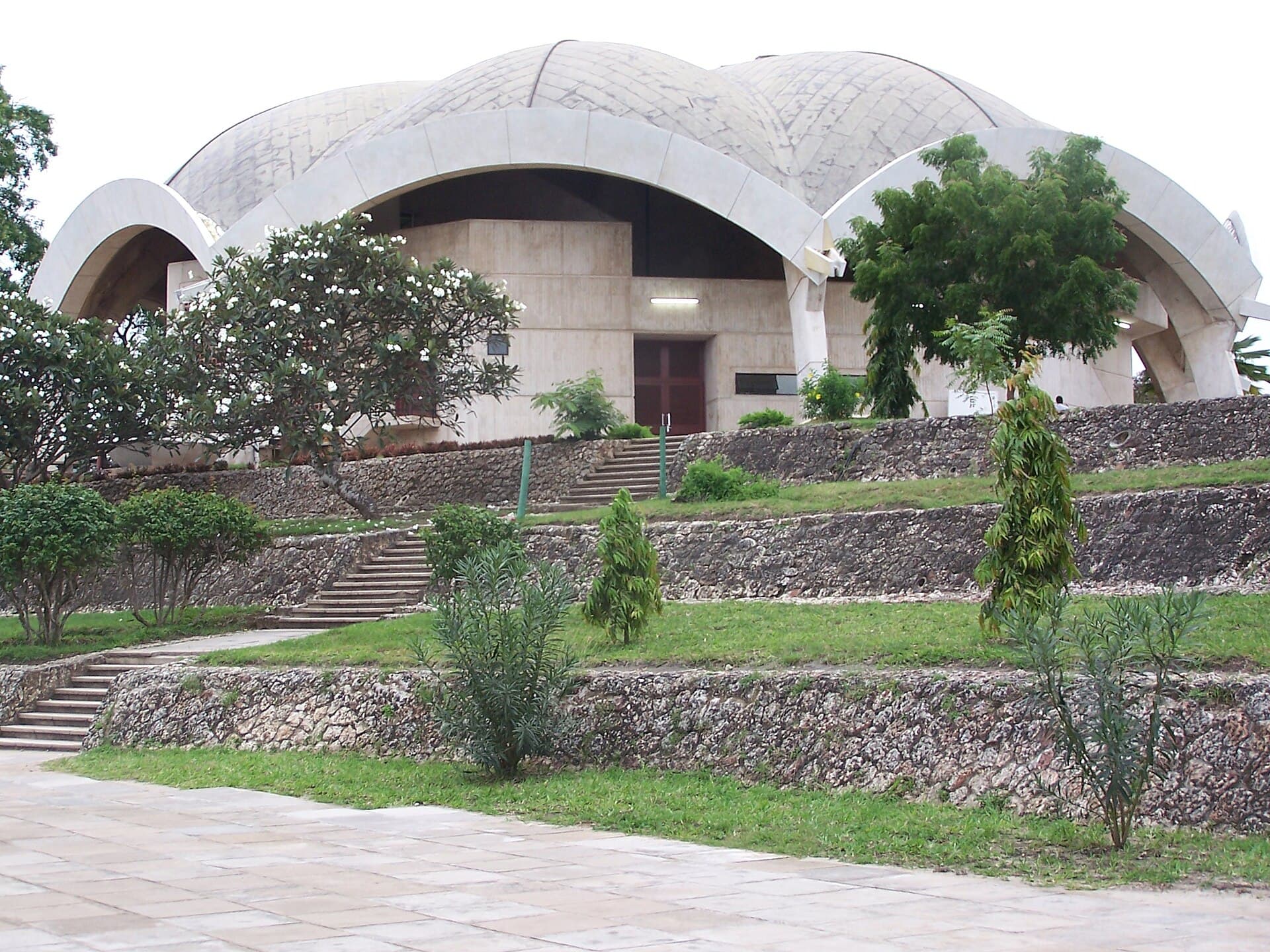
Mlimani sits on what surveyors called observation hill, ground that rises out of the coastal plain west of the city. Its buildings are laid along the contours in terraces faced with coral rag, the porous limestone quarried up and down this coast, so the campus reads as cut into the slope rather than set upon it.
The building that gives the university its public face is Nkrumah Hall, its assembly building, named for Kwame Nkrumah of Ghana. Its roof is a cluster of thin concrete shells springing from wide parabolic ribs, an ambitious piece of 1960s engineering that reads from the lawns below as overlapping domes. It was gazetted as a national heritage site in 2015 and passed into the care of the National Museum of Tanzania. Tanzanians have carried a picture of it for decades: the 500 shilling note of the 2003 series showed a buffalo on the front and Nkrumah Hall on the back, and the note issued from 2011 still puts the university's central hall on its reverse.
Teaching runs through six colleges on the Mlimani campus, covering the social sciences, humanities, natural and applied sciences, engineering, computing and agriculture, alongside schools of law, education, business, economics, journalism, mines and aquatic sciences. Constituent colleges of education at Dar es Salaam and at Mkwawa in Iringa extend it beyond the city. Several former faculties are now universities of their own: agriculture left in 1984 to become Sokoine University of Agriculture, and the medical college at Muhimbili and the faculty of lands and architecture separated in 2006.
The history department was built by Terence Ranger, an Englishman whom the white government of Southern Rhodesia deported in 1963 for his politics and who arrived in Dar es Salaam as its first professor of history. He taught there until 1969, writing Revolt in Southern Rhodesia, 1896 to 1897 while he did, and the group he assembled around him became the school. Isaria Kimambo, the first African professor of history in Tanzania, published A Political History of the Pare of Tanzania, c.1500 to 1900 in 1969 and edited A History of Tanzania with Arnold Temu the same year, drawn from papers given at a departmental conference for schoolteachers in December 1967. Gilbert Gwassa spent 1966 to 1969 recording oral testimony in the southern regions about the Maji Maji rising of 1905; the transcripts he and John Iliffe published in 1974 remain the basis of what is known about it.
Walter Rodney taught history on the Hill in 1966 and 1967, was expelled from Jamaica in October 1968 for his political work there, and returned in 1969, staying until 1974 and rising to associate professor in 1973. How Europe Underdeveloped Africa was written on that second stay: its preface states plainly that the text as a whole was written within Tanzania, thanks Karim Hirji and Henry Mapolu of the university for reading the manuscript, and is signed from Dar es Salaam. It appeared in 1972 from Bogle-L'Ouverture in London and the Tanzania Publishing House in Dar es Salaam, published in both places at once.
The book's method is the school's method. Before Rodney reaches the slave trade or colonial rule he spends a long chapter on what African societies had built by the fifteenth century, one section of it on the stone-building cultures between the Zambezi and the Limpopo. He describes the walls of Great Zimbabwe, the labour and skill they took, and the gold that carried the Mutapa state into Indian Ocean commerce reaching India, Indonesia and China. He also notes what Cecil Rhodes's agents assumed on seeing the ruins, which was that white people must have made them. The ports through which that gold left the continent were the Swahili cities of this coast, Kilwa Kisiwani chief among them, which took the gold harbour of Sofala late in the twelfth century.
Students argued the same case in their own publications. The University Students' African Revolutionary Front, founded in 1967, ran Sunday study groups and brought C. L. R. James and Stokely Carmichael onto the Hill; Yoweri Museveni chaired it throughout his time as a student. Its journal Cheche, a Swahili word for spark, put out its first issue in November 1969 with an article by Rodney on African labour under capitalism. When Issa Shivji, then a law student, used it to argue that Arusha socialism was being run by a bureaucratic class in its own interest, the front and its journal were banned in 1970. A successor, Maji Maji, named for the rising Gwassa was documenting, ran to forty-six issues before it stopped in 1986.
Similar arguments were running elsewhere. At the University of Nairobi three literature scholars asked in 1968 why the syllabus of an African university began in London, and at Legon the University of Ghana built an institute to record African music and oral tradition as primary evidence. Dar es Salaam took the economic corner: not which books to read or which voices to record, but where the wealth had gone.
The playwright Ebrahim Hussein studied French literature and theatre arts at the college and wrote Kinjeketile in 1969, a Swahili play about Kinjikitile Ngwale, the ritual leader whose water medicine gave the Maji Maji rising its name. It is treated as the founding work of modern Tanzanian theatre, and it was written while the historians a few buildings away were recovering the same events from oral testimony. Hussein took a doctorate at Humboldt University in East Berlin, taught theatre at Dar es Salaam from 1975, and left in 1986. Shivji stayed and became the leading legal scholar of his generation, turning his 1970 pamphlet into Class Struggles in Tanzania in 1976.
Museveni took a degree in economics and political science on the Hill in 1970 and has been president of Uganda since 1986. John Garang, later leader of the Sudan People's Liberation Movement and vice-president of Sudan at his death in July 2005, belonged to the same student front. Jakaya Kikwete read economics there, served as president of Tanzania from 2005 to 2015, and is now the university's chancellor. John Magufuli, president from 2015 until his death in 2021, took his degree there in chemistry and mathematics.
Enrolment stands at 38,201 students in the 2026 edition of the Times Higher Education rankings, with about twenty students to each member of academic staff. William Anangisye has been vice-chancellor since December 2017, and the university remains the first-ranked institution in Tanzania and among the leading few in East Africa.
The economics of the place changed sharply after Nyerere left office in 1985. Donor priorities shifted towards primary schooling, revenue fell, senior staff left, and by the 1990s the university was reintroducing the tuition fees it had abolished in 1967. Students fought that decision hard, and the loan scheme that replaced free places is now how most Tanzanians pay for a degree. What survived the retrenchment was the Hill's standing as the reference point of Tanzanian higher education.
Mlimani lies about thirteen kilometres from the centre of Dar es Salaam, off Sam Nujoma Road, half an hour by road outside the worst traffic. It is a working campus, not an attraction: gates are staffed, buildings entered on business, nothing laid on for sightseers. Nkrumah Hall is the thing worth going for, best seen from the terraces below it where the shells of the roof line up against the sky. For the other half of the university's story there is no plaque. The rooms where Rodney lectured are ordinary rooms; the record of what happened in them is in the library.
History
Campus and academics
Rodney, Cheche and the Dar es Salaam school
Scholarship
The university today
Visiting
References and resources
- University of Dar es Salaam: History (official)
- University of Dar es Salaam School of Law (official)
- Wikipedia: University of Dar es Salaam
- Wikipedia: University of East Africa
- Wikipedia: Walter Rodney
- Wikipedia: Julius Nyerere
- Wikipedia: Arusha Declaration
- Wikipedia: Terence Ranger
- Wikipedia: Ebrahim Hussein
- Wikipedia: University Students' African Revolutionary Front
- Wikipedia: Tanzanian shilling
- Scottish Centre for Global History: USARF, Cheche and the University College, Dar es Salaam
- The Conversation: A contested legacy, Julius Nyerere and the 2020 Tanzanian election
- Sustainable Development of Heritage Tanzania: Nkrumah Hall
- Times Higher Education: University of Dar es Salaam