Heritage · Country
Ghana Culture and Heritage
Ghana took its name from a medieval empire and its independence, in 1957, before any other colony in sub-Saharan Africa. This is a guide to the land of the Golden Stool and the coastal slave castles, where funerals are the great gathering and the dead are carried home in coffins shaped like their lives.Written to last.
By Confinity Heritage Editorial · Updated 2026-07-31 · 8-minute readQuiet tools, kept out of the way.
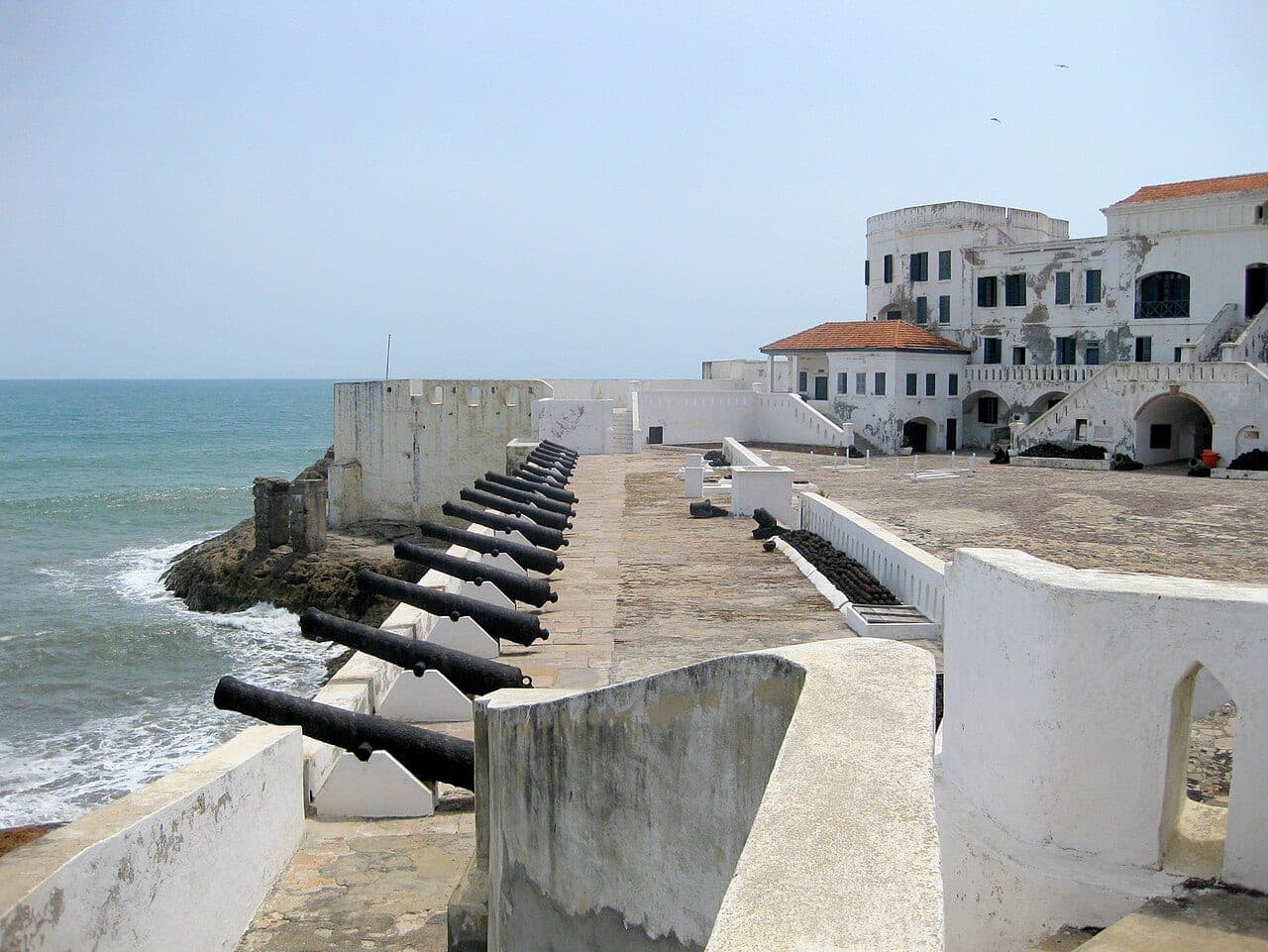
Few nations wear their memory as openly as Ghana. Its very name is an act of remembrance, borrowed at independence from an empire that flourished a thousand years ago and hundreds of miles to the north-west, so that a new African state could stand on an African past rather than a colonial one. Along its coast, a chain of white forts and castles keeps a harder memory: the four centuries in which this shore was drawn into the transatlantic slave trade, and each year descendants of the enslaved cross the Atlantic to walk the cells and pass through the doors their ancestors were forced through.
Inland, memory is a weekly practice. The Ghanaian funeral is among the largest social occasions in the country, a gathering of hundreds in red and black that can eclipse a wedding, and the Ga carpenters of the coast send their dead into the ground in coffins carved into one last portrait of a life. Above the political nation sits an older one, the Asante confederacy, whose people believe the soul of the whole kingdom lives in a golden stool that has never touched the earth.
Ghana occupies a block of West Africa on the Gulf of Guinea, some 238,500 square kilometres bordered by Côte d'Ivoire to the west, Burkina Faso to the north and Togo to the east, with the Atlantic along its whole southern edge. Its terrain climbs from a coastal plain and forest belt to the drier savanna of the north, and it holds Lake Volta, the largest reservoir on the planet by surface area, created when the Akosombo Dam closed across the Volta River in the mid-1960s.
The population passed 34 million by the mid-2020s, spread across sixteen regions and governed from Accra, the capital and largest city. Cocoa and gold, the commodities that named and enriched the coast, remain central to the economy. Ghana is among the most plural states in the region: the Akan are the largest grouping at some 46 per cent, followed by the Mole-Dagbon peoples of the north, the Ewe of the south-east and the Ga-Adangbe of the coast around Accra, each with its own languages, festivals and ways of burying the dead.
Accra. The capital grew from a cluster of Ga fishing towns beside the old European forts and is now the political and commercial heart of the country. Its landmarks are memorials as much as monuments: the Kwame Nkrumah Memorial Park and Mausoleum, resting place of the founding leader; Black Star Square and the Independence Arch of 1957; and the National Museum, home of Akan gold weights and Asante regalia.
Kumasi. The inland capital of the Ashanti Region is the seat of the Asante nation and its king, the Asantehene, whose Manhyia Palace and museum anchor the city. Sacked by British forces in the nineteenth century and later rebuilt, it is the craft heartland where weavers make the kente and stamp the adinkra described below.
Cape Coast. This Central Region town served as capital of the Gold Coast colony until 1877 and is dominated by Cape Coast Castle, whose dungeons held enslaved Africans before shipment; with neighbouring Elmina it is the focus of remembrance pilgrimage.
Elmina. A short drive west, the fishing town holds St George's Castle, built by the Portuguese in 1482 and the oldest surviving European building in sub-Saharan Africa.
Tamale. The principal city of the north is the metropolis of the Dagomba and a centre of Ghanaian Islam, and the gateway to the savanna and the Larabanga mosque.
Sekondi-Takoradi. The twin-city port of the Western Region handles timber and cocoa and, since offshore discoveries in the late 2000s, the country's oil.
The forest and savanna that became Ghana were home to Akan-speaking states long before Europeans reached the coast. Early Akan polities such as Bono drew wealth from the interior goldfields and traded north across the Sahara toward the empires of the Sahel. Around 1701 a ruler named Osei Tutu, guided by the priest Okomfo Anokye, forged an alliance that defeated the regional power of Denkyira at the Battle of Feyiase and bound the Asante states into a single confederacy, its emblem the Golden Stool, said to have descended from the sky to hold the soul of the whole nation. The Asante Empire that grew from it became one of the most powerful states in the region.
Europeans came for the metal. The Portuguese built Elmina in 1482, finding so much gold between the Ankobra and Volta rivers that they named the place after their word for a mine, and the Dutch, English, Danes and others followed, studding the coast with forts. What began as a trade in gold and ivory turned, over the following centuries, into a trade in people.
The transatlantic slave trade is the gravest chapter in this history, and it should be met plainly. The forts and castles built along the coast between 1482 and 1786 became holding stations where captured Africans, seized in the interior and marched to the sea, were confined in dark, airless dungeons before being loaded onto ships. Vast numbers passed through these walls, many dying in the cells and many more in the crossing that followed. The low doorway through which they were taken to the boats is remembered as the Door of No Return. This traffic tore families and whole communities from the continent for generations, and no account of Ghana's heritage is complete without holding that weight.
Britain gradually displaced its rivals and, after a series of wars against the Asante that ended with the exile of the Asantehene Prempeh I and the resistance led by Yaa Asantewaa in 1900, declared the Gold Coast a colony. Kwame Nkrumah founded the Convention People's Party in 1949 with the demand for self-government now, and on 6 March 1957 the Gold Coast became Ghana, the first colony in sub-Saharan Africa to win its independence, helping trigger a wave of liberation across the continent. Nkrumah, a leading theorist of pan-Africanism, was overthrown in 1966 and died in exile in 1972.
English is Ghana's official language, the medium of government and schooling, but a first language for few. Ghanaians speak roughly eighty indigenous languages, a dozen supported by the state. The largest is Akan, with its major dialects Asante Twi, Akuapem Twi and Fante, understood across much of the south; alongside it stand Ewe in the south-east, Ga around Accra, and Dagbani, the language of the Dagomba, in the north, with Nzema, Gonja and Dagaare among many others. Much of the country's oral history is held in these tongues rather than in English.
The name of the country is itself a piece of historical memory. At independence its leaders chose to name the new state after the medieval Ghana Empire, a wealthy trading power of the western Sahel, where in the Soninke language "Ghana" was a royal title meaning something like war-king. The historic empire lay far to the north-west, in what is now Mauritania and Mali, and no part of the modern country fell within it; the name was adopted because Akan oral tradition held that the ancestors of the coastal peoples had migrated south from that older world, reaching past the colonial century to claim a deeper African lineage.
Two cloths carry the country's identity. Kente, called nwentoma or woven cloth in Akan, is a silk and cotton textile woven in narrow strips and sewn into brilliant geometric wraps; Asante tradition traces its origin to the weavers of Bonwire, and every pattern carries a name and a meaning, once reserved for royalty. Its companion is adinkra, a set of stamped symbols the Asante adopted from the Gyaman people, each a compact proverb: Gye Nyame, "except for God", and Sankofa, the backward-looking bird that means "go back and fetch it". Fittingly, the word adinkra means "farewell", and the cloth was first of all a cloth of mourning.
Presiding over Asante identity is the Golden Stool, never sat upon and never allowed to touch the ground, understood to contain the spirit of the living, the dead and the yet unborn. The ceremonial year turns on the Akwasidae festival, held every six weeks, when the Asantehene receives homage in regalia of gold. Other peoples keep their own gatherings: the Ga of Accra celebrate Homowo, which hoots at hunger in memory of a famine survived; and the Ewe hold Hogbetsotso, re-enacting their migration from ancestral Notsie. Binding much of this together is highlife, the guitar-and-horn dance music born on this coast.
Ghana is predominantly Christian, with about 71 per cent of the population professing Christianity in the 2021 census, across Catholic, mainline Protestant, Pentecostal and independent African churches. Islam accounts for roughly 20 per cent and is concentrated in the north, where it arrived centuries ago along the trans-Saharan trade routes; the Larabanga Mosque, a Sudanese-style structure of mud and timber traditionally dated to the fifteenth century, is the oldest in the country. Christian and Muslim Ghanaians generally live together with an ease notable in the region.
 Larabanga is built in the Sudanese mud style, with projecting timbers that are both structure and scaffolding for the replastering. Photograph by Sheihu Salawatia, CC BY-SA 4.0, via Wikimedia Commons.
Beneath and alongside these faiths runs the older stratum of Akan traditional religion, still practised openly and often blended with Christianity. It recognises a supreme creator, Onyame, a host of lesser deities, the abosom, and the earth goddess Asase Yaa. Closest of all are the ancestors, the nsamanfo, thought not to have left the family but to have passed to the world of the spirits from which they watch and guide. They are addressed through the pouring of libation, a few drops of drink offered to the ground with words of respect, and their authority is embodied in the blackened stools of departed chiefs, enshrined as the seats of their spirits.
Nowhere is Ghana's memory culture more visible than at a funeral. The Ghanaian funeral is a major social institution, held on a weekend so the whole extended family and community can travel to attend, and it can run for days, with printed obituary posters, hired canopies, drumming groups and mourners in the colours of grief, deep red and black for close kin. Far from being only an occasion of sorrow, it is the great gathering of the living, and to bury a relative well, at home among their own, is a profound duty.
Larabanga is built in the Sudanese mud style, with projecting timbers that are both structure and scaffolding for the replastering. Photograph by Sheihu Salawatia, CC BY-SA 4.0, via Wikimedia Commons.
Beneath and alongside these faiths runs the older stratum of Akan traditional religion, still practised openly and often blended with Christianity. It recognises a supreme creator, Onyame, a host of lesser deities, the abosom, and the earth goddess Asase Yaa. Closest of all are the ancestors, the nsamanfo, thought not to have left the family but to have passed to the world of the spirits from which they watch and guide. They are addressed through the pouring of libation, a few drops of drink offered to the ground with words of respect, and their authority is embodied in the blackened stools of departed chiefs, enshrined as the seats of their spirits.
Nowhere is Ghana's memory culture more visible than at a funeral. The Ghanaian funeral is a major social institution, held on a weekend so the whole extended family and community can travel to attend, and it can run for days, with printed obituary posters, hired canopies, drumming groups and mourners in the colours of grief, deep red and black for close kin. Far from being only an occasion of sorrow, it is the great gathering of the living, and to bury a relative well, at home among their own, is a profound duty.
 Elmina was built by the Portuguese in 1482 and became a holding place for people sold into slavery. Its doorway to the beach is known as the door of no return, and descendants come back through it deliberately. Photograph by Matti Blume, CC BY-SA 4.0, via Wikimedia Commons.
From this culture the coast has produced one of the world's most striking funerary arts. Around 1950 the Ga carpenter Seth Kane Kwei of Teshie, near Accra, began building figurative coffins, known in Ga as abebuu adekai, each shaped to portray the life or trade of the person inside: a fish for a fisherman, a cocoa pod for a farmer, an aeroplane, a car. The tradition, carried on by apprentices such as the celebrated Paa Joe, spread through the workshops of Teshie and Nungua, and these coffins now sit in the British Museum, the Brooklyn Museum and the Centre Pompidou. Ancestor veneration threads through all of it, so that remembrance is a continuing relationship, renewed at births, marriages and festivals with libation and the naming of the dead.
The coastal castles hold a remembrance of a different order, no longer of individual kin but of a people scattered by force. Cape Coast and Elmina have become sites of memory and pilgrimage for the African diaspora, who come to stand in the dungeons and at the Door of No Return; the American scholar W. E. B. Du Bois spent his last years in Accra and is buried there. In 2019 Ghana declared the Year of Return, marking four hundred years since the first documented enslaved Africans were landed at Jamestown in 1619 and inviting the global African family home under the Akan greeting akwaaba, welcome. Hundreds of thousands answered, and it has continued as a programme encouraging descendants to visit, and in some cases to settle, in the land their ancestors were taken from.
Ghana's records run from stool histories to castle ledgers, and the two describe the same centuries from opposite ends.
The Akan states keep their history in the stool. Each office has a succession of occupants that is recited and re-recited, and the linguist's staff and the drum texts encode the names. Asante, Fante, Ga, Ewe and Dagomba lineages hold their own genealogies, and for most Ghanaian families the elders and the funeral, which is the great gathering, are where descent is stated publicly.
The written record starts on the coast. The Portuguese, Dutch, Danish, Swedish, Brandenburg and British all built forts here, more of them in a shorter stretch of coastline than anywhere in Africa, and each kept accounts. Those ledgers, in Lisbon, The Hague, Copenhagen and London, record the trade in people from Elmina and Cape Coast in commercial terms.
PRAAD, the Public Records and Archives Administration Department, holds the colonial and national series in Accra and in regional offices. Church registers from the Basel, Wesleyan and Catholic missions carry nineteenth and twentieth century vital events, and civil registration is now compulsory though not yet complete.
The most active piece of Ghanaian genealogy is the return. The Year of Return in 2019 brought large numbers of African Americans and Afro-Caribbeans, some with DNA results pointing to the region, and Ghana has since granted citizenship to several hundred of them. It is a family reunion conducted at national scale and largely without documents.
Ghana holds two UNESCO World Heritage sites, and both are records of loss. The first, inscribed in 1979, is the collective listing Forts and Castles, Volta, Greater Accra, Central and Western Regions, which protects the European fortifications built along the coast between 1482 and 1786, Cape Coast and Elmina among them, as monuments to four centuries of gold, ivory and slave trading. The second, inscribed in 1980, is the Asante Traditional Buildings, about ten shrine houses near Kumasi that are the last substantial survivals of Asante court architecture, most of it destroyed in the wars of the nineteenth century; built of timber, bamboo and mud, their walls carry bas-relief adinkra motifs.
These sites are cared for by the Ghana Museums and Monuments Board, while the Asante court maintains its own institutions, including the Manhyia Palace Museum in Kumasi. Preservation here carries an unusual burden, because much of what survives was built to serve the very trade the nation now memorialises, and the work has turned increasingly toward interpreting these places honestly.
The fragility of the coastal monuments has made Ghana a focus for digital preservation. The Zamani Project recorded Cape Coast Castle and Elmina Castle in high-resolution three-dimensional laser scans, producing permanent digital models and panoramic virtual tours that let the sites be studied, restored from an accurate record if damaged, and walked online from anywhere. Ghanaian institutions have also contributed collections and stories to platforms such as Google Arts and Culture, while museums, universities and diaspora organisations digitise archives, oral histories and images, work of particular weight for a heritage whose story is so often held in memory and in scattered objects.
Ghanaian culture reaches far beyond its borders. In music, the highlife that formed on this coast in the early twentieth century, shaped by the bandleader E. T. Mensah and carried abroad by the band Osibisa, evolved through the 1990s rap fusion of hiplife, pioneered by Reggie Rockstone, into the contemporary afrobeats of Sarkodie, Stonebwoy, Amaarae and Black Sherif. Ghanaian letters gave the continent Ama Ata Aidoo and Ayi Kwei Armah, and the country produced Kofi Annan, Secretary-General of the United Nations and a Nobel Peace laureate. Kente has become a near-universal emblem of African identity, worn as graduation stoles worldwide.
Asante gold comes home. In 2024, after 150 years in Britain, items of Asante royal gold and silver regalia looted during the wars of the nineteenth century returned to Kumasi on loan for an exhibition called Homecoming at the Manhyia Palace Museum. The Victoria and Albert Museum lent seventeen objects, the British Museum fifteen and the Fowler Museum seven, many seen in Ghana for the first time in a century and a half.
The Year of Return. Ghana's 2019 invitation to the descendants of the enslaved drew hundreds of thousands of visitors and shifted how the coastal castles are understood, from places of shame to places of reunion.
Coffins in the world's museums. The figurative coffins of Teshie have travelled to the British Museum, the Brooklyn Museum and the Centre Pompidou, a private art of grief become one of Ghana's most recognisable exports.
The castles preserved in code. Through three-dimensional documentation, the fabric of Cape Coast and Elmina now exists as a permanent digital record, insuring against decay the very walls through which so many were taken.
Elmina was built by the Portuguese in 1482 and became a holding place for people sold into slavery. Its doorway to the beach is known as the door of no return, and descendants come back through it deliberately. Photograph by Matti Blume, CC BY-SA 4.0, via Wikimedia Commons.
From this culture the coast has produced one of the world's most striking funerary arts. Around 1950 the Ga carpenter Seth Kane Kwei of Teshie, near Accra, began building figurative coffins, known in Ga as abebuu adekai, each shaped to portray the life or trade of the person inside: a fish for a fisherman, a cocoa pod for a farmer, an aeroplane, a car. The tradition, carried on by apprentices such as the celebrated Paa Joe, spread through the workshops of Teshie and Nungua, and these coffins now sit in the British Museum, the Brooklyn Museum and the Centre Pompidou. Ancestor veneration threads through all of it, so that remembrance is a continuing relationship, renewed at births, marriages and festivals with libation and the naming of the dead.
The coastal castles hold a remembrance of a different order, no longer of individual kin but of a people scattered by force. Cape Coast and Elmina have become sites of memory and pilgrimage for the African diaspora, who come to stand in the dungeons and at the Door of No Return; the American scholar W. E. B. Du Bois spent his last years in Accra and is buried there. In 2019 Ghana declared the Year of Return, marking four hundred years since the first documented enslaved Africans were landed at Jamestown in 1619 and inviting the global African family home under the Akan greeting akwaaba, welcome. Hundreds of thousands answered, and it has continued as a programme encouraging descendants to visit, and in some cases to settle, in the land their ancestors were taken from.
Ghana's records run from stool histories to castle ledgers, and the two describe the same centuries from opposite ends.
The Akan states keep their history in the stool. Each office has a succession of occupants that is recited and re-recited, and the linguist's staff and the drum texts encode the names. Asante, Fante, Ga, Ewe and Dagomba lineages hold their own genealogies, and for most Ghanaian families the elders and the funeral, which is the great gathering, are where descent is stated publicly.
The written record starts on the coast. The Portuguese, Dutch, Danish, Swedish, Brandenburg and British all built forts here, more of them in a shorter stretch of coastline than anywhere in Africa, and each kept accounts. Those ledgers, in Lisbon, The Hague, Copenhagen and London, record the trade in people from Elmina and Cape Coast in commercial terms.
PRAAD, the Public Records and Archives Administration Department, holds the colonial and national series in Accra and in regional offices. Church registers from the Basel, Wesleyan and Catholic missions carry nineteenth and twentieth century vital events, and civil registration is now compulsory though not yet complete.
The most active piece of Ghanaian genealogy is the return. The Year of Return in 2019 brought large numbers of African Americans and Afro-Caribbeans, some with DNA results pointing to the region, and Ghana has since granted citizenship to several hundred of them. It is a family reunion conducted at national scale and largely without documents.
Ghana holds two UNESCO World Heritage sites, and both are records of loss. The first, inscribed in 1979, is the collective listing Forts and Castles, Volta, Greater Accra, Central and Western Regions, which protects the European fortifications built along the coast between 1482 and 1786, Cape Coast and Elmina among them, as monuments to four centuries of gold, ivory and slave trading. The second, inscribed in 1980, is the Asante Traditional Buildings, about ten shrine houses near Kumasi that are the last substantial survivals of Asante court architecture, most of it destroyed in the wars of the nineteenth century; built of timber, bamboo and mud, their walls carry bas-relief adinkra motifs.
These sites are cared for by the Ghana Museums and Monuments Board, while the Asante court maintains its own institutions, including the Manhyia Palace Museum in Kumasi. Preservation here carries an unusual burden, because much of what survives was built to serve the very trade the nation now memorialises, and the work has turned increasingly toward interpreting these places honestly.
The fragility of the coastal monuments has made Ghana a focus for digital preservation. The Zamani Project recorded Cape Coast Castle and Elmina Castle in high-resolution three-dimensional laser scans, producing permanent digital models and panoramic virtual tours that let the sites be studied, restored from an accurate record if damaged, and walked online from anywhere. Ghanaian institutions have also contributed collections and stories to platforms such as Google Arts and Culture, while museums, universities and diaspora organisations digitise archives, oral histories and images, work of particular weight for a heritage whose story is so often held in memory and in scattered objects.
Ghanaian culture reaches far beyond its borders. In music, the highlife that formed on this coast in the early twentieth century, shaped by the bandleader E. T. Mensah and carried abroad by the band Osibisa, evolved through the 1990s rap fusion of hiplife, pioneered by Reggie Rockstone, into the contemporary afrobeats of Sarkodie, Stonebwoy, Amaarae and Black Sherif. Ghanaian letters gave the continent Ama Ata Aidoo and Ayi Kwei Armah, and the country produced Kofi Annan, Secretary-General of the United Nations and a Nobel Peace laureate. Kente has become a near-universal emblem of African identity, worn as graduation stoles worldwide.
Asante gold comes home. In 2024, after 150 years in Britain, items of Asante royal gold and silver regalia looted during the wars of the nineteenth century returned to Kumasi on loan for an exhibition called Homecoming at the Manhyia Palace Museum. The Victoria and Albert Museum lent seventeen objects, the British Museum fifteen and the Fowler Museum seven, many seen in Ghana for the first time in a century and a half.
The Year of Return. Ghana's 2019 invitation to the descendants of the enslaved drew hundreds of thousands of visitors and shifted how the coastal castles are understood, from places of shame to places of reunion.
Coffins in the world's museums. The figurative coffins of Teshie have travelled to the British Museum, the Brooklyn Museum and the Centre Pompidou, a private art of grief become one of Ghana's most recognisable exports.
The castles preserved in code. Through three-dimensional documentation, the fabric of Cape Coast and Elmina now exists as a permanent digital record, insuring against decay the very walls through which so many were taken.
National Overview
Notable Cities
Historical Foundations
Linguistic and Etymological Roots
Cultural Identity
Religion and Spirituality
Remembrance and Mourning Traditions
Tracing a Family in Ghana
Heritage Preservation Efforts
Digital Heritage
Contemporary Cultural Influences
Success Stories
References and resources
- Encyclopaedia Britannica, Ghana: geography, people, economy and national profile.
- Encyclopaedia Britannica, History of Ghana: from the Akan states and the gold trade to independence.
- UNESCO World Heritage Centre, Forts and Castles, Volta, Greater Accra, Central and Western Regions: the 1979 inscription of the coastal fortifications.
- Wikipedia, Asante Traditional Buildings: the 1980 World Heritage shrine houses near Kumasi.
- Wikipedia, Golden Stool: the Sika Dwa Kofi and the founding of the Asante confederacy.
- Wikipedia, Kente cloth and Adinkra symbols: the two great Akan textiles and their meanings.
- Wikipedia, Fantasy coffin: the figurative coffins of the Ga coast and their makers.
- Wikipedia, Year of Return, Ghana 2019: the diaspora homecoming marking 400 years since 1619.
- British Museum, Asante Gold Regalia: the contested objects and the 2024 loan to Kumasi.
- Zamani Project, Cape Coast Castle: three-dimensional documentation and virtual tours of the coastal castles.
- Visit Ghana, Cape Coast Castle: the official heritage-tourism account of the site.