Heritage · Country
Tanzania Culture and Heritage
In the volcanic ash at Laetoli, two upright figures walked side by side 3.6 million years ago and left the oldest human footprints on earth. Tanzania keeps that first memory and every one since, from the Swahili coast to the sober cathedral raised over Zanzibar's slave market.Written to last.
By Confinity Heritage Editorial · Updated 2026-07-31 · 8-minute readQuiet tools, kept out of the way.
Around 3.6 million years ago, at a place now called Laetoli in northern Tanzania, a light fall of volcanic ash was dampened by rain, and across it walked at least two members of the species Australopithecus afarensis, upright, one behind the other. A further eruption sealed their tracks, and in 1978 the palaeontologist Mary Leakey and her team uncovered a trail almost 27 metres long holding roughly 70 impressions: the oldest unequivocal evidence of bipedal walking in the human lineage (Leakey Foundation). A short distance away, the floor of Olduvai Gorge has yielded fossils and tools from key phases of our origins. No country on earth holds a longer memory of what it is to be human.
Between that first footprint and the present lies a nation of extraordinary plurality: roughly 120 ethnic groups bound together by Swahili, a coastline that traded with Arabia, Persia, India and China for a thousand years, and the islands of Zanzibar, where the same ocean that carried spices and porcelain also carried enslaved people through a market whose site is now a cathedral floor.
The United Republic of Tanzania occupies 947,303 square kilometres of East Africa, fronting the Indian Ocean (Encyclopaedia Britannica). It borders Kenya, Uganda, Rwanda, Burundi, the Democratic Republic of the Congo, Zambia, Malawi and Mozambique, and its edges touch three of Africa's largest lakes, Victoria, Tanganyika and Nyasa. Its northern plains rise to Mount Kilimanjaro, at 5,895 metres the highest point in Africa.
The population passed 61.7 million at the 2022 census and is estimated near 67 million today (Wikipedia). Around 120 ethnic groups live within the country, none a majority; the Sukuma near Lake Victoria are the largest, alongside the Chagga, Nyamwezi, Haya, Maasai and coastal Swahili. Dodoma, in the central highlands, has been the official capital since the 1990s, though Dar es Salaam remains the largest city and principal port. The state unites mainland Tanganyika and the semi-autonomous archipelago of Zanzibar, which keeps its own president and legislature.
Dar es Salaam. The name means "abode of peace" in Arabic, and the city grew from a fishing village the Sultan of Zanzibar developed in the 1860s. It became the mainland capital under colonial rule and remains the economic engine and largest port. Its National Museum holds the Olduvai finds, including the skull of Paranthropus boisei.
 Kilwa Kisiwani controlled the gold trade out of Africa's interior and minted its own coins, and Ibn Battuta called it one of the finest cities he had seen. Photograph by Ron Van Oers, CC BY-SA 3.0 IGO, via Wikimedia Commons.
Dodoma. Chosen for its central position when the government sought a capital away from the coast, Dodoma sits on a plateau about 480 kilometres inland. It houses the National Assembly, and the surrounding region holds the Kondoa rock-art sites, among the oldest and most extensive galleries of painting in Africa.
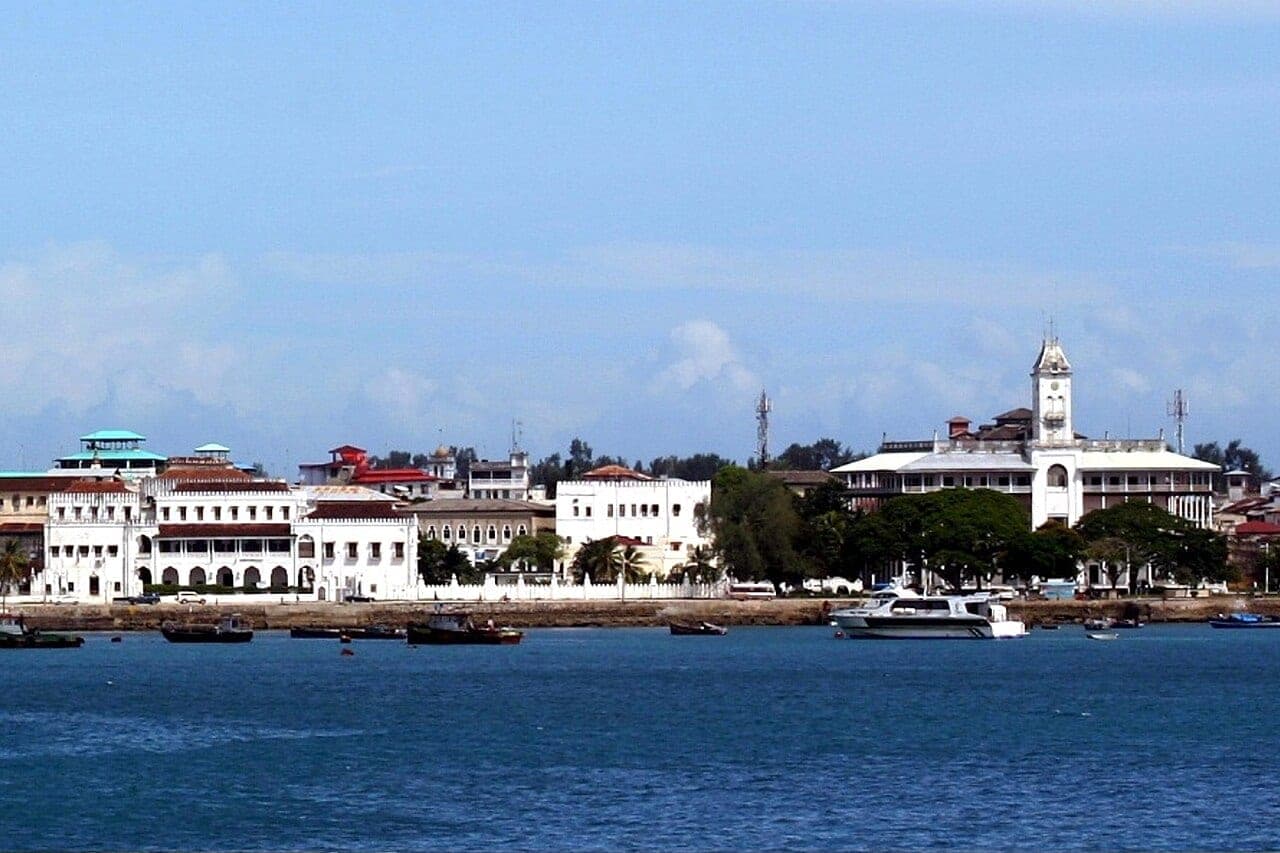
Zanzibar City and Stone Town. The historic core of Zanzibar City, Stone Town, is a UNESCO World Heritage Site inscribed in 2000 for its coral-stone houses, carved doors, mosques and the fusion of African, Arab, Indian and European forms that defines Swahili urban culture (UNESCO). It was the seat of the Omani sultanate, the centre of the clove and ivory trades, and the site of the East African slave market, and its craftsmen made the great studded wooden doors found nowhere else.
Arusha. Beneath Mount Meru in the north, Arusha is the safari gateway to the Serengeti, Ngorongoro and Kilimanjaro. The Arusha Declaration of 1967 set out Tanzania's socialist path, and the city now hosts the headquarters of the East African Community.
Human origins run deeper here than anywhere. At Olduvai Gorge, within the Ngorongoro Conservation Area, Louis and Mary Leakey recovered in 1959 the skull nicknamed "Nutcracker Man," and later the remains of Homo habilis, with stone tools spanning nearly two million years (Wikipedia). Nearby at Laetoli lay the ash-preserved footprints of Australopithecus afarensis, the earliest firm trace of our upright walk, making northern Tanzania a foundational archive of human evolution.
Kilwa Kisiwani controlled the gold trade out of Africa's interior and minted its own coins, and Ibn Battuta called it one of the finest cities he had seen. Photograph by Ron Van Oers, CC BY-SA 3.0 IGO, via Wikimedia Commons.
Dodoma. Chosen for its central position when the government sought a capital away from the coast, Dodoma sits on a plateau about 480 kilometres inland. It houses the National Assembly, and the surrounding region holds the Kondoa rock-art sites, among the oldest and most extensive galleries of painting in Africa.
Zanzibar City and Stone Town. The historic core of Zanzibar City, Stone Town, is a UNESCO World Heritage Site inscribed in 2000 for its coral-stone houses, carved doors, mosques and the fusion of African, Arab, Indian and European forms that defines Swahili urban culture (UNESCO). It was the seat of the Omani sultanate, the centre of the clove and ivory trades, and the site of the East African slave market, and its craftsmen made the great studded wooden doors found nowhere else.
Arusha. Beneath Mount Meru in the north, Arusha is the safari gateway to the Serengeti, Ngorongoro and Kilimanjaro. The Arusha Declaration of 1967 set out Tanzania's socialist path, and the city now hosts the headquarters of the East African Community.
Human origins run deeper here than anywhere. At Olduvai Gorge, within the Ngorongoro Conservation Area, Louis and Mary Leakey recovered in 1959 the skull nicknamed "Nutcracker Man," and later the remains of Homo habilis, with stone tools spanning nearly two million years (Wikipedia). Nearby at Laetoli lay the ash-preserved footprints of Australopithecus afarensis, the earliest firm trace of our upright walk, making northern Tanzania a foundational archive of human evolution.
 Olduvai Gorge cuts through two million years of sediment, which is why so much of what is known about early humans was found in this one valley. Photograph by David Berkowitz, CC BY 2.0, via Wikimedia Commons.
Over the following millennia the region was settled by successive peoples: Cushitic-speaking herders from the north, Khoisan-related hunter-gatherers whose descendants include the Hadza and Sandawe with their click languages, and, from around two thousand years ago, Bantu-speaking farmers and ironworkers who came to form the majority, joined later by Nilotic pastoralists such as the Maasai. On the coast, contact across the Indian Ocean produced the Swahili civilisation, a Bantu culture shaped by Islam and by trade with Arabia, Persia, India and China.
That trade reached its height at Kilwa. The island town of Kilwa Kisiwani, south of modern Dar es Salaam, flourished between the 13th and 14th centuries as the leading port of the East African gold trade, minting its own coinage and dealing in gold, ivory and imported Persian and Chinese wares (UNESCO). The traveller Ibn Battuta, who visited in 1331, judged it among the most beautiful cities he had seen. Its Great Mosque and the cliff-top palace of Husuni Kubwa stand today with the ruins of neighbouring Songo Mnara, until Portuguese arrival in the 16th century began the decline.
Power on the coast passed in time to Oman. In the early 19th century the Omani ruler Sayyid Said moved his capital to Zanzibar, drawn by a plantation economy: from 1828 his subjects were required to grow cloves, worked by enslaved Africans seized from the interior. This chapter must be set down plainly. Zanzibar became the hub of the East African and Indian Ocean slave trade; at its height enslaved people made up a majority of the archipelago's own population, tens of thousands passed through its market each year, and vast numbers died on the marches from the interior (Wikipedia). Under British pressure, and after the campaigning of David Livingstone and others, the Frere Treaty of 1873 closed the open market in Stone Town; the legal status of slavery ended in 1897, and slavery was finally abolished, including for concubines, in 1909.
Colonial rule followed. The mainland became German East Africa, where the Maji Maji rising of 1905 to 1907 was crushed with a famine that killed perhaps a quarter of a million people. After the First World War it passed to Britain as the League of Nations mandate of Tanganyika, administered from 1920 to 1961. Nationalism gathered under Julius Nyerere, a teacher whose party, TANU, won independence without war: Tanganyika became free on 9 December 1961 and Zanzibar on 10 December 1963 (Britannica). A revolution overturned the Zanzibar sultanate in January 1964, and on 26 April 1964 the two states joined to form Tanzania, with Nyerere as first president.
Tanzania's national language is Swahili, or Kiswahili, a Bantu language enriched over centuries by Arabic, Persian and other loanwords through Indian Ocean contact. Nyerere made it the language of national unity, and it now binds together a country of some 120 mother tongues; English continues in higher courts, diplomacy and higher education (Wikipedia). The word Swahili comes from the Arabic sawahil, "of the coasts."
The country's name is a deliberate compound, coined at the 1964 union from the first syllables of its two parts: Tan from Tanganyika and Zan from Zanzibar, with the ending -ia. Tanganyika took its name from the great lake on its western border, while Zanzibar derives from the Persian Zangbar, "coast of the Zanj," the term outsiders used for the Black peoples of East Africa. In the far north the Hadza and Sandawe still speak click languages unrelated to Bantu, among the oldest linguistic layers on the continent.
Tanzanian material culture is renowned above all for the ebony sculpture of the Makonde people of the south and the Mozambique border. Makonde carvers work blackwood into ancestral figures, spirit forms called shetani, and interlocking columns of bodies called ujamaa, or "tree of life," a genealogy rising from the ancestors (Britannica). In painting, the Tingatinga style, founded in Dar es Salaam by Edward Saidi Tingatinga before his death in 1972, fills bright enamel canvases with animals, birds and village scenes, and has become one of the most recognisable schools of contemporary African art.
On the coast and islands the defining art is taarab, sung poetry set to an orchestra that blends African rhythm with Arab, Indian and Persian melody; the Zanzibari singer Siti binti Saad, active in the 1920s and 1930s, was its first great voice and the first East African woman to record. Inland, each culture keeps its signature: the Maasai with beadwork, red shuka cloth and cattle-centred life; the Chagga with irrigation and coffee on Kilimanjaro's slopes; the Sukuma with their dance societies. The shared table runs from the maize staple ugali and grilled nyama choma to the coast's spiced pilau, biryani and coconut curries, the fruit of Zanzibar's standing as the "spice islands."
Tanzania is divided fairly evenly between Christianity and Islam, with African traditional beliefs practised throughout and often alongside both. The mainland holds large Roman Catholic, Lutheran, Anglican and Pentecostal communities, the legacy of German and British missions and of energetic local churches. Islam predominates on the coast and overwhelmingly on Zanzibar, almost entirely Muslim, where Islamic learning reaches back more than a thousand years and the year turns through Ramadan, Eid and the new-year rites of Mwaka Kogwa at Makunduchi.
Beneath and within these faiths lies the older conviction that the dead remain present. In the traditional religions of Tanzania's peoples, ancestors are not absent but watchful, addressed at births, harvests and times of trouble, and honoured with offerings and libations. For millions this coexists without contradiction with church or mosque, so that a Christian or Muslim family may still keep the observances that acknowledge the forebears who watch over the household.
Across Tanzania's cultures, death draws the whole community, and the funeral is among the most important of social duties. In the practice known in Swahili as matanga, relatives, neighbours and colleagues gather at the bereaved home for a mourning period, commonly three days and often longer, to sit with the family, share food, sing and pray. Attendance is a duty of belonging: to stay away is to fail the family and, in traditional understanding, the ancestors themselves. Many peoples hold that the deceased must be carried home to be buried among their kin, and where ancestral traditions are strong a further ceremony, months or a year later, marks the passage of the dead into the company of the ancestors, from where they guide the living.
On the Muslim coast and islands the rites follow Islamic law with care and speed. The body is washed (ghusl), wrapped in a plain white shroud (kafan), and buried as soon as possible, ideally within a day, laid to face Mecca. The community offers the funeral prayer, salat al-janazah; formal mourning lasts three days, a widow keeps the longer waiting period, the iddah, of four months and ten days, and gatherings on the third, seventh and fortieth days bring relatives together for Quran recitation. Christian Tanzanians hold night vigils and church services before burial, keeping the same rhythm of requiem and later memorial that joins Christian liturgy to the African insistence that the dead are mourned before the whole community.
The nation also carries a public site of memory that speaks to the gravest of its histories. Where the Stone Town slave market once stood, the Universities' Mission to Central Africa raised Christ Church Cathedral in 1879, its altar set on the spot where enslaved people had been whipped for sale, and dark stones in the floor recalling the holding pits below (UNESCO CIPDH). Nearby, a sculpture of chained figures in a pit and a heritage centre opened in 2016 keep the memory of the trade and address its modern forms. It is remembrance in the fullest sense: a wound marked, named and kept before the eyes of the living.
Tanzanian records are German, then British, then reorganised by a policy that moved most of the country.
Missionary registers, Lutheran, Moravian, Anglican and Catholic, are the earliest written vital records and reach back to the nineteenth century. German East Africa's administrative files are largely in Berlin; British Tanganyika's are split between Dar es Salaam and Kew. Civil registration exists and has never been complete outside the towns.
The Swahili coast has the older written record. Kilwa, Bagamoyo and the coastal towns kept Arabic chronicles and sharia court registers, and the coastal families' genealogies connect to Oman, the Hadhramaut and the Comoros.
Zanzibar is a separate archive and a separate history. The Zanzibar National Archives hold the sultanate's records, including the clove plantation and slave trade documentation, and the revolution of 1964 killed thousands and drove out much of the Arab and South Asian population, whose records left with them.
The policy that reshaped the mainland record was ujamaa. Between 1973 and 1976 the government moved something like five million people into planned villages, in many cases compulsorily. Families were relocated away from ancestral land and burial sites, and the village registers created in the process replaced whatever local records existed. For a great many Tanzanian families the question of where their grandparents are buried has an answer that is not where the family now lives.
Clan and age-set knowledge, among the Chagga, Sukuma, Haya and others, carries the rest.
Tanzania holds seven UNESCO World Heritage sites spanning the natural, cultural and human past. The Ngorongoro Conservation Area, inscribed in 1979, is a rare mixed site, valued for its caldera and wildlife, for the Olduvai and Laetoli fossils, and for the living pastoral culture of the Maasai who share the land (UNESCO). The Serengeti (1981) protects the migration of well over a million wildebeest and zebra; Selous Game Reserve, now largely Nyerere National Park, was inscribed in 1982; and Kilimanjaro National Park (1987) guards Africa's highest mountain.
The cultural sites carry the country's deeper memory. The ruins of Kilwa Kisiwani and Songo Mnara (1981) preserve the medieval Swahili trading world in coral and lime; the Stone Town of Zanzibar (2000) protects a living Swahili city and, within it, the site of memory at the former slave market; and the Kondoa Rock-Art Sites (2006), hundreds of painted shelters in the central highlands, record two thousand years of life, from hunter-gatherers to herders (Wikipedia). Custody is shared among the Antiquities Division, the parks authorities and local communities, with partners such as the World Monuments Fund helping the coast's coral-stone monuments withstand the sea.
Tanzania's heritage is steadily coming online. The National Museum publishes collection and visitor information digitally, and the Ngorongoro Conservation Area Authority maintains public records of the Olduvai and Laetoli discoveries (NCAA). The Laetoli footprints, too fragile to leave exposed, have been cast and three-dimensionally scanned, so the trail can be studied without disturbing the originals reburied for their protection.
Swahili, unusually for an African language, has a growing digital life: supported across major translation and voice platforms, taught in online courses worldwide, and documented in extensive dictionaries and corpora, a reflection of its role as a lingua franca for perhaps 100 million speakers across East and Central Africa. Diaspora communities and cultural bodies maintain online archives of taarab recordings, Makonde and Tingatinga art, and oral histories, extending a heritage once carried only by voice and hand.
Tanzanian culture travels far beyond its borders. Among the young, the coastal traditions of taarab and the mainland's dance bands have given way to Bongo Flava, a home-grown blend of hip-hop, R&B and Swahili melody whose stars, among them Diamond Platnumz, draw audiences across the continent. Swahili itself is an export: a working language of the African Union, taught on several continents, and the source of globally used words such as hakuna matata, "no worries," and safari, "journey."
The landscapes are a story the world knows by heart: Kilimanjaro, the Serengeti migration and the Ngorongoro Crater are among the most recognised images of Africa. Abroad, the Tanzanian diaspora keeps taarab evenings, Eid and Christmas gatherings, and the cooking of the coast as acts of belonging.
A language that united a nation. Where many post-colonial states fractured along ethnic lines, Tanzania made Swahili the shared tongue of government, school and street, so that some 120 peoples could speak as equals. Its rise from a coastal trade language to one of continental institutions is counted among the most successful nation-building projects in modern Africa.
A market turned into a place of memory. The former slave market of Stone Town was not paved over and forgotten. The cathedral raised on its ground, the memorial sculpture beside it, and a heritage centre keep the trade visible and name it honestly, so visitors confront the history where it happened (Anglican Communion News).
The footprints, protected for the future. After the Laetoli trail began to suffer from exposure and root growth, conservators reburied the prints under engineered protective layers, preserving the 3.6-million-year-old record while casts and scans let the world see them without harm.
A living monument shared with its people. The Ngorongoro Conservation Area pioneered a model in which a World Heritage landscape is neither emptied of its people nor closed to wildlife, letting Maasai pastoralists graze their cattle within it, an experiment in holding natural, cultural and human heritage in one place.
Olduvai Gorge cuts through two million years of sediment, which is why so much of what is known about early humans was found in this one valley. Photograph by David Berkowitz, CC BY 2.0, via Wikimedia Commons.
Over the following millennia the region was settled by successive peoples: Cushitic-speaking herders from the north, Khoisan-related hunter-gatherers whose descendants include the Hadza and Sandawe with their click languages, and, from around two thousand years ago, Bantu-speaking farmers and ironworkers who came to form the majority, joined later by Nilotic pastoralists such as the Maasai. On the coast, contact across the Indian Ocean produced the Swahili civilisation, a Bantu culture shaped by Islam and by trade with Arabia, Persia, India and China.
That trade reached its height at Kilwa. The island town of Kilwa Kisiwani, south of modern Dar es Salaam, flourished between the 13th and 14th centuries as the leading port of the East African gold trade, minting its own coinage and dealing in gold, ivory and imported Persian and Chinese wares (UNESCO). The traveller Ibn Battuta, who visited in 1331, judged it among the most beautiful cities he had seen. Its Great Mosque and the cliff-top palace of Husuni Kubwa stand today with the ruins of neighbouring Songo Mnara, until Portuguese arrival in the 16th century began the decline.
Power on the coast passed in time to Oman. In the early 19th century the Omani ruler Sayyid Said moved his capital to Zanzibar, drawn by a plantation economy: from 1828 his subjects were required to grow cloves, worked by enslaved Africans seized from the interior. This chapter must be set down plainly. Zanzibar became the hub of the East African and Indian Ocean slave trade; at its height enslaved people made up a majority of the archipelago's own population, tens of thousands passed through its market each year, and vast numbers died on the marches from the interior (Wikipedia). Under British pressure, and after the campaigning of David Livingstone and others, the Frere Treaty of 1873 closed the open market in Stone Town; the legal status of slavery ended in 1897, and slavery was finally abolished, including for concubines, in 1909.
Colonial rule followed. The mainland became German East Africa, where the Maji Maji rising of 1905 to 1907 was crushed with a famine that killed perhaps a quarter of a million people. After the First World War it passed to Britain as the League of Nations mandate of Tanganyika, administered from 1920 to 1961. Nationalism gathered under Julius Nyerere, a teacher whose party, TANU, won independence without war: Tanganyika became free on 9 December 1961 and Zanzibar on 10 December 1963 (Britannica). A revolution overturned the Zanzibar sultanate in January 1964, and on 26 April 1964 the two states joined to form Tanzania, with Nyerere as first president.
Tanzania's national language is Swahili, or Kiswahili, a Bantu language enriched over centuries by Arabic, Persian and other loanwords through Indian Ocean contact. Nyerere made it the language of national unity, and it now binds together a country of some 120 mother tongues; English continues in higher courts, diplomacy and higher education (Wikipedia). The word Swahili comes from the Arabic sawahil, "of the coasts."
The country's name is a deliberate compound, coined at the 1964 union from the first syllables of its two parts: Tan from Tanganyika and Zan from Zanzibar, with the ending -ia. Tanganyika took its name from the great lake on its western border, while Zanzibar derives from the Persian Zangbar, "coast of the Zanj," the term outsiders used for the Black peoples of East Africa. In the far north the Hadza and Sandawe still speak click languages unrelated to Bantu, among the oldest linguistic layers on the continent.
Tanzanian material culture is renowned above all for the ebony sculpture of the Makonde people of the south and the Mozambique border. Makonde carvers work blackwood into ancestral figures, spirit forms called shetani, and interlocking columns of bodies called ujamaa, or "tree of life," a genealogy rising from the ancestors (Britannica). In painting, the Tingatinga style, founded in Dar es Salaam by Edward Saidi Tingatinga before his death in 1972, fills bright enamel canvases with animals, birds and village scenes, and has become one of the most recognisable schools of contemporary African art.
On the coast and islands the defining art is taarab, sung poetry set to an orchestra that blends African rhythm with Arab, Indian and Persian melody; the Zanzibari singer Siti binti Saad, active in the 1920s and 1930s, was its first great voice and the first East African woman to record. Inland, each culture keeps its signature: the Maasai with beadwork, red shuka cloth and cattle-centred life; the Chagga with irrigation and coffee on Kilimanjaro's slopes; the Sukuma with their dance societies. The shared table runs from the maize staple ugali and grilled nyama choma to the coast's spiced pilau, biryani and coconut curries, the fruit of Zanzibar's standing as the "spice islands."
Tanzania is divided fairly evenly between Christianity and Islam, with African traditional beliefs practised throughout and often alongside both. The mainland holds large Roman Catholic, Lutheran, Anglican and Pentecostal communities, the legacy of German and British missions and of energetic local churches. Islam predominates on the coast and overwhelmingly on Zanzibar, almost entirely Muslim, where Islamic learning reaches back more than a thousand years and the year turns through Ramadan, Eid and the new-year rites of Mwaka Kogwa at Makunduchi.
Beneath and within these faiths lies the older conviction that the dead remain present. In the traditional religions of Tanzania's peoples, ancestors are not absent but watchful, addressed at births, harvests and times of trouble, and honoured with offerings and libations. For millions this coexists without contradiction with church or mosque, so that a Christian or Muslim family may still keep the observances that acknowledge the forebears who watch over the household.
Across Tanzania's cultures, death draws the whole community, and the funeral is among the most important of social duties. In the practice known in Swahili as matanga, relatives, neighbours and colleagues gather at the bereaved home for a mourning period, commonly three days and often longer, to sit with the family, share food, sing and pray. Attendance is a duty of belonging: to stay away is to fail the family and, in traditional understanding, the ancestors themselves. Many peoples hold that the deceased must be carried home to be buried among their kin, and where ancestral traditions are strong a further ceremony, months or a year later, marks the passage of the dead into the company of the ancestors, from where they guide the living.
On the Muslim coast and islands the rites follow Islamic law with care and speed. The body is washed (ghusl), wrapped in a plain white shroud (kafan), and buried as soon as possible, ideally within a day, laid to face Mecca. The community offers the funeral prayer, salat al-janazah; formal mourning lasts three days, a widow keeps the longer waiting period, the iddah, of four months and ten days, and gatherings on the third, seventh and fortieth days bring relatives together for Quran recitation. Christian Tanzanians hold night vigils and church services before burial, keeping the same rhythm of requiem and later memorial that joins Christian liturgy to the African insistence that the dead are mourned before the whole community.
The nation also carries a public site of memory that speaks to the gravest of its histories. Where the Stone Town slave market once stood, the Universities' Mission to Central Africa raised Christ Church Cathedral in 1879, its altar set on the spot where enslaved people had been whipped for sale, and dark stones in the floor recalling the holding pits below (UNESCO CIPDH). Nearby, a sculpture of chained figures in a pit and a heritage centre opened in 2016 keep the memory of the trade and address its modern forms. It is remembrance in the fullest sense: a wound marked, named and kept before the eyes of the living.
Tanzanian records are German, then British, then reorganised by a policy that moved most of the country.
Missionary registers, Lutheran, Moravian, Anglican and Catholic, are the earliest written vital records and reach back to the nineteenth century. German East Africa's administrative files are largely in Berlin; British Tanganyika's are split between Dar es Salaam and Kew. Civil registration exists and has never been complete outside the towns.
The Swahili coast has the older written record. Kilwa, Bagamoyo and the coastal towns kept Arabic chronicles and sharia court registers, and the coastal families' genealogies connect to Oman, the Hadhramaut and the Comoros.
Zanzibar is a separate archive and a separate history. The Zanzibar National Archives hold the sultanate's records, including the clove plantation and slave trade documentation, and the revolution of 1964 killed thousands and drove out much of the Arab and South Asian population, whose records left with them.
The policy that reshaped the mainland record was ujamaa. Between 1973 and 1976 the government moved something like five million people into planned villages, in many cases compulsorily. Families were relocated away from ancestral land and burial sites, and the village registers created in the process replaced whatever local records existed. For a great many Tanzanian families the question of where their grandparents are buried has an answer that is not where the family now lives.
Clan and age-set knowledge, among the Chagga, Sukuma, Haya and others, carries the rest.
Tanzania holds seven UNESCO World Heritage sites spanning the natural, cultural and human past. The Ngorongoro Conservation Area, inscribed in 1979, is a rare mixed site, valued for its caldera and wildlife, for the Olduvai and Laetoli fossils, and for the living pastoral culture of the Maasai who share the land (UNESCO). The Serengeti (1981) protects the migration of well over a million wildebeest and zebra; Selous Game Reserve, now largely Nyerere National Park, was inscribed in 1982; and Kilimanjaro National Park (1987) guards Africa's highest mountain.
The cultural sites carry the country's deeper memory. The ruins of Kilwa Kisiwani and Songo Mnara (1981) preserve the medieval Swahili trading world in coral and lime; the Stone Town of Zanzibar (2000) protects a living Swahili city and, within it, the site of memory at the former slave market; and the Kondoa Rock-Art Sites (2006), hundreds of painted shelters in the central highlands, record two thousand years of life, from hunter-gatherers to herders (Wikipedia). Custody is shared among the Antiquities Division, the parks authorities and local communities, with partners such as the World Monuments Fund helping the coast's coral-stone monuments withstand the sea.
Tanzania's heritage is steadily coming online. The National Museum publishes collection and visitor information digitally, and the Ngorongoro Conservation Area Authority maintains public records of the Olduvai and Laetoli discoveries (NCAA). The Laetoli footprints, too fragile to leave exposed, have been cast and three-dimensionally scanned, so the trail can be studied without disturbing the originals reburied for their protection.
Swahili, unusually for an African language, has a growing digital life: supported across major translation and voice platforms, taught in online courses worldwide, and documented in extensive dictionaries and corpora, a reflection of its role as a lingua franca for perhaps 100 million speakers across East and Central Africa. Diaspora communities and cultural bodies maintain online archives of taarab recordings, Makonde and Tingatinga art, and oral histories, extending a heritage once carried only by voice and hand.
Tanzanian culture travels far beyond its borders. Among the young, the coastal traditions of taarab and the mainland's dance bands have given way to Bongo Flava, a home-grown blend of hip-hop, R&B and Swahili melody whose stars, among them Diamond Platnumz, draw audiences across the continent. Swahili itself is an export: a working language of the African Union, taught on several continents, and the source of globally used words such as hakuna matata, "no worries," and safari, "journey."
The landscapes are a story the world knows by heart: Kilimanjaro, the Serengeti migration and the Ngorongoro Crater are among the most recognised images of Africa. Abroad, the Tanzanian diaspora keeps taarab evenings, Eid and Christmas gatherings, and the cooking of the coast as acts of belonging.
A language that united a nation. Where many post-colonial states fractured along ethnic lines, Tanzania made Swahili the shared tongue of government, school and street, so that some 120 peoples could speak as equals. Its rise from a coastal trade language to one of continental institutions is counted among the most successful nation-building projects in modern Africa.
A market turned into a place of memory. The former slave market of Stone Town was not paved over and forgotten. The cathedral raised on its ground, the memorial sculpture beside it, and a heritage centre keep the trade visible and name it honestly, so visitors confront the history where it happened (Anglican Communion News).
The footprints, protected for the future. After the Laetoli trail began to suffer from exposure and root growth, conservators reburied the prints under engineered protective layers, preserving the 3.6-million-year-old record while casts and scans let the world see them without harm.
A living monument shared with its people. The Ngorongoro Conservation Area pioneered a model in which a World Heritage landscape is neither emptied of its people nor closed to wildlife, letting Maasai pastoralists graze their cattle within it, an experiment in holding natural, cultural and human heritage in one place.
National Overview
Notable Cities
Historical Foundations
Linguistic and Etymological Roots
Cultural Identity
Religion and Spirituality
Remembrance and Mourning Traditions
Tracing a Family in Tanzania
Heritage Preservation Efforts
Digital Heritage
Contemporary Cultural Influences
Success Stories
References and resources
- Encyclopaedia Britannica: Tanzania. Geography, population, history and society.
- Encyclopaedia Britannica: Julius Nyerere. Independence, the 1964 union and Ujamaa.
- UNESCO World Heritage Centre: Stone Town of Zanzibar. The 2000 inscription of the Swahili city.
- UNESCO World Heritage Centre: Kilwa Kisiwani and Songo Mnara. The medieval Indian Ocean trading ruins.
- UNESCO World Heritage Centre: Ngorongoro Conservation Area. The mixed site of crater, wildlife, Olduvai and Maasai life.
- Christ Church Cathedral and the former slave market (UNESCO CIPDH Sites of Memory). The Stone Town site of memory.
- Wikipedia: Slavery in Zanzibar. The East African and Indian Ocean slave trade and its abolition.
- Wikipedia: Kondoa Rock-Art Sites. The central-highland painted shelters.
- The Leakey Foundation: Laetoli footprints. The earliest evidence of upright walking.
- Ngorongoro Conservation Area Authority: Laetoli Footprints. Official record of the site and its protection.