Heritage · Landmark
Great Zimbabwe: History, Architecture & Legacy
Great Zimbabwe is the largest ancient stone city in sub-Saharan Africa, a medieval capital of mortarless granite walls raised by the ancestors of the Shona people. The modern nation took its name from the site, the Shona words for houses of stone.Written to last.
By Confinity Heritage Editorial · Updated 2026-07-31 · 7-minute readQuiet tools, kept out of the way.
On a granite plateau in southeastern Zimbabwe, a short drive from the town of Masvingo, stand the largest stone ruins in sub-Saharan Africa. Great Zimbabwe was a city of the living before it was a ruin. At its height it was home to more than ten thousand people and served as the capital of a kingdom that drew gold and ivory from across the plateau and sent them down to the Indian Ocean. Its walls were raised without mortar, granite block set on granite block, and many of them still stand after seven centuries of weather (UNESCO).
The site matters twice over. It is one of the great achievements of medieval African building, and it is also a record of how that achievement was denied. For most of a century, early European visitors and a settler government insisted the walls were too fine to be African work and assigned them to Phoenicians, Arabs, or the biblical Queen of Sheba. Archaeology settled the question long ago. The city was built by the ancestors of the Shona people, and the nation that surrounds it now carries its name. This page keeps both facts on the record: what was made here, and what was said about who made it.
People farmed and herded on this plateau for centuries before the first walls went up. The builders were an Iron Age, Bantu-speaking population, ancestors of today's Shona, most likely descended from the earlier Gokomere culture (Wikipedia). Construction in stone began around the eleventh century, and by the thirteenth Great Zimbabwe had become the capital of a kingdom that controlled the gold-bearing country between the Zambezi and the Limpopo (Britannica).
Its wealth came from trade. Cattle were the measure of local standing, but the kingdom's reach depended on gold and ivory carried east to the Swahili coast, to ports such as Sofala and Kilwa, and from there into the Indian Ocean network that linked Africa to Arabia, Persia, India, and China. Excavations at the site have turned up Chinese porcelain, Persian and Syrian glass and ceramics, and coins from the coastal trading towns, physical proof of how far these connections ran (UNESCO). At its peak in the fourteenth century the city may have held more than ten thousand residents, with the ruling elite living inside the stone enclosures and the great majority in mud-and-timber housing spread across the surrounding valley.
The decline came in the fifteenth century. By about 1450 the capital was largely abandoned (UNESCO). The reasons were probably layered rather than single: a population that had outgrown what the land and water around it could support, exhausted soils and cleared woodland, and shifting trade routes that drew power northward to the successor state of Mutapa and, later, west toward Torwa and Butua. Great Zimbabwe was not destroyed. Its people moved, and the kingdom's centre of gravity moved with them, leaving the walls to the grass and to the keepers of memory.
Great Zimbabwe spreads across nearly eight hundred hectares and falls into three main areas (UNESCO). The oldest is the Hill Complex, a cluster of enclosures woven between the granite boulders of a steep hill and occupied from roughly the eleventh to the thirteenth centuries. Set among natural rock and reached by narrow stepped passages, it is generally read as the ceremonial and spiritual heart of the city and the seat of its rulers.
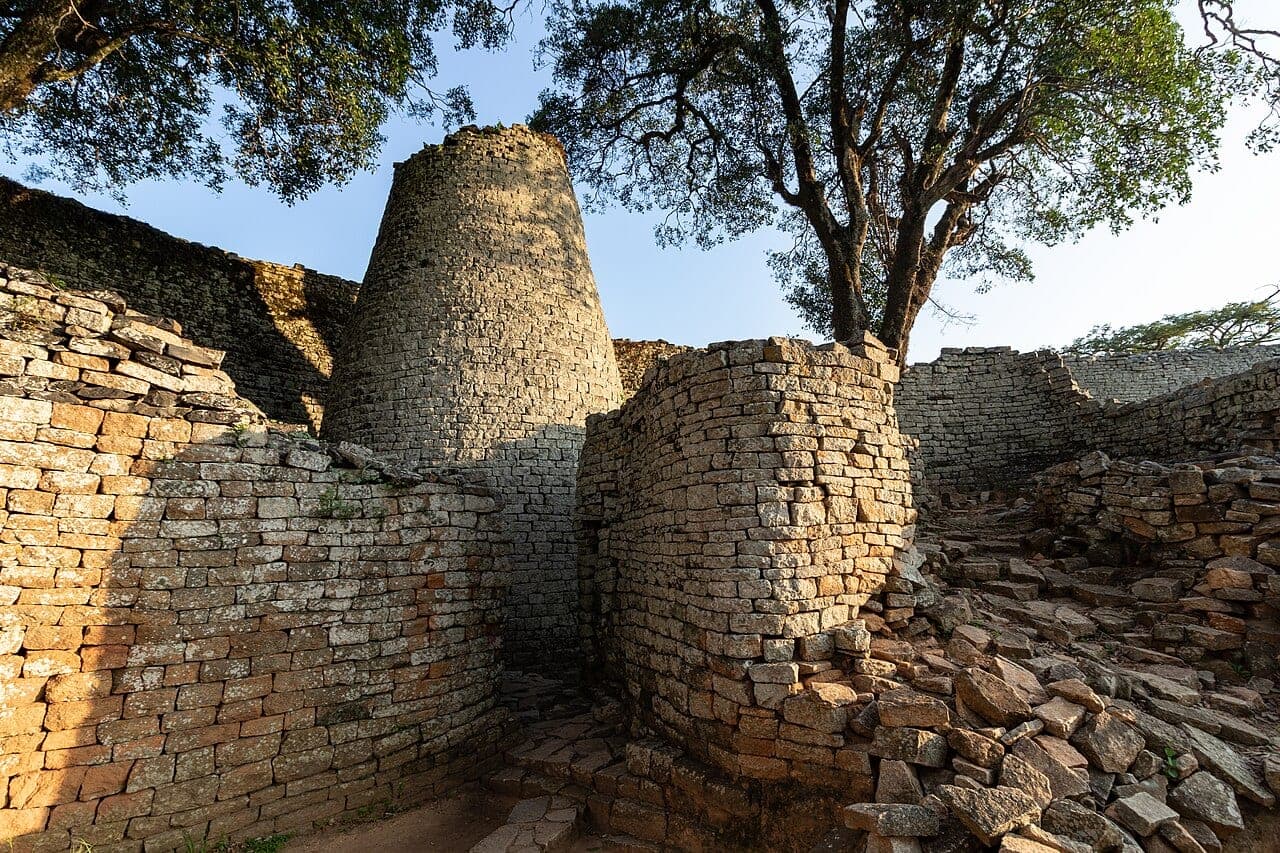
 The Great Enclosure wall runs some 250 metres and stands eleven metres at its highest, laid dry without mortar. Photograph by Andrew Moore, CC BY-SA 2.0, via Wikimedia Commons.
Below the hill lies the Great Enclosure, built between the thirteenth and fifteenth centuries and the most famous structure on the site. Its outer wall runs some 250 metres around, rises as high as about 11 metres, and is several metres thick at the base, which makes it the largest single ancient structure in sub-Saharan Africa (Wikipedia). Inside it stands the Conical Tower, a solid rounded pillar of stone roughly 5.5 metres across and 9 metres high, built for no structural purpose that anyone has identified. It is often read as a symbolic grain bin, an image of the good harvest and of a ruler's duty to provide, though its exact meaning was never written down and cannot now be recovered.
What unites the whole site is the walling. The builders worked in dry stone, without mortar, using granite that splits naturally into flat slabs when the rock is heated and cooled, a process called exfoliation. Masons trimmed these slabs and laid them in even courses so that the walls hold by weight and balance alone. The finest sections curve gently, taper as they rise, and carry decorative bands of chevron and herringbone patterning worked into the stone. No two walls are identical, and the quality of the coursing improves over time, evidence of a craft refined across generations rather than imported ready-made.
From the site came its most enduring emblem. Carved on the tops of tall soapstone monoliths were birds, part raptor and part human in their stylised features, of which eight are known. These Zimbabwe Birds most likely represented the ancestors or the spiritual authority of the rulers (Wikipedia). Several were carried off during the colonial period, and their return and reassembly became a long story in itself. Today a Zimbabwe Bird appears on the national flag and the coat of arms, the country's chosen symbol of continuity with the people who cut it.
Great Zimbabwe was never lost to the people who lived around it; local Shona knowledge is what guided outsiders to it. What changed in the nineteenth century was who told the story. When the German geologist Karl Mauch reached the ruins in 1871, he refused to credit them to Africans and proposed instead that he had found Ophir, the gold land of the Bible, and a copy of the palace of the Queen of Sheba built with the help of King Solomon (World History Encyclopedia). In 1891 the British antiquarian James Theodore Bent, backed by the Royal Geographical Society and by Cecil Rhodes, read the stone birds as Phoenician work and concluded that a northern, non-African people had raised the walls.
The bias had physical consequences. Working for Rhodes's British South Africa Company, Richard Nicklin Hall dug at the site in the early 1900s and removed archaeological deposits up to several metres deep in the name of restoration, stripping out exactly the medieval African layers that could have dated the place and destroying evidence that can never be recovered (World History Encyclopedia).
The correction came from within the discipline. In 1905 and 1906 the archaeologist David Randall-MacIver carried out the first controlled excavation and reported that the finds were African in character and medieval in date, with nothing to support an ancient foreign origin (Wikipedia). In 1929 Gertrude Caton-Thompson, using careful stratigraphy in undisturbed deposits, confirmed the conclusion and announced to the British Association that the ruins were of African origin and medieval date (Wikipedia). Among professional archaeologists the question was effectively closed by 1930.
Politics kept it open far longer. Under the white-minority Rhodesian government, and especially after Ian Smith's regime declared independence in 1965, official publications and museum guides were pressed to omit or dispute the African authorship of Great Zimbabwe. Archaeologists who stated the evidence plainly, among them Peter Garlake, met censorship and pressure, and some left the country (World History Encyclopedia). When the country won independence in 1980 it answered the long denial by naming itself for the site. The word Zimbabwe comes from the Shona for houses of stone, and the birds that colonial collectors had carried away became the emblem of the new state (Britannica).
Great Zimbabwe was inscribed on the UNESCO World Heritage List in 1986, recognised as the physical record of the Shona civilisation between the eleventh and fifteenth centuries (UNESCO). It is managed by National Museums and Monuments of Zimbabwe. The main threats are those of any exposed stone site: walls loosened by water and root growth, sections weakened or collapsed where early clearance disturbed their footings, erosion of the unwalled ground where most of the population once lived, and the pressure of visitors on fragile fabric. The damage done by Hall's early digging is permanent, and some of the reconstruction carried out in the colonial period followed guesswork rather than the original coursing, which complicates the work of later conservators. Ongoing care focuses on stabilising walls, controlling drainage and vegetation, and recording the site so that what survives is documented against future loss.
The ruins lie about 30 kilometres southeast of Masvingo and are reached by road from Harare or Bulawayo. A visit usually begins with the climb to the Hill Complex, where the enclosures thread between the boulders and the view opens across the valley, then moves down to the Great Enclosure and the Conical Tower, and on through the Valley Ruins where daily life was lived. A site museum holds several of the Zimbabwe Birds, including examples returned from abroad. Visitors are asked to treat the place as many Zimbabweans regard it: an ancestral site that still carries meaning for the descendants of the people who built it.
The Great Enclosure wall runs some 250 metres and stands eleven metres at its highest, laid dry without mortar. Photograph by Andrew Moore, CC BY-SA 2.0, via Wikimedia Commons.
Below the hill lies the Great Enclosure, built between the thirteenth and fifteenth centuries and the most famous structure on the site. Its outer wall runs some 250 metres around, rises as high as about 11 metres, and is several metres thick at the base, which makes it the largest single ancient structure in sub-Saharan Africa (Wikipedia). Inside it stands the Conical Tower, a solid rounded pillar of stone roughly 5.5 metres across and 9 metres high, built for no structural purpose that anyone has identified. It is often read as a symbolic grain bin, an image of the good harvest and of a ruler's duty to provide, though its exact meaning was never written down and cannot now be recovered.
What unites the whole site is the walling. The builders worked in dry stone, without mortar, using granite that splits naturally into flat slabs when the rock is heated and cooled, a process called exfoliation. Masons trimmed these slabs and laid them in even courses so that the walls hold by weight and balance alone. The finest sections curve gently, taper as they rise, and carry decorative bands of chevron and herringbone patterning worked into the stone. No two walls are identical, and the quality of the coursing improves over time, evidence of a craft refined across generations rather than imported ready-made.
From the site came its most enduring emblem. Carved on the tops of tall soapstone monoliths were birds, part raptor and part human in their stylised features, of which eight are known. These Zimbabwe Birds most likely represented the ancestors or the spiritual authority of the rulers (Wikipedia). Several were carried off during the colonial period, and their return and reassembly became a long story in itself. Today a Zimbabwe Bird appears on the national flag and the coat of arms, the country's chosen symbol of continuity with the people who cut it.
Great Zimbabwe was never lost to the people who lived around it; local Shona knowledge is what guided outsiders to it. What changed in the nineteenth century was who told the story. When the German geologist Karl Mauch reached the ruins in 1871, he refused to credit them to Africans and proposed instead that he had found Ophir, the gold land of the Bible, and a copy of the palace of the Queen of Sheba built with the help of King Solomon (World History Encyclopedia). In 1891 the British antiquarian James Theodore Bent, backed by the Royal Geographical Society and by Cecil Rhodes, read the stone birds as Phoenician work and concluded that a northern, non-African people had raised the walls.
The bias had physical consequences. Working for Rhodes's British South Africa Company, Richard Nicklin Hall dug at the site in the early 1900s and removed archaeological deposits up to several metres deep in the name of restoration, stripping out exactly the medieval African layers that could have dated the place and destroying evidence that can never be recovered (World History Encyclopedia).
The correction came from within the discipline. In 1905 and 1906 the archaeologist David Randall-MacIver carried out the first controlled excavation and reported that the finds were African in character and medieval in date, with nothing to support an ancient foreign origin (Wikipedia). In 1929 Gertrude Caton-Thompson, using careful stratigraphy in undisturbed deposits, confirmed the conclusion and announced to the British Association that the ruins were of African origin and medieval date (Wikipedia). Among professional archaeologists the question was effectively closed by 1930.
Politics kept it open far longer. Under the white-minority Rhodesian government, and especially after Ian Smith's regime declared independence in 1965, official publications and museum guides were pressed to omit or dispute the African authorship of Great Zimbabwe. Archaeologists who stated the evidence plainly, among them Peter Garlake, met censorship and pressure, and some left the country (World History Encyclopedia). When the country won independence in 1980 it answered the long denial by naming itself for the site. The word Zimbabwe comes from the Shona for houses of stone, and the birds that colonial collectors had carried away became the emblem of the new state (Britannica).
Great Zimbabwe was inscribed on the UNESCO World Heritage List in 1986, recognised as the physical record of the Shona civilisation between the eleventh and fifteenth centuries (UNESCO). It is managed by National Museums and Monuments of Zimbabwe. The main threats are those of any exposed stone site: walls loosened by water and root growth, sections weakened or collapsed where early clearance disturbed their footings, erosion of the unwalled ground where most of the population once lived, and the pressure of visitors on fragile fabric. The damage done by Hall's early digging is permanent, and some of the reconstruction carried out in the colonial period followed guesswork rather than the original coursing, which complicates the work of later conservators. Ongoing care focuses on stabilising walls, controlling drainage and vegetation, and recording the site so that what survives is documented against future loss.
The ruins lie about 30 kilometres southeast of Masvingo and are reached by road from Harare or Bulawayo. A visit usually begins with the climb to the Hill Complex, where the enclosures thread between the boulders and the view opens across the valley, then moves down to the Great Enclosure and the Conical Tower, and on through the Valley Ruins where daily life was lived. A site museum holds several of the Zimbabwe Birds, including examples returned from abroad. Visitors are asked to treat the place as many Zimbabweans regard it: an ancestral site that still carries meaning for the descendants of the people who built it.
History
Architecture