Heritage · University
University of Dhaka: History and Overview
Founded in 1921 in the buildings of a provincial capital that had just been abolished, the University of Dhaka is the oldest and most prominent university in Bangladesh. Its students led the Language Movement of 1952, and the killings of 21 February that year are remembered by the Shaheed Minar on its campus and, since 2000, by International Mother Language Day around the world.Written to last.
By Confinity Heritage Editorial · 2026-08-25 · 8-minute readQuiet tools, kept out of the way.
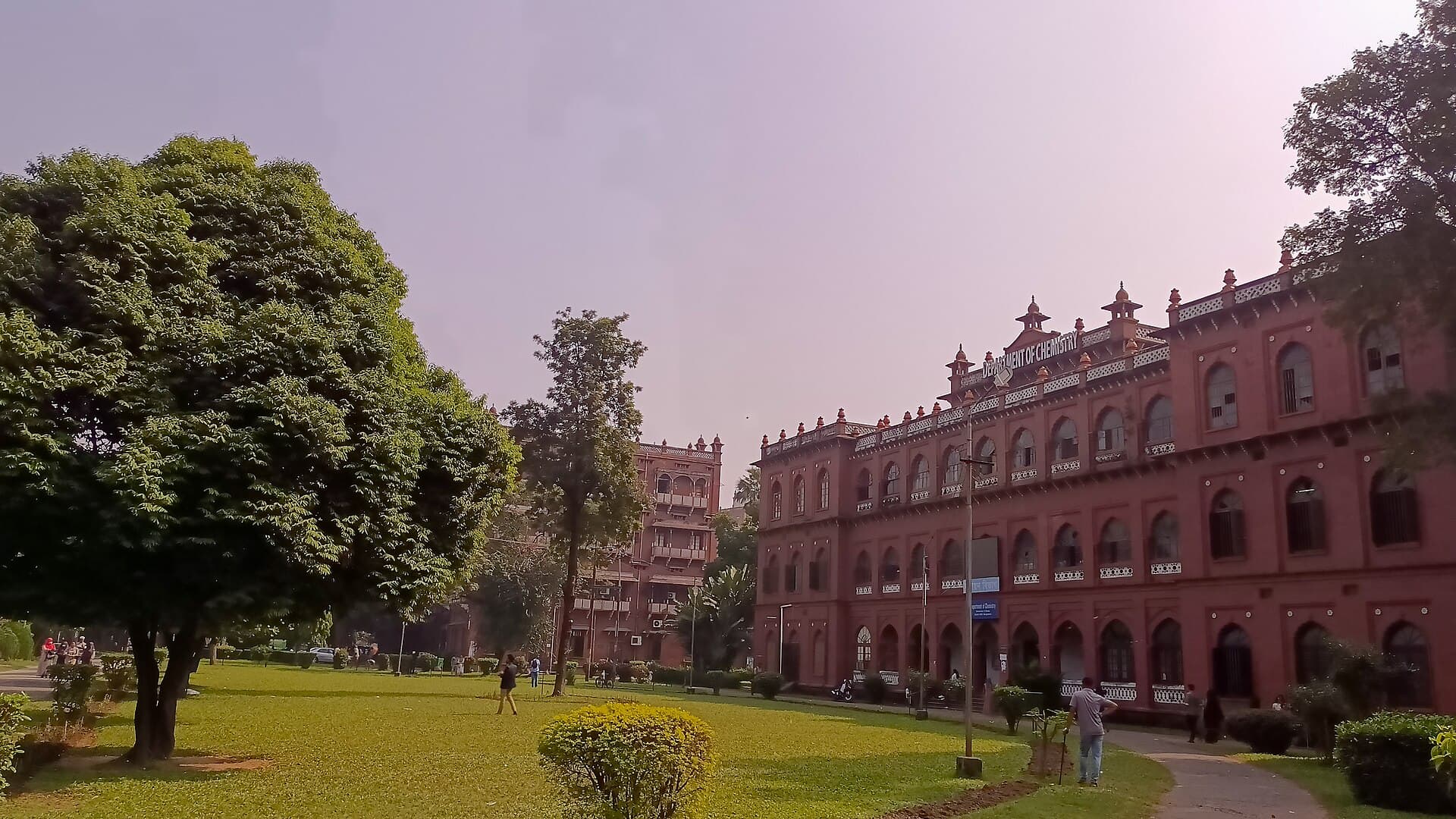
The University of Dhaka opened on 1 July 1921 in a city that had just lost the capital it briefly held. It is the oldest university in Bangladesh and the most consequential: the place where the country's language, its independence and much of its politics were argued into being. Its science faculty took over Curzon Hall, the red brick hall of Mughal arches raised for the short-lived provincial government of Eastern Bengal and Assam.
One date explains the institution better than any other. On 21 February 1952 its students defied a ban on public gatherings and marched for the right to have their language recognised by the state; police fired on them and several were killed. The monument raised where they fell stands at the edge of the campus, and the day they chose is now the day the world sets aside for mother tongues.
The university exists because of a partition that was made and then unmade. In 1905 the British divided Bengal, creating the province of Eastern Bengal and Assam with Dhaka as its capital and requisitioning 600 acres in Ramna for its government. Opposition brought the annulment in 1911, and the city lost its province after six years. A delegation of Dhaka notables led by Nawab Sir Salimullah asked the Viceroy, Lord Hardinge, on his visit in January 1912 for a university in its place.
The Dacca University Act of 1920 received assent that March, and teaching began on 1 July 1921 with three faculties, twelve departments, three halls of residence and 847 students. Higher education in eastern Bengal had run until then through the University of Calcutta, whose affiliated Dhaka College gave its buildings and library to the new university. The place was modelled on Oxford and Cambridge, its students attached to residential halls, and in its early decades it carried the epithet "the Oxford of the East", a phrase of its era rather than a claim it needs now.
Partition in 1947 put Dhaka in East Pakistan and made the campus the centre of Bengali political life, through the strikes of 1948 and the autonomy movements of 1966 and 1969. When war came in 1971 it came here first: the plan for Operation Searchlight, begun on the night of 25 March, required that Dhaka University be occupied and searched. Troops shelled the residential halls, Jagannath Hall and Rokeya Hall among them, and killed teachers in their flats on Fuller Road; ten died in the first hours. On 14 December, two days before the surrender, more than two hundred Bengali professors, doctors, journalists and writers were taken from their homes by the Al-Badr militia and the army and executed at Rayerbazar and Mirpur; many taught here, and Bangladesh marks the date as Martyred Intellectuals Day. The university counts fourteen teachers, twenty-six employees and hundreds of students among the war's dead.
No national movement since has bypassed the campus: its students were central to the uprising that ended military rule in 1990 and to the protests of July 2024, which closed the university and ended in the resignation of the prime minister.
Curzon Hall came first. Lord Curzon laid its foundation stone in February 1904, for a planned town hall and college library, and it was completed in 1908. Arcades of cusped arches and domed pavilions in red brick make it a Mughal revival by way of the Raj, and it passed to the university in 1921 as the home of the science faculty, which it remains, the teaching botanical garden in its grounds.
North of Shahbagh, in front of the Arts Building, stands Aparajeyo Bangla, "Unvanquished Bengal", Syed Abdullah Khalid's group of three concrete figures, unveiled on 16 December 1979 after years of interruption. The Teacher-Student Centre, the TSC, built in 1961 to a design by the Greek planner Constantinos Doxiadis, remains the social heart of the campus, with Madhur Canteen, the tea shop of student politics, close by. The Shaheed Minar stands at the northern edge beside Dhaka Medical College.
When Pakistan was created in 1947, Bengali speakers made up 44 million of the new state's 69 million people. In 1948 the government declared Urdu the sole state language. Students here struck that March, and when Muhammad Ali Jinnah restated the policy to a convocation at Curzon Hall on 24 March, a student stood up to tell him it could not be.
The question reopened when Prime Minister Khawaja Nazimuddin defended the Urdu-only policy in January 1952. An all-party language action committee formed at the university's Bar Library Hall on 31 January and called a protest for 21 February; the government answered with Section 144, banning all gatherings. At nine that morning students assembled on the university premises anyway. Police ringed the campus, fired tear gas at the gate and arrested those who tried to leave. The students moved toward the East Bengal Legislative Assembly to put their demand to the legislators, and the police opened fire. Abul Barkat, Rafiq Uddin Ahmed, Abdus Salam and Abdul Jabbar were among those killed. The government admitted three dead and sixty-nine injured and censored the reporting; more were shot the next day, when a police volley struck a funeral procession on Nawabpur Road.
On the night of 23 February students of Dhaka Medical College built a monument on the ground where the shooting had happened, working through the curfew and finishing at dawn under a handwritten sign reading Shaheed Smritistombho, the memorial of the martyrs. Police pulled it down three days later. The present Shaheed Minar, designed by the sculptor Hamidur Rahman with Novera Ahmed, was inaugurated on 21 February 1963 by Hasina Begum, the mother of Abul Barkat. Pakistani forces demolished it in 1971, independent Bangladesh rebuilt it, and it was enlarged in 1983. Its half-circle of columns is read as a mother standing with her fallen sons, and copies stand in schoolyards across the country and in Bengali neighbourhoods abroad.
The movement carried its point: Bengali was granted state-language status in 1956, and the argument that began over a language ended fifteen years later in a separate country. In 1998 two Bengalis in Vancouver, Rafiqul Islam and Abdus Salam, wrote to the United Nations proposing a day for mother tongues, dated 21 February. Bangladesh carried the proposal to UNESCO, where the 1999 General Conference approved it, and International Mother Language Day has been observed worldwide since 2000. Every year before dawn people walk barefoot to the Shaheed Minar with flowers. A student protest over the right to be taught in one's own language became the day the world marks every language at risk of being lost.
Satyendra Nath Bose joined the new university in 1921 as a reader in physics. In 1924, while teaching at Dhaka, he derived Planck's radiation law by counting identical particles in a new way, without recourse to classical physics. A journal turned it down, so he posted it to Albert Einstein, who translated it into German himself and submitted it on his behalf. The statistics carry both names, and the particles obeying them are called bosons.
Muhammad Yunus took his BA in economics here in 1960 and his MA in 1961, then founded Grameen Bank and a model of small unsecured lending that spread to about a hundred countries, sharing the Nobel Peace Prize in 2006. Sheikh Mujibur Rahman, who led the movement that made Bangladesh, entered the law department after partition and was expelled in 1949 for supporting a protest by the university's employees; the order stood for sixty-one years, until the university withdrew it in 2010.
The university remains the oldest and most prestigious in the country, and the highest-placed Bangladeshi institution in the international rankings. Official figures record thirteen faculties, eighty-three departments and twenty residential halls, with about 37,000 students on the main campus and close to 2,000 teachers. Entry is by national competitive examination and heavily oversubscribed, and its graduates fill the civil service, the judiciary, the press and the newer universities. February still belongs to the language: the Ekushey Book Fair runs all month on the Bangla Academy grounds beside the campus.
The campus lies in Shahbagh and Ramna in central Dhaka, and its roads are public thoroughfares, so it is walked through rather than entered. Curzon Hall and its gardens are the set piece. The Shaheed Minar is open ground at any hour, and most solemn before dawn on 21 February when the barefoot processions arrive; the TSC and Aparajeyo Bangla lie a few minutes north. Suhrawardy Udyan, where Pakistani forces surrendered on 16 December 1971, sits at the campus edge. Lectures and examinations run through the buildings, so the public routes and the open ground around the Shaheed Minar are where a visit belongs.