Heritage · University
University of Nairobi: History and Overview
Kenya's oldest and largest university began as the Royal Technical College of East Africa in 1956 and became a full university in 1970. In 1968 three of its literature scholars wrote the memo that put African literature and orature at the centre of the syllabus, a founding document of postcolonial literary studies.Written to last.
By Confinity Heritage Editorial · 2026-08-25 · 8-minute readQuiet tools, kept out of the way.
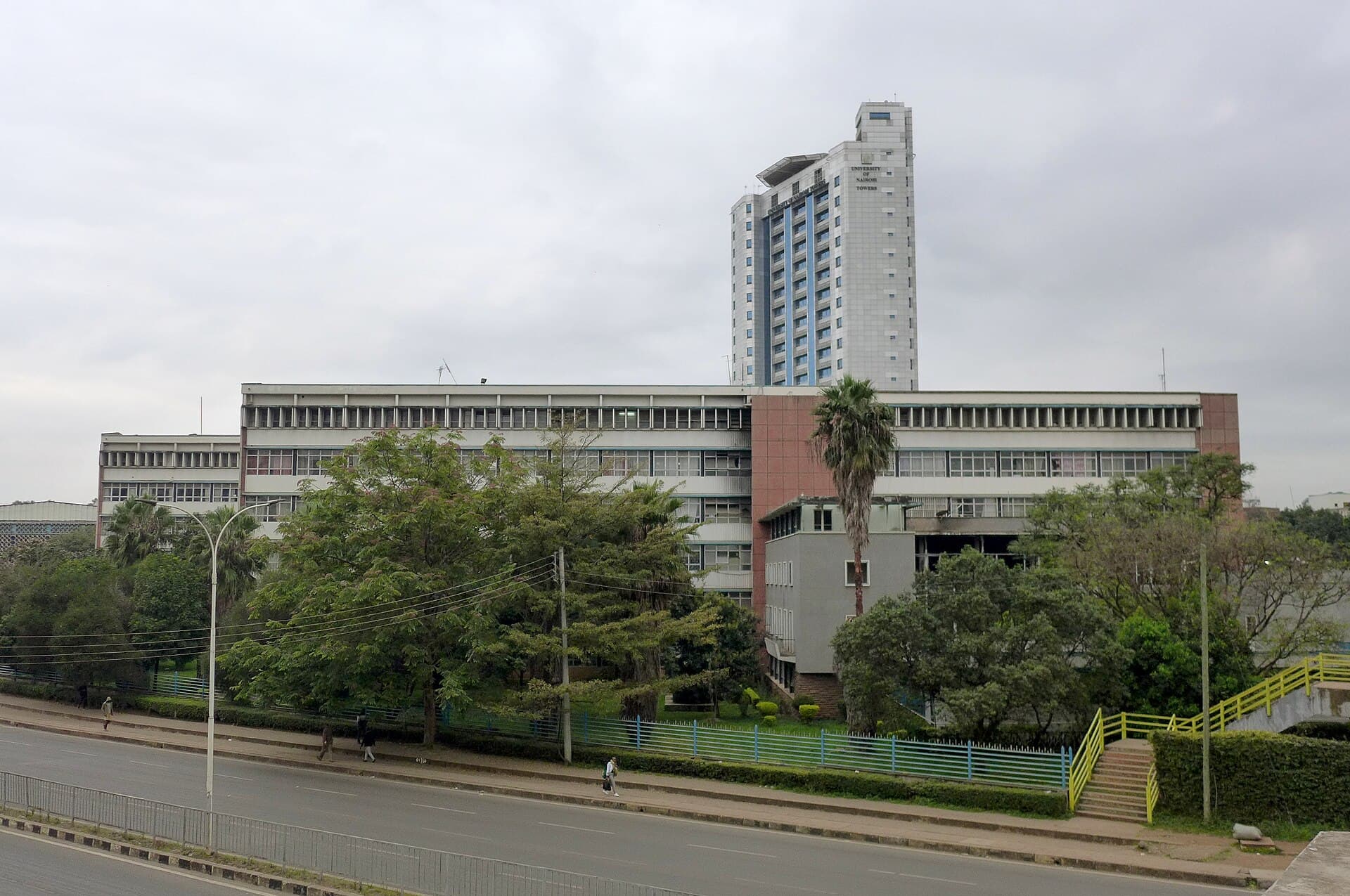
The University of Nairobi is Kenya's oldest and largest university, and its main campus sits in the middle of the capital, along Harry Thuku Road at the northern edge of the central business district. The place has carried four names in seventy years: the Royal Technical College of East Africa, Royal College Nairobi, University College Nairobi, and finally, in 1970, the University of Nairobi, the first university of independent Kenya. Each renaming marks a stage in the region's movement from colony to nation, and the institution's own account of itself reads as a compressed history of East African higher education.
For an archive concerned with memory, one moment in that history stands apart. In 1968 three scholars on the Nairobi faculty wrote a short memo asking why a university in the heart of Africa still organised the study of literature around England. The document they produced changed the syllabus in Nairobi and then changed how literature is taught far beyond it. A university is, among other things, a decision about which memory gets handed on, and Nairobi made that decision unusually visible.
The institution began as the Royal Technical College of East Africa, which admitted its first students in April 1956 on the present main campus site. Its founding drew together two efforts at once: a colonial plan for a technical college serving the whole of British East Africa, and the funds raised by East Africa's Asian communities for a college in memory of Mahatma Gandhi, which were folded into the project through the Gandhi Memorial Academy. The college taught engineering, commerce and the trades to students from across the region.
Within a few years the ambition grew from technical training to full university education. In 1961 the institution became Royal College Nairobi and began preparing students for degrees of the University of London, the standard arrangement for new colleges across the late colonial world. Then, in 1963, it joined a federal experiment: the University of East Africa, a single regional university built from three constituent colleges, Makerere in Kampala, Nairobi, and Dar es Salaam in Tanzania. The Nairobi college took the name University College Nairobi in 1964 and awarded degrees of the federal university rather than London's. For a few years the three colleges shared one academic destiny, and the staff and students who moved among them seeded friendships and rivalries that still shape East African intellectual life.
The federation was always going to strain against three new nations' desire for universities of their own. In 1970 it was dissolved by agreement, and each college became a national university. The University of Nairobi was established by an Act of Parliament that year as Kenya's first fully fledged university, with Makerere University and the University of Dar es Salaam emerging as its siblings from the same dissolution. The decades that followed brought rapid growth, the absorption of professional schools, and the reorganisation of the university into constituent colleges spread across Nairobi and its edges.
The main campus occupies a green wedge between Harry Thuku Road and University Way, a short walk from the city's centre. Its ceremonial heart is Taifa Hall, where graduations and public lectures are held, set beside the lawns of the Great Court with its fountain. The skyline of the campus changed in the mid-2010s with the completion of the University of Nairobi Towers, a 22-storey block that is now the university's most photographed building and a landmark visible across the northern business district. Across the road stands the Kenya National Theatre, a neighbour that has mattered to generations of Nairobi's writers and actors, many of them trained or teaching at the university.
The university's other campuses map its professional schools onto the city. Chiromo, north-west of the centre, houses the biological and physical sciences, and the College of Health Sciences works alongside Kenyatta National Hospital, the country's largest referral hospital, where the medical school has trained doctors for Kenya and for the wider region since the 1960s. Law is taught at Parklands, education at Kikuyu on the city's western outskirts, and business in the lower Kabete area. Together the colleges enrol tens of thousands of students, making Nairobi the largest university in Kenya as well as its oldest.
In October 1968 three members of the Nairobi faculty, Ngugi wa Thiong'o, then writing as James Ngugi, together with Taban Lo Liyong and Henry Owuor-Anyumba, submitted a paper to the university titled On the Abolition of the English Department. Its argument was short and radical. The existing department placed English literature at the centre of study and everything else at the margins, as if the literary memory of a Kenyan student naturally began in London. The three asked for the order to be reversed: African literature, African oral traditions, and the literatures of the wider African world first, with European writing studied in relation to them. If any single cultural tradition deserved continuous study in Nairobi, they asked, "why can't this be African?"
The university accepted the substance of the argument. The English Department became the Department of Literature, with orature, the spoken and sung inheritance of East Africa, given a place in the syllabus alongside written work. The memo travelled far beyond Nairobi. It was reprinted, debated and taught, and it is now read as one of the founding documents of postcolonial literary studies, cited wherever universities argue about what a canon is for. The question it posed was never only about reading lists. It was about whose stories a society places at the centre of its self-understanding, and Nairobi answered it a generation before most universities admitted the question existed.
The later story of its most famous author is part of the university's memory too. Ngugi wa Thiong'o went on to lead the Literature department, and in 1977, after a community theatre production in Kamiriithu staged in Gikuyu, he was detained without trial for a year; he left Kenya in 1982 and spent decades in exile, writing and teaching abroad while his novels kept their place on the syllabus his memo had rebuilt.
The university's most celebrated scholar is Wangari Maathai, who in 1971 became the first woman in East and Central Africa to earn a doctorate, taking her PhD in veterinary anatomy at Nairobi. She stayed to teach, and became the first woman in the region to chair a university department and to hold an associate professorship, both at Nairobi. From that base she founded the Green Belt Movement in 1977, the tree-planting campaign that grew into a movement for environment, democracy and women's rights, and in 2004 she became the first African woman to receive the Nobel Peace Prize.
Beyond Maathai and the literature department, the university has educated a large share of Kenya's public life: cabinet ministers, judges, physicians, engineers and vice-chancellors across the country's newer universities trace their training to Nairobi. Because it was for two decades the only university in Kenya, almost every institution founded since carries some of its imprint, and its graduates and former staff are found through the universities, hospitals and courts of the wider region.
The University of Nairobi remains Kenya's largest university and consistently ranks among the leading institutions of East Africa. Its research spans tropical medicine and public health, agriculture and veterinary science, engineering, law and the humanities, much of it carried out with international partners drawn by the university's position in one of Africa's major capitals. The Department of Literature continues the tradition the 1968 memo began, and the university's presses and journals remain an outlet for East African writing and scholarship.
Like all of Kenya's public universities it has faced the strains of scale, funding and reform. Through those changes it has kept its standing as the reference point of Kenyan higher education, the institution against which the country's newer universities measure themselves.
The main campus sits on Harry Thuku Road, within walking distance of central Nairobi's hotels and of landmarks such as the Kenya National Theatre directly opposite and the historic Norfolk Hotel nearby. Buildings are entered past a gate check and nothing is arranged for sightseers, but the campus and its surroundings are part of any walk through the university quarter of the city. Visitors interested in the university's history will find its story told through the fabric of the place itself: the 1950s blocks of the technical college years, Taifa Hall and the Great Court, and the Towers above them, each layer recording a stage in the growth of a college that became a country's university.