Heritage · University
University of Ghana: History and Overview
Founded in 1948 as the University College of the Gold Coast, the University of Ghana taught for London degrees until it became a university in its own right in 1961. Its campus at Legon, white walls and red pantile roofs on a hill above Accra, holds the Balme Library and the Institute of African Studies, whose sound archive preserves seven decades of recorded African music and oral tradition.Written to last.
By Confinity Heritage Editorial · 2026-08-25 · 8-minute readQuiet tools, kept out of the way.
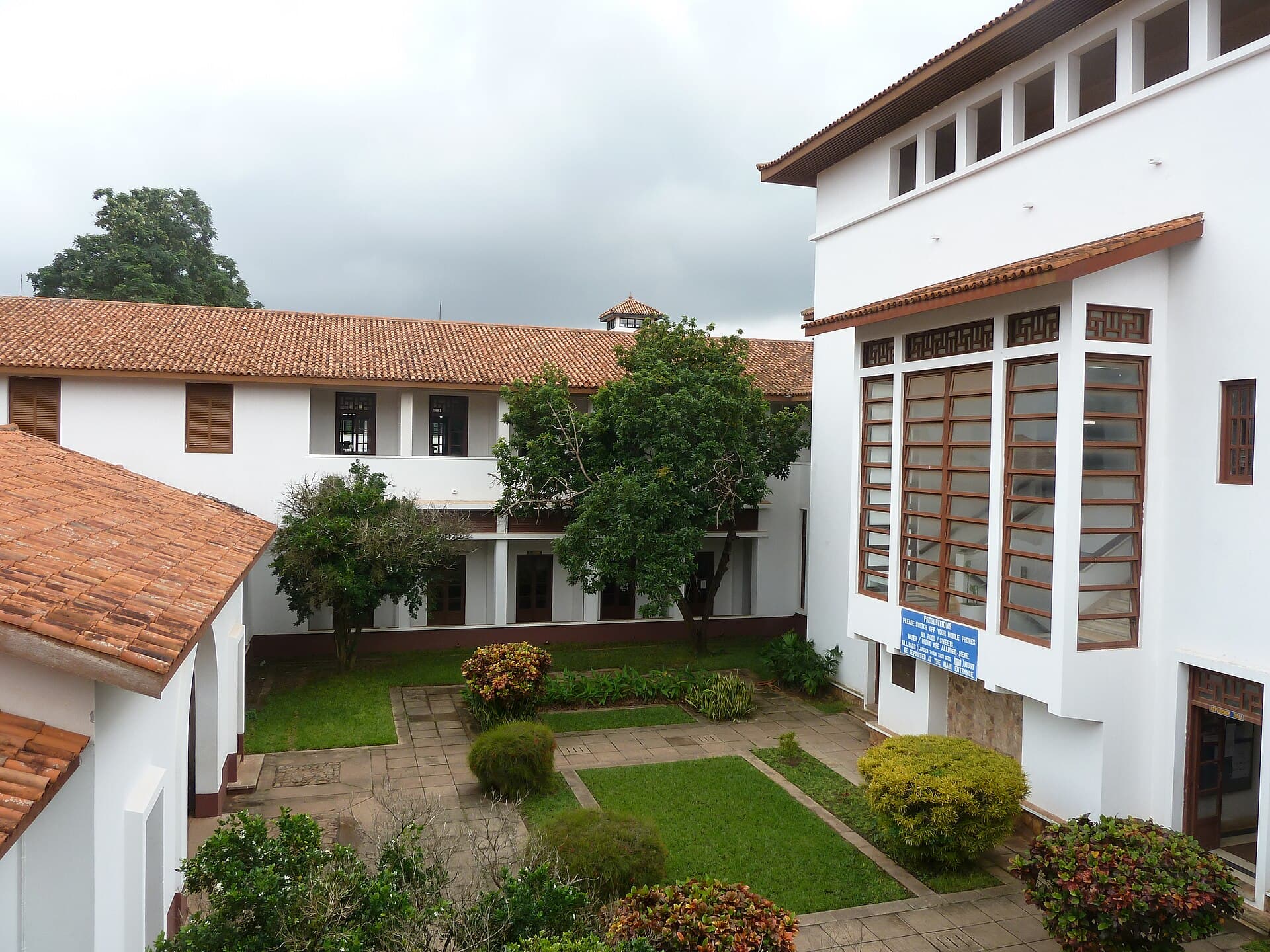
The University of Ghana sits on a low hill about thirteen kilometres northeast of central Accra, on ground the Ga people call Legon, from words meaning knowledge and hill. It is the oldest and largest university in Ghana, founded by ordinance on 11 August 1948 as the University College of the Gold Coast, more than eight years before the colony became an independent country. Its buildings are recognisable from a distance: long white ranges under red clay pantiles, laid along the contours of the hill with the Great Hall on the summit.
What earns the place a page in an archive of memory is not the architecture. It is a decision taken in the first years of independence, when the university founded an Institute of African Studies and set it to work collecting sound. The drumming, song, funeral dirges and spoken tradition recorded by the ethnomusicologist J. H. Kwabena Nketia and his colleagues are still held at Legon. They amount to a claim about evidence: that a voice on tape is a primary source, like a charter or a ledger.
The university owes its existence to a British commission and a Ghanaian refusal. The Asquith Commission on Higher Education in the Colonies, working through a West African committee chaired by Walter Elliot, recommended a network of university colleges tied to the University of London, which would supervise their teaching and award their degrees. The plan put a single college in Nigeria to serve all of British West Africa. The people of the Gold Coast rejected it and pressed for a college of their own, founded in 1948 as the University College of the Gold Coast.
Its first principal was the classicist David Mowbray Balme, who held the post from 1948 to 1957 and built it around a small residential model with high entry standards. For its first thirteen years it examined its students for London degrees. Independence in 1957 brought a change of name to the University College of Ghana, and in 1961 an Act of Parliament granted full university status, letting it award its own degrees at last. Kwame Nkrumah, the country's first head of state, became its first chancellor.
The years after brought a slower change: the replacement of an expatriate senior faculty by Ghanaian scholars. The argument over what the university was for reached its top office when the Irish writer and diplomat Conor Cruise O'Brien was vice-chancellor in the early 1960s. He was succeeded in 1966 by the classical historian Alexander Kwapong, the first Ghanaian to hold the office, who led the university until 1975. Departments filled with Ghanaian professors through the same decade, among them the historian Albert Adu Boahen, whose insistence on reading the African past from African evidence set the method of the Legon history school.
The Legon campus is a tropical adaptation of a collegiate plan: whitewashed walls to throw off the sun, gabled roofs in red clay tile, and long buildings turned north to south so the classrooms take shade rather than glare. The Great Hall crowns the summit, part of the convocation group that also houses the central administration, with a tower given by the government of Ghana to commemorate independence. Below it spread the first halls of residence, Legon, Akuafo, Commonwealth, Mensah Sarbah and Volta, each with its own colours and rivalries.
The building that anchors the campus is the Balme Library, named for the first principal, whose collections began in a room at Achimota College and moved into their present home at the end of the 1950s. Its arcaded courtyard is one of the most photographed spaces in Ghanaian higher education. It holds more than four hundred thousand printed volumes, an Africana collection, an Arabic library and a United Nations depository, and anchors a network of faculty libraries across the university.
Teaching runs through four colleges: humanities, basic and applied sciences, education, and health sciences. Law began as a department of the Faculty of Social Studies in the 1958/59 session and became a faculty two years later, training a large share of the Ghanaian bar. Medicine followed in 1962, when the first medical students began work in temporary buildings at Korle Bu Hospital in Accra; the Ghana Medical School joined the university in 1969 and Korle Bu became its teaching hospital.
The Institute of African Studies was set up in the first years of independence with Nkrumah's backing, and he opened it formally on 25 October 1963 with an address titled The African Genius. Its argument was that Africa should be studied on African terms rather than as a footnote to European history, and that the Institute's work was to advance knowledge by "re-interpreting and providing new assessments" of the African past, in Nkrumah's words. The historian Thomas Hodgkin was its first director.
 The Institute of African Studies at Legon, home to the Nketia archive, the Ghana Dance Ensemble and a museum of African material culture. Photograph by Nanakwafoa, CC BY-SA 3.0, via Wikimedia Commons.
That charge was carried out, in large part, with a tape recorder. J. H. Kwabena Nketia joined the university as a teacher of music in 1952 and later directed the Institute, and the collections he and his colleagues assembled are now held as the J. H. Kwabena Nketia Archives, named for him in 2015. The holdings run across quarter-inch reel-to-reel tape, shellac discs at 78, 45 and 33 rpm, digital audio tape, cassettes and compact discs. The oldest material dates to the early 1950s, before independence, and documents drumming, dance music, dirges, storytelling and speech from communities across the country. Alongside it sit commercial highlife records, film of Asante coronation and funeral rites, video of stage performances from the early 1980s onward, some 2,470 printed photographs and roughly ten thousand black-and-white negatives still uncatalogued.
The other half of the programme was performance. The Ghana Dance Ensemble was created in 1962 by the Institute with the government's Institute of Arts and Culture, and grew up under Nketia's direction with the choreographer Albert Mawere Opoku, whose work from 1962 to 1976 shaped the repertoire that carried Ghanaian dance onto the formal stage. Its choreographies drew on the same field research that filled the tape shelves, so the archive and the ensemble worked as two ends of one process: record a tradition, study it, then perform it. The Institute also keeps the Manhyia Archives of the Asante royal court and a museum of African material culture.
The writer Ama Ata Aidoo entered Legon in 1961 and took her degree in English there, writing her first play, The Dilemma of a Ghost, while still a student. She returned to teach English there and served as a research fellow at the Institute of African Studies before moving to the University of Cape Coast, where she became a professor, and to a term as Ghana's Minister of Education in the 1980s. Her novel Changes won the Commonwealth Writers' Prize for Africa in 1992.
The poet Kofi Awoonor graduated from Legon in 1960 and stayed on, first as a lecturer in English and then as a research fellow at the Institute, where he worked on the Ewe oral poetry that runs through Rediscovery and Night of My Blood. He later served as Ghana's ambassador to Brazil and Cuba and as its permanent representative to the United Nations. He was killed in the attack on the Westgate shopping centre in Nairobi in September 2013, while attending a literary festival.
A Legon degree carries a particular weight in Ghanaian public life. The university's graduates fill the senior civil service, the judiciary and the cabinet, and for decades it was the only route into that world. In that it belongs to the same generation of institutions as Makerere University in Kampala, another colonial-era college whose graduates staffed the first governments of newly independent states.
The university remains Ghana's largest, with a student body of about sixty thousand once regular, sandwich, weekend and distance programmes are counted, drawn from Ghana and more than seventy other countries. It belongs to the Association of African Universities and the African Research Universities Alliance. Nana Aba Appiah Amfo became vice-chancellor in 2021, the first woman to hold the office, and the former United Nations official Mary Chinery-Hesse serves as chancellor.
The Legon campus is open, and the drive from central Accra takes half an hour outside the rush. The Great Hall and its tower on the summit are the obvious first stop, and the Balme Library courtyard rewards the walk, though its reading rooms are for members of the university. The Institute of African Studies keeps a museum of African material culture, and the Ghana Dance Ensemble performs on and off campus; check both with the Institute in advance, since the archive is opened for researchers rather than casual visitors.
The Institute of African Studies at Legon, home to the Nketia archive, the Ghana Dance Ensemble and a museum of African material culture. Photograph by Nanakwafoa, CC BY-SA 3.0, via Wikimedia Commons.
That charge was carried out, in large part, with a tape recorder. J. H. Kwabena Nketia joined the university as a teacher of music in 1952 and later directed the Institute, and the collections he and his colleagues assembled are now held as the J. H. Kwabena Nketia Archives, named for him in 2015. The holdings run across quarter-inch reel-to-reel tape, shellac discs at 78, 45 and 33 rpm, digital audio tape, cassettes and compact discs. The oldest material dates to the early 1950s, before independence, and documents drumming, dance music, dirges, storytelling and speech from communities across the country. Alongside it sit commercial highlife records, film of Asante coronation and funeral rites, video of stage performances from the early 1980s onward, some 2,470 printed photographs and roughly ten thousand black-and-white negatives still uncatalogued.
The other half of the programme was performance. The Ghana Dance Ensemble was created in 1962 by the Institute with the government's Institute of Arts and Culture, and grew up under Nketia's direction with the choreographer Albert Mawere Opoku, whose work from 1962 to 1976 shaped the repertoire that carried Ghanaian dance onto the formal stage. Its choreographies drew on the same field research that filled the tape shelves, so the archive and the ensemble worked as two ends of one process: record a tradition, study it, then perform it. The Institute also keeps the Manhyia Archives of the Asante royal court and a museum of African material culture.
The writer Ama Ata Aidoo entered Legon in 1961 and took her degree in English there, writing her first play, The Dilemma of a Ghost, while still a student. She returned to teach English there and served as a research fellow at the Institute of African Studies before moving to the University of Cape Coast, where she became a professor, and to a term as Ghana's Minister of Education in the 1980s. Her novel Changes won the Commonwealth Writers' Prize for Africa in 1992.
The poet Kofi Awoonor graduated from Legon in 1960 and stayed on, first as a lecturer in English and then as a research fellow at the Institute, where he worked on the Ewe oral poetry that runs through Rediscovery and Night of My Blood. He later served as Ghana's ambassador to Brazil and Cuba and as its permanent representative to the United Nations. He was killed in the attack on the Westgate shopping centre in Nairobi in September 2013, while attending a literary festival.
A Legon degree carries a particular weight in Ghanaian public life. The university's graduates fill the senior civil service, the judiciary and the cabinet, and for decades it was the only route into that world. In that it belongs to the same generation of institutions as Makerere University in Kampala, another colonial-era college whose graduates staffed the first governments of newly independent states.
The university remains Ghana's largest, with a student body of about sixty thousand once regular, sandwich, weekend and distance programmes are counted, drawn from Ghana and more than seventy other countries. It belongs to the Association of African Universities and the African Research Universities Alliance. Nana Aba Appiah Amfo became vice-chancellor in 2021, the first woman to hold the office, and the former United Nations official Mary Chinery-Hesse serves as chancellor.
The Legon campus is open, and the drive from central Accra takes half an hour outside the rush. The Great Hall and its tower on the summit are the obvious first stop, and the Balme Library courtyard rewards the walk, though its reading rooms are for members of the university. The Institute of African Studies keeps a museum of African material culture, and the Ghana Dance Ensemble performs on and off campus; check both with the Institute in advance, since the archive is opened for researchers rather than casual visitors.
History
Campus and academics
The Institute of African Studies and the Nketia archive