Heritage · University
University of Athens: History and Overview
Founded in 1837 as the Othonian University, the National and Kapodistrian University of Athens was the first university of the modern Greek state and the first in the Balkans and the eastern Mediterranean. Its neoclassical main building on Panepistimiou Street forms the middle term of the Athenian trilogy, and the institution stood at the centre of Greece's long argument over which form of its own language to write.Written to last.
By Confinity Heritage Editorial · 2026-08-25 · 8-minute readQuiet tools, kept out of the way.
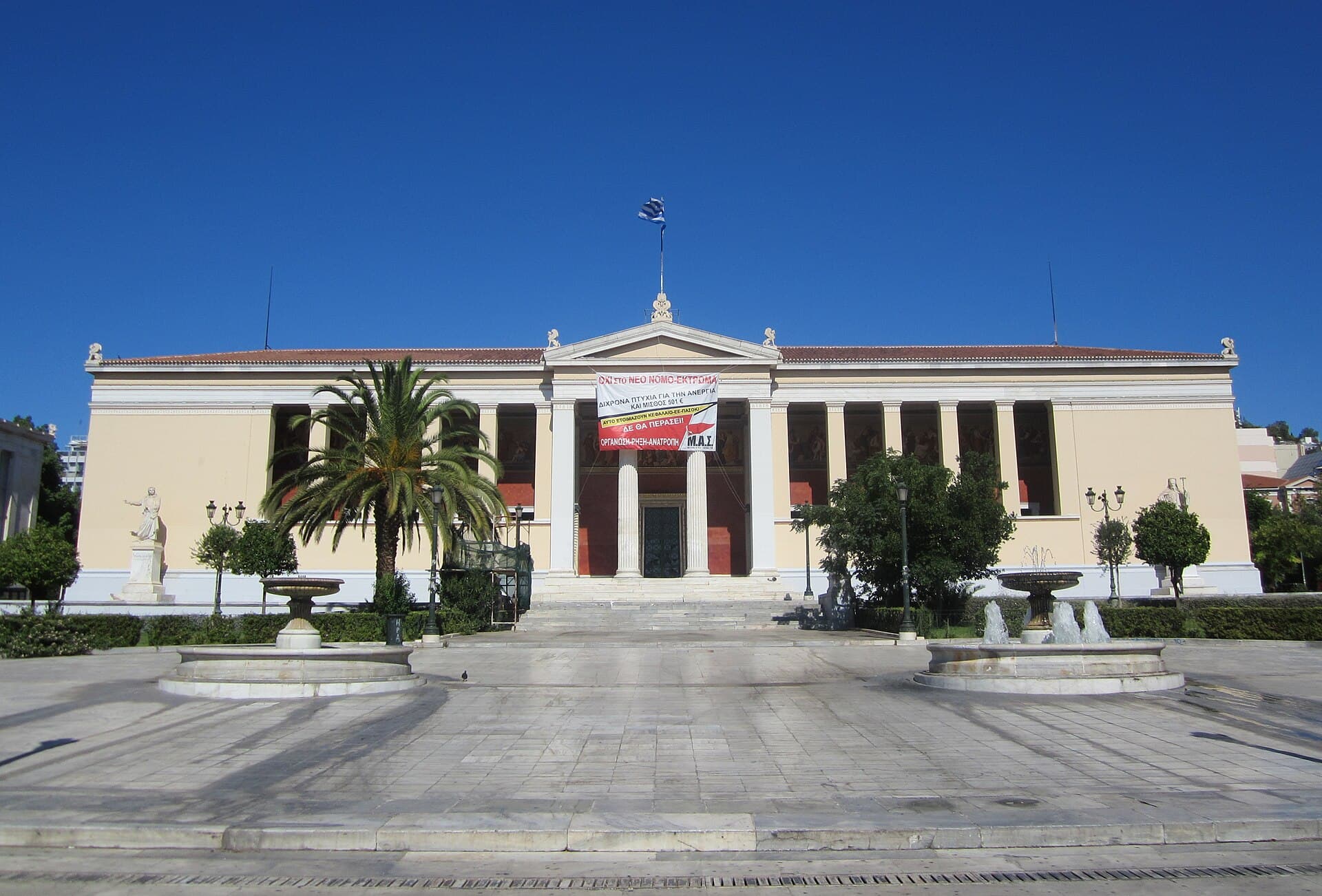
The National and Kapodistrian University of Athens opened when the state that chartered it was barely older than its first intake. Greece had won independence from the Ottoman Empire a few years earlier, and Otto of Bavaria had just moved his capital to Athens, then a town of a few thousand below a battered Acropolis. It was inaugurated on 3 May 1837 with four faculties, thirty-three professors and fifty-two matriculated students, under the name Othonian University after the king.
It was the first university of the modern Greek state and the first of its kind in the Balkans and the eastern Mediterranean, which made it more than a place of instruction. A country that had spent four centuries under foreign rule was claiming descent from antiquity, and it built the claim in marble along one street. The harder question was which Greek to make it in, and the answer stayed contested for another hundred and forty years.
The founding decree gave four faculties: Theology, Law, Medicine, and Arts, the last including mathematics and applied sciences. Teaching began in the house of architects Stamatios Kleanthis and Eduard Schaubert on the north slope of the Acropolis, still called the Old University. Alongside the fifty-two registered students sat seventy-five auditors.
In November 1841 the university moved to the building it still occupies on Panepistimiou Street. The Danish architect Christian Hansen began construction in 1839 on an H-shaped plan of restrained neoclassical proportions. The front wing, the Propylaea, was finished in 1842-1843; the rest, supervised by Lysandros Kaftanzoglou and then Anastasios Theofilas, was completed in 1864.
Names followed politics. The Othonian University became the National University in 1862, the year Otto was deposed. From 1911 to 1932 it ran as two legal entities, the Kapodistrian University for the humanities, named for Ioannis Kapodistrias, independent Greece's first head of state, and the National University for the sciences; they merged in 1932 under the compound title carried today. As the region's only university for decades its reach ran past the kingdom's borders, and young men from across the still-Ottoman Balkans came to study Greek letters before returning home.
Hansen's building is the middle term of what Athenians call the neoclassical trilogy, three public buildings raised in a row over half a century. On one side is the Academy of Athens, by Christian Hansen's brother Theophil, completed in 1885 by his pupil Ernst Ziller; on the other the National Library of Greece, also by Theophil Hansen. The three make an argument in stone: a small, poor state a few decades old chose the orders of fifth-century Athens to house its university, its academy and its books, and by that choice named the ancestors it claimed.
 The Athenian trilogy: the Academy at right, the university in the middle, the National Library at left. Photograph by athenswalk, CC0, via Wikimedia Commons.
Most of the teaching has since left it. From the 1960s the university built a campus at Ano Ilisia in the suburb of Zografou, east of the city, and the Schools of Science, Theology and Philosophy moved there; Health Sciences sits at Goudi beside the teaching hospitals, and Law and Economics remain in the centre. The Propylaea kept the rectorate and the ceremonies, so the most photographed building in Greek higher education is now the one where the least of it happens. Its steps are the customary assembly point for marches down Panepistimiou.
Greece recovered an ancient inheritance and then had to decide which version of its own memory to speak in. When the new state settled on a written language in 1830 it took katharevousa, a simplified Ancient Greek devised as a temporary bridge, over demotic, the vernacular people used. The bridge became permanent and drifted further from speech. The university policed the difference: in 1882 the classical philologist Konstantinos Kontos, a professor here, published two hundred observations cataloguing other scholars' grammatical errors. The poet Kostis Palamas, the leading voice on the demoticist side, held an administrative post in the same university from 1897, and the old administration building carries his name.
In 1901 the argument reached the street. Alexandros Pallis, a Greek merchant in Liverpool, had translated the Gospels into demotic, and from September the Athens daily Akropolis serialised his Matthew under the headline "the Gospel in the language of the people". Opposition was immediate and broad: most of the Athenian press, the Ecumenical Patriarchate, the opposition parties, and this university's theological faculty, which had already declared against translation. Greece had been beaten by the Ottomans four years earlier, and the accusations ran to Pan-Slav plots and Protestant proselytising.
Students of the university were at the front of what came next. On 5 November they wrecked the offices of Akropolis and marched on the residence of Prokopios II, the Metropolitan of Athens. The crowd grew over the following days, and on 8 November it gathered by the temple of Olympian Zeus demanding that the translators be excommunicated. Cavalry were sent to clear the streets, shots were exchanged, and eight demonstrators were killed, about seventy wounded. Athens called it Black Thursday; some later accounts put the dead higher. Prokopios II resigned and withdrew to a monastery on Salamis, dying the next year; the Theotokis government fell three days later. The Holy Synod banned translation of the Bible into demotic, and in 1911 a clause went into the constitution protecting the official language from corruption. Half a century later and half a world away, students at the University of Dhaka would be shot for demanding the opposite, the right to be taught in the language they already spoke at home.
Both sides believed they were defending continuity: one that a people who let the ancient forms go would lose the claim those forms carried, the other that a nation writing in a language nobody spoke could not educate its children. The dispute outlasted everyone in it. The junta of 1967-1974 made katharevousa official in 1968 and dismissed professors who supported demotic. The November 1973 uprising that broke the regime's authority happened at the Athens Polytechnic, the National Technical University of Athens and a separate institution; this university's moment came that February, when law students barricaded themselves inside its Law School in central Athens. Two years after the colonels fell, Law 309 of 30 April 1976 made modern Greek the sole language of education at every level, and the administration and the courts followed. The argument had been violent because the stakes were identity rather than grammar.
The university's most durable contribution has been the recovery of Greek antiquity by Greek scholars, alongside and sometimes against the foreign expeditions that dominated early excavation. Panagiotis Kavvadias, professor here and head of the Archaeological Service from 1885 to 1909, stripped the Acropolis of its medieval and later structures between 1885 and 1890, opened the National Archaeological Museum, and drove through the 1899 law against looting. Christos Tsountas, professor from 1904, made the first archaeological survey of Thessaly and the first formal excavations of the citadel of Mycenae, and named Cycladic culture. Spyridon Marinatos studied here from 1916, returned as professor and served as rector, and excavated the Minoan town of Akrotiri on Thera from 1967 until he died at the site in 1974.
In medicine, Georgios Papanikolaou took his degree at Athens in 1904 before emigrating to the United States and developing the cervical smear test that carries his name. Leonidas Zervas, who started in chemistry here, held the chair of organic chemistry from 1939 until the junta removed him in 1968. Graduates in letters and public life include Nikos Kazantzakis, who read law here and wrote his thesis on Nietzsche; Odysseas Elytis, who passed the law school entrance examinations in 1928, gave up law for poetry and won the 1979 Nobel Prize in Literature; the statesman Eleftherios Venizelos; and Nectarios of Aegina, later canonised. Fifteen Greek prime ministers and eight presidents studied here.
It is the largest university in Greece and among the largest in Europe by enrolment, with about 68,500 undergraduate and postgraduate students across nine Schools and more than 2,100 academic staff. It ranks as the highest-placed Greek institution in the international rankings, strongest in medicine and the health sciences, physics, and the classical and Byzantine disciplines. Funding has been precarious since the debt crisis; in 2013 the Senate voted to suspend all operations after the ministry cut 1,655 administrative posts nationally.
The Propylaea and its neighbours are best taken from the pavement of Panepistimiou, where the three facades line up in one view; the interior opens for ceremonies and occasional exhibitions rather than on a daily schedule, and the Academy and the National Library keep their own arrangements. The part built for visitors is the Athens University History Museum at Tholou 5 in Plaka, the Kleanthis house where teaching started in 1837, holding rare editions, manuscripts and instruments; its hours are weekday mornings plus the first Sunday of the month, so check before climbing the hill. The Zografou campus is a bus ride east from Evangelismos or Akadimia and rewards the trip by contrast: 1960s concrete faculties on a bare hillside, where the work the marble stands for is done.
The Athenian trilogy: the Academy at right, the university in the middle, the National Library at left. Photograph by athenswalk, CC0, via Wikimedia Commons.
Most of the teaching has since left it. From the 1960s the university built a campus at Ano Ilisia in the suburb of Zografou, east of the city, and the Schools of Science, Theology and Philosophy moved there; Health Sciences sits at Goudi beside the teaching hospitals, and Law and Economics remain in the centre. The Propylaea kept the rectorate and the ceremonies, so the most photographed building in Greek higher education is now the one where the least of it happens. Its steps are the customary assembly point for marches down Panepistimiou.
Greece recovered an ancient inheritance and then had to decide which version of its own memory to speak in. When the new state settled on a written language in 1830 it took katharevousa, a simplified Ancient Greek devised as a temporary bridge, over demotic, the vernacular people used. The bridge became permanent and drifted further from speech. The university policed the difference: in 1882 the classical philologist Konstantinos Kontos, a professor here, published two hundred observations cataloguing other scholars' grammatical errors. The poet Kostis Palamas, the leading voice on the demoticist side, held an administrative post in the same university from 1897, and the old administration building carries his name.
In 1901 the argument reached the street. Alexandros Pallis, a Greek merchant in Liverpool, had translated the Gospels into demotic, and from September the Athens daily Akropolis serialised his Matthew under the headline "the Gospel in the language of the people". Opposition was immediate and broad: most of the Athenian press, the Ecumenical Patriarchate, the opposition parties, and this university's theological faculty, which had already declared against translation. Greece had been beaten by the Ottomans four years earlier, and the accusations ran to Pan-Slav plots and Protestant proselytising.
Students of the university were at the front of what came next. On 5 November they wrecked the offices of Akropolis and marched on the residence of Prokopios II, the Metropolitan of Athens. The crowd grew over the following days, and on 8 November it gathered by the temple of Olympian Zeus demanding that the translators be excommunicated. Cavalry were sent to clear the streets, shots were exchanged, and eight demonstrators were killed, about seventy wounded. Athens called it Black Thursday; some later accounts put the dead higher. Prokopios II resigned and withdrew to a monastery on Salamis, dying the next year; the Theotokis government fell three days later. The Holy Synod banned translation of the Bible into demotic, and in 1911 a clause went into the constitution protecting the official language from corruption. Half a century later and half a world away, students at the University of Dhaka would be shot for demanding the opposite, the right to be taught in the language they already spoke at home.
Both sides believed they were defending continuity: one that a people who let the ancient forms go would lose the claim those forms carried, the other that a nation writing in a language nobody spoke could not educate its children. The dispute outlasted everyone in it. The junta of 1967-1974 made katharevousa official in 1968 and dismissed professors who supported demotic. The November 1973 uprising that broke the regime's authority happened at the Athens Polytechnic, the National Technical University of Athens and a separate institution; this university's moment came that February, when law students barricaded themselves inside its Law School in central Athens. Two years after the colonels fell, Law 309 of 30 April 1976 made modern Greek the sole language of education at every level, and the administration and the courts followed. The argument had been violent because the stakes were identity rather than grammar.
The university's most durable contribution has been the recovery of Greek antiquity by Greek scholars, alongside and sometimes against the foreign expeditions that dominated early excavation. Panagiotis Kavvadias, professor here and head of the Archaeological Service from 1885 to 1909, stripped the Acropolis of its medieval and later structures between 1885 and 1890, opened the National Archaeological Museum, and drove through the 1899 law against looting. Christos Tsountas, professor from 1904, made the first archaeological survey of Thessaly and the first formal excavations of the citadel of Mycenae, and named Cycladic culture. Spyridon Marinatos studied here from 1916, returned as professor and served as rector, and excavated the Minoan town of Akrotiri on Thera from 1967 until he died at the site in 1974.
In medicine, Georgios Papanikolaou took his degree at Athens in 1904 before emigrating to the United States and developing the cervical smear test that carries his name. Leonidas Zervas, who started in chemistry here, held the chair of organic chemistry from 1939 until the junta removed him in 1968. Graduates in letters and public life include Nikos Kazantzakis, who read law here and wrote his thesis on Nietzsche; Odysseas Elytis, who passed the law school entrance examinations in 1928, gave up law for poetry and won the 1979 Nobel Prize in Literature; the statesman Eleftherios Venizelos; and Nectarios of Aegina, later canonised. Fifteen Greek prime ministers and eight presidents studied here.
It is the largest university in Greece and among the largest in Europe by enrolment, with about 68,500 undergraduate and postgraduate students across nine Schools and more than 2,100 academic staff. It ranks as the highest-placed Greek institution in the international rankings, strongest in medicine and the health sciences, physics, and the classical and Byzantine disciplines. Funding has been precarious since the debt crisis; in 2013 the Senate voted to suspend all operations after the ministry cut 1,655 administrative posts nationally.
The Propylaea and its neighbours are best taken from the pavement of Panepistimiou, where the three facades line up in one view; the interior opens for ceremonies and occasional exhibitions rather than on a daily schedule, and the Academy and the National Library keep their own arrangements. The part built for visitors is the Athens University History Museum at Tholou 5 in Plaka, the Kleanthis house where teaching started in 1837, holding rare editions, manuscripts and instruments; its hours are weekday mornings plus the first Sunday of the month, so check before climbing the hill. The Zografou campus is a bus ride east from Evangelismos or Akadimia and rewards the trip by contrast: 1960s concrete faculties on a bare hillside, where the work the marble stands for is done.
History
Campus and academics