Heritage · University
Aarhus University: History and Overview
Founded in 1928 by civic subscription with 64 students in rented rooms, Aarhus University broke Copenhagen's four-century monopoly on Danish higher learning. Its University Park, held to one vocabulary of yellow brick and oak trees for ninety years, is among the canonical works of Danish modernism.Written to last.
By Confinity Heritage Editorial · 2026-08-25 · 8-minute readQuiet tools, kept out of the way.
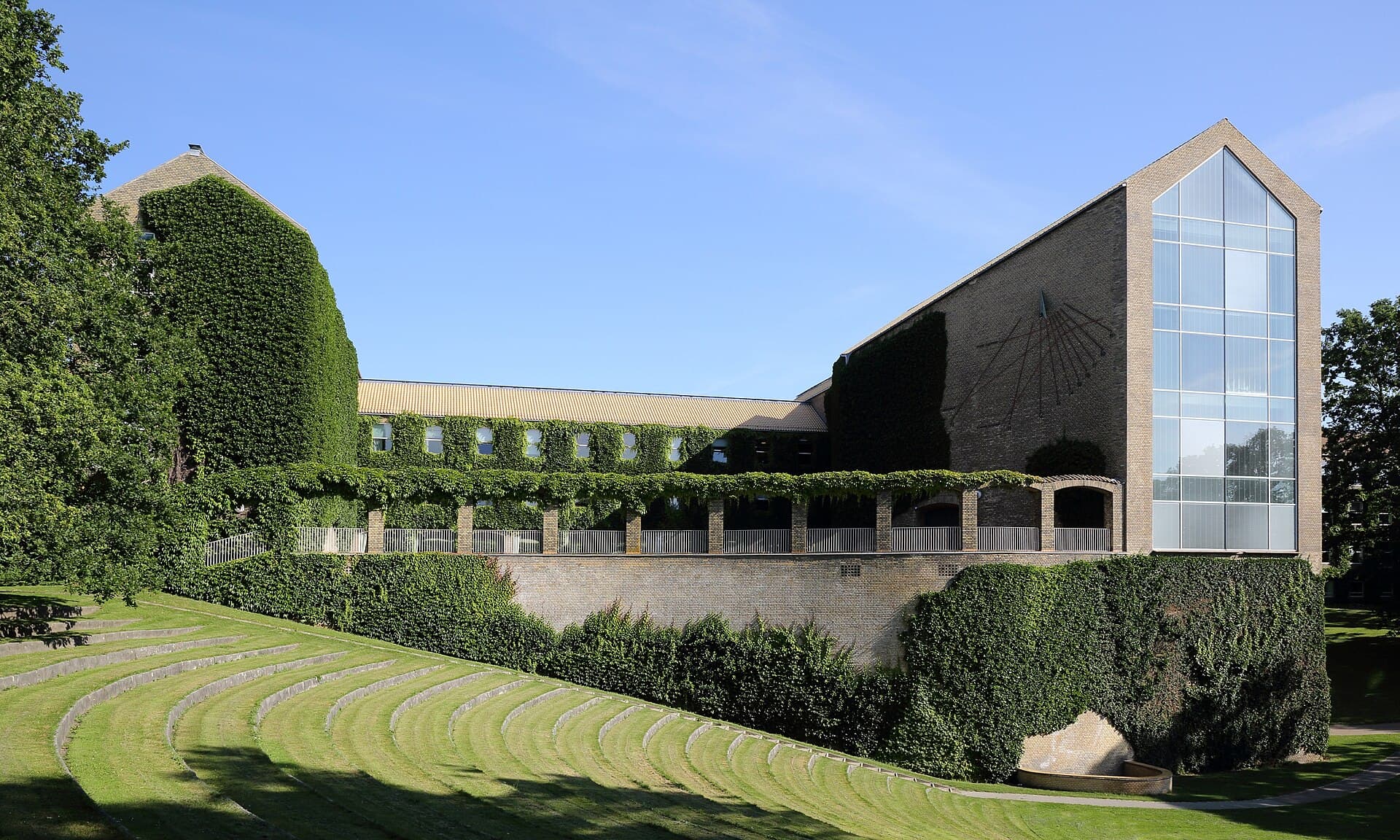
For four and a half centuries Denmark had one university and one only, in Copenhagen, on the far side of the water from the peninsula where half the country lived. Jutland campaigned for its own for decades and was refused for decades. In September 1928 the city of Aarhus stopped waiting, raised the money locally, rented rooms in the technical college and opened teaching with 64 students and a handful of lecturers.
What grew from that improvisation is now Denmark's largest university by some measures and among the most recognisable campuses in northern Europe: a park of yellow brick buildings set in a glacial hollow, planted with oaks, built to one architectural vocabulary that has been held without a serious break since 1933. Almost nothing about the place suggests a start in borrowed rooms.
The 1928 opening was a municipal and private venture rather than a state one, funded by the city and by public subscription, and it was called simply university teaching in Jutland. The state took time to be convinced. Recognition came in stages through the 1930s, faculty by faculty, and in 1933 the institution took the name Aarhus University and moved into the first purpose-built structure in its new park.
The Second World War left the deepest mark in the university's memory. During the occupation the Gestapo requisitioned two of the student halls in the park as its headquarters for Jutland, and by 1944 those buildings held the card indexes and interrogation files that were dismantling the Danish resistance across the peninsula. What followed is described in the next section but one; the short version is that the resistance asked for the buildings to be destroyed, and the Royal Air Force destroyed them.
The postwar decades were a long expansion: new faculties, the medical school and its hospital partnership, the sciences pushing north through the park, and satellite campuses at Moesgaard for archaeology and anthropology and at Herning and Emdrup. A round of national mergers in 2006 and 2007 brought in the Danish School of Education, the Aarhus School of Business and several government research institutes, taking the university to its present scale of roughly thirty-eight thousand students.
The University Park is the reason architects visit. In 1931 a competition for the new campus was won by Kay Fisker, C. F. Møller and Povl Stegmann, working with the landscape architect C. Th. Sørensen, and their plan did something unusual: instead of a formal quadrangle it set free-standing buildings loosely among the contours of a morainic hollow, with the lawns, the stream and the oak trees doing the work that colonnades do elsewhere.
The vocabulary they fixed is severe and consistent. Every building is faced in the same yellow brick, roofed in the same yellow tile, with steep gables, plain rectangular windows and almost no ornament. Successive architects have added to the park for ninety years, and the rule has held: the newest teaching blocks speak the same sentence as the first one from 1933. The effect is a campus that reads as a single work rather than a collection, and the amphitheatre of grass terraces below the main building, used for matriculation and for summer concerts, is the room where the whole composition can be seen at once.
Academically the university is organised into five faculties covering the arts, natural sciences, technical sciences, health, and business and social sciences. Its research strengths run to nanoscience at the iNANO centre, molecular biology and biomedicine, environmental and Arctic science, wind energy, and a strong empirical tradition in economics and political science. The Aarhus Institute of Advanced Studies, housed in a circular building at the edge of the park, hosts fellows across all disciplines.
On the morning of 31 October 1944, twenty-five de Havilland Mosquitoes of the Royal Air Force came in low over Jutland and bombed the two university dormitories the Gestapo had taken over. The attack had been requested by the Danish resistance, which knew that its own arrested members were being broken with the help of the archive inside, and that the files were about to be used for a wider sweep.
The raid was accurate. The halls were wrecked, the Gestapo's records for the whole peninsula burned with them, and the planned round-up did not happen. It also killed people: German staff, Danish civilians working in the buildings, and at least one Danish prisoner held there. Aarhus counts the day among the events that mattered most to its survival through the occupation, and counts the cost alongside it.
There is a hard lesson sitting in the middle of a page about a university, and it is worth stating plainly. Records are power in both directions. The same qualities that make an archive precious to a family or a scholar, its completeness, its indexing, its resistance to time, made this one worth killing for and worth destroying. The dormitories were rebuilt after the war in the park's yellow brick, and the university that teaches in them treats the story as part of its own history rather than a footnote to somebody else's.
The university's best-known scientific result came out of a basement laboratory in the medical faculty. Jens Christian Skou began at Aarhus as a young physician in 1947 and never left; in 1957 he identified the enzyme that pumps sodium and potassium across the cell membrane, the mechanism that keeps every nerve impulse in every animal possible. Forty years later, at the age of 79, he received the Nobel Prize in Chemistry for it.
Other lines are shorter but distinct. The economist Dale T. Mortensen, a Nobel laureate for his work on search and matching in labour markets, held a long visiting professorship at Aarhus, and one of the school of business and social sciences buildings carries his name. Bjarne Stroustrup took his master's degree in mathematics and computer science at Aarhus in the 1970s before going on to create C++. Queen Margrethe II read political science in the park in the early 1960s, one stop on an unusually wide student career.
The archaeological tradition deserves its own paragraph. Aarhus scholars excavated and conserved the Grauballe Man, the Iron Age body lifted out of a Jutland bog in 1952 with his face, hair and fingerprints intact after more than two thousand years. The conservation work, led by the professor of archaeology P. V. Glob, was among the first of its kind and made the body one of the best preserved of all bog finds. He is on display at the Moesgaard Museum south of the city, an institution grown out of the university's own department, where a man who died before the Roman conquest of Gaul is met at eye level. A university that lost an archive to fire in 1944 has spent the decades since keeping a face that the peat kept for it.
Aarhus is placed in the top hundred of the main international rankings and is Denmark's second-oldest university and its largest by campus area. Around thirty-eight thousand students are enrolled, some twelve per cent of them from abroad, and the university is among the country's largest employers. The park itself is publicly accessible, and on any warm afternoon the terraces are full of people who have nothing to do with the institution, which is close to what its founders in 1928 had in mind.
The elder relation is the University of Copenhagen, founded in 1479 and for 449 years the only game in the kingdom. The two now sit near each other in the rankings, which is the clearest measure of what a provincial subscription drive achieved.
The University Park is open to the public without restriction, and the amphitheatre lawns below the main building are the place to start. The main building's aula and the surrounding blocks are the canonical view of Danish functionalism, easily seen in a walk of an hour. Moesgaard Museum, ten kilometres south of the centre and reachable by city bus, holds the Grauballe Man and the university's archaeological collections in a grass-roofed building that visitors are invited to walk up and sit on. Both are a short distance from the city centre and its cathedral.