Heritage · University
Peking University: History and Overview
Peking University, founded in 1898 as the Imperial University of Peking, was the first modern national university in China and the only institution to survive the Hundred Days' Reform. From its Yan Yuan campus around Weiming Lake, it helped shape the New Culture and May Fourth movements and remains one of the country's foremost research universities.Written to last.
By Confinity Heritage Editorial · Updated 2026-07-31 · 8-minute readQuiet tools, kept out of the way.
Peking University, known in Chinese as Beijing Daxue and widely called Beida, is a public national research university in Beijing and the first modern national university established in China. It was founded in 1898 as the Imperial University of Peking (Jingshi Daxuetang), created by imperial edict during the reform effort of the late Qing dynasty and conceived as a successor to the country's imperial academy tradition (Britannica).
For more than a century the university has held a central place in the intellectual and cultural life of modern China. It was the setting for the New Culture Movement and a focal point of the May Fourth Movement of 1919, and it later gathered on the garden campus of Yan Yuan, around Weiming Lake and the Boya Pagoda, where it continues its teaching and research today.
The Imperial University of Peking was established in 1898, when the Guangxu Emperor approved its charter during the Hundred Days' Reform, a brief programme of modernisation prompted in part by China's defeat in the First Sino-Japanese War of 1894–1895 (Britannica). The reform movement was quickly reversed by conservative forces at court, but the new university was allowed to continue, making it the only lasting institution to emerge from that episode (Peking University). It was designed as both the highest seat of learning in the country and, in its early years, a central administrative body for education, drawing on the older imperial academy tradition it was meant to modernise. After the founding of the Republic of China, the institution was renamed Peking University in 1912.
The university's modern character was shaped above all by Cai Yuanpei, who was appointed chancellor in late 1916 and took office at the start of 1917 (Cai Yuanpei). Cai reorganised the university around the principles he summarised as freedom of thought and inclusiveness, recruiting faculty on intellectual merit and giving professors a formal role in governance. Among those he brought to Beijing were Chen Duxiu, appointed dean of the School of Letters, and Li Dazhao, who became chief librarian, alongside scholars such as Hu Shi and the writer Lu Xun.
Under Cai's leadership the university became the centre of the New Culture Movement, an intellectual current that promoted writing in the vernacular, scientific method, and new social ideas, expressed in journals such as New Youth, which Chen Duxiu edited. In 1918 the university moved into its Red Building in central Beijing, which became closely associated with these debates (Peking University). That year a young Mao Zedong worked as an assistant in the university library under Li Dazhao, where he encountered the ideas circulating on campus.
On 4 May 1919, students from Peking University and other institutions gathered in Beijing to protest the terms of the Treaty of Versailles, which assigned former German holdings in Shandong to Japan rather than returning them to China. The demonstrations grew into the wider May Fourth Movement, a national wave of student activism and cultural reform that reshaped modern Chinese thought. The date remains central to the university's identity, and Peking University marks its founding anniversary on 4 May (Peking University).
When full-scale war with Japan began in 1937, Peking University joined Tsinghua University and Nankai University in moving south, first forming a temporary university at Changsha and then relocating to Kunming in Yunnan as the National Southwestern Associated University, often shortened to Lianda (National Southwestern Associated University). Operating under wartime hardship from 1938 to 1946, the combined institution kept up a demanding academic programme and educated a generation of scholars and scientists. The three universities resumed independent operation after the war, and Peking University returned to Beijing in 1946.
A nationwide reorganisation of higher education in 1952 reshaped the university again. Peking University merged with faculties from other institutions and took over the campus of the former Yenching University, an American mission university on the north-western edge of the city (Britannica). The move brought the university to the garden campus of Yan Yuan, which has remained its home ever since.
The Yan Yuan campus lies in the Haidian district of north-western Beijing, on grounds that were once part of Qing dynasty princely gardens. Its landscaped design was created for Yenching University in the 1920s by the American architect Henry Killam Murphy, who worked in a manner that combined traditional Chinese forms with modern facilities. At the heart of the campus is Weiming Lake, the largest of its ornamental lakes, whose name, meaning roughly the unnamed lake, was given by the scholar Qian Mu (Peking University).
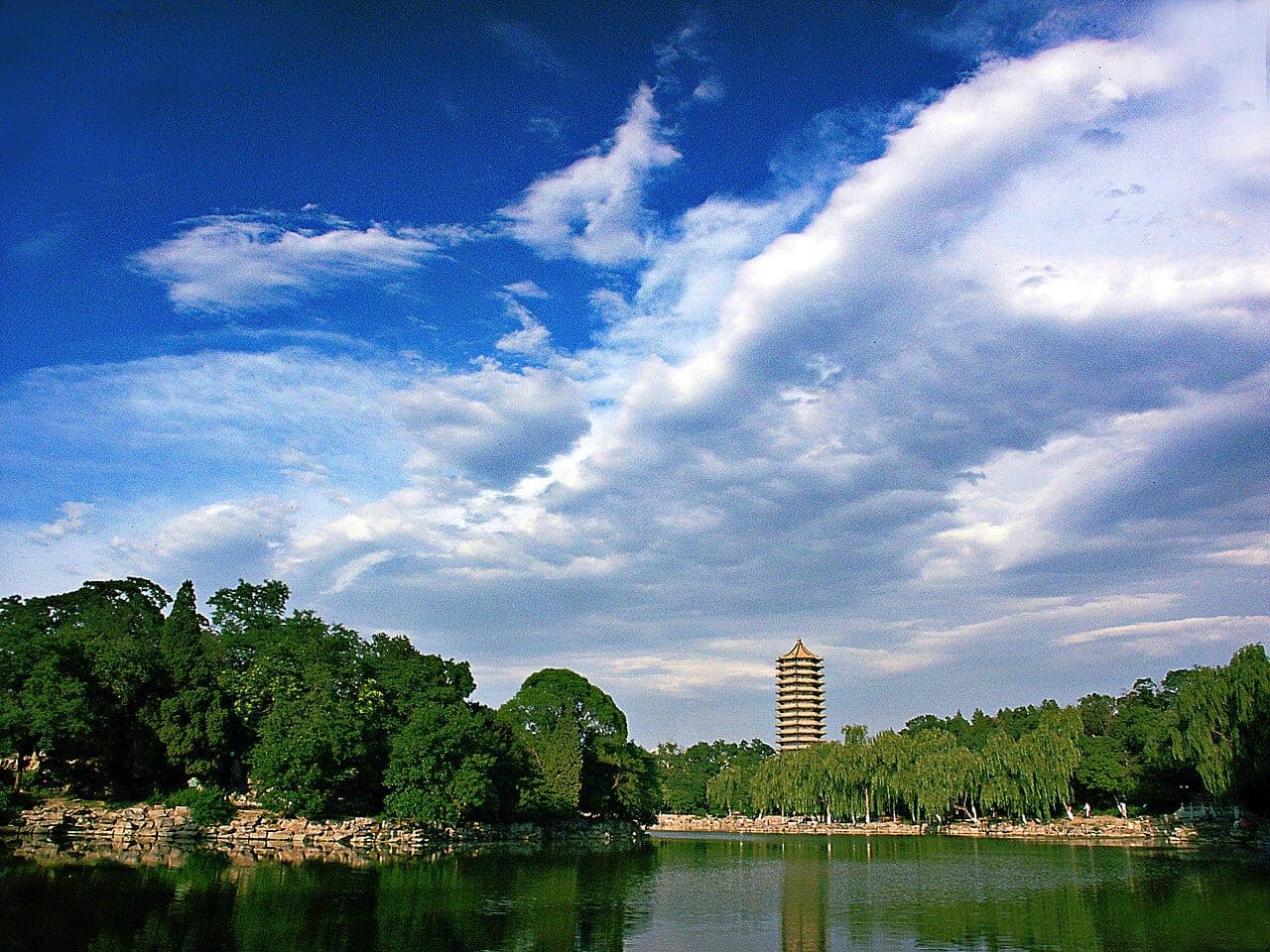
 Weiming means unnamed: the lake was left without a name because nobody could agree on one, and the name stuck. The pagoda beside it is a water tower. Photograph by endeneon, CC BY-SA 4.0, via Wikimedia Commons.
Beside the lake rises the Boya Pagoda, an octagonal thirteen-storey tower about 37 metres tall. Built in 1924, it was originally constructed as a water tower and was named, following a Yenching tradition of honouring donors, after a benefactor (Peking University). The pagoda and the lake below it have become the most familiar image of the campus, and the surrounding gardens preserve pavilions, steles, and older garden features from the site's imperial past.
Academically, the university is organised into faculties and schools spanning the humanities, social sciences, natural sciences, engineering, and professional fields, together with the Peking University Health Science Center, which oversees its medical education. Its library is among the largest academic libraries in Asia. The university teaches at undergraduate, master's, and doctoral levels and supports a broad network of research institutes and laboratories across these disciplines.
Beida's older home still stands, across the city from Yan Yuan at 29 Wusi Street in the Dongcheng district. Put up between 1916 and 1918 and named for the red brick it is built of, it was meant as a dormitory and used instead for the university offices, the arts faculty and, from October 1918, the library (Peking University Red Building).
The library that moved into the ground floor was the one Li Dazhao directed, and the collection behind it went back to the Book Collection Building of 1898, the first library of a national university in China (Peking University Libraries). From August 1918 to March 1919 its staff included an assistant from Hunan, Mao Zedong, placed there by his old teacher Yang Changji and posted to the second reading room, where the newspapers were kept. He sat in on lectures but was never enrolled and never graduated.
The building was put under national protection in 1961, and since 2002 its ground floor has held a museum of the New Culture Movement. Six rooms have been returned to their 1918 arrangement: Li Dazhao's office, the newspaper reading room where Mao worked, the accessions room, one of the ordinary book stacks, a large classroom, and the premises of the Xinchao Society, where students made more than three thousand flags and banners and Luo Jialun drafted a declaration that was run off in twenty thousand copies and handed out on the march of 4 May 1919.
The library outgrew those rooms long ago. It now holds some 1.6 million volumes of pre-modern Chinese books, about 170,000 of them rare editions, and roughly 24,000 titles of ink rubbings taken from inscribed stone, in about 56,000 sheets, the largest holding of its kind in any Chinese university.
Peking University has long been associated with the modernisation of Chinese scholarship. In the early twentieth century its faculty helped introduce vernacular literature, modern philosophy, and new approaches to history and the sciences into Chinese higher education, and it established some of the earliest dedicated research institutes in the country's universities (Peking University). The reforms of this period set a pattern of academic inquiry that later universities in China would follow.
Its roll of scholars includes Cai Yuanpei, remembered as a reformer of Chinese education; the philosopher and essayist Hu Shi, a leading advocate of writing in the vernacular; the writer Lu Xun, who lectured on the history of Chinese fiction; and the historian Qian Mu. The library where Li Dazhao worked, and where the young Mao Zedong was briefly employed, became a meeting point for the political and intellectual currents that ran through the campus in that era (Cai Yuanpei). In later decades the university continued to produce influential figures across the sciences, the humanities, and public life, and its alumni are found among China's leading writers, researchers, and academics.
Today Peking University is one of China's foremost research universities. It belongs to the C9 League, an informal grouping of leading Chinese universities, and is included in the national Double First-Class initiative for university and discipline development. It enrols tens of thousands of undergraduate and graduate students and appears near the top of national rankings, as well as among the higher-placed institutions in international rankings (Britannica). Its strengths span the natural sciences, humanities, social sciences, and medicine, and it maintains extensive research programmes, doctoral training, and partnerships with universities abroad. The university also preserves its own archives and museum collections, which document both its institutional history and the wider story of modern Chinese education.
Yan Yuan was never laid out for visitors, but its lake, pagoda and old halls draw a steady stream of them. The area around Weiming Lake and the Boya Pagoda is the most photographed part of the grounds, and the gardens are especially admired in autumn. Public access is managed by the university and can require advance registration and identification, so visitors are advised to check current entry arrangements before arriving. The campus lies in Haidian, close to the city's other university and technology districts, and is served by the Beijing metro, which makes it straightforward to combine with nearby sites such as the Summer Palace and the neighbouring Tsinghua University.
Weiming means unnamed: the lake was left without a name because nobody could agree on one, and the name stuck. The pagoda beside it is a water tower. Photograph by endeneon, CC BY-SA 4.0, via Wikimedia Commons.
Beside the lake rises the Boya Pagoda, an octagonal thirteen-storey tower about 37 metres tall. Built in 1924, it was originally constructed as a water tower and was named, following a Yenching tradition of honouring donors, after a benefactor (Peking University). The pagoda and the lake below it have become the most familiar image of the campus, and the surrounding gardens preserve pavilions, steles, and older garden features from the site's imperial past.
Academically, the university is organised into faculties and schools spanning the humanities, social sciences, natural sciences, engineering, and professional fields, together with the Peking University Health Science Center, which oversees its medical education. Its library is among the largest academic libraries in Asia. The university teaches at undergraduate, master's, and doctoral levels and supports a broad network of research institutes and laboratories across these disciplines.
Beida's older home still stands, across the city from Yan Yuan at 29 Wusi Street in the Dongcheng district. Put up between 1916 and 1918 and named for the red brick it is built of, it was meant as a dormitory and used instead for the university offices, the arts faculty and, from October 1918, the library (Peking University Red Building).
The library that moved into the ground floor was the one Li Dazhao directed, and the collection behind it went back to the Book Collection Building of 1898, the first library of a national university in China (Peking University Libraries). From August 1918 to March 1919 its staff included an assistant from Hunan, Mao Zedong, placed there by his old teacher Yang Changji and posted to the second reading room, where the newspapers were kept. He sat in on lectures but was never enrolled and never graduated.
The building was put under national protection in 1961, and since 2002 its ground floor has held a museum of the New Culture Movement. Six rooms have been returned to their 1918 arrangement: Li Dazhao's office, the newspaper reading room where Mao worked, the accessions room, one of the ordinary book stacks, a large classroom, and the premises of the Xinchao Society, where students made more than three thousand flags and banners and Luo Jialun drafted a declaration that was run off in twenty thousand copies and handed out on the march of 4 May 1919.
The library outgrew those rooms long ago. It now holds some 1.6 million volumes of pre-modern Chinese books, about 170,000 of them rare editions, and roughly 24,000 titles of ink rubbings taken from inscribed stone, in about 56,000 sheets, the largest holding of its kind in any Chinese university.
Peking University has long been associated with the modernisation of Chinese scholarship. In the early twentieth century its faculty helped introduce vernacular literature, modern philosophy, and new approaches to history and the sciences into Chinese higher education, and it established some of the earliest dedicated research institutes in the country's universities (Peking University). The reforms of this period set a pattern of academic inquiry that later universities in China would follow.
Its roll of scholars includes Cai Yuanpei, remembered as a reformer of Chinese education; the philosopher and essayist Hu Shi, a leading advocate of writing in the vernacular; the writer Lu Xun, who lectured on the history of Chinese fiction; and the historian Qian Mu. The library where Li Dazhao worked, and where the young Mao Zedong was briefly employed, became a meeting point for the political and intellectual currents that ran through the campus in that era (Cai Yuanpei). In later decades the university continued to produce influential figures across the sciences, the humanities, and public life, and its alumni are found among China's leading writers, researchers, and academics.
Today Peking University is one of China's foremost research universities. It belongs to the C9 League, an informal grouping of leading Chinese universities, and is included in the national Double First-Class initiative for university and discipline development. It enrols tens of thousands of undergraduate and graduate students and appears near the top of national rankings, as well as among the higher-placed institutions in international rankings (Britannica). Its strengths span the natural sciences, humanities, social sciences, and medicine, and it maintains extensive research programmes, doctoral training, and partnerships with universities abroad. The university also preserves its own archives and museum collections, which document both its institutional history and the wider story of modern Chinese education.
Yan Yuan was never laid out for visitors, but its lake, pagoda and old halls draw a steady stream of them. The area around Weiming Lake and the Boya Pagoda is the most photographed part of the grounds, and the gardens are especially admired in autumn. Public access is managed by the university and can require advance registration and identification, so visitors are advised to check current entry arrangements before arriving. The campus lies in Haidian, close to the city's other university and technology districts, and is served by the Beijing metro, which makes it straightforward to combine with nearby sites such as the Summer Palace and the neighbouring Tsinghua University.
History
Campus and academics