Heritage · Landmark
Kilwa Kisiwani: the city that wrote itself down
A coral island off southern Tanzania holds the ruins of the richest port on the medieval East African coast: a mosque roofed entirely in domes and vaults, a palace whose storerooms took up half its floor, and a mint that struck copper coins in the sultans' own names. Kilwa also left something rarer than walls, a written account of its own dynasty.Written to last.
By Confinity Heritage Editorial · 2026-08-25 · 7-minute readQuiet tools, kept out of the way.
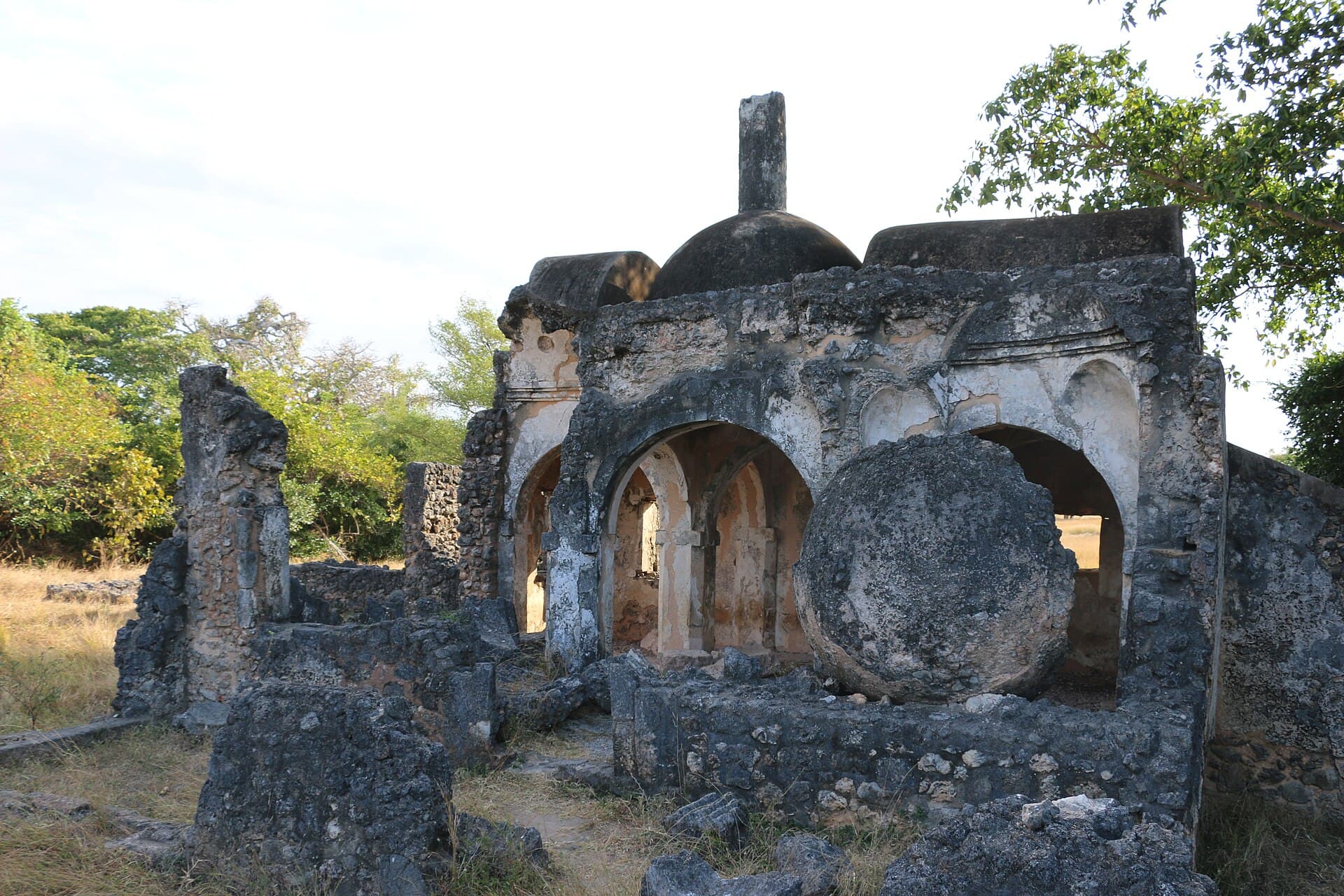
On a low coral island off the southern coast of Tanzania, some 300 kilometres below Dar es Salaam, the walls of a medieval port still stand in the scrub. Kilwa Kisiwani was occupied from the ninth century to the nineteenth, and at its height its merchants dealt in gold, pearls, perfume, Persian earthenware and Chinese porcelain, handling much of the trade of the Indian Ocean (UNESCO). Since 1981 its ruins, with those of neighbouring Songo Mnara, have formed one World Heritage property. Kilwa also left something rarer than walls: a written account of itself, in Arabic, naming its own kings.
Kilwa began modestly, founded early in the ninth century on an island of thin topsoil and no rivers. Its fortune turned on one acquisition. Late in the twelfth century it took Sofala, far south on the coast of what is now Mozambique, where the gold of the interior reached the sea. The metal came off the plateau between the Zambezi and the Limpopo, the country of Great Zimbabwe and later of Mutapa. Whoever held Sofala took a share of that traffic, and the revenue paid for what Kilwa built afterwards (World History Encyclopedia).
The rest came from being a harbour where ships could wait. Dhows crossing to Arabia and India ran on the monsoon, which reverses twice a year and fixes when a vessel may sail, so cargoes held back by the wind were warehoused here. Out went ivory, tortoiseshell, copper ingots, mangrove poles, incense, grain, and enslaved people from the interior. By the fifteenth century the sultanate claimed overlordship from Sofala north to Malindi.
The buildings are coral: reef limestone dressed into blocks, set in lime mortar, roofed with cut coral over mangrove poles. UNESCO dates the Great Mosque's first construction to the eleventh century and a substantial enlargement to the thirteenth, describes it as roofed entirely with domes and vaults, some decorated with Chinese porcelain embedded in the plaster, and calls it the oldest standing mosque on the East African coast, its sixteen domed and vaulted bays giving it a plan found nowhere else. Its great dome, by that account, was East Africa's largest until the nineteenth century.
The superlatives deserve caution. Other summaries call it one of the earliest partially surviving mosques on the Swahili coast, and the dome's dating is unsettled: the southern extension carrying it is often assigned to the early fourteenth century and to Sultan al-Hasan ibn Sulaiman, whose reign also saw the roof come down (Wikipedia). The ambition is not in dispute: a congregational mosque without a courtyard, wholly enclosed and vaulted, at a scale nothing else on the coast attempted.
The Moroccan traveller Ibn Battuta reached Kilwa in 1331 and called it "one of the most beautiful towns in the world," praising the open-handedness of its sultan and describing the mosque's new dome. He also reported the building as timber when its stone walls already stood, a caution about visitors' accounts as evidence.
East of the town, on a promontory above the water, stand the remains of Husuni Kubwa, the great palace. UNESCO dates it to roughly 1310 to 1333, under the same al-Hasan ibn Sulaiman who extended the mosque. It covered close to a hectare, reached by a stair cut into the rock from the shore, and held an audience court with tiered seating, over a hundred rooms, domed ceilings and barrel vaults, and an octagonal bathing pool. Storerooms took about half the floor area, which tells you what it was: a residence that was also a warehouse, its outer plaster studded with Chinese porcelain. For reasons nobody has established, the palace was lived in only briefly and abandoned before completion, and no surviving source, Kilwan or Portuguese, describes a building like it.
Kilwa struck its own money. UNESCO dates the minting to the eleventh through fourteenth centuries; other accounts run it later. The coins are mostly copper, small and thin, carrying the ruler's name on one face and a rhyming religious phrase on the other. The earliest series names Ali bin al-Hasan, whom the city's own chronicle credits with founding the dynasty, and the numismatic evidence places him in the mid-eleventh century (Brielle et al., Nature). Caches turn up in the buildings themselves, pots of coins set inside the walls of the Great Mosque, and finds have been recorded as far inland as Great Zimbabwe.
One much-repeated claim needs care. In 1944 an Australian serviceman on Marchinbar Island, in the Wessel Islands off Arnhem Land, found nine coins in the sand; four were later identified as Dutch East India Company issues and five as Kilwan, and another thought to be Kilwan turned up on Elcho Island in 2018 (Wikipedia). Neither find came from a dated deposit, and a coin loose on a beach carries no date of arrival. They have been much used as evidence for early contact with northern Australia; on their own they do not establish it. The claim is contested.
Around 1520, a century before most of the written history of this coast was set down by anyone, Kilwa produced an account of its own dynasty. Two versions survive. The Arabic text, the Kitab al-Sulwa, was edited from a manuscript and published by S. Arthur Strong in the Journal of the Royal Asiatic Society in 1895. The Portuguese version sits inside João de Barros's Décadas da Ásia, printed at Lisbon in 1552 from a Kilwan account the Portuguese had obtained. The genealogies broadly agree; much else varies, and the two are not always in concordance (Wikipedia).
The chronicle opens with a story. Ali ibn al-Hasan, a son of a ruler of Shiraz, driven from his inheritance by his brothers, sails down the coast and buys the island from a mainland king for as much coloured cloth as will reach around it; when the seller changes his mind, the newcomers cut through the tidal land bridge and Kilwa becomes an island in fact. From there the text runs the succession forward, sultan by sultan, to the Portuguese.
Historians do not read this as an annal. The founding narrative is treated as legend, a charter myth of the kind coastal towns told about themselves, and the cloth-and-land-bridge episode as folklore. The regnal lists are used, but corrected: the chronicle dates Ali ibn al-Hasan to about 957, while the coins bearing his name put him a century later. Edward Saad's 1979 study of Kilwa's dynastic historiography remains the standard critical treatment. The text is most valuable as evidence for how Kilwa's elite in 1520 wished its past understood, a question separate from what happened in the tenth century.
Here is why that matters. For a long stretch of the modern period, European and colonial accounts of eastern Africa began from an assumption that the coral towns and vaulted mosques were too accomplished to be African work and must have been planted by Persians or Arabs. Mid-twentieth-century archaeologists built that reading into their interpretation of coastal sites. Kilwa is where the assumption was easiest to test, because the people concerned had written down who they were, and the document was there to be read, in two languages, since 1552 and 1895.
The colonial reading did not overlook the chronicle. It took one episode, the arrival from Shiraz, and treated that as the meaning of the whole. The centuries of local politics in the same text, the ministers and the successions and the money, went largely unused.
The physical evidence has since caught up. In 2023 a team sequenced ancient DNA from eighty individuals buried at six coastal towns, Kilwa Kisiwani and Songo Mnara among them. Persian ancestry is real and appears from about the year 1000, and it is overwhelmingly male; the African ancestry is overwhelmingly female; and on this southern coast the African share is the larger, around three-quarters at Kilwa (Brielle et al., Nature). Genetics cannot confirm a voyage, as the authors say. What it shows is mixing, at roughly the moment the chronicle describes, in a society that spoke a Bantu language and kept its own books.
By the end of the fifteenth century Kilwa was weak from the inside. Viziers had become kingmakers; after the murder of Sultan al-Fudail the usurper Emir Ibrahim took power without taking the title, and the vassal towns, refusing to recognise him, went their own way. The Portuguese arrived into that vacuum. Vasco da Gama reached the coast in 1497, Cabral failed to agree a treaty at Kilwa in 1500, and da Gama returned in 1502 to extort tribute.
In 1505 Francisco de Almeida brought his fleet into the harbour, landed some five hundred soldiers, drove Emir Ibrahim out, installed a client sultan, and raised Fort Santiago to watch him. Portuguese law followed, barring all but Portuguese shipping from the main coastal ports and putting Kilwa's merchants out of business. Within a year the client sultan was assassinated, factions fought in the streets, and much of the population fled. The Portuguese stayed only briefly, but the damage held: trade shifted north to Mombasa and did not return. The Gereza, the Swahili word for prison, stands today on the ruins of their fort.
Kilwa Kisiwani and Songo Mnara were inscribed on the World Heritage List in 1981 under criterion (iii). In 2004 the property was moved onto the List of World Heritage in Danger, because deterioration was bringing down the structures for which it had been inscribed. The pressures were the usual ones for coral on an eroding shore: vegetation forcing the masonry apart, seawater inundation, grazing livestock, and new building over unexcavated archaeology.
On 17 June 2014, meeting in Doha, the World Heritage Committee found that management and safeguarding had improved enough for the property to come off the Danger List, ten years after it went on (UNESCO). The site remains exposed: wave action, thin community participation and an incomplete conservation programme are named as live issues, and two related groups of remains, at Kilwa Kivinje and Sanje ya Kati, lie outside the boundary.
About a thousand people live on the island today, in a hamlet reached by small boat, with no roads and solar power, and much of the medieval town has never been dug. What is above ground makes an unusual case: the walls attest that a city stood here, the coins name its rulers, and the chronicle sets down what the city believed about itself. Few places whose achievements were once explained away left so much of their own testimony behind.
The gold road from Sofala
The Great Mosque and its coral domes
Husuni Kubwa, the palace on the bluff
Coins with the sultans' names on them
The city that wrote its own history
1505, and the fort in the harbour
Ruin, the Danger List, and the work of keeping
References and resources
- UNESCO World Heritage Centre, Ruins of Kilwa Kisiwani and Ruins of Songo Mnara
- UNESCO World Heritage Centre, Tanzania's Ruins of Kilwa Kisiwani and Ruins of Songo Mnara removed from the List of World Heritage in Danger, 17 June 2014
- Brielle, E. S., Fleisher, J., Wynne-Jones, S. et al., "Entwined African and Asian genetic roots of medieval peoples of the Swahili coast," Nature 615 (2023)
- World History Encyclopedia, Kilwa
- Wikipedia, Kilwa Chronicle, Kilwa Sultanate, Kilwa Kisiwani, and Great Mosque of Kilwa
- S. Arthur Strong, "The History of Kilwa, edited from an Arabic MS," Journal of the Royal Asiatic Society (1895)