Heritage · Country
China Culture and Heritage
Each spring, families climb to the graves of their forebears to sweep the stone, burn incense and report the year's news to the dead. China keeps faith with one of the world's oldest continuous civilisations through tomb-sweeping and hungry-ghost rites, lineage halls and genealogies that run back scores of generations.Written to last.
By Confinity Heritage Editorial · Updated 2026-07-31 · 8-minute readQuiet tools, kept out of the way.
Chinese writing began as a way of speaking to the dead. More than three thousand years ago the kings of the Shang dynasty put questions to their ancestors by heating ox shoulder-blades and turtle shells until they cracked, read the fractures for an answer, and carved the exchange into the bone. Tens of thousands of these oracle bones survive, the earliest substantial body of Chinese script and the parent of every character written in the language today, and UNESCO added them to its Memory of the World register in 2017. At the root of one of the world's oldest continuous civilisations, in other words, sits an act of remembrance: a living generation consulting the ones who went before.
That habit never left. Each spring, at the festival of Qingming, many millions of Chinese people return to family graves to pull the weeds, sweep the stone, set out food and burn paper money for relatives to spend in the next world. Ancestors keep their places on household altars and in genealogies that run back dozens of generations; lineage halls bind whole villages to a shared forebear; and a summer festival opens the gates of the underworld so that the wandering dead may be fed. China also carries painful memory. The twentieth century brought war and upheaval, and between 1966 and 1976 a political campaign damaged much of the country's built heritage before a long work of restoration began.
China occupies some 9.6 million square kilometres of eastern Asia, its landscape descending like a staircase from the Tibetan Plateau and the Himalayas in the west to the fertile plains and long coastline of the east. Two great rivers shaped the civilisation: the Yellow River (Huang He), whose loess valleys cradled the earliest dynasties, and the Yangtze (Chang Jiang), the longest river in Asia.
With roughly 1.4 billion people, China was long the most populous nation on earth, though its population has recently begun to decline. About 92 per cent are Han Chinese, with 55 further recognised ethnic groups, among them the Zhuang, Manchu, Hui, Uyghur, Miao, Yi, Tibetan and Mongol peoples. The country is organised into 22 provinces, five autonomous regions, four municipalities and two special administrative regions, Hong Kong and Macau; the capital is Beijing. China holds one of the largest collections of UNESCO World Heritage sites of any nation, reaching 61 inscriptions in July 2026 with the listing of the Jingdezhen porcelain-kiln sites, rivalled only by Italy.
Beijing. The capital under the Ming, Qing and later governments is arranged around the Forbidden City, the vast palace complex built between 1406 and 1420 that now houses the Palace Museum. The Temple of Heaven, the Summer Palace and the nearby ramparts of the Great Wall are all inscribed as World Heritage, and in 2024 the ceremonial Central Axis of the old city joined the list.
Xi'an. As Chang'an, this was the capital of the Zhou, Qin, Han and Tang dynasties and the eastern anchor of the Silk Road. Its Ming-era city walls are among the most complete in China, and a few kilometres east lies the Mausoleum of the First Qin Emperor with its buried army of terracotta soldiers.
Nanjing. The "southern capital" served several dynasties and holds the tomb of the founding Ming emperor. It also keeps a memorial hall to the mass killings of 1937 during the Japanese occupation, one of the country's principal sites of modern public mourning.
Hangzhou. Capital of the Southern Song and southern terminus of the Grand Canal, Hangzhou is known for West Lake, a landscape of causeways, pagodas and gardens inscribed as a cultural landscape in 2011.
Qufu. The birthplace of Confucius in Shandong preserves the Temple of Confucius, the Kong Family Mansion and the Cemetery of Confucius, where the philosopher and his descendants have been buried for well over two thousand years, together inscribed as World Heritage in 1994.
Farming villages along the Yellow River gave rise to the painted-pottery Yangshao and later Longshan cultures. Written history opens with the Shang dynasty of the second millennium BC, whose oracle bones, unearthed at the Yin ruins near Anyang, record divination, sacrifice and the names of kings. The long Zhou dynasty that followed produced the philosophical ferment of the Spring and Autumn and Warring States eras, when Confucius and Laozi lived and the foundations of Chinese thought were laid.
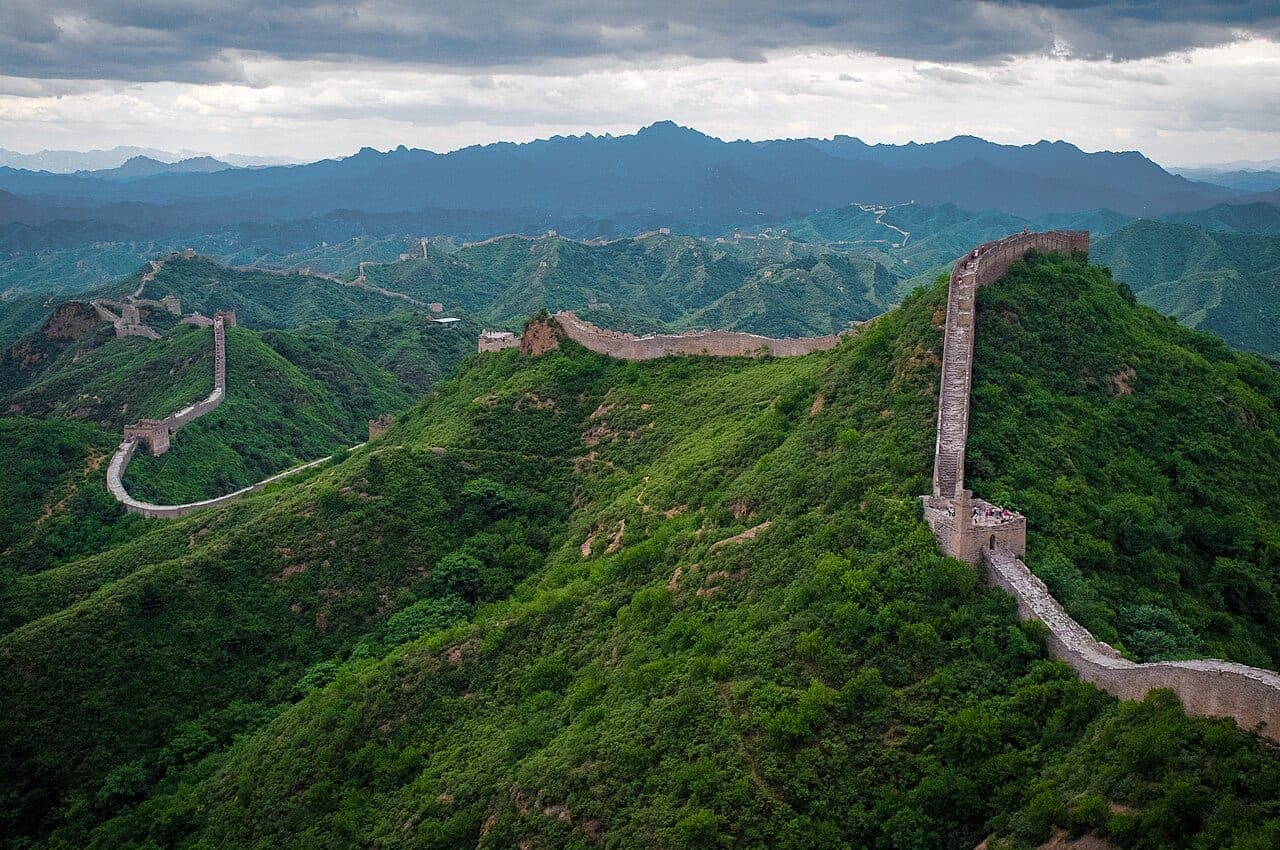
 The wall at Mutianyu. What is usually called the Great Wall is many walls, built and rebuilt across some two thousand years. Photograph by xiquinhosilva, CC BY 2.0, via Wikimedia Commons.
In 221 BC the state of Qin conquered its rivals and its ruler declared himself Qin Shi Huang, first emperor of a unified China; he standardised the script, coinage, weights and measures and linked earlier frontier walls into a single defensive system. The Han dynasty (206 BC to 220 AD) made Confucian learning the basis of government and opened the Silk Road, and after centuries of division the Tang (618 to 907) presided over a golden age of poetry and Buddhist art. The Song advanced printing, the compass and gunpowder; the Mongol Yuan governed a Eurasian empire; the Ming (1368 to 1644) built the Forbidden City and the surviving Great Wall; and the Manchu Qing (1644 to 1912) was the last of the imperial dynasties, whose fall in 1912 ended more than two thousand years of dynastic rule. The decades that followed brought civil conflict, the Japanese invasion and the Second World War; the People's Republic was founded in 1949, and the years from 1966 to 1976 saw the political movement known as the Cultural Revolution.
Chinese forms the Sinitic branch of the Sino-Tibetan language family and is written not with an alphabet but with characters, each standing for a syllable and a unit of meaning. The script's ancestry runs in an unbroken line from the Shang oracle bones to the forms in use today. The First Emperor's standardisation of the characters in the third century BC gave a country of many spoken tongues a single written language, a unity that has held ever since.
Those spoken tongues remain numerous. Mandarin, promoted in its standard form as Putonghua, is the national language, but Cantonese, Wu (including Shanghainese), Min, Hakka and others are mutually unintelligible in speech while sharing the written script. The mainland later simplified many characters and adopted the pinyin romanisation, while traditional characters remain in use in Hong Kong, Macau and among overseas communities. The country's own name for itself, Zhongguo, is usually rendered "Middle Kingdom" or "central state"; the English word "China" descends instead from the Qin dynasty, carried west through Sanskrit and Persian long before Europeans reached the country. Calligraphy, the art of writing the characters, is honoured among the highest of the visual arts and is inscribed on UNESCO's intangible heritage list.
Chinese culture is built around the family and its continuity, an outlook shaped above all by Confucian ethics: the duties owed between parent and child, elder and younger, ruler and subject, and the ideal of social harmony. Its classical arts include calligraphy, ink painting, poetry and the qin zither, and its craft traditions reached extraordinary refinement in silk, jade, lacquer and above all porcelain, whose kilns at Jingdezhen supplied emperors and, eventually, the world.
The performing arts carry their own long descent, from the stately Kunqu opera to the Peking opera codified in the nineteenth century. The festival calendar orders the year: the Spring Festival, or Lunar New Year, the most important, with its reunions and ancestral offerings; Qingming in spring; the Dragon Boat Festival in summer; and the Mid-Autumn Festival with its mooncakes. Cuisine is regional to its core, the cooking of Sichuan, Canton, Shandong and Jiangsu amounting to distinct culinary worlds.
Chinese spiritual life has rarely demanded that a person choose a single faith. For most of the country's history three teachings coexisted and blended: Confucianism, less a religion than a moral and social order; Daoism, the native tradition traced to the sage Laozi and the classic ascribed to him, the Dao De Jing; and Buddhism, which arrived from India along the Silk Road in the Han period and grew into distinctly Chinese schools such as Chan, the ancestor of Japanese Zen, and Pure Land. Beneath and around these ran a folk religion of local gods, kitchen deities, city guardians and, everywhere, the ancestors.
Sacred geography maps this diversity: the Five Great Mountains of the Daoist tradition, the four mountains holy to Buddhism, and cave temples such as Mogao, Longmen and Yungang, where the faithful carved the Buddha into living rock. Islam has been present since the Tang dynasty among the Hui and other peoples, and Christianity has a long if smaller history. The modern state is officially secular, yet the practices that touch nearly every household, the veneration of ancestors and the rites of the family dead, belong less to any one creed than to the shared culture itself.
Ancestor veneration is the oldest continuous religious practice in China, reaching back past the Shang kings who consulted their forebears on oracle bones. Its moral engine is filial piety, xiao, the duty of children to honour and care for their parents, which Confucian teaching extends beyond the grave: the dead remain members of the family, owed the same respect as the living. The virtue is set out in the Classic of Filial Piety and lies at the centre of Confucian ethics. In practice it means the family altar, where spirit tablets naming the ancestors, often beside their photographs, receive incense, fruit and the family's news.
The wall at Mutianyu. What is usually called the Great Wall is many walls, built and rebuilt across some two thousand years. Photograph by xiquinhosilva, CC BY 2.0, via Wikimedia Commons.
In 221 BC the state of Qin conquered its rivals and its ruler declared himself Qin Shi Huang, first emperor of a unified China; he standardised the script, coinage, weights and measures and linked earlier frontier walls into a single defensive system. The Han dynasty (206 BC to 220 AD) made Confucian learning the basis of government and opened the Silk Road, and after centuries of division the Tang (618 to 907) presided over a golden age of poetry and Buddhist art. The Song advanced printing, the compass and gunpowder; the Mongol Yuan governed a Eurasian empire; the Ming (1368 to 1644) built the Forbidden City and the surviving Great Wall; and the Manchu Qing (1644 to 1912) was the last of the imperial dynasties, whose fall in 1912 ended more than two thousand years of dynastic rule. The decades that followed brought civil conflict, the Japanese invasion and the Second World War; the People's Republic was founded in 1949, and the years from 1966 to 1976 saw the political movement known as the Cultural Revolution.
Chinese forms the Sinitic branch of the Sino-Tibetan language family and is written not with an alphabet but with characters, each standing for a syllable and a unit of meaning. The script's ancestry runs in an unbroken line from the Shang oracle bones to the forms in use today. The First Emperor's standardisation of the characters in the third century BC gave a country of many spoken tongues a single written language, a unity that has held ever since.
Those spoken tongues remain numerous. Mandarin, promoted in its standard form as Putonghua, is the national language, but Cantonese, Wu (including Shanghainese), Min, Hakka and others are mutually unintelligible in speech while sharing the written script. The mainland later simplified many characters and adopted the pinyin romanisation, while traditional characters remain in use in Hong Kong, Macau and among overseas communities. The country's own name for itself, Zhongguo, is usually rendered "Middle Kingdom" or "central state"; the English word "China" descends instead from the Qin dynasty, carried west through Sanskrit and Persian long before Europeans reached the country. Calligraphy, the art of writing the characters, is honoured among the highest of the visual arts and is inscribed on UNESCO's intangible heritage list.
Chinese culture is built around the family and its continuity, an outlook shaped above all by Confucian ethics: the duties owed between parent and child, elder and younger, ruler and subject, and the ideal of social harmony. Its classical arts include calligraphy, ink painting, poetry and the qin zither, and its craft traditions reached extraordinary refinement in silk, jade, lacquer and above all porcelain, whose kilns at Jingdezhen supplied emperors and, eventually, the world.
The performing arts carry their own long descent, from the stately Kunqu opera to the Peking opera codified in the nineteenth century. The festival calendar orders the year: the Spring Festival, or Lunar New Year, the most important, with its reunions and ancestral offerings; Qingming in spring; the Dragon Boat Festival in summer; and the Mid-Autumn Festival with its mooncakes. Cuisine is regional to its core, the cooking of Sichuan, Canton, Shandong and Jiangsu amounting to distinct culinary worlds.
Chinese spiritual life has rarely demanded that a person choose a single faith. For most of the country's history three teachings coexisted and blended: Confucianism, less a religion than a moral and social order; Daoism, the native tradition traced to the sage Laozi and the classic ascribed to him, the Dao De Jing; and Buddhism, which arrived from India along the Silk Road in the Han period and grew into distinctly Chinese schools such as Chan, the ancestor of Japanese Zen, and Pure Land. Beneath and around these ran a folk religion of local gods, kitchen deities, city guardians and, everywhere, the ancestors.
Sacred geography maps this diversity: the Five Great Mountains of the Daoist tradition, the four mountains holy to Buddhism, and cave temples such as Mogao, Longmen and Yungang, where the faithful carved the Buddha into living rock. Islam has been present since the Tang dynasty among the Hui and other peoples, and Christianity has a long if smaller history. The modern state is officially secular, yet the practices that touch nearly every household, the veneration of ancestors and the rites of the family dead, belong less to any one creed than to the shared culture itself.
Ancestor veneration is the oldest continuous religious practice in China, reaching back past the Shang kings who consulted their forebears on oracle bones. Its moral engine is filial piety, xiao, the duty of children to honour and care for their parents, which Confucian teaching extends beyond the grave: the dead remain members of the family, owed the same respect as the living. The virtue is set out in the Classic of Filial Piety and lies at the centre of Confucian ethics. In practice it means the family altar, where spirit tablets naming the ancestors, often beside their photographs, receive incense, fruit and the family's news.
 The terracotta army was grave goods. Thousands of individually modelled soldiers were buried to serve one man after his death. Photograph by xiquinhosilva, CC BY 2.0, via Wikimedia Commons.
The great public expression of this bond is Qingming, the tomb-sweeping festival, held in early April around the fifteenth day after the spring equinox. Its rites of grave maintenance and ancestral worship are recorded as far back as the Zhou dynasty, were made an official holiday by the Tang emperor Xuanzong in 732, and were restored as a national public holiday in the People's Republic in 2008. Families clear the weeds, repaint the inscription, lay out food and wine, and burn joss paper and paper models of goods so that relatives want for nothing in the next world. Its counterpart falls in high summer, on the fifteenth day of the seventh lunar month: the festival known to Daoists as Zhongyuan and to Buddhists as Yulanpen, the Hungry Ghost Festival, when the dead are believed to return among the living and offerings are made to feed wandering and ancestral spirits alike. Its Buddhist form takes its story from the monk Mulian, who descended to the underworld to save his mother from suffering as a hungry ghost; families mark the day with offerings, burning paper goods and floating lanterns to guide the spirits.
Memory in China is also organised by lineage. In the southern provinces especially, ancestral halls, or citang, stand at the heart of villages, housing the tablets of a founding forebear and gathering the clan for worship. Families keep genealogies, the jiapu or zupu, tracing descent across many generations and periodically revised and reprinted. The most famous is the genealogy of the descendants of Confucius, whose 2009 edition ran to some two million names across more than eighty generations and is recognised as the longest family tree in the world. Traditional funerary custom, in which white rather than black is the colour of mourning, surrounds death with stages of vigil, procession and periodic memorial. Modern life has added new forms, from urban columbaria and sea burials to online memorial pages where relatives sweep a virtual tomb, but the underlying grammar, that the dead are kept and tended, has held.
Autumn brings the second of the year's grave-tending days. The Double Ninth, Chongyang, falls on the ninth day of the ninth lunar month, when families climb high ground, carry dogwood and drink chrysanthemum wine. In Hong Kong and Macau it is a public holiday spent at the hillside cemeteries; on the mainland the same date has since been designated a day for the elderly, so one festival now attends to both ends of the same obligation.
Immediately before Qingming sits the festival it swallowed. At the Cold Food Festival, Hanshi, no fire could be lit and everything was eaten cold, in penance for a duke who set a forest alight to force a loyal servant out of it and killed him instead. The two fell in the same week, ran together over centuries, and the merged version kept the grave-sweeping and dropped the hard part.
Chinese families have kept their own records for longer than most states have kept any, and the form is the jiapu, the clan genealogy. A jiapu is compiled by the lineage rather than the government, revised every few decades, and traces descent through the male line, sometimes across dozens of generations. Libraries in China hold tens of thousands of them and the Shanghai Library's collection is the largest anywhere.
The twentieth century treated them badly. Lineage halls were closed, land was redistributed and during the Cultural Revolution genealogies were burned as feudal remnants, sometimes by the families that owned them. A great many survived by being hidden, buried or carried abroad, and since the 1980s the recompilation of jiapu has become a substantial movement in its own right, with villages reconstructing from memory what was destroyed within living memory.
The state record is the hukou, the household registration system, formalised in 1958. It is administrative rather than genealogical and it is not open to researchers, but it governs where a person may legally live and it records where a family is from, which is often the fact a descendant abroad most needs.
For the diaspora the most remarkable archive is the qiaopi. From the nineteenth century, emigrants in Southeast Asia and the Americas sent letters home with money enclosed, carried by private couriers, and the families kept them. Something over 160,000 of these letters and remittance slips survive, mostly in Guangdong and Fujian, and UNESCO added them to the Memory of the World Register in 2013. They are the correspondence of ordinary migrant workers, kept by the people who received it.
Protection of the country's monuments is coordinated by the National Cultural Heritage Administration under the Cultural Relics Protection Law of 1982. The scale is large. A national survey completed in 2012 measured the Great Wall, in all its dynasties, at 21,196 kilometres, of which the well-preserved Ming sections account for about 8,850. The buried army of the First Emperor, discovered by well-diggers near Xi'an in 1974 and thought to include around 8,000 individually modelled figures, was inscribed as World Heritage in 1987, alongside the Forbidden City and the Mogao Caves. The Grand Canal was added in 2014 and the Confucius sites at Qufu in 1994.
This record carries a sober chapter. During the Cultural Revolution of 1966 to 1976, a campaign to "destroy the Four Olds", old ideas, customs, culture and habits, led to the damage or destruction of a large share of the country's cultural relics; one later survey found that thousands of the 6,843 heritage sites recorded in Beijing in 1958 had been harmed. Among the sites attacked was the Temple and Cemetery of Confucius at Qufu, vandalised in 1966. In the decades since, the state has invested heavily in restoration and expanded legal protection. China also leads the world in living traditions: its 44 elements on UNESCO's intangible cultural heritage lists, the most of any country, include Kunqu opera, Chinese calligraphy, acupuncture and, added in 2024, the Spring Festival.
China has embraced digital preservation on a large scale. The most advanced surrounds the Mogao Caves at Dunhuang, a 1,600-year-old complex of Buddhist grottoes in the Gobi Desert. The Dunhuang Academy began scanning the murals in the 1990s, launched the Digital Dunhuang platform in 2016, and has since created high-resolution records of 735 caves, amounting to more than 600 terabytes of data, sparing fragile paintings the wear of visitors while opening them far beyond the desert.
The Palace Museum has digitised much of its collection of more than a million objects, publishing high-resolution images online. Oracle-bone studies have moved online too, with the roughly 150,000 known fragments increasingly catalogued and researchers turning to artificial intelligence and crowdsourced transcription to decipher the many characters still unread. The same instinct has reached remembrance: websites now let families who cannot travel at Qingming tend an online memorial and leave virtual offerings.
Chinese culture reaches the wider world through a diaspora of tens of millions, whose clan associations and lineage networks keep the Spring Festival, Qingming and ancestral worship alive on every continent, while Chinese cuisine, the martial arts and tea culture have found global followings.
In the arts, the novelist Mo Yan won the Nobel Prize in Literature in 2012, Liu Cixin's science-fiction trilogy beginning with The Three-Body Problem has been translated worldwide, and directors such as Zhang Yimou brought Chinese cinema to global audiences. What travels outward most reliably, though, is the family calendar: wherever Chinese communities settle, the reunion dinner at New Year and the tending of the ancestors return each year, carrying a habit of remembrance into new lands.
The oldest script recovered and read. The Shang oracle bones, the earliest Chinese writing, were inscribed on UNESCO's Memory of the World register in 2017, and the effort to decipher their characters continues with digital catalogues and computational tools, keeping a three-thousand-year-old record legible.
Dunhuang preserved twice over. The Dunhuang Academy's decades of imaging have produced high-resolution digital copies of 735 caves at Mogao, safeguarding the murals against decay and mass tourism while opening one of the great Buddhist art sites to anyone with a screen.
A lineage that would not be broken. The genealogy of the descendants of Confucius, its revision interrupted by the upheavals of the twentieth century, was completed again in 2009 with some two million names, and the temple and cemetery at Qufu damaged in 1966 have been restored as a place of pilgrimage.
Newly recognised heritage. The Xixia Imperial Tombs in 2025 and the Jingdezhen porcelain-kiln sites in July 2026 carried China's World Heritage total to 61, honouring the funerary landscape of a lost dynasty and the craft city that gave the world fine porcelain.
The terracotta army was grave goods. Thousands of individually modelled soldiers were buried to serve one man after his death. Photograph by xiquinhosilva, CC BY 2.0, via Wikimedia Commons.
The great public expression of this bond is Qingming, the tomb-sweeping festival, held in early April around the fifteenth day after the spring equinox. Its rites of grave maintenance and ancestral worship are recorded as far back as the Zhou dynasty, were made an official holiday by the Tang emperor Xuanzong in 732, and were restored as a national public holiday in the People's Republic in 2008. Families clear the weeds, repaint the inscription, lay out food and wine, and burn joss paper and paper models of goods so that relatives want for nothing in the next world. Its counterpart falls in high summer, on the fifteenth day of the seventh lunar month: the festival known to Daoists as Zhongyuan and to Buddhists as Yulanpen, the Hungry Ghost Festival, when the dead are believed to return among the living and offerings are made to feed wandering and ancestral spirits alike. Its Buddhist form takes its story from the monk Mulian, who descended to the underworld to save his mother from suffering as a hungry ghost; families mark the day with offerings, burning paper goods and floating lanterns to guide the spirits.
Memory in China is also organised by lineage. In the southern provinces especially, ancestral halls, or citang, stand at the heart of villages, housing the tablets of a founding forebear and gathering the clan for worship. Families keep genealogies, the jiapu or zupu, tracing descent across many generations and periodically revised and reprinted. The most famous is the genealogy of the descendants of Confucius, whose 2009 edition ran to some two million names across more than eighty generations and is recognised as the longest family tree in the world. Traditional funerary custom, in which white rather than black is the colour of mourning, surrounds death with stages of vigil, procession and periodic memorial. Modern life has added new forms, from urban columbaria and sea burials to online memorial pages where relatives sweep a virtual tomb, but the underlying grammar, that the dead are kept and tended, has held.
Autumn brings the second of the year's grave-tending days. The Double Ninth, Chongyang, falls on the ninth day of the ninth lunar month, when families climb high ground, carry dogwood and drink chrysanthemum wine. In Hong Kong and Macau it is a public holiday spent at the hillside cemeteries; on the mainland the same date has since been designated a day for the elderly, so one festival now attends to both ends of the same obligation.
Immediately before Qingming sits the festival it swallowed. At the Cold Food Festival, Hanshi, no fire could be lit and everything was eaten cold, in penance for a duke who set a forest alight to force a loyal servant out of it and killed him instead. The two fell in the same week, ran together over centuries, and the merged version kept the grave-sweeping and dropped the hard part.
Chinese families have kept their own records for longer than most states have kept any, and the form is the jiapu, the clan genealogy. A jiapu is compiled by the lineage rather than the government, revised every few decades, and traces descent through the male line, sometimes across dozens of generations. Libraries in China hold tens of thousands of them and the Shanghai Library's collection is the largest anywhere.
The twentieth century treated them badly. Lineage halls were closed, land was redistributed and during the Cultural Revolution genealogies were burned as feudal remnants, sometimes by the families that owned them. A great many survived by being hidden, buried or carried abroad, and since the 1980s the recompilation of jiapu has become a substantial movement in its own right, with villages reconstructing from memory what was destroyed within living memory.
The state record is the hukou, the household registration system, formalised in 1958. It is administrative rather than genealogical and it is not open to researchers, but it governs where a person may legally live and it records where a family is from, which is often the fact a descendant abroad most needs.
For the diaspora the most remarkable archive is the qiaopi. From the nineteenth century, emigrants in Southeast Asia and the Americas sent letters home with money enclosed, carried by private couriers, and the families kept them. Something over 160,000 of these letters and remittance slips survive, mostly in Guangdong and Fujian, and UNESCO added them to the Memory of the World Register in 2013. They are the correspondence of ordinary migrant workers, kept by the people who received it.
Protection of the country's monuments is coordinated by the National Cultural Heritage Administration under the Cultural Relics Protection Law of 1982. The scale is large. A national survey completed in 2012 measured the Great Wall, in all its dynasties, at 21,196 kilometres, of which the well-preserved Ming sections account for about 8,850. The buried army of the First Emperor, discovered by well-diggers near Xi'an in 1974 and thought to include around 8,000 individually modelled figures, was inscribed as World Heritage in 1987, alongside the Forbidden City and the Mogao Caves. The Grand Canal was added in 2014 and the Confucius sites at Qufu in 1994.
This record carries a sober chapter. During the Cultural Revolution of 1966 to 1976, a campaign to "destroy the Four Olds", old ideas, customs, culture and habits, led to the damage or destruction of a large share of the country's cultural relics; one later survey found that thousands of the 6,843 heritage sites recorded in Beijing in 1958 had been harmed. Among the sites attacked was the Temple and Cemetery of Confucius at Qufu, vandalised in 1966. In the decades since, the state has invested heavily in restoration and expanded legal protection. China also leads the world in living traditions: its 44 elements on UNESCO's intangible cultural heritage lists, the most of any country, include Kunqu opera, Chinese calligraphy, acupuncture and, added in 2024, the Spring Festival.
China has embraced digital preservation on a large scale. The most advanced surrounds the Mogao Caves at Dunhuang, a 1,600-year-old complex of Buddhist grottoes in the Gobi Desert. The Dunhuang Academy began scanning the murals in the 1990s, launched the Digital Dunhuang platform in 2016, and has since created high-resolution records of 735 caves, amounting to more than 600 terabytes of data, sparing fragile paintings the wear of visitors while opening them far beyond the desert.
The Palace Museum has digitised much of its collection of more than a million objects, publishing high-resolution images online. Oracle-bone studies have moved online too, with the roughly 150,000 known fragments increasingly catalogued and researchers turning to artificial intelligence and crowdsourced transcription to decipher the many characters still unread. The same instinct has reached remembrance: websites now let families who cannot travel at Qingming tend an online memorial and leave virtual offerings.
Chinese culture reaches the wider world through a diaspora of tens of millions, whose clan associations and lineage networks keep the Spring Festival, Qingming and ancestral worship alive on every continent, while Chinese cuisine, the martial arts and tea culture have found global followings.
In the arts, the novelist Mo Yan won the Nobel Prize in Literature in 2012, Liu Cixin's science-fiction trilogy beginning with The Three-Body Problem has been translated worldwide, and directors such as Zhang Yimou brought Chinese cinema to global audiences. What travels outward most reliably, though, is the family calendar: wherever Chinese communities settle, the reunion dinner at New Year and the tending of the ancestors return each year, carrying a habit of remembrance into new lands.
The oldest script recovered and read. The Shang oracle bones, the earliest Chinese writing, were inscribed on UNESCO's Memory of the World register in 2017, and the effort to decipher their characters continues with digital catalogues and computational tools, keeping a three-thousand-year-old record legible.
Dunhuang preserved twice over. The Dunhuang Academy's decades of imaging have produced high-resolution digital copies of 735 caves at Mogao, safeguarding the murals against decay and mass tourism while opening one of the great Buddhist art sites to anyone with a screen.
A lineage that would not be broken. The genealogy of the descendants of Confucius, its revision interrupted by the upheavals of the twentieth century, was completed again in 2009 with some two million names, and the temple and cemetery at Qufu damaged in 1966 have been restored as a place of pilgrimage.
Newly recognised heritage. The Xixia Imperial Tombs in 2025 and the Jingdezhen porcelain-kiln sites in July 2026 carried China's World Heritage total to 61, honouring the funerary landscape of a lost dynasty and the craft city that gave the world fine porcelain.
National Overview
Notable Cities
Historical Foundations
Linguistic and Etymological Roots
Cultural Identity
Religion and Spirituality
Remembrance and Mourning Traditions
Tracing a Family in China
Heritage Preservation Efforts
Digital Heritage
Contemporary Cultural Influences
Success Stories
References and resources
- UNESCO World Heritage Centre: China. The state-party page listing China's World Heritage sites.
- UNESCO Memory of the World: Chinese Oracle-Bone Inscriptions. The 2017 inscription of China's earliest writing.
- Encyclopaedia Britannica: Qingming Festival. The history and rites of the tomb-sweeping festival.
- Encyclopaedia Britannica: Hungry Ghost Festival. The Zhongyuan and Yulanpen observances of the seventh lunar month.
- Encyclopaedia Britannica: Qin tomb. The Mausoleum of the First Emperor and the Terracotta Army.
- Encyclopaedia Britannica: Four Olds. The Cultural Revolution campaign and its effect on heritage.
- Government of China: UNESCO inscribes Spring Festival. China's 44 intangible heritage elements, the most of any country.
- CGTN: China protects cultural heritage with digitalization. The Digital Dunhuang project and the digitising of the caves.
- Taipei Times: New Confucius family tree hits two million. The 2009 edition of the world's longest genealogy.