Heritage · Country
Norway Culture and Heritage
In 1844 a handful of antiquarians began buying Norway's medieval stave churches outright to stop farmers from pulling them down for firewood and timber. A guide to how a small northern nation guards its wooden churches and Viking dead, and how it has learned to mourn an occupation and a massacre.Written to last.
By Confinity Heritage Editorial · 2026-07-11 · 8-minute readQuiet tools, kept out of the way.
By the middle of the nineteenth century Norway was quietly demolishing its own oldest buildings. The medieval stave churches, timber-framed and shingled black with pine tar, had stood in the valleys for seven or eight hundred years, but a growing population wanted larger churches and free building material, and one by one the old ones were being torn down. In 1844 a small group of artists and antiquarians founded the Society for the Preservation of Ancient Norwegian Monuments, and did something practical about it: they started buying the churches. Borgund, Urnes, Heddal and others were rescued this way, purchased outright or fought for in the local press, and of the roughly thousand stave churches that once existed only twenty-eight survive, nearly all because someone in the 1800s decided a wooden building could be worth more standing than felled.
That instinct, to keep the old thing rather than replace it, runs against the grain of a country that has spent much of its modern life becoming new. Norway went from one of the poorest corners of Europe to one of the richest within a single lifetime, on the back of North Sea oil, yet it has poured extraordinary care into its Viking ships, its fjord farms and its churches, and into the harder business of remembering an occupation, a resistance and, in 2011, a massacre of its own children.
 The Geirangerfjord above the village of Merok, in a Photoglob-style photochrome print of the 1890s. Public domain, via Wikimedia Commons.
Norway occupies the western and northern reaches of the Scandinavian peninsula, a long, thin country whose mainland runs some 1,750 kilometres from the Skagerrak in the south to the Barents Sea, with a coastline so deeply cut by fjords and fringed by islands that, measured around every inlet, it stretches to over 100,000 kilometres. The land is mostly mountain, forest and rock: only a small fraction is arable, glaciers still sit on the high plateaus, and the northern third lies above the Arctic Circle, where the sun does not set for weeks in summer and does not rise for weeks in winter. The country also administers the Arctic archipelago of Svalbard and, in the far south, the sub-Antarctic islands, giving a nation of modest population a very long geographic reach.
That population is small: about 5.5 million people, unevenly spread, with the great majority in the south-east around Oslo and along the coast, and vast interior districts almost empty. Norway is a constitutional monarchy under King Harald V, with a single-chamber parliament, the Storting, and one of the oldest written constitutions still in use, dating from 1814. It sits outside the European Union, having twice voted no in referendums, but is bound closely to Europe through the European Economic Area. Modern Norway is shaped above all by petroleum: oil and gas discovered in the North Sea from 1969 turned it into one of the wealthiest societies on earth, its earnings banked in a sovereign wealth fund now worth well over a trillion dollars and held, in principle, for future generations. The indigenous Sami people of the north, whose lands cross into Sweden, Finland and Russia, are a recognised people with their own parliament, and immigration over the past half-century has made the cities far more diverse than the folk-costume image of Norway suggests.
Oslo. The capital sits at the head of a long fjord, ringed by forested hills into which the city dissolves. Founded around 1000 and rebuilt after a great fire in 1624 under the Danish king Christian IV, who renamed it Christiania, it recovered its old name only in 1925. Its memory sites are national ones: Akershus Fortress, where resistance members were executed under the German occupation and which now holds the Norwegian Resistance Museum; the Vigeland installation in Frogner Park, Gustav Vigeland's vast sculpture cycle of the human life course; and the government quarter and Utøya, scarred by the terror attacks of 2011 and now the focus of national memorials.
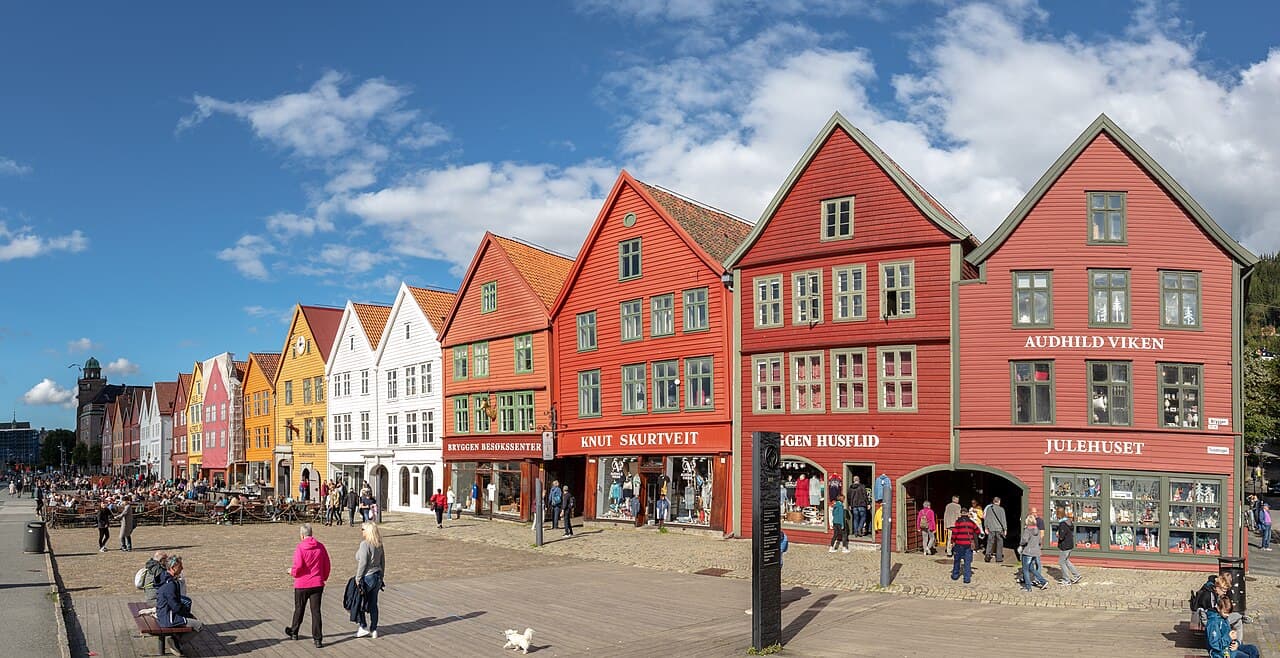
Bergen. For centuries the largest town in Norway and a Hanseatic trading post, Bergen keeps the Bryggen, the row of wooden gabled warehouses along its harbour where German merchants once ran the dried-cod trade. Repeatedly gutted by fire and each time rebuilt on the medieval foundations and along the medieval property lines, Bryggen was among Norway's first UNESCO World Heritage Sites in 1979. The city gave the world the composer Edvard Grieg, whose lakeside villa at Troldhaugen is now a museum, and it remains the gateway to the western fjords.
The Geirangerfjord above the village of Merok, in a Photoglob-style photochrome print of the 1890s. Public domain, via Wikimedia Commons.
Norway occupies the western and northern reaches of the Scandinavian peninsula, a long, thin country whose mainland runs some 1,750 kilometres from the Skagerrak in the south to the Barents Sea, with a coastline so deeply cut by fjords and fringed by islands that, measured around every inlet, it stretches to over 100,000 kilometres. The land is mostly mountain, forest and rock: only a small fraction is arable, glaciers still sit on the high plateaus, and the northern third lies above the Arctic Circle, where the sun does not set for weeks in summer and does not rise for weeks in winter. The country also administers the Arctic archipelago of Svalbard and, in the far south, the sub-Antarctic islands, giving a nation of modest population a very long geographic reach.
That population is small: about 5.5 million people, unevenly spread, with the great majority in the south-east around Oslo and along the coast, and vast interior districts almost empty. Norway is a constitutional monarchy under King Harald V, with a single-chamber parliament, the Storting, and one of the oldest written constitutions still in use, dating from 1814. It sits outside the European Union, having twice voted no in referendums, but is bound closely to Europe through the European Economic Area. Modern Norway is shaped above all by petroleum: oil and gas discovered in the North Sea from 1969 turned it into one of the wealthiest societies on earth, its earnings banked in a sovereign wealth fund now worth well over a trillion dollars and held, in principle, for future generations. The indigenous Sami people of the north, whose lands cross into Sweden, Finland and Russia, are a recognised people with their own parliament, and immigration over the past half-century has made the cities far more diverse than the folk-costume image of Norway suggests.
Oslo. The capital sits at the head of a long fjord, ringed by forested hills into which the city dissolves. Founded around 1000 and rebuilt after a great fire in 1624 under the Danish king Christian IV, who renamed it Christiania, it recovered its old name only in 1925. Its memory sites are national ones: Akershus Fortress, where resistance members were executed under the German occupation and which now holds the Norwegian Resistance Museum; the Vigeland installation in Frogner Park, Gustav Vigeland's vast sculpture cycle of the human life course; and the government quarter and Utøya, scarred by the terror attacks of 2011 and now the focus of national memorials.
Bergen. For centuries the largest town in Norway and a Hanseatic trading post, Bergen keeps the Bryggen, the row of wooden gabled warehouses along its harbour where German merchants once ran the dried-cod trade. Repeatedly gutted by fire and each time rebuilt on the medieval foundations and along the medieval property lines, Bryggen was among Norway's first UNESCO World Heritage Sites in 1979. The city gave the world the composer Edvard Grieg, whose lakeside villa at Troldhaugen is now a museum, and it remains the gateway to the western fjords.
 The fish market and harbour at Bergen, in a Library of Congress photochrome print of the 1890s. Public domain, via Wikimedia Commons.
Trondheim. Founded by the Viking king Olav Tryggvason in 997 at the mouth of the Nidelva, the old Nidaros was Norway's medieval capital and remains its spiritual centre. Nidaros Cathedral, raised over the grave of Saint Olav, is the largest medieval building in Scandinavia and the traditional site of royal consecrations; the revived pilgrimage routes, the St Olav Ways, converge on it once more, drawing walkers along the paths that medieval pilgrims followed to the shrine.
Stavanger. A modest fishing and canning town for most of its history, Stavanger became Norway's oil capital after the North Sea discoveries and now houses the Norwegian Petroleum Museum, which treats the oil age itself as heritage. Its old quarter, Gamle Stavanger, preserves one of northern Europe's largest collections of wooden houses, and nearby cliffs such as Preikestolen draw hikers to the Lysefjord.
Tromsø. The largest city of the Arctic north, Tromsø calls itself the gateway to the Arctic and was the launching point for polar expeditions; its Polar Museum records the era of Amundsen and Nansen. It is a centre of Sami and northern culture, a place to see the northern lights, and home to the world's northernmost university, cathedral and brewery, markers of a settled modern life at a latitude where few nations bother to build cities at all.
Norway's recorded story begins in earnest with the Viking Age, conventionally dated from the raid on the English monastery of Lindisfarne in 793 to the middle of the eleventh century. Norse seafarers from the western fjords raided, traded and settled across the North Atlantic, reaching Iceland, Greenland and, around the year 1000, the coast of North America at L'Anse aux Meadows, five centuries before Columbus. At home the many petty kingdoms were drawn together by kings such as Harald Fairhair, and Christianity arrived with rulers like Olav Haraldsson, killed at the Battle of Stiklestad in 1030 and soon venerated as Saint Olav, Norway's eternal king and patron. The high Middle Ages brought the great stave churches, the cathedral at Nidaros and a literate court culture, before the Black Death of 1349 killed perhaps half the population and broke the old society.
Weakened, Norway entered a long union with Denmark that lasted, in effect, from 1380 to 1814 and is sometimes remembered bitterly as the "four-hundred-year night", during which Copenhagen governed, Danish became the written language, and the Reformation was imposed from above in 1537. When Denmark, on the losing side of the Napoleonic Wars, was forced to cede Norway to Sweden in 1814, Norwegians seized the moment: at Eidsvoll that spring an assembly wrote a liberal constitution and declared independence, and though Sweden compelled a looser union, the constitution of 17 May survived and became the foundation of national identity. The nineteenth century saw a cultural awakening, the collecting of folk tales and music, and a growing nationalism that dissolved the Swedish union peacefully in 1905, when Norway chose a Danish prince as King Haakon VII. Neutral in the First World War, Norway was invaded by Nazi Germany in April 1940 and occupied for five years under the collaborator Vidkun Quisling, whose name entered the English language as a synonym for traitor; liberation came in May 1945. The oil age from 1969 transformed the economy, and the country entered the twenty-first century as one of the most prosperous and stable in the world, a stability shaken but not broken by the attacks of 22 July 2011.
The name Norway comes from the Old Norse Norðvegr, the "north way", the coastal sailing route along which the Norse travelled up the fjord-cut shore; the land was named, in other words, for the sea path that held it together. Norwegian belongs to the North Germanic branch, descended from the Old Norse of the sagas and closely related to Danish and Swedish, so that the three mainland Scandinavian languages remain broadly mutually intelligible. The long Danish period left its deepest mark on the written language, and modern Norway carries the consequence in an unusual form: it has two official written standards, Bokmål, "book tongue", close to Danish, and Nynorsk, "new Norwegian", constructed in the mid-nineteenth century by the linguist Ivar Aasen out of rural dialects to give the country a written language rooted in its own speech. Both are taught in schools and used in government, and the balance between them is still a live cultural question.
Spoken Norwegian is famously a country of dialects, valued and used with pride in public life to a degree unusual in Europe; there is no single enforced spoken standard, and a national broadcaster or politician may speak in the accent of their home district without apology. Older and separate are the Sami languages, spoken by the indigenous people of the north and belonging to the Uralic family, unrelated to Norwegian; Northern Sami is the largest, with Lule and Southern Sami smaller and more endangered, and all were suppressed for generations under a policy of "Norwegianisation" before being granted official status in Sami areas and taught again in schools. The map of Norway records its layers in place names: the fjord (fjord), the mountain farm (seter), the -vik inlets and -nes headlands and -dal valleys of Norse settlement, and, across the north, Sami names for lakes, rivers and grazing grounds that predate the Norse coast entirely.
Norwegian identity is bound up with the outdoors to an almost formal degree. Friluftsliv, "open-air life", is a genuine national value, the idea that time spent walking, skiing or sitting by a fire in the mountains is essential to a well-lived life; the allemannsrett, the ancient right to roam, guarantees access to uncultivated land, and the mountain cabin, the hytte, is a fixture of family life. The country half-jokingly says it was "born with skis on", and cross-country skiing is less a sport than a birthright, its heroes national figures and the Holmenkollen jump above Oslo a shrine. Food heritage runs to the preserved and the hardy: dried and salted cod that once paid for Bergen's warehouses, cured and smoked mutton, brown goat's cheese, and the divisive delicacies of lutefisk and fermented trout that appear at Christmas.
The country's arts have carried far beyond its size. Henrik Ibsen reshaped modern theatre from Norway; Edvard Grieg set its landscape to music; and Edvard Munch, whose The Scream is among the most recognised images in the world, gave the anxieties of the modern age their face, his work now housed in a dedicated museum on the Oslo waterfront. The folk tradition that the nineteenth-century collectors saved, the trolls and hidden folk of Asbjørnsen and Moe's tales, the Hardanger fiddle, the rose-painting of rosemaling, remains alive in festivals and craft. Above all, the bunad, the elaborate regional folk costume, has become a living national uniform, worn with pride at weddings, christenings, confirmations and, most of all, on the seventeenth of May, when the whole country turns out in the dress of its own valley.
Christianity came to Norway with the Viking kings around the year 1000, replacing the old Norse faith of Odin, Thor and the fatalistic world of the sagas, and it took visible form in the stave churches, whose carved portals still coil with dragons and vine-serpents that look back to the pagan past even as they frame a Christian door. The Reformation reached Norway in 1537, imposed from Denmark, and made the country Lutheran; for centuries the Church of Norway was a state church, its clergy royal officials, its parish registers the basic record of every birth, marriage and death. That establishment ended only recently: a constitutional change in 2012 and further reforms completed in 2017 separated church and state, so that the Church of Norway, while still the largest and constitutionally named "people's church", is no longer an arm of government.
The fish market and harbour at Bergen, in a Library of Congress photochrome print of the 1890s. Public domain, via Wikimedia Commons.
Trondheim. Founded by the Viking king Olav Tryggvason in 997 at the mouth of the Nidelva, the old Nidaros was Norway's medieval capital and remains its spiritual centre. Nidaros Cathedral, raised over the grave of Saint Olav, is the largest medieval building in Scandinavia and the traditional site of royal consecrations; the revived pilgrimage routes, the St Olav Ways, converge on it once more, drawing walkers along the paths that medieval pilgrims followed to the shrine.
Stavanger. A modest fishing and canning town for most of its history, Stavanger became Norway's oil capital after the North Sea discoveries and now houses the Norwegian Petroleum Museum, which treats the oil age itself as heritage. Its old quarter, Gamle Stavanger, preserves one of northern Europe's largest collections of wooden houses, and nearby cliffs such as Preikestolen draw hikers to the Lysefjord.
Tromsø. The largest city of the Arctic north, Tromsø calls itself the gateway to the Arctic and was the launching point for polar expeditions; its Polar Museum records the era of Amundsen and Nansen. It is a centre of Sami and northern culture, a place to see the northern lights, and home to the world's northernmost university, cathedral and brewery, markers of a settled modern life at a latitude where few nations bother to build cities at all.
Norway's recorded story begins in earnest with the Viking Age, conventionally dated from the raid on the English monastery of Lindisfarne in 793 to the middle of the eleventh century. Norse seafarers from the western fjords raided, traded and settled across the North Atlantic, reaching Iceland, Greenland and, around the year 1000, the coast of North America at L'Anse aux Meadows, five centuries before Columbus. At home the many petty kingdoms were drawn together by kings such as Harald Fairhair, and Christianity arrived with rulers like Olav Haraldsson, killed at the Battle of Stiklestad in 1030 and soon venerated as Saint Olav, Norway's eternal king and patron. The high Middle Ages brought the great stave churches, the cathedral at Nidaros and a literate court culture, before the Black Death of 1349 killed perhaps half the population and broke the old society.
Weakened, Norway entered a long union with Denmark that lasted, in effect, from 1380 to 1814 and is sometimes remembered bitterly as the "four-hundred-year night", during which Copenhagen governed, Danish became the written language, and the Reformation was imposed from above in 1537. When Denmark, on the losing side of the Napoleonic Wars, was forced to cede Norway to Sweden in 1814, Norwegians seized the moment: at Eidsvoll that spring an assembly wrote a liberal constitution and declared independence, and though Sweden compelled a looser union, the constitution of 17 May survived and became the foundation of national identity. The nineteenth century saw a cultural awakening, the collecting of folk tales and music, and a growing nationalism that dissolved the Swedish union peacefully in 1905, when Norway chose a Danish prince as King Haakon VII. Neutral in the First World War, Norway was invaded by Nazi Germany in April 1940 and occupied for five years under the collaborator Vidkun Quisling, whose name entered the English language as a synonym for traitor; liberation came in May 1945. The oil age from 1969 transformed the economy, and the country entered the twenty-first century as one of the most prosperous and stable in the world, a stability shaken but not broken by the attacks of 22 July 2011.
The name Norway comes from the Old Norse Norðvegr, the "north way", the coastal sailing route along which the Norse travelled up the fjord-cut shore; the land was named, in other words, for the sea path that held it together. Norwegian belongs to the North Germanic branch, descended from the Old Norse of the sagas and closely related to Danish and Swedish, so that the three mainland Scandinavian languages remain broadly mutually intelligible. The long Danish period left its deepest mark on the written language, and modern Norway carries the consequence in an unusual form: it has two official written standards, Bokmål, "book tongue", close to Danish, and Nynorsk, "new Norwegian", constructed in the mid-nineteenth century by the linguist Ivar Aasen out of rural dialects to give the country a written language rooted in its own speech. Both are taught in schools and used in government, and the balance between them is still a live cultural question.
Spoken Norwegian is famously a country of dialects, valued and used with pride in public life to a degree unusual in Europe; there is no single enforced spoken standard, and a national broadcaster or politician may speak in the accent of their home district without apology. Older and separate are the Sami languages, spoken by the indigenous people of the north and belonging to the Uralic family, unrelated to Norwegian; Northern Sami is the largest, with Lule and Southern Sami smaller and more endangered, and all were suppressed for generations under a policy of "Norwegianisation" before being granted official status in Sami areas and taught again in schools. The map of Norway records its layers in place names: the fjord (fjord), the mountain farm (seter), the -vik inlets and -nes headlands and -dal valleys of Norse settlement, and, across the north, Sami names for lakes, rivers and grazing grounds that predate the Norse coast entirely.
Norwegian identity is bound up with the outdoors to an almost formal degree. Friluftsliv, "open-air life", is a genuine national value, the idea that time spent walking, skiing or sitting by a fire in the mountains is essential to a well-lived life; the allemannsrett, the ancient right to roam, guarantees access to uncultivated land, and the mountain cabin, the hytte, is a fixture of family life. The country half-jokingly says it was "born with skis on", and cross-country skiing is less a sport than a birthright, its heroes national figures and the Holmenkollen jump above Oslo a shrine. Food heritage runs to the preserved and the hardy: dried and salted cod that once paid for Bergen's warehouses, cured and smoked mutton, brown goat's cheese, and the divisive delicacies of lutefisk and fermented trout that appear at Christmas.
The country's arts have carried far beyond its size. Henrik Ibsen reshaped modern theatre from Norway; Edvard Grieg set its landscape to music; and Edvard Munch, whose The Scream is among the most recognised images in the world, gave the anxieties of the modern age their face, his work now housed in a dedicated museum on the Oslo waterfront. The folk tradition that the nineteenth-century collectors saved, the trolls and hidden folk of Asbjørnsen and Moe's tales, the Hardanger fiddle, the rose-painting of rosemaling, remains alive in festivals and craft. Above all, the bunad, the elaborate regional folk costume, has become a living national uniform, worn with pride at weddings, christenings, confirmations and, most of all, on the seventeenth of May, when the whole country turns out in the dress of its own valley.
Christianity came to Norway with the Viking kings around the year 1000, replacing the old Norse faith of Odin, Thor and the fatalistic world of the sagas, and it took visible form in the stave churches, whose carved portals still coil with dragons and vine-serpents that look back to the pagan past even as they frame a Christian door. The Reformation reached Norway in 1537, imposed from Denmark, and made the country Lutheran; for centuries the Church of Norway was a state church, its clergy royal officials, its parish registers the basic record of every birth, marriage and death. That establishment ended only recently: a constitutional change in 2012 and further reforms completed in 2017 separated church and state, so that the Church of Norway, while still the largest and constitutionally named "people's church", is no longer an arm of government.
%252C_Norway-LCCN2001700748.jpg%2F1280px-Hitterdals_Church%252C_Telemarken_(i.e%252C_Telemark)%252C_Norway-LCCN2001700748.jpg&w=3840&q=75) Heddal stave church in Telemark, Norway's largest surviving stave church, in a photochrome print of the 1890s. Public domain, via Wikimedia Commons.
Today Norway is a thoroughly secular society in practice, even as most people retain a loose attachment to the church for the rites of passage. Around six in ten Norwegians remain members of the Church of Norway, but active weekly attendance is low, and the fastest-growing categories are the unaffiliated and members of other faiths. Immigration has brought sizeable Muslim, Catholic and other communities, so that the Catholic Church, tiny for centuries, is now one of the country's larger congregations again through Polish and other arrivals. The sacred geography that endures is as much national as devotional: pilgrimage to Nidaros along the St Olav Ways, midsummer bonfires on the coast, and the old churches themselves, kept less as centres of worship now than as monuments to a very long Christian past.
For most of Norwegian history death was handled by the Lutheran church and marked in the churchyard, and the shape of a Norwegian funeral still follows that pattern: a service in the church or chapel, hymns, a eulogy, and burial or, increasingly, cremation, with the family gathering afterward for a minnestund, a quiet memorial reception of coffee, open sandwiches and cake at which the dead person is remembered and stories told. Graves are tended carefully; on Christmas Eve many families carry lanterns and candles to the cemetery to light the graves of their dead, so that on the darkest evening of the year Norwegian churchyards glow with small flames, an unofficial custom now almost universal. Cremation has risen sharply, especially in the cities, and where an old churchyard held families in named plots for generations, urns and shared memorial groves are now common.
Public remembrance in Norway is dominated by two experiences: the Second World War and the terror of 2011. The five-year German occupation left a deep and carefully kept memory of resistance and sacrifice. Akershus Fortress in Oslo, where members of the underground were shot, holds both the Norwegian Resistance Museum and the national memorial to the fallen; the camps at Grini and Falstad are preserved as memorial sites; and 8 May, Liberation Day, is marked each year, along with the older wartime dates. The country has also reckoned, slowly and with discomfort, with the fate of its Jewish citizens, more than seven hundred of whom were deported to Auschwitz, most from the quay at Oslo aboard the ship Donau in November 1942; the Holocaust Center at Villa Grande and the bronze "stumbling stones" set into pavements outside victims' former homes now keep that memory in public view.
Heddal stave church in Telemark, Norway's largest surviving stave church, in a photochrome print of the 1890s. Public domain, via Wikimedia Commons.
Today Norway is a thoroughly secular society in practice, even as most people retain a loose attachment to the church for the rites of passage. Around six in ten Norwegians remain members of the Church of Norway, but active weekly attendance is low, and the fastest-growing categories are the unaffiliated and members of other faiths. Immigration has brought sizeable Muslim, Catholic and other communities, so that the Catholic Church, tiny for centuries, is now one of the country's larger congregations again through Polish and other arrivals. The sacred geography that endures is as much national as devotional: pilgrimage to Nidaros along the St Olav Ways, midsummer bonfires on the coast, and the old churches themselves, kept less as centres of worship now than as monuments to a very long Christian past.
For most of Norwegian history death was handled by the Lutheran church and marked in the churchyard, and the shape of a Norwegian funeral still follows that pattern: a service in the church or chapel, hymns, a eulogy, and burial or, increasingly, cremation, with the family gathering afterward for a minnestund, a quiet memorial reception of coffee, open sandwiches and cake at which the dead person is remembered and stories told. Graves are tended carefully; on Christmas Eve many families carry lanterns and candles to the cemetery to light the graves of their dead, so that on the darkest evening of the year Norwegian churchyards glow with small flames, an unofficial custom now almost universal. Cremation has risen sharply, especially in the cities, and where an old churchyard held families in named plots for generations, urns and shared memorial groves are now common.
Public remembrance in Norway is dominated by two experiences: the Second World War and the terror of 2011. The five-year German occupation left a deep and carefully kept memory of resistance and sacrifice. Akershus Fortress in Oslo, where members of the underground were shot, holds both the Norwegian Resistance Museum and the national memorial to the fallen; the camps at Grini and Falstad are preserved as memorial sites; and 8 May, Liberation Day, is marked each year, along with the older wartime dates. The country has also reckoned, slowly and with discomfort, with the fate of its Jewish citizens, more than seven hundred of whom were deported to Auschwitz, most from the quay at Oslo aboard the ship Donau in November 1942; the Holocaust Center at Villa Grande and the bronze "stumbling stones" set into pavements outside victims' former homes now keep that memory in public view.
 The German surrender of Akershus Fortress in Oslo, 11 May 1945, when the resistance officer Terje Rollem took back the castle. Public domain, via Wikimedia Commons.
The newest and rawest grief is that of 22 July 2011, when a far-right terrorist set off a bomb in the Oslo government quarter, killing eight, and then shot dead sixty-nine people, most of them teenagers, at a Labour Party youth summer camp on the island of Utøya, seventy-seven dead in all. Norway's response became a study in public mourning: hundreds of thousands filled the streets of Oslo carrying roses in the "rose marches", the prime minister spoke of answering violence with "more democracy, more openness", and the country resolved to remember without hatred. Permanent memorials followed after long and painful debate, including the national memorial near the government quarter and the sites on and around Utøya itself, where the youth camp continues, deliberately, to be held. For the indigenous Sami, remembrance carries a further charge: a Truth and Reconciliation Commission, reporting to the Storting in 2023, documented the long injustice of forced assimilation, and the work of acknowledging that history has become its own form of national mourning.
Norwegian research is unusually well served, because the National Archives decided early that the way to preserve records was to give them away. The Digitalarkivet publishes the parish registers, the censuses and much else free and without a login, and it has done so since the 1990s.
Parish registers were required from 1685 and survive from the early eighteenth century in most places, with a national form imposed in 1812 that makes the later ones easy to read once you know the columns. The censuses of 1801, 1865, 1875, 1900 and 1910 are transcribed name by name and searchable, so a person can often be placed in a household in minutes rather than days.
The Norwegian naming system is the obstacle and the clue. Before surnames settled in the late nineteenth century a person carried a patronymic and a farm name, and the farm name changed when they moved. Ole Hansen Vik became Ole Hansen Berg by moving to Berg, and the same man appears under both. Searching for a surname will fail; searching for a farm will work.
For the roughly 800,000 Norwegians who left for America between 1825 and 1925, out of a country that never held three million people, the emigrant protocols kept by the police at Oslo, Bergen and Trondheim record the departure, the destination and the age, and they are online in the same archive as everything else.
Norway's heritage system grew from that early voluntary impulse. The Society for the Preservation of Ancient Norwegian Monuments, founded in 1844 and still active, pioneered the rescue of the stave churches and open-air preservation; the great folk museums followed, above all Norsk Folkemuseum at Bygdøy in Oslo and the Maihaugen collection at Lillehammer, which moved whole timber farms, storehouses and churches to open-air sites so that ordinary rural building could be saved and shown. The state took over the lead role through the Directorate for Cultural Heritage, the Riksantikvaren, which administers the Cultural Heritage Act of 1978 and maintains the national register of protected buildings and sites, and a dedicated national stave-church preservation programme in the 2000s restored all the surviving churches to a common standard.
Norway holds eight UNESCO World Heritage Sites, and they map the national story neatly: Bryggen in Bergen and Urnes stave church, both inscribed in 1979; the old copper-mining town of Røros, a wooden town preserved almost intact; the prehistoric rock carvings at Alta in the far north; the West Norwegian Fjords, Geirangerfjord and Nærøyfjord, listed for their natural grandeur in 2005; the Vega archipelago, recognised for a fishing and eider-down way of life; the Norwegian sections of the Struve Geodetic Arc; and the Rjukan–Notodden industrial heritage site, where hydro-electric power and fertiliser production reshaped a valley. The Viking ships recovered from the Oseberg and Gokstad burial mounds, among the finest objects to survive from the age, are the treasures of the national collection and are being rehoused in a purpose-built Museum of the Viking Age in Oslo, a major project intended to preserve the fragile timber for another century.
Norway has been unusually ambitious in digitising its documentary heritage, on the argument that a small, wealthy country can afford to put its whole memory online. The National Library of Norway launched a programme to digitise, in principle, everything ever published in Norwegian, books, newspapers, magazines, maps, photographs, film and sound, and makes a vast and growing share of it freely readable through its Bokhylla, or "bookshelf", service, an achievement few nations have matched at that scale. The National Archives runs the Digitalarkivet, the Digital Archive, which has put census returns, parish registers of baptisms, marriages and burials, emigration lists and probate records online for free, making Norwegian genealogy one of the most accessible in the world, a matter of real weight in a country from which some 800,000 people emigrated to North America between 1825 and 1930.
That emigration has produced its own transatlantic memory infrastructure. The Norwegian-American Genealogical Center and archives in the United States, and Norwegian projects tracing the emigrant ships and their passengers, let descendants on both sides of the ocean reconstruct families divided by the great migration. Museums and universities have digitised their collections through shared portals, the Sami archives and the national broadcaster have opened historical holdings, and oral-history and dialect-recording projects have preserved the voices of a country that prizes its spoken variety. For the events of 22 July 2011, a dedicated documentation project and the July 22 Center have gathered testimony, objects and records so that the attack and the response will be understood by generations who did not live through them.
Norway's cultural reach today is out of all proportion to its population. Its crime writers, led by Jo Nesbø, are read worldwide; its television and film, from slow-TV experiments to the international success of series and of directors like Joachim Trier, punch far above the country's weight; and its musicians range from the pop of a-ha to a black-metal scene that, for all the notoriety of its violent early-1990s history, became one of Norway's most distinctive and studied cultural exports. State support runs deep: the oil wealth funds a generous cultural policy, new landmark institutions such as the Oslo Opera House, whose sloping marble roof invites the public to walk up it, and the rebuilt Munch Museum and National Museum have remade the capital's waterfront around art.
The living debates are those of a rich, homogeneous country becoming plural and reckoning with its past. Immigration and integration are constant political themes; the relationship with the Sami, sharpened by disputes over wind farms and reindeer grazing land and by the reconciliation process, forces questions about whose heritage the state protects; and the oil that paid for the museums is itself now contested, as a nation that markets its clean fjords weighs its role as a major fossil-fuel exporter. The diaspora, above all the millions of Americans of Norwegian descent across the upper Midwest, keeps its own festivals, bunad and lutefisk suppers, and Norway tends the connection carefully, aware that much of its remembered self now lives an ocean away.
The stave churches saved. The campaign begun by the Society for the Preservation of Ancient Norwegian Monuments in 1844, buying and defending medieval churches that were being demolished, preserved a building type found almost nowhere else on earth; twenty-eight survive, Urnes among them inscribed as World Heritage in 1979, and a national programme in the 2000s restored the whole group, a rescue that started as private conviction and ended as UNESCO heritage.
A town kept whole at Røros. The old copper-mining town of Røros, its blackened wooden houses and slag heaps intact, was protected rather than modernised and inscribed as a World Heritage Site in 1980, showing that an entire working landscape, and not only its grandest monuments, could be preserved as a living community rather than a museum.
The Viking ships rehoused. The Oseberg and Gokstad ships, excavated from burial mounds in 1904 and 1880 and among the best-preserved Viking vessels anywhere, are being moved into a new Museum of the Viking Age in Oslo built specifically to stabilise their thousand-year-old timber, a long and costly conservation project undertaken so that the ships survive the next century as well as the last.
Answering terror with openness. After the massacre of 22 July 2011, Norway chose public mourning and democratic resolve over vengeance, holding rose marches, keeping the Utøya youth camp alive on the island where the killings happened, and building memorials and a documentation centre so that the dead are remembered and the ideology that killed them confronted rather than buried.
A reckoning with the Sami. The Truth and Reconciliation Commission that reported to parliament in 2023, after years of testimony, set out in full the harm done to the Sami and other minorities by generations of forced assimilation, turning a long-silenced history into an official public record and a starting point for redress.
The German surrender of Akershus Fortress in Oslo, 11 May 1945, when the resistance officer Terje Rollem took back the castle. Public domain, via Wikimedia Commons.
The newest and rawest grief is that of 22 July 2011, when a far-right terrorist set off a bomb in the Oslo government quarter, killing eight, and then shot dead sixty-nine people, most of them teenagers, at a Labour Party youth summer camp on the island of Utøya, seventy-seven dead in all. Norway's response became a study in public mourning: hundreds of thousands filled the streets of Oslo carrying roses in the "rose marches", the prime minister spoke of answering violence with "more democracy, more openness", and the country resolved to remember without hatred. Permanent memorials followed after long and painful debate, including the national memorial near the government quarter and the sites on and around Utøya itself, where the youth camp continues, deliberately, to be held. For the indigenous Sami, remembrance carries a further charge: a Truth and Reconciliation Commission, reporting to the Storting in 2023, documented the long injustice of forced assimilation, and the work of acknowledging that history has become its own form of national mourning.
Norwegian research is unusually well served, because the National Archives decided early that the way to preserve records was to give them away. The Digitalarkivet publishes the parish registers, the censuses and much else free and without a login, and it has done so since the 1990s.
Parish registers were required from 1685 and survive from the early eighteenth century in most places, with a national form imposed in 1812 that makes the later ones easy to read once you know the columns. The censuses of 1801, 1865, 1875, 1900 and 1910 are transcribed name by name and searchable, so a person can often be placed in a household in minutes rather than days.
The Norwegian naming system is the obstacle and the clue. Before surnames settled in the late nineteenth century a person carried a patronymic and a farm name, and the farm name changed when they moved. Ole Hansen Vik became Ole Hansen Berg by moving to Berg, and the same man appears under both. Searching for a surname will fail; searching for a farm will work.
For the roughly 800,000 Norwegians who left for America between 1825 and 1925, out of a country that never held three million people, the emigrant protocols kept by the police at Oslo, Bergen and Trondheim record the departure, the destination and the age, and they are online in the same archive as everything else.
Norway's heritage system grew from that early voluntary impulse. The Society for the Preservation of Ancient Norwegian Monuments, founded in 1844 and still active, pioneered the rescue of the stave churches and open-air preservation; the great folk museums followed, above all Norsk Folkemuseum at Bygdøy in Oslo and the Maihaugen collection at Lillehammer, which moved whole timber farms, storehouses and churches to open-air sites so that ordinary rural building could be saved and shown. The state took over the lead role through the Directorate for Cultural Heritage, the Riksantikvaren, which administers the Cultural Heritage Act of 1978 and maintains the national register of protected buildings and sites, and a dedicated national stave-church preservation programme in the 2000s restored all the surviving churches to a common standard.
Norway holds eight UNESCO World Heritage Sites, and they map the national story neatly: Bryggen in Bergen and Urnes stave church, both inscribed in 1979; the old copper-mining town of Røros, a wooden town preserved almost intact; the prehistoric rock carvings at Alta in the far north; the West Norwegian Fjords, Geirangerfjord and Nærøyfjord, listed for their natural grandeur in 2005; the Vega archipelago, recognised for a fishing and eider-down way of life; the Norwegian sections of the Struve Geodetic Arc; and the Rjukan–Notodden industrial heritage site, where hydro-electric power and fertiliser production reshaped a valley. The Viking ships recovered from the Oseberg and Gokstad burial mounds, among the finest objects to survive from the age, are the treasures of the national collection and are being rehoused in a purpose-built Museum of the Viking Age in Oslo, a major project intended to preserve the fragile timber for another century.
Norway has been unusually ambitious in digitising its documentary heritage, on the argument that a small, wealthy country can afford to put its whole memory online. The National Library of Norway launched a programme to digitise, in principle, everything ever published in Norwegian, books, newspapers, magazines, maps, photographs, film and sound, and makes a vast and growing share of it freely readable through its Bokhylla, or "bookshelf", service, an achievement few nations have matched at that scale. The National Archives runs the Digitalarkivet, the Digital Archive, which has put census returns, parish registers of baptisms, marriages and burials, emigration lists and probate records online for free, making Norwegian genealogy one of the most accessible in the world, a matter of real weight in a country from which some 800,000 people emigrated to North America between 1825 and 1930.
That emigration has produced its own transatlantic memory infrastructure. The Norwegian-American Genealogical Center and archives in the United States, and Norwegian projects tracing the emigrant ships and their passengers, let descendants on both sides of the ocean reconstruct families divided by the great migration. Museums and universities have digitised their collections through shared portals, the Sami archives and the national broadcaster have opened historical holdings, and oral-history and dialect-recording projects have preserved the voices of a country that prizes its spoken variety. For the events of 22 July 2011, a dedicated documentation project and the July 22 Center have gathered testimony, objects and records so that the attack and the response will be understood by generations who did not live through them.
Norway's cultural reach today is out of all proportion to its population. Its crime writers, led by Jo Nesbø, are read worldwide; its television and film, from slow-TV experiments to the international success of series and of directors like Joachim Trier, punch far above the country's weight; and its musicians range from the pop of a-ha to a black-metal scene that, for all the notoriety of its violent early-1990s history, became one of Norway's most distinctive and studied cultural exports. State support runs deep: the oil wealth funds a generous cultural policy, new landmark institutions such as the Oslo Opera House, whose sloping marble roof invites the public to walk up it, and the rebuilt Munch Museum and National Museum have remade the capital's waterfront around art.
The living debates are those of a rich, homogeneous country becoming plural and reckoning with its past. Immigration and integration are constant political themes; the relationship with the Sami, sharpened by disputes over wind farms and reindeer grazing land and by the reconciliation process, forces questions about whose heritage the state protects; and the oil that paid for the museums is itself now contested, as a nation that markets its clean fjords weighs its role as a major fossil-fuel exporter. The diaspora, above all the millions of Americans of Norwegian descent across the upper Midwest, keeps its own festivals, bunad and lutefisk suppers, and Norway tends the connection carefully, aware that much of its remembered self now lives an ocean away.
The stave churches saved. The campaign begun by the Society for the Preservation of Ancient Norwegian Monuments in 1844, buying and defending medieval churches that were being demolished, preserved a building type found almost nowhere else on earth; twenty-eight survive, Urnes among them inscribed as World Heritage in 1979, and a national programme in the 2000s restored the whole group, a rescue that started as private conviction and ended as UNESCO heritage.
A town kept whole at Røros. The old copper-mining town of Røros, its blackened wooden houses and slag heaps intact, was protected rather than modernised and inscribed as a World Heritage Site in 1980, showing that an entire working landscape, and not only its grandest monuments, could be preserved as a living community rather than a museum.
The Viking ships rehoused. The Oseberg and Gokstad ships, excavated from burial mounds in 1904 and 1880 and among the best-preserved Viking vessels anywhere, are being moved into a new Museum of the Viking Age in Oslo built specifically to stabilise their thousand-year-old timber, a long and costly conservation project undertaken so that the ships survive the next century as well as the last.
Answering terror with openness. After the massacre of 22 July 2011, Norway chose public mourning and democratic resolve over vengeance, holding rose marches, keeping the Utøya youth camp alive on the island where the killings happened, and building memorials and a documentation centre so that the dead are remembered and the ideology that killed them confronted rather than buried.
A reckoning with the Sami. The Truth and Reconciliation Commission that reported to parliament in 2023, after years of testimony, set out in full the harm done to the Sami and other minorities by generations of forced assimilation, turning a long-silenced history into an official public record and a starting point for redress.
National Overview
Notable Cities
Historical Foundations
Linguistic and Etymological Roots
Cultural Identity
Religion and Spirituality
Remembrance and Mourning Traditions
Tracing a Family in Norway
Heritage Preservation Efforts
Digital Heritage
Contemporary Cultural Influences
Success Stories
References and resources
- UNESCO World Heritage Centre, Norway, the state-party page covering Bryggen, Urnes, Røros, the West Norwegian Fjords and Norway's other inscribed sites.
- Riksantikvaren, Directorate for Cultural Heritage, the national body administering the Cultural Heritage Act and the register of protected monuments.
- The Digital Archives (Digitalarkivet), National Archives of Norway, free access to censuses, parish registers and other genealogical records.
- National Library of Norway, the mass-digitisation programme and the Bokhylla service making Norwegian publications freely readable.
- Norsk Folkemuseum, the open-air museum of Norwegian rural building and folk life at Bygdøy, Oslo.
- Museum of the Viking Age, University of Oslo, the Oseberg and Gokstad ships and the project to rehouse them.
- The 22 July Centre, the official documentation and learning centre for the 2011 terror attacks.
- Fortidsminneforeningen, Society for the Preservation of Ancient Norwegian Monuments, the heritage society founded in 1844 that rescued the stave churches.
- Encyclopaedia Britannica, Norway, geography, history and political background.