Heritage · Country
North Korea Culture and Heritage
Beneath the pine ridges of the northern peninsula lie the painted tombs of Goguryeo, the old Koryo capital at Kaesong, and the caldera lake of Mount Paektu where the Dangun story begins. This is a guide to the deep Korean heritage of the land, its Confucian and Buddhist inheritance, and the ancestral rites by which Koreans keep company with their dead.Written to last.
By Confinity Heritage Editorial · Updated 2026-07-31 · 8-minute readQuiet tools, kept out of the way.
The northern half of the Korean peninsula holds some of the oldest layers of Korean civilisation. Beneath its pine ridges and river plains lie the painted burial chambers of Goguryeo, one of the Three Kingdoms of ancient Korea, whose murals of dragons, dancers and hunters were sealed underground more than fourteen centuries ago. Its walled city of Kaesong was the capital of the Koryo dynasty, from whose name the word Korea descends, and Mount Paektu, on the far northern border, is the peak that Korean tradition places at the root of the nation's founding story. These are not the possessions of any one era; they are the inheritance of the whole Korean people, north and south, and of communities of Korean descent worldwide.
This guide reads that inheritance as an archive of memory. Korea has long treated remembrance as a duty owed to the dead: families keep their ancestors' names on wooden tablets, set out food and wine on fixed anniversaries, and bow before them in the rite called jesa. The Goguryeo tombs are the same instinct in stone and pigment, homes for the dead painted with the world they were meant to keep. From the academy at Kaesong to the celadon of the Koryo court and the alphabet made so ordinary Koreans could write, this is the record of a people who took great care to be remembered.
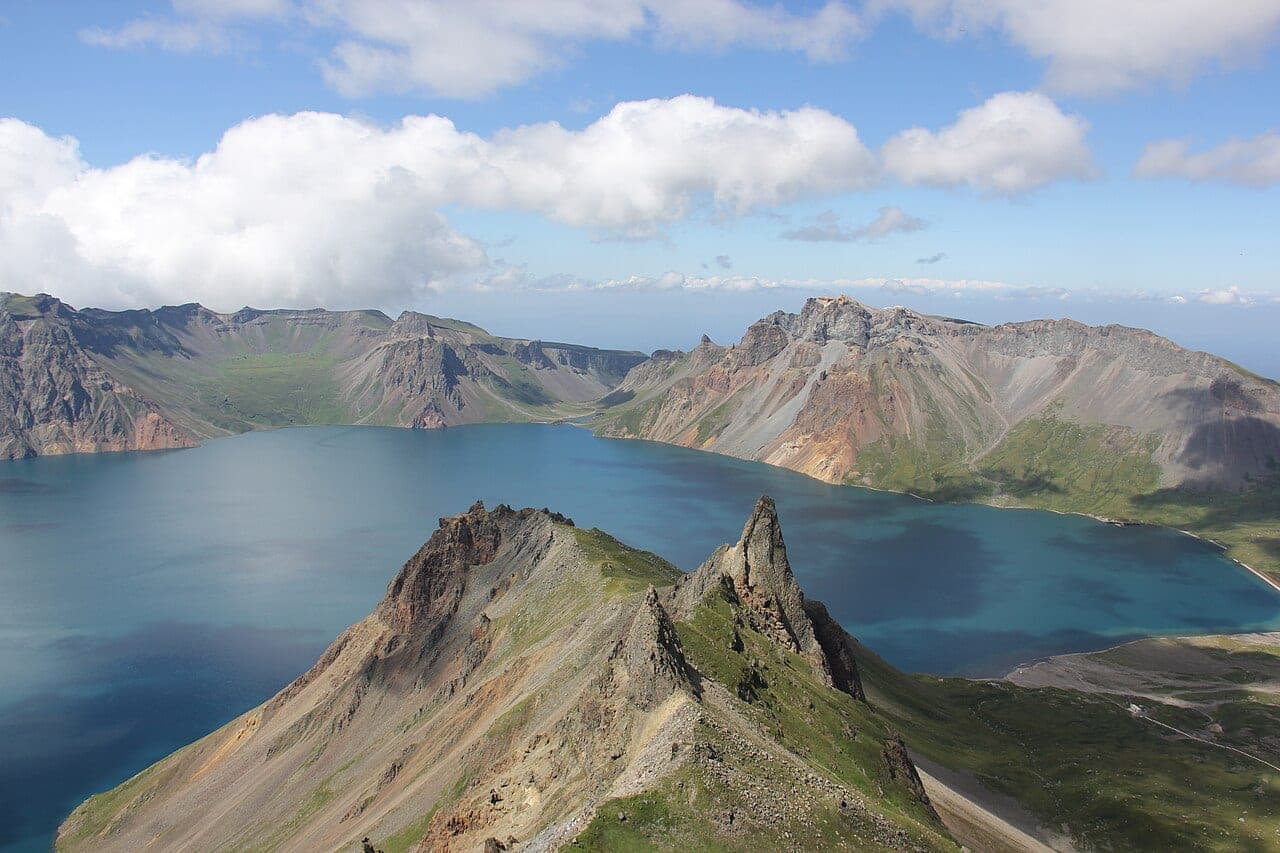
The land covered here occupies the northern portion of the Korean peninsula, which reaches south from the Asian mainland between the Yellow Sea to the west and the Sea of Japan, also called the East Sea, to the east. It is mountainous, with the widest farmland along the western coastal plains and the valley of the Taedong River, which runs through Pyongyang to the sea. The northern border follows two rivers that rise on Mount Paektu, the Amnok (Yalu) to the west and the Tuman (Tumen) to the east. Paektu itself, at 2,744 metres, is the highest point on the whole peninsula, and its summit holds a deep crater lake, Chonji or Heaven Lake, formed by a great eruption around 946 CE.
The people of this land are part of the Korean nation, among the most linguistically and culturally unified populations in the world. They speak Korean, share an ancestry reaching back thousands of years, and hold in common the myths, rites, foods and crafts described below. The northern half of the peninsula is home to roughly 26 million people. This page treats their heritage as Korean heritage, belonging to the peninsula as a whole rather than to any single modern state.
Pyongyang. On the Taedong River in the west, Pyongyang is among the oldest continuously inhabited cities in Korea. Tradition links its founding to Gojoseon, the legendary first Korean kingdom, and in 427 CE the Goguryeo king Jangsu moved his capital here. Many painted Goguryeo tombs lie in and around the city, among them the mausoleum honoured as the tomb of King Tongmyong, the founder of Goguryeo.
 Pyongyang was almost completely destroyed by bombing between 1950 and 1953 and rebuilt to a plan, so the city is a designed statement rather than an accumulated one. Photograph by David Clayton Ellsworth, CC BY-SA 4.0, via Wikimedia Commons.
Kaesong. North of the peninsula's midline, Kaesong was the capital of the Koryo dynasty for most of its span from 918 to 1392, and it kept its medieval monuments better than almost any Korean city. Its Confucian academy, the Koryo Songgyungwan, the Manwoldae palace site, the Namdae gate, the Sonjuk Bridge and the royal Koryo tombs survive together and were inscribed as a UNESCO World Heritage Site in 2013.
Nampo. The main port on the west coast, Nampo sits near the mouth of the Taedong below Pyongyang. In the nearby Kangso district lie the Kangso Three Tombs, among the most celebrated Goguryeo burials, whose chambers carry the Four Guardian murals of the Azure Dragon, White Tiger, Vermilion Bird and Black Tortoise-and-Snake.
Wonsan. A port on the east coast in the old Kangwon region, Wonsan is the gateway to Mount Kumgang, the Diamond Mountains, whose peaks and waterfalls have drawn Korean poets and painters for centuries; the painter Jeong Seon made the range a defining image of Korean art.
Korean tradition dates its history to 2333 BCE, when Dangun is said to have founded Gojoseon, the first kingdom. The story, recorded in the thirteenth-century Samguk Yusa by the monk Iryon, tells of Hwanung, a son of heaven who came down to a mountain often identified with Paektu, and of a bear who kept a hundred days in a cave on mugwort and garlic until she became a woman and bore Dangun. Historians treat Gojoseon as a real early state of the northern peninsula and Manchuria until its conquest by Han China in 108 BCE.
Of the Three Kingdoms that followed, Goguryeo, founded by tradition in 37 BCE, was the largest and most northerly. It adopted Buddhism in 372 CE, moved its capital to Pyongyang in 427, and at its height in the fifth century controlled much of Manchuria and the northern peninsula, leaving the painted tombs that are the region's greatest antiquity before it fell in 668. After the Silla and Balhae periods came the Koryo dynasty, founded in 918 with its capital at Kaesong. Koryo, whose name became the word Korea, unified the peninsula, produced the prized jade-green celadon, and carved the Buddhist Tripitaka Koreana. In 1392 the Joseon dynasty replaced it, adopting neo-Confucianism and, under King Sejong in the 1440s, giving Korea its own alphabet.
Joseon governed a united Korea until the end of the nineteenth century. From 1910 to 1945 the peninsula was ruled by Japan as a colony. In 1945, at the close of the Second World War, Japanese rule ended and Korea was divided along the 38th parallel of latitude; in 1948 two states were established, the Republic of Korea in the south and the Democratic People's Republic of Korea in the north. The heritage described here predates that division and belongs to the Korean people as a whole.
Korean is spoken by some seventy-five million people on the peninsula and in the diaspora, and it forms a family of its own, Koreanic, with no securely proven relatives beyond the Jeju variety of the south. For most of history Koreans wrote with Chinese characters, a system that fitted the spoken tongue poorly and that only the educated could master. In the 1440s King Sejong the Great and his scholars devised a new alphabet and promulgated it in 1446 in a document called the Hunminjeongeum, the Correct Sounds for the Instruction of the People. Its letters follow featural principles, the consonant signs modelled on the tongue, lips and throat that produce them, so the script encodes speech directly.
The alphabet has different names on the two sides of the peninsula: Hangul in the south and Chosongul in the north, the latter adopted in 1949, but it is one and the same script, the common possession of all Koreans, and the original Hunminjeongeum manuscript is inscribed on UNESCO's Memory of the World register. The country's English name is itself a relic: Korea descends through the trade routes from Koryo, so the modern land is called, in effect, after a kingdom that ended more than six hundred years ago.
The traditional dress of Korea is the hanbok, worn across the peninsula in forms that reach back to the Goguryeo wall paintings. Its elements, a short jacket called the jeogori worn over a full skirt, the chima, for women, or loose trousers, the baji, for men, favour clean lines and blocks of clear colour from the five hues of obangsaek. The tomb murals show courtiers and dancers in versions of the same silhouette.
Korean food is built on rice, on the fermented vegetable dish kimchi, and on the fermented soy pastes that season nearly every table; the Kaesong region is remembered for a distinctive court and merchant cuisine. The supreme achievement of the medieval Korean arts was celadon: potters of the Koryo court perfected a stoneware glazed in a soft blue-green they called bisaek, the colour of jade, and by the twelfth century they had invented sanggam, an inlay in which incised designs of cranes, clouds and lotuses were filled with white and black slip before glazing. Alongside these court arts run the folk traditions: the masked dance-dramas of talchum, the farmers' percussion of pungmul, the folk paintings of minhwa, the mulberry-bark paper called hanji, and the ondol under-floor heating that shapes how Koreans build and live.
Three currents of belief have run through Korean life, layered rather than opposed. The oldest is the indigenous shamanism, musok, in which a shaman, most often a woman called a mudang, mediates between the living and the spirits of ancestors and nature through the ritual gut. Buddhism reached Goguryeo in 372 CE and became, under Koryo, the dominant faith of court and country, its monasteries, pagodas and printed canon marking the height of Korean Buddhist civilisation.
With the Joseon dynasty from 1392, neo-Confucianism became the organising philosophy of state and family, and Confucian thought, more than any single religion, shaped Korean ideas of duty, learning and the bond between generations; the Songgyungwan academy at Kaesong, founded in the tenth century, trained the scholars who carried that learning. These traditions were never exclusive: one household might keep ties to a Buddhist temple, honour Confucian rites, and call on a shaman in time of trouble.
Nowhere is Korean memory more concentrated than in the rites owed to ancestors. The Confucian tradition adopted under Joseon made care of the dead a central family duty, and its forms survive across the peninsula today. The general name for ancestral rites is jesa. On the death anniversary of a parent or grandparent the family gathers for the rite called gije, setting out a table of prescribed foods arranged by strict convention, with a memorial tablet or photograph standing for the ancestor at the head. Male descendants offer cups of wine in order of seniority, all present bow, and a silence is left for the spirit to partake before the family shares the food.
A related rite, charye, is performed at the great seasonal holidays, above all Seollal, the lunar new year, and Chuseok, the autumn harvest festival, when families also visit and tend the grave mounds of their forebears in the custom called seongmyo. Traditional funerals were governed by Confucian mourning grades, the bereaved dressed in undyed hemp and the body buried beneath a rounded earth mound. The great Goguryeo tombs are the ancient ancestors of this care: chambers built like houses, roofed with corbelled stone and painted with feasts, processions and guardian spirits so the dead might be accompanied. The line from those painted chambers to the family table set today is one of the longest continuities in Korean culture.
North Korea maintains a hereditary record of every citizen that has nothing to do with genealogy as anyone else understands it, and everything to do with what a family is allowed to become.
Songbun is the classification system. Households were sorted in the decades after 1945 into broad categories, loyal, wavering and hostile, and then into dozens of subdivisions, on the basis of what a person's ancestors were doing before and during the Korean War: landowner, collaborator, Christian, southern family, or partisan. The classification is inherited through the father and it is recorded in a file held by the state. It has governed where a person may live, what they may study, whether they may join the party, and what they eat in a shortage. A family's genealogy, in other words, is kept meticulously by the state and used against them.
The traditional record still exists underneath. Korean clan genealogies, the jokbo, were carried north as well as south, though openly maintaining one was politically unwise for most of the period.
For the roughly 34,000 defectors who have reached South Korea, and for the families divided in 1950, the documentation problem is acute in both directions: arriving with no papers that the South recognises, and leaving behind relatives whose songbun their departure has just made worse.
What outsiders can consult is small: the colonial-era registers to 1945, and the testimony collections built by defector organisations and by the United Nations commission of inquiry.
Two sites in the northern peninsula are inscribed on the UNESCO World Heritage List, and both belong to the deep Korean past. The Complex of Koguryo Tombs, inscribed in 2004 as the first World Heritage Site in the country, gathers sixty-three tombs in several groups around Pyongyang and Nampo, sixteen of them containing wall paintings. Of the roughly ten thousand Goguryeo tombs known in Korea and neighbouring China, only about ninety carry murals, and this complex holds the majority of the painted ones. The paintings, in ink and mineral pigments on plaster, show portraits of the tomb owners, scenes of daily life and the Four Guardian animals of the directions. Because the chambers are fragile, most are kept closed, and international bodies have supported their conservation and documentation.
The second site, the Historic Monuments and Sites in Kaesong, was inscribed in 2013 and comprises twelve components recording the Koryo dynasty from the tenth to the fourteenth centuries: the Manwoldae palace site and its observatory, the city walls and the Namdae gate, the Koryo Songgyungwan academy, the Sungyang and other memorials, the Sonjuk Bridge, and the royal mausoleums of King Wang Kon, the dynasty's founder, and King Kongmin. The academy buildings, rebuilt after a sixteenth-century fire, now house the Koryo Museum, where celadon and other relics of the dynasty are kept.
The most fragile of this heritage is also the most studied at a distance. Because the Koguryo mural tombs cannot be freely opened without risking the paintings, scholars have relied for decades on photographic surveys, measured drawings and pigment analysis, and this documentation now forms a growing digital record of chambers few will ever enter, while facsimiles let the murals be exhibited and taught. More broadly, the heritage of Goguryeo, Koryo and Joseon is shared across the whole Korean world, and museums on the peninsula and in the diaspora have digitised Korean manuscripts, ceramics and paintings, so this common inheritance grows more accessible wherever Koreans live.
The ancient arts of the peninsula continue to shape Korean creative life. The lines and colours of hanbok appear in modern Korean design; the jade glaze of Koryo celadon is pursued again by ceramists who have revived the old kiln techniques; and Korean cuisine, from kimchi to the fermented pastes at its base, is now known and eaten around the world. The imagery of the Goguryeo tombs, the Four Guardians, the dancers and the hunting scenes, recurs in later Korean painting, stage design and illustration. Korean traditional music, dance and the crafts of paper, lacquer and textile are taught and performed across the peninsula and among communities of Korean descent abroad, who keep the seasonal festivals and ancestral rites alive far from the peninsula. This heritage belongs to that wider Korean world as much as to the land where the monuments stand.
The first inscription. In 2004 the Complex of Koguryo Tombs became the first site in the country on the UNESCO World Heritage List, drawing recognition and conservation to the region's oldest art.
A dynasty recognised. The 2013 inscription of the Historic Monuments and Sites in Kaesong preserved the ensemble of the Koryo capital, palace, walls, academy, bridge and royal tombs, as a single record of the dynasty that gave Korea its name.
The academy reborn. The Songgyungwan, the highest Confucian school of the Koryo and early Joseon periods, survived fire and centuries of change and now serves as the Koryo Museum where its scholars once studied.
A living rite. The ancestral rites of jesa and charye have outlasted kingdoms and colonisation and continue in Korean homes on the peninsula and around the world, carried unbroken from parent to child.
An alphabet for everyone. The alphabet promulgated in 1446 so any Korean could read and write remains in daily use by the whole nation, and the manuscript that announced it is inscribed on UNESCO's Memory of the World register.
Pyongyang was almost completely destroyed by bombing between 1950 and 1953 and rebuilt to a plan, so the city is a designed statement rather than an accumulated one. Photograph by David Clayton Ellsworth, CC BY-SA 4.0, via Wikimedia Commons.
Kaesong. North of the peninsula's midline, Kaesong was the capital of the Koryo dynasty for most of its span from 918 to 1392, and it kept its medieval monuments better than almost any Korean city. Its Confucian academy, the Koryo Songgyungwan, the Manwoldae palace site, the Namdae gate, the Sonjuk Bridge and the royal Koryo tombs survive together and were inscribed as a UNESCO World Heritage Site in 2013.
Nampo. The main port on the west coast, Nampo sits near the mouth of the Taedong below Pyongyang. In the nearby Kangso district lie the Kangso Three Tombs, among the most celebrated Goguryeo burials, whose chambers carry the Four Guardian murals of the Azure Dragon, White Tiger, Vermilion Bird and Black Tortoise-and-Snake.
Wonsan. A port on the east coast in the old Kangwon region, Wonsan is the gateway to Mount Kumgang, the Diamond Mountains, whose peaks and waterfalls have drawn Korean poets and painters for centuries; the painter Jeong Seon made the range a defining image of Korean art.
Korean tradition dates its history to 2333 BCE, when Dangun is said to have founded Gojoseon, the first kingdom. The story, recorded in the thirteenth-century Samguk Yusa by the monk Iryon, tells of Hwanung, a son of heaven who came down to a mountain often identified with Paektu, and of a bear who kept a hundred days in a cave on mugwort and garlic until she became a woman and bore Dangun. Historians treat Gojoseon as a real early state of the northern peninsula and Manchuria until its conquest by Han China in 108 BCE.
Of the Three Kingdoms that followed, Goguryeo, founded by tradition in 37 BCE, was the largest and most northerly. It adopted Buddhism in 372 CE, moved its capital to Pyongyang in 427, and at its height in the fifth century controlled much of Manchuria and the northern peninsula, leaving the painted tombs that are the region's greatest antiquity before it fell in 668. After the Silla and Balhae periods came the Koryo dynasty, founded in 918 with its capital at Kaesong. Koryo, whose name became the word Korea, unified the peninsula, produced the prized jade-green celadon, and carved the Buddhist Tripitaka Koreana. In 1392 the Joseon dynasty replaced it, adopting neo-Confucianism and, under King Sejong in the 1440s, giving Korea its own alphabet.
Joseon governed a united Korea until the end of the nineteenth century. From 1910 to 1945 the peninsula was ruled by Japan as a colony. In 1945, at the close of the Second World War, Japanese rule ended and Korea was divided along the 38th parallel of latitude; in 1948 two states were established, the Republic of Korea in the south and the Democratic People's Republic of Korea in the north. The heritage described here predates that division and belongs to the Korean people as a whole.
Korean is spoken by some seventy-five million people on the peninsula and in the diaspora, and it forms a family of its own, Koreanic, with no securely proven relatives beyond the Jeju variety of the south. For most of history Koreans wrote with Chinese characters, a system that fitted the spoken tongue poorly and that only the educated could master. In the 1440s King Sejong the Great and his scholars devised a new alphabet and promulgated it in 1446 in a document called the Hunminjeongeum, the Correct Sounds for the Instruction of the People. Its letters follow featural principles, the consonant signs modelled on the tongue, lips and throat that produce them, so the script encodes speech directly.
The alphabet has different names on the two sides of the peninsula: Hangul in the south and Chosongul in the north, the latter adopted in 1949, but it is one and the same script, the common possession of all Koreans, and the original Hunminjeongeum manuscript is inscribed on UNESCO's Memory of the World register. The country's English name is itself a relic: Korea descends through the trade routes from Koryo, so the modern land is called, in effect, after a kingdom that ended more than six hundred years ago.
The traditional dress of Korea is the hanbok, worn across the peninsula in forms that reach back to the Goguryeo wall paintings. Its elements, a short jacket called the jeogori worn over a full skirt, the chima, for women, or loose trousers, the baji, for men, favour clean lines and blocks of clear colour from the five hues of obangsaek. The tomb murals show courtiers and dancers in versions of the same silhouette.
Korean food is built on rice, on the fermented vegetable dish kimchi, and on the fermented soy pastes that season nearly every table; the Kaesong region is remembered for a distinctive court and merchant cuisine. The supreme achievement of the medieval Korean arts was celadon: potters of the Koryo court perfected a stoneware glazed in a soft blue-green they called bisaek, the colour of jade, and by the twelfth century they had invented sanggam, an inlay in which incised designs of cranes, clouds and lotuses were filled with white and black slip before glazing. Alongside these court arts run the folk traditions: the masked dance-dramas of talchum, the farmers' percussion of pungmul, the folk paintings of minhwa, the mulberry-bark paper called hanji, and the ondol under-floor heating that shapes how Koreans build and live.
Three currents of belief have run through Korean life, layered rather than opposed. The oldest is the indigenous shamanism, musok, in which a shaman, most often a woman called a mudang, mediates between the living and the spirits of ancestors and nature through the ritual gut. Buddhism reached Goguryeo in 372 CE and became, under Koryo, the dominant faith of court and country, its monasteries, pagodas and printed canon marking the height of Korean Buddhist civilisation.
With the Joseon dynasty from 1392, neo-Confucianism became the organising philosophy of state and family, and Confucian thought, more than any single religion, shaped Korean ideas of duty, learning and the bond between generations; the Songgyungwan academy at Kaesong, founded in the tenth century, trained the scholars who carried that learning. These traditions were never exclusive: one household might keep ties to a Buddhist temple, honour Confucian rites, and call on a shaman in time of trouble.
Nowhere is Korean memory more concentrated than in the rites owed to ancestors. The Confucian tradition adopted under Joseon made care of the dead a central family duty, and its forms survive across the peninsula today. The general name for ancestral rites is jesa. On the death anniversary of a parent or grandparent the family gathers for the rite called gije, setting out a table of prescribed foods arranged by strict convention, with a memorial tablet or photograph standing for the ancestor at the head. Male descendants offer cups of wine in order of seniority, all present bow, and a silence is left for the spirit to partake before the family shares the food.
A related rite, charye, is performed at the great seasonal holidays, above all Seollal, the lunar new year, and Chuseok, the autumn harvest festival, when families also visit and tend the grave mounds of their forebears in the custom called seongmyo. Traditional funerals were governed by Confucian mourning grades, the bereaved dressed in undyed hemp and the body buried beneath a rounded earth mound. The great Goguryeo tombs are the ancient ancestors of this care: chambers built like houses, roofed with corbelled stone and painted with feasts, processions and guardian spirits so the dead might be accompanied. The line from those painted chambers to the family table set today is one of the longest continuities in Korean culture.
North Korea maintains a hereditary record of every citizen that has nothing to do with genealogy as anyone else understands it, and everything to do with what a family is allowed to become.
Songbun is the classification system. Households were sorted in the decades after 1945 into broad categories, loyal, wavering and hostile, and then into dozens of subdivisions, on the basis of what a person's ancestors were doing before and during the Korean War: landowner, collaborator, Christian, southern family, or partisan. The classification is inherited through the father and it is recorded in a file held by the state. It has governed where a person may live, what they may study, whether they may join the party, and what they eat in a shortage. A family's genealogy, in other words, is kept meticulously by the state and used against them.
The traditional record still exists underneath. Korean clan genealogies, the jokbo, were carried north as well as south, though openly maintaining one was politically unwise for most of the period.
For the roughly 34,000 defectors who have reached South Korea, and for the families divided in 1950, the documentation problem is acute in both directions: arriving with no papers that the South recognises, and leaving behind relatives whose songbun their departure has just made worse.
What outsiders can consult is small: the colonial-era registers to 1945, and the testimony collections built by defector organisations and by the United Nations commission of inquiry.
Two sites in the northern peninsula are inscribed on the UNESCO World Heritage List, and both belong to the deep Korean past. The Complex of Koguryo Tombs, inscribed in 2004 as the first World Heritage Site in the country, gathers sixty-three tombs in several groups around Pyongyang and Nampo, sixteen of them containing wall paintings. Of the roughly ten thousand Goguryeo tombs known in Korea and neighbouring China, only about ninety carry murals, and this complex holds the majority of the painted ones. The paintings, in ink and mineral pigments on plaster, show portraits of the tomb owners, scenes of daily life and the Four Guardian animals of the directions. Because the chambers are fragile, most are kept closed, and international bodies have supported their conservation and documentation.
The second site, the Historic Monuments and Sites in Kaesong, was inscribed in 2013 and comprises twelve components recording the Koryo dynasty from the tenth to the fourteenth centuries: the Manwoldae palace site and its observatory, the city walls and the Namdae gate, the Koryo Songgyungwan academy, the Sungyang and other memorials, the Sonjuk Bridge, and the royal mausoleums of King Wang Kon, the dynasty's founder, and King Kongmin. The academy buildings, rebuilt after a sixteenth-century fire, now house the Koryo Museum, where celadon and other relics of the dynasty are kept.
The most fragile of this heritage is also the most studied at a distance. Because the Koguryo mural tombs cannot be freely opened without risking the paintings, scholars have relied for decades on photographic surveys, measured drawings and pigment analysis, and this documentation now forms a growing digital record of chambers few will ever enter, while facsimiles let the murals be exhibited and taught. More broadly, the heritage of Goguryeo, Koryo and Joseon is shared across the whole Korean world, and museums on the peninsula and in the diaspora have digitised Korean manuscripts, ceramics and paintings, so this common inheritance grows more accessible wherever Koreans live.
The ancient arts of the peninsula continue to shape Korean creative life. The lines and colours of hanbok appear in modern Korean design; the jade glaze of Koryo celadon is pursued again by ceramists who have revived the old kiln techniques; and Korean cuisine, from kimchi to the fermented pastes at its base, is now known and eaten around the world. The imagery of the Goguryeo tombs, the Four Guardians, the dancers and the hunting scenes, recurs in later Korean painting, stage design and illustration. Korean traditional music, dance and the crafts of paper, lacquer and textile are taught and performed across the peninsula and among communities of Korean descent abroad, who keep the seasonal festivals and ancestral rites alive far from the peninsula. This heritage belongs to that wider Korean world as much as to the land where the monuments stand.
The first inscription. In 2004 the Complex of Koguryo Tombs became the first site in the country on the UNESCO World Heritage List, drawing recognition and conservation to the region's oldest art.
A dynasty recognised. The 2013 inscription of the Historic Monuments and Sites in Kaesong preserved the ensemble of the Koryo capital, palace, walls, academy, bridge and royal tombs, as a single record of the dynasty that gave Korea its name.
The academy reborn. The Songgyungwan, the highest Confucian school of the Koryo and early Joseon periods, survived fire and centuries of change and now serves as the Koryo Museum where its scholars once studied.
A living rite. The ancestral rites of jesa and charye have outlasted kingdoms and colonisation and continue in Korean homes on the peninsula and around the world, carried unbroken from parent to child.
An alphabet for everyone. The alphabet promulgated in 1446 so any Korean could read and write remains in daily use by the whole nation, and the manuscript that announced it is inscribed on UNESCO's Memory of the World register.
National Overview
Notable Cities
Historical Foundations
Linguistic and Etymological Roots
Cultural Identity
Religion and Spirituality
Remembrance and Mourning Traditions
Tracing a Family in North Korea
Heritage Preservation Efforts
Digital Heritage
Contemporary Cultural Influences
Success Stories
References and resources
- UNESCO World Heritage Centre: Complex of Koguryo Tombs
- UNESCO World Heritage Centre: Historic Monuments and Sites in Kaesong
- UNESCO: Safeguarding the Koguryo Tombs and Mural Paintings
- Encyclopaedia Britannica: North Korea
- Wikipedia: Paektu Mountain
- Wikipedia: Hangul
- Wikipedia: Jesa
- World History Encyclopedia: Dangun
- World History Encyclopedia: Korean Celadon Pottery
- Wikipedia: Historic Monuments and Sites in Kaesong