Heritage · Country
Tatarstan Culture and Heritage
A republic of the Russian Federation on the middle Volga, Tatarstan holds three UNESCO World Heritage Sites and a Muslim history that begins in 922, before the baptism of Kyivan Rus. This is a guide to its heritage, from Bolgar and the Kazan Kremlin to the mourning customs of a people with a long memory of 1552.Written to last.
By Confinity Heritage Editorial · Updated 2026-08-17 · 8-minute readQuiet tools, kept out of the way.
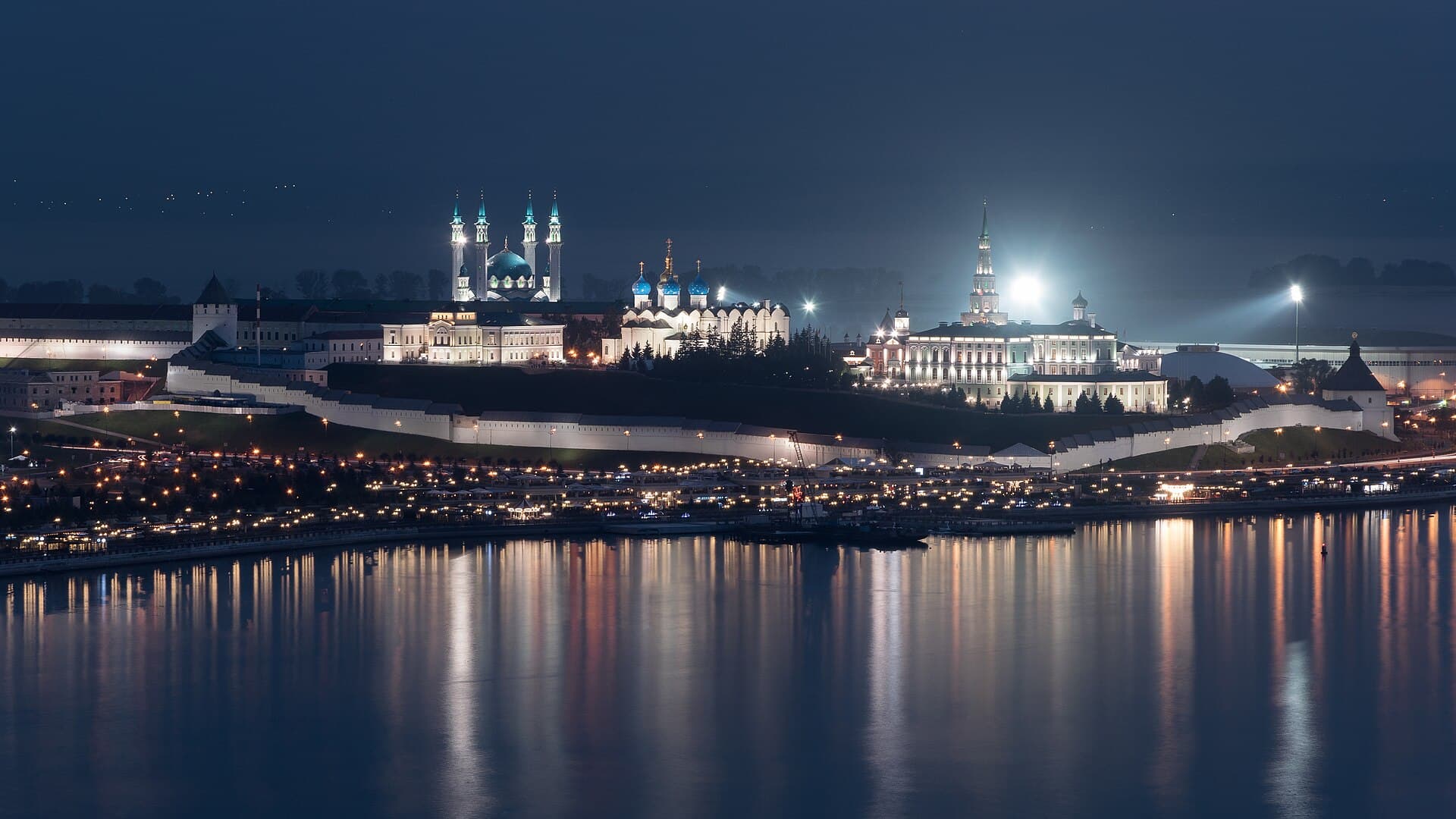
Inside one set of white walls above the Kazanka river stand a mosque with four minarets and an Orthodox cathedral of the sixteenth century, a few hundred metres apart. The cathedral was built after Ivan IV took the city in 1552; the mosque, opened in 2005, is a modern reconstruction on the site of the one his army destroyed. Putting them within sight of each other was deliberate policy, and it is the first thing most visitors to Tatarstan are shown.
Tatarstan is a republic of the Russian Federation on the middle Volga, with about four million people, two state languages and three UNESCO World Heritage Sites. Its Muslim history runs from 922, when the rulers of Volga Bulgaria accepted Islam, sixty-six years before the baptism of Kyivan Rus; its modern history runs through a khanate destroyed, a long imperial restriction on where Tatars could live and worship, a reform movement that made Kazan a centre of Muslim publishing, and a treaty with Moscow that lapsed in 2017.
Tatarstan covers about 68,000 square kilometres of the East European plain where the Kama runs into the Volga, forest-steppe with no mountains and a hard continental winter. The 2021 census counted just over four million residents, of whom Tatars made up roughly 54 per cent and Russians about 40 per cent, with Chuvash, Mari and Udmurt most of the rest. Russian and Tatar are both state languages under the republic's constitution. The economy rests on oil from the Romashkino field and the petrochemical plants around it, on the KamAZ truck works at Naberezhnye Chelny and on aviation manufacturing in Kazan, which makes Tatarstan one of the wealthier regions of Russia.
Kazan. The capital, a city of about 1.3 million on the Volga, and the seat of a Muslim khanate before it was a Russian provincial capital. The Kremlin on its hill holds the Qol Sharif mosque, the Annunciation Cathedral, the leaning Söyembikä tower and the republic's government buildings. Below it lie the Old Tatar Quarter with its wooden houses and historic mosques, and Kazan Federal University, founded in 1804, where Lobachevsky taught and Tolstoy and Lenin studied.
Bolgar. Two hundred kilometres downstream, the ruins of the medieval city where Islam was adopted in 922, with the Cathedral Mosque, the Great Minaret, the Black Chamber and the Khan's Tomb standing in open meadow above the Volga.
Sviyazhsk. A small island town at the mouth of the Sviyaga, built in 1551 as the base for the assault on Kazan and now a monastery town of a few hundred people.
Yelabuga. An old merchant town on the Kama below the earthworks of a Volga Bulgar fortress, birthplace of the painter Ivan Shishkin and the place where Marina Tsvetaeva died in 1941.
Volga Bulgaria was a Turkic state on the middle Volga from the ninth century, living on the fur trade and the river route between the Baltic and the Caliphate. In 922 its ruler Almış received an embassy from the Abbasid caliph al-Muqtadir and adopted Islam as the state religion, an occasion described at first hand by the traveller Ahmad ibn Fadlan. That date matters locally because it precedes the Christianisation of Kyivan Rus in 988, and Tatar historians have long used it to argue that Islam on the Volga is older than Orthodoxy on the Dnieper.
The Mongols destroyed Bolgar in 1236 and the region became part of the Golden Horde, under which Bolgar was rebuilt and prospered. As the Horde broke up, Ulugh Muhammad founded the Khanate of Kazan in 1438, a Muslim state with its own court, madrasas and diplomacy, which spent a century in alliance and conflict with Moscow. In 1551 Ivan IV had a fortress at Sviyazhsk assembled in about four weeks from timbers prefabricated upstream at Uglich and floated down. The following August his army laid siege to Kazan, and on 2 October 1552 sappers blew breaches in the walls. What followed was a massacre of the defenders and much of the civilian population; the imam Qol Sharif was killed with his students defending his mosque, and almost all the Tatar buildings inside the city, the mosques among them, were destroyed. Surviving Tatars were expelled and resettled beyond the Bolaq channel in what became the Tatar Quarter, and for two centuries they were barred from the city centre, restricted in trades and periodically pressed to convert, with a further wave of mosque demolitions in the 1740s. Catherine II's visit in 1767 marked a relaxation, and permission to build in stone produced the Marjani mosque of 1766 to 1770.
The nineteenth century brought a Muslim revival through printing and schooling. The twentieth brought the Tatar Autonomous Soviet Socialist Republic, proclaimed on 27 May 1920, famine, purges and three changes of alphabet. Tatarstan declared sovereignty on 30 August 1990, held a referendum in 1992, declined to sign the Federation Treaty, and on 15 February 1994 signed a power-sharing treaty with Moscow, renewed in 2007 and allowed to expire on 24 July 2017.
Tatar belongs to the Kipchak branch of the Turkic family, with roughly four million first-language speakers, which makes it the most widely spoken minority language in Russia. Its core vocabulary is Turkic, with heavy Arabic and Persian layers that came with Islam and a Russian layer laid over the top since the sixteenth century. The name Tatar was applied from outside, first to Mongol and Turkic groups and then to the Muslim subjects of the Horde, and was taken up as a self-description in the nineteenth century, when some scholars argued for Bulgar instead. Kazan is usually connected with the Turkic qazan, a cauldron, and Tatar keeps its own names for the geography: the Volga is Idel.
The written language has changed script three times in a century. Tatar was written in Arabic letters for the better part of a thousand years, in the İske imlâ orthography until 1920 and then the reformed Yaña imlâ; in 1928 it moved to the Latin Jaŋalif; in 1939 it moved again to Cyrillic, where it remains. Each change put the previous generation's books out of ordinary reach, so that a Tatar reader today needs training to open a book printed in Kazan in 1900. In 1999 the republic legislated for a return to Latin, a federal law of 2002 required the state languages of republics to use Cyrillic, and the Constitutional Court upheld that law in 2004.
The sharpest recent argument concerns schools, where Tatar had been taught to all pupils, including Russian-speaking ones, under the republic's language law. In July 2017 President Putin said publicly that nobody should be compelled to learn a language that is not their mother tongue and instructed the prosecutor general to inspect how regions were handling the question; prosecutors' checks in Tatarstan followed, and from late 2017 Tatar teaching was cut to no more than two hours a week and made conditional on written parental consent. A federal law of August 2018 confirmed that study of a republic's state language would be voluntary. Officials in Moscow presented this as protecting parental choice; the World Congress of Tatars, Tatar writers and cultural organisations objected in open letters and petitions, and there were protests in Kazan, arguing that the change would take the language out of daily use within a generation. Instruction hours fell sharply, and the republic has since funded voluntary classes, online courses and Tatar-medium schools that parents choose.
Kazan's most consequential intellectual movement was jadidism, the "new method" of Muslim reform. Şihabetdin Marjani, imam at the mosque that now carries his name and a historian who reclaimed the Bulgar past for the Tatars, argued from the middle of the nineteenth century that Muslims should study modern subjects without abandoning their faith; Qayyum Nasyri wrote textbooks and grammars in Tatar; and reformed madrasas such as the Muhammadiya, founded in 1882, taught mathematics and geography beside theology. Kazan was also the printing capital of Russian Islam, with a Quran printed there from 1803 in editions exported across Central Asia.
Modern Tatar letters begin with Ğabdulla Tuqay, who died in 1913 at twenty-seven and is still the national poet. His "Tuğan tel", native language, is sung like an anthem; his verse tale "Şüräle" became a ballet by Farid Yarullin. Tatar theatre began with public performances from 1906 and is centred on the Kamal Theatre, named for the playwright Ğaliäsgär Kamal. Musa Cälil, a poet captured in 1942 and executed in Berlin in 1944, wrote the Moabit Notebooks in prison; they were smuggled out and published after the war, and his statue stands outside the Kremlin wall.
Sabantuy, the plough festival, is the calendar's centre. Its name joins saban, the plough, to tuy, a celebration, and its origins are agrarian and pre-Islamic. Held in June once the sowing is done, it opens with köräş, belt wrestling on towels in which the champion takes a ram, and runs through horse racing, pole climbing, smashing pots blindfold and fishing a coin out of a bowl of qatyq. Villages hold theirs first, then districts, then the republican Sabantuy in Kazan, and Tatar communities from Istanbul to Toronto hold their own. The government of Tatarstan has said for years that it wants Sabantuy nominated to UNESCO's intangible heritage list, though no inscription has been made.
At the table it means chak-chak, fried dough bound with honey into a mound and cut at weddings, which has had its own museum in Kazan since 2014; öçpoçmaq, a triangular pastry of beef, potato and onion; qıstıbıy, gubadiya and the sweet floss called talqış kaleve; and tea taken seriously and often.
Islam here is Sunni of the Hanafi school, organised under the Spiritual Administration of Muslims of the Republic of Tatarstan. The Marjani mosque, built between 1766 and 1770 by Catherine II's permission and paid for by subscription, was the first stone mosque raised in Kazan after 1552 and the only one in the city that stayed open through the Soviet period. Bolgar has become a place of pilgrimage: the annual Izge Bolgar Jyeny gathering marks the adoption of Islam in 922, and the Bolgar Islamic Academy opened there in 2017 for advanced religious training.
 The original Qolsarif was destroyed when Ivan the Terrible took Kazan in 1552. This one was finished in 2005, on the city's millennium, inside a kremlin that also holds an Orthodox cathedral. Photograph by Alexxx1979, CC BY-SA 4.0, via Wikimedia Commons.
Orthodoxy has been present since the diocese of Kazan was founded in 1555. The Kazan icon of the Mother of God, found by a girl named Matrona after a fire in 1579, became one of the most venerated images in Russia before it was stolen in 1904; the cathedral built over the place of its finding was destroyed under Soviet rule and reconsecrated in 2021. The Annunciation Cathedral in the Kremlin, begun in 1561, is attributed to the builders who also worked on St Basil's.
Between the two sit the Kryashens, Tatar-speaking Orthodox Christians whose ancestors converted in waves from the sixteenth to the nineteenth century, some under duress and some for the tax relief and schooling conversion carried. Nikolai Ilminsky developed a Cyrillic orthography for Tatar in 1862 and founded a school for converts the following year, so Kryashen liturgy is celebrated in Tatar. The 2010 census recorded about 34,900 of them. Whether they are a distinct people or a religious group within the Tatars is argued about by Kryashen organisations, Tatar national bodies and the census takers alike.
Muslim burial here follows the Hanafi pattern, adapted to a northern climate and Russian municipal rules. The body is washed by relatives of the same sex, wrapped in a plain shroud and buried as soon as possible, ideally within a day; the janaza prayer is said at the mosque or the graveside, and the dead are laid facing the qibla. Graves are marked simply, often with the name, the dates and a line of Quran, and Tatar cemeteries are kept separate from Orthodox ones, which becomes a practical difficulty in mixed families.
The commemorations that follow are the part outsiders notice. Families gather on the third day, the seventh and the fortieth, and again at the year, for a mäjles at which a mullah or a hafiz reads the Quran and the household serves food, a meal often called Qor'an ashı. Relatives visit the graves before the two Eids and during Ramadan. Kryashen and Orthodox families keep Radonitsa instead, going out to the cemeteries after Easter, so in mixed villages two calendars of remembrance run side by side.
Then there is 1552. Since the late 1980s Tatar public organisations have marked 15 October as Xäter köne, the Day of Remembrance for the defenders of Kazan, with prayers in the mosques and, in earlier years, a procession through the city; some who observe it describe the fallen as martyrs. The observance has always carried political weight, and in recent years the authorities have restricted or refused permission for the public march while the prayers continue. Older grief is quieter. The Volga famine of 1921 and 1922 fell on the newly created Tatar republic with terrible force, emptying villages; the Soviet famine of 1932 and 1933 struck the region again. Neither could be discussed publicly for decades, and both are now the subject of archival research and family accounts collected late.
Tatar genealogy is called shezhere, and the mullahs kept the registers.
A Tatar family's shezhere traces the male line, sometimes across many generations, and written examples survive from the medieval period. Under Russian rule the state required Muslim communities to keep metrical books, and the mullah of each mahalla, the parish, recorded births, marriages, divorces and deaths in Tatar in Arabic script. Those books are held at the National Archive of the Republic of Tatarstan in Kazan and are the primary genealogical source for Tatar families from the early nineteenth century.
Orthodox metrical books cover the Kryashen, the baptised Tatars, and the Russian population, and the revision lists taken as tax censuses between 1719 and 1858 name households across the whole province.
Two alphabet changes complicate everything. Tatar was written in Arabic script until 1927, then Latin, then Cyrillic from 1939, so a family's own documents may be in three scripts within one lifetime and the older ones are unreadable to most descendants.
The deep record is Volga Bulgaria, the Muslim state on this territory from the tenth century, and the Bolgar site is inscribed by UNESCO. Kazan fell to Ivan the Terrible in 1552, and the Tatar nobility that survived either converted or lost its status; the petitions and service records of those families document the choice.
Soviet ZAGS registration covers the twentieth century.
Tatarstan holds three World Heritage Sites, an unusual concentration for one region. The Historic and Architectural Complex of the Kazan Kremlin was inscribed in 2000 as the only surviving Tatar fortress with substantial remains of its pre-conquest layout, valued in part for the way Muslim and Christian building sit in a single enclosure. The Bolgar Historical and Archaeological Complex followed in 2014, and the Assumption Cathedral and Monastery of the town-island of Sviyazhsk in 2017, chiefly for its sixteenth-century frescoes.
Both later inscriptions came out of one programme. The Renaissance Foundation, set up in 2010 under the republic's former president Mintimer Shaimiev, raised money to restore Bolgar and Sviyazhsk and pushed both nominations through. The work was contested: ICOMOS, the advisory body to the World Heritage Committee, recommended against inscribing Bolgar in 2014 on the ground that extensive reconstruction had reduced the site's authenticity in material and setting, and the committee inscribed it anyway. The same programme built the White Mosque at Bolgar in 2012.
In Kazan the preservation argument is about wooden houses. Much of the Old Tatar Quarter and the nineteenth-century centre was lost to fire and development in the 1990s and 2000s, and campaigns by local preservationists won protected status for surviving streets and a restoration programme timed around the Universiade of 2013. The Institute of Language, Literature and Art of the Tatarstan Academy of Sciences, founded in 1939, remains the main body for language, folklore and manuscript research.
Tatarstan has put an unusual amount of its scholarship online. Tatarica, produced by the Institute of the Tatar Encyclopaedia, publishes in Tatar, Russian and English and is freely readable. The National Library of the Republic of Tatarstan runs an electronic library of Tatar books, periodicals and rare editions, including Arabic-script printing from the Kazan presses that most readers can no longer decipher unaided. Ana Tele, a state-funded online school launched in 2013, teaches Tatar free to anyone who registers, and a written corpus supports dictionary and translation work. The state archive has digitised metrical registers from mosques and parishes, which is the practical route for families tracing ancestors, and the Bolgar and Sviyazhsk museum-reserves publish virtual tours and excavation records.
Kazan has spent two decades presenting itself to the world, beginning with its millennium celebrations in 2005 and running through the 2013 Universiade, matches of the 2018 football World Cup and the BRICS summit of 2024. The city trademarked the description "third capital of Russia" and has built an economy around events, halal trade and the annual Russia and Islamic World forum, alongside Tatneft, KamAZ and the technology town of Innopolis.
The republic's constitutional position has narrowed over the same period. The power-sharing treaty of 1994, renewed in 2007, lapsed in July 2017 without replacement, leaving Tatarstan on the same footing as other federal subjects. Federal legislation then removed the right of republics to call their leaders president; Tatarstan was the last to hold the title, its parliament voted in December 2022 to amend the republic's constitution, and from 2023 the office has been styled Rais, with transitional arrangements for the incumbent. Taken with the school language change, these are the facts most often cited in discussion of Tatarstan's autonomy, and this profile records them and the positions taken on them rather than choosing between them.
Two sites restored and inscribed. Bolgar entered the World Heritage List in 2014 and Sviyazhsk in 2017 after a decade of fundraising and conservation, though the reconstruction at Bolgar drew a negative ICOMOS recommendation.
A mosque rebuilt beside a cathedral. Qol Sharif opened in 2005 on the site of the mosque destroyed in 1552, inside the same Kremlin walls as the Annunciation Cathedral, a pairing the republic presents as its model of coexistence.
A national encyclopaedia in three languages. Tatarica publishes Tatar scholarship in Tatar, Russian and English, and the National Library's electronic collections have reopened Arabic-script printing to readers.
A festival that travelled. Sabantuy is held wherever Tatar communities have settled, from Moscow and Istanbul to Canada, keeping wrestling, horse racing and the language in annual use far from the Volga.
The original Qolsarif was destroyed when Ivan the Terrible took Kazan in 1552. This one was finished in 2005, on the city's millennium, inside a kremlin that also holds an Orthodox cathedral. Photograph by Alexxx1979, CC BY-SA 4.0, via Wikimedia Commons.
Orthodoxy has been present since the diocese of Kazan was founded in 1555. The Kazan icon of the Mother of God, found by a girl named Matrona after a fire in 1579, became one of the most venerated images in Russia before it was stolen in 1904; the cathedral built over the place of its finding was destroyed under Soviet rule and reconsecrated in 2021. The Annunciation Cathedral in the Kremlin, begun in 1561, is attributed to the builders who also worked on St Basil's.
Between the two sit the Kryashens, Tatar-speaking Orthodox Christians whose ancestors converted in waves from the sixteenth to the nineteenth century, some under duress and some for the tax relief and schooling conversion carried. Nikolai Ilminsky developed a Cyrillic orthography for Tatar in 1862 and founded a school for converts the following year, so Kryashen liturgy is celebrated in Tatar. The 2010 census recorded about 34,900 of them. Whether they are a distinct people or a religious group within the Tatars is argued about by Kryashen organisations, Tatar national bodies and the census takers alike.
Muslim burial here follows the Hanafi pattern, adapted to a northern climate and Russian municipal rules. The body is washed by relatives of the same sex, wrapped in a plain shroud and buried as soon as possible, ideally within a day; the janaza prayer is said at the mosque or the graveside, and the dead are laid facing the qibla. Graves are marked simply, often with the name, the dates and a line of Quran, and Tatar cemeteries are kept separate from Orthodox ones, which becomes a practical difficulty in mixed families.
The commemorations that follow are the part outsiders notice. Families gather on the third day, the seventh and the fortieth, and again at the year, for a mäjles at which a mullah or a hafiz reads the Quran and the household serves food, a meal often called Qor'an ashı. Relatives visit the graves before the two Eids and during Ramadan. Kryashen and Orthodox families keep Radonitsa instead, going out to the cemeteries after Easter, so in mixed villages two calendars of remembrance run side by side.
Then there is 1552. Since the late 1980s Tatar public organisations have marked 15 October as Xäter köne, the Day of Remembrance for the defenders of Kazan, with prayers in the mosques and, in earlier years, a procession through the city; some who observe it describe the fallen as martyrs. The observance has always carried political weight, and in recent years the authorities have restricted or refused permission for the public march while the prayers continue. Older grief is quieter. The Volga famine of 1921 and 1922 fell on the newly created Tatar republic with terrible force, emptying villages; the Soviet famine of 1932 and 1933 struck the region again. Neither could be discussed publicly for decades, and both are now the subject of archival research and family accounts collected late.
Tatar genealogy is called shezhere, and the mullahs kept the registers.
A Tatar family's shezhere traces the male line, sometimes across many generations, and written examples survive from the medieval period. Under Russian rule the state required Muslim communities to keep metrical books, and the mullah of each mahalla, the parish, recorded births, marriages, divorces and deaths in Tatar in Arabic script. Those books are held at the National Archive of the Republic of Tatarstan in Kazan and are the primary genealogical source for Tatar families from the early nineteenth century.
Orthodox metrical books cover the Kryashen, the baptised Tatars, and the Russian population, and the revision lists taken as tax censuses between 1719 and 1858 name households across the whole province.
Two alphabet changes complicate everything. Tatar was written in Arabic script until 1927, then Latin, then Cyrillic from 1939, so a family's own documents may be in three scripts within one lifetime and the older ones are unreadable to most descendants.
The deep record is Volga Bulgaria, the Muslim state on this territory from the tenth century, and the Bolgar site is inscribed by UNESCO. Kazan fell to Ivan the Terrible in 1552, and the Tatar nobility that survived either converted or lost its status; the petitions and service records of those families document the choice.
Soviet ZAGS registration covers the twentieth century.
Tatarstan holds three World Heritage Sites, an unusual concentration for one region. The Historic and Architectural Complex of the Kazan Kremlin was inscribed in 2000 as the only surviving Tatar fortress with substantial remains of its pre-conquest layout, valued in part for the way Muslim and Christian building sit in a single enclosure. The Bolgar Historical and Archaeological Complex followed in 2014, and the Assumption Cathedral and Monastery of the town-island of Sviyazhsk in 2017, chiefly for its sixteenth-century frescoes.
Both later inscriptions came out of one programme. The Renaissance Foundation, set up in 2010 under the republic's former president Mintimer Shaimiev, raised money to restore Bolgar and Sviyazhsk and pushed both nominations through. The work was contested: ICOMOS, the advisory body to the World Heritage Committee, recommended against inscribing Bolgar in 2014 on the ground that extensive reconstruction had reduced the site's authenticity in material and setting, and the committee inscribed it anyway. The same programme built the White Mosque at Bolgar in 2012.
In Kazan the preservation argument is about wooden houses. Much of the Old Tatar Quarter and the nineteenth-century centre was lost to fire and development in the 1990s and 2000s, and campaigns by local preservationists won protected status for surviving streets and a restoration programme timed around the Universiade of 2013. The Institute of Language, Literature and Art of the Tatarstan Academy of Sciences, founded in 1939, remains the main body for language, folklore and manuscript research.
Tatarstan has put an unusual amount of its scholarship online. Tatarica, produced by the Institute of the Tatar Encyclopaedia, publishes in Tatar, Russian and English and is freely readable. The National Library of the Republic of Tatarstan runs an electronic library of Tatar books, periodicals and rare editions, including Arabic-script printing from the Kazan presses that most readers can no longer decipher unaided. Ana Tele, a state-funded online school launched in 2013, teaches Tatar free to anyone who registers, and a written corpus supports dictionary and translation work. The state archive has digitised metrical registers from mosques and parishes, which is the practical route for families tracing ancestors, and the Bolgar and Sviyazhsk museum-reserves publish virtual tours and excavation records.
Kazan has spent two decades presenting itself to the world, beginning with its millennium celebrations in 2005 and running through the 2013 Universiade, matches of the 2018 football World Cup and the BRICS summit of 2024. The city trademarked the description "third capital of Russia" and has built an economy around events, halal trade and the annual Russia and Islamic World forum, alongside Tatneft, KamAZ and the technology town of Innopolis.
The republic's constitutional position has narrowed over the same period. The power-sharing treaty of 1994, renewed in 2007, lapsed in July 2017 without replacement, leaving Tatarstan on the same footing as other federal subjects. Federal legislation then removed the right of republics to call their leaders president; Tatarstan was the last to hold the title, its parliament voted in December 2022 to amend the republic's constitution, and from 2023 the office has been styled Rais, with transitional arrangements for the incumbent. Taken with the school language change, these are the facts most often cited in discussion of Tatarstan's autonomy, and this profile records them and the positions taken on them rather than choosing between them.
Two sites restored and inscribed. Bolgar entered the World Heritage List in 2014 and Sviyazhsk in 2017 after a decade of fundraising and conservation, though the reconstruction at Bolgar drew a negative ICOMOS recommendation.
A mosque rebuilt beside a cathedral. Qol Sharif opened in 2005 on the site of the mosque destroyed in 1552, inside the same Kremlin walls as the Annunciation Cathedral, a pairing the republic presents as its model of coexistence.
A national encyclopaedia in three languages. Tatarica publishes Tatar scholarship in Tatar, Russian and English, and the National Library's electronic collections have reopened Arabic-script printing to readers.
A festival that travelled. Sabantuy is held wherever Tatar communities have settled, from Moscow and Istanbul to Canada, keeping wrestling, horse racing and the language in annual use far from the Volga.
National Overview
Notable Cities
Historical Foundations
Linguistic and Etymological Roots
Cultural Identity
Religion and Spirituality
Remembrance and Mourning Traditions
Tracing a Family in Tatarstan
Heritage Preservation Efforts
Digital Heritage
Contemporary Cultural Influences
Success Stories
References and resources
- UNESCO, Historic and Architectural Complex of the Kazan Kremlin: the 2000 inscription.
- UNESCO, Bolgar Historical and Archaeological Complex: the 2014 inscription of the medieval Volga Bulgar capital.
- UNESCO, Assumption Cathedral and Monastery of Sviyazhsk: the 2017 inscription and its frescoes.
- Volga Bulgaria, Wikipedia: the state and the adoption of Islam in 922.
- Siege of Kazan, Wikipedia: the 1552 campaign and its aftermath.
- Tatar language, Wikipedia: the three scripts and the alphabet dispute.
- Kryashens, Wikipedia: the Christianised Tatars and the identity debate.
- Sabantuy, Wikipedia: the plough festival and its diaspora observance.
- Tatarica: the republic's reference work in three languages.
- Tatarstan, Wikipedia: geography, population and the treaties with Moscow.