Heritage · Country
Mongolia Culture and Heritage
From the felt walls of the ger to the wrestlers of Naadam and the throat-singers of the Altai, Mongolia carries the memory of the steppe in living practice rather than in stone. This guide follows the empire of Genghis Khan, the monasteries that outlasted the purges, and the ways a nomadic people keeps faith with its dead.Written to last.
By Confinity Heritage Editorial · Updated 2026-07-31 · 8-minute readQuiet tools, kept out of the way.
Mongolia is the homeland of the steppe nomad, a country the size of Western Europe with only about 3.5 million people, which makes it the most sparsely populated sovereign state on earth. Its heritage was built for movement. The ger, the round felt tent the wider world calls a yurt, can be raised or struck in an hour and loaded onto animals, and a herding family's wealth walks on four legs across the grass. Where other nations wrote their memory into cathedrals and city walls, Mongolians carried theirs in the saddle, in song, and in the horse and the herd.
Yet Mongolia is not without monuments. It built the largest contiguous land empire in history, ruled from a capital at Karakorum whose ruins lie in the sacred Orkhon Valley, and later covered the steppe with Buddhist monasteries, most of them destroyed in one of the twentieth century's least remembered purges and rebuilt after 1990.
Mongolia is landlocked between Russia and China, covering roughly 1,564,116 square kilometres, the eighteenth-largest country in the world and, by density, the emptiest. Its landscape runs from the forested mountains and lakes of the north, through the central grassland of the Mongolian-Manchurian steppe, to the Gobi Desert in the south, a great cold desert celebrated for dinosaur fossils. The Altai range rises along the western edge, and the Orkhon and Selenge rivers drain the heartland. Winters are long and severe, and the periodic disaster known as the dzud, a drought followed by a killing winter, has shaped nomadic life for as long as there have been herds.
About half the population lives in the capital, Ulaanbaatar, and the rest across a countryside where herding remains central and many families still move with the seasons; horses outnumber people, and the Mongol bond with them is close to definitional. Mongolia has been a parliamentary democracy since it left one-party socialist rule in 1990, and its economy leans on mining, cashmere and livestock.
Ulaanbaatar. The capital and by far the largest city began as the movable monastic camp of Urga, seat of the Jebtsundamba Khutuktu, the country's chief Buddhist prelate, and was renamed Ulaanbaatar, "red hero", in 1924 under the socialist republic. Around Chinggis Khaan Square and its seated bronze of Genghis Khan cluster the National Museum of Mongolia, the Gandantegchinlen monastery, and, since 2022, the Chinggis Khaan National Museum.
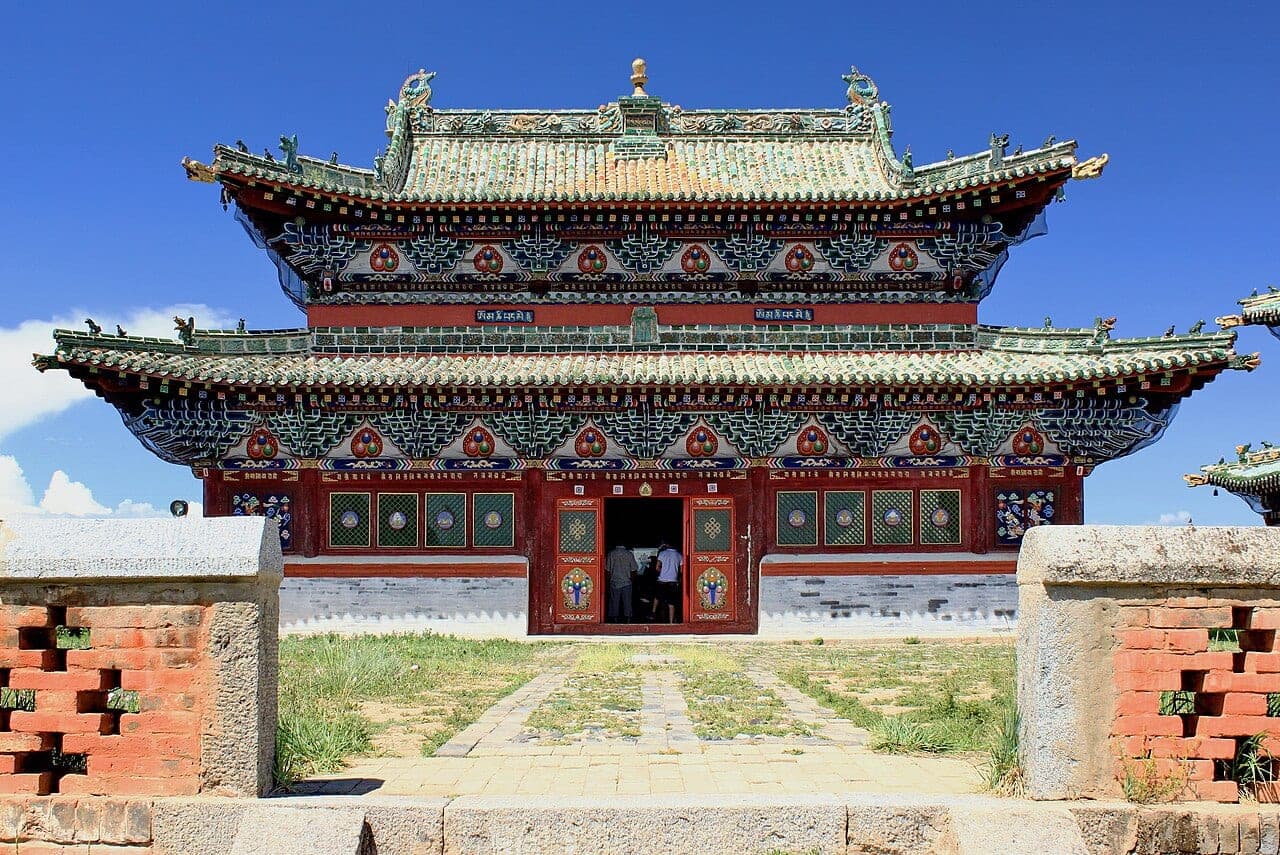
Kharkhorin (Karakorum). Kharkhorin in Övörkhangai province sits beside the ruins of Karakorum, the capital Ögedei Khan built in 1235 as the seat of the Mongol Empire. Little of the medieval city survives above ground, but beside it rises Erdene Zuu, the country's first great Buddhist monastery, founded in 1585 and partly built from the ruined capital's stones; the area lies within the Orkhon Valley Cultural Landscape.
Erdenet. Erdenet, in the north, grew from 1974 around one of the largest copper and molybdenum mines in Asia, a joint Mongolian-Soviet venture, a reminder that Mongolia's twentieth century was written as much in mining towns and Soviet cooperation as in monasteries and grassland.
The grassland was the seat of empires long before the Mongols. The Xiongnu confederation dominated the steppe from around 209 BC and pressed hard enough on Han China to help provoke the building of the Great Wall. It was followed by the Xianbei, the Rouran, and the Turkic Khaganate of the sixth to eighth centuries, whose rulers left the Orkhon inscriptions, monuments to the princes Kul Tigin and Bilge Khagan that carry the oldest known writing in any Turkic language. The Uyghur Khaganate then ruled from Ordu-Baliq, whose ruins (Khar Balgas) lie in the Orkhon Valley, until the Kyrgyz overthrew it in 840.
 The Orkhon valley has held the seat of power for one steppe empire after another, including Karakorum, and its heritage listing covers the grazing landscape as much as the ruins. Photograph by Jonashtand, CC BY-SA 4.0, via Wikimedia Commons.
The Mongols entered world history through one man. Temüjin, born around 1162, united the warring tribes and in 1206 was proclaimed Genghis Khan, universal ruler. Under him and his heirs the Mongol Empire grew into the largest contiguous land empire ever assembled, reaching from Korea to Hungary. His son Ögedei built the capital at Karakorum in 1235, and the friar William of Rubruck, who reached it in 1254, found a cosmopolitan city of Buddhists, Muslims and Christians with a silver drinking-fountain shaped like a tree. Genghis Khan's grandson Kublai Khan founded the Yuan dynasty in 1271 and completed the conquest of China, moving the centre south to Dadu, modern Beijing, which left Karakorum a provincial town.
When the Yuan fell in 1368 the Mongols withdrew to the steppe, Tibetan Buddhism spread deeply from the sixteenth century, and from the late seventeenth the Manchu Qing dynasty ruled Mongolia as an outer dependency. As the Qing collapsed, Outer Mongolia declared independence on 29 December 1911 under the Bogd Khan, its chief lama; it was lost to Chinese and White Russian forces and re-established in the Mongolian Revolution of 1921 with Soviet help. When the Bogd Khan died in 1924 the country became the Mongolian People's Republic, for sixty-five years a close Soviet ally. The socialist era brought literacy, health care and industry, but also, in the late 1930s, a Stalinist terror in which tens of thousands were killed and the monastic institution was all but destroyed. In 1990 peaceful demonstrations ended one-party rule, and a democratic constitution followed in 1992.
The national language is Mongolian, the chief member of the Mongolic family, spoken in the standard Khalkha dialect by most of the population. The origin of the name "Mongol" is uncertain; one proposal traces it to Mugulü, a fourth-century founder of the Rouran, while the tribal name appears in Chinese records of the Tang period. "Mongolia" is the Latinate form meaning the land of the Mongols, and the country calls itself Mongol Uls, the Mongolian State.
Mongolian has been written in more scripts than almost any comparable language. The traditional vertical script, adopted in Genghis Khan's time from the Old Uyghur alphabet (itself descended, through Sogdian, from Aramaic), runs top to bottom in columns and carried the language for seven centuries; the seventeenth-century lama Zanabazar also devised the ornamental Soyombo script, whose head symbol became the national emblem still flown on the flag. Soviet influence replaced the vertical script with Cyrillic in the 1940s, but a 2025 reform now requires both scripts in official government documents, returning a written heritage nearly lost in the twentieth century to daily use.
At the centre of Mongolian identity sits the ger, the circular lattice-and-felt tent with its south-facing painted door, central hearth, and interior ordered by an old etiquette that assigns places to guests, elders and the household altar. Around it turns a culture of the horse: children ride almost before they walk, and the herder's year follows the movement of the animals.
Its fullest public expression is Naadam, the summer festival of the "three manly games", the eriin gurvan naadam of wrestling, horse racing and archery, inscribed by UNESCO as Naadam, Mongolian traditional festival. Bökh wrestling has no weight classes and its own eagle dance, the races are long cross-country gallops ridden by child jockeys, and archery is contested by men and women alike. In the far west, the Kazakhs of Bayan-Ölgii hunt with trained golden eagles, celebrated each autumn at the Golden Eagle Festival.
Mongolia's music is equally distinctive. Khöömei, the traditional art of throat singing from the western Altai, lets one performer sound a low drone and a whistling melody of overtones at once, imitating wind, water and the calls of animals. Its partner is the morin khuur, the two-stringed horse-head fiddle whose sound is said to evoke a galloping herd, and both, along with the urtiin duu or "long song", carry UNESCO recognition. Cuisine follows the herd: dairy "white foods" such as airag (fermented mare's milk), and mutton served as steamed buuz, fried khuushuur or khorkhog cooked with fire-heated stones. Everyday dress is the deel, a long belted robe.
Mongolia's dominant faith is Tibetan Buddhism of the Gelug school, the tradition of the Dalai Lamas, which spread across the country from the sixteenth century after Altan Khan gave the Dalai Lama his title and the Khalkha nobility embraced it. Recent census figures put Buddhists at about 51.7 per cent and the religiously unaffiliated at around 40.6 per cent, with smaller Muslim (chiefly Kazakh), Christian and shamanist communities. The chief monastery is Gandantegchinlen in Ulaanbaatar, founded in 1809, whose towering rebuilt statue of Migjid Janraisig is a focus of national devotion.
The Orkhon valley has held the seat of power for one steppe empire after another, including Karakorum, and its heritage listing covers the grazing landscape as much as the ruins. Photograph by Jonashtand, CC BY-SA 4.0, via Wikimedia Commons.
The Mongols entered world history through one man. Temüjin, born around 1162, united the warring tribes and in 1206 was proclaimed Genghis Khan, universal ruler. Under him and his heirs the Mongol Empire grew into the largest contiguous land empire ever assembled, reaching from Korea to Hungary. His son Ögedei built the capital at Karakorum in 1235, and the friar William of Rubruck, who reached it in 1254, found a cosmopolitan city of Buddhists, Muslims and Christians with a silver drinking-fountain shaped like a tree. Genghis Khan's grandson Kublai Khan founded the Yuan dynasty in 1271 and completed the conquest of China, moving the centre south to Dadu, modern Beijing, which left Karakorum a provincial town.
When the Yuan fell in 1368 the Mongols withdrew to the steppe, Tibetan Buddhism spread deeply from the sixteenth century, and from the late seventeenth the Manchu Qing dynasty ruled Mongolia as an outer dependency. As the Qing collapsed, Outer Mongolia declared independence on 29 December 1911 under the Bogd Khan, its chief lama; it was lost to Chinese and White Russian forces and re-established in the Mongolian Revolution of 1921 with Soviet help. When the Bogd Khan died in 1924 the country became the Mongolian People's Republic, for sixty-five years a close Soviet ally. The socialist era brought literacy, health care and industry, but also, in the late 1930s, a Stalinist terror in which tens of thousands were killed and the monastic institution was all but destroyed. In 1990 peaceful demonstrations ended one-party rule, and a democratic constitution followed in 1992.
The national language is Mongolian, the chief member of the Mongolic family, spoken in the standard Khalkha dialect by most of the population. The origin of the name "Mongol" is uncertain; one proposal traces it to Mugulü, a fourth-century founder of the Rouran, while the tribal name appears in Chinese records of the Tang period. "Mongolia" is the Latinate form meaning the land of the Mongols, and the country calls itself Mongol Uls, the Mongolian State.
Mongolian has been written in more scripts than almost any comparable language. The traditional vertical script, adopted in Genghis Khan's time from the Old Uyghur alphabet (itself descended, through Sogdian, from Aramaic), runs top to bottom in columns and carried the language for seven centuries; the seventeenth-century lama Zanabazar also devised the ornamental Soyombo script, whose head symbol became the national emblem still flown on the flag. Soviet influence replaced the vertical script with Cyrillic in the 1940s, but a 2025 reform now requires both scripts in official government documents, returning a written heritage nearly lost in the twentieth century to daily use.
At the centre of Mongolian identity sits the ger, the circular lattice-and-felt tent with its south-facing painted door, central hearth, and interior ordered by an old etiquette that assigns places to guests, elders and the household altar. Around it turns a culture of the horse: children ride almost before they walk, and the herder's year follows the movement of the animals.
Its fullest public expression is Naadam, the summer festival of the "three manly games", the eriin gurvan naadam of wrestling, horse racing and archery, inscribed by UNESCO as Naadam, Mongolian traditional festival. Bökh wrestling has no weight classes and its own eagle dance, the races are long cross-country gallops ridden by child jockeys, and archery is contested by men and women alike. In the far west, the Kazakhs of Bayan-Ölgii hunt with trained golden eagles, celebrated each autumn at the Golden Eagle Festival.
Mongolia's music is equally distinctive. Khöömei, the traditional art of throat singing from the western Altai, lets one performer sound a low drone and a whistling melody of overtones at once, imitating wind, water and the calls of animals. Its partner is the morin khuur, the two-stringed horse-head fiddle whose sound is said to evoke a galloping herd, and both, along with the urtiin duu or "long song", carry UNESCO recognition. Cuisine follows the herd: dairy "white foods" such as airag (fermented mare's milk), and mutton served as steamed buuz, fried khuushuur or khorkhog cooked with fire-heated stones. Everyday dress is the deel, a long belted robe.
Mongolia's dominant faith is Tibetan Buddhism of the Gelug school, the tradition of the Dalai Lamas, which spread across the country from the sixteenth century after Altan Khan gave the Dalai Lama his title and the Khalkha nobility embraced it. Recent census figures put Buddhists at about 51.7 per cent and the religiously unaffiliated at around 40.6 per cent, with smaller Muslim (chiefly Kazakh), Christian and shamanist communities. The chief monastery is Gandantegchinlen in Ulaanbaatar, founded in 1809, whose towering rebuilt statue of Migjid Janraisig is a focus of national devotion.
 Erdene Zuu was built in 1585 partly from the stones of Karakorum, and survived the purges of the 1930s as a museum while hundreds of other monasteries were destroyed. Photograph by Bernard Gagnon, CC0, via Wikimedia Commons.
Beneath and alongside Buddhism runs a much older layer: shamanism and the worship of Tengri, the eternal blue sky, together with the spirits of land, water and ancestors. This is the faith of the ovoo, the sacred cairn of heaped stones on hills and mountain passes, which travellers circle three times clockwise, adding a stone and an offering for safe passage; mountains such as Burkhan Khaldun are themselves objects of worship. Mongolian Buddhism absorbed rather than erased these practices, and since 1990 shamanism has seen a marked revival, so that consulting a shaman and honouring an ovoo coexist naturally with monastery attendance.
Mongolian ways of death reflect this double inheritance and the demands of a mobile life on open land. In the older steppe custom the dead were not buried in marked graves but returned to the country: the body was carried out and left in a chosen place on the open steppe, where exposure to the elements and to wild animals completed the passage, an act understood as a return to nature rather than neglect. The greatest of the dead vanished entirely; Genghis Khan, by tradition, was buried in secret near his sacred mountain of Burkhan Khaldun, the escort killed and the ground trampled by horses so that the site could never be found, and it remains unknown to this day.
Tibetan Buddhism layered its own rites over this foundation. A lama or astrologer is consulted after a death to fix the auspicious day and the direction in which the body should be taken, and prayers guide the deceased through the bardo, the intermediate state held to last up to forty-nine days before rebirth; cremation became common, and open-air disposal was practised in some regions. Under the socialist state, cemetery burial in the Soviet manner became widespread and remains usual in the cities today, so a Mongolian funeral now often combines a marked grave with monks reciting the prayers of the forty-nine days.
Remembrance also reaches back to ancestors and forward through the calendar. Tsagaan Sar, the lunar new year, is the great occasion of family piety, when households honour their elders and remember those who have died in the past year. Above all national ancestors stands Genghis Khan, revered less as a conqueror than as founder of the nation, his image on the currency and the central square and his birthplace protected as sacred ground. For a platform like Confinity, built on the conviction that families must actively keep the memory of their dead, Mongolia models remembrance as ritual and reverence for ancestors rather than the headstone.
Mongolians lost their surnames and then had to choose them again, and the second choice tells you what the first one cost.
In the 1920s the communist government banned clan names, in order to break the aristocratic lineages that traced descent from Genghis Khan. For three generations Mongolians used a patronymic and a given name and nothing else. In 1997 a new law required surnames again, and it was largely ignored until identity cards made them compulsory, at which point most families discovered they no longer knew which clan they belonged to. Many chose a mountain or a river from their home district, or an ancestral trade. A very large number chose Borjigin, the clan of Genghis, which is now the most common surname in the country. It is a genealogical loss recorded in the shape of the recovery.
The deep record survived in writing anyway. The Secret History of the Mongols, composed in the thirteenth century, opens with a genealogy and is the founding document of the nation.
Buddhist monastery records were largely destroyed in the purges of the 1930s, when monasteries were closed and thousands of monks killed. Soviet-era registration through the civil registry covers the twentieth century, and the archives are in Ulaanbaatar.
Herding families keep their own record in the ovoo, the cairns marking ancestral territory, and in the seasonal camps a family returns to, which are inherited in practice if not on paper.
Mongolia has placed four properties on the UNESCO World Heritage List. The Orkhon Valley Cultural Landscape, inscribed in 2004, protects grassland along the Orkhon River that has been a centre of steppe power for two thousand years, holding the ruins of Karakorum and the Uyghur capital Khar Balgas, the Erdene Zuu monastery and the Tövkhön hermitage of Zanabazar. The Petroglyphic Complexes of the Mongolian Altai, inscribed in 2011, preserve rock carvings in Bayan-Ölgii that record twelve thousand years of human life on the steppe. The Uvs Nuur Basin, a transboundary natural site inscribed in 2003, centres on a great saline lake vital to migratory birds. And the Great Burkhan Khaldun Mountain and its surrounding sacred landscape, inscribed in 2015, protects the mountain of Genghis Khan's birth and burial and its tradition of mountain worship.
The intangible heritage is as carefully recognised, with Naadam, khöömei, the morin khuur, the long song and the Mongol epic among the traditions inscribed on UNESCO's lists. The hardest chapter of preservation concerns what was lost. During the Stalinist repression of the late 1930s, under the leadership of Khorloogiin Choibalsan and at Soviet direction, more than seven hundred monasteries were razed and the monkhood was effectively annihilated: of some 83,000 monks recorded in 1937, fewer than five hundred remained by the end of 1938, and the terror is estimated to have killed between 22,000 and 30,000 people. Gandantegchinlen, closed in 1939, reopened as the country's single functioning monastery only in 1944, when Stalin allowed it as a showpiece; Erdene Zuu was largely destroyed the same year, three temples surviving as a museum. Since 1990 the rebuilding of monasteries and the documentation of what remains have been a sustained national effort.
For a heritage carried so much in performance and in fragile manuscript, digitisation has particular value. The National Library of Mongolia holds one of the world's great collections of Mongolian and Tibetan Buddhist texts, including printings of the Buddhist canon (the Ganjuur and Danjuur), and has worked to digitise them, some recognised in UNESCO documentary heritage programmes; the National Museum of Mongolia and the Chinggis Khaan National Museum, opened in Ulaanbaatar in 2022, have expanded online access to their collections. The Google Arts and Culture platform hosts virtual exhibitions of the country's UNESCO sites, and Unicode support for the vertical script lets a nearly displaced writing system travel on the same screens that carry Cyrillic.
Mongolian tradition has proved unexpectedly portable in the twenty-first century. The band The Hu, which fuses morin khuur, throat singing and heavy rock into what its members call "hunnu rock", reached tens of millions of listeners worldwide and contributed music to a Star Wars video game. Mongolian wrestlers have transformed sumo in Japan, several rising to the highest rank of yokozuna. Genghis Khan, long treated abroad chiefly as a symbol of conquest, has been reclaimed inside Mongolia as national founder, his image everywhere from banknotes to the vast steel equestrian statue at Tsonjin Boldog. At the same time, climate stress and the pull of Ulaanbaatar have drawn many families off the land into the capital's ger districts, and much recent film, literature and music turns on that passage between herding life and the city, while diaspora communities keep the festivals and the language alive far from the steppe.
The monastery that kept the flame. Gandantegchinlen, reopened in 1944 as the only working monastery in a country that had destroyed all the others, carried a thread of monastic learning through the socialist decades and became the seedbed of a nationwide Buddhist revival after 1990.
A statue rebuilt from loss. The Migjid Janraisig statue at Gandan, dismantled by Soviet troops in 1937, was rebuilt at 26.5 metres in 1996 with gold donated by Nepal and Japan.
The steppe goes global. Through The Hu and a generation of khöömei performers, Mongolian throat singing and the morin khuur have found audiences on every continent, proving a musical heritage rooted in herding life can travel without being diluted.
Bringing back the vertical script. By teaching the traditional Mongolian script in schools and requiring it in government documents under the 2025 reform, alongside Unicode support that puts it on ordinary devices, Mongolia is restoring to daily use a writing system the twentieth century came close to erasing.
Erdene Zuu was built in 1585 partly from the stones of Karakorum, and survived the purges of the 1930s as a museum while hundreds of other monasteries were destroyed. Photograph by Bernard Gagnon, CC0, via Wikimedia Commons.
Beneath and alongside Buddhism runs a much older layer: shamanism and the worship of Tengri, the eternal blue sky, together with the spirits of land, water and ancestors. This is the faith of the ovoo, the sacred cairn of heaped stones on hills and mountain passes, which travellers circle three times clockwise, adding a stone and an offering for safe passage; mountains such as Burkhan Khaldun are themselves objects of worship. Mongolian Buddhism absorbed rather than erased these practices, and since 1990 shamanism has seen a marked revival, so that consulting a shaman and honouring an ovoo coexist naturally with monastery attendance.
Mongolian ways of death reflect this double inheritance and the demands of a mobile life on open land. In the older steppe custom the dead were not buried in marked graves but returned to the country: the body was carried out and left in a chosen place on the open steppe, where exposure to the elements and to wild animals completed the passage, an act understood as a return to nature rather than neglect. The greatest of the dead vanished entirely; Genghis Khan, by tradition, was buried in secret near his sacred mountain of Burkhan Khaldun, the escort killed and the ground trampled by horses so that the site could never be found, and it remains unknown to this day.
Tibetan Buddhism layered its own rites over this foundation. A lama or astrologer is consulted after a death to fix the auspicious day and the direction in which the body should be taken, and prayers guide the deceased through the bardo, the intermediate state held to last up to forty-nine days before rebirth; cremation became common, and open-air disposal was practised in some regions. Under the socialist state, cemetery burial in the Soviet manner became widespread and remains usual in the cities today, so a Mongolian funeral now often combines a marked grave with monks reciting the prayers of the forty-nine days.
Remembrance also reaches back to ancestors and forward through the calendar. Tsagaan Sar, the lunar new year, is the great occasion of family piety, when households honour their elders and remember those who have died in the past year. Above all national ancestors stands Genghis Khan, revered less as a conqueror than as founder of the nation, his image on the currency and the central square and his birthplace protected as sacred ground. For a platform like Confinity, built on the conviction that families must actively keep the memory of their dead, Mongolia models remembrance as ritual and reverence for ancestors rather than the headstone.
Mongolians lost their surnames and then had to choose them again, and the second choice tells you what the first one cost.
In the 1920s the communist government banned clan names, in order to break the aristocratic lineages that traced descent from Genghis Khan. For three generations Mongolians used a patronymic and a given name and nothing else. In 1997 a new law required surnames again, and it was largely ignored until identity cards made them compulsory, at which point most families discovered they no longer knew which clan they belonged to. Many chose a mountain or a river from their home district, or an ancestral trade. A very large number chose Borjigin, the clan of Genghis, which is now the most common surname in the country. It is a genealogical loss recorded in the shape of the recovery.
The deep record survived in writing anyway. The Secret History of the Mongols, composed in the thirteenth century, opens with a genealogy and is the founding document of the nation.
Buddhist monastery records were largely destroyed in the purges of the 1930s, when monasteries were closed and thousands of monks killed. Soviet-era registration through the civil registry covers the twentieth century, and the archives are in Ulaanbaatar.
Herding families keep their own record in the ovoo, the cairns marking ancestral territory, and in the seasonal camps a family returns to, which are inherited in practice if not on paper.
Mongolia has placed four properties on the UNESCO World Heritage List. The Orkhon Valley Cultural Landscape, inscribed in 2004, protects grassland along the Orkhon River that has been a centre of steppe power for two thousand years, holding the ruins of Karakorum and the Uyghur capital Khar Balgas, the Erdene Zuu monastery and the Tövkhön hermitage of Zanabazar. The Petroglyphic Complexes of the Mongolian Altai, inscribed in 2011, preserve rock carvings in Bayan-Ölgii that record twelve thousand years of human life on the steppe. The Uvs Nuur Basin, a transboundary natural site inscribed in 2003, centres on a great saline lake vital to migratory birds. And the Great Burkhan Khaldun Mountain and its surrounding sacred landscape, inscribed in 2015, protects the mountain of Genghis Khan's birth and burial and its tradition of mountain worship.
The intangible heritage is as carefully recognised, with Naadam, khöömei, the morin khuur, the long song and the Mongol epic among the traditions inscribed on UNESCO's lists. The hardest chapter of preservation concerns what was lost. During the Stalinist repression of the late 1930s, under the leadership of Khorloogiin Choibalsan and at Soviet direction, more than seven hundred monasteries were razed and the monkhood was effectively annihilated: of some 83,000 monks recorded in 1937, fewer than five hundred remained by the end of 1938, and the terror is estimated to have killed between 22,000 and 30,000 people. Gandantegchinlen, closed in 1939, reopened as the country's single functioning monastery only in 1944, when Stalin allowed it as a showpiece; Erdene Zuu was largely destroyed the same year, three temples surviving as a museum. Since 1990 the rebuilding of monasteries and the documentation of what remains have been a sustained national effort.
For a heritage carried so much in performance and in fragile manuscript, digitisation has particular value. The National Library of Mongolia holds one of the world's great collections of Mongolian and Tibetan Buddhist texts, including printings of the Buddhist canon (the Ganjuur and Danjuur), and has worked to digitise them, some recognised in UNESCO documentary heritage programmes; the National Museum of Mongolia and the Chinggis Khaan National Museum, opened in Ulaanbaatar in 2022, have expanded online access to their collections. The Google Arts and Culture platform hosts virtual exhibitions of the country's UNESCO sites, and Unicode support for the vertical script lets a nearly displaced writing system travel on the same screens that carry Cyrillic.
Mongolian tradition has proved unexpectedly portable in the twenty-first century. The band The Hu, which fuses morin khuur, throat singing and heavy rock into what its members call "hunnu rock", reached tens of millions of listeners worldwide and contributed music to a Star Wars video game. Mongolian wrestlers have transformed sumo in Japan, several rising to the highest rank of yokozuna. Genghis Khan, long treated abroad chiefly as a symbol of conquest, has been reclaimed inside Mongolia as national founder, his image everywhere from banknotes to the vast steel equestrian statue at Tsonjin Boldog. At the same time, climate stress and the pull of Ulaanbaatar have drawn many families off the land into the capital's ger districts, and much recent film, literature and music turns on that passage between herding life and the city, while diaspora communities keep the festivals and the language alive far from the steppe.
The monastery that kept the flame. Gandantegchinlen, reopened in 1944 as the only working monastery in a country that had destroyed all the others, carried a thread of monastic learning through the socialist decades and became the seedbed of a nationwide Buddhist revival after 1990.
A statue rebuilt from loss. The Migjid Janraisig statue at Gandan, dismantled by Soviet troops in 1937, was rebuilt at 26.5 metres in 1996 with gold donated by Nepal and Japan.
The steppe goes global. Through The Hu and a generation of khöömei performers, Mongolian throat singing and the morin khuur have found audiences on every continent, proving a musical heritage rooted in herding life can travel without being diluted.
Bringing back the vertical script. By teaching the traditional Mongolian script in schools and requiring it in government documents under the 2025 reform, alongside Unicode support that puts it on ordinary devices, Mongolia is restoring to daily use a writing system the twentieth century came close to erasing.
National Overview
Notable Cities
Historical Foundations
Linguistic and Etymological Roots
Cultural Identity
Religion and Spirituality
Remembrance and Mourning Traditions
Tracing a Family in Mongolia
Heritage Preservation Efforts
Digital Heritage
Contemporary Cultural Influences
Success Stories
References and resources
- UNESCO, Orkhon Valley Cultural Landscape.
- UNESCO, Petroglyphic Complexes of the Mongolian Altai.
- UNESCO, Uvs Nuur Basin.
- UNESCO, Great Burkhan Khaldun Mountain and its surrounding sacred landscape.
- UNESCO, Naadam, Mongolian traditional festival.
- UNESCO, Mongolian traditional art of Khöömei.
- UNESCO, Traditional music of the morin khuur.
- Wikipedia, Erdene Zuu Monastery.
- Wikipedia, Gandantegchinlen Monastery.
- Wikipedia, Mongol Empire.
- Wikipedia, Mongolian Revolution of 1921.
- Wikipedia, Stalinist repressions in Mongolia.
- Wikipedia, Mongolia.