Heritage · Country
Chechnya Culture and Heritage
Stone battle towers built into the cliffs of the Argun gorge, a necropolis of forty-two crypts the Chechens call the city of the dead, and a deportation on 23 February 1944 that emptied the whole republic. This guide follows Chechen heritage and how Chechens keep their dead.Written to last.
By Confinity Heritage Editorial · Updated 2026-08-17 · 8-minute readQuiet tools, kept out of the way.
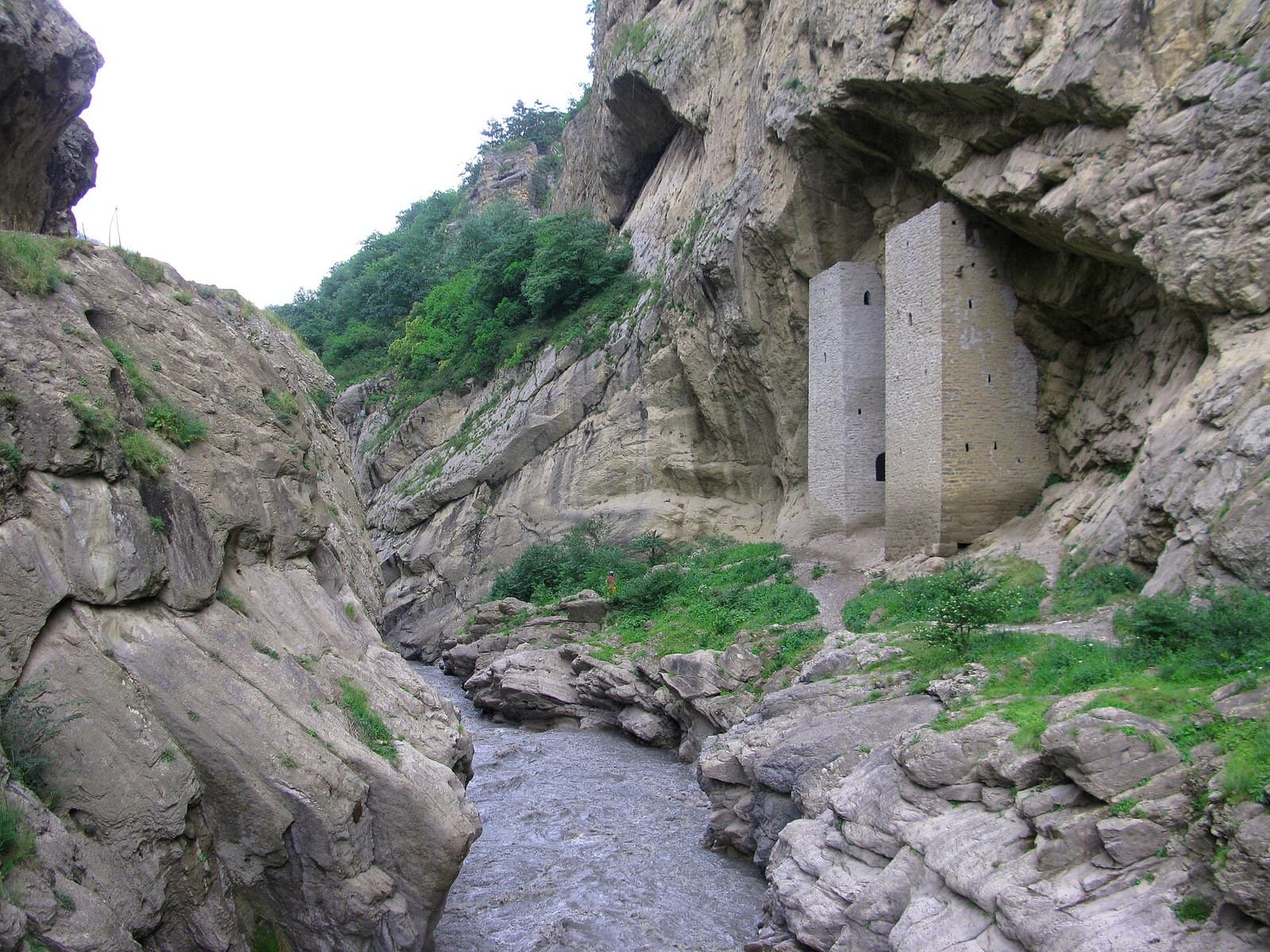
On a grass spur above the Argun near the Georgian border stand forty-two small stone buildings with gabled roofs and low arched openings, close enough together to look like a village. They're crypts, and the place is called Tsoi-Pede. The account attached to it locally is that during an epidemic people who knew they were dying walked up here themselves, lay down inside and pulled the slab across, so their families would not have to carry them or catch it.
Whether or not that happened as told, it says something about how the burial ground was understood: as a settlement of its own, built to last, kept apart and visited.
Chechnya is a republic of the Russian Federation, with Grozny as its capital, an area of about 16,000 square kilometres and roughly 1.5 million people, around 95 per cent of them Chechen. The land falls into three strips: the Terek lowland in the north, the Chechen plain in the middle where most people live, and the Caucasus range in the south, rising past 4,000 metres at Tebulosmta and cut by the Argun, Sharo-Argun and Chanty-Argun gorges. Almost all of the older architecture is in those gorges.
The evidence base needs stating plainly, because it shapes everything below. Reporting from inside Chechnya on the wars of the 1990s and on the government of Ramzan Kadyrov is heavily constrained, and most of what is documented comes from Russian and international human rights organisations, several of which have since been designated or dissolved by Russian authorities. Memorial, the society founded in 1987 to record Soviet repression and later the main documenter of the Chechen wars, was ordered dissolved by Russia's Supreme Court in December 2021 and received the Nobel Peace Prize in 2022 (Nobel Prize). Anna Politkovskaya, who reported on Chechnya for Novaya Gazeta, was murdered in Moscow in October 2006, and Memorial's Grozny researcher Natalia Estemirova was abducted and killed in July 2009. The European Court of Human Rights has ruled against Russia in a long series of Chechnya cases beginning with Khashiyev and Akayeva v. Russia in February 2005, and Russia ceased to be a party to the Convention on 16 September 2022.
Chechnya declared independence as the Chechen Republic of Ichkeria in 1991, a claim no state recognised; two wars followed, and a constitution approved by referendum in March 2003 defines the republic as part of the Russian Federation. Ramzan Kadyrov has headed it since 2007. Accounts of the wars, of casualty figures and of the present administration differ sharply between Russian official sources, Chechen exile sources and human rights organisations. This page attributes contested claims and takes no position on the republic's status or on its government.
Grozny. Founded in 1818 as the Russian fortress Groznaya at the mouth of the Sunzha valley, the city was fought over twice in a decade and rebuilt from the mid-2000s, so almost nothing standing is older than about twenty years. The Akhmad Kadyrov Mosque, opened in 2008, holds several thousand worshippers, and the republic's museum and archive collections are being reassembled from what survived.
Argun, Gudermes and Urus-Martan. The lowland towns of the Chechen plain, each rebuilt after heavy damage.
Itum-Kali and Shatoy. Small district centres high in the Argun valley, and the way in to the tower country: Ushkaloy, Nikaroy, Khoy and the Malkhista villages lie within a day of them.
Vedeno. Imam Shamil's headquarters in the eastern mountains from 1845 until Russian forces took it in 1859.
The Chechens and Ingush, who call themselves collectively Vainakh, are among the oldest continuously resident peoples of the North Caucasus, and their Nakh languages have no close relatives outside the region. Medieval Chechen society was organised in clans in the mountains, with the towers as its most visible product; Christianity reached parts of the highlands from Georgia, and Islam spread from Dagestan between the sixteenth and early nineteenth centuries.
Russian expansion up the Terek from the sixteenth century brought Cossack settlement and then fortresses, and Sheikh Mansur, a Naqshbandi preacher, led a rising from 1785 until his capture in 1791. The Caucasian War proper ran from 1817, and from 1834 the imamate of Imam Shamil, a Dagestani Avar, united much of Chechnya and Dagestan against the empire for twenty-five years; he surrendered at Gunib in August 1859, was exiled to Kaluga and died in Medina (Wikipedia). Defeat was followed by the muhajirat of the 1860s, when thousands of families left for Ottoman territory, founding the communities that still exist in Türkiye, Jordan and Syria.
The Soviet period gave the Chechens an autonomous region in 1922 and a joint Chechen-Ingush republic in 1936, then abolished both. The entire Chechen and Ingush population was deported to Central Asia on 23 February 1944, the republic was struck off the map and its districts handed to neighbours, and return was permitted only from 1957.
Independence was declared in 1991 under Dzhokhar Dudayev. Russian forces entered in December 1994; the first war ended with the Khasavyurt accord of August 1996 and left Grozny in ruins. Fighting resumed in 1999, and the assault on Grozny that winter destroyed what remained of the city. Akhmad Kadyrov, the former chief mufti, became president in 2003 and was killed by a bomb in the Grozny stadium in May 2004.
Chechen, Nokhchiin mott to its speakers, belongs to the Nakh branch of the Northeast Caucasian family, alongside Ingush and the small Bats language of Georgia, and it has no demonstrated relationship to Indo-European, Turkic or Semitic. Roughly 1.3 to 1.5 million people speak it, and UNESCO classifies it as vulnerable rather than endangered, since transmission at home continues. Its grammar is difficult in specific ways: nouns fall into six classes marked on the verb, the case system is ergative, and the sound inventory runs to dozens of consonants including ejectives and pharyngeals along with an unusually large set of vowels and diphthongs (Wikipedia).
Its writing has changed alphabet three times in a century. Arabic script was used for Chechen from about the sixteenth century, mostly for religious texts; the ethnographer Peter von Uslar produced a Cyrillic-based alphabet in 1862 that was little used; a Latin alphabet was introduced in 1925; Cyrillic replaced it in 1938 and remains official. A Latin alphabet was adopted again in 1992 under the independence government and dropped afterwards, which means Chechen written before 1925, between 1925 and 1938, and since sits in three mutually unreadable systems.
The names are worth unpicking. Nokhchi is what Chechens call themselves; Chechen comes through Russian from the lowland village of Chechen-Aul; and Vainakh, the term covering Chechens and Ingush together, means our people.
Chechen society is organised through the teip, a patrilineal clan with a named ancestor and a territory of origin, of which there are around 130 grouped into nine larger tukkhum. Alongside Islamic law runs adat, the older customary law, which governed inheritance, marriage, hospitality and the blood feud, and it's still the framework within which reconciliation between families is negotiated. The word Chechens use for the whole code of conduct is nokhchalla: hospitality without being asked, restraint in speech, deference to elders and to guests.
The music is narrative. Illi are heroic songs performed by a singer called an illanch, telling of raids, of exile and of individual courage, and they're accompanied by the dechig-pondar, a three-stringed lute, or the adhokhu-pondar, a bowed instrument played upright on the knee. The dance is the nokhchi khalkhar, fast and upright, and the Vainakh State Dance Ensemble, founded in 1939, carried it well beyond the Caucasus; the dancer Makhmud Esambayev, who was nineteen when his family was deported in 1944, became one of the best-known performers in the Soviet Union.
At the table the dish everyone names is zhizhig-galnash, boiled meat with dumplings and a garlic broth poured over, followed by chepalgash, thin flatbreads filled with curd. The old dress survives in performance and at weddings: the cherkeska with its row of cartridge tubes across the chest, the tall papakha of sheepskin, and for women a long fitted dress with a headscarf.
Chechens are Sunni Muslims of the Shafi'i school, and Sufism shapes religious life more visibly here than almost anywhere else in Europe. Two orders matter. The Naqshbandi spread during the Caucasian War and was the framework of Shamil's imamate. The Qadiri arrived with Kunta-Haji Kishiev in the 1850s and 1860s, a shepherd's son who had made the pilgrimage and who preached withdrawal from armed struggle and patience under Russian rule; the authorities arrested him in 1864 and he died in exile in 1867, and his followers have never accepted that he is simply dead (Wikipedia).
 Grozny was reduced to rubble twice within a decade, and almost nothing standing in the city predates the rebuilding. The mosque opened in 2008 on ground that had been cleared to nothing. Photograph by Vyacheslav Argenberg, CC BY 4.0, via Wikimedia Commons.
The orders subdivide into virds, brotherhoods attached to a particular teacher, of which there are around thirty. What distinguishes the Qadiri virds is the loud zikr: men form a circle, chant the names of God, and move faster and faster in unison, sometimes for an hour, and it's performed at funerals as well as in the mosque. Pilgrimage to the tombs of ustazes, the founding teachers, is the other central practice, and the shrine of Kunta-Haji's mother at Ertan-Kort draws visitors from across the republic.
An older layer persists under all of this. The mountains hold sieli, pre-Islamic sanctuaries built of stone with niches for offerings, and two of them stand at the entrance to the Tsoi-Pede necropolis; sun symbols are carved on tower walls and grave slabs; and ancestors are named and remembered in ways that owe as much to clan practice as to Islam.
Chechen funerals follow Islamic practice with local emphases. The body is washed, wrapped in a shroud and buried the same day, without a coffin, laid on its right side in a niche cut into the side of the grave. The marker is a chirt, an upright stone stele carved with an Arabic inscription and often with the sun and moon. The mourning gathering, the tezet, runs for three days: the men stand in rows in the courtyard receiving each arrival, the women gather inside, and the dead person's vird performs the zikr. Alms are given, the Quran is read, and the family is visited again on the fortieth day.
The deportation of 23 February 1944. Operation Lentil, ordered by Lavrentiy Beria and executed by NKVD troops already stationed in the republic on the pretext of exercises, removed the entire Chechen and Ingush population in a matter of days. Soviet records account for about 496,000 people, some 387,000 Chechens and 91,000 Ingush, loaded into freight wagons and sent mainly to the Kazakh and Kirghiz republics under a special settlement regime that made leaving the assigned district a criminal offence (Wikipedia). The Chechen-Ingush republic was abolished and its territory distributed to neighbouring regions, and Chechen books, gravestones and place names went with it.
How many died is disputed and should be read as a range. J. Otto Pohl arrives at about 123,000 deaths, the demographer Dalkhat Ediev at 125,500 Chechens and 20,300 Ingush, or roughly 31 and 21 per cent of each people, John Dunlop at around 200,000 including indirect losses, and Chechen sources at up to 400,000. Whatever figure is used, a quarter or more of a nation died in transit or in the first years of exile.
One episode is alleged rather than established. Accounts published during perestroika, resting on the testimony of the NKVD officer Dziyaudin Malsagov and on documents attributed to the operation, state that on 27 February 1944 some 700 people who could not be moved were locked in a barn at the mountain village of Khaibakh and burned alive on the order of an NKVD commander. Chechen historians and the republic's authorities treat it as fact; Russian historians have disputed both the documents and the number, and no court has ruled on it, so this page reports it as an allegation (Wikipedia).
Return was permitted by a decree of January 1957 that restored the republic, and by 1961 some 432,000 of about 524,000 deportees had come back, often to houses occupied by other people. On 26 February 2004 the European Parliament, in a resolution on relations with Russia, recognised the deportation of the Chechen people as an act of genocide within the meaning of the 1907 Hague Convention and the 1948 Genocide Convention; that is a statement by a parliamentary body rather than a ruling of a court.
The date is kept as a day of mourning, and the way it's kept has itself become part of the memory. In 2011 Ramzan Kadyrov moved the republic's official Day of Remembrance and Sorrow from 23 February to 10 May, the date of his father's burial, and Caucasian Knot reports that the official observance is held on 10 May while Chechens at home and abroad continue to mark 23 February (Caucasian Knot). One monument tells the same story in stone. In 1991 and 1992, under Dzhokhar Dudayev, old Chechen grave markers that Soviet builders had used as construction material were gathered into a memorial in central Grozny, inscribed with the words we will not break, we will not weep, we will never forget. It was dismantled under the later administration and the stones moved, a decision widely criticised outside the republic.
Chechen genealogy is the teip, and it survived the destruction of everything written.
A Chechen belongs to a teip, a clan, of which there are more than a hundred and thirty, and within it to a smaller descent group. The teip determines obligation, marriage and, historically, feud, and a Chechen can recite the line and place another Chechen by it. The system was carried orally and it has outlasted every archive.
The archives did not last. Grozny was reduced to rubble twice within a decade, in 1994 to 1996 and again in 1999 to 2000, and the republican archives, the registry offices and the university were destroyed. Almost nothing standing in the city predates the rebuilding. For a great many Chechen families there is no civil record of the twentieth century at all, and identity documents were reissued on the strength of testimony.
The deportation is the other absence. On 23 February 1944 the entire Chechen and Ingush population, around half a million people, was loaded onto trains and deported to Kazakhstan and Central Asia; a very large number died in transit and in the first years. The NKVD lists of that operation exist in Russian archives and are the document Chechen families most want, because they name who was put on which train.
The vainakh towers of the Argun gorge, and the necropolis at Tsoy-Pede they call the city of the dead, are the oldest surviving Chechen record.
The towers are the great architectural inheritance of the region and the focus of most conservation work. Residential towers, ghala, stand three or four storeys on a rectangular plan of roughly seven by eleven metres, with a flat roof and stone parapet. Combat towers, b'ov, rise 20 to 25 metres in four or five floors from a square base five or six metres wide, tapering as they climb, with walls about a metre thick at the bottom and half that at the top, and are finished either with corner battlements or with the stepped pyramidal roof of four to sixteen corbelled courses closed by a pointed capstone. Most were built between the eleventh and eighteenth centuries, with the classic combat towers of the fifteenth and sixteenth, and tradition names individual masters and the lineages they came from (Wikipedia).
The Argun State Historical, Architectural and Natural Museum-Reserve was created in 1988 to protect them, and it covers around 150 tower settlements in the gorges, with several hundred residential and combat towers, about fifteen sanctuaries and roughly 150 above-ground burial vaults. It suffered badly during the wars, when towers were used as positions and shelled, and restoration has been running since the mid-2000s. Tsoi-Pede, with its 42 crypts, two pillar-shaped sanctuaries and two combat towers, was submitted by the Russian Federation to UNESCO's Tentative List on 13 November 2024 as the Complex of Structures of the Tsoi-Pede Necropolis (UNESCO).
Against that stands a loss that has not been recovered. The Chechen state museums held roughly 230,000 items before 1994, and reporting on the aftermath of the first war concluded that up to 90 per cent were destroyed or taken, with the fine arts collection burned in its building and paintings later found slashed and shot through; the republican archive and library burned as well, taking much of the written record of the nineteenth and twentieth centuries with them (The Art Newspaper). Surviving canvases were sent to Moscow for restoration and some were returned. A United Nations assessment in 2003 described Grozny as the most destroyed city on earth (Wikipedia).
Because so much paper burned, the surviving record is disproportionately digital and held outside the republic. Memorial's databases of Soviet repression, which include deportation records, remain online after the organisation's dissolution and are the main searchable source for families tracing what happened to a grandparent in 1944. The judgments of the European Court of Human Rights form a second archive, since each one contains sworn testimony about a specific disappearance or death, indexed and publicly readable. Photogrammetric survey has produced measured models of tower complexes that are still slowly collapsing, and Chechen has a Wikipedia and a growing body of digitised print.
The Chechen diaspora falls into two layers. The older one descends from the emigrations of the 1860s and lives in Türkiye, Jordan and Syria, where Chechen villages kept the language and the dance for a century and a half. The newer one left during and after the wars, and there are now substantial communities in Austria, France, Germany, Belgium and Poland, alongside the Chechens who stayed in Kazakhstan after 1957.
Chechen literature in the Soviet period found its subject in exile: Abuzar Aidamirov's novel Long Nights took the emigration of the 1860s as its material and was read as being about 1944 as well. The Vainakh ensemble still tours, wrestling carries Chechen names internationally, and diaspora communities keep the illi and the zikr going in halls in Vienna and Istanbul.
A necropolis put forward. Tsoi-Pede, with its 42 crypts and its two sanctuaries, entered UNESCO's Tentative List in November 2024.
Towers standing again. The Argun museum-reserve, created in 1988 and badly damaged in the wars, has had tower complexes surveyed and restored since the mid-2000s.
An archive that outlived its keeper. Memorial was dissolved by court order in 2021, awarded the Nobel Peace Prize in 2022, and its databases of the deported and the repressed are still searchable.
A deportation named. The European Parliament recognised the events of 23 February 1944 as an act of genocide in February 2004.
Grozny was reduced to rubble twice within a decade, and almost nothing standing in the city predates the rebuilding. The mosque opened in 2008 on ground that had been cleared to nothing. Photograph by Vyacheslav Argenberg, CC BY 4.0, via Wikimedia Commons.
The orders subdivide into virds, brotherhoods attached to a particular teacher, of which there are around thirty. What distinguishes the Qadiri virds is the loud zikr: men form a circle, chant the names of God, and move faster and faster in unison, sometimes for an hour, and it's performed at funerals as well as in the mosque. Pilgrimage to the tombs of ustazes, the founding teachers, is the other central practice, and the shrine of Kunta-Haji's mother at Ertan-Kort draws visitors from across the republic.
An older layer persists under all of this. The mountains hold sieli, pre-Islamic sanctuaries built of stone with niches for offerings, and two of them stand at the entrance to the Tsoi-Pede necropolis; sun symbols are carved on tower walls and grave slabs; and ancestors are named and remembered in ways that owe as much to clan practice as to Islam.
Chechen funerals follow Islamic practice with local emphases. The body is washed, wrapped in a shroud and buried the same day, without a coffin, laid on its right side in a niche cut into the side of the grave. The marker is a chirt, an upright stone stele carved with an Arabic inscription and often with the sun and moon. The mourning gathering, the tezet, runs for three days: the men stand in rows in the courtyard receiving each arrival, the women gather inside, and the dead person's vird performs the zikr. Alms are given, the Quran is read, and the family is visited again on the fortieth day.
The deportation of 23 February 1944. Operation Lentil, ordered by Lavrentiy Beria and executed by NKVD troops already stationed in the republic on the pretext of exercises, removed the entire Chechen and Ingush population in a matter of days. Soviet records account for about 496,000 people, some 387,000 Chechens and 91,000 Ingush, loaded into freight wagons and sent mainly to the Kazakh and Kirghiz republics under a special settlement regime that made leaving the assigned district a criminal offence (Wikipedia). The Chechen-Ingush republic was abolished and its territory distributed to neighbouring regions, and Chechen books, gravestones and place names went with it.
How many died is disputed and should be read as a range. J. Otto Pohl arrives at about 123,000 deaths, the demographer Dalkhat Ediev at 125,500 Chechens and 20,300 Ingush, or roughly 31 and 21 per cent of each people, John Dunlop at around 200,000 including indirect losses, and Chechen sources at up to 400,000. Whatever figure is used, a quarter or more of a nation died in transit or in the first years of exile.
One episode is alleged rather than established. Accounts published during perestroika, resting on the testimony of the NKVD officer Dziyaudin Malsagov and on documents attributed to the operation, state that on 27 February 1944 some 700 people who could not be moved were locked in a barn at the mountain village of Khaibakh and burned alive on the order of an NKVD commander. Chechen historians and the republic's authorities treat it as fact; Russian historians have disputed both the documents and the number, and no court has ruled on it, so this page reports it as an allegation (Wikipedia).
Return was permitted by a decree of January 1957 that restored the republic, and by 1961 some 432,000 of about 524,000 deportees had come back, often to houses occupied by other people. On 26 February 2004 the European Parliament, in a resolution on relations with Russia, recognised the deportation of the Chechen people as an act of genocide within the meaning of the 1907 Hague Convention and the 1948 Genocide Convention; that is a statement by a parliamentary body rather than a ruling of a court.
The date is kept as a day of mourning, and the way it's kept has itself become part of the memory. In 2011 Ramzan Kadyrov moved the republic's official Day of Remembrance and Sorrow from 23 February to 10 May, the date of his father's burial, and Caucasian Knot reports that the official observance is held on 10 May while Chechens at home and abroad continue to mark 23 February (Caucasian Knot). One monument tells the same story in stone. In 1991 and 1992, under Dzhokhar Dudayev, old Chechen grave markers that Soviet builders had used as construction material were gathered into a memorial in central Grozny, inscribed with the words we will not break, we will not weep, we will never forget. It was dismantled under the later administration and the stones moved, a decision widely criticised outside the republic.
Chechen genealogy is the teip, and it survived the destruction of everything written.
A Chechen belongs to a teip, a clan, of which there are more than a hundred and thirty, and within it to a smaller descent group. The teip determines obligation, marriage and, historically, feud, and a Chechen can recite the line and place another Chechen by it. The system was carried orally and it has outlasted every archive.
The archives did not last. Grozny was reduced to rubble twice within a decade, in 1994 to 1996 and again in 1999 to 2000, and the republican archives, the registry offices and the university were destroyed. Almost nothing standing in the city predates the rebuilding. For a great many Chechen families there is no civil record of the twentieth century at all, and identity documents were reissued on the strength of testimony.
The deportation is the other absence. On 23 February 1944 the entire Chechen and Ingush population, around half a million people, was loaded onto trains and deported to Kazakhstan and Central Asia; a very large number died in transit and in the first years. The NKVD lists of that operation exist in Russian archives and are the document Chechen families most want, because they name who was put on which train.
The vainakh towers of the Argun gorge, and the necropolis at Tsoy-Pede they call the city of the dead, are the oldest surviving Chechen record.
The towers are the great architectural inheritance of the region and the focus of most conservation work. Residential towers, ghala, stand three or four storeys on a rectangular plan of roughly seven by eleven metres, with a flat roof and stone parapet. Combat towers, b'ov, rise 20 to 25 metres in four or five floors from a square base five or six metres wide, tapering as they climb, with walls about a metre thick at the bottom and half that at the top, and are finished either with corner battlements or with the stepped pyramidal roof of four to sixteen corbelled courses closed by a pointed capstone. Most were built between the eleventh and eighteenth centuries, with the classic combat towers of the fifteenth and sixteenth, and tradition names individual masters and the lineages they came from (Wikipedia).
The Argun State Historical, Architectural and Natural Museum-Reserve was created in 1988 to protect them, and it covers around 150 tower settlements in the gorges, with several hundred residential and combat towers, about fifteen sanctuaries and roughly 150 above-ground burial vaults. It suffered badly during the wars, when towers were used as positions and shelled, and restoration has been running since the mid-2000s. Tsoi-Pede, with its 42 crypts, two pillar-shaped sanctuaries and two combat towers, was submitted by the Russian Federation to UNESCO's Tentative List on 13 November 2024 as the Complex of Structures of the Tsoi-Pede Necropolis (UNESCO).
Against that stands a loss that has not been recovered. The Chechen state museums held roughly 230,000 items before 1994, and reporting on the aftermath of the first war concluded that up to 90 per cent were destroyed or taken, with the fine arts collection burned in its building and paintings later found slashed and shot through; the republican archive and library burned as well, taking much of the written record of the nineteenth and twentieth centuries with them (The Art Newspaper). Surviving canvases were sent to Moscow for restoration and some were returned. A United Nations assessment in 2003 described Grozny as the most destroyed city on earth (Wikipedia).
Because so much paper burned, the surviving record is disproportionately digital and held outside the republic. Memorial's databases of Soviet repression, which include deportation records, remain online after the organisation's dissolution and are the main searchable source for families tracing what happened to a grandparent in 1944. The judgments of the European Court of Human Rights form a second archive, since each one contains sworn testimony about a specific disappearance or death, indexed and publicly readable. Photogrammetric survey has produced measured models of tower complexes that are still slowly collapsing, and Chechen has a Wikipedia and a growing body of digitised print.
The Chechen diaspora falls into two layers. The older one descends from the emigrations of the 1860s and lives in Türkiye, Jordan and Syria, where Chechen villages kept the language and the dance for a century and a half. The newer one left during and after the wars, and there are now substantial communities in Austria, France, Germany, Belgium and Poland, alongside the Chechens who stayed in Kazakhstan after 1957.
Chechen literature in the Soviet period found its subject in exile: Abuzar Aidamirov's novel Long Nights took the emigration of the 1860s as its material and was read as being about 1944 as well. The Vainakh ensemble still tours, wrestling carries Chechen names internationally, and diaspora communities keep the illi and the zikr going in halls in Vienna and Istanbul.
A necropolis put forward. Tsoi-Pede, with its 42 crypts and its two sanctuaries, entered UNESCO's Tentative List in November 2024.
Towers standing again. The Argun museum-reserve, created in 1988 and badly damaged in the wars, has had tower complexes surveyed and restored since the mid-2000s.
An archive that outlived its keeper. Memorial was dissolved by court order in 2021, awarded the Nobel Peace Prize in 2022, and its databases of the deported and the repressed are still searchable.
A deportation named. The European Parliament recognised the events of 23 February 1944 as an act of genocide in February 2004.
National Overview
Notable Cities
Historical Foundations
Linguistic and Etymological Roots
Cultural Identity
Religion and Spirituality
Remembrance and Mourning Traditions
Tracing a Family in Chechnya
Heritage Preservation Efforts
Digital Heritage
Contemporary Cultural Influences
Success Stories
References and resources
- Operation Lentil (Caucasus), Wikipedia: the deportation figures, the death-toll estimates and the 1957 return.
- Khaibakh massacre, Wikipedia: the allegation and the dispute over it.
- UNESCO Tentative List, Complex of Structures of the Tsoi-Pede Necropolis: submitted 13 November 2024.
- Nobel Peace Prize 2022, Memorial.
- The Art Newspaper, Art and archaeology falls casualty to the Chechen war.
- Caucasian Knot, Day of Remembrance and Sorrow in Chechnya.
- Wikipedia: Chechen tower architecture, Chechen language, Teip, Vainakh peoples.
- Wikipedia: Kunta-Hajji, Imam Shamil, Melkhista, Grozny.
- Wikipedia: First Chechen War, Second Chechen War, Battle of Grozny 1999-2000, Memorial.
- Encyclopaedia Britannica, Chechnya.