Heritage · Country
Israel Culture and Heritage
Within a few hours' drive lie a desert fortress, the caves that kept the Dead Sea Scrolls, and an Old City holy to three faiths at once. This is a guide to the layered heritage of the land, and to the traditions of remembrance carried by the peoples who live with it.Written to last.
By Confinity Heritage Editorial · Updated 2026-07-31 · 8-minute readQuiet tools, kept out of the way.
Few landscapes hold as many layers of memory in so small a space as the ground between the Jordan River and the Mediterranean Sea. Within a short drive lie the desert fortress of Masada, the caves near Qumran that preserved the Dead Sea Scrolls, the Galilee hills where early Christianity took shape, the terraced Bahai gardens of Haifa, and the Old City of Jerusalem, a place held sacred by Judaism, Christianity and Islam alike. Layer rests upon layer here: Canaanite tells beneath Israelite towns, Roman roads over Second Temple stones, Ottoman markets over Crusader walls. The modern State of Israel, established in 1948, administers much of this ground today, and its heritage is bound up with that of the Jewish people gathered from around the world and with the Arab, Druze, Christian and other communities who also call the land home.
It treats the sacred places of each faith evenhandedly and describes the mourning customs of Jewish, Muslim, Christian and Druze communities with equal care. The political questions that surround this land, among them the status of Jerusalem and the location of borders, are the subject of long international dispute; this profile takes no position on them, keeping instead to the inheritance that remains meaningful to many peoples at once.
Israel occupies a narrow strip along the eastern Mediterranean, running from the hills of the Galilee in the north to the Negev desert, which makes up roughly half the land area, in the south. The Jordan Rift Valley cuts down the eastern side, cradling the freshwater Sea of Galilee and, further south, the Dead Sea, whose shore is the lowest point of dry land on Earth at about 430 metres below sea level (Britannica). A fertile coastal plain fronts the sea, packing an unusual range of climates into a small compass.
The population is roughly 9.9 million. About three-quarters are Jewish, gathered over the past century and a half from Europe, the Middle East, North Africa, Ethiopia and the former Soviet Union, and about a fifth are Arab citizens who are Muslim, Christian or Druze. Hebrew is the official language and Arabic holds a special legal status. The country's internationally recognised boundaries remain unsettled in parts, a fact noted here without comment.
Jerusalem. Among the oldest continuously inhabited cities on Earth, Jerusalem has been built and rebuilt for over three thousand years, its walled Old City packing the holiest sites of three faiths into less than a square kilometre. For Jews, the Western Wall is the most sacred place of prayer, a surviving section of the retaining wall of the Second Temple compound. A few steps away, Christians venerate the Church of the Holy Sepulchre, traditionally held to stand over the sites of the crucifixion and resurrection of Jesus. On the raised platform above, known to Jews as the Temple Mount and to Muslims as the Haram al-Sharif or Al-Aqsa compound, stand the Dome of the Rock and the Al-Aqsa Mosque, among the most revered places in Islam. The status of the city is the subject of international dispute, recorded here plainly and not adjudicated.
 Acre, where the Ottoman town was built directly on top of the Crusader city, sealing it underneath rather than clearing it away. Photograph by Yaniv Ben-Arie, CC BY-SA 2.0, via Wikimedia Commons.
Tel Aviv-Jaffa. Founded in 1909 on the dunes north of the ancient port of Jaffa, Tel Aviv grew into the country's commercial and cultural centre. Its core holds the White City, the largest concentration of Bauhaus and International Style architecture in the world, some four thousand buildings raised largely in the 1930s and 1940s and inscribed by UNESCO in 2003 (UNESCO). Jaffa itself, joined to Tel Aviv in 1950, is far older, a harbour named in ancient texts and layered with Canaanite, Egyptian, Ottoman and modern remains.
Haifa. The northern port city rises in tiers up Mount Carmel, known for its mix of Jewish, Arab, Christian and other residents. Its best-known feature is the Bahai World Centre, whose golden-domed Shrine of the Bab crowns nineteen terraces of gardens, part of the Bahai Holy Places inscribed by UNESCO in 2008 (UNESCO).
Nazareth. The largest Arab city in Israel, Nazareth is central to Christian tradition as the town where Jesus is held to have grown up. Its Basilica of the Annunciation, among the largest churches in the Middle East, marks the site of the announcement of his birth and draws pilgrims worldwide.
Acre. The old harbour of Acre, or Akko, preserves an Ottoman walled town built above a largely intact Crusader city, with vaulted halls, a citadel and the Al-Jazzar Mosque. It also holds significance for the Bahai faith, whose founder was imprisoned there. The Old City was inscribed by UNESCO in 2001 (UNESCO).
The land's recorded history reaches deep into the Bronze Age, when Canaanite city-states dotted the hills and coast. The kingdoms of ancient Israel and Judah took shape in the Iron Age, the latter ruled from Jerusalem. The earliest known reference to a people called Israel appears outside the Bible on the Merneptah Stele, an Egyptian victory inscription dated to around 1208 BCE (Biblical Archaeology Society).
Acre, where the Ottoman town was built directly on top of the Crusader city, sealing it underneath rather than clearing it away. Photograph by Yaniv Ben-Arie, CC BY-SA 2.0, via Wikimedia Commons.
Tel Aviv-Jaffa. Founded in 1909 on the dunes north of the ancient port of Jaffa, Tel Aviv grew into the country's commercial and cultural centre. Its core holds the White City, the largest concentration of Bauhaus and International Style architecture in the world, some four thousand buildings raised largely in the 1930s and 1940s and inscribed by UNESCO in 2003 (UNESCO). Jaffa itself, joined to Tel Aviv in 1950, is far older, a harbour named in ancient texts and layered with Canaanite, Egyptian, Ottoman and modern remains.
Haifa. The northern port city rises in tiers up Mount Carmel, known for its mix of Jewish, Arab, Christian and other residents. Its best-known feature is the Bahai World Centre, whose golden-domed Shrine of the Bab crowns nineteen terraces of gardens, part of the Bahai Holy Places inscribed by UNESCO in 2008 (UNESCO).
Nazareth. The largest Arab city in Israel, Nazareth is central to Christian tradition as the town where Jesus is held to have grown up. Its Basilica of the Annunciation, among the largest churches in the Middle East, marks the site of the announcement of his birth and draws pilgrims worldwide.
Acre. The old harbour of Acre, or Akko, preserves an Ottoman walled town built above a largely intact Crusader city, with vaulted halls, a citadel and the Al-Jazzar Mosque. It also holds significance for the Bahai faith, whose founder was imprisoned there. The Old City was inscribed by UNESCO in 2001 (UNESCO).
The land's recorded history reaches deep into the Bronze Age, when Canaanite city-states dotted the hills and coast. The kingdoms of ancient Israel and Judah took shape in the Iron Age, the latter ruled from Jerusalem. The earliest known reference to a people called Israel appears outside the Bible on the Merneptah Stele, an Egyptian victory inscription dated to around 1208 BCE (Biblical Archaeology Society).
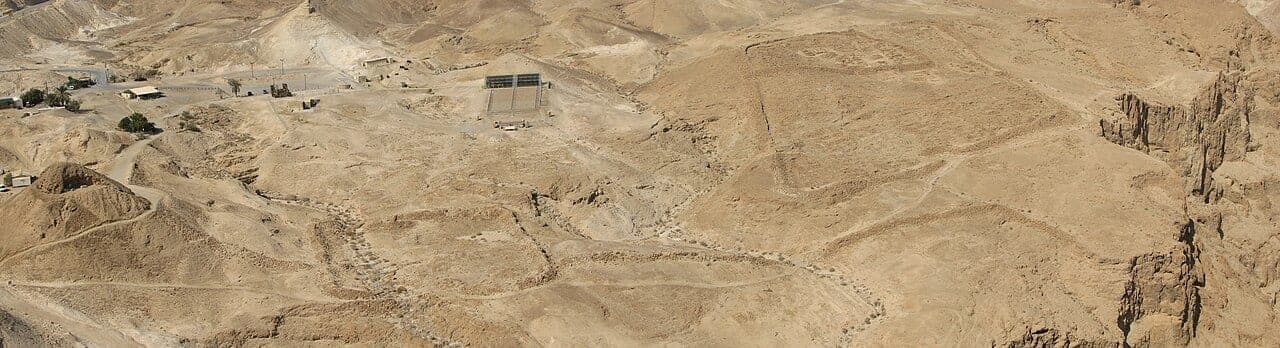
 Masada, where Herod built a palace on a rock and where the siege of AD 73 became a founding story argued over ever since. Photograph by Godot13, CC BY-SA 4.0, via Wikimedia Commons.
The Babylonian conquest of Jerusalem in 586 BCE destroyed the First Temple and carried much of Judah's population into exile. After the Persian ruler Cyrus permitted a return, the Second Temple was rebuilt around 516 BCE. The Second Temple period saw Persian and then Hellenistic rule after the conquests of Alexander the Great, the Maccabean revolt and the independent Hasmonean kingdom, and finally the arrival of Rome. Herod the Great, a Roman client king, enlarged the Temple and its platform on a monumental scale and built desert palaces including the cliff-top fortress of Masada. Roman Judaea produced two great revolts; the first ended with the destruction of the Second Temple in 70 CE, and Masada fell around 73 to 74 CE after a siege recorded by Josephus.
The centuries that followed layered rule upon rule: Byzantine Christian administration filled the land with churches and monasteries; the Islamic conquest of the seventh century brought new sacred building in Jerusalem; the Crusades left castles and cathedrals; and four centuries of Ottoman rule, from 1517 until the First World War, shaped the walls, mosques and markets that survive in many old towns. From the late nineteenth century, waves of Jewish immigration, together with an older resident Jewish presence and the enduring Arab population, reshaped the land under late Ottoman and then British administration. The modern State of Israel was established in 1948. The wider history surrounding that event, and the competing national narratives attached to it, is contested and lies beyond the scope of this heritage profile.
The revival of Hebrew is among the most unusual episodes in the history of language. For centuries Hebrew survived as a language of prayer, study and scripture, called lashon ha-kodesh, the holy tongue, but had no community of native everyday speakers. Beginning in the 1880s, Eliezer Ben-Yehuda (1858 to 1922) and the pioneers around him turned it back into a spoken vernacular, coining thousands of new words and compiling a comprehensive dictionary (Academy of the Hebrew Language). By 1922 the British Mandate authorities recognised Hebrew as an official language, and it became the daily speech of a nation, the clearest case of a language brought back from purely liturgical use into full modern life.
Arabic is the mother tongue of a large minority and holds a special legal status, its dialects and place names woven through the country's geography. The name Israel itself carries an old story: in the Hebrew scriptures the patriarch Jacob receives it after wrestling through the night with a divine figure, and the text glosses it as one who has struggled with God and prevailed, from roots meaning to strive and God (Wikipedia). The name later attached to the northern kingdom, to the people as a whole, and in 1948 to the modern state.
Israeli culture draws on the many origins of its people. Jewish communities arrived carrying the customs of Poland and Yemen, Morocco and Iraq, Germany and Ethiopia, Russia and Argentina, and those traditions meet the deep-rooted culture of the country's Arab citizens, making one society from many.
Hebrew writing flowered in the twentieth century: S. Y. Agnon shared the Nobel Prize in Literature in 1966, later novelists such as Amos Oz, A. B. Yehoshua and David Grossman found readers worldwide, and the poet Yehuda Amichai gave modern Hebrew verse a plain and enduring voice, while Arabic-language authors including Emile Habibi added a distinct strand. Music ranges from the piyyutim and cantorial traditions of the synagogue to Mizrahi pop and the Arabic maqam heard in Nazareth and Haifa, and to artists such as Ofra Haza, whose Yemenite songs reached global audiences, and Idan Raichel, who blended Ethiopian and other influences into widely heard recordings.
The country's food tells the same story of gathered communities: dishes shared across many groups, among them hummus, falafel, shakshuka, the spice blend za'atar and slow-cooked Sabbath stews, sit alongside the specific cooking of each community of origin.
Judaism gives the land much of its sacred geography, from the Western Wall in Jerusalem to the tombs of sages in the Galilee and the hill town of Safed, a centre of Kabbalah since the sixteenth century. The Sea of Galilee and its shore, with sites such as Capernaum, Tabgha and the Mount of Beatitudes, are central to Christian tradition as the setting of much of the ministry of Jesus, and Nazareth and Jerusalem draw Christian pilgrims year-round. For Islam, Jerusalem holds the Al-Aqsa compound with the Dome of the Rock and the Al-Aqsa Mosque, among the faith's most revered sites, and Muslim communities maintain mosques and shrines across the country.
Two smaller communities add further dimension. The Druze, an Arabic-speaking people whose esoteric monotheistic faith emerged in the eleventh century, live chiefly in villages of the Carmel and Galilee such as Daliyat al-Karmel and keep their own religious leadership and customs. The Bahai faith has its spiritual and administrative heart in Israel, with the Shrine of the Bab and its gardens in Haifa and the Shrine of Bahaullah near Acre drawing pilgrims from around the world.
Burial in Jewish tradition takes place as soon as possible, often within a day, beginning a structured passage through grief back toward daily life. The seven days after the funeral form the shiva, when close mourners remain at home and the community comes to them, followed by the sheloshim, a thirty-day period of lighter mourning. The mourner's Kaddish, a prayer that praises the divine without mentioning death, is recited for months after a parent's passing and again on each yahrzeit, the anniversary of a death, when a memorial candle is lit, and the Yizkor service on certain festivals gathers the community to remember its dead by name. Two solemn days mark national remembrance: Yom HaZikaron, for fallen soldiers and victims of terror, and Yom HaShoah, the Holocaust remembrance day. Central to that memory is Yad Vashem, established by law in 1953 on the Mount of Remembrance in Jerusalem as the national centre for commemorating the six million Jews murdered in the Holocaust (Yad Vashem); its Hall of Names preserves the victims' identities, and its Righteous Among the Nations programme honours non-Jews who saved Jewish lives.
The country's other communities keep their own customs with equal care. Muslim tradition also calls for prompt burial, preceded by the ritual washing and shrouding of the body, the funeral prayer known as Salat al-Janazah, and interment on the right side facing Mecca, with a mourning period of three days and a longer period observed by a widow. Christian communities, among them Greek Orthodox, Catholic and Armenian, mark death with funeral liturgies and later memorial services according to their traditions. The Druze, who hold a belief in the transmigration of the soul, bury their dead without cremation and gather in large numbers to mourn, with religious figures leading the rites. Across all these traditions, the visiting and tending of graves remains a shared act of memory.
Israel holds the largest single archive of the dead of one people anywhere, and it exists because the record of them was being destroyed as it was made.
Yad Vashem's Central Database of Shoah Victims' Names holds several million individual identifications, built from Pages of Testimony submitted by survivors and relatives, from deportation lists, ghetto registers and community records recovered across Europe. Each Page of Testimony is a form filled in by someone who knew the person: name, parents, birthplace, occupation, place and circumstances of death. It is a genealogical archive assembled by families rather than by a state, and it is free to search.
Alongside it, the Central Archives for the History of the Jewish People holds the surviving communal records of Jewish communities across Europe, North Africa and the Middle East: birth and marriage registers, burial society books, tax rolls and rabbinical court files, gathered from places where the communities themselves no longer exist.
The Israeli state's own record is the population registry from 1948 onward, together with the immigration and absorption files of the aliyot, which document the arrival of Jews from Europe, Yemen, Iraq, Morocco, Ethiopia and the former Soviet Union in enormous detail.
For Palestinian families the records of the same territory are elsewhere and are contested: Ottoman and British Mandate land and population registers, UNRWA's registration of 1948 refugees and their descendants, and family papers, including the deeds and keys that households kept.
Israel counts nine UNESCO World Heritage Sites, all of them cultural. Masada and the Old City of Acre were the first, inscribed together in 2001; the White City of Tel Aviv followed in 2003; the Biblical Tels of Megiddo, Hazor and Beer Sheba and the Incense Route with its Nabataean desert cities in the Negev were added in 2005; the Bahai Holy Places in Haifa and the Western Galilee in 2008; the caves of human evolution at Nahal Me'arot on Mount Carmel in 2012; the Caves of Maresha and Bet Guvrin in 2014; and the Necropolis of Beit She'arim, a landmark of Jewish renewal, in 2015 (UNESCO). Separately, the Old City of Jerusalem and its Walls was inscribed on the World Heritage List in 1981, on a nomination submitted by Jordan, and placed at the same time on the List of World Heritage in Danger (UNESCO); its listing reflects the site's universal significance and takes no position on the disputes surrounding the city.
The custody of this inheritance falls largely to the Israel Antiquities Authority, established in 1990, which oversees excavation, conservation and the national collection of finds. Because construction regularly uncovers ancient remains, salvage archaeology is constant, and sites from prehistoric caves to Crusader castles are maintained as parks and museums.
The most far-reaching digital project centres on the Dead Sea Scrolls, the roughly nine hundred manuscripts and thousands of fragments discovered from 1947 onward in caves near Qumran on the western shore of the Dead Sea. Their fragility long limited access, but the Israel Antiquities Authority, working with Google, created the Leon Levy Dead Sea Scrolls Digital Library, which puts high-resolution, multi-spectral images of the collection online for anyone to study (Dead Sea Scrolls Digital Library). The imaging captures text invisible to the naked eye, and the archive is searchable and freely available, opening manuscripts once reserved for a handful of scholars to readers across the world, alongside digitised museum and archive collections of photographs, testimonies and records that carry the country's heritage well beyond its borders.
Contemporary Israeli culture reaches a wide international audience: its television dramas have been adapted around the world, its technology and design sectors carry the country's name abroad, and its musicians, chefs, writers and dance companies travel widely. This output moves alongside a large Jewish diaspora and an Arab diaspora with their own ties to the land, keeping the heritage described here in use in communities across the globe.
The scrolls made universal. The Dead Sea Scrolls, hidden in desert caves for two thousand years and too fragile for ordinary handling, are now legible on any screen, the digital library built with Google turning a collection once reserved for specialists into an open resource for all.
A city of gardens preserved. The Bahai terraces on Mount Carmel, tended by a global community of volunteers, were recognised by UNESCO in 2008, and their conservation shows how a living faith and a public landmark can be maintained together.
Modernism given a second life. Once neglected, the Bauhaus buildings of Tel Aviv's White City have been surveyed, restored and protected since their UNESCO inscription in 2003, and a dedicated centre now teaches visitors to read the surrounding streets.
Names that are not lost. At Yad Vashem, the ongoing effort to recover the names of Holocaust victims has documented millions of individuals, so that people once meant to be erased are recorded and remembered, one name at a time.
Masada, where Herod built a palace on a rock and where the siege of AD 73 became a founding story argued over ever since. Photograph by Godot13, CC BY-SA 4.0, via Wikimedia Commons.
The Babylonian conquest of Jerusalem in 586 BCE destroyed the First Temple and carried much of Judah's population into exile. After the Persian ruler Cyrus permitted a return, the Second Temple was rebuilt around 516 BCE. The Second Temple period saw Persian and then Hellenistic rule after the conquests of Alexander the Great, the Maccabean revolt and the independent Hasmonean kingdom, and finally the arrival of Rome. Herod the Great, a Roman client king, enlarged the Temple and its platform on a monumental scale and built desert palaces including the cliff-top fortress of Masada. Roman Judaea produced two great revolts; the first ended with the destruction of the Second Temple in 70 CE, and Masada fell around 73 to 74 CE after a siege recorded by Josephus.
The centuries that followed layered rule upon rule: Byzantine Christian administration filled the land with churches and monasteries; the Islamic conquest of the seventh century brought new sacred building in Jerusalem; the Crusades left castles and cathedrals; and four centuries of Ottoman rule, from 1517 until the First World War, shaped the walls, mosques and markets that survive in many old towns. From the late nineteenth century, waves of Jewish immigration, together with an older resident Jewish presence and the enduring Arab population, reshaped the land under late Ottoman and then British administration. The modern State of Israel was established in 1948. The wider history surrounding that event, and the competing national narratives attached to it, is contested and lies beyond the scope of this heritage profile.
The revival of Hebrew is among the most unusual episodes in the history of language. For centuries Hebrew survived as a language of prayer, study and scripture, called lashon ha-kodesh, the holy tongue, but had no community of native everyday speakers. Beginning in the 1880s, Eliezer Ben-Yehuda (1858 to 1922) and the pioneers around him turned it back into a spoken vernacular, coining thousands of new words and compiling a comprehensive dictionary (Academy of the Hebrew Language). By 1922 the British Mandate authorities recognised Hebrew as an official language, and it became the daily speech of a nation, the clearest case of a language brought back from purely liturgical use into full modern life.
Arabic is the mother tongue of a large minority and holds a special legal status, its dialects and place names woven through the country's geography. The name Israel itself carries an old story: in the Hebrew scriptures the patriarch Jacob receives it after wrestling through the night with a divine figure, and the text glosses it as one who has struggled with God and prevailed, from roots meaning to strive and God (Wikipedia). The name later attached to the northern kingdom, to the people as a whole, and in 1948 to the modern state.
Israeli culture draws on the many origins of its people. Jewish communities arrived carrying the customs of Poland and Yemen, Morocco and Iraq, Germany and Ethiopia, Russia and Argentina, and those traditions meet the deep-rooted culture of the country's Arab citizens, making one society from many.
Hebrew writing flowered in the twentieth century: S. Y. Agnon shared the Nobel Prize in Literature in 1966, later novelists such as Amos Oz, A. B. Yehoshua and David Grossman found readers worldwide, and the poet Yehuda Amichai gave modern Hebrew verse a plain and enduring voice, while Arabic-language authors including Emile Habibi added a distinct strand. Music ranges from the piyyutim and cantorial traditions of the synagogue to Mizrahi pop and the Arabic maqam heard in Nazareth and Haifa, and to artists such as Ofra Haza, whose Yemenite songs reached global audiences, and Idan Raichel, who blended Ethiopian and other influences into widely heard recordings.
The country's food tells the same story of gathered communities: dishes shared across many groups, among them hummus, falafel, shakshuka, the spice blend za'atar and slow-cooked Sabbath stews, sit alongside the specific cooking of each community of origin.
Judaism gives the land much of its sacred geography, from the Western Wall in Jerusalem to the tombs of sages in the Galilee and the hill town of Safed, a centre of Kabbalah since the sixteenth century. The Sea of Galilee and its shore, with sites such as Capernaum, Tabgha and the Mount of Beatitudes, are central to Christian tradition as the setting of much of the ministry of Jesus, and Nazareth and Jerusalem draw Christian pilgrims year-round. For Islam, Jerusalem holds the Al-Aqsa compound with the Dome of the Rock and the Al-Aqsa Mosque, among the faith's most revered sites, and Muslim communities maintain mosques and shrines across the country.
Two smaller communities add further dimension. The Druze, an Arabic-speaking people whose esoteric monotheistic faith emerged in the eleventh century, live chiefly in villages of the Carmel and Galilee such as Daliyat al-Karmel and keep their own religious leadership and customs. The Bahai faith has its spiritual and administrative heart in Israel, with the Shrine of the Bab and its gardens in Haifa and the Shrine of Bahaullah near Acre drawing pilgrims from around the world.
Burial in Jewish tradition takes place as soon as possible, often within a day, beginning a structured passage through grief back toward daily life. The seven days after the funeral form the shiva, when close mourners remain at home and the community comes to them, followed by the sheloshim, a thirty-day period of lighter mourning. The mourner's Kaddish, a prayer that praises the divine without mentioning death, is recited for months after a parent's passing and again on each yahrzeit, the anniversary of a death, when a memorial candle is lit, and the Yizkor service on certain festivals gathers the community to remember its dead by name. Two solemn days mark national remembrance: Yom HaZikaron, for fallen soldiers and victims of terror, and Yom HaShoah, the Holocaust remembrance day. Central to that memory is Yad Vashem, established by law in 1953 on the Mount of Remembrance in Jerusalem as the national centre for commemorating the six million Jews murdered in the Holocaust (Yad Vashem); its Hall of Names preserves the victims' identities, and its Righteous Among the Nations programme honours non-Jews who saved Jewish lives.
The country's other communities keep their own customs with equal care. Muslim tradition also calls for prompt burial, preceded by the ritual washing and shrouding of the body, the funeral prayer known as Salat al-Janazah, and interment on the right side facing Mecca, with a mourning period of three days and a longer period observed by a widow. Christian communities, among them Greek Orthodox, Catholic and Armenian, mark death with funeral liturgies and later memorial services according to their traditions. The Druze, who hold a belief in the transmigration of the soul, bury their dead without cremation and gather in large numbers to mourn, with religious figures leading the rites. Across all these traditions, the visiting and tending of graves remains a shared act of memory.
Israel holds the largest single archive of the dead of one people anywhere, and it exists because the record of them was being destroyed as it was made.
Yad Vashem's Central Database of Shoah Victims' Names holds several million individual identifications, built from Pages of Testimony submitted by survivors and relatives, from deportation lists, ghetto registers and community records recovered across Europe. Each Page of Testimony is a form filled in by someone who knew the person: name, parents, birthplace, occupation, place and circumstances of death. It is a genealogical archive assembled by families rather than by a state, and it is free to search.
Alongside it, the Central Archives for the History of the Jewish People holds the surviving communal records of Jewish communities across Europe, North Africa and the Middle East: birth and marriage registers, burial society books, tax rolls and rabbinical court files, gathered from places where the communities themselves no longer exist.
The Israeli state's own record is the population registry from 1948 onward, together with the immigration and absorption files of the aliyot, which document the arrival of Jews from Europe, Yemen, Iraq, Morocco, Ethiopia and the former Soviet Union in enormous detail.
For Palestinian families the records of the same territory are elsewhere and are contested: Ottoman and British Mandate land and population registers, UNRWA's registration of 1948 refugees and their descendants, and family papers, including the deeds and keys that households kept.
Israel counts nine UNESCO World Heritage Sites, all of them cultural. Masada and the Old City of Acre were the first, inscribed together in 2001; the White City of Tel Aviv followed in 2003; the Biblical Tels of Megiddo, Hazor and Beer Sheba and the Incense Route with its Nabataean desert cities in the Negev were added in 2005; the Bahai Holy Places in Haifa and the Western Galilee in 2008; the caves of human evolution at Nahal Me'arot on Mount Carmel in 2012; the Caves of Maresha and Bet Guvrin in 2014; and the Necropolis of Beit She'arim, a landmark of Jewish renewal, in 2015 (UNESCO). Separately, the Old City of Jerusalem and its Walls was inscribed on the World Heritage List in 1981, on a nomination submitted by Jordan, and placed at the same time on the List of World Heritage in Danger (UNESCO); its listing reflects the site's universal significance and takes no position on the disputes surrounding the city.
The custody of this inheritance falls largely to the Israel Antiquities Authority, established in 1990, which oversees excavation, conservation and the national collection of finds. Because construction regularly uncovers ancient remains, salvage archaeology is constant, and sites from prehistoric caves to Crusader castles are maintained as parks and museums.
The most far-reaching digital project centres on the Dead Sea Scrolls, the roughly nine hundred manuscripts and thousands of fragments discovered from 1947 onward in caves near Qumran on the western shore of the Dead Sea. Their fragility long limited access, but the Israel Antiquities Authority, working with Google, created the Leon Levy Dead Sea Scrolls Digital Library, which puts high-resolution, multi-spectral images of the collection online for anyone to study (Dead Sea Scrolls Digital Library). The imaging captures text invisible to the naked eye, and the archive is searchable and freely available, opening manuscripts once reserved for a handful of scholars to readers across the world, alongside digitised museum and archive collections of photographs, testimonies and records that carry the country's heritage well beyond its borders.
Contemporary Israeli culture reaches a wide international audience: its television dramas have been adapted around the world, its technology and design sectors carry the country's name abroad, and its musicians, chefs, writers and dance companies travel widely. This output moves alongside a large Jewish diaspora and an Arab diaspora with their own ties to the land, keeping the heritage described here in use in communities across the globe.
The scrolls made universal. The Dead Sea Scrolls, hidden in desert caves for two thousand years and too fragile for ordinary handling, are now legible on any screen, the digital library built with Google turning a collection once reserved for specialists into an open resource for all.
A city of gardens preserved. The Bahai terraces on Mount Carmel, tended by a global community of volunteers, were recognised by UNESCO in 2008, and their conservation shows how a living faith and a public landmark can be maintained together.
Modernism given a second life. Once neglected, the Bauhaus buildings of Tel Aviv's White City have been surveyed, restored and protected since their UNESCO inscription in 2003, and a dedicated centre now teaches visitors to read the surrounding streets.
Names that are not lost. At Yad Vashem, the ongoing effort to recover the names of Holocaust victims has documented millions of individuals, so that people once meant to be erased are recorded and remembered, one name at a time.
National Overview
Notable Cities
Historical Foundations
Linguistic and Etymological Roots
Cultural Identity
Religion and Spirituality
Remembrance and Mourning Traditions
Tracing a Family in Israel
Heritage Preservation Efforts
Digital Heritage
Contemporary Cultural Influences
Success Stories
References and resources
- Encyclopaedia Britannica: Israel - geography, demography and historical background.
- UNESCO World Heritage Centre: Israel - the nine inscribed sites and their dates.
- UNESCO: Old City of Jerusalem and its Walls - the 1981 inscription and its listing among sites in danger.
- UNESCO: White City of Tel Aviv - the modern movement ensemble inscribed in 2003.
- UNESCO: Bahai Holy Places in Haifa and the Western Galilee - the 2008 inscription.
- The Leon Levy Dead Sea Scrolls Digital Library - the digitised scrolls, from the Israel Antiquities Authority and Google.
- Yad Vashem: World Holocaust Remembrance Center - the 1953 remembrance authority and its collections.
- Academy of the Hebrew Language: Eliezer Ben-Yehuda - the revival of spoken Hebrew.
- Biblical Archaeology Society: The Merneptah Stele - the earliest extrabiblical mention of Israel.