Heritage · Landmark
Saint Basil's Cathedral: Moscow's Emblem on Red Square
Commissioned by Ivan the Terrible to mark the capture of Kazan, Saint Basil's Cathedral gathers nine chapels on one foundation at the southern end of Red Square. Its swirl of onion domes, colored generations after the church was built, has become one of the most recognized images of Russia.Written to last.
By Confinity Heritage Editorial · Updated 2026-07-31 · 7-minute readQuiet tools, kept out of the way.
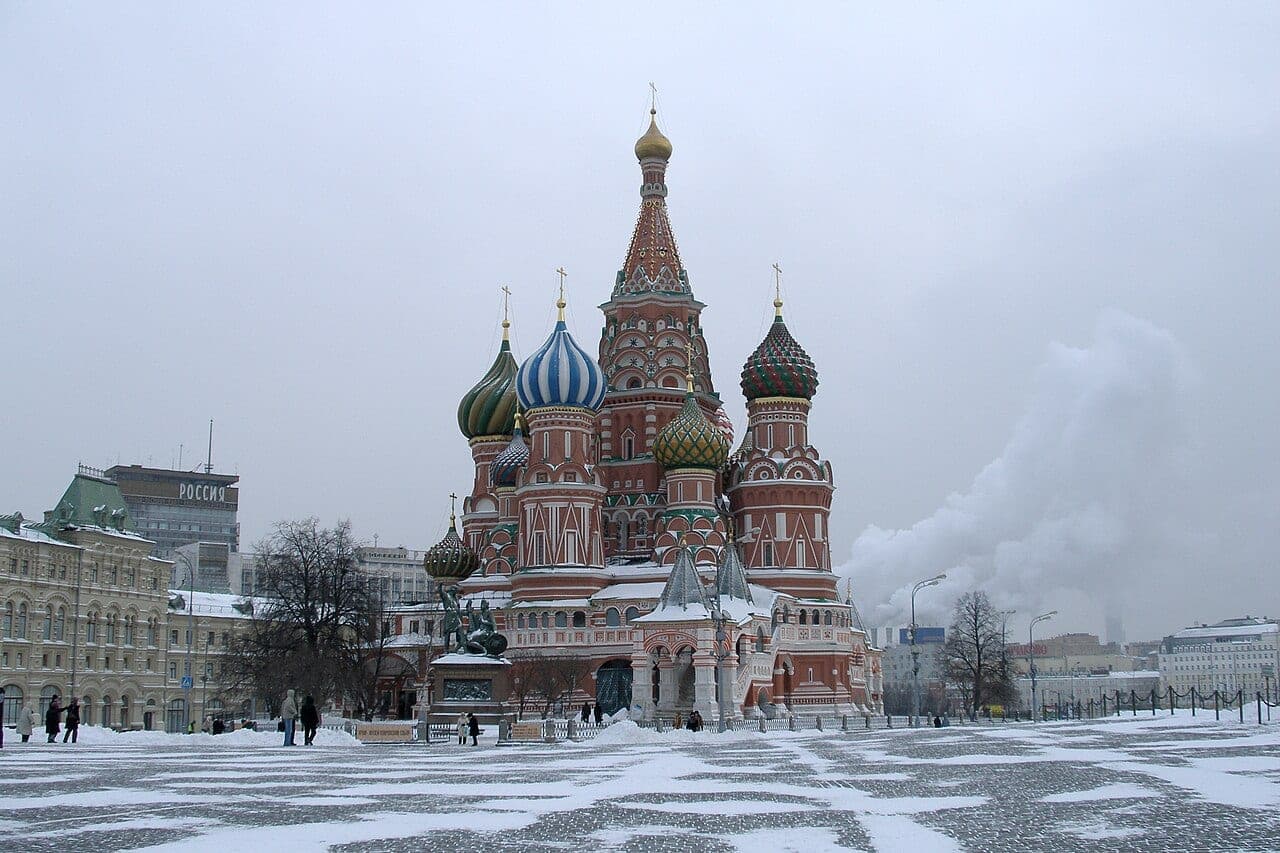
At the southern end of Red Square, where the ground falls away toward the Moskva River, a cluster of towers rises in a swirl of color and pattern that has no close rival anywhere. This is the Cathedral of the Intercession of the Most Holy Theotokos on the Moat, known in Russia as the Pokrovsky Cathedral and to most of the world as Saint Basil's Cathedral. Nine chapels of different heights, each crowned by an onion dome, gather around a tall central tower on a single raised foundation, so that the whole reads as one building and as a small city of churches at the same time.
Ivan IV, the ruler remembered as Ivan the Terrible, ordered it built in the 1550s to mark a military victory, and it has kept its place on the square through every change of Russian government since. Today the cathedral belongs to the State Historical Museum, which runs it as a museum of its own architecture and interiors, while Orthodox services are held there again on certain days (State Historical Museum). Since 1990 it has been protected as part of the Kremlin and Red Square UNESCO World Heritage Site (UNESCO).
Ivan IV came to the throne as a child and was crowned the first tsar of Russia in 1547. In 1552 his army captured Kazan, the capital of the Khanate of Kazan on the middle Volga, and over the following years Russian forces took Astrakhan as well, opening the whole length of the Volga to Moscow. To give thanks for these victories, Ivan commissioned a great votive church on Red Square (Britannica). Building began in 1555 and the cathedral was consecrated in 1561 (State Historical Museum); some references give the dates as 1554 to 1560.
Each of the surrounding chapels was dedicated to a saint or feast whose day fell on one of the decisive dates of the Kazan campaign, so that the plan itself records the sequence of the war. The main church at the center was dedicated to the Intercession of the Virgin, the feast on which the final assault on Kazan began, and it is from this dedication that the cathedral takes its formal name.
The popular name came later and from a very different figure. Vasily, or Basil, was a holy fool of Moscow, one of the ascetics who gave up ordinary life to live in poverty and speak uncomfortable truths, and he was widely revered in the city. He was buried beside the cathedral, and in 1588, during the reign of Ivan's son Fyodor I, a further chapel was added over his grave (Wikipedia). Muscovites increasingly called the whole building after this chapel, and the name Saint Basil's has stayed with it ever since.
One story about the cathedral has traveled further than almost any fact about it. According to legend, Ivan was so struck by the finished building that he had the architects blinded so they could never design anything to equal it. Historians treat the tale as apocryphal. The architect most often named, Postnik Yakovlev, is recorded working afterward on the walls and towers of the Kazan Kremlin, which he could not have done had he been blinded (Russia Beyond). The identity of the builders is itself uncertain: chronicles mention the names Barma and Postnik, sometimes as two men and sometimes as one, and their exact roles are still debated (Wikipedia).
The cathedral's plan is what makes it unusual. Rather than a single large hall, it is a group of nine separate churches, eight of them arranged in a symmetrical pattern around a ninth and tallest church at the center, all sharing one foundation and linked by an interior gallery (Britannica). Four larger chapels sit on the main axes and four smaller ones on the diagonals, giving the building an eight-pointed shape when seen from above. Each church has its own dome, its own altar, and its own dedication, and the interiors are small and narrow rather than open, so a visit becomes a walk from one intimate chapel to the next.
 Nine separate churches on one foundation, each with its own dome. The colours are not original; the building was largely white and gold for its first two centuries. Photograph by Vyacheslav Argenberg, CC BY 4.0, via Wikimedia Commons.
The central Church of the Intercession is capped not by a dome but by a tall, faceted spire known as a tent roof, or shatyor, a form drawn from Russian wooden church building and carried here into brick. It lifts the middle of the composition high above the surrounding chapels and pulls the whole cluster together. The building is made of brick, then an increasingly favored material in Moscow, worked into arches, gables, and blind arcades that give every surface a strong sense of depth.
The famous onion domes did not always look as they do now. Scholars believe the early cathedral was far more restrained, its brickwork left largely red and white and its domes probably plain or gilded; several accounts connect the present bulbous domes to rebuilding after a fire late in the sixteenth century (Britannica). The bold, contrasting colors that define it today were applied much later, mainly across the seventeenth and eighteenth centuries, with the green and red scheme largely settled during restoration work around 1896 to 1909 (Wikipedia). Each dome carries a different pattern of facets, studs, and spirals, so that no two are alike.
After the Russian Revolution the new Soviet state closed the cathedral to worship. It was secularized at the end of the 1920s and turned into a museum, becoming a branch of the State Historical Museum in 1928, a status it has kept in one form or another ever since (State Historical Museum). The decision to preserve it as a museum, rather than repurpose or demolish it, is part of why the building came through a period when many Moscow churches were torn down.
The most repeated story of its survival belongs to the 1930s, when Stalin's planners were reshaping central Moscow and clearing buildings around Red Square to make room for parades and traffic. By tradition, the architect Pyotr Baranovsky resisted the idea of removing the cathedral and campaigned to protect it, at real personal cost; a further, often-told episode has an official presenting Stalin with a model of the square and being ordered to put Saint Basil's back (Russia Beyond). How much of this is exact and how much has grown in the retelling is hard to know, but the cathedral was not demolished, and it remained open as a museum through the Soviet decades and the Second World War.
Few buildings serve as shorthand for an entire country the way Saint Basil's does for Russia. Its silhouette appears on book covers, news broadcasts, and travel posters as an instant sign of Moscow, much as the Eiffel Tower signals Paris. That role is partly an accident of its position on Red Square, the ceremonial center of the nation, and partly a product of its sheer distinctiveness: there was nothing quite like it when it was built, and there is little like it now.
For the Orthodox Church the cathedral remains a holy place tied to the veneration of the Intercession and to the memory of Basil the Blessed. For architects and historians it marks a high point of sixteenth-century Russian building, a moment when native forms in wood and the masonry traditions of Moscow were brought together at ambitious scale. UNESCO, in inscribing the Kremlin and Red Square in 1990, recognized the ensemble of the square, with the cathedral at its edge, as a place of outstanding universal value (UNESCO).
Saint Basil's Cathedral sits at the southern end of Red Square, a short walk from the Kremlin and from the State Historical Museum at the square's opposite end. It operates as a museum, with an admission ticket, and visitors can climb the narrow stairways and pass through the linked chapels to see the painted walls, icon screens, and the tight, candlelit rooms that surprise many who know only the exterior (State Historical Museum). Occasional Orthodox services are still held on particular feast days.
Opening hours vary by season and are sometimes affected by events on Red Square, so it is worth checking the museum's official information before a visit. The nearest metro stations put visitors within a few minutes of the square, and the cathedral is usually combined with a wider walk taking in Red Square, the Kremlin, and the surrounding historic center of the city.
Nine separate churches on one foundation, each with its own dome. The colours are not original; the building was largely white and gold for its first two centuries. Photograph by Vyacheslav Argenberg, CC BY 4.0, via Wikimedia Commons.
The central Church of the Intercession is capped not by a dome but by a tall, faceted spire known as a tent roof, or shatyor, a form drawn from Russian wooden church building and carried here into brick. It lifts the middle of the composition high above the surrounding chapels and pulls the whole cluster together. The building is made of brick, then an increasingly favored material in Moscow, worked into arches, gables, and blind arcades that give every surface a strong sense of depth.
The famous onion domes did not always look as they do now. Scholars believe the early cathedral was far more restrained, its brickwork left largely red and white and its domes probably plain or gilded; several accounts connect the present bulbous domes to rebuilding after a fire late in the sixteenth century (Britannica). The bold, contrasting colors that define it today were applied much later, mainly across the seventeenth and eighteenth centuries, with the green and red scheme largely settled during restoration work around 1896 to 1909 (Wikipedia). Each dome carries a different pattern of facets, studs, and spirals, so that no two are alike.
After the Russian Revolution the new Soviet state closed the cathedral to worship. It was secularized at the end of the 1920s and turned into a museum, becoming a branch of the State Historical Museum in 1928, a status it has kept in one form or another ever since (State Historical Museum). The decision to preserve it as a museum, rather than repurpose or demolish it, is part of why the building came through a period when many Moscow churches were torn down.
The most repeated story of its survival belongs to the 1930s, when Stalin's planners were reshaping central Moscow and clearing buildings around Red Square to make room for parades and traffic. By tradition, the architect Pyotr Baranovsky resisted the idea of removing the cathedral and campaigned to protect it, at real personal cost; a further, often-told episode has an official presenting Stalin with a model of the square and being ordered to put Saint Basil's back (Russia Beyond). How much of this is exact and how much has grown in the retelling is hard to know, but the cathedral was not demolished, and it remained open as a museum through the Soviet decades and the Second World War.
Few buildings serve as shorthand for an entire country the way Saint Basil's does for Russia. Its silhouette appears on book covers, news broadcasts, and travel posters as an instant sign of Moscow, much as the Eiffel Tower signals Paris. That role is partly an accident of its position on Red Square, the ceremonial center of the nation, and partly a product of its sheer distinctiveness: there was nothing quite like it when it was built, and there is little like it now.
For the Orthodox Church the cathedral remains a holy place tied to the veneration of the Intercession and to the memory of Basil the Blessed. For architects and historians it marks a high point of sixteenth-century Russian building, a moment when native forms in wood and the masonry traditions of Moscow were brought together at ambitious scale. UNESCO, in inscribing the Kremlin and Red Square in 1990, recognized the ensemble of the square, with the cathedral at its edge, as a place of outstanding universal value (UNESCO).
Saint Basil's Cathedral sits at the southern end of Red Square, a short walk from the Kremlin and from the State Historical Museum at the square's opposite end. It operates as a museum, with an admission ticket, and visitors can climb the narrow stairways and pass through the linked chapels to see the painted walls, icon screens, and the tight, candlelit rooms that surprise many who know only the exterior (State Historical Museum). Occasional Orthodox services are still held on particular feast days.
Opening hours vary by season and are sometimes affected by events on Red Square, so it is worth checking the museum's official information before a visit. The nearest metro stations put visitors within a few minutes of the square, and the cathedral is usually combined with a wider walk taking in Red Square, the Kremlin, and the surrounding historic center of the city.
History
Architecture
The Soviet era and survival
Cultural significance
Visiting
References and resources
- Kremlin and Red Square, Moscow, UNESCO World Heritage Centre
- Saint Basil the Blessed, Encyclopaedia Britannica
- Pokrovsky Cathedral (Saint Basil's), State Historical Museum
- Saint Basil's Cathedral, Wikipedia
- 8 facts about St. Basil's Cathedral, Russia Beyond
- Did Ivan the Terrible really blind the architects?, Russia Beyond