Heritage · Country
Transnistria Culture and Heritage
An Ottoman fortress on the Dniester rebuilt to plans attributed to Sinan, a monastery with a seventy-metre bell tower, and the last place on earth where Moldovan is written in Cyrillic. This guide follows the heritage of the strip of land east of the river.Written to last.
By Confinity Heritage Editorial · Updated 2026-08-17 · 8-minute readQuiet tools, kept out of the way.
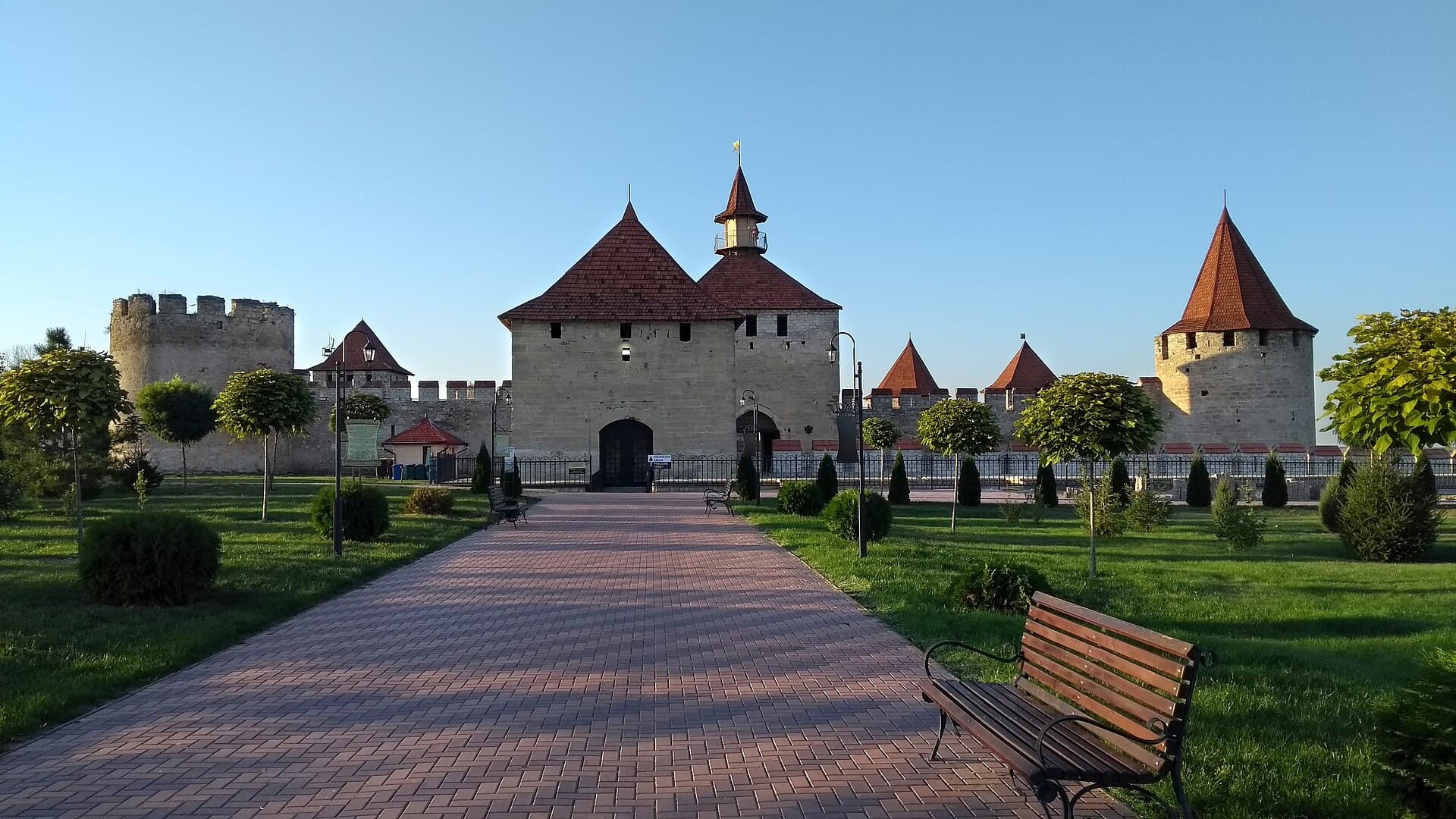
The fortress at Bender is the best thing on this stretch of the Dniester, and it has been rebuilt so often that reading it is a kind of archaeology in itself. A Moldavian earth-and-timber work stood here under Stephen the Great. The Ottomans took it in 1538 and rebuilt it in stone by 1541, to plans traditionally attributed to Mimar Sinan, and by the early eighteenth century it had grown into a system of ten bastions and eleven towers behind a deep ditch. Russian armies took it three times in thirty-six years. Charles XII of Sweden spent four years camped just outside it after Poltava, and in 1713 the Ottomans had to fight him to make him leave.
Transnistria is a strip of land about 4,160 square kilometres in area, running roughly 200 kilometres along the east bank of the Dniester and rarely more than 20 kilometres wide. Around 360,000 to 470,000 people live in it, depending on which count you use, in a place whose political status has been unresolved since 1992. This profile is about what the strip holds: the fortress, a monastery with a seventy-metre bell tower, a Soviet-era built environment that has survived almost intact, an unusual writing convention, and a set of burial customs shared with the villages across the water.
The territory sits on the left bank of the Dniester, which Romanian speakers call the Nistru, on flat black-earth farmland that grows wheat, sunflower, maize and grapes. Bender, the largest town on the right bank, is the exception to the river line and has been under Transnistrian administration since 1992, inside the security zone created by the ceasefire. The population is roughly a third Russian, a third Moldovan and a quarter Ukrainian, with Bulgarian, Gagauz and Jewish minorities, and it has fallen steadily since the 1990s through emigration.
No United Nations member state recognises the Pridnestrovian Moldavian Republic, which declared itself in 1990 and has been outside the effective control of the Moldovan government since the fighting of 1992. Moldova regards the area as the Administrative-Territorial Units of the Left Bank of the Dniester, part of the Republic of Moldova with a promised special status, and the international community takes the same view; the authorities in Tiraspol hold that the territory separated lawfully as the Soviet Union broke up and that its population has repeatedly voted for independence. Talks run in the format known as 5+2, mediated by the Organization for Security and Co-operation in Europe with Russia and Ukraine, and with the European Union and the United States as observers (OSCE). Around 1,500 Russian troops remain, part as peacekeepers under the Joint Control Commission and part guarding a Soviet ammunition depot at Cobasna. This page uses Transnistria as a geographic description and takes no position on the dispute.
Tiraspol. Founded in 1792 as a Russian fortress town on the site of a Moldavian village, Tiraspol is the administrative centre and keeps an unusually intact Soviet city centre. Its axis is October 25 Street, with the House of Soviets of 1953, a Lenin bust in front of it, the equestrian monument to Suvorov of 1979, and the Kvint distillery, working since 1897.
 Bender sits on the west bank of the Dniester, the only substantial territory on that side under Tiraspol's control, and its Ottoman fortress has been fought over by almost every power in the region. Photograph by Julian Nyca, CC BY-SA 4.0, via Wikimedia Commons.
Bender (Tighina). The city's Moldavian name is medieval and its other name comes through Ottoman usage from the Persian word for a port. It was a customs post by 1408, an Ottoman garrison town from 1538 to 1812, and a Russian imperial garrison after that. Besides the fortress it keeps the Transfiguration Cathedral, a nineteenth-century railway quarter and a Jewish cemetery.
Rîbnița, Dubăsari and Camenca. Rîbnița is an industrial town with a large steel works and a prewar Jewish population; Dubăsari sits beside the hydroelectric dam that made the reservoir upstream; Camenca in the north was a Polish and then Russian estate town with a park laid out by the Wittgenstein family.
Rașcov. A village on the river with three separate inheritances in a few hundred metres: the ruins of a synagogue, the Roman Catholic church of Saint Cajetan built when the area lay under the Polish crown, and the remains of a fourteenth-century Lithuanian castle at Kalaur nearby. Rabbi Jacob Joseph of Polonne, whose Toldot Yaakov Yosef of 1780 was the first Hasidic book ever printed, served here as rabbi.
The Dniester has been a boundary for as long as anyone has drawn boundaries. Trypillian farmers left settlements on both banks in the fourth millennium BC, Scythian and Sarmatian burial mounds stand in the fields, and the river later divided the Roman world from the steppe. In the Middle Ages the right bank belonged to the Principality of Moldavia and the left to a shifting frontier held at various times by the Grand Duchy of Lithuania, the Polish crown, the Crimean Khanate and the Ottomans. Bender, downstream, was the pivot: a Moldavian fort, then an Ottoman stone fortress from 1538, besieged and taken by Russian armies in 1770, 1789 and 1806.
Russia annexed the left bank in 1792 and Bessarabia in 1812, and Tiraspol was laid out as a garrison town in the interval. When Bessarabia united with Romania in 1918, the Soviet Union responded in 1924 by creating the Moldavian Autonomous Soviet Socialist Republic on the left bank, with Balta and then Tiraspol as its capital, as a standing claim on the territory across the river. That autonomous republic is the origin of almost everything distinctive here: the industry, the Russian-speaking administrative class, and the Cyrillic Moldovan orthography devised in the 1920s and 1930s.
The name Transnistria also belongs to something else entirely, and the two should never be run together. From 19 August 1941 until early 1944, Romania administered a zone it called Transnistria stretching from the Dniester east to the Southern Bug, with Odesa as its capital and an area of about 39,700 square kilometres, roughly ten times the size of the present territory, which it contained only as a narrow western strip. Romanian authorities deported Jews from Bessarabia and Bukovina into that zone, along with Roma from Romania proper, and enormous numbers were murdered or died there. The International Commission on the Holocaust in Romania, chaired by Elie Wiesel, concluded in its 2004 final report that between 280,000 and 380,000 Jews were killed or died under Romanian civilian and military authority, of whom 105,000 to 120,000 perished after being expelled into the territory between the Dniester and the Bug, and that around 11,000 Roma died there as well (Wiesel Commission). Ghettos operated inside what is now Transnistria, at Rîbnița among other places. The wartime zone and the republic that declared itself in 1990 share a name and very little else.
The modern dispute began with language. Moldova's law of 31 August 1989 made Moldovan the state language and returned it to the Latin script, and on 2 September 1990 authorities on the left bank proclaimed a separate Soviet republic. Fighting broke out in March 1992 and reached its worst in Bender that June, where street fighting involved tanks and artillery. Estimates of the dead vary; the figures usually cited run to close to a thousand killed in total, with around three thousand wounded. A ceasefire agreement signed on 21 July 1992 by the presidents of Russia and Moldova created a demilitarised security zone along the river and a trilateral peacekeeping force under a Joint Control Commission, and that arrangement has held since (Wikipedia).
Three languages are official: Russian, Ukrainian, and Moldovan written in Cyrillic. The third is the genuine curiosity. Romanian was written in a Cyrillic alphabet from the medieval period until the 1860s, when Romania adopted the Latin script, and the Soviet authorities revived a reformed Cyrillic for Moldovan in the 1920s in the Moldavian autonomous republic, keeping it in use from 1938 until 1989. Moldova abandoned it with the language law of 1989. Transnistria did not, and it is now the only jurisdiction anywhere that writes a Romance language in Cyrillic as a matter of official policy, so a road sign at Tiraspol may read Кишинэу for a city written Chișinău forty kilometres away.
The consequence for schooling has been litigated. Several schools on the left bank continued to teach in Moldovan with the Latin script, and from 2002 they were subjected to closures, evictions and pressure on staff and parents. In Catan and Others v. Moldova and Russia, decided by the Grand Chamber of the European Court of Human Rights on 19 October 2012, more than 170 pupils, parents and teachers from three such schools brought a complaint. The Court held unanimously that there had been a violation of Article 2 of Protocol No. 1, the right to education, by the Russian Federation, on the ground that Russia exercised effective control over the territory through its continued military, economic and political support; it found no violation by Moldova, which it held had discharged its positive obligations (HUDOC). A handful of Latin-script schools still operate, funded from Chișinău.
Place names carry the layers plainly. Nistru and Dniester are the same river under Romanian and Slavic tongues, Tiraspol is a nineteenth-century Greek coinage meaning the city on the Tyras, the classical name of the river, and Bender came through Ottoman usage from a Persian word for a harbour.
The most unusual heritage asset here is the built environment itself. Because the territory was not swept by the removal of Soviet monuments that followed 1991 elsewhere, Tiraspol retains a complete Stalin-era and late-Soviet ensemble in working use: the House of Soviets of 1953 with its ten-column portico and red star, the Lenin bust before it, mosaic panels on apartment blocks, and the equestrian Suvorov monument of 1979 by the sculptors Vladimir and Valentin Artamonov, which appears on banknotes and stamps. Scholars of Soviet material culture treat the territory as an unusually intact field site, and visitors come for the same reason, which puts a strange kind of value on buildings that were never designed to become heritage.
Everyday culture here is Moldovan and Ukrainian at heart. The food is placinte and mamaliga, borscht, sarmale, and the pickled vegetables that every household still puts up in autumn. Wine and brandy matter: Kvint at Tiraspol has been distilling since 1897 and its divins are the territory's best-known export. Doina singing, the caval and the cimpoi bagpipe, the hora danced in a ring at weddings, and the Ukrainian and Russian choral repertoire all coexist, often in the same evening.
The great majority of believers are Orthodox Christians, and the churches on the left bank belong to a diocese of Tiraspol and Dubăsari under the Moscow Patriarchate, whereas the parishes across the river answer to the Metropolis of Chișinău. Old Believer communities settled in the north in the eighteenth century.
The principal monument is the monastery of Noul Neamț at Chițcani, just south of Bender. It was founded in 1861 by monks who left Neamț in Moldavia in protest at the confiscation of monastery estates, and it grew into one of the largest religious houses in the region, with a bell tower of about seventy metres, generally described as the tallest in Moldova, and a substantial library of manuscripts and early printed books. Soviet authorities closed it on 16 May 1962 and used the buildings as a hospital; the church reopened in 1989 and a seminary followed in 1991 (Wikipedia).
Jewish life here is old and much reduced. Rașcov, Rîbnița, Dubăsari and Bender all had substantial communities before the war, and Rașcov's one-time rabbi wrote the first Hasidic book to be printed. Small congregations remain at Tiraspol and Bender, with cemeteries maintained in several towns.
Orthodox funeral practice governs most mourning. The body is watched at home for three days with candles and psalms, carried to the church and then to the grave with the coffin open, and buried facing east; a meal, the pomana, follows, and memorial services are held on the ninth and fortieth day, at six months, and at a year, with boiled wheat, colivă, handed round. Objects and food are given away in the name of the dead. Families here keep the same calendar as their relatives across the river.
The strongest custom is grave visiting at Radonitsa, which Moldovans call Paștele Blajinilor, the Easter of the gentle souls, on the Monday or Tuesday after Orthodox Easter. Whole villages go out to the cemetery with cloths, bread, eggs, wine and cakes, lay a table beside the graves, invite the priest to bless them, and eat there for the afternoon. The custom crosses every political line in the region without difficulty, and it is the clearest evidence that the strip belongs culturally to the country on the other bank.
Twentieth-century remembrance is layered and contested. Memorials to the Second World War stand in every town, with eternal flames and lists of names, and Bender and Tiraspol both hold memorial complexes to the dead of 1992, where families gather on the anniversaries of the March and June fighting. The Jewish dead of the Romanian-administered zone are commemorated separately, at the Jewish cemetery in Bender, where a Holocaust memorial was dedicated in 2003, and at sites in Rîbnița and Dubăsari. Keeping those two sets of memory distinct matters, because the wartime deportations happened over a far larger area than the present territory and were carried out by a different administration for different reasons.
Transnistria issues birth certificates that no country recognises, which is the first fact of family history here.
The strip east of the Dniester was part of the Moldavian ASSR within Soviet Ukraine before 1940 and then of Soviet Moldova, and it broke away after a short war in 1992. It has run its own administration since, with its own currency, passports and civil registry, and none of it is recognised internationally. A person born in Tiraspol needs a Moldovan, Russian or Ukrainian document to exist abroad, and many hold two or three.
The historical record is Russian and Soviet: Orthodox metrical books from the imperial period, revision lists, and ZAGS registration from the 1920s, held in Tiraspol and duplicated in Chișinău and in Ukrainian archives.
Jewish records are a substantial part of the older archive and a substantial absence. Under Romanian administration during the war, Transnistria was the destination for the deportation of Jews and Roma from Bessarabia and Bukovina, and a very large number died in the camps and ghettos here. The deportation lists are in Romanian and Ukrainian archives.
The distinctive linguistic fact is that Moldovan is still written in Cyrillic here, alone in the world, so a school certificate from Tiraspol is in a script that Moldova abandoned in 1989.
The Ottoman fortress at Bender, rebuilt to plans attributed to Sinan, is the oldest surviving structure in the record.
Non-recognition shapes everything about conservation here. Transnistria cannot be a party to the World Heritage Convention or nominate anything, no site in the territory is inscribed or on a tentative list, and Moldova's national heritage register nominally covers monuments its inspectors cannot reach. Practical protection therefore rests with local institutions, which have done more than the situation would suggest.
The Bender fortress is the case in point. After two centuries as a military installation and decades of closure it was restored between 2008 and 2012 and opened as a museum, with the curtain walls consolidated, the towers reroofed and the interior given over to displays on the Ottoman, Russian and Swedish episodes. The Noul Neamț monastery has been repaired since 1989 by the community itself. Excavation of Trypillian settlements and Scythian mounds continues under archaeologists based in Tiraspol, often in cooperation with colleagues in Ukraine and Russia, and the results circulate in Russian-language journals that Moldovan and Romanian researchers do not always see. That divided literature is itself a preservation problem, because the same landscape is being written up in two record systems that rarely cite each other.
The territory's documentary record is split across archives it is awkward to use together. Registers from the Moldavian autonomous republic and from the Romanian administration of 1941 to 1944 sit in Chișinău, Odesa and Bucharest, while Soviet-era civil registration for the left bank is held in Tiraspol, so a family search usually means three jurisdictions and two alphabets. The Wiesel Commission's final report, published online, remains the most complete published account of what happened in the wartime zone, and Yad Vashem's names database holds the largest searchable record of its victims.
Local museums at Tiraspol, Bender and Rîbnița have digitised parts of their photographic holdings, and the Bender fortress has been recorded photogrammetrically as part of its museum programme. Diaspora communities in Russia, Ukraine, Germany and Israel maintain genealogy forums and cemetery photograph collections that in practice do much of the work an official heritage inventory would do elsewhere.
Tiraspol's cultural life runs on Russian-language theatre, a state philharmonic, folk ensembles that perform Moldovan and Ukrainian repertoire, and a football club, Sheriff Tiraspol, that plays in the Moldovan league and reached the Champions League group stage in 2021, beating Real Madrid in Madrid. Kvint brandy and Sheriff are the two names outsiders know.
Interest from abroad has settled into a particular shape. Journalists and photographers arrive for the Soviet streetscape, academics for the study of unrecognised states, and a small tourism business has grown around day trips from Chișinău to the fortress, the monastery and October 25 Street. Younger people increasingly leave for Chișinău, Odesa, Moscow or the European Union, and many hold two or three passports, which makes the cultural boundary far more porous than the political one.
A fortress reopened. The Bender works, closed to the public for most of two centuries, were consolidated between 2008 and 2012 and now operate as a museum covering the Ottoman, Russian and Swedish layers of the site.
A monastery back in use. Noul Neamț at Chițcani, closed in 1962 and turned into a hospital, has functioned again since 1989 and runs a seminary.
A judgment on schooling. The European Court of Human Rights ruled in 2012 that the closure of Latin-script Moldovan schools breached the right to education, and several of those schools still teach.
A shared spring. Paștele Blajinilor is kept identically on both banks of the Dniester, one of the few practices in the region that nobody has tried to divide.
Bender sits on the west bank of the Dniester, the only substantial territory on that side under Tiraspol's control, and its Ottoman fortress has been fought over by almost every power in the region. Photograph by Julian Nyca, CC BY-SA 4.0, via Wikimedia Commons.
Bender (Tighina). The city's Moldavian name is medieval and its other name comes through Ottoman usage from the Persian word for a port. It was a customs post by 1408, an Ottoman garrison town from 1538 to 1812, and a Russian imperial garrison after that. Besides the fortress it keeps the Transfiguration Cathedral, a nineteenth-century railway quarter and a Jewish cemetery.
Rîbnița, Dubăsari and Camenca. Rîbnița is an industrial town with a large steel works and a prewar Jewish population; Dubăsari sits beside the hydroelectric dam that made the reservoir upstream; Camenca in the north was a Polish and then Russian estate town with a park laid out by the Wittgenstein family.
Rașcov. A village on the river with three separate inheritances in a few hundred metres: the ruins of a synagogue, the Roman Catholic church of Saint Cajetan built when the area lay under the Polish crown, and the remains of a fourteenth-century Lithuanian castle at Kalaur nearby. Rabbi Jacob Joseph of Polonne, whose Toldot Yaakov Yosef of 1780 was the first Hasidic book ever printed, served here as rabbi.
The Dniester has been a boundary for as long as anyone has drawn boundaries. Trypillian farmers left settlements on both banks in the fourth millennium BC, Scythian and Sarmatian burial mounds stand in the fields, and the river later divided the Roman world from the steppe. In the Middle Ages the right bank belonged to the Principality of Moldavia and the left to a shifting frontier held at various times by the Grand Duchy of Lithuania, the Polish crown, the Crimean Khanate and the Ottomans. Bender, downstream, was the pivot: a Moldavian fort, then an Ottoman stone fortress from 1538, besieged and taken by Russian armies in 1770, 1789 and 1806.
Russia annexed the left bank in 1792 and Bessarabia in 1812, and Tiraspol was laid out as a garrison town in the interval. When Bessarabia united with Romania in 1918, the Soviet Union responded in 1924 by creating the Moldavian Autonomous Soviet Socialist Republic on the left bank, with Balta and then Tiraspol as its capital, as a standing claim on the territory across the river. That autonomous republic is the origin of almost everything distinctive here: the industry, the Russian-speaking administrative class, and the Cyrillic Moldovan orthography devised in the 1920s and 1930s.
The name Transnistria also belongs to something else entirely, and the two should never be run together. From 19 August 1941 until early 1944, Romania administered a zone it called Transnistria stretching from the Dniester east to the Southern Bug, with Odesa as its capital and an area of about 39,700 square kilometres, roughly ten times the size of the present territory, which it contained only as a narrow western strip. Romanian authorities deported Jews from Bessarabia and Bukovina into that zone, along with Roma from Romania proper, and enormous numbers were murdered or died there. The International Commission on the Holocaust in Romania, chaired by Elie Wiesel, concluded in its 2004 final report that between 280,000 and 380,000 Jews were killed or died under Romanian civilian and military authority, of whom 105,000 to 120,000 perished after being expelled into the territory between the Dniester and the Bug, and that around 11,000 Roma died there as well (Wiesel Commission). Ghettos operated inside what is now Transnistria, at Rîbnița among other places. The wartime zone and the republic that declared itself in 1990 share a name and very little else.
The modern dispute began with language. Moldova's law of 31 August 1989 made Moldovan the state language and returned it to the Latin script, and on 2 September 1990 authorities on the left bank proclaimed a separate Soviet republic. Fighting broke out in March 1992 and reached its worst in Bender that June, where street fighting involved tanks and artillery. Estimates of the dead vary; the figures usually cited run to close to a thousand killed in total, with around three thousand wounded. A ceasefire agreement signed on 21 July 1992 by the presidents of Russia and Moldova created a demilitarised security zone along the river and a trilateral peacekeeping force under a Joint Control Commission, and that arrangement has held since (Wikipedia).
Three languages are official: Russian, Ukrainian, and Moldovan written in Cyrillic. The third is the genuine curiosity. Romanian was written in a Cyrillic alphabet from the medieval period until the 1860s, when Romania adopted the Latin script, and the Soviet authorities revived a reformed Cyrillic for Moldovan in the 1920s in the Moldavian autonomous republic, keeping it in use from 1938 until 1989. Moldova abandoned it with the language law of 1989. Transnistria did not, and it is now the only jurisdiction anywhere that writes a Romance language in Cyrillic as a matter of official policy, so a road sign at Tiraspol may read Кишинэу for a city written Chișinău forty kilometres away.
The consequence for schooling has been litigated. Several schools on the left bank continued to teach in Moldovan with the Latin script, and from 2002 they were subjected to closures, evictions and pressure on staff and parents. In Catan and Others v. Moldova and Russia, decided by the Grand Chamber of the European Court of Human Rights on 19 October 2012, more than 170 pupils, parents and teachers from three such schools brought a complaint. The Court held unanimously that there had been a violation of Article 2 of Protocol No. 1, the right to education, by the Russian Federation, on the ground that Russia exercised effective control over the territory through its continued military, economic and political support; it found no violation by Moldova, which it held had discharged its positive obligations (HUDOC). A handful of Latin-script schools still operate, funded from Chișinău.
Place names carry the layers plainly. Nistru and Dniester are the same river under Romanian and Slavic tongues, Tiraspol is a nineteenth-century Greek coinage meaning the city on the Tyras, the classical name of the river, and Bender came through Ottoman usage from a Persian word for a harbour.
The most unusual heritage asset here is the built environment itself. Because the territory was not swept by the removal of Soviet monuments that followed 1991 elsewhere, Tiraspol retains a complete Stalin-era and late-Soviet ensemble in working use: the House of Soviets of 1953 with its ten-column portico and red star, the Lenin bust before it, mosaic panels on apartment blocks, and the equestrian Suvorov monument of 1979 by the sculptors Vladimir and Valentin Artamonov, which appears on banknotes and stamps. Scholars of Soviet material culture treat the territory as an unusually intact field site, and visitors come for the same reason, which puts a strange kind of value on buildings that were never designed to become heritage.
Everyday culture here is Moldovan and Ukrainian at heart. The food is placinte and mamaliga, borscht, sarmale, and the pickled vegetables that every household still puts up in autumn. Wine and brandy matter: Kvint at Tiraspol has been distilling since 1897 and its divins are the territory's best-known export. Doina singing, the caval and the cimpoi bagpipe, the hora danced in a ring at weddings, and the Ukrainian and Russian choral repertoire all coexist, often in the same evening.
The great majority of believers are Orthodox Christians, and the churches on the left bank belong to a diocese of Tiraspol and Dubăsari under the Moscow Patriarchate, whereas the parishes across the river answer to the Metropolis of Chișinău. Old Believer communities settled in the north in the eighteenth century.
The principal monument is the monastery of Noul Neamț at Chițcani, just south of Bender. It was founded in 1861 by monks who left Neamț in Moldavia in protest at the confiscation of monastery estates, and it grew into one of the largest religious houses in the region, with a bell tower of about seventy metres, generally described as the tallest in Moldova, and a substantial library of manuscripts and early printed books. Soviet authorities closed it on 16 May 1962 and used the buildings as a hospital; the church reopened in 1989 and a seminary followed in 1991 (Wikipedia).
Jewish life here is old and much reduced. Rașcov, Rîbnița, Dubăsari and Bender all had substantial communities before the war, and Rașcov's one-time rabbi wrote the first Hasidic book to be printed. Small congregations remain at Tiraspol and Bender, with cemeteries maintained in several towns.
Orthodox funeral practice governs most mourning. The body is watched at home for three days with candles and psalms, carried to the church and then to the grave with the coffin open, and buried facing east; a meal, the pomana, follows, and memorial services are held on the ninth and fortieth day, at six months, and at a year, with boiled wheat, colivă, handed round. Objects and food are given away in the name of the dead. Families here keep the same calendar as their relatives across the river.
The strongest custom is grave visiting at Radonitsa, which Moldovans call Paștele Blajinilor, the Easter of the gentle souls, on the Monday or Tuesday after Orthodox Easter. Whole villages go out to the cemetery with cloths, bread, eggs, wine and cakes, lay a table beside the graves, invite the priest to bless them, and eat there for the afternoon. The custom crosses every political line in the region without difficulty, and it is the clearest evidence that the strip belongs culturally to the country on the other bank.
Twentieth-century remembrance is layered and contested. Memorials to the Second World War stand in every town, with eternal flames and lists of names, and Bender and Tiraspol both hold memorial complexes to the dead of 1992, where families gather on the anniversaries of the March and June fighting. The Jewish dead of the Romanian-administered zone are commemorated separately, at the Jewish cemetery in Bender, where a Holocaust memorial was dedicated in 2003, and at sites in Rîbnița and Dubăsari. Keeping those two sets of memory distinct matters, because the wartime deportations happened over a far larger area than the present territory and were carried out by a different administration for different reasons.
Transnistria issues birth certificates that no country recognises, which is the first fact of family history here.
The strip east of the Dniester was part of the Moldavian ASSR within Soviet Ukraine before 1940 and then of Soviet Moldova, and it broke away after a short war in 1992. It has run its own administration since, with its own currency, passports and civil registry, and none of it is recognised internationally. A person born in Tiraspol needs a Moldovan, Russian or Ukrainian document to exist abroad, and many hold two or three.
The historical record is Russian and Soviet: Orthodox metrical books from the imperial period, revision lists, and ZAGS registration from the 1920s, held in Tiraspol and duplicated in Chișinău and in Ukrainian archives.
Jewish records are a substantial part of the older archive and a substantial absence. Under Romanian administration during the war, Transnistria was the destination for the deportation of Jews and Roma from Bessarabia and Bukovina, and a very large number died in the camps and ghettos here. The deportation lists are in Romanian and Ukrainian archives.
The distinctive linguistic fact is that Moldovan is still written in Cyrillic here, alone in the world, so a school certificate from Tiraspol is in a script that Moldova abandoned in 1989.
The Ottoman fortress at Bender, rebuilt to plans attributed to Sinan, is the oldest surviving structure in the record.
Non-recognition shapes everything about conservation here. Transnistria cannot be a party to the World Heritage Convention or nominate anything, no site in the territory is inscribed or on a tentative list, and Moldova's national heritage register nominally covers monuments its inspectors cannot reach. Practical protection therefore rests with local institutions, which have done more than the situation would suggest.
The Bender fortress is the case in point. After two centuries as a military installation and decades of closure it was restored between 2008 and 2012 and opened as a museum, with the curtain walls consolidated, the towers reroofed and the interior given over to displays on the Ottoman, Russian and Swedish episodes. The Noul Neamț monastery has been repaired since 1989 by the community itself. Excavation of Trypillian settlements and Scythian mounds continues under archaeologists based in Tiraspol, often in cooperation with colleagues in Ukraine and Russia, and the results circulate in Russian-language journals that Moldovan and Romanian researchers do not always see. That divided literature is itself a preservation problem, because the same landscape is being written up in two record systems that rarely cite each other.
The territory's documentary record is split across archives it is awkward to use together. Registers from the Moldavian autonomous republic and from the Romanian administration of 1941 to 1944 sit in Chișinău, Odesa and Bucharest, while Soviet-era civil registration for the left bank is held in Tiraspol, so a family search usually means three jurisdictions and two alphabets. The Wiesel Commission's final report, published online, remains the most complete published account of what happened in the wartime zone, and Yad Vashem's names database holds the largest searchable record of its victims.
Local museums at Tiraspol, Bender and Rîbnița have digitised parts of their photographic holdings, and the Bender fortress has been recorded photogrammetrically as part of its museum programme. Diaspora communities in Russia, Ukraine, Germany and Israel maintain genealogy forums and cemetery photograph collections that in practice do much of the work an official heritage inventory would do elsewhere.
Tiraspol's cultural life runs on Russian-language theatre, a state philharmonic, folk ensembles that perform Moldovan and Ukrainian repertoire, and a football club, Sheriff Tiraspol, that plays in the Moldovan league and reached the Champions League group stage in 2021, beating Real Madrid in Madrid. Kvint brandy and Sheriff are the two names outsiders know.
Interest from abroad has settled into a particular shape. Journalists and photographers arrive for the Soviet streetscape, academics for the study of unrecognised states, and a small tourism business has grown around day trips from Chișinău to the fortress, the monastery and October 25 Street. Younger people increasingly leave for Chișinău, Odesa, Moscow or the European Union, and many hold two or three passports, which makes the cultural boundary far more porous than the political one.
A fortress reopened. The Bender works, closed to the public for most of two centuries, were consolidated between 2008 and 2012 and now operate as a museum covering the Ottoman, Russian and Swedish layers of the site.
A monastery back in use. Noul Neamț at Chițcani, closed in 1962 and turned into a hospital, has functioned again since 1989 and runs a seminary.
A judgment on schooling. The European Court of Human Rights ruled in 2012 that the closure of Latin-script Moldovan schools breached the right to education, and several of those schools still teach.
A shared spring. Paștele Blajinilor is kept identically on both banks of the Dniester, one of the few practices in the region that nobody has tried to divide.
National Overview
Notable Cities
Historical Foundations
Linguistic and Etymological Roots
Cultural Identity
Religion and Spirituality
Remembrance and Mourning Traditions
Tracing a Family in Transnistria
Heritage Preservation Efforts
Digital Heritage
Contemporary Cultural Influences
Success Stories
References and resources
- Transnistria, Wikipedia: area, population, the 1990 declaration and recognition status.
- OSCE Mission to Moldova: the settlement process and the 5+2 format.
- Catan and Others v. Moldova and Russia, HUDOC: the Grand Chamber judgment of 19 October 2012.
- Transnistria War, Wikipedia: the 1992 fighting, casualty estimates and the ceasefire.
- Bender Fortress, Wikipedia: the building phases and the restoration.
- Bender, Moldova, Wikipedia: the names, the sieges and Charles XII at Varnița.
- Transnistria (World War II), Wikipedia: the boundaries and dates of the Romanian-administered zone.
- Wiesel Commission, Wikipedia: the 2004 final report and its figures.
- Moldovan Cyrillic alphabet, Wikipedia: the script's history and where it survives.
- Noul Neamț Monastery, Wikipedia: foundation, closure and reopening.
- Suvorov Monument, Tiraspol, Wikipedia: the 1979 monument and its sculptors.
- Rașcov, Wikipedia: the synagogue ruins, Saint Cajetan and Jacob Joseph of Polonne.
- Encyclopaedia Britannica, Transdniestria: geography and the outline of the dispute.