Heritage · Country
Sakha Culture and Heritage
Sakha is the largest subnational territory on earth and the coldest inhabited part of it, and its permafrost preserves flesh, hair and stomach contents from animals that died forty thousand years ago. This is a guide to Sakha heritage, and to a place where the ground keeps everything material and almost nothing of what people said.Written to last.
By Confinity Heritage Editorial · Updated 2026-08-20 · 8-minute readQuiet tools, kept out of the way.
The permafrost under Sakha runs to more than a kilometre deep in places, and it is the most effective archive anyone has ever not built. Mammoths come out of it with hair, skin, blood and the contents of their stomachs intact after forty thousand years. Horses, bison, wolves, cave lion cubs and a bird have all been recovered in a condition that lets researchers sequence them. Nothing was intended, nobody maintained it, and it has outperformed every purpose-built collection on the planet.
Set against that is what the ground cannot hold. The Olonkho, the Sakha heroic epic, exists in performance: tens of thousands of lines, sung and spoken by a single narrator over several nights, carried in memory alone. The land preserved the mammoth without being asked and preserved not one line of the epic.
The Sakha Republic, also called Yakutia, is a republic of the Russian Federation covering more than three million square kilometres of northeastern Siberia. It is the largest subnational division in the world, roughly a fifth of Russia and larger than Argentina, and fewer than a million people live in it. Around half are Sakha, with Russians the next largest group and several small Indigenous peoples of the north, among them Evenki, Even, Dolgan, Yukaghir and Chukchi.
The defining condition is cold. Permafrost underlies effectively the whole republic. Yakutsk, the capital, is the coldest city of its size anywhere, and Oymyakon and Verkhoyansk to its north-east compete for the title of coldest permanently inhabited place, with readings near minus 68 degrees. The same places swing to well above thirty in summer, an annual range of close to a hundred degrees, and in June 2020 Verkhoyansk recorded 38 degrees, the highest temperature ever registered inside the Arctic Circle.
The republic has its own constitution, and Sakha is a state language alongside Russian. The economy rests on diamonds, gold, coal and gas: Yakutia produces the large majority of Russia's diamonds, mined in the west around Mirny.
Yakutsk. Built on permafrost, which means the buildings stand on piles driven into permanently frozen ground so their heat does not melt what holds them up. It has the Mammoth Museum, the Melnikov Permafrost Institute with its underground laboratory in the frozen ground, the Khomus Museum devoted to the jaw harp, and the republic's national library and archives.
Mirny. The diamond town in the west, built around an open pit more than half a kilometre across and 500 metres deep, one of the largest excavations on earth.
Verkhoyansk and Oymyakon. Small settlements in the northeast that hold the cold records, and that have become, awkwardly, a tourist proposition.
Neryungri. The coal town in the south, the second largest settlement, and the terminus for much of the road and rail traffic entering the republic.
Zhigansk and the Arctic districts. Along the lower Lena, where the Indigenous minority peoples of the north are concentrated and where reindeer herding and fishing remain the basis of life.
The Sakha are a Turkic people, and their language belongs with those of Central Asia rather than with anything else in Siberia, which points to an origin far to the south. The accepted account is a migration north, probably from the Baikal region, over several centuries in the second millennium, bringing horses and cattle into a latitude where nobody had kept them before. The Sakha adapted a steppe pastoral economy to a subarctic one, which is why Yakutia has its own breed of horse that lives outdoors through a Siberian winter and digs through snow to feed.
Russian expansion reached the Lena in the 1620s and 1630s, and Yakutsk was founded as a fort in 1632. What followed was the standard pattern of the Siberian conquest: tribute in furs, epidemics, and revolt, and then Yakutsk's development as the staging point for Russian expansion to the Pacific and the Arctic coast.
The territory's other role was as a place to send people. Political exiles were despatched here through the nineteenth century, and under Stalin the Kolyma region in the republic's east became one of the deadliest parts of the Gulag system, its gold mines worked by prisoners brought by sea to Magadan and marched inland along a route still called the Road of Bones. Sakha national and cultural figures were among those killed in the purges, and the republic's twentieth-century cultural history has a hole in it as a result.
A Yakut Autonomous Soviet Socialist Republic was created in 1922, and the present Sakha Republic dates from the reorganisation of the early 1990s, when the Sakha language was made a state language alongside Russian.
Sakha, often called Yakut in English, is a Siberian Turkic language with roughly 450,000 speakers, and it is the strongest Indigenous language in the Russian Far East by a wide margin. UNESCO classifies it as vulnerable rather than endangered, and it is genuinely used: in schools, in publishing, in broadcasting and in film. Long isolation from other Turkic languages left it distinct, with a large Mongolic layer and vocabulary borrowed from the Evenki for the northern world the migrants arrived into.
The other languages of the republic are in a far worse position. Yukaghir, which is not related to any surviving family and is a remnant of the linguistic landscape that existed before the Turkic and Tungusic arrivals, has a very small number of elderly speakers and is critically endangered. Even, Evenki and Dolgan are all under pressure. A visitor to Sakha meeting a confident, functioning Indigenous language is meeting the exception rather than the rule.
The central institution is the Yhyakh, the summer festival held around the solstice, when the sun barely sets. It is a new year celebration rather than a harvest one: fermented mare's milk, kumys, is drunk from carved wooden vessels, a shaman or elder performs the algys, a blessing spoken to the fire and the sky, and hundreds or thousands of people join the osuokhai, a slow circle dance that moves with the sun and can continue for hours. The Yhyakh at Yakutsk draws tens of thousands and has become the largest public expression of Sakha identity.
 Yhyakh is held around the solstice, when the sun barely sets, and the osuokhai circle dance moves with the sun and can go on for hours. Photograph by Tenebroid, CC BY-SA 4.0, via Wikimedia Commons.
The serge is the object that stands for the culture. It is a carved wooden post, originally for tethering horses, and its presence marks a place as belonging to somebody. Serge are raised for births, weddings and arrivals, and also as memorials, so a single carved form does duty across the whole range of things a family needs to mark.
The khomus, a metal jaw harp, is played in Sakha with a virtuosity found almost nowhere else, and Yakutsk holds a museum and international festival devoted to it. Craft traditions run to silver jewellery, birchbark vessels, horsehair weaving and the carving of mammoth ivory, which is a legal and locally significant trade precisely because the material keeps coming out of the ground.
Sakha religion is usually described as Tengrism or as the Aiyy faith, and its structure sets a group of upper deities, the aiyy, against harmful spirits, the abaahy, with the middle world of people between them. The sky god Urun Aiyy Toyon stands at the top, the fire spirit receives an offering before anything is eaten or drunk, and particular places, springs, passes and old trees have owners who are addressed on passing.
Shamans were the specialists who moved between the worlds, distinguished as white shamans serving the upper deities and black shamans dealing with the lower, and the shaman's costume, hung with iron pendants representing bones, is among the most recognisable objects in Siberian ethnography. Soviet policy suppressed shamanic practice hard, and much of what exists now is a conscious revival rather than an unbroken line, a distinction Sakha practitioners themselves generally make.
Russian Orthodoxy arrived with the conquest and was widely adopted, so a great many Sakha families have held both frameworks at once for centuries: baptism and the church calendar alongside the fire offering and the algys. The Aiyy revival since the 1990s has built temples and formalised a priesthood, and it is closely bound up with the assertion of Sakha national identity.
Older Sakha practice did not put the dead in the ground, and the reason is straightforward: for much of the year the ground will not take them. Burial in permafrost requires either fire or a long wait, and neither is easy. The traditional answer was the arangas, a platform raised on posts, on which the body was placed in a hollowed log coffin with the things the person would need, so that the dead lay above the ground rather than in it. Shamans in particular were given air burial, and their equipment was left with them.
Grave goods were generous and specific, and this is why Sakha burials are archaeologically productive to an unusual degree. Because the permafrost preserves organic material, excavated Sakha graves have yielded clothing, leather, birchbark, wooden vessels and horse harness in a state of preservation that lets researchers reconstruct what a person wore and carried. A French and Russian archaeological programme working in central Yakutia over the past two decades has excavated a substantial number of these burials, and the result is one of the most detailed material pictures of any preindustrial northern population anywhere.
The horse ran through the whole practice. Horses were sacrificed at funerals and their hides and heads displayed, harness was buried with the dead, and the serge posts raised at a grave marked the presence of a person in the same visual language used at a living household's gate.
The twentieth century added a category the tradition had no procedure for. Families who lost members to the Kolyma camps and to the purges frequently had no body, no date and no place, and the Soviet state's records were closed for decades. Memorial work on this in Sakha, as elsewhere in Russia, has depended on archive access and on the work of civil society organisations, and the practical reality is that many families have a name and no grave.
Sakha genealogy is clan-based, and the permafrost keeps a different kind of record entirely.
A Sakha belongs to an aga-uusa, a patrilineal descent group, within a nasleg, the territorial community that held pasture and hayfields. Those units survived into the Soviet administrative system and are still the units people identify with. Genealogies were recited and, from the nineteenth century, written down.
The written state record follows the Russian pattern. Orthodox metrical books, kept after the missions reached the Lena from the eighteenth century, and the imperial tax and household lists, are held at the National Archives in Yakutsk, with Soviet ZAGS registration from the 1920s.
The olonkho, the Sakha epic tradition, runs to tens of thousands of lines and was inscribed by UNESCO in 2005. It is the collective genealogy: a people's origin rather than a household's.
Two Soviet histories are in every family. The Gulag ran camps across the republic and the Kolyma road was built by prisoners, so a great many people arrived here as deportees from elsewhere and stayed. And collectivisation and the settlement policies moved Sakha families off ancestral pastures.
The permafrost is the other archive. It preserves flesh, hair and stomach contents from animals dead forty thousand years, and it also preserves human remains and grave goods, which has made Sakha burial archaeology unusually rich and unusually contested by descendants.
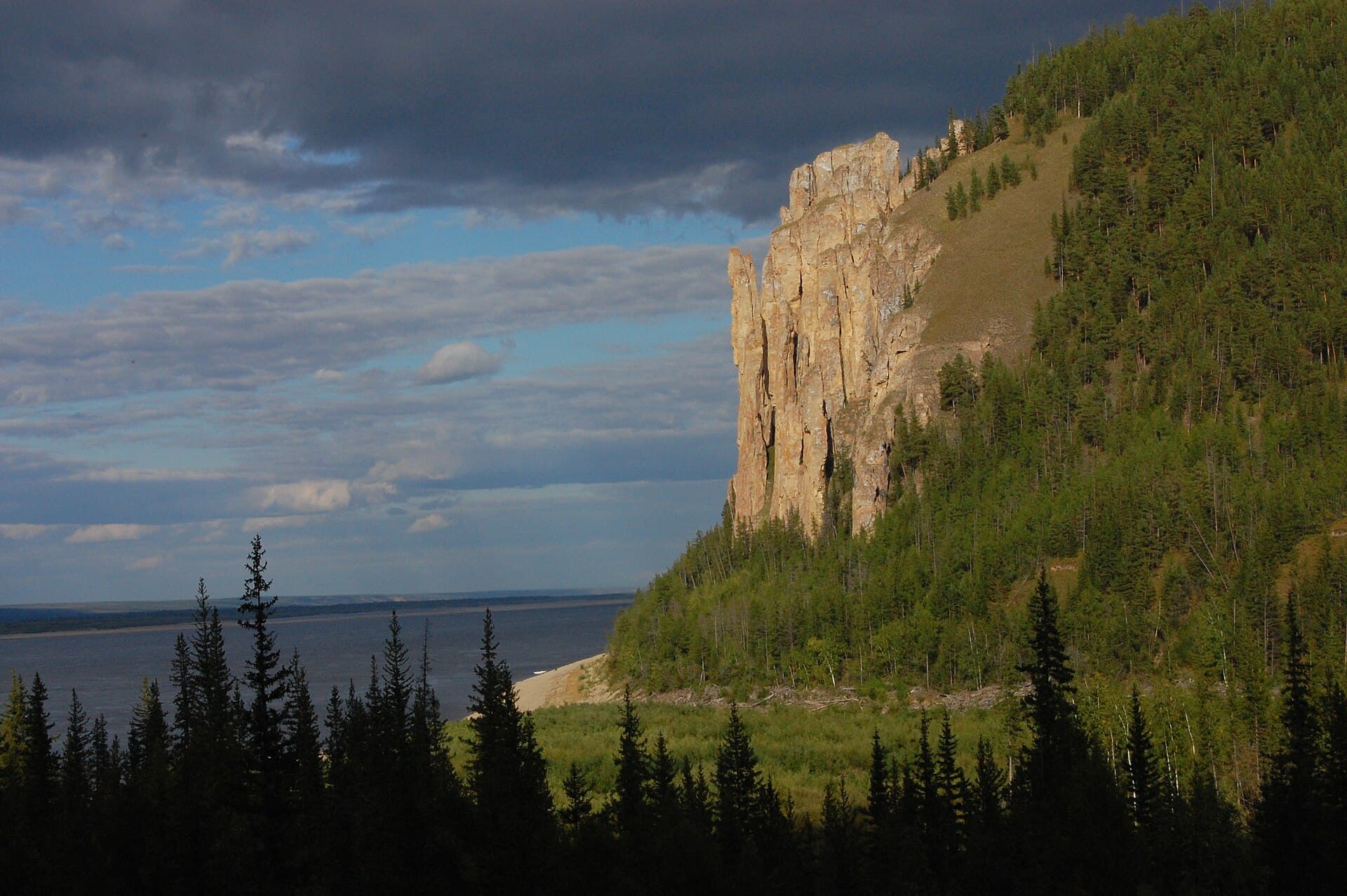
The Lena Pillars Nature Park was inscribed by UNESCO on 22 July 2012, a property of about 1,387,000 hectares on the right bank of the middle Lena, protecting a wall of weathered limestone columns rising some hundred metres above the river together with an important Cambrian fossil record. It is a natural rather than cultural inscription, though the pillars carry rock art and have long been a marked place.
The permafrost itself has an institution. The Melnikov Permafrost Institute at Yakutsk, established in 1960, is the principal centre for the study of frozen ground anywhere and maintains an underground laboratory cut into the permafrost. Alongside it, the Mammoth Museum holds the specimens the ground gives up, including several of the best-preserved Pleistocene animals ever found.
That work has become urgent rather than academic. Permafrost thaw is releasing material at a rate nobody can process, and doing so destructively: a carcass that emerges and is not recovered quickly rots in a season after forty thousand years. The Batagaika megaslump, a thaw crater in the northeast that has been enlarging since the 1960s and is now the largest of its kind, exposes hundreds of thousands of years of sediment and is both a research opportunity and a demonstration of what is happening across the republic. Thaw also undermines buildings, roads and pipelines built on the assumption that the ground would stay frozen.
Cultural preservation is organised around the Olonkho. Its recognition by UNESCO in 2005 was followed by a sustained republican programme: a state institute for Olonkho research at the North-Eastern Federal University, the epic taught in schools, and a network of teachers training children in a performance tradition whose last fully traditional narrators died in the twentieth century.
The Olonkho is the clearest case anywhere of a heritage that only exists once it is recorded. A full performance runs to tens of thousands of lines over several nights, and the longest recorded texts run past thirty thousand. Sound recordings, transcriptions, translations into Russian and English, and a dedicated digital archive at the university have converted a memory tradition into a consultable corpus. This is a real gain and a real change: the epic used to be a relationship with a particular olonkhosut, and it is now also a text.
Palaeogenomics has made the permafrost archive digital in a different sense. Sequencing of mammoth, horse, wolf and other remains from Yakutia has produced some of the oldest genomes ever recovered, so the ground's contents are now readable as data, and the data survives even when the specimen does not.
Language and media are the third strand. Sakha has dictionaries, corpora, keyboard support, a substantial Wikipedia and a strong broadcast presence, and Sakha-language film has built its own distribution. For the smaller languages of the republic, particularly Yukaghir, documentation is a rescue operation: recordings of a handful of elderly speakers are, realistically, the form in which the language will continue to exist.
The most striking recent development is cinema. A film industry based in Yakutsk, working in the Sakha language on very small budgets, has produced a body of work that wins prizes at Russian and international festivals and reliably outsells Hollywood releases in the republic's own cinemas. It is one of the few cases anywhere of a minority-language film industry that is commercially self-supporting in its home market, and it has made contemporary Sakha identity visible in a way that heritage programmes could not.
Mammoth ivory is the republic's strangest export. Trade in it is legal, unlike elephant ivory, and thawing ground has increased supply, so tusks are collected and sold, mostly to China. The result is an economy built on the same thaw that is destroying the archive, and a real argument inside Sakha about whether collectors are salvaging material that would otherwise rot or stripping sites before they can be recorded.
The republic sits at the sharp end of climate change. The wildfire seasons of recent years have burned areas larger than anywhere else on earth in the same period, filling Yakutsk with smoke for weeks, and the combination of fire, thaw and record heat has made Sakha one of the most closely watched places in climate science.
An epic taken from memory into the record. The Olonkho was recognised by UNESCO in 2005 and is now recorded, transcribed, translated, taught in schools and held in a dedicated digital archive, after its last fully traditional narrators had died.
A World Heritage inscription on the Lena. The Lena Pillars Nature Park was listed on 22 July 2012, protecting some 1,387,000 hectares of river cliff and its Cambrian fossil record.
The best-preserved Ice Age animals anywhere. Yakutian permafrost has produced mammoths, horses, wolves and cave lion cubs complete enough to sequence, held and studied at the Mammoth Museum and the Permafrost Institute in Yakutsk.
A minority-language film industry that pays for itself. Sakha-language cinema made in Yakutsk wins festival prizes and outsells international releases at home, without needing a subsidy to justify the language.
Yhyakh is held around the solstice, when the sun barely sets, and the osuokhai circle dance moves with the sun and can go on for hours. Photograph by Tenebroid, CC BY-SA 4.0, via Wikimedia Commons.
The serge is the object that stands for the culture. It is a carved wooden post, originally for tethering horses, and its presence marks a place as belonging to somebody. Serge are raised for births, weddings and arrivals, and also as memorials, so a single carved form does duty across the whole range of things a family needs to mark.
The khomus, a metal jaw harp, is played in Sakha with a virtuosity found almost nowhere else, and Yakutsk holds a museum and international festival devoted to it. Craft traditions run to silver jewellery, birchbark vessels, horsehair weaving and the carving of mammoth ivory, which is a legal and locally significant trade precisely because the material keeps coming out of the ground.
Sakha religion is usually described as Tengrism or as the Aiyy faith, and its structure sets a group of upper deities, the aiyy, against harmful spirits, the abaahy, with the middle world of people between them. The sky god Urun Aiyy Toyon stands at the top, the fire spirit receives an offering before anything is eaten or drunk, and particular places, springs, passes and old trees have owners who are addressed on passing.
Shamans were the specialists who moved between the worlds, distinguished as white shamans serving the upper deities and black shamans dealing with the lower, and the shaman's costume, hung with iron pendants representing bones, is among the most recognisable objects in Siberian ethnography. Soviet policy suppressed shamanic practice hard, and much of what exists now is a conscious revival rather than an unbroken line, a distinction Sakha practitioners themselves generally make.
Russian Orthodoxy arrived with the conquest and was widely adopted, so a great many Sakha families have held both frameworks at once for centuries: baptism and the church calendar alongside the fire offering and the algys. The Aiyy revival since the 1990s has built temples and formalised a priesthood, and it is closely bound up with the assertion of Sakha national identity.
Older Sakha practice did not put the dead in the ground, and the reason is straightforward: for much of the year the ground will not take them. Burial in permafrost requires either fire or a long wait, and neither is easy. The traditional answer was the arangas, a platform raised on posts, on which the body was placed in a hollowed log coffin with the things the person would need, so that the dead lay above the ground rather than in it. Shamans in particular were given air burial, and their equipment was left with them.
Grave goods were generous and specific, and this is why Sakha burials are archaeologically productive to an unusual degree. Because the permafrost preserves organic material, excavated Sakha graves have yielded clothing, leather, birchbark, wooden vessels and horse harness in a state of preservation that lets researchers reconstruct what a person wore and carried. A French and Russian archaeological programme working in central Yakutia over the past two decades has excavated a substantial number of these burials, and the result is one of the most detailed material pictures of any preindustrial northern population anywhere.
The horse ran through the whole practice. Horses were sacrificed at funerals and their hides and heads displayed, harness was buried with the dead, and the serge posts raised at a grave marked the presence of a person in the same visual language used at a living household's gate.
The twentieth century added a category the tradition had no procedure for. Families who lost members to the Kolyma camps and to the purges frequently had no body, no date and no place, and the Soviet state's records were closed for decades. Memorial work on this in Sakha, as elsewhere in Russia, has depended on archive access and on the work of civil society organisations, and the practical reality is that many families have a name and no grave.
Sakha genealogy is clan-based, and the permafrost keeps a different kind of record entirely.
A Sakha belongs to an aga-uusa, a patrilineal descent group, within a nasleg, the territorial community that held pasture and hayfields. Those units survived into the Soviet administrative system and are still the units people identify with. Genealogies were recited and, from the nineteenth century, written down.
The written state record follows the Russian pattern. Orthodox metrical books, kept after the missions reached the Lena from the eighteenth century, and the imperial tax and household lists, are held at the National Archives in Yakutsk, with Soviet ZAGS registration from the 1920s.
The olonkho, the Sakha epic tradition, runs to tens of thousands of lines and was inscribed by UNESCO in 2005. It is the collective genealogy: a people's origin rather than a household's.
Two Soviet histories are in every family. The Gulag ran camps across the republic and the Kolyma road was built by prisoners, so a great many people arrived here as deportees from elsewhere and stayed. And collectivisation and the settlement policies moved Sakha families off ancestral pastures.
The permafrost is the other archive. It preserves flesh, hair and stomach contents from animals dead forty thousand years, and it also preserves human remains and grave goods, which has made Sakha burial archaeology unusually rich and unusually contested by descendants.
The Lena Pillars Nature Park was inscribed by UNESCO on 22 July 2012, a property of about 1,387,000 hectares on the right bank of the middle Lena, protecting a wall of weathered limestone columns rising some hundred metres above the river together with an important Cambrian fossil record. It is a natural rather than cultural inscription, though the pillars carry rock art and have long been a marked place.
The permafrost itself has an institution. The Melnikov Permafrost Institute at Yakutsk, established in 1960, is the principal centre for the study of frozen ground anywhere and maintains an underground laboratory cut into the permafrost. Alongside it, the Mammoth Museum holds the specimens the ground gives up, including several of the best-preserved Pleistocene animals ever found.
That work has become urgent rather than academic. Permafrost thaw is releasing material at a rate nobody can process, and doing so destructively: a carcass that emerges and is not recovered quickly rots in a season after forty thousand years. The Batagaika megaslump, a thaw crater in the northeast that has been enlarging since the 1960s and is now the largest of its kind, exposes hundreds of thousands of years of sediment and is both a research opportunity and a demonstration of what is happening across the republic. Thaw also undermines buildings, roads and pipelines built on the assumption that the ground would stay frozen.
Cultural preservation is organised around the Olonkho. Its recognition by UNESCO in 2005 was followed by a sustained republican programme: a state institute for Olonkho research at the North-Eastern Federal University, the epic taught in schools, and a network of teachers training children in a performance tradition whose last fully traditional narrators died in the twentieth century.
The Olonkho is the clearest case anywhere of a heritage that only exists once it is recorded. A full performance runs to tens of thousands of lines over several nights, and the longest recorded texts run past thirty thousand. Sound recordings, transcriptions, translations into Russian and English, and a dedicated digital archive at the university have converted a memory tradition into a consultable corpus. This is a real gain and a real change: the epic used to be a relationship with a particular olonkhosut, and it is now also a text.
Palaeogenomics has made the permafrost archive digital in a different sense. Sequencing of mammoth, horse, wolf and other remains from Yakutia has produced some of the oldest genomes ever recovered, so the ground's contents are now readable as data, and the data survives even when the specimen does not.
Language and media are the third strand. Sakha has dictionaries, corpora, keyboard support, a substantial Wikipedia and a strong broadcast presence, and Sakha-language film has built its own distribution. For the smaller languages of the republic, particularly Yukaghir, documentation is a rescue operation: recordings of a handful of elderly speakers are, realistically, the form in which the language will continue to exist.
The most striking recent development is cinema. A film industry based in Yakutsk, working in the Sakha language on very small budgets, has produced a body of work that wins prizes at Russian and international festivals and reliably outsells Hollywood releases in the republic's own cinemas. It is one of the few cases anywhere of a minority-language film industry that is commercially self-supporting in its home market, and it has made contemporary Sakha identity visible in a way that heritage programmes could not.
Mammoth ivory is the republic's strangest export. Trade in it is legal, unlike elephant ivory, and thawing ground has increased supply, so tusks are collected and sold, mostly to China. The result is an economy built on the same thaw that is destroying the archive, and a real argument inside Sakha about whether collectors are salvaging material that would otherwise rot or stripping sites before they can be recorded.
The republic sits at the sharp end of climate change. The wildfire seasons of recent years have burned areas larger than anywhere else on earth in the same period, filling Yakutsk with smoke for weeks, and the combination of fire, thaw and record heat has made Sakha one of the most closely watched places in climate science.
An epic taken from memory into the record. The Olonkho was recognised by UNESCO in 2005 and is now recorded, transcribed, translated, taught in schools and held in a dedicated digital archive, after its last fully traditional narrators had died.
A World Heritage inscription on the Lena. The Lena Pillars Nature Park was listed on 22 July 2012, protecting some 1,387,000 hectares of river cliff and its Cambrian fossil record.
The best-preserved Ice Age animals anywhere. Yakutian permafrost has produced mammoths, horses, wolves and cave lion cubs complete enough to sequence, held and studied at the Mammoth Museum and the Permafrost Institute in Yakutsk.
A minority-language film industry that pays for itself. Sakha-language cinema made in Yakutsk wins festival prizes and outsells international releases at home, without needing a subsidy to justify the language.
National Overview
Notable Cities
Historical Foundations
Linguistic and Etymological Roots
Cultural Identity
Religion and Spirituality
Remembrance and Mourning Traditions
Tracing a Family in Sakha
Heritage Preservation Efforts
Digital Heritage
Contemporary Cultural Influences
Success Stories
References and resources
- UNESCO, Lena Pillars Nature Park: the 2012 inscription and its extent.
- Olonkho, Wikipedia: the epic, the olonkhosut and the 2005 UNESCO recognition.
- Sakha Republic, Wikipedia: area, population, government and economy.
- Yakut language, Wikipedia: speaker numbers, classification and status.
- Yhyakh, Wikipedia: the summer festival, kumys and the osuokhai.
- Batagaika crater, Wikipedia: the megaslump and its growth.
- Permafrost, Wikipedia: depth, distribution and thaw.
- Yukaghir languages, Wikipedia: the isolate family and its speakers.
- Kolyma, Wikipedia: the camps, the gold mines and the Road of Bones.
- Dmitry Davydov, Wikipedia: one of the leading directors of the Sakha-language film industry.