Heritage · Landmark
Notre-Dame de Paris: History, the Fire and Visitor Guide
Medieval French Gothic cathedral on Paris's Ile de la Cite, begun in 1163. Damaged by the 2019 fire and reopened in December 2024 after restoration.Written to last.
By Confinity Heritage Editorial · Updated 2026-07-31 · 7-minute readQuiet tools, kept out of the way.
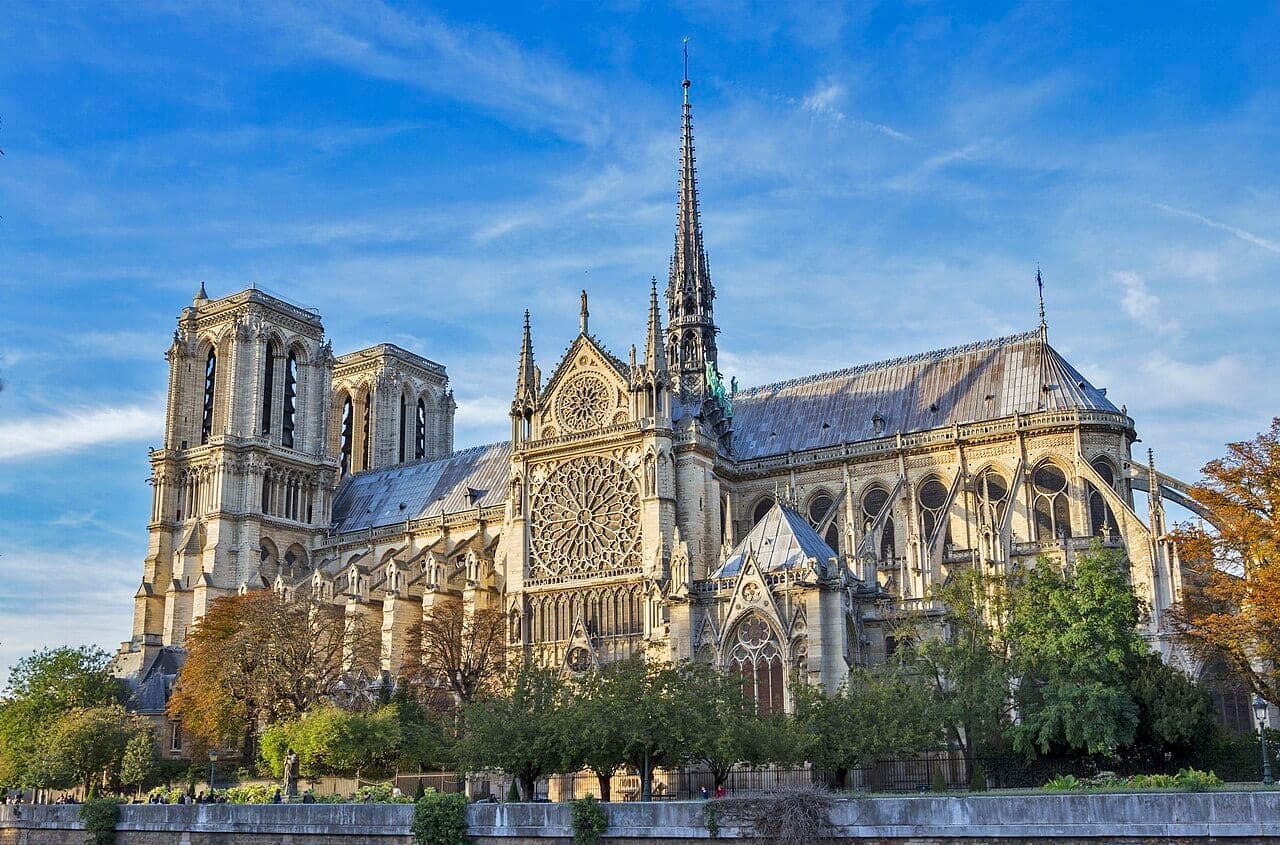
Notre-Dame de Paris is the medieval Catholic cathedral on the Ile de la Cite, the island at the heart of Paris. Begun in 1163 and largely finished by the middle of the 14th century, it is one of the defining works of French Gothic architecture and among the most visited buildings in Europe. The cathedral forms part of the UNESCO World Heritage Site "Paris, Banks of the Seine," inscribed in 1991 (UNESCO). On 15 April 2019 a fire destroyed its spire and roof, and after a five-year restoration the cathedral reopened to the public in December 2024.
Construction began in 1163 under Bishop Maurice de Sully, who wanted a cathedral worthy of the growing capital. Building continued across nearly two centuries, with the main structure largely complete by the mid-14th century. Notre-Dame was among the first buildings to use the flying buttress on a large scale, and its height and light helped define what came to be called Gothic architecture (Britannica).
The cathedral has long stood at the center of French public life. On 2 December 1804 Napoleon Bonaparte crowned himself Emperor there in a ceremony attended by Pope Pius VII. By the early 19th century the building had fallen into disrepair, and Victor Hugo's 1831 novel "Notre-Dame de Paris," known in English as "The Hunchback of Notre-Dame," drew wide attention to its neglected state. Public feeling stirred by the book helped launch a major restoration between 1844 and 1864, led by Jean-Baptiste Lassus and Eugene Viollet-le-Duc. Viollet-le-Duc designed the tall oak-and-lead spire, or fleche, that became one of the cathedral's most recognizable features and that was lost in 2019 (Wikipedia).
Notre-Dame is a benchmark of the Gothic style. Its flying buttresses carry the outward thrust of the stone vaults to external piers, which lets the walls open up for large windows. Three great rose windows, dating from the 13th century, fill the north, south and west ends with colored glass, and the north rose keeps much of its original medieval glazing. The west facade is organized around two square towers that rise to roughly 69 metres, framing the central portals and the Gallery of Kings (Britannica).
 The buttresses take the outward thrust of the vault away from the walls, which is what allowed the walls to become windows. Photograph by Mariordo, CC BY-SA 4.0, via Wikimedia Commons.
The cathedral is also known for its bells. The great bourdon in the south tower, named Emmanuel and cast in 1685, weighs about 13 tonnes and sounds on major feast days and national occasions. A new set of bells was installed in the north tower in 2013 for the building's 850th anniversary, restoring a fuller peal to the towers (Wikipedia).
On 15 April 2019 a fire broke out beneath the roof during renovation work. Within hours the flames consumed the timber roof structure, a dense lattice of medieval oak beams known as "the forest," and brought down Viollet-le-Duc's spire, which collapsed through the vault. Firefighters worked through the night and saved the main stone structure, including the two west towers and the great organ, while human chains helped rescue relics and artworks, among them the relic venerated as the Crown of Thorns. The three great rose windows survived (Wikipedia).
The response was immediate and global. Within days, donors pledged close to 1 billion euros toward reconstruction. After a debate over whether to modernize the design, French authorities decided to rebuild the spire and roof as they had been before the fire. The work drew on some 2,000 craftspeople and hundreds of firms and used traditional methods, including hand-hewn oak for the reconstructed spire and roof frame. The total cost of the restoration ran to roughly 700 million euros (Britannica).
The cathedral reopened over the weekend of 7–8 December 2024. A ceremony on 7 December, attended by President Emmanuel Macron, Archbishop Laurent Ulrich and heads of state and religious leaders from around the world, marked the formal reopening, and the first Masses followed on 8 December, returning the building to public worship almost exactly five years after the fire (Wikipedia).
Notre-Dame is both a working cathedral of the Archdiocese of Paris and a national symbol. Distances in France are measured from a marker on its forecourt, the Point Zero of the roads of France. Over the centuries it has hosted state funerals, memorial services and Te Deums marking moments in French history, and it draws millions of visitors each year. The 2019 fire, watched live around the world, showed how widely the building is regarded as shared cultural heritage well beyond France.
Since the December 2024 reopening, Notre-Dame is again open to visitors and worshippers. Entry to the cathedral is free, though demand is high, and the diocese offers free timed reservations online to shorten waits, with walk-in entry possible when space allows. Because access arrangements have kept evolving after reopening, visitors should check current opening hours and any conditions for the treasury and the towers before arriving. The cathedral remains an active place of worship, and Mass and prayer times are published on its official site.
The buttresses take the outward thrust of the vault away from the walls, which is what allowed the walls to become windows. Photograph by Mariordo, CC BY-SA 4.0, via Wikimedia Commons.
The cathedral is also known for its bells. The great bourdon in the south tower, named Emmanuel and cast in 1685, weighs about 13 tonnes and sounds on major feast days and national occasions. A new set of bells was installed in the north tower in 2013 for the building's 850th anniversary, restoring a fuller peal to the towers (Wikipedia).
On 15 April 2019 a fire broke out beneath the roof during renovation work. Within hours the flames consumed the timber roof structure, a dense lattice of medieval oak beams known as "the forest," and brought down Viollet-le-Duc's spire, which collapsed through the vault. Firefighters worked through the night and saved the main stone structure, including the two west towers and the great organ, while human chains helped rescue relics and artworks, among them the relic venerated as the Crown of Thorns. The three great rose windows survived (Wikipedia).
The response was immediate and global. Within days, donors pledged close to 1 billion euros toward reconstruction. After a debate over whether to modernize the design, French authorities decided to rebuild the spire and roof as they had been before the fire. The work drew on some 2,000 craftspeople and hundreds of firms and used traditional methods, including hand-hewn oak for the reconstructed spire and roof frame. The total cost of the restoration ran to roughly 700 million euros (Britannica).
The cathedral reopened over the weekend of 7–8 December 2024. A ceremony on 7 December, attended by President Emmanuel Macron, Archbishop Laurent Ulrich and heads of state and religious leaders from around the world, marked the formal reopening, and the first Masses followed on 8 December, returning the building to public worship almost exactly five years after the fire (Wikipedia).
Notre-Dame is both a working cathedral of the Archdiocese of Paris and a national symbol. Distances in France are measured from a marker on its forecourt, the Point Zero of the roads of France. Over the centuries it has hosted state funerals, memorial services and Te Deums marking moments in French history, and it draws millions of visitors each year. The 2019 fire, watched live around the world, showed how widely the building is regarded as shared cultural heritage well beyond France.
Since the December 2024 reopening, Notre-Dame is again open to visitors and worshippers. Entry to the cathedral is free, though demand is high, and the diocese offers free timed reservations online to shorten waits, with walk-in entry possible when space allows. Because access arrangements have kept evolving after reopening, visitors should check current opening hours and any conditions for the treasury and the towers before arriving. The cathedral remains an active place of worship, and Mass and prayer times are published on its official site.
History
Architecture