Heritage · Country
French Guiana Culture and Heritage
A rainforest region the size of Austria where six Amerindian peoples, four Maroon nations, Creoles, Hmong farmers and a European spaceport share the same map. This is a guide to Guianese heritage, from the maraké initiation and the Maroni river villages to the roofless cell blocks of the penal colony.Written to last.
By Confinity Heritage Editorial · Updated 2026-08-17 · 8-minute readQuiet tools, kept out of the way.
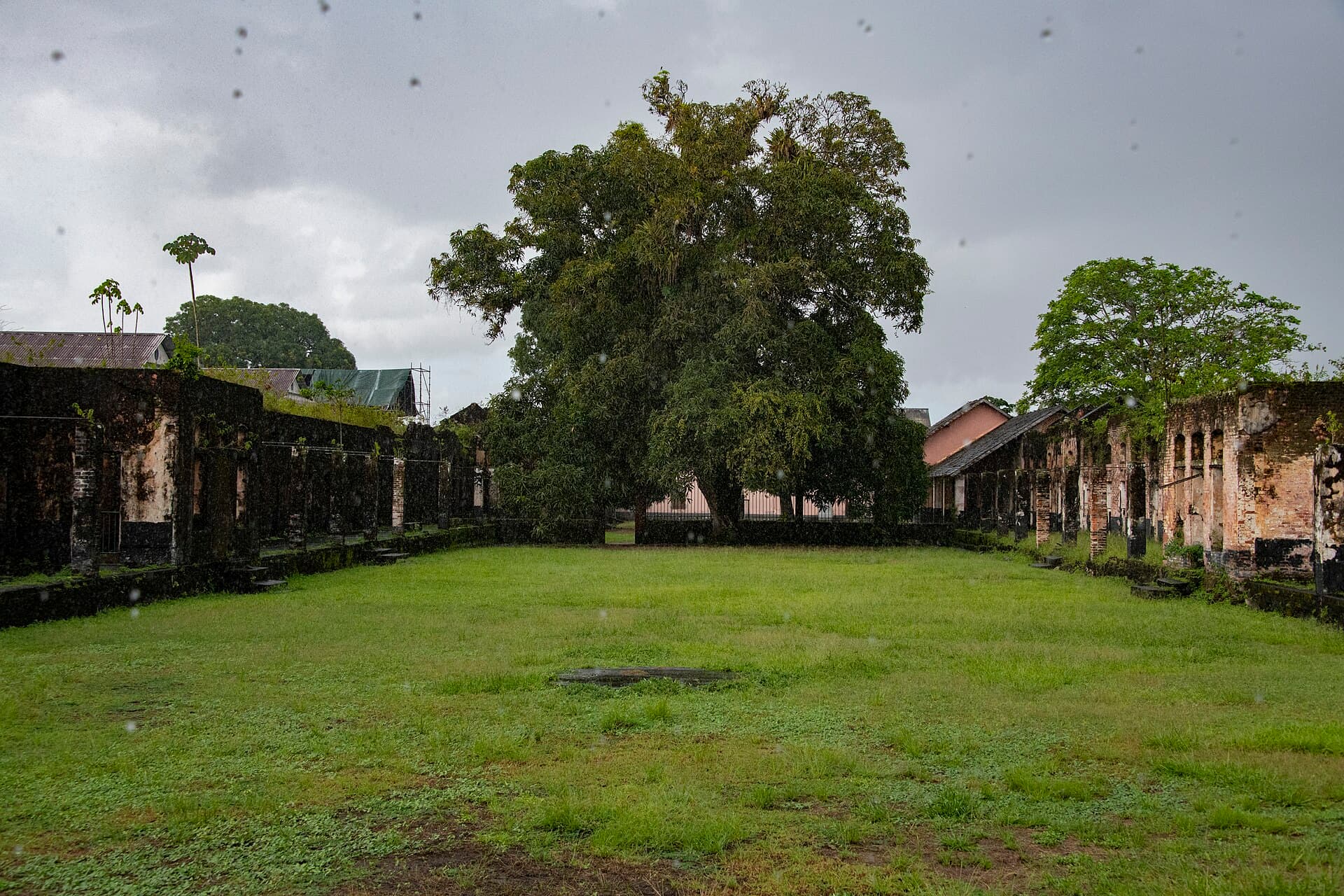
In 1858 the French state began landing convicts at a clearing on the left bank of the Maroni river, and for most of the following century the town that grew there was a penal settlement first and a place to live second. The roofless cell blocks of Saint-Laurent-du-Maroni still line a grass courtyard in the middle of town, and around them lives a population of roughly 48,000, the great majority descended from Africans who escaped Dutch plantations on the far bank of the same river.
That collision is the ordinary condition of French Guiana. Six Amerindian peoples, four Maroon nations, a Creole society formed under slavery, Hmong villages founded by refugees from Laos in the 1970s, Brazilian, Haitian, Surinamese and Chinese communities, and a European launch complex that puts satellites into orbit from the edge of the forest all occupy one administrative unit, legally a French region and an outermost region of the European Union. No other territory in this series holds so many distinct peoples in so small a population.
French Guiana covers about 83,500 square kilometres on the north-east shoulder of South America, between Suriname and Brazil, which makes it the largest French region by area and the only part of the European Union on the South American mainland. Close to ninety-eight per cent of it is rainforest, drained by the Maroni and the Oyapock, which are also its two international borders, and the population of roughly 299,000 lives almost entirely on a narrow coastal strip and along the rivers (Britannica). It became a French overseas department on 19 March 1946, and since 2015 its regional and departmental assemblies have merged into the Collectivité Territoriale de Guyane. The euro is the currency, and this is the youngest and fastest-growing population in the republic.
Cayenne. The capital, about 65,000 people, sits on a peninsula where the Cayenne river meets the sea, on ground first fortified by the French in 1643 at Fort Cépérou. Its centre is a grid of low Creole houses around the Place des Palmistes, and it holds the Musée des cultures guyanaises and a daily market where Hmong growers, Creole traders and Brazilian and Surinamese sellers work side by side.
Saint-Laurent-du-Maroni. The second city, on the river frontier with Suriname, was laid out by the penal administration and is now one of the fastest-growing communes in France. The Camp de la Transportation occupies several hectares of the centre, and pirogues cross constantly to Albina on the Surinamese bank.
Kourou. A fishing and farming village until the 1960s, Kourou is now the town of the space centre, with the Îles du Salut offshore.
Maripasoula and the interior. Maripasoula, on the upper Maroni, is by area the largest commune in France at more than 18,000 square kilometres, reachable only by river or light aircraft, and it is the administrative centre for Wayana and Aluku villages. Cacao and Javouhey are the Hmong farming villages.
People have lived on this coast for several thousand years, and the peoples recorded at contact spoke Carib, Arawak and Tupi-Guarani languages; their descendants are the six Amerindian communities of today, the Kali'na, Lokono and Palikur near the coast and the Wayana, Wayampi and Teko on the upper Maroni and Oyapock (IWGIA). French settlement began in fits and starts from the early 1600s, with Cayenne founded in 1643, and the colony that followed was built on sugar and the enslavement of Africans.
Two catastrophes shaped what France did with the territory afterwards. The first was the Kourou expedition of 1763, launched after the loss of Canada to repopulate the Americas with free settlers. Somewhere between eleven and fifteen thousand people were shipped out with almost no preparation, and within two years the great majority were dead of disease and hunger; the survivors were evacuated to three small islands off the Kourou river, which the administration named the Îles du Salut, the Islands of Salvation (The Mariners' Museum). The name outlived any salvation it described.
The second was the penal colony. Slavery, abolished by the Convention in 1794 and restored by Napoleon in 1802, ended with the decree of 27 April 1848; the commissioner André-Aimé Pariset proclaimed it in Guiana on 10 June, freeing some 12,500 people, and 10 June is still the abolition holiday. Four years later Napoleon III closed the prison hulks of the French ports and sent convicts overseas instead. From 1852 until 1953 France transported some 70,000 to 80,000 men to Guiana, to Saint-Laurent, to the forest camps and to the Îles du Salut, where Île Royale was the reception centre, Saint-Joseph held the solitary cells and Devil's Island took political prisoners (Britannica).
The system was designed to be one-way. A rule known as doublage required any man sentenced to less than eight years to stay in the colony after release for a period equal to his sentence, while men sentenced to eight years or more never legally left at all, so that release meant destitution in a place with no work rather than a passage home. Mortality in the worst camps and years was appalling. The best-known inmate was Alfred Dreyfus, the artillery captain convicted of treason on forged evidence, landed on Devil's Island in 1895 and held alone there until he was brought back for retrial in 1899. Transportation was suspended in 1938 and the last convicts were repatriated by the Salvation Army in 1953.
A quieter chapter ran alongside it. After unrest in Indochina, the administration deported Vietnamese political prisoners to Guiana, and from 1931 several hundred were held on the Crique Anguille in what is now Montsinéry-Tonnégrande. The site, the Bagne des Annamites, is a scatter of concrete ruins in the forest, and the number of men who died there has never been established. Departmentalisation came in 1946, and in 1964 the state chose Kourou for a new launch range after losing the Algerian site at Hammaguir.
French is the only official language and the language of the state, the school and the courts, but a dozen others are spoken in daily life. French Guianese Creole, kriyòl gwiyannen, is a French-lexifier creole with West African grammatical structures, close enough to Antillean Creole for mutual understanding and different enough to be immediately audible. The Maroon peoples speak English-lexifier creoles carried out of Suriname: Nengee, the language of the Ndyuka, Aluku and Paramaka, and Saramaccan, which draws on Portuguese as well. The Amerindian languages belong to three separate families, Carib for Kali'na and Wayana, Arawak for Lokono and Palikur, and Tupi-Guarani for Wayampi and Teko, so that a single administrative region contains language families as distant from one another as Finnish is from Arabic. To these add Hmong, Haitian Creole, Sranan Tongo, Brazilian Portuguese and Hakka Chinese.
The map records the same layering. Kourou, Maroni, Oyapock and Sinnamary are Amerindian names that predate the French entirely, and Guiana itself is usually glossed from an indigenous term for a land of many waters, an etymology repeated more often than it is documented. Bushinenge, the collective term for the Maroon peoples, comes from Sranan for people of the forest and was reclaimed by those it names.
The Amerindian inheritance is strongest in the interior. The maraké, known to the Wayana as ëputop, is an initiation held over weeks or months in which candidates fast, learn the kalau chants that carry cosmology and genealogy, and finally have a woven frame called a kunana pressed against the body, the frame holding dozens of bullet ants or wasps whose stings mark the passage into full adult standing. It could be undertaken several times in a lifetime rather than once. Full ceremonies are now rare; one was held at Talhuwen on the upper Maroni in 2004, and the Ministry of Culture entered the ritual on France's inventory of intangible cultural heritage in 2011.
Maroon material culture is more visible. Tembe, the carved and painted decoration applied to house fronts, doors, paddles, stools and combs, is a graphic tradition of interlocking curves in red, white, black and yellow that developed in the Guianas after the eighteenth century and now appears on public buildings and album covers as well as on village houses.
Creole Guiana keeps its own carnival, unlike any other in the French Caribbean. Its central figure is the touloulou, a woman covered from head to foot in gown, gloves, mask and hood so that no part of her is recognisable, who attends the Saturday-night paré-masqué dances, chooses a man to dance with and cannot, by the convention of the ball, be refused. The kitchen carries the same plurality: bouillon d'awara, the long-cooked Easter dish made from the pulp of the awara palm with smoked fish and salt meat, comes with the saying that anyone who eats it will return to Guiana.
Roman Catholicism is the majority religion, brought with settlement and creolised in practice, and it organises the calendar of patronal feasts, processions and the two great family days of Easter and All Saints. Evangelical and Pentecostal churches, many of them Brazilian or Haitian in origin, have grown quickly along the coast, and there are Adventist, Muslim, Hindu and Buddhist communities around Cayenne.
Older systems run alongside. Maroon religion centres on the ancestors and on obia, the body of protective and healing knowledge held by specialists, with village authority vested in a gaanman and a council of captains whose jurisdiction the French state has never formally recognised but has in practice accommodated for generations. Amerindian communities keep shamanic practice, the pïyai, with the songs and prohibitions attached to particular places in the forest. Many Hmong became Catholic after resettlement while their households went on keeping shamanic rites for illness and the new year.
The Creole coast keeps the wake, the veillée, in the nights between a death and the burial, with the house kept full, coffee and rum served, and stories told so that the family is never left alone with the body. All Saints, 1 November, is the largest family day of the year after Christmas: households clean and repaint the tombs in the days before, then return after dark with flowers and candles, and the older burial grounds of Cayenne double as a record of who arrived when, with Creole, Chinese, Lebanese, Hmong and metropolitan names in adjacent rows.
 France sent around seventy thousand convicts to Guiana between 1852 and 1953, and most of them died there. Devil's Island held political prisoners, Alfred Dreyfus among them. Photograph by Cayambe, CC BY-SA 4.0, via Wikimedia Commons.
The Maroon funerary cycle is the most elaborate set of mourning practices in the territory, and it is best described the way anthropologists of the Guianas describe it, as a sequence rather than an event. Among the Aluku, and in related forms among the Ndyuka and Paramaka, the process opens with rites known as booko dei and closes, often a year or more later, with the puu baaka, the lifting of mourning, at which the surviving spouse and the close kin are released from the restrictions they have observed since the death (Laméca). Both stages draw relatives from different villages and matriclans back to the village of origin, with obligations of food, drumming, song and gift exchange running between them, so that a death reactivates a whole network of kinship rather than only a household. Divination to establish the cause of a death forms part of the sequence in many communities, in forms that vary from village to village.
Public remembrance is organised around two things the French state did here. On 10 June the abolition of slavery is marked with ceremonies, marches and readings. The penal colony is remembered in a more contested register, since its ruins are also the region's best-known tourist sites, and Saint-Laurent has spent thirty years working out how to present them as a place where people were destroyed. At Montsinéry-Tonnégrande the Bagne des Annamites receives Vietnamese delegations for deportees whose names were often never recorded.
French Guiana holds three separate populations with three separate archives, and the most notorious of them is the penal colony.
France transported around seventy thousand convicts here between 1852 and 1938, and the bagne kept detailed dossiers on each: crime, sentence, physical description, conduct, death. Those files survive at the overseas archives at Aix-en-Provence and are indexed, and for families in France and in Guiana they are frequently the fullest personal record of an ancestor that exists. The doublage rule required convicts to remain in the colony after release for as long again as their sentence, so many never left, and Guianese families descend from them.
The second archive is slavery and emancipation. Abolition came in 1848 and, as in the Antilles, the registres d'individualité name every freed person with the surname assigned to them; the departmental archives at Cayenne have digitised them along with the civil registers.
The third is not French at all. The Businenge, descendants of people who escaped slavery in Dutch Suriname and established independent communities on the Maroni river, keep their own genealogy through matrilineal clans, the lo, and their history was carried orally and in the drum and textile traditions rather than in registers. The Amerindian peoples, Wayana, Wayampi, Kali'na, Palikur and others, likewise hold their own descent.
Space is the modern layer: the Kourou centre, built from 1965, displaced villages and drew workers from across the Caribbean and metropolitan France.
The Camp de la Transportation is the central heritage project. Saint-Laurent-du-Maroni bought the site in 1990, it was classified as a historic monument by decree on 14 February 1995, and the town has since installed a Centre d'Interprétation de l'Architecture et du Patrimoine there, with guided visits taking in the cell blocks, the disciplinary quarter and the cell where the convict Henri Charrière is said to have carved his name (Wikipédia). Restoration is slow and the buildings are in poor condition, a plain consequence of climate and a small municipal budget. Offshore, the hut on Devil's Island associated with Dreyfus is kept as a monument.
The Musée des cultures guyanaises in Cayenne, created in 1995 and holding the Musée de France label, occupies a restored Creole house and collects across the whole society: Amerindian and colonial archaeology, Bushinenge carving and textiles, Creole domestic objects and material from the Hmong, Brazilian, Haitian and Chinese communities (Musée des Cultures Guyanaises). The Bagne des Annamites belongs to the Conservatoire du littoral, which protects it both as forest and as a place of memory.
The largest protected area is the Parc Amazonien de Guyane, created on 27 February 2007, with a core zone of about 20,300 square kilometres and an adhesion zone of about 13,600, together the largest national park in France and in the European Union (Parc Amazonien de Guyane). Its unusual feature is that people live inside it: Wayana, Wayampi, Teko and Aluku communities occupy the upper rivers, and the park's charter commits it to working with them on land use, health, schooling and the transmission of knowledge. Its activity report for 2024 sets out the year's work on those commitments and on illegal gold mining, which puts mercury into the rivers those communities drink from.
The records that let a Guianese family cross 1848 are held by the Archives Nationales d'Outre-Mer at Aix-en-Provence, whose colonial civil registers include the entries in which the newly freed were given surnames; the Anchoukaj project publishes a free searchable index of those registers (Anchoukaj). Manioc, the digital library of the Université des Antilles, calls itself a library of the Caribbean and Amazonia and has digitised colonial books, prints and periodicals covering Guiana (Manioc).
The penal history has been unusually well served online. Criminocorpus, the digital museum of the history of justice and punishment, publishes an exhibition on the Camp de la Transportation together with digitised registers, plans and photographs of the penal administration, so a researcher can follow a convict's file without travelling. Academic projects have added open image collections of the penal sites under free licences; the photograph at the head of this page comes from one.
The space centre is the largest single fact of the modern economy and the source of the region's longest-running land dispute. Establishing the range from 1964 required expropriating a stretch of coast Creole and Amerindian families were living on, and roughly four thousand people were moved, among them the whole village of Malmanoury; the operation was quick, compensation was small, and the replacement plots were often poor or hard to reach (CNES). The space agency's own historical account now acknowledges the expropriations and the sense of injustice they left. Sixty years on, the range is where Ariane 6 lifted off for the first time on 9 July 2024.
The other defining recent event is the movement of spring 2017. From 20 March, a coalition of unions, professional bodies and citizens' collectives calling itself Pou Lagwiyann dékolé, roughly "so that Guiana can take off", blocked roads and brought the territory to a standstill for a month over insecurity, health care, schooling and land rights. A first offer of a little over one billion euros was rejected; agreement was reached on 21 April on an emergency plan worth up to 2.1 billion euros (Wikipedia). Many of those commitments are still being argued over.
Guiana's cultural exports are older than either. Léon-Gontran Damas, born in Cayenne in 1912, published Pigments in 1937 and was one of the three founders of négritude with Aimé Césaire and Léopold Sédar Senghor, the only one from the South American mainland and the one most often left out. Félix Éboué, born in Cayenne in 1884 to a family descended from the enslaved, became the first Black governor in the French colonial service, rallied French Equatorial Africa to de Gaulle in August 1940 and in 1949 became the first Black man interred in the Panthéon. Christiane Taubira, deputy for Guiana, gave her name to the law of 21 May 2001 recognising the Atlantic slave trade and slavery as crimes against humanity.
The camp saved by the town it was built to punish. Saint-Laurent-du-Maroni bought the Camp de la Transportation in 1990 and had it listed as a historic monument in 1995, turning a penal settlement into a heritage centre run by the descendants of those it was imposed on.
A national park with residents. The Parc Amazonien de Guyane, created in 2007, is the largest protected area in the European Union and is governed under a charter committing it to work with the communities inside its boundaries.
A refugee settlement that fed a region. Hmong families resettled from Laos at Cacao and Javouhey from 1977 built villages from nothing and now supply a large share of the region's fresh produce.
An initiation on the national record. The Wayana ëputop was entered on France's inventory of intangible cultural heritage in 2011, after it had nearly stopped being performed.
France sent around seventy thousand convicts to Guiana between 1852 and 1953, and most of them died there. Devil's Island held political prisoners, Alfred Dreyfus among them. Photograph by Cayambe, CC BY-SA 4.0, via Wikimedia Commons.
The Maroon funerary cycle is the most elaborate set of mourning practices in the territory, and it is best described the way anthropologists of the Guianas describe it, as a sequence rather than an event. Among the Aluku, and in related forms among the Ndyuka and Paramaka, the process opens with rites known as booko dei and closes, often a year or more later, with the puu baaka, the lifting of mourning, at which the surviving spouse and the close kin are released from the restrictions they have observed since the death (Laméca). Both stages draw relatives from different villages and matriclans back to the village of origin, with obligations of food, drumming, song and gift exchange running between them, so that a death reactivates a whole network of kinship rather than only a household. Divination to establish the cause of a death forms part of the sequence in many communities, in forms that vary from village to village.
Public remembrance is organised around two things the French state did here. On 10 June the abolition of slavery is marked with ceremonies, marches and readings. The penal colony is remembered in a more contested register, since its ruins are also the region's best-known tourist sites, and Saint-Laurent has spent thirty years working out how to present them as a place where people were destroyed. At Montsinéry-Tonnégrande the Bagne des Annamites receives Vietnamese delegations for deportees whose names were often never recorded.
French Guiana holds three separate populations with three separate archives, and the most notorious of them is the penal colony.
France transported around seventy thousand convicts here between 1852 and 1938, and the bagne kept detailed dossiers on each: crime, sentence, physical description, conduct, death. Those files survive at the overseas archives at Aix-en-Provence and are indexed, and for families in France and in Guiana they are frequently the fullest personal record of an ancestor that exists. The doublage rule required convicts to remain in the colony after release for as long again as their sentence, so many never left, and Guianese families descend from them.
The second archive is slavery and emancipation. Abolition came in 1848 and, as in the Antilles, the registres d'individualité name every freed person with the surname assigned to them; the departmental archives at Cayenne have digitised them along with the civil registers.
The third is not French at all. The Businenge, descendants of people who escaped slavery in Dutch Suriname and established independent communities on the Maroni river, keep their own genealogy through matrilineal clans, the lo, and their history was carried orally and in the drum and textile traditions rather than in registers. The Amerindian peoples, Wayana, Wayampi, Kali'na, Palikur and others, likewise hold their own descent.
Space is the modern layer: the Kourou centre, built from 1965, displaced villages and drew workers from across the Caribbean and metropolitan France.
The Camp de la Transportation is the central heritage project. Saint-Laurent-du-Maroni bought the site in 1990, it was classified as a historic monument by decree on 14 February 1995, and the town has since installed a Centre d'Interprétation de l'Architecture et du Patrimoine there, with guided visits taking in the cell blocks, the disciplinary quarter and the cell where the convict Henri Charrière is said to have carved his name (Wikipédia). Restoration is slow and the buildings are in poor condition, a plain consequence of climate and a small municipal budget. Offshore, the hut on Devil's Island associated with Dreyfus is kept as a monument.
The Musée des cultures guyanaises in Cayenne, created in 1995 and holding the Musée de France label, occupies a restored Creole house and collects across the whole society: Amerindian and colonial archaeology, Bushinenge carving and textiles, Creole domestic objects and material from the Hmong, Brazilian, Haitian and Chinese communities (Musée des Cultures Guyanaises). The Bagne des Annamites belongs to the Conservatoire du littoral, which protects it both as forest and as a place of memory.
The largest protected area is the Parc Amazonien de Guyane, created on 27 February 2007, with a core zone of about 20,300 square kilometres and an adhesion zone of about 13,600, together the largest national park in France and in the European Union (Parc Amazonien de Guyane). Its unusual feature is that people live inside it: Wayana, Wayampi, Teko and Aluku communities occupy the upper rivers, and the park's charter commits it to working with them on land use, health, schooling and the transmission of knowledge. Its activity report for 2024 sets out the year's work on those commitments and on illegal gold mining, which puts mercury into the rivers those communities drink from.
The records that let a Guianese family cross 1848 are held by the Archives Nationales d'Outre-Mer at Aix-en-Provence, whose colonial civil registers include the entries in which the newly freed were given surnames; the Anchoukaj project publishes a free searchable index of those registers (Anchoukaj). Manioc, the digital library of the Université des Antilles, calls itself a library of the Caribbean and Amazonia and has digitised colonial books, prints and periodicals covering Guiana (Manioc).
The penal history has been unusually well served online. Criminocorpus, the digital museum of the history of justice and punishment, publishes an exhibition on the Camp de la Transportation together with digitised registers, plans and photographs of the penal administration, so a researcher can follow a convict's file without travelling. Academic projects have added open image collections of the penal sites under free licences; the photograph at the head of this page comes from one.
The space centre is the largest single fact of the modern economy and the source of the region's longest-running land dispute. Establishing the range from 1964 required expropriating a stretch of coast Creole and Amerindian families were living on, and roughly four thousand people were moved, among them the whole village of Malmanoury; the operation was quick, compensation was small, and the replacement plots were often poor or hard to reach (CNES). The space agency's own historical account now acknowledges the expropriations and the sense of injustice they left. Sixty years on, the range is where Ariane 6 lifted off for the first time on 9 July 2024.
The other defining recent event is the movement of spring 2017. From 20 March, a coalition of unions, professional bodies and citizens' collectives calling itself Pou Lagwiyann dékolé, roughly "so that Guiana can take off", blocked roads and brought the territory to a standstill for a month over insecurity, health care, schooling and land rights. A first offer of a little over one billion euros was rejected; agreement was reached on 21 April on an emergency plan worth up to 2.1 billion euros (Wikipedia). Many of those commitments are still being argued over.
Guiana's cultural exports are older than either. Léon-Gontran Damas, born in Cayenne in 1912, published Pigments in 1937 and was one of the three founders of négritude with Aimé Césaire and Léopold Sédar Senghor, the only one from the South American mainland and the one most often left out. Félix Éboué, born in Cayenne in 1884 to a family descended from the enslaved, became the first Black governor in the French colonial service, rallied French Equatorial Africa to de Gaulle in August 1940 and in 1949 became the first Black man interred in the Panthéon. Christiane Taubira, deputy for Guiana, gave her name to the law of 21 May 2001 recognising the Atlantic slave trade and slavery as crimes against humanity.
The camp saved by the town it was built to punish. Saint-Laurent-du-Maroni bought the Camp de la Transportation in 1990 and had it listed as a historic monument in 1995, turning a penal settlement into a heritage centre run by the descendants of those it was imposed on.
A national park with residents. The Parc Amazonien de Guyane, created in 2007, is the largest protected area in the European Union and is governed under a charter committing it to work with the communities inside its boundaries.
A refugee settlement that fed a region. Hmong families resettled from Laos at Cacao and Javouhey from 1977 built villages from nothing and now supply a large share of the region's fresh produce.
An initiation on the national record. The Wayana ëputop was entered on France's inventory of intangible cultural heritage in 2011, after it had nearly stopped being performed.
National Overview
Notable Cities
Historical Foundations
Linguistic and Etymological Roots
Cultural Identity
Religion and Spirituality
Remembrance and Mourning Traditions
Tracing a Family in French Guiana
Heritage Preservation Efforts
Digital Heritage
Contemporary Cultural Influences
Success Stories
References and resources
- Encyclopaedia Britannica, French Guiana: geography, population and government.
- Encyclopaedia Britannica, Devil's Island: the penal colony and Dreyfus.
- IWGIA, Indigenous Peoples in French Guiana: the six Amerindian peoples and their land questions.
- The Mariners' Museum, Welcome to Kourou: the 1763 expedition.
- Bagne de Saint-Laurent-du-Maroni, Wikipédia: the camp, its listing and its restoration.
- Musée des Cultures Guyanaises: the Cayenne museum of Guianese cultures.
- Parc Amazonien de Guyane: the park and its residents.
- Laméca, Booko dei et puu baaka chez les Marrons de l'Est: the Aluku funerary cycle.
- CNES, From Algeria to French Guiana: the 1964 expropriations.
- 2017 Social Unrest in French Guiana, Wikipedia: the general strike and the accords of 21 April.