Heritage · Country
Mayotte Culture and Heritage
An island in the Comoros archipelago that France administers as its hundred-and-first department and the Comoros still claims, where almost everyone is Muslim and French is mostly the language of school. This is a guide to Mahoran heritage, from the Tsingoni mosque to burial before sunset.Written to last.
By Confinity Heritage Editorial · Updated 2026-08-17 · 8-minute readQuiet tools, kept out of the way.
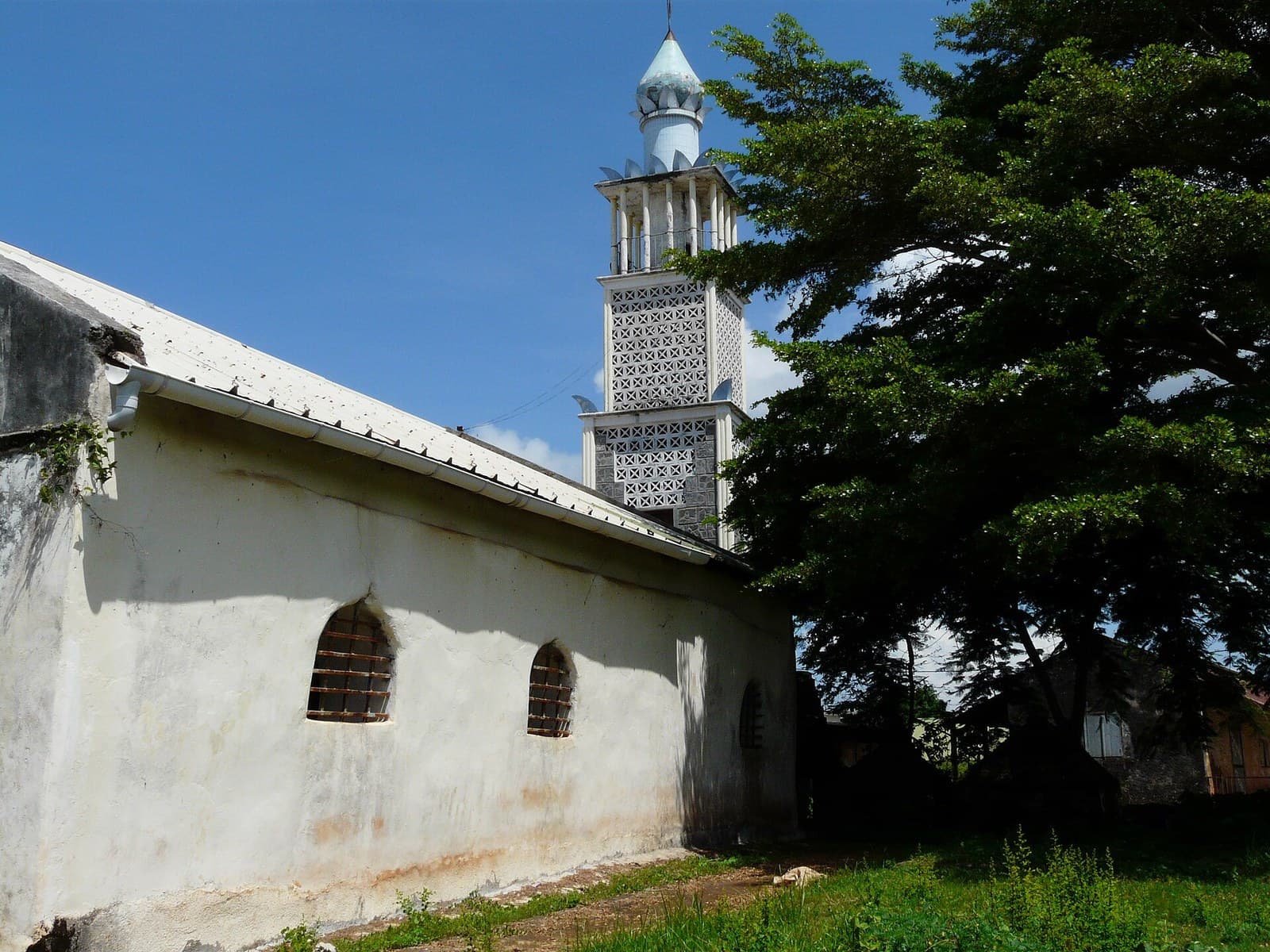
At Tsingoni, on the west coast of Mayotte, a low whitewashed prayer hall has been in use for close to five hundred years. An inscription beside its mihrab gives the date 1538 and the sultan who ordered the work. It's the oldest working mosque in France, a strange thing to say about a building raised by a Swahili-speaking sultanate two centuries before France was a power in this ocean, and it says most of what needs saying about how Mahoran heritage sits inside the French state.
Mayotte is one of the four islands of the Comoros archipelago, and it's the one that stayed. When the archipelago voted on independence in 1974, three islands chose to leave and Mayotte chose to remain French; the Comoros has claimed it ever since, the United Nations General Assembly repeatedly affirmed Comorian sovereignty over it, and France has administered it throughout, making it a department in 2011.
Mayotte covers about 374 square kilometres in the northern Mozambique Channel, between Madagascar and the African mainland: Grande-Terre, the smaller Petite-Terre and a scatter of islets, ringed by a lagoon of roughly 1,100 square kilometres enclosed by a double barrier reef of a kind found in only about ten places on earth. The census of January 2024 counted 320,901 inhabitants, which makes it one of the most densely settled parts of the republic and by a distance its youngest. It became France's hundred-and-first department on 31 March 2011 and an outermost region of the European Union in 2014, and it remains the poorest department in France by every standard measure, with a large majority of households below the national poverty line. Almost the whole population is Muslim. French is the sole official language, and Shimaore and Kibushi are what people speak at home.
Mamoudzou. The prefecture and by far the largest commune, spread up the hillsides of eastern Grande-Terre, with the market, the hospital, the departmental council and the barge that shuttles across to Petite-Terre. Its neighbourhoods run from concrete apartment blocks to the sheet-metal quarters of Kaweni, the largest informal settlement in France.
Dzaoudzi and Labattoir. Petite-Terre holds the airport at Pamandzi and, on the rock of Dzaoudzi joined to the island by a causeway, the former colonial capital, where the barracks of 1845 stand among the administrative buildings of the period when Dzaoudzi governed the whole archipelago for France.
Tsingoni and the village belt. Tsingoni, on the west coast, was the capital of the sultanate, and its Friday mosque is the oldest still in use anywhere in France. The coastal villages keep the older pattern of Mahoran life: a mosque at the centre, banga huts at the edge for young unmarried men, salt production at Bandrélé, and Shirazi ruins at Acoua and Polé.
People from the East African coast settled these islands from around the eighth or ninth century, part of the Swahili trading world that ran from Somalia to Mozambique, and Islam arrived with it. By the fifteenth century Mayotte had a sultanate with its capital at Tsingoni, ruled by a class who traced their descent to Shirazi settlers from Persia, an origin story common along the whole Swahili coast and read by historians as a claim to legitimacy as much as a record of migration. Malagasy speakers settled in numbers too, which is why a Malagasy language is spoken here alongside a Bantu one.
The early nineteenth century nearly emptied the island. Sakalava and Betsimisaraka war fleets from Madagascar raided the Comoros repeatedly for captives, and Mayotte, the closest of the four and the lowest-lying, suffered worst. Out of that upheaval came the last sultan: Andriantsoly, a prince of the Sakalava kingdom of Boina who converted to Islam, lost a war against the expanding Merina kingdom, reached Mayotte in 1831 and took the sultanate the following year. Under pressure from rivals, he signed the island over to France on 25 April 1841 in a treaty with the naval officer Pierre Passot, for a life pension of 1,000 piastres and the education of two of his children in Réunion; Paris ratified it in 1843 (Wikipédia).
France ran Mayotte first as a plantation colony with imported labour, then from 1886 as the seat of a protectorate over the other three islands, so that Dzaoudzi governed the archipelago until the capital moved to Moroni in 1958. From the late 1950s a Mahoran movement pressed to stay French, its street politics led conspicuously by women, the chatouilleuses.
The archipelago voted on 22 December 1974. Across the four islands the result was about 94.6 per cent for independence, but the returns were counted island by island, and on Mayotte roughly 63.8 per cent voted against it. The Comoros declared independence in July 1975, and on 12 November 1975 the United Nations General Assembly admitted it in resolution 3385 (XXX), reaffirming the territorial integrity of a Comoros comprising Anjouan, Grande Comore, Mayotte and Mohéli. On 6 February 1976 France used its Security Council veto against a draft calling on it to negotiate Mayotte's return, and two days later a referendum on Mayotte alone returned 99.4 per cent for staying French, on a vote the pro-independence side boycotted. On 21 October 1976 the General Assembly adopted resolution 31/4, condemning those referendums, rejecting any future consultation of the kind and urging France to negotiate; the item stayed on its agenda as the "Question of the Comorian island of Mayotte" until 1995, and the African Union takes the same position (UN Digital Library).
France holds that the votes of 1974, 1976 and 2009 were exercises of self-determination by the people who live on the island. The Comoros holds that the archipelago was a single colonial unit whose partition at independence was unlawful, and that the General Assembly said so repeatedly. Both positions are set out here as they are held. A referendum on 29 March 2009 approved departmentalisation by about 95 per cent, the Comoros protested, and Mayotte became a department in 2011.
Two languages carry daily life. Shimaore is a Bantu language of the Comorian group, closest to the speech of neighbouring Anjouan, and it's the island's lingua franca. Kibushi, also written Shibushi, is a Malagasy language descended from Sakalava speech and used mainly in villages of the west and south. Neither has official status. Surveys by the national statistics office show the division of labour between them and French: among people aged fifteen and over, about 75 per cent report a command of Shimaore and 18 per cent of Kibushi, with 81 per cent reporting at least one of the two, while only around 29 per cent of adults under sixty-five use French with family and friends (Insee). Command of French rises steeply with schooling, from under a third of those over sixty to more than four fifths of those aged fifteen to twenty-four, so the language of the state is the language of the young and of the classroom.
Arabic is the language of the Qur'an and of the village schools. The island's own name in Shimaore is Maore, from which Mahorais and Mahoran derive; "Mayotte" is the French rendering of the same word by way of earlier European charts, and the word bushi itself means Malagasy.
Mahoran expressive culture is largely sung, largely communal, and often divided by gender. The debaa is a women's practice of Sufi origin, performed seated or kneeling in rows, in which religious poems in Arabic praising the Prophet are sung while the performers move hands, arms and heads in choreographed unison, in matched cloth chosen for the occasion; village groups compete, and the form is entered on France's national inventory of intangible cultural heritage (PCI-Lab). The shigoma is a men's dance with drums, the mbiwi a women's dance of interlocking bamboo sticks, and the wadaha, the pestle dance, turns the work of pounding rice into a display of timing. Much of it belongs to weddings, above all the manzaraka, the procession that carries the groom to the bride's house.
Dress and adornment are unusually legible. The salouva, a length of printed cloth wrapped and knotted, is worn with a kishali over the shoulder, and over the face many women wear msindzano, a pale paste ground from sandalwood, sometimes with coral, applied in patterns and worn as sun protection, as cosmetic and as a marker of who is at ease in her own village.
Islam has been on these islands for roughly a thousand years and is the religion of almost the whole population, Sunni of the Shafi'i school, with a strong Sufi presence organised in brotherhoods that hold dhikr gatherings. Every village has its Friday mosque, and most have a Qur'anic school, the shioni or madrasa, which children attend early in the morning or after the state school day, learning to read and recite Arabic. Islamic judges, the cadis, held formal authority in matters of personal status well into the departmental period, and the alignment of that law with French civil law during the 2000s was among the most consequential changes departmentalisation brought.
Alongside all of this, and generally practised by the same people, runs a body of spirit practice. Anthropologists working here, above all Michael Lambek in Knowledge and Practice in Mayotte, describe possession as a system of knowledge coexisting with Islamic learning rather than competing with it. Two families of spirits are named most often: trumba, of Malagasy origin, understood as the spirits of dead Sakalava royalty and often inherited within a family, and patros or patrosi, associated with the coast and with Arab lineages. Mediums, more often women than men, enter trance at ceremonies that are at once healing rituals, initiations and occasions the spirits themselves are said to enjoy. These practices are held privately, are contested by some reformist currents within Mahoran Islam, and are described here as ethnographers describe them.
Death is handled quickly and by the community. Where it's possible the burial happens on the day of death and before sunset, and in any case within about a day. The body is washed by relatives of the same sex, wrapped in a plain white shroud without a coffin, and carried on a bier to the village cemetery, which usually lies at the edge of the houses; the funeral prayer, swalat janaza, is said by the men, and the grave is marked with upright stones rather than an inscribed monument, so that Mahoran burial grounds read as fields of low stone rather than as the tiled family tombs of the other French overseas departments. Reconciling that speed and plainness with French civil registration and public health rules has taken decades of accommodation between the communes, the prefecture and the cadis.
The mourning that follows is a sequence rather than a day. The bereaved household receives visitors for three days, with Qur'an readings and shared food; further gatherings fall over the following weeks, and the fortieth day is marked by a large communal meal that closes the formal mourning period. A widow observes the waiting period of four months and ten days prescribed by Islamic law. Graves are visited afterwards in the practice of ziyara, and the word ziara also names the larger village ceremonies at the tombs of ancestors and of holy men, at which a community asks for protection and renews its claim on its own ground. The oldest such place is Tsingoni, where tombs in the mosque enclosure are attributed to the sultans.
In December 2024, after Cyclone Chido, that customary speed became one of the reasons officials gave for the difficulty of establishing how many people had died: families had buried their dead before anyone counted them.
Mayotte's records are French and its family structures are Comorian, and the two do not fit together neatly.
The island became French in 1841 and voted in 1974 to remain French when the other Comoros became independent, so its civil registration is French while its society is Swahili, Muslim and matrilocal, with houses passing through women and the manzaraka marriage establishing a family's standing.
The practical problem is that the French état civil, applied to a population using Comorian naming conventions, produced records that did not match how families actually worked. Names were recorded inconsistently across generations, and in 2000 France created a commission to revise Mayotte's civil status entirely, fixing surnames for families that had not used them in the French sense. So for many Mahoran families the state's record of their name is younger than the people in it.
Islamic records are the older layer: qadi court registers of marriage, divorce and inheritance, and the mosque foundations, of which Tsingoni is the oldest still in use in France, dating from the sixteenth century.
The Comorian claim to the island is maintained, so a family with relatives on Anjouan may have branches documented by two states that disagree about which country one of them is in. The kwassa kwassa crossings between the islands, and the very large undocumented population that has resulted, mean a substantial share of people living in Mayotte have no French record at all.
The Tsingoni mosque is the island's principal monument. Its mihrab carries an inscription giving the year 1538 and the sultan who commissioned it, archaeological work has proposed a first structure on the site around the 1440s, and the coral masonry and proportions belong to the Swahili architecture of the East African coast. It was listed as a monument historique in 2016, and a restoration costing in the region of two million euros began in 2019 (Wikipédia).
The Musée de Mayotte, the MuMA, opened in 2015 in the Dzaoudzi barracks and received the Musée de France label on 20 December 2018 (Wikipédia). It has been shut to visitors since 2020, when the earthquake swarm produced by Fani Maoré, the submarine volcano that grew off the east coast from 2018, weakened the building; Cyclone Chido then tore the roof off the barracks in December 2024, and the museum has worked outside its own walls while its collections were moved to safety (Fondation du patrimoine).
Most of the protected area is water. The Parc naturel marin de Mayotte, created on 18 January 2010, covers roughly 68,000 square kilometres taking in the lagoon, the territorial waters and the whole exclusive economic zone, with tighter protection over the passe en S, N'Gouja, Papani and the Saziley headland (Office français de la biodiversité). Five species of marine turtle feed and nest here, and Saziley is among the most important green and hawksbill nesting sites in the western Indian Ocean. The national nature reserve of the îlot M'Bouzi, created by decree in January 2007, protects 82 hectares of island and the water around it.
Mayotte's documentary record is thin, young and vulnerable, which shapes what digital heritage means here. The departmental archives are a recent institution, and the older layers of Mahoran memory are oral, held in genealogies, poems and the practice of villages rather than in paper. Much of the written record before the twentieth century sits in French naval and colonial collections in mainland France, among them Charles Guillain's volumes on the history and commerce of eastern Africa, digitised through the national library.
The University of Mayotte, which grew out of the university centre created in 2011 and became a full university on 1 January 2024, publishes theses and research through the national open-access repository. The statistics office has built the most detailed public picture of contemporary Mahoran society in a decade of open studies on languages, households, migration and poverty (Insee), and the national inventory of intangible cultural heritage carries fieldwork records anyone can read.
Three linked emergencies define Mayotte's recent history, and they need reporting plainly.
The first is migration. The seventy kilometres between Anjouan and Mayotte separate one of the poorest countries in the world from a French department with a hospital, schools and family already there. In 1995 France introduced a visa requirement for Comorians travelling to Mayotte, and a crossing that had been ordinary became an irregular one made at night in kwassa-kwassa, small outboard fishing boats. People drown on that route regularly; there's no reliable count, and published estimates over three decades vary by an order of magnitude. Around the time of the 2023 operations, official French figures put roughly a third of the island's residents as lacking residence rights, and many of those living in the sheet-metal quarters are children.
The second is the state's response. Operation Wuambushu, from the Shimaore for recovery, ran from 24 April to 11 September 2023 with some 1,800 police and gendarmes, producing 1,327 arrests and about 400 demolitions of informal housing against a target of a thousand. Both of Mayotte's deputies and several local collectives supported it; the government of the Comoros, UNICEF and a number of human rights organisations opposed it, on the grounds that mass expulsions and demolitions fall hardest on children and on people with nowhere to go. A second operation from 16 April 2024 demolished roughly 1,300 dwellings (Wikipedia).
The third is water and weather. The drought of 2023 was the worst since 1997: the Combani reservoir fell to around a tenth of capacity, running water was rationed to one day in three across much of the island for months, and an outbreak of acute gastroenteritis followed, while works for a third reservoir and a second desalination plant had not begun. On 14 December 2024 Cyclone Chido crossed the island with sustained winds around 215 kilometres per hour, the strongest storm to hit Mayotte in at least ninety years, destroying whole informal settlements including much of Kaweni. Early speculation about the death toll ran into the thousands and was withdrawn; the official count settled at around forty dead with dozens more missing, a figure officials themselves called uncertain (Wikipedia).
The oldest mosque in France protected. Tsingoni's Friday mosque, in use since the sixteenth century, was listed as a historic monument in 2016 and has been under restoration since 2019.
A women's practice on the national inventory. The debaa was documented and entered on France's inventory of intangible cultural heritage, on the same terms as mainland practices.
A lagoon under protection. The marine park created in 2010 and the M'Bouzi reserve created in 2007 protect the double barrier reef and the turtle nesting beaches at Saziley.
Two languages counted and taught. Surveys have established how many people speak Shimaore and Kibushi and in what settings, and both now have teaching material and university research behind them.
National Overview
Notable Cities
Historical Foundations
Linguistic and Etymological Roots
Cultural Identity
Religion and Spirituality
Remembrance and Mourning Traditions
Tracing a Family in Mayotte
Heritage Preservation Efforts
Digital Heritage
Contemporary Cultural Influences
Success Stories
References and resources
- UN Digital Library, Question of the Comorian island of Mayotte: the General Assembly resolutions.
- Histoire de Mayotte, Wikipédia: the sultanates, the raids and the referendums.
- Andriantsouli, Wikipédia: the last sultan and the 1841 cession.
- Mosquée de Tsingoni, Wikipédia: the 1538 mihrab and the 2016 listing.
- Tsingoni Mosque, Wikipedia: the building's history and restoration.
- Insee, Mayotte, un territoire riche de ses langues: command of Shimaore, Kibushi and French.
- Insee, six adultes sur dix en difficulté à l'écrit en français: adult literacy and language use.
- PCI-Lab, Le debaa des femmes: the inventory record for the women's sung practice.
- Office français de la biodiversité, Parc naturel marin de Mayotte: the marine park and the lagoon.
- Musée de Mayotte, Wikipédia: the museum in the 1845 barracks at Dzaoudzi.
- Fondation du patrimoine, ancienne caserne de Dzaoudzi: the building's damage and restoration appeal.
- Operation Wuambushu, Wikipedia: the 2023 and 2024 operations and the criticism.
- Cyclone Chido, Wikipedia: the December 2024 storm and the difficulty of counting the dead.