Heritage · Country
Martinique Culture and Heritage
An island whose finest city was erased by a volcano in three minutes in 1902, and whose answer was a century of writing that changed how French speakers talk about race. This is a guide to Martinican heritage, from Saint-Pierre and the bèlè drum to the candle-lit cemeteries of All Saints.Written to last.
By Confinity Heritage Editorial · Updated 2026-08-17 · 8-minute readQuiet tools, kept out of the way.
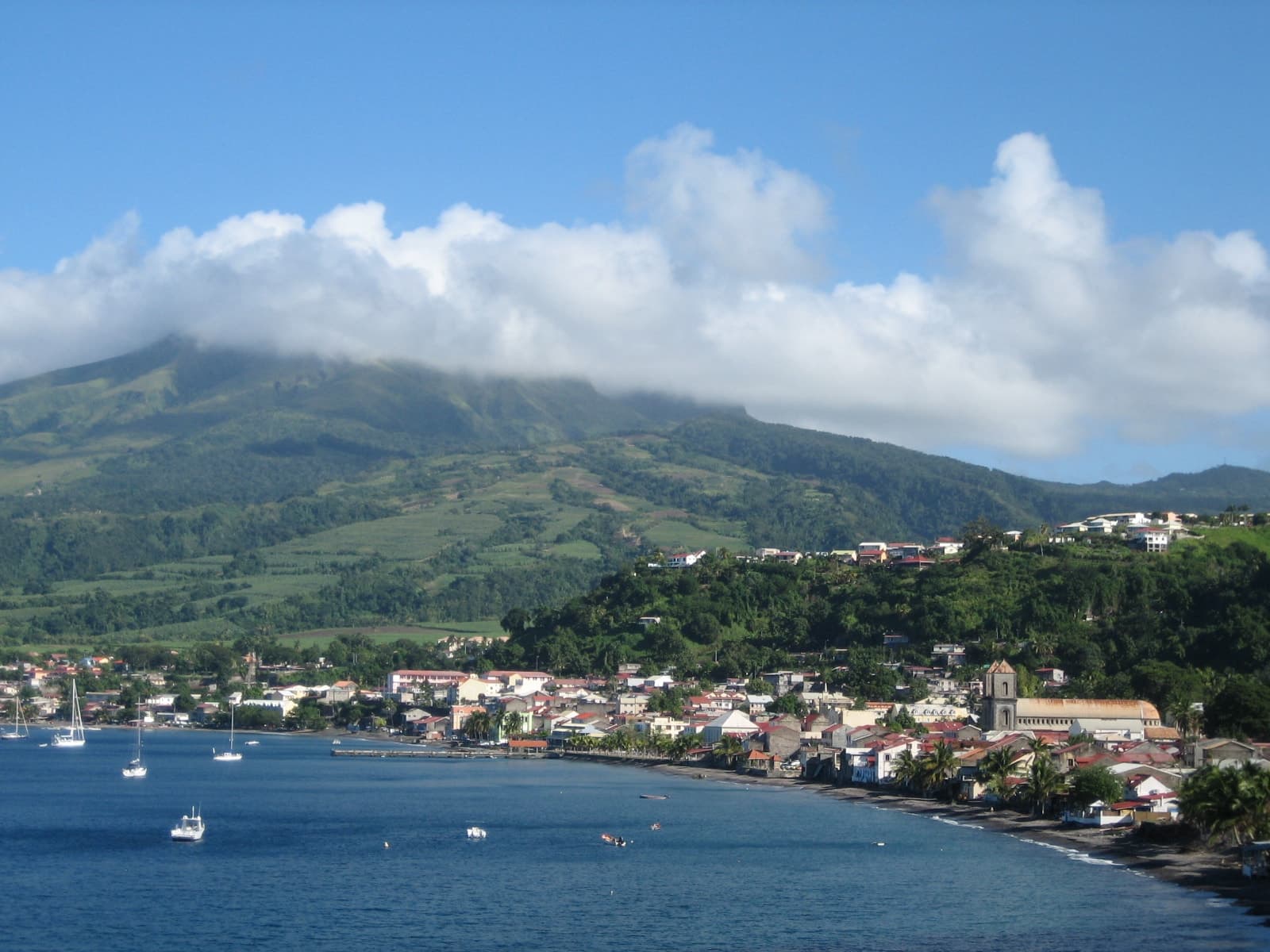
At about eight o'clock on the morning of 8 May 1902, the flank of Mount Pelée opened and a cloud of superheated gas and ash rolled down onto Saint-Pierre. The town below was the commercial and cultural capital of the French Antilles, a place of theatres, newspapers, tramways and stone quays that visitors liked to call the Paris of the Caribbean. Within a few minutes almost everyone in it was dead, some thirty thousand people, and the harbour was on fire.
Martinique has spent the century since learning to speak about loss with precision. The island's largest export is language: the poetry of Aimé Césaire, who named négritude and then governed Fort-de-France for fifty-six years, the philosophy of Édouard Glissant, who argued that Caribbean identity is made by mixture rather than descent, and the Creole novels of Patrick Chamoiseau. That vocation grew out of a society built by enslaved Africans on land taken from the Kalinago.
Martinique is a single island of about 1,128 square kilometres in the Windward group of the Lesser Antilles, lying between Dominica and Saint Lucia, with a population of roughly 350,000. The north is mountainous and wet, dominated by Mount Pelée at 1,397 metres and the forested ridges of the Pitons du Carbet; the centre is a plain of cane and banana around the bay of Fort-de-France; the south is drier and lower. Politically the island is part of France: an overseas department since the law of 19 March 1946, an overseas region as well, and since 2015 a single body, the Collectivité Territoriale de Martinique, that merged the two assemblies. It is an outermost region of the European Union and uses the euro. French is the official language and Martinican Creole the language of the yard and the market. The population is overwhelmingly of African and mixed descent, with smaller communities descended from Indian indentured workers and from the white planter families known as békés.
Fort-de-France. The capital, about 75,000 people, grew around Fort Saint-Louis on a deep bay and only became the island's first city after Saint-Pierre was destroyed. Its centre holds the Bibliothèque Schœlcher, a cast-iron and glazed-brick pavilion designed by Pierre-Henri Picq, shown at the 1889 Paris Exposition Universelle and then taken apart, shipped across the Atlantic and rebuilt here in 1893. The Savane, the park facing the harbour, holds the empty plinth of the statue of Empress Joséphine, born on the island, beheaded by activists in 1991 and pulled down in 2020.
Saint-Pierre. Founded in 1635 and the island's capital until 1902, Saint-Pierre is now a town of about 4,000 living among the ruins of a city of thirty thousand. The shell of the theatre, the cell that saved Ludger Sylbaris, the cathedral walls and the wrecks in the bay are all preserved.
Le Lamentin, Sainte-Marie and Basse-Pointe. Le Lamentin, east of the capital, holds the airport and now rivals Fort-de-France in population. In the north-east, Sainte-Marie and Basse-Pointe are the heartland of bèlè drumming and of the rum estates, and Basse-Pointe is where Aimé Césaire was born in 1913.
The island was settled from South America in waves, first by Arawak-speaking Saladoid people in the early centuries of the common era, then by Kalinago groups who were living there when Europeans arrived. Columbus reached the coast in 1502, but Spain took no interest, and French settlement began on 15 September 1635, when Pierre Belain d'Esnambuc landed with about a hundred men and built Fort Saint-Pierre. Within a generation the Kalinago had been driven off, and the survivors withdrew to Dominica and Saint Vincent.
What replaced them was a sugar economy that required people who could not leave. From the middle of the seventeenth century, French ships carried enslaved Africans to Martinique in numbers that remade the island completely, and the Code Noir of 1685 set out in law the status of the enslaved as movable property. Everything in the built heritage runs back to that labour: the aqueducts and stone mills of the estates, the harbour works at Saint-Pierre, the terraces cut into the hills. A first abolition voted by the National Convention in 1794 was never applied here, because the planters had handed the island to the British to avoid it, and slavery ran on another fifty-four years.
Abolition, when it came, was taken as much as given. Victor Schœlcher, an abolitionist writer appointed under-secretary of state for the colonies after the revolution of February 1848, drafted the decree signed in Paris on 27 April, and news of it crossed the Atlantic slowly. On 22 May, before the text arrived, enslaved people around Saint-Pierre rose after the arrest of a man named Romain, marched on the town and forced the governor to proclaim freedom the following day rather than face a general revolt (Wikipedia). Martinique's emancipation holiday is 22 May, the date of the rising, rather than 27 April, the date of the signature.
The rest of the century was cane, indenture and decline, and then came 1902. The volcano had been smoking and shaking for weeks, ash was falling on the streets, a mudflow had already killed workers at the Guérin factory, and snakes driven down from the slopes had killed livestock and people, but a commission appointed by Governor Louis Mouttet advised that the town was safe, and an election fell on 11 May. On the morning of 8 May a pyroclastic flow, the phenomenon the French geologist Alfred Lacroix went on to name a nuée ardente from his study of this eruption, reached Saint-Pierre in under three minutes and killed almost the entire population (Wikipedia). Ships burned at anchor in the roadstead, and estimates of the dead run from 28,000 to 30,000.
Two survivors are remembered. Léon Compère-Léandre, a shoemaker at the edge of town, walked out badly burned. Ludger Sylbaris, held in a thick-walled punishment cell in the gaol on a charge of brawling, was found alive days later, scarred for life, and afterwards toured with the Barnum and Bailey circus as the man who survived the doomed city (Wikipedia). His cell is still standing. Martinique became a French department in 1946 under a law whose rapporteur was the young deputy Aimé Césaire, and autonomy movements have argued over the island's status ever since.
French is the official language and the language of school, court and administration. Martinican Creole, kréyol matinitjé, is a French-lexifier Creole formed among enslaved Africans and their descendants, with grammar shaped by West African languages and a vocabulary drawn largely from the French of the period. Most islanders speak both, and the relationship between them is a classic case of diglossia: French carries formal authority, Creole carries intimacy, humour and anger. That hierarchy was enforced for generations by schools that punished children for speaking Creole, and its reversal has been a deliberate project since the 1970s, with Creole taught in classrooms and a competitive teaching qualification created in 2001.
The names carry the same layering. Kalinago speakers are recorded as calling the island Madinina or Madiana, glossed in later sources as the island of flowers, and the modern French name derives from that Amerindian word rather than from a European saint. Fort-de-France was Fort-Royal until the Revolution, and older Martinicans still say Foyal. Commune names such as Le Diamant and Le Prêcheur read as plain description, while the estate names that dot the map, Habitation Clément, Habitation Depaz, Fonds Saint-Jacques, are the surnames of families who owned both the land and the people who worked it.
Martinique's central inheritance is literary, and it begins with Aimé Césaire. Born in 1913 and educated in Paris, he coined the term négritude with the Senegalese poet Léopold Sédar Senghor and the Guianese poet Léon-Gontran Damas in the 1930s, and in 1939 published Cahier d'un retour au pays natal, a long poem of return in which shame at the colonised island turns into acceptance and then into refusal (Britannica). He was mayor of Fort-de-France from 1945 until 2001 and a deputy in the National Assembly from 1945 to 1993. When he died in April 2008 the French state gave him a national funeral in the Dillon stadium, and in 2011 a plaque in his memory went up in the Panthéon.
The generation that followed argued with him. Frantz Fanon, born in Fort-de-France in 1925 and taught by Césaire at the Lycée Schœlcher, wrote Peau noire, masques blancs and Les Damnés de la terre and became a theorist of decolonisation in Algeria. Édouard Glissant proposed créolisation in place of négritude, the idea that Caribbean cultures are formed by unpredictable mixture rather than by a recovered African essence, and defended what he called the right to opacity. Patrick Chamoiseau, with Jean Bernabé and Raphaël Confiant, published the manifesto Éloge de la créolité in 1989 and won the Prix Goncourt in 1992 for Texaco, a novel narrated in a French shot through with Creole.
Music and craft carry the same history in another register. Bèlè is the island's drum tradition, played on a single tanbou laid horizontally and ridden by the drummer, with a second player striking ti-bwa sticks on the body of the drum, a singer leading, a chorus answering and dancers working in a ring; it survived on the north-eastern estates and has been revived since the 1980s through village schools and the swaré bèlè. At Christmas, households hold chanté Nwel, weeks of gathered singing from a shared book of carols. Carnival runs from the Sunday before Lent through Ash Wednesday, with burlesque weddings on the Monday, red devils on the Tuesday, and on the Wednesday the whole island in black and white to burn Vaval, the carnival king, mourned with theatrical grief before the fire. The rum has protected status of its own: rhum agricole distilled from fresh cane juice rather than molasses received the Appellation d'Origine Contrôlée Martinique in 1996, the only such appellation for rum anywhere.
Roman Catholicism has been dominant since the first French settlement and remains the affiliation of most Martinicans, with parish churches at the centre of every commune and patronal feasts that shape the local year. Evangelical, Adventist and Jehovah's Witness congregations have grown substantially since the 1970s, and there is a small Hindu presence from the indenture period, with temples and ceremonies in the northern communes.
Alongside the church sits a body of belief usually described in Creole. Quimbois, the island's magico-religious practice, blends African, Kalinago and European folk elements and covers healing with plants, protection of a house or a garden, and the undoing of harm; the practitioner is a quimboiseur, and consultation is common enough to be unremarkable while rarely discussed with outsiders.
The Martinican wake, the veillée, is a working institution rather than a formality. Neighbours and family gather at the house on the nights between death and burial, coffee and rum are served, and the night fills with sung responses, drumming in some communes, and above all talk. A storyteller opens by calling Yé krik! and waits for the room to answer Yé krak!, then works through kont, the Creole tales of Compè Lapin and Compè Zamba, into riddles introduced by the call Tim tim! and answered Bwa sèk! (Wikipedia). The point of the noise is practical: the household is not left alone, the dead person is talked about out loud, and grief is carried by a room rather than one family.
 Mont Pelee destroyed Saint-Pierre on 8 May 1902 and killed close to thirty thousand people in minutes. One of the very few who lived through it was a prisoner in a thick-walled cell, and the ruins were left standing. Photograph by Larry Syverson, CC BY-SA 2.0, via Wikimedia Commons.
Burial is above ground, in vaults and family tombs faced with tile, and the graves are painted and repainted by relatives. The day that matters most is 1 November. On All Saints, families clean the tombs, cover them with fresh flowers and after dark set out candles, so that the cemeteries at Saint-Pierre, Le Carbet and the coastal communes stand lit against the sea while people sit among the graves and talk half the night.
Public remembrance is organised around slavery and around the volcano. The 22 May holiday marks the rising at Saint-Pierre with marches, drumming and readings. At Anse Cafard near Le Diamant, fifteen white concrete figures by the Martinican artist Laurent Valère, raised in 1998 for the hundred and fiftieth anniversary of abolition, face the sea toward the Gulf of Guinea at the place where a slave ship went down on the rocks in April 1830 with most of those chained below decks. Every 8 May, Saint-Pierre marks the eruption with a mass and a procession, in a town where the ruins are the memorial.
Martinique's records follow the French colonial pattern and the departmental archives have made most of them free.
Civil registration runs from the nineteenth century, Catholic parish registers from the seventeenth for the free population, and the registres d'individualité of 1848 name every formerly enslaved person with the surname assigned at emancipation. The Archives départementales de la Martinique publish digitised images of all three, so a Martinican family can usually be traced back across 1848 from a laptop.
Notarial records at Fort-de-France and at the French overseas archives at Aix-en-Provence document estates, dowries and the plantation economy.
The event that shapes the archive is 8 May 1902. Mount Pelée destroyed Saint-Pierre in minutes, killing around thirty thousand people, effectively the whole city, and with them the colonial capital's records. Saint-Pierre had been the administrative and commercial centre of the island, so a substantial part of Martinique's documentary past went in that eruption. Records that survived did so because duplicates were elsewhere.
Indenture after emancipation brought Indian labourers, chiefly Tamil, whose arrival records survive, and Congolese and Chinese workers in smaller numbers.
The intellectual record is its own archive. Aimé Césaire, Frantz Fanon and Édouard Glissant were all Martinican, and the papers of the Négritude movement and the journal Tropiques document a century of thinking about exactly the question of what a Caribbean family's inheritance consists of.
In September 2023, UNESCO inscribed the Volcanoes and Forests of Mount Pelée and the Pitons of Northern Martinique on the World Heritage List as a natural site, recognised for its record of volcanic processes and for the rainforest and endemic species of the northern massifs (UNESCO). It is the island's first World Heritage inscription, on ground that is both a geological reference and the scene of the 1902 disaster.
The museums divide the same story between them. The Mémorial de la Catastrophe de 1902, formerly the volcanological museum founded at Saint-Pierre in 1932 by the American geologist Frank A. Perret, reopened in 2019 with the melted glass, warped clocks and fused objects recovered from the ruins. The Musée Départemental d'Archéologie in Fort-de-France holds the Saladoid and Kalinago material. Habitation Clément and the Fonds Saint-Jacques estate at Sainte-Marie preserve the sugar and rum landscape, and La Savane des Esclaves reconstructs a village of the enslaved and of the maroons who escaped.
Living practice has been protected too. In 2020 UNESCO inscribed the yole of Martinique, from the building of the boats to the way they are sailed, on the Representative List of the Intangible Cultural Heritage of Humanity, citing it as a model of community-led safeguarding (UNESCO). The yole is a keel-less wooden boat descended from local fishing craft, raced round the island each summer by crews who hang out on poles to hold it upright.
The documents that let Martinicans trace a family past 1848 are now largely online. The Archives Nationales d'Outre-Mer at Aix-en-Provence hold the colonial civil registers, among them those of the nouveaux libres, the people freed in 1848 and given surnames by registrars in the months that followed. The Anchoukaj project, whose name means rooting in Creole, publishes a free searchable database of those registers for Martinique, Guadeloupe, Guiana and Réunion, so that a family can find the exact entry in which an ancestor received a surname and a legal identity (Anchoukaj).
Alongside it, Manioc, the digital library run by the Université des Antilles, has digitised books, prints, photographs and colonial periodicals, including a substantial holding on Saint-Pierre before 1902 (Manioc). The departmental archives publish parish registers and estate papers, and the Institut de Physique du Globe runs the volcanological observatory.
Martinique's cultural reach is out of proportion to its size. Césaire and Fanon are read in universities on every continent, Glissant's ideas about creolisation and opacity have been taken up well beyond Caribbean studies, and Chamoiseau, Confiant and a younger generation keep a Creole-inflected French in print in Paris. Zouk, kompa and the newer shatta styles fill the airwaves, and bèlè bands play at festivals in Europe.
Two contemporary matters dominate public argument. The first is chlordecone. An organochlorine pesticide used against the banana weevil, it was applied to Martinican and Guadeloupean banana land from 1972 and stayed authorised in the Antilles until 1993, three years after mainland France banned it. It does not break down. A national health study published in 2018 found the compound in the blood of around ninety-two per cent of adults tested in Martinique; soils and river mouths will stay contaminated for what soil scientists measure in centuries; fishing is banned in defined coastal zones; and the island has among the highest recorded rates of prostate cancer in the world (Wikipedia). A parliamentary inquiry reported in 2019 that the state bore a share of the responsibility. In January 2023 the investigating magistrates dismissed the criminal case on the ground that too much time had passed, a decision met with large demonstrations and widely felt as a second injury. It shapes how many islanders read anything the state says about their land.
The second is the cost of living. In 2009 a strike movement paralysed Martinique for over a month alongside the larger action in Guadeloupe, and protests over food prices returned in 2024. Behind both sits an economy where much of the retail and import trade remains concentrated in a few hands, a pattern with a direct line back to the plantation.
A poet who governed. Aimé Césaire wrote the founding text of négritude and then spent fifty-six years as mayor of Fort-de-France, building housing and schools while remaining one of the most translated poets in French.
The volcano protected. The Mount Pelée massif and the Pitons du Nord were inscribed by UNESCO in 2023, giving legal protection to the geological record of 1902 and the rainforest above the ruins.
The 1848 registers made searchable. Anchoukaj put the registers of the newly freed online free of charge, so descendants can find the moment an ancestor was entered by name in the civil record.
A boat kept sailing. The Martinique yole was inscribed by UNESCO in 2020 as an example of a community safeguarding its own craft, from the shipwrights who build the hulls to the crews who race them.
Mont Pelee destroyed Saint-Pierre on 8 May 1902 and killed close to thirty thousand people in minutes. One of the very few who lived through it was a prisoner in a thick-walled cell, and the ruins were left standing. Photograph by Larry Syverson, CC BY-SA 2.0, via Wikimedia Commons.
Burial is above ground, in vaults and family tombs faced with tile, and the graves are painted and repainted by relatives. The day that matters most is 1 November. On All Saints, families clean the tombs, cover them with fresh flowers and after dark set out candles, so that the cemeteries at Saint-Pierre, Le Carbet and the coastal communes stand lit against the sea while people sit among the graves and talk half the night.
Public remembrance is organised around slavery and around the volcano. The 22 May holiday marks the rising at Saint-Pierre with marches, drumming and readings. At Anse Cafard near Le Diamant, fifteen white concrete figures by the Martinican artist Laurent Valère, raised in 1998 for the hundred and fiftieth anniversary of abolition, face the sea toward the Gulf of Guinea at the place where a slave ship went down on the rocks in April 1830 with most of those chained below decks. Every 8 May, Saint-Pierre marks the eruption with a mass and a procession, in a town where the ruins are the memorial.
Martinique's records follow the French colonial pattern and the departmental archives have made most of them free.
Civil registration runs from the nineteenth century, Catholic parish registers from the seventeenth for the free population, and the registres d'individualité of 1848 name every formerly enslaved person with the surname assigned at emancipation. The Archives départementales de la Martinique publish digitised images of all three, so a Martinican family can usually be traced back across 1848 from a laptop.
Notarial records at Fort-de-France and at the French overseas archives at Aix-en-Provence document estates, dowries and the plantation economy.
The event that shapes the archive is 8 May 1902. Mount Pelée destroyed Saint-Pierre in minutes, killing around thirty thousand people, effectively the whole city, and with them the colonial capital's records. Saint-Pierre had been the administrative and commercial centre of the island, so a substantial part of Martinique's documentary past went in that eruption. Records that survived did so because duplicates were elsewhere.
Indenture after emancipation brought Indian labourers, chiefly Tamil, whose arrival records survive, and Congolese and Chinese workers in smaller numbers.
The intellectual record is its own archive. Aimé Césaire, Frantz Fanon and Édouard Glissant were all Martinican, and the papers of the Négritude movement and the journal Tropiques document a century of thinking about exactly the question of what a Caribbean family's inheritance consists of.
In September 2023, UNESCO inscribed the Volcanoes and Forests of Mount Pelée and the Pitons of Northern Martinique on the World Heritage List as a natural site, recognised for its record of volcanic processes and for the rainforest and endemic species of the northern massifs (UNESCO). It is the island's first World Heritage inscription, on ground that is both a geological reference and the scene of the 1902 disaster.
The museums divide the same story between them. The Mémorial de la Catastrophe de 1902, formerly the volcanological museum founded at Saint-Pierre in 1932 by the American geologist Frank A. Perret, reopened in 2019 with the melted glass, warped clocks and fused objects recovered from the ruins. The Musée Départemental d'Archéologie in Fort-de-France holds the Saladoid and Kalinago material. Habitation Clément and the Fonds Saint-Jacques estate at Sainte-Marie preserve the sugar and rum landscape, and La Savane des Esclaves reconstructs a village of the enslaved and of the maroons who escaped.
Living practice has been protected too. In 2020 UNESCO inscribed the yole of Martinique, from the building of the boats to the way they are sailed, on the Representative List of the Intangible Cultural Heritage of Humanity, citing it as a model of community-led safeguarding (UNESCO). The yole is a keel-less wooden boat descended from local fishing craft, raced round the island each summer by crews who hang out on poles to hold it upright.
The documents that let Martinicans trace a family past 1848 are now largely online. The Archives Nationales d'Outre-Mer at Aix-en-Provence hold the colonial civil registers, among them those of the nouveaux libres, the people freed in 1848 and given surnames by registrars in the months that followed. The Anchoukaj project, whose name means rooting in Creole, publishes a free searchable database of those registers for Martinique, Guadeloupe, Guiana and Réunion, so that a family can find the exact entry in which an ancestor received a surname and a legal identity (Anchoukaj).
Alongside it, Manioc, the digital library run by the Université des Antilles, has digitised books, prints, photographs and colonial periodicals, including a substantial holding on Saint-Pierre before 1902 (Manioc). The departmental archives publish parish registers and estate papers, and the Institut de Physique du Globe runs the volcanological observatory.
Martinique's cultural reach is out of proportion to its size. Césaire and Fanon are read in universities on every continent, Glissant's ideas about creolisation and opacity have been taken up well beyond Caribbean studies, and Chamoiseau, Confiant and a younger generation keep a Creole-inflected French in print in Paris. Zouk, kompa and the newer shatta styles fill the airwaves, and bèlè bands play at festivals in Europe.
Two contemporary matters dominate public argument. The first is chlordecone. An organochlorine pesticide used against the banana weevil, it was applied to Martinican and Guadeloupean banana land from 1972 and stayed authorised in the Antilles until 1993, three years after mainland France banned it. It does not break down. A national health study published in 2018 found the compound in the blood of around ninety-two per cent of adults tested in Martinique; soils and river mouths will stay contaminated for what soil scientists measure in centuries; fishing is banned in defined coastal zones; and the island has among the highest recorded rates of prostate cancer in the world (Wikipedia). A parliamentary inquiry reported in 2019 that the state bore a share of the responsibility. In January 2023 the investigating magistrates dismissed the criminal case on the ground that too much time had passed, a decision met with large demonstrations and widely felt as a second injury. It shapes how many islanders read anything the state says about their land.
The second is the cost of living. In 2009 a strike movement paralysed Martinique for over a month alongside the larger action in Guadeloupe, and protests over food prices returned in 2024. Behind both sits an economy where much of the retail and import trade remains concentrated in a few hands, a pattern with a direct line back to the plantation.
A poet who governed. Aimé Césaire wrote the founding text of négritude and then spent fifty-six years as mayor of Fort-de-France, building housing and schools while remaining one of the most translated poets in French.
The volcano protected. The Mount Pelée massif and the Pitons du Nord were inscribed by UNESCO in 2023, giving legal protection to the geological record of 1902 and the rainforest above the ruins.
The 1848 registers made searchable. Anchoukaj put the registers of the newly freed online free of charge, so descendants can find the moment an ancestor was entered by name in the civil record.
A boat kept sailing. The Martinique yole was inscribed by UNESCO in 2020 as an example of a community safeguarding its own craft, from the shipwrights who build the hulls to the crews who race them.
National Overview
Notable Cities
Historical Foundations
Linguistic and Etymological Roots
Cultural Identity
Religion and Spirituality
Remembrance and Mourning Traditions
Tracing a Family in Martinique
Heritage Preservation Efforts
Digital Heritage
Contemporary Cultural Influences
Success Stories
References and resources
- UNESCO, Volcanoes and Forests of Mount Pelée and the Pitons of Northern Martinique: the 2023 natural World Heritage inscription.
- UNESCO, The Yole of Martinique: the 2020 intangible heritage listing.
- 1902 Eruption of Mount Pelée, Wikipedia: the eruption and the destruction of Saint-Pierre.
- Encyclopaedia Britannica, Martinique: geography, history and government.
- Encyclopaedia Britannica, Aimé Césaire: négritude, the Cahier and his political career.
- Ludger Sylbaris, Wikipedia: the prisoner who survived in his cell.
- Victor Schœlcher, Wikipedia: the 1848 decree and its author.
- Chlordecone, Wikipedia: the pesticide and the contamination that followed.
- Anchoukaj: searchable registers of the people freed in 1848.
- Manioc, Digital Library of the Caribbean and Amazonia: digitised Antillean books and periodicals.