Heritage · Country
Brittany Culture and Heritage
Breton villages built their churchyards as a single composition of church, calvary and ossuary, and in the ossuary they kept skulls in small wooden boxes with the person's name painted on the front. This is a guide to Breton heritage, from megaliths UNESCO listed in July 2025 to a Celtic language that has lost most of its speakers within one lifetime.Written to last.
By Confinity Heritage Editorial · Updated 2026-08-20 · 8-minute readQuiet tools, kept out of the way.
In the ossuaries of Finistère, families kept the skulls of their dead in small wooden boxes shaped like tiny chapels, each with an opening cut at the front and a name written above it. The graveyards were too small to leave anyone undisturbed for long, so bones were lifted after some years and moved indoors, and the box was the answer to an obvious problem: once a skeleton is out of its grave, how does anyone know whose it is. The Breton answer was to write it down and keep the person findable.
That instinct runs through the whole culture, and so does its opposite, because Brittany has also lost more than most places. A language spoken by well over a million people a century ago now has around two hundred thousand speakers.
Brittany is the peninsula at the north-western corner of France, and how large it is depends on which Brittany is meant. The administrative region of Bretagne covers about 27,200 square kilometres in four departments, with roughly 3.4 million residents and its capital at Rennes. Historic Brittany includes a fifth department, Loire-Atlantique, and with it Nantes, the old ducal capital, which was separated from the region in 1941 and remains outside it. Campaigns for reunification are a permanent feature of Breton politics, and repeated polling in Loire-Atlantique has shown majority support for rejoining.
The coastline runs to well over 2,000 kilometres and has determined the economy and the culture: fishing, naval ports at Brest and Lorient, and a long history of losing men at sea. Inland is the Argoat, the wooded country, against the Armor, the country by the sea, a distinction the language itself makes. Brittany is not a region with devolved legislative power; it is a French region, and its cultural claims run through associations, schools and local authorities rather than through a parliament.
Rennes. The regional capital, with the Breton parliament building of the seventeenth century, rebuilt after a serious fire in 1994, and the Musée de Bretagne, the reference collection for the region's history.
Nantes. The historic capital of the duchy, outside the modern region, where the Château des ducs de Bretagne holds the city's history museum and the tombs of the duchy's rulers sit in the cathedral.
Quimper. The old capital of Cornouaille, with the twin-spired cathedral of Saint Corentin, the Musée départemental breton beside it, and a faience industry running since 1690.
Saint-Malo. The walled corsair port, almost entirely destroyed in the fighting of 1944 and rebuilt stone by stone to the old plan, which makes it one of the more instructive reconstructions in France.
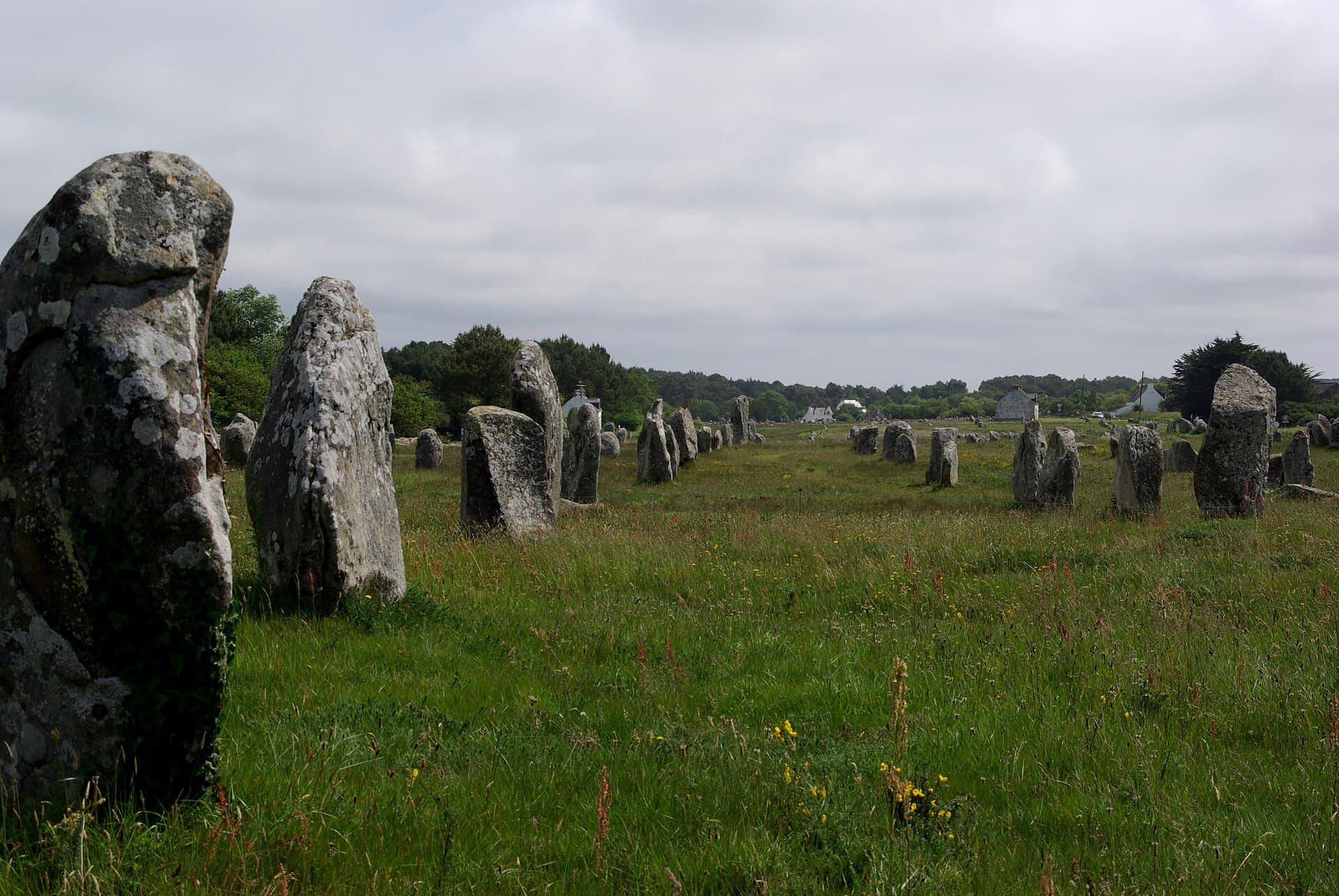
Carnac. A small town in Morbihan with several thousand standing stones in rows around it, now the centre of Brittany's first World Heritage inscription.
Lorient. A naval town that hosts the Festival Interceltique each August, the largest gathering of Celtic-country musicians anywhere, running since 1971.
The peninsula's oldest heritage is far older than anything Celtic. From about 5000 BCE, Neolithic communities in what is now southern Morbihan raised standing stones, alignments, dolmens and passage graves in one of the densest concentrations of megalithic building in the world, and kept doing so for more than two millennia. The Cairn of Barnenez and the Gavrinis passage tomb are among the earliest monumental structures in Europe.
The name and the language came later and by sea. Between roughly the fifth and seventh centuries, Brittonic speakers crossed from Britain, particularly from the south-west, and settled the peninsula in numbers sufficient to replace the local speech. This is why Breton is a sister language of Cornish and Welsh rather than a survival of Gaulish, and why the region is called Brittany at all.
An independent kingdom formed under Nominoë in the ninth century and became a duchy that spent centuries balancing between France and England. It ended by marriage and treaty rather than conquest: Duchess Anne married two successive French kings, and the Edict of Union in 1532 joined the duchy to France while guaranteeing certain Breton privileges, which were steadily eroded and abolished at the Revolution.
The nineteenth and twentieth centuries did the cultural damage. State schooling in French treated Breton as an obstacle, and the practice of the symbole, a token passed to any child caught speaking it and punished at the end of the day, worked as designed. Two world wars took a heavy toll from a region that supplied sailors and soldiers in disproportionate numbers, and the collaboration of a small number of Breton nationalists during the occupation left the cultural movement politically compromised for a generation afterwards.
Brittany has two regional languages. Breton, or brezhoneg, is Celtic and belongs to the Brythonic branch alongside Welsh and Cornish. Gallo is a Romance language of the eastern half, an oïl language related to French but distinct from it, and it has fewer speakers and much less recognition.
The numbers for Breton are stark. Well over a million people spoke it at the start of the twentieth century. A survey by the Région Bretagne in 2018 put speakers at around 213,000, some 5.5 per cent of the population, heavily weighted towards the elderly, and UNESCO classifies the language as severely endangered. The break happened in a single generation, when parents who had been punished at school decided not to pass it on.
The legal position is unusually hard. Article 2 of the French constitution states that the language of the Republic is French. France signed the European Charter for Regional or Minority Languages in 1999 but has never ratified it, the Constitutional Council having found it incompatible with the constitution, and subsequent attempts to give regional languages a stronger footing have been trimmed by the same court. Whatever revival exists has therefore been built by associations rather than granted by the state.
It has been built. Diwan opened the first Breton immersion school in 1977 at Lampaul-Ploudalmézeau with five children, and the network now teaches several thousand, alongside bilingual streams in state and Catholic schools. Ofis Publik ar Brezhoneg, the public office for the Breton language, coordinates terminology, signage and certification. Ar Redadeg, a relay race carrying a written message across Brittany every two years, raises money for language projects and is a genuinely popular event. Place names carry the older language everywhere: ker for a settlement, plou for a parish, lan for a monastic foundation, tre for a subdivision, so that the map remains readable in Breton even where the speech has gone.
Breton music did not need reviving so much as amplifying. The bagad, a pipe band on the Scottish model but using the Breton bombarde and biniou, was developed in the mid twentieth century and is now a competitive institution. The fest-noz, a night dance where the community dances in lines and chains to sung or played music, was inscribed by UNESCO on the Representative List of Intangible Cultural Heritage in 2012, and the citation was notable for recognising a living social practice with thousands of events a year rather than a museum piece.
The sung tradition beneath it is the gwerz, a long narrative ballad, often about a drowning, a murder or a plague, sung unaccompanied. The Barzaz Breiz, published by La Villemarqué in 1839, made these famous and also started an argument about how much the collector improved his material that has never entirely finished, which is a useful reminder of how nineteenth-century folklore collections were made.
The visual identity is modern and effective. The Gwenn-ha-du, the black and white flag designed by Morvan Marchal in 1923, with nine stripes for the historic dioceses and ermine spots for the duchy, is now on car stickers, jerseys and town halls across the region, an unusual case of a deliberately invented emblem achieving complete popular adoption. The triskele has travelled the same route.
Brittany was among the most intensely Catholic regions of France and remains marked by it, with a religious geography built by saints who mostly do not appear in any Roman calendar. The seven founder saints, Brieuc, Malo, Samson, Patern, Corentin, Paul Aurelian and Tugdual, are the ones the Tro Breizh pilgrimage links, a circuit of about six hundred kilometres between their cathedral cities that medieval Bretons were expected to complete once in a lifetime, revived in the twentieth century and walked in stages today.
The characteristic ceremony is the pardon, a parish pilgrimage on a saint's day with a procession of banners, relics and often the whole village in traditional dress, followed by a communal meal. The largest is at Sainte-Anne-d'Auray in Morbihan. Pardons are penitential in name and social in practice, and they are one of the strongest surviving links between the church calendar and village life.
Underneath the Catholicism sits a body of belief about the dead that the church absorbed rather than removed. Wells, stones and springs retained their power; the Ankou remained the figure who came for people; and the Toussaint, All Saints on 1 November, is still the day when Breton families return to the graves in numbers, with the following day, the Day of the Dead, historically the more important of the two.
The Ankou is not death but death's servant, and Breton tradition gives the office to the last person to die in a parish in a given year, who must then collect the dead for the next twelve months. He is described as a tall gaunt figure with a scythe turned outwards, driving a cart whose axle squeals, and the sound of that cart at night is the omen. Making death a local, rotating job held by someone whose name the village knew is a very particular way of thinking about the subject.
 The Guimiliau calvary carries around two hundred figures crowded around its base. It was built as instruction for a parish that could not read, and it stands in a walled close with the church and the ossuary. Photograph by Zairon, CC BY-SA 4.0, via Wikimedia Commons.
The architecture matches it. From the sixteenth and seventeenth centuries, prosperous parishes in Lower Brittany, enriched by linen and hemp, built the enclos paroissial, the parish close: a walled churchyard entered by a triumphal arch, containing the church, a calvary and an ossuary, laid out as one design. The calvaries are the distinctive part, stone crosses with tiers of carved figures crowded around the base showing the passion and the last judgement, at Guimiliau, Saint-Thégonnec, Pleyben and Plougastel-Daoulas, and they were built as instruction for people who could not read.
The ossuary was the practical building. Ground was limited, so remains were exhumed after a period and moved into the ossuary house, and from the seventeenth century the skull was often placed in a small reliquary box, a boîte à crâne, with a heart-shaped or arched opening at the front and an inscription naming the person, sometimes with the date of death and a request for prayers. Families could visit a named ancestor indoors. The practice was progressively restricted by public health regulation in the nineteenth and twentieth centuries, and the surviving boxes are now protected objects in churches and museums rather than a living custom, but they remain the clearest statement of the Breton position: a body may be moved, but a person should not become anonymous.
The sea produced its own vocabulary of loss. Coastal parishes carry monuments to men lost at sea, whose bodies were rarely recovered, and the proëlla, recorded on Ouessant, provided the missing funeral: a small wax cross stood for the drowned man, was watched over and mourned in the house, and was then placed in the church, so that a family with no body still had something to bury.
Breton records are French in form, and the Breton family's oldest record is a box of bones with a name painted on it.
Parish registers begin in the sixteenth and seventeenth centuries and the departmental archives of the five historic departments have digitised both those and the civil registers, publishing them free. French civil registration applies from 1792, with the marginal notes that turn a birth record into a summary of a life.
The Breton complication is naming. Breton first names were often Frenchified by clerks, place names appear in Breton and French versions, and the same saint's name can look like three different names across three registers. Farm and village names carry more weight than they do in most of France.
The ossuary is the physical record. Breton parish closes were built as a single composition of church, calvary and charnel house, and because burial ground was scarce the bones were lifted after some years and kept in the ossuary, in the older practice in small wooden boxes with the person's name painted on the front. A parish's dead were therefore named and stored where the living could see them.
Emigration went to Paris and to the sea. Breton men crewed the Newfoundland and Iceland cod fleets, and the loss lists of those fisheries are substantial. The Anaon, the community of the dead in Breton belief, and the gwerz ballads that recount particular drownings and murders, are the oral record of the same thing.
On 12 July 2025 UNESCO inscribed the Megaliths of Carnac and of the shores of Morbihan on the World Heritage List, a serial property in four component parts drawing on more than 550 megalithic sites across 28 communes, built between roughly 5000 and 2300 BCE. It is the first World Heritage site in Brittany, and it arrived after a campaign begun in 2011 by an association formed for the purpose. The listing changes the management problem rather than solving it: the stones stand in ordinary countryside among houses, roads and farms, and the practical work now is planning control across a large inhabited area.
The parish closes and calvaries are protected as historic monuments and have been the subject of long conservation programmes, the granite being durable but the carved detail vulnerable to lichen and frost. The Musée de Bretagne at Rennes and the Musée départemental breton at Quimper hold the principal regional collections, and the maritime museums at Douarnenez and elsewhere document the fishing culture that has largely ended.
Language preservation is where most Breton energy goes, and it is organised rather than sentimental: Diwan and the bilingual streams for transmission, Ofis Publik ar Brezhoneg for standards and signage, and a body of publishing, broadcasting and certification built to make the language usable in adult life rather than only at school.
Breton has a substantial digital presence for a language of its size. There are online dictionaries and terminology databases, machine translation and spell-checking, a Breton Wikipedia of respectable size, and radio and television output including Brezhoweb, alongside sustained work to get Breton into interfaces and public signage. This matters more than it sounds: the practical test of a language's survival is whether a teenager can use it on a phone.
The sung and spoken tradition is comparatively well recorded. Collections of gwerzioù and dance tunes gathered across the twentieth century by Dastum, an association founded to collect and share Breton oral heritage, have been digitised and made searchable, which turns a scattered set of field recordings into something a musician or a family can actually consult.
Megalithic documentation has improved sharply. Photogrammetric and laser survey of the alignments, cairns and engraved stones has produced accurate three-dimensional records of carvings that are eroding, and the World Heritage nomination itself required an inventory across dozens of communes that had never previously been assembled in one place.
Breton music has had an unusual commercial afterlife. Alan Stivell's harp and rock recordings from the early 1970s reopened the tradition to a young audience, Tri Yann and others followed, and the Festival Interceltique de Lorient, running since 1971, now draws hundreds of thousands and functions as the meeting point of the Celtic countries. Fest-noz continues to be held weekly through the winter across Brittany, which is the part that matters.
The regional identity is strong, visible and largely cultural rather than separatist. Support for outright independence has remained small in polling, while support for greater regional powers and for the return of Loire-Atlantique is considerably broader, and the Breton flag functions as a general marker of belonging including for people with no Breton language at all.
The pressures are ordinary and serious: an ageing rural population inland, coastal property priced beyond local wages, the long decline of the fishing fleet, and an agricultural economy under environmental strain. Heritage in Brittany is not primarily threatened by neglect of monuments. It is threatened by the emptying of the villages that gave the monuments their reason.
A first World Heritage inscription after a fourteen-year campaign. The Carnac and Morbihan megaliths were listed on 12 July 2025, covering more than 550 sites across 28 communes.
A social practice recognised as heritage. The 2012 UNESCO listing of the fest-noz recognised a living dance still held thousands of times a year, rather than a revival staged for visitors.
A school network built without the state. Diwan opened in 1977 with five children and, with the bilingual streams that followed it, now teaches Breton to thousands, in a country whose constitution recognises only one language.
Named skulls rather than anonymous bones. The Breton reliquary box solved the problem of the crowded churchyard without letting the dead become nameless, and the surviving boxes are now protected objects.
The Guimiliau calvary carries around two hundred figures crowded around its base. It was built as instruction for a parish that could not read, and it stands in a walled close with the church and the ossuary. Photograph by Zairon, CC BY-SA 4.0, via Wikimedia Commons.
The architecture matches it. From the sixteenth and seventeenth centuries, prosperous parishes in Lower Brittany, enriched by linen and hemp, built the enclos paroissial, the parish close: a walled churchyard entered by a triumphal arch, containing the church, a calvary and an ossuary, laid out as one design. The calvaries are the distinctive part, stone crosses with tiers of carved figures crowded around the base showing the passion and the last judgement, at Guimiliau, Saint-Thégonnec, Pleyben and Plougastel-Daoulas, and they were built as instruction for people who could not read.
The ossuary was the practical building. Ground was limited, so remains were exhumed after a period and moved into the ossuary house, and from the seventeenth century the skull was often placed in a small reliquary box, a boîte à crâne, with a heart-shaped or arched opening at the front and an inscription naming the person, sometimes with the date of death and a request for prayers. Families could visit a named ancestor indoors. The practice was progressively restricted by public health regulation in the nineteenth and twentieth centuries, and the surviving boxes are now protected objects in churches and museums rather than a living custom, but they remain the clearest statement of the Breton position: a body may be moved, but a person should not become anonymous.
The sea produced its own vocabulary of loss. Coastal parishes carry monuments to men lost at sea, whose bodies were rarely recovered, and the proëlla, recorded on Ouessant, provided the missing funeral: a small wax cross stood for the drowned man, was watched over and mourned in the house, and was then placed in the church, so that a family with no body still had something to bury.
Breton records are French in form, and the Breton family's oldest record is a box of bones with a name painted on it.
Parish registers begin in the sixteenth and seventeenth centuries and the departmental archives of the five historic departments have digitised both those and the civil registers, publishing them free. French civil registration applies from 1792, with the marginal notes that turn a birth record into a summary of a life.
The Breton complication is naming. Breton first names were often Frenchified by clerks, place names appear in Breton and French versions, and the same saint's name can look like three different names across three registers. Farm and village names carry more weight than they do in most of France.
The ossuary is the physical record. Breton parish closes were built as a single composition of church, calvary and charnel house, and because burial ground was scarce the bones were lifted after some years and kept in the ossuary, in the older practice in small wooden boxes with the person's name painted on the front. A parish's dead were therefore named and stored where the living could see them.
Emigration went to Paris and to the sea. Breton men crewed the Newfoundland and Iceland cod fleets, and the loss lists of those fisheries are substantial. The Anaon, the community of the dead in Breton belief, and the gwerz ballads that recount particular drownings and murders, are the oral record of the same thing.
On 12 July 2025 UNESCO inscribed the Megaliths of Carnac and of the shores of Morbihan on the World Heritage List, a serial property in four component parts drawing on more than 550 megalithic sites across 28 communes, built between roughly 5000 and 2300 BCE. It is the first World Heritage site in Brittany, and it arrived after a campaign begun in 2011 by an association formed for the purpose. The listing changes the management problem rather than solving it: the stones stand in ordinary countryside among houses, roads and farms, and the practical work now is planning control across a large inhabited area.
The parish closes and calvaries are protected as historic monuments and have been the subject of long conservation programmes, the granite being durable but the carved detail vulnerable to lichen and frost. The Musée de Bretagne at Rennes and the Musée départemental breton at Quimper hold the principal regional collections, and the maritime museums at Douarnenez and elsewhere document the fishing culture that has largely ended.
Language preservation is where most Breton energy goes, and it is organised rather than sentimental: Diwan and the bilingual streams for transmission, Ofis Publik ar Brezhoneg for standards and signage, and a body of publishing, broadcasting and certification built to make the language usable in adult life rather than only at school.
Breton has a substantial digital presence for a language of its size. There are online dictionaries and terminology databases, machine translation and spell-checking, a Breton Wikipedia of respectable size, and radio and television output including Brezhoweb, alongside sustained work to get Breton into interfaces and public signage. This matters more than it sounds: the practical test of a language's survival is whether a teenager can use it on a phone.
The sung and spoken tradition is comparatively well recorded. Collections of gwerzioù and dance tunes gathered across the twentieth century by Dastum, an association founded to collect and share Breton oral heritage, have been digitised and made searchable, which turns a scattered set of field recordings into something a musician or a family can actually consult.
Megalithic documentation has improved sharply. Photogrammetric and laser survey of the alignments, cairns and engraved stones has produced accurate three-dimensional records of carvings that are eroding, and the World Heritage nomination itself required an inventory across dozens of communes that had never previously been assembled in one place.
Breton music has had an unusual commercial afterlife. Alan Stivell's harp and rock recordings from the early 1970s reopened the tradition to a young audience, Tri Yann and others followed, and the Festival Interceltique de Lorient, running since 1971, now draws hundreds of thousands and functions as the meeting point of the Celtic countries. Fest-noz continues to be held weekly through the winter across Brittany, which is the part that matters.
The regional identity is strong, visible and largely cultural rather than separatist. Support for outright independence has remained small in polling, while support for greater regional powers and for the return of Loire-Atlantique is considerably broader, and the Breton flag functions as a general marker of belonging including for people with no Breton language at all.
The pressures are ordinary and serious: an ageing rural population inland, coastal property priced beyond local wages, the long decline of the fishing fleet, and an agricultural economy under environmental strain. Heritage in Brittany is not primarily threatened by neglect of monuments. It is threatened by the emptying of the villages that gave the monuments their reason.
A first World Heritage inscription after a fourteen-year campaign. The Carnac and Morbihan megaliths were listed on 12 July 2025, covering more than 550 sites across 28 communes.
A social practice recognised as heritage. The 2012 UNESCO listing of the fest-noz recognised a living dance still held thousands of times a year, rather than a revival staged for visitors.
A school network built without the state. Diwan opened in 1977 with five children and, with the bilingual streams that followed it, now teaches Breton to thousands, in a country whose constitution recognises only one language.
Named skulls rather than anonymous bones. The Breton reliquary box solved the problem of the crowded churchyard without letting the dead become nameless, and the surviving boxes are now protected objects.
National Overview
Notable Cities
Historical Foundations
Linguistic and Etymological Roots
Cultural Identity
Religion and Spirituality
Remembrance and Mourning Traditions
Tracing a Family in Brittany
Heritage Preservation Efforts
Digital Heritage
Contemporary Cultural Influences
Success Stories
References and resources
- UNESCO, Megaliths of Carnac and of the shores of Morbihan: the July 2025 inscription and its components.
- UNESCO, Fest-noz, festive gathering based on the collective practice of traditional dances in Brittany: the 2012 listing.
- Breton language, Wikipedia: speaker numbers, decline and legal status.
- Diwan school, Wikipedia: the immersion network from 1977.
- Ankou, Wikipedia: the figure, the cart and the annual office.
- Parish close, Wikipedia: the enclos paroissial and its ossuary and calvary.
- Carnac stones, Wikipedia: the alignments and their dating.
- Tro Breizh, Wikipedia: the pilgrimage of the seven founder saints.
- Dastum: the collection and digitisation of Breton oral heritage.
- Brittany, Wikipedia: geography, history and the question of Loire-Atlantique.